GPA Calculator (US) — Semester & Cumulative GPA on a 4.0 Scale

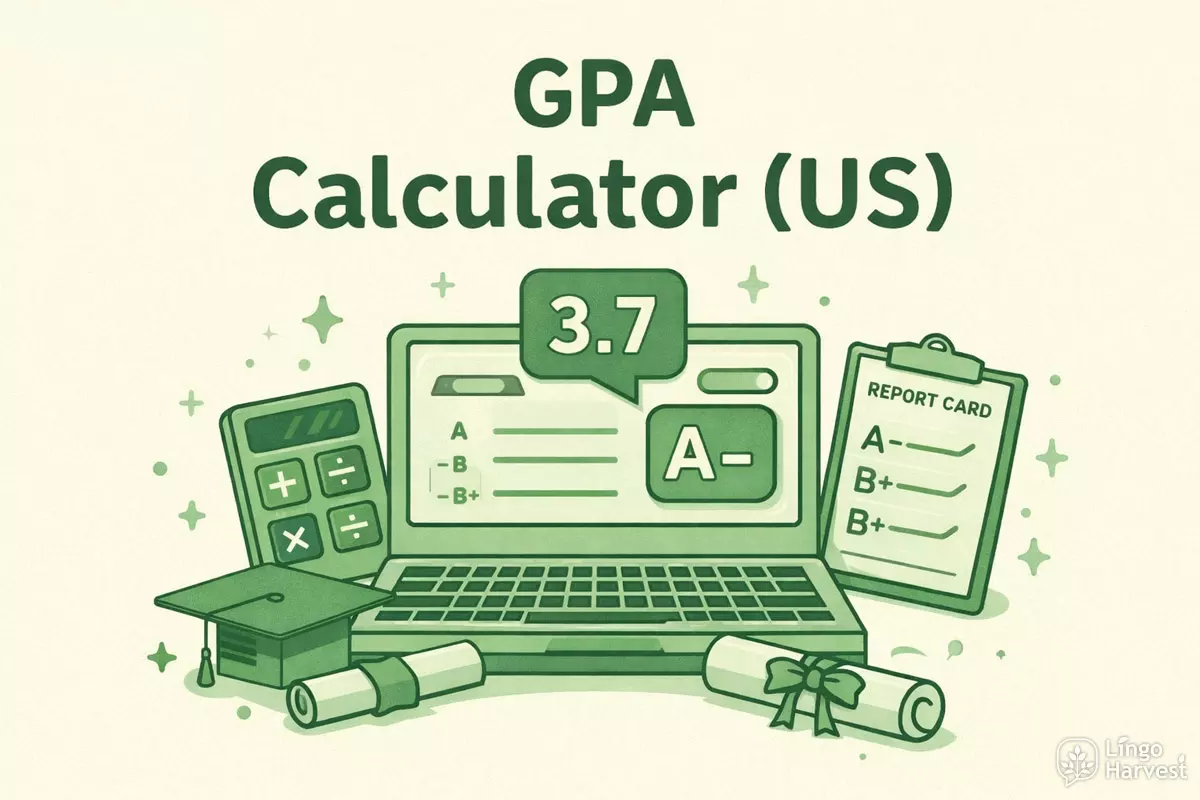 This US GPA Calculator helps college and university students accurately calculate their semester or cumulative GPA using the standard 4.0 grading scale. Add courses with letter grades and credit hours to see your GPA, total credits counted, and quality points. The calculator is suitable for most US institutions and common academic grading systems.
| Name (optional) | Grade | Credits | Remove |
|---|
What GPA Means in the US Education System
GPA (Grade Point Average) is a standard metric used in the United States to measure a student’s academic performance. It represents the average of grade points earned across completed courses and is used by colleges, universities, employers, and scholarship committees.
In the US education system, GPA is calculated on a numeric scale, most commonly the 4.0 scale, where letter grades such as A, B, C, and D are converted into grade points. These points are then weighted by the number of credits assigned to each course.
GPA plays a critical role in academic life. It can affect:
- Academic standing and eligibility to continue studies
- Admission to colleges, graduate programs, and transfer schools
- Scholarships, financial aid, and honors programs
- Internships and entry-level job applications
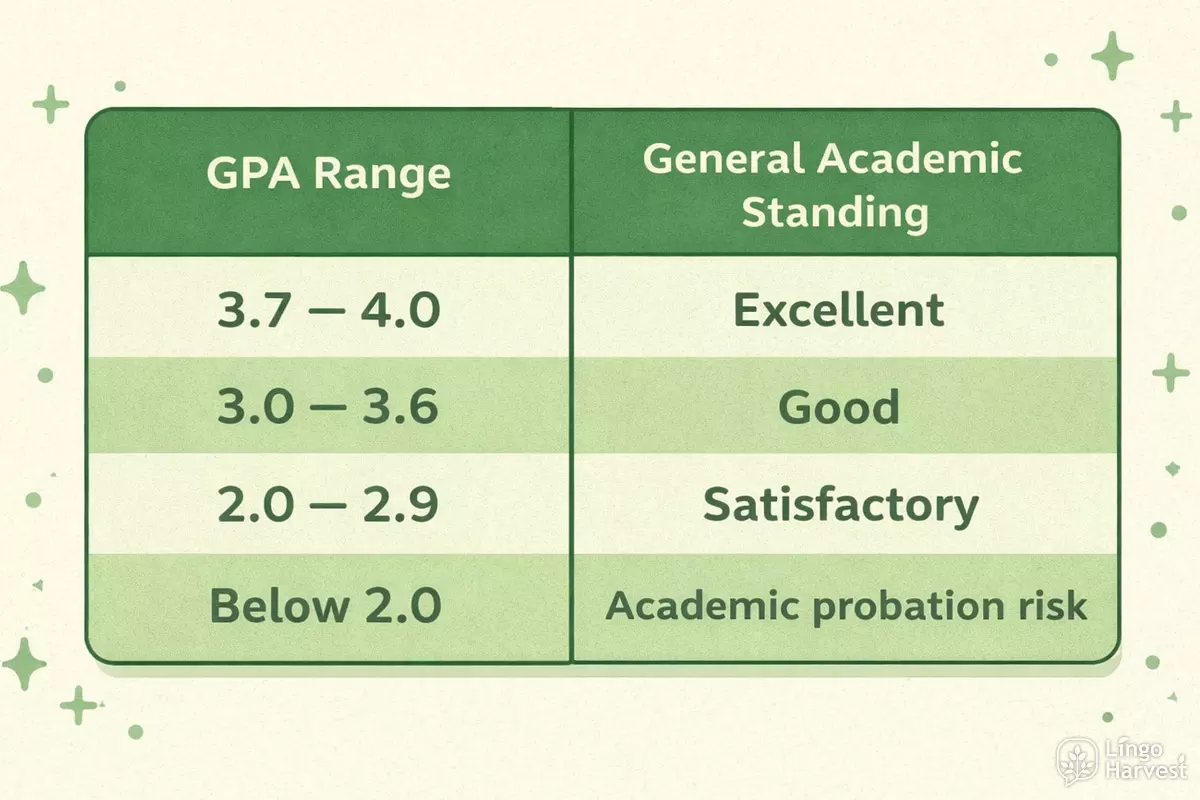
| GPA Range | General Academic Standing |
|---|---|
| 3.7 – 4.0 | Excellent / Honors level |
| 3.0 – 3.6 | Good academic standing |
| 2.0 – 2.9 | Satisfactory / Minimum requirement |
| Below 2.0 | Academic probation risk |
Because GPA summarizes overall academic performance into a single number, even small changes can have a meaningful impact. This is why accurate GPA calculation is essential, especially when planning future coursework.
How GPA Is Calculated on the 4.0 Scale
On the standard US 4.0 GPA scale, each letter grade corresponds to a numeric value known as grade points. These points are multiplied by the number of credits for each course to determine quality points.
The core GPA formula is:
GPA = Total Quality Points ÷ Total Credits
Courses with more credit hours have a greater influence on the final GPA, which is why credit weighting is fundamental to the calculation.
| Letter Grade | Grade Points (4.0 Scale) |
|---|---|
| A | 4.0 |
| B | 3.0 |
| C | 2.0 |
| D | 1.0 |
| F | 0.0 |
To better understand the calculation, consider how credits affect weighting.
| Course | Grade | Credits | Quality Points |
|---|---|---|---|
| English | A | 3 | 12.0 |
| Biology | B | 4 | 12.0 |
| History | C | 3 | 6.0 |
In this example, the total quality points are divided by the total credits to produce the final GPA. This weighted approach ensures that higher-credit courses have a stronger impact on academic results.
Semester GPA vs Cumulative GPA
In US colleges and universities, GPA can be calculated in two main ways: semester GPA and cumulative GPA. While both use the same grading scale, they serve different academic purposes.
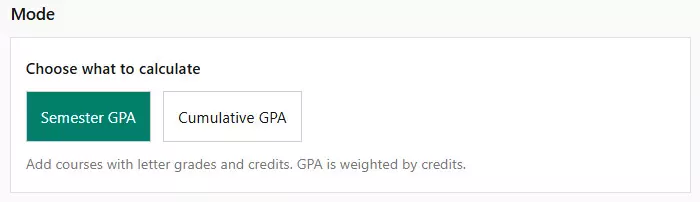
Semester GPA reflects your performance during a single academic term. It includes only the courses taken in that specific semester and is often used to evaluate short-term progress.
Cumulative GPA represents your overall academic performance across all completed semesters. It combines previously earned credits and grades with any new coursework.
| Type of GPA | What It Includes | Common Use |
|---|---|---|
| Semester GPA | Courses from one term | Term performance review |
| Cumulative GPA | All completed courses | Graduation, transfers, scholarships |
Understanding the difference is important because a strong semester GPA can improve your cumulative GPA over time, while a weak semester may have a lasting impact if many credits are involved.
How Credits Affect Your GPA
Credits determine how much influence each course has on your GPA. In the US system, courses with more credits carry more weight in GPA calculations because they represent a greater academic workload.
For example, a four-credit course affects your GPA more than a one- or two-credit course, even if the letter grade is the same.
| Course Credits | Grade | Grade Points | Quality Points |
|---|---|---|---|
| 4 | A | 4.0 | 16.0 |
| 3 | B | 3.0 | 9.0 |
| 1 | A | 4.0 | 4.0 |
Because GPA is based on total quality points divided by total credits, courses with higher credit values can significantly raise or lower your average.
This weighting system encourages consistent performance in major courses and explains why students often prioritize high-credit classes when aiming to improve their GPA.
How to Use the GPA Calculator
This GPA calculator is designed to estimate academic performance using the standard US grading system. It works for both individual terms and overall academic records, making it suitable for ongoing GPA tracking throughout college or university studies.
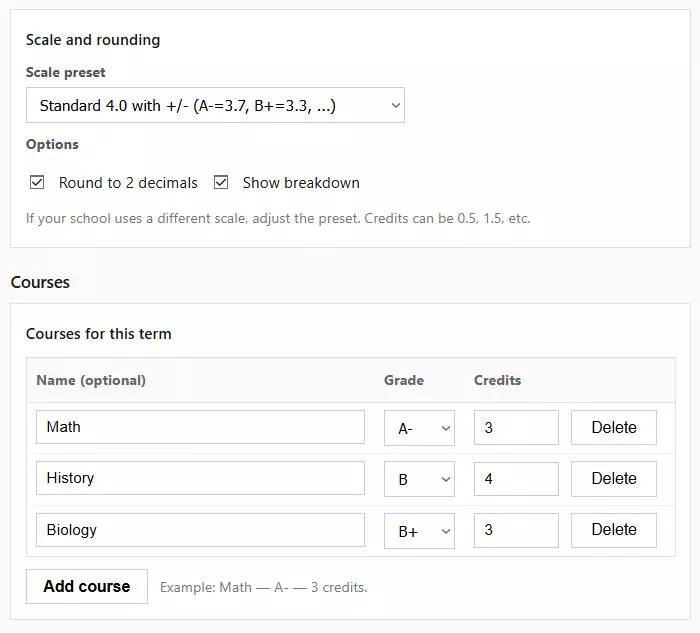
To calculate a GPA accurately, you need two key pieces of information for each course:
- Letter grade earned in the course
- Credit hours assigned to the course
For cumulative calculations, previously earned GPA and total credits are included to reflect how new coursework affects the overall academic average.
The calculator automatically applies credit weighting, ensuring that higher-credit courses have a stronger influence on the final result. This mirrors how GPA is calculated by most US colleges and universities.
Using a GPA calculator is especially helpful when planning future semesters, estimating eligibility for academic programs, or understanding how upcoming grades may impact long-term performance.
How to Read and Interpret Your GPA Results
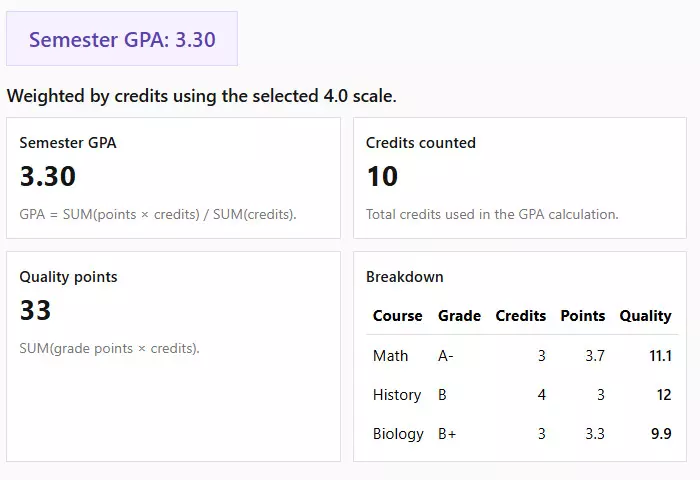
The GPA result represents your weighted academic average on the 4.0 scale. While the number itself is important, understanding what it means in an academic context is equally critical.
A higher GPA generally indicates stronger academic performance and may improve opportunities for scholarships, honors programs, graduate school admission, or competitive internships.
When reviewing your results, pay attention to:
- Total credits counted, which show how much coursework influenced the GPA
- Quality points, which reflect the combined impact of grades and credits
- Individual course contribution, helping identify which classes had the greatest effect
If your GPA is lower than expected, focusing on high-credit courses in future terms can often produce the most noticeable improvement. Consistent performance over time is the most effective way to build and maintain a strong cumulative GPA.
GPA Questions and Answers
- What is a good GPA in the United States?
A GPA of 3.0 or higher is generally considered good in most US colleges and universities. A GPA above 3.5 is often viewed as strong or excellent and may qualify students for honors, scholarships, or competitive academic programs.
- Is GPA always calculated on a 4.0 scale?
Most US institutions use the 4.0 scale, but some schools apply variations such as weighted GPAs, honors scales, or extended systems that go up to 4.5 or 5.0. Always check your institution’s grading policy.
- What is the difference between GPA and grade percentage?
GPA is a weighted average based on letter grades and credits, while grade percentage reflects raw scores (such as 85% or 92%). GPA standardizes performance across courses with different credit values.
- Do all courses count toward GPA?
Not always. Some courses, such as pass/fail classes, remedial courses, or audited classes, may not be included in GPA calculations depending on institutional rules.
- How do credit hours affect GPA?
Courses with more credit hours have a greater impact on GPA because their grade points are weighted more heavily. A low grade in a high-credit course can affect GPA more than a low grade in a minor course.
- Can one semester significantly change my cumulative GPA?
Yes. A semester with many credits can noticeably raise or lower cumulative GPA, especially early in your academic career when total earned credits are still low.
- Does GPA matter after graduation?
GPA may matter for graduate school admissions, internships, and some entry-level jobs. Over time, professional experience often becomes more important than academic performance.
- Is cumulative GPA more important than semester GPA?
In most cases, cumulative GPA is more important because it reflects long-term academic consistency. However, semester GPA can be useful for tracking recent improvement or decline.
- How accurate is an online GPA calculator?
An online GPA calculator provides accurate estimates when grades and credits are entered correctly. Final official GPA calculations are always determined by the institution.
- Can GPA calculators be used for planning future semesters?
Yes. GPA calculators are often used to estimate how future grades may affect cumulative GPA, helping students set academic goals and plan course loads more strategically.