Search the site
Search
Grammar ▾
▸ Articles
▸ Advanced Grammar
▸ Adjectives & Adverbs
▸ Conjunctions
▸ Conditionals
▸ Determiners
▸ Gerunds & Infinitives
▸ Grammar Practice
▸ Modal Verbs
▸ Nouns
▸ Parts of Speech
▸ Passive Voice
▸ Prepositions
▸ Pronouns
▸ Quantifiers
▸ Question Formation
▸ Reported Speech
▸ Verbs
Writing ▾
▸ Punctuation
▸ Sentence Structure
▸ Writing Mistakes
Vocabulary ▾
▸ Visual Vocabulary
▸ Food Vocabulary
▸ People Vocabulary
▸ Places Vocabulary
▸ Hobbies Vocabulary
▸ Home Vocabulary
▸ School Vocabulary
▸ Weather Vocabulary
▸ Basic Vocabulary
▸ General Vocabulary
Speaking ▾
▸ Conversational English
Calculators
Contacts
Home
»
English
» Grammar
Grammar
This section focuses on English grammar explained in a simple and practical way. You will find clear rules, step-by-step examples, and common mistakes to avoid, helping you build a strong foundation for speaking and writing confidently.
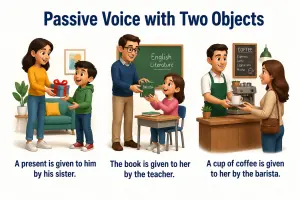
Passive Voice with Two Objects
This article explains passive voice with two-object verbs. It covers how direct and indirect objects change place, when forms like She was given or A gift was given sound more natural, plus by-phrases, prepositions, questions, common mistakes, and rewrite practice.
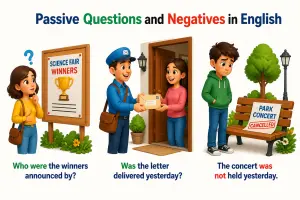
Passive Questions and Negatives in English
Here we how to form passive questions and negatives. It explains be in yes-no and wh-questions, how not works with be, have, and modals, tense patterns, agent use, common word order mistakes, a quick correction test, practice, and an FAQ.
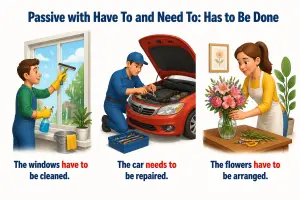
Passive with Have To and Need To: Has to Be Done
This article explains how to use passive infinitives with have to and need to. It covers rules vs necessary tasks, need doing in American English, negatives and questions, have to be done vs must be done, common do/be mistakes, homework, and an FAQ.
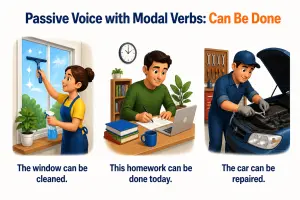
Passive Voice with Modal Verbs: Can Be Done
This article explains how to form the modal passive with can, must, should, may, and might, including uses for ability, permission, obligation, advice, and uncertainty. It also covers negatives, question word order, differences from normal passive tenses, plus practice and an FAQ.
Future Passive: Will Be Done and Going to Be Done
Here we the future passive voice: what it means, when to use will be done or going to be done, and how it works in announcements, project updates, deadlines, negatives, and questions. It also compares the two forms, highlights common mistakes with will, be, and past participles, and includes practice plus an FAQ.
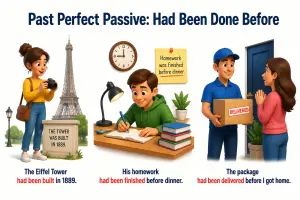
Past Perfect Passive: Had Been Done Before
This article explains the past perfect passive, especially how had been done shows a passive action before another past event. It covers timelines, questions, negatives, key time words, common mistakes, comparisons with past simple passive, practice, and an FAQ.
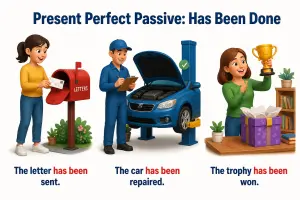
Present Perfect Passive: Has Been Done
Here we the present perfect passive: what it means, how has been and have been form it, and when to use it for results, life experience, and recent changes. It also explains questions, negatives, time markers, common mistakes, the difference from the past simple passive, plus practice and an FAQ.
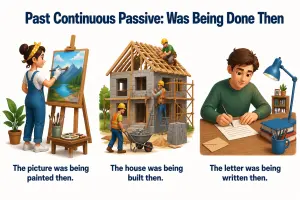
Past Continuous Passive: Was Being Done Then
This article explains the past continuous passive: what it means, how to form it with was being and were being, and when to use it for actions in progress in the past. It also covers negatives and questions, examples, common mistakes, practice, FAQs, and how it differs from the past simple passive.
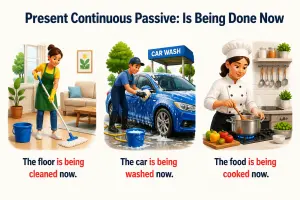
Present Continuous Passive: Is Being Done Now
Here we the present continuous passive: what it means, how is being, are being, and am being work, and when to use it for actions happening now or temporary ongoing processes. It also explains questions, negatives, common mistakes, simple passive comparisons, and sentence-building practice.
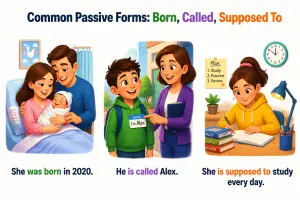
Common Passive Forms: Born, Called, Supposed To
This article explains why forms like be born, be called, and be supposed to act more like fixed expressions than regular passives. It covers meanings, common patterns, everyday American English examples, typical mistakes, practice, and an FAQ.
Previous
1
2
3
4
5
6
7
8
9
10
...
126
Next