Modal Verbs Used in Negotiation and Persuasion

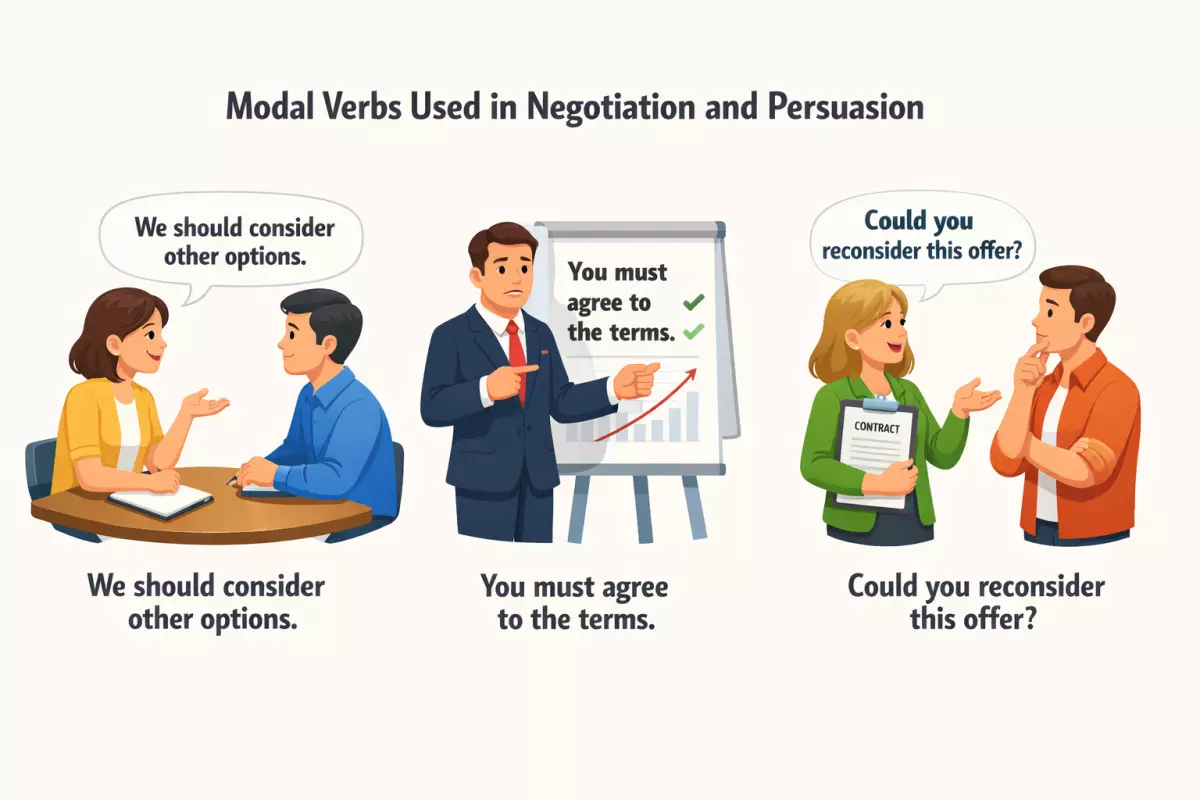 This article explains why negotiators use modal verbs to sound diplomatic, how they introduce proposals without pushing, and which modals help suggest compromises. It shows examples with could, might, and would, how they soften demands, when they boost cooperation, and includes practice exercises.
- Why negotiators often rely on modal verbs to present ideas diplomatically
- How modal verbs help introduce proposals without sounding forceful
- Modal verbs commonly used when suggesting compromises or alternatives
- Examples of persuasive statements formed with could, might, and would
- How tone shifts when modal verbs replace direct commands or demands
- Situations where modal language encourages cooperation during discussion
- Exercises and practice activities using modal verbs in negotiation contexts
In bargaining and persuasion, small helping verbs like can, could, might, should, and must can shape whether you sound pushy, polite, or confident. This guide explains how the right choice helps you soften requests, offer options, set boundaries, and show flexibility. With clear workplace and everyday examples, you will hear the difference and use it right away.
Why negotiators often rely on modal verbs to present ideas diplomatically
Modal verbs help speakers propose, question, and adjust positions without sounding absolute. In bargaining and persuasion, that flexibility matters because it protects relationships, leaves room for movement, and reduces the chance that the other side feels pushed into a corner.
How modals soften claims and protect face
Strong statements (“This is the only option”) can trigger resistance. Modals such as could, might, and would create distance between the speaker and the claim, making it easier for the listener to engage without losing status.
- Could frames a proposal as one possible path: “We could extend the deadline by two weeks.”
- Might signals uncertainty or openness to evidence: “That might work if the reporting stays weekly.”
- Would keeps the tone conditional and cooperative: “We would be able to sign if the warranty is included.”
- May adds polite formality and reduces pressure: “We may need to revisit the payment schedule.”
- Can is useful for capability without sounding like a demand: “We can share the data after the NDA is in place.”
Common negotiation patterns built around modals
In practice, modals appear in repeatable sentence frames. These patterns let negotiators float ideas, test reactions, and propose trade-offs while keeping the conversation constructive.
- Suggestion frame: “We could + verb…” (“We could split the shipment into two batches.”)
- Conditional offer: “We can + verb, if you can + verb…” (“We can reduce the fee, if you can commit to a longer term.”)
- Exploring willingness: “Would you be willing to + verb…?” (“Would you be willing to add a service-level clause?”)
- Low-pressure question: “Could you + verb…?” (“Could you clarify how returns are handled?”)
- Testing feasibility: “Could we + verb…?” (“Could we move the meeting to Thursday?”)
- Soft constraint: “We may need to + verb…” (“We may need to involve legal before final approval.”)
- Risk flag: “That might + verb…” (“That might delay onboarding by a week.”)
- Preference without ultimatum: “We’d prefer to + verb…” (“We’d prefer to keep the scope stable for phase one.”)
- Counterproposal opener: “Would it work if we + verb…?” (“Would it work if we adjusted the milestones?”)
- Trade-off framing: “If we + verb, could you + verb…?” (“If we pay upfront, could you lower the unit price?”)
- Boundary with politeness: “We can’t + verb, but we could + verb…” (“We can’t accept net-90, but we could do net-45.”)
- Process control: “Could we agree to + verb first?” (“Could we agree to the definitions first?”)
Using modals to negotiate power and commitment
Modals also let speakers calibrate how committed they sound. This is useful when you want to keep leverage, avoid premature promises, or show seriousness at the right moment.
- Low commitment (exploring): “We might be able to…” / “We could consider…”
- Medium commitment (likely): “We should be able to…” / “We would expect to…”
- High commitment (conditional but firm): “We can agree to X if Y is included.”
- Firm limit (clear refusal): “We can’t agree to that term.” (Direct, but still professional.)
Polite pressure: guiding the other side without sounding demanding
Persuasion often requires directing attention to next steps. Modals make requests sound collaborative rather than controlling, especially when paired with brief reasons or options.
- ✅ “Could you send the revised draft by Friday so we can review it?”
- ✅ “Would you be open to a shorter pilot to reduce risk?”
- ✅ “May we confirm the decision-maker for final sign-off?”
- ❌ “Send the revised draft by Friday.” → ✅ “Could you send the revised draft by Friday?”
- ❌ “You must accept this pricing.” → ✅ “We could keep this pricing if the volume is guaranteed.”
How modal verbs help introduce proposals without sounding forceful
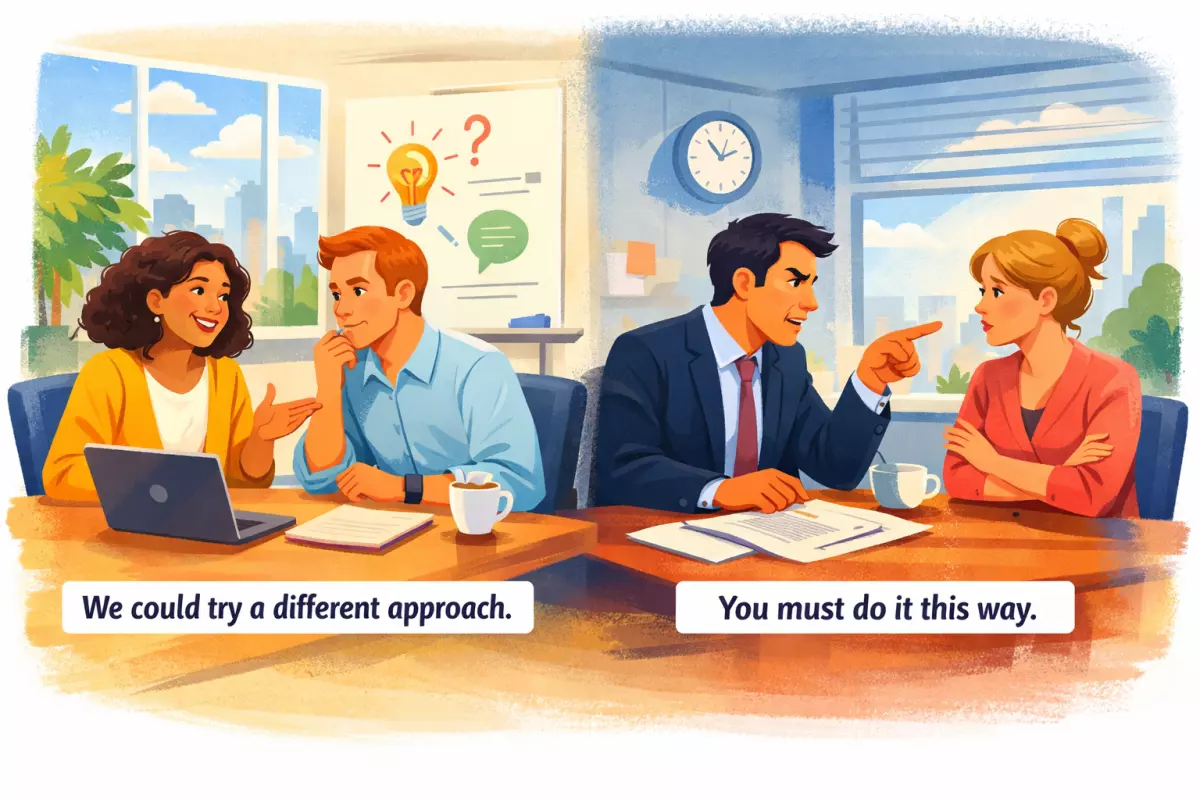
Modal verbs let you present an idea as a possibility rather than a command. In negotiation and persuasion, this softens the “push” of a proposal, signals respect for the other side’s autonomy, and leaves room for discussion. The result is language that invites collaboration while still moving the conversation forward.
Core pattern: modal + base verb
Most proposal moves rely on a simple structure: modal + base verb. The modal sets the level of pressure (tentative, neutral, firm-but-polite), while the main verb names the action (adjust, extend, include, revisit, agree).
- Could + base verb: suggests an option and reduces imposition (e.g., “Could we revisit the timeline?”).
- Might + base verb: introduces a possibility with extra tentativeness (e.g., “We might adjust the scope to hit the date.”).
- May + base verb: polite, somewhat formal permission/possibility (e.g., “May we propose a split delivery?”).
- Would + base verb: frames a proposal as a preference or conditional choice (e.g., “We would include support if the term is extended.”).
- Should + base verb: offers a recommendation; can sound stronger, so pair with softeners when needed (e.g., “We should probably confirm the acceptance criteria.”).
- Can + base verb: focuses on feasibility; often reads as practical rather than forceful (e.g., “Can we align on the payment schedule?”).
Useful proposal frames (ready-to-use patterns)
These frames keep the proposal clear while maintaining a cooperative tone. They work well in meetings, emails, and counteroffers.
- Could we + base verb + …? (collaborative suggestion) → “Could we explore a two-phase rollout?”
- Might we + base verb + …? (very tentative, brainstorming) → “Might we adjust the milestones slightly?”
- Would you be open to + noun/gerund? (checks receptiveness) → “Would you be open to extending the pilot?”
- Would it work if + clause? (tests fit) → “Would it work if we moved the review to Friday?”
- Could you consider + noun/gerund? (polite request for evaluation) → “Could you consider a 12-month term?”
- We could + base verb + … (offers an option without demanding) → “We could include training in the first month.”
- We might + base verb + … (signals flexibility) → “We might be able to reduce the deposit.”
- We would + base verb + … if + condition (conditional trade-off) → “We would lower the rate if volume increases.”
- Could we agree to + base verb + …? (moves toward commitment gently) → “Could we agree to a shared definition of ‘done’?”
- May I suggest + noun/clause? (formal, respectful entry) → “May I suggest a shorter renewal window?”
- Perhaps we could + base verb + … (adds a light hedge) → “Perhaps we could separate delivery from installation.”
- It may make sense to + base verb + … (frames as logic, not pressure) → “It may make sense to cap the overage.”
- Would it be possible to + base verb + …? (polite feasibility check) → “Would it be possible to invoice monthly?”
- Could we start with + noun + …? (reduces scope; easier yes) → “Could we start with a 60-day trial?”
- We can + base verb + … as long as + condition (firm but cooperative boundary) → “We can expedite shipping as long as specs are final.”
Dialing the force up or down with small add-ons
Modals become even less imposing when combined with short hedges or perspective markers. These additions show openness to alternatives without making the proposal vague.
- Add a hedge: “Could we possibly shift the deadline by a week?”
- Use “a bit/slightly” for small changes: “We might slightly adjust the scope.”
- Signal shared problem-solving: “Could we work out a schedule that fits both teams?”
- Invite correction: “We might be missing something—could we review the assumptions?”
- Offer choice: “We could do A, or we could do B—what would you prefer?”
Common pitfalls and quick fixes
- ❌ “You must accept this by Friday.” → ✅ “Could you confirm by Friday, or would Monday work better?”
- ❌ “We will change the terms.” → ✅ “We could adjust the terms to reflect the new scope.”
- ❌ Overusing should when stakes are high. → ✅ Use “could/would” plus a reason: “We could move the date to reduce risk.”
- ❌ Making everything tentative (“might/could” in every sentence). → ✅ Keep the modal for the proposal, and state facts directly: “The budget is fixed. Could we revise the deliverables?”
Modal verbs commonly used when suggesting compromises or alternatives
When you propose a middle ground, modal verbs help you sound flexible without giving up clarity. They let you soften demands, introduce options, and test ideas while leaving room for the other side to respond. The most useful patterns combine a modal with a practical action verb (adjust, revise, split, extend) and a condition (if, as long as, provided that).
Core modals and the negotiation patterns they create
- Could for low-pressure options: “We could extend the deadline by a week.” / “Could we split the shipment into two batches?”
- Can for workable alternatives and capability: “We can deliver on Friday instead.” / “Can we move this item to the next phase?”
- Would for conditional compromise and politeness: “We would accept 30 days if the unit price stays the same.” / “Would you be open to a smaller first order?”
- May for cautious proposals (more formal): “We may be able to reduce the fee if the scope is simplified.”
- Might for tentative suggestions and exploration: “We might consider a pilot first.” / “That might work if support is included.”
- Should for recommendations that still allow discussion: “We should keep the core features and postpone the extras.”
- Shall for structured offers (often in meetings): “Shall we review the numbers and revisit the target?”
- Must to state non-negotiable limits (use sparingly): “We must stay within the compliance requirements.”
High-utility sentence frames for proposing trade-offs
- Modal + base verb: “We could revise the schedule.” / “You might prefer a fixed rate.”
- Modal + be able to for feasibility: “We may be able to add one more resource.”
- Modal + consider to invite discussion: “Could you consider a longer contract term?”
- Modal + if-clause to link concessions: “We can lower the price if payment is upfront.”
- Would + if for conditional acceptance: “We would agree if the warranty is extended.”
- Could + we for collaborative problem-solving: “Could we align on the priority items first?”
- Might + need to for gentle constraints: “We might need to adjust the scope to meet the date.”
- Can’t / won’t + but to refuse while offering an alternative: “We can’t do next-day delivery, but we can expedite standard shipping.”
- Would you be willing to…? to request a concession: “Would you be willing to cap the change requests?”
- Could we meet halfway by…? to propose a balanced solution: “Could we meet halfway by splitting the difference on the fee?”
- May I suggest…? for formal proposals: “May I suggest a phased rollout?”
- Should we…? to frame a recommendation as a question: “Should we lock the base scope and review add-ons later?”
Common compromise moves (with modal choices)
- Adjusting quantities: “We could reduce the first order and scale up after results.”
- Changing timing: “We can bring forward the kickoff, but the final delivery would move by three days.”
- Splitting deliverables: “We might deliver the core module now and the reporting later.”
- Trading price for terms: “We would lower the rate if the contract is 12 months.”
- Trading scope for speed: “We can meet the date if we drop the optional features.”
- Adding safeguards: “We could agree to the change, provided that testing is included.”
- Offering a pilot: “We could start with a trial to confirm performance.”
- Setting boundaries: “We can’t approve that clause, but we can propose an alternative wording.”
Accuracy notes: keeping the tone cooperative
- ✅ “We could do X if you can do Y.” → Clear trade-off that invites agreement.
- ❌ “We must do X” (when it is actually negotiable) → Sounds rigid and can shut down options.
- ✅ “We might be able to…” → Signals exploration; follow with what you need to confirm.
- ✅ “We can’t do X, but we can do Y.” → Refusal paired with an alternative keeps momentum.
Examples of persuasive statements formed with could, might, and would
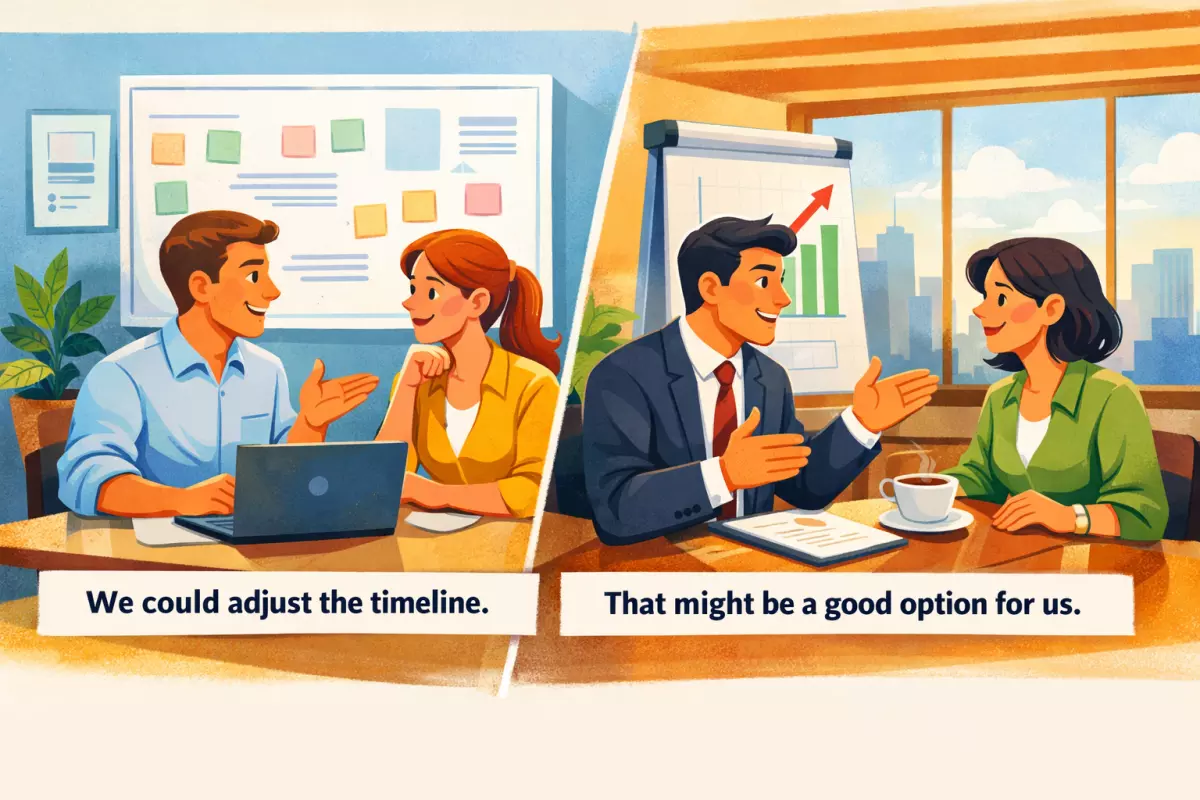
In negotiation, these modals help you sound flexible while still guiding the other person toward a decision. Could often frames options and capability, might introduces possibilities and low-pressure suggestions, and would proposes conditional commitments and preferred outcomes. The patterns below show how to shape offers, requests, and trade-offs with clear, cooperative language.
Common patterns that work well
- Could + base verb to offer an option: “We could adjust the timeline.”
- Could you + base verb to request politely: “Could you share the updated numbers?”
- Might + base verb to soften a suggestion: “We might consider a smaller first phase.”
- Might be able to to signal tentative capacity: “We might be able to deliver earlier if we simplify the scope.”
- Would + base verb to propose a preference: “We would prefer to keep the current pricing model.”
- Would you be willing to + base verb to invite cooperation: “Would you be willing to extend the contract?”
- If …, we could/would … to trade concessions: “If you can approve by Friday, we could include onboarding.”
- Would it help if … to reframe around benefits: “Would it help if we added a monthly review?”
Ready-to-use persuasive statements
- “We could start with a pilot to reduce risk on both sides.”
- “Could we revisit the delivery dates and prioritize the critical items?”
- “You could lock in the current rate by confirming this week.”
- “We could meet halfway by adjusting the payment schedule rather than the total.”
- “Could you clarify which features are non-negotiable for your team?”
- “We might get faster approval if we provide a one-page summary for stakeholders.”
- “It might make sense to separate the urgent work from the long-term improvements.”
- “We might be able to add that feature if we move it to phase two.”
- “That approach might work better if we define success metrics upfront.”
- “Would you consider a two-year term in exchange for a lower monthly price?”
- “We would be comfortable with that scope if the acceptance criteria are written clearly.”
- “Would it be acceptable to deliver in two releases instead of one?”
- “We would recommend keeping the current process to avoid delays.”
- “If you can increase the order volume, we could reduce the unit cost.”
- “If you need a faster turnaround, we would need a single point of contact for approvals.”
- “If we extend the deadline, we could improve quality without increasing cost.”
Small wording choices that increase persuasion
- Use could to present alternatives without sounding demanding: “We could…” often feels collaborative.
- Use might when you want to test an idea safely: it signals openness to feedback and reduces resistance.
- Use would to state a conditional position clearly: it helps define what you will do once conditions are met.
- Prefer questions for sensitive requests: ✅ “Could we adjust the scope?” ❌ “Adjust the scope.”
- Pair a modal with a reason to make the proposal easier to accept: “We could do X, so that Y.”
How tone shifts when modal verbs replace direct commands or demands
Replacing an imperative (a straight command) with a modal verb changes the social meaning of the sentence. Instead of sounding like an order, the message can sound like a request, a proposal, a shared problem to solve, or a condition for agreement. In negotiation and persuasion, this shift often lowers resistance because it gives the other person more perceived choice.
What changes in the listener’s perception
- From obligation to option: Imperatives imply compliance; modals can suggest alternatives or flexibility.
- From authority to collaboration: “Do X” positions the speaker above; “Could we…?” positions both parties as contributors.
- From certainty to openness: Modals can soften claims so the other side can respond without losing face.
- From threat to consequence: “Stop or else” feels punitive; “We may need to…” frames a practical outcome.
- From blame to process: “Fix this” targets a person; “We should address…” targets the issue.
- From final decision to negotiable proposal: “We will do this” closes the door; “We could do this” invites input.
Modal patterns that soften commands (with practical templates)
- Could you + base verb → polite request: “Could you send the updated figures by noon?”
- Would you mind + -ing → extra polite, indirect: “Would you mind sharing the draft before the call?”
- Can we + base verb → collaborative action: “Can we review the timeline together?”
- Could we + base verb → tentative proposal: “Could we move the deadline to Friday?”
- Would it be possible to + base verb → formal, low-pressure: “Would it be possible to split delivery into two phases?”
- May I + base verb → permission-seeking (deferential): “May I clarify one assumption before we decide?”
- We might + base verb → suggestion without commitment: “We might prioritize the highest-impact items first.”
- We could + base verb → option-building: “We could extend support for 30 days at no extra cost.”
- We should + base verb → strong recommendation (still softer than an order): “We should confirm the acceptance criteria today.”
- We need to + base verb → necessity (firm but impersonal): “We need to agree on the payment schedule.”
- You may want to + base verb → advice that protects autonomy: “You may want to run this by legal before signing.”
- Would you be able to + base verb → checks capacity, reduces pressure: “Would you be able to provide references by Wednesday?”
- Could you possibly + base verb → very soft; use sparingly to avoid sounding hesitant: “Could you possibly share a redlined version?”
- Would you consider + -ing → invites evaluation: “Would you consider adjusting the scope to match the budget?”
Side-by-side examples: command vs. modal-based phrasing
| Direct command or demand | Modal-based alternative (tone effect) |
|---|---|
| Send the contract today. | Could you send the contract today? (request, allows refusal or negotiation) |
| Lower your price. | Could you adjust the price if we increase volume? (conditional, problem-solving) |
| Stop delaying. | We may need to proceed without the remaining inputs by Friday. (consequence-focused, less accusatory) |
| Accept these terms. | Would you consider these terms if we add a 30-day exit clause? (invites evaluation) |
| Explain this discrepancy. | Could you help me understand the discrepancy in line 4? (curiosity, reduces blame) |
| Meet me at 3 PM. | Could we meet at 3 PM, or would 4 PM work better? (choice, flexibility) |
Common usage cautions (to keep the tone effective)
- Match softness to urgency: Use “need to” when timing is non-negotiable; use “could” when exploring options.
- Avoid accidental ambiguity: “We might need to…” can sound unsure; add a condition or deadline if clarity matters.
- Don’t over-soften firm boundaries: If something is a requirement, “We must” or “We need to” is clearer than repeated “could.”
- Use questions strategically: A modal question invites response; a modal statement (“We could…”) invites counterproposals.
- Keep the ask specific: Modals soften delivery, but specificity (“by Thursday,” “in a single PDF”) prevents misunderstandings.
Situations where modal language encourages cooperation during discussion
Cooperative dialogue often depends on how directly you frame requests, disagreements, and next steps. Modal verbs help you adjust pressure: they can soften demands, invite options, and signal respect for the other person’s constraints while still moving the conversation forward.
Common moments where modals help keep talks collaborative
- Opening the discussion with shared goals: Use could and might to propose a starting point without locking anyone in.
- “We could start by listing priorities.”
- “We might agree on a timeline first.”
- Making requests that feel workable: Prefer could/would over bare imperatives to reduce friction.
- “Could you share the latest figures?”
- “Would you be willing to walk us through the risks?”
- Offering help without taking control: Use can/could to volunteer support while leaving choice to the other party.
- “I can draft a summary if that helps.”
- “I could run the numbers again before tomorrow.”
- Testing ideas as options, not ultimatums: Use could/might to frame proposals as flexible.
- “We could split delivery into two phases.”
- “That might work if we adjust the scope.”
- Disagreeing while preserving rapport: Pair modals with reasoning to keep the tone constructive.
- “I see the logic, but it might create delays.”
- “That could be costly in the long run.”
- Raising concerns as shared problem-solving: Use may/might to flag risks without sounding accusatory.
- “There may be a compliance issue here.”
- “We might need a backup plan.”
- Inviting the other side’s preferences: Use question forms with would/could to encourage input.
- “What would you prefer: option A or B?”
- “How could we make this easier on your team?”
- Keeping face-saving exits available: Use could/might to let someone adjust position without “losing.”
- “We could revisit that once we have the final data.”
- “You might be right—let’s test it quickly.”
- Setting boundaries politely: Use can’t/won’t with brief context; add could to offer an alternative.
- “We can’t commit to Friday, but we could do Monday.”
- “I won’t be able to approve that today; I could review it first thing tomorrow.”
- Negotiating trade-offs: Use could to propose conditional adjustments without sounding transactional or harsh.
- “We could reduce the price if the contract term is longer.”
- “We could add that feature, but we’d need more time.”
- Clarifying expectations without blame: Use should for guidance and need to for non-negotiable requirements, but soften delivery with framing.
- “We should confirm who owns each task.”
- “To meet the deadline, we need to lock the scope today.”
- De-escalating tension: Use could to redirect toward process and next steps.
- “We could take a step back and review the criteria.”
- “Could we pause for two minutes and summarize where we agree?”
- Confirming agreement and commitment: Use will for clear follow-through after options have been discussed.
- “We will send the revised proposal by 3 p.m.”
- “I will update the schedule and share it today.”
- Asking for permission in sensitive areas: Use may/could to show respect for authority or boundaries.
- “May I ask about your budget range?”
- “Could we discuss the reasons behind that constraint?”
- Summarizing neutrally to prevent misunderstandings: Use could to propose a recap and should to check alignment.
- “I could recap the key points to confirm we’re aligned.”
- “We should make sure we mean the same thing by ‘priority.’”
Useful patterns to practice
- Suggestion: “We could + verb …” / “One option might be + noun/gerund …”
- Polite request: “Could you + verb …?” / “Would you be willing to + verb …?”
- Soft disagreement: “That might + verb …” / “That could + verb …” + brief reason
- Boundary + alternative: “We can’t + verb …, but we could + verb …”
- Commitment after consensus: “We will + verb …” (use once the group has agreed)
Exercises and practice activities using modal verbs in negotiation contexts
Use the activities below to practice choosing modal verbs that match your intent (polite request, firm limit, cautious proposal, or conditional concession). Focus on three patterns: (1) modal + base verb, (2) modal + be + past participle for process language, and (3) conditional frames (If..., we could/might/would...).
1) Pattern warm-up: choose the most effective modal
Complete each sentence with one modal: can, could, may, might, would, should, must, will. Some items have more than one possible answer, but choose the best fit for the context.
- To keep things moving, we ______ agree on the timeline first, then pricing.
- We ______ be able to approve this today, but I need confirmation from finance.
- ______ you share the revised proposal by Friday?
- We ______ accept that clause as written; it creates too much risk on our side.
- If you extend the contract to 12 months, we ______ reduce the monthly rate.
- We ______ need a written commitment before we allocate resources.
- That approach ______ work, but it depends on volume forecasts.
- To avoid confusion, the deliverables ______ be defined in an appendix.
- We ______ prefer to resolve this informally before escalating.
- ______ I suggest a short break so we can review the numbers?
Show answers
- should
- might
- Could
- can’t
- could
- will
- might
- should
- would
- May
2) Upgrade the tone: soften, strengthen, or keep neutral
Rewrite each line to match the instruction in brackets. Keep the meaning, but adjust the modal and structure.
- Send the updated terms today. (make it polite but direct)
- We need a discount. (make it collaborative)
- That’s unacceptable. (set a firm boundary without sounding hostile)
- We will not change the deadline. (make it firm but less absolute)
- Give us your final offer. (make it formal)
- We can sign if you add support. (make it a conditional concession)
- You are responsible for delays. (make it less accusatory)
- We want to talk to your manager. (make it tactful)
Show answers
- Could you send the updated terms today?
- We could consider a discount to make this work for both sides.
- We can’t accept that as it stands.
- We wouldn’t be able to change the deadline.
- May we have your final offer?
- We could sign if you add support.
- Delays might need to be handled under the service terms.
- Would it be possible to speak with your manager?
3) Build negotiation moves with ready-to-use frames
Practice these sentence frames aloud, then swap the bracketed parts to fit your scenario. Aim for accurate form (modal + base verb) and consistent level of certainty.
- Polite request: Could you + base verb...?
- Permission/formality: May we + base verb...?
- Low-pressure suggestion: We could + base verb... / You might + base verb...
- Recommendation: We should + base verb... / You may want to + base verb...
- Firm limit: We can’t + base verb... / We won’t + base verb...
- Conditional concession: If you + present simple..., we could/would + base verb...
- Risk/uncertainty: That might + base verb... / This could + base verb...
- Process language: The issue should be addressed... / The payment must be received...
- Checking feasibility: Can we + base verb... within [time/budget]?
- Testing flexibility: Would you be willing to + base verb...?
- Clarifying requirements: We will need + noun... / We would need + noun... to proceed.
- Offering options: We could either + base verb... or + base verb...
- Parking an issue: We could revisit this after we + base verb...
- Summarizing agreement: So we’ll + base verb..., and you’ll + base verb...
4) Spot the problem: modal form and meaning checks
Each sentence has a typical issue (wrong form, wrong strength, or awkward negotiation tone). Rewrite each one so it sounds natural and strategic.
- We must to reduce the price.
- You should to accept our terms.
- We could to deliver next week.
- Can you would send the contract?
- We might can approve it today.
- We will to need a deposit.
- We mustn’t accept any changes. (intended meaning: “we are not allowed to” vs. “we refuse to”)
- May you send it now? (intended meaning: polite request)
Show answers
- We should reduce the price. / We could reduce the price.
- You should accept our terms.
- We could deliver next week.
- Could you send the contract?
- We might be able to approve it today.
- We will need a deposit.
- We can’t accept any changes. (refusal) / We aren’t allowed to accept any changes. (prohibition)
- Could you send it now?
5) Mini role-play prompts (pair or solo practice)
For each scenario, produce 4 lines: (1) opening proposal using could/would, (2) a cautious concern using might, (3) a boundary using can’t/won’t, and (4) a conditional concession using if + present, we could/would.
- Vendor negotiation: you want a lower unit price and faster delivery.
- Salary discussion: you want a higher base or a signing bonus.
- Project scope: the client is requesting extra features without extra budget.
- Renewal: you want a longer commitment in exchange for a discount.
Show answers
- We could move forward today if we can align on a lower unit price.
Faster delivery might be difficult during peak season.
We can’t commit to next-day shipping at this rate.
If you increase the order volume, we could reduce the unit price and prioritize production. - Would you consider adjusting the base to reflect the role’s scope?
A higher base might be challenging this quarter.
I can’t accept the offer as it stands.
If the base can’t change, I would consider a signing bonus and an earlier review. - We could add those features if we adjust the budget or timeline.
The current plan might not support additional testing work.
We can’t include new features without revisiting scope.
If you prioritize the top two requests, we could deliver them within the existing schedule. - We could offer a better rate if we extend the term.
A month-to-month renewal might increase pricing risk.
We won’t be able to hold the current discount without a longer commitment.
If you renew for 12 months, we could reduce the monthly fee and include onboarding support.