Pronouns in Coordinated Phrases: You and I vs You and Me

 Here we the use of coordinated phrases with pronouns in subject and object positions, discusses pronoun order and politeness, explains how to check correctness, highlights common mistakes, and provides practice for fixing pronouns.
- What coordinated phrases are
- Subject position: you and I, she and he
- Object position: you and me, her and him
- Pronoun order and politeness conventions
- Removing the other noun to test correctness
- Common spoken vs written patterns
- Typical learner mistakes and corrections
- Practice: fix pronouns in coordinated phrases
Choosing between expressions like “me and you” or “you and I” can be confusing, but understanding the rules behind them helps you speak more naturally and correctly. The key is to determine whether the phrase is the subject or the object of the sentence. Use “you and I” when the phrase is the subject, as in “You and I are going to the store.” Use “me and you” (preferably “you and me” for politeness) when it is the object, as in “The teacher called you and me.” Getting this right not only clarifies your meaning but also makes your speech sound more polished and confident in everyday conversations.
What coordinated phrases are
In English, a coordinated phrase is a group of two or more elements of the same grammatical type joined by a coordinating conjunction such as and, or, or but. These elements can be nouns, pronouns, verbs, adjectives, or even whole clauses. When combined, they work together as a single unit within a sentence, affecting how pronouns are chosen and used.
For example, in the phrase you and I, both you and I are pronouns of the same kind, connected by and. This structure is especially common when talking about groups that include the speaker. Coordinated groups often appear as the subject or object of a sentence, and the correct form of pronouns in these groups can sometimes be confusing.
Common structures in coordination
Coordinated phrases follow a few basic patterns, depending on what is being combined. Here are some typical examples:
- Nouns: Tom and Jerry
- Pronouns: she and I, him or me
- Noun + Pronoun: my brother and me
- Verbs: run and jump
- Adjectives: tall and strong
- Whole clauses: She likes tea and he prefers coffee
Coordinating conjunctions
The most common word used to join coordinated elements is and, but or and but are also frequent. These conjunctions signal that the connected items have equal grammatical status in the sentence.
- And: combines elements (e.g., you and me)
- Or: presents alternatives (e.g., he or she)
- But: contrasts elements (e.g., fast but careful)
Examples of coordinated phrases with pronouns

Here are several coordinated groups featuring pronouns, showing the range of possible combinations:
- You and I should review the plan before the meeting.
- The manager asked you and me to stay after the training.
- He and she are presenting the results today.
- Please send the files to me or him.
- They and we will meet at the entrance at 9 a.m.
- The coach spoke to her and us after practice.
- The message was addressed to them or me.
- We and they agreed to split the work evenly.
- The invitation was sent to him and her.
- I and she were invited to the panel discussion.
- If there’s a problem, he or I will call you.
- This is between me and you.
- The decision is up to us or them.
- She and I are working on the same project.
- You can contact you or them for more details.
- The teacher spoke with me and my sister after class.
- It’s either her or me who needs to sign the form.
Grammatical function and pronoun choice
The role a coordinated group plays in a sentence—subject, object, or complement—determines which pronoun form is correct. For instance, you and I is appropriate as a subject, while you and me is used as an object. This distinction is central to understanding why certain combinations sound natural and others do not.
| Function | Example of Coordinated Phrase |
|---|---|
| Subject | you and I went to the store |
| Object | The teacher saw you and me |
| Complement | The winners were she and I |
| Alternative (object) | He will call you or me |
In summary, coordinated phrases are fundamental building blocks in English sentences. They allow speakers and writers to connect multiple elements efficiently, but they also require careful attention to pronoun forms, especially when "you and I" or "you and me" are involved.
Subject position: you and I, she and he
When pronouns appear in the subject of a sentence, standard English favors subject forms like "I," "he," "she," "we," and "they." This pattern holds when pronouns are combined with others using "and." For example, "You and I are going," not "You and me are going." The same pattern applies with other pronouns: "She and he went to the store" is considered correct, while "Her and him went" is not standard.
- You and I will meet at noon. ✅
- He and she are responsible for the project. ✅
- Me and you will meet at noon. ❌
- Her and him are responsible. ❌
Order of Pronouns
Native speakers often place themselves last in a coordinated subject: "John and I," not "I and John." This is a matter of etiquette rather than strict grammar, but it’s widely observed.
Common Subject Pronoun Patterns
In coordinated subjects, these pairings frequently occur:
- My friend and I are planning a short trip this weekend.
- You and I should review the agenda before the call.
- She and I have the same class on Mondays.
- He and I worked on the report together.
- They and I share the same goal for this project.
- You and she can join the discussion first.
- He and you were the first to arrive.
- She and he are responsible for the final presentation.
- We and they agreed to meet halfway.
- Tom and she are hosting the event.
- Alex and he are in charge of logistics.
- We and you can solve this quickly.
- They and he completed the task ahead of schedule.
- You and they should confirm the time by email.
- My brother and he play tennis every Friday.
- My sister and I live in the same neighborhood.
Subject vs. Object Forms
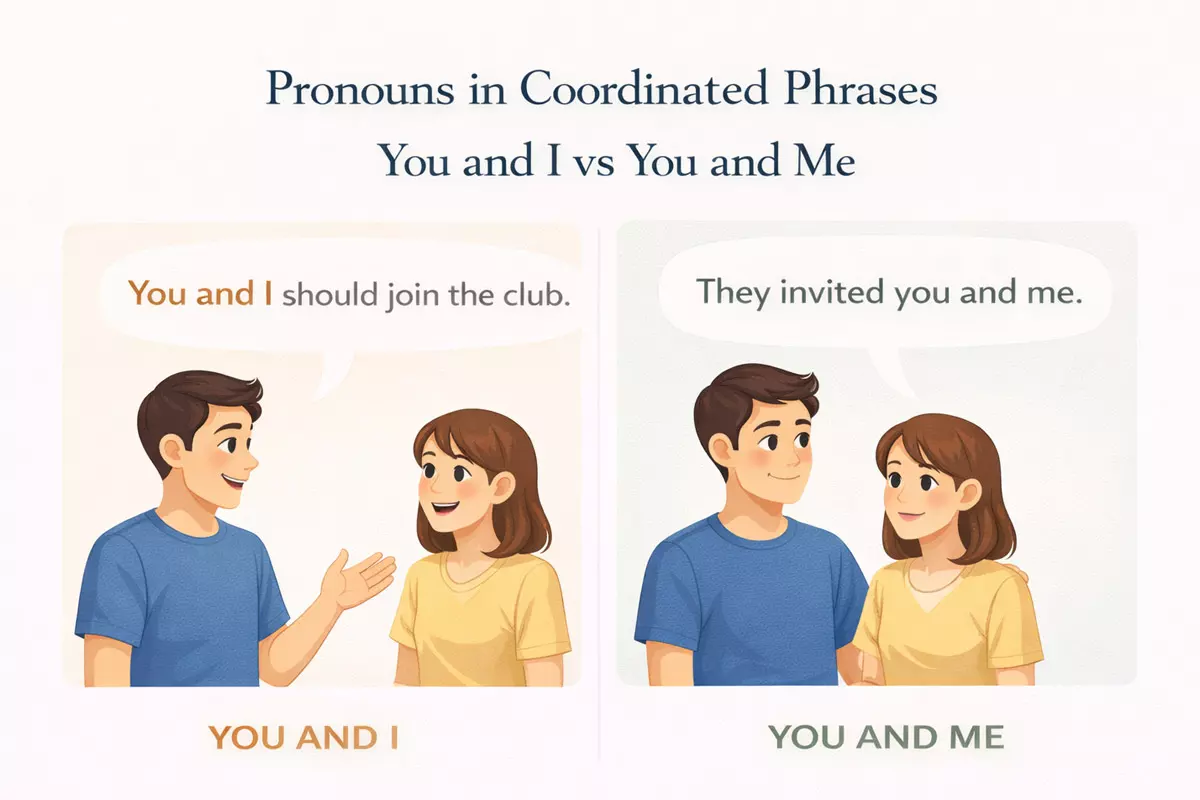
The distinction between subject and object forms is important. "You and I" is used as the subject, while "you and me" is correct as the object (e.g., "They saw you and me").
| Subject Position | Object Position |
|---|---|
| You and I are leaving. | They called you and me. |
| She and he will present. | The teacher praised her and him. |
| My brother and I run daily. | She invited my brother and me. |
| They and we agree. | The coach congratulated them and us. |
Getting comfortable with these pronoun patterns in coordinated phrases helps both clarity and correctness in writing and speech. Remember, subject forms belong in the subject, and object forms in the object position—especially when pronouns are linked with "and."
Object position: you and me, her and him
When pronouns appear as part of a coordinated phrase in the object position—after verbs or prepositions—English prefers the use of object pronouns: me, him, her, us, and them. This differs from subject position, where subject pronouns are required. For example, we say, “She saw you and me at the park,” not “She saw you and I.” Native speakers sometimes stumble here, especially in formal contexts, but standard grammar is clear on the pattern.
Common patterns and examples
Let’s look at frequent ways coordinated pronouns function as objects. These examples show how the choice of pronoun changes based on their position in the sentence:
- They invited him and her to dinner.
- Would you like to join us and them for coffee?
- The gift is from her and me.
- She called you and me first.
- He waved at you and her from across the street.
- My parents met him and me after the show.
- The teacher spoke to them and us about the project.
- Can you help her and him with their bags?
- The invitation is for you and them.
- She smiled at me and him.
Why object pronouns are used
The main reason for using object forms is that coordinated pronouns after verbs or prepositions act as objects in the sentence. English does not allow subject forms like “I” or “she” in these spots. This rule holds even when politeness or formality might tempt some to say “you and I.” For instance, “He thanked you and me” is correct; “He thanked you and I” is not.
Comparison: subject vs. object forms
It can be helpful to see the difference between pronoun forms in subject and object positions. The table below summarizes the correct forms for each role in coordinated phrases:
| Subject Position | Object Position |
|---|---|
| you and I | you and me |
| he and she | him and her |
| they and we | them and us |
| I and he | me and him |
| she and you | her and you |
In summary, when pronouns are joined by “and” after a verb or preposition, always use the object form. This helps sentences sound natural and avoids common grammar mistakes.
Pronoun order and politeness conventions
The sequence of pronouns in coordinated phrases—such as "you and I" or "me and you"—is shaped by both grammatical norms and social customs. In English, traditional etiquette often places the speaker last in a list out of modesty or politeness, particularly in formal writing and speech. This means "you and I" is generally preferred over "I and you," regardless of whether the subject or object form is needed.
Common patterns of pronoun sequencing
- "You and I" (subject position, polite and standard)
- "You and me" (object position, polite and standard)
- "She and I" / "He and I" (subject position, third person before first)
- "My friends and I" (group before self in subject position)
- "You and your sister and I" (others before self, even with more than two)
- "Dad and I" / "Mom and I" (family members named before self)
- "You and me" (object of a preposition, e.g., "between you and me")
- "You and I" (subject of a verb, e.g., "You and I are leaving")
- "Me and you" (informal, sometimes nonstandard or casual contexts)
- "I and you" (rare, sometimes archaic or poetic)
- "He and me" (object position, third person before first)
- "We and they" (group pronouns, group before others)
- "Them and us" (object position, group before self)
- "You, John, and I" (specific names before self)
- "Her and me" (object position, third person before first)
Formality and social considerations
The convention of listing oneself last is not just about grammar—it signals respect and humility. For example, in the phrase "between you and me," using "me" (not "I") is both grammatically correct and socially appropriate. In contrast, "me and you" is common in casual conversation but may be considered less polite or less formal. Some speakers reverse the order ("me and you") to emphasize themselves, but this can sound self-centered or childlike in formal contexts.
Summary of pronoun order preferences
| Context | Preferred Pronoun Order |
|---|---|
| Subject (formal/written) | Other(s) and I (e.g., "You and I") |
| Object (after prepositions) | Other(s) and me (e.g., "You and me") |
| Informal speech | Me and you / You and me (variable) |
| Emphasis on self | Me and X (less formal, sometimes discouraged) |
While grammar provides the framework for correct pronoun usage, social expectations often determine the most appropriate sequence. In both writing and conversation, consider your audience and the context to choose the most suitable and courteous phrasing.
Removing the other noun to test correctness
A practical way to decide between “you and I” and “you and me” is to temporarily leave out the other noun or pronoun in the phrase. This strategy helps clarify which pronoun form sounds natural and is grammatically correct in the sentence. Let’s see how this works in context.
How the method works
When you have a coordinated phrase like “you and I” or “you and me,” try removing either “you” or the other noun. Then, check if the sentence still makes sense. If the pronoun you’re left with feels right, you’ve likely chosen the correct form.
- “You and I are going to the store.” → Remove “you”: “I am going to the store.” (Correct)
- “You and me are going to the store.” → Remove “you”: “Me am going to the store.” (Incorrect)
- “The teacher saw you and me.” → Remove “you”: “The teacher saw me.” (Correct)
- “The teacher saw you and I.” → Remove “you”: “The teacher saw I.” (Incorrect)
Common sentence positions
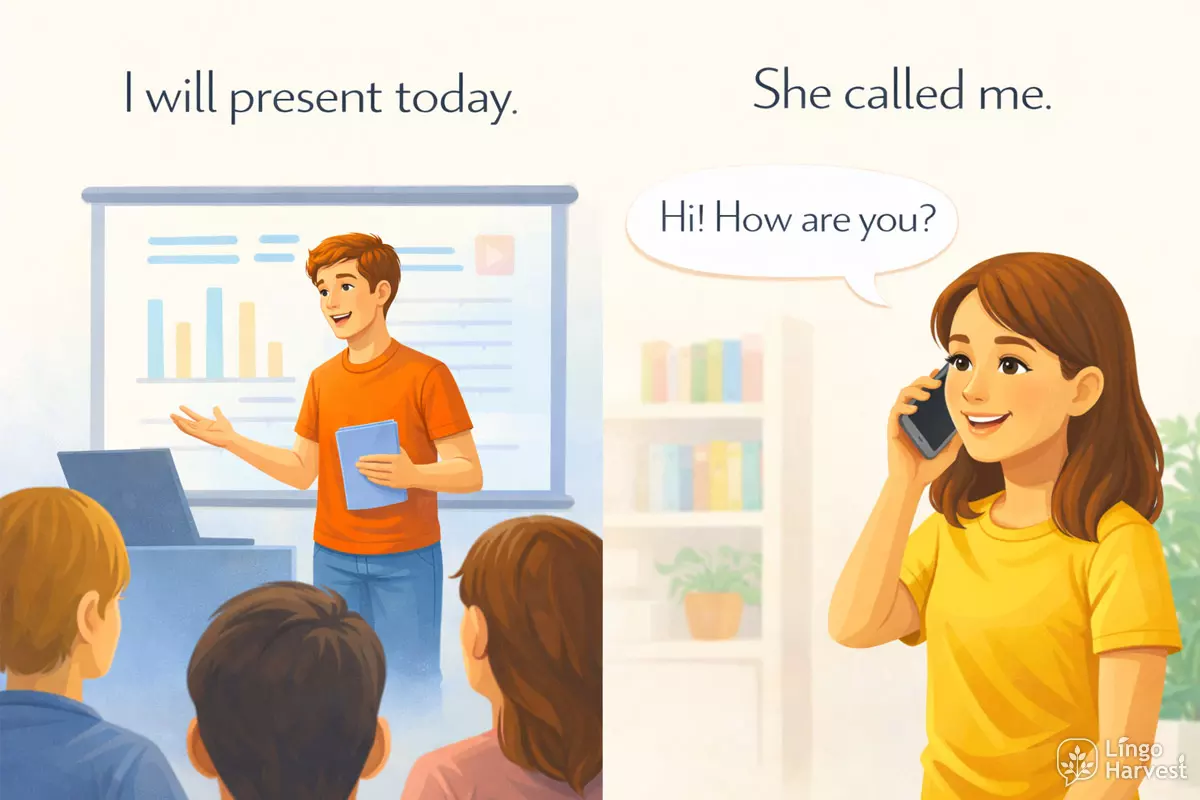
The choice between “I” and “me” depends on whether the phrase acts as the subject or the object in the sentence. Here’s a comparison:
| Sentence Example | Remove Other Noun/Pronoun | Result |
|---|---|---|
| You and I will present today. | I will present today. | ✅ Correct |
| You and me will present today. | Me will present today. | ❌ Incorrect |
| She called you and me. | She called me. | ✅ Correct |
| She called you and I. | She called I. | ❌ Incorrect |
| The gift is for you and me. | The gift is for me. | ✅ Correct |
| The gift is for you and I. | The gift is for I. | ❌ Incorrect |
Practice: Try it yourself
- _____ and you have finished the project.
- The manager thanked you and ____.
- Could you and ____ help me move this table?
- The invitation was addressed to you and ____.
- _____ and you are listed as team leaders.
- The client asked you and ____ to join the call.
- You and ____ need to sign this form.
- The coach spoke to you and ____ after practice.
- Between you and ____, this plan won’t work.
- The report was written by you and ____.
Show answers
- I
- me
- I
- me
- I
- me
- I
- me
- me
- me
This approach is especially useful when you’re unsure which pronoun to use in coordinated phrases. By isolating the pronoun, you can hear what sounds natural and avoid common mistakes.
Common spoken vs written patterns
Everyday conversation and formal writing often diverge in how pronoun pairs like "you and I" or "you and me" are used. In casual speech, people tend to follow natural rhythm and comfort, sometimes bending grammatical rules that are more strictly observed in written language. This creates a noticeable difference in the frequency and acceptability of each phrase, depending on the context.
Spoken language: flexibility and informality
In informal speech, native speakers frequently prioritize ease of pronunciation and what "sounds right" over textbook grammar. As a result, "you and me" often appears in places where "you and I" would be technically correct. For example, it's common to hear "You and me should go" instead of "You and I should go," even though the latter is grammatically proper in standard English.
- People often use "you and me" as the subject in speech: "You and me are going."
- Redundancy or repetition for emphasis is more accepted: "Me and you, we're the best team."
- Order may change for rhythm: "Me and you" vs "You and me."
- Grammatical case is sometimes ignored: "Between you and I" (instead of "me").
- Intonation and context help clarify meaning, reducing ambiguity.
- Correction is rare in casual conversation, even if the form is technically "wrong."
Written language: adherence to standards
Formal writing, such as essays, reports, and official correspondence, usually demands adherence to prescriptive grammar. Here, the distinction between subject and object pronouns is enforced, and the traditional order ("you and I" rather than "me and you") is favored for politeness and clarity.
- "You and I" is the standard for subjects: "You and I will attend the meeting."
- "You and me" is reserved for objects: "The invitation was sent to you and me."
- Writers avoid switching word order unless stylistically justified.
- Editors flag misuse such as "Between you and I."
- Consistency in pronoun case is expected throughout the text.
- Writers may rephrase to avoid awkward constructions: "Both of us will go."
Typical usage patterns: spoken vs written
| Spoken Example | Written Example |
|---|---|
| "You and me are going to the store." | "You and I are going to the store." |
| "It’s just between you and I." | "It’s just between you and me." |
| "Me and you should try that." | "You and I should try that." |
| "They saw you and me." | "They saw you and me." |
| "You and me, we got this!" | "You and I have this under control." |
While both forms are widely understood, being aware of these tendencies helps avoid confusion or unintended informality, especially in professional or academic writing. The difference is less about strict rules in conversation and more about audience expectations and context.
Typical learner mistakes and corrections
Many English learners struggle with pronouns in coordinated phrases, especially when deciding between forms like "you and I" versus "you and me." The confusion often stems from not recognizing when to use subject or object pronouns within these combinations. This section highlights frequent errors and provides clear corrections to help learners understand the correct usage in context.
Common mistakes with subject and object pronouns
Learners frequently mix up subject and object pronouns. Here are some typical errors and how to fix them:
- Incorrect: Me and John went to the store.
Correct: John and I went to the store. - Incorrect: She gave the tickets to you and I.
Correct: She gave the tickets to you and me. - Incorrect: Between you and I, this is a secret.
Correct: Between you and me, this is a secret. - Incorrect: Him and I are working together.
Correct: He and I are working together. - Incorrect: Please call Sarah or I.
Correct: Please call Sarah or me. - Incorrect: The teacher spoke to he and I.
Correct: The teacher spoke to him and me. - Incorrect: Us and our friends will help.
Correct: We and our friends will help. - Incorrect: This is a gift from my brother and I.
Correct: This is a gift from my brother and me. - Incorrect: You and me can do it.
Correct: You and I can do it. - Incorrect: The choice is between she and I.
Correct: The choice is between her and me.
Table: Comparing "You and I" vs "You and Me" in Contexts
| Phrase | Correct Context |
|---|---|
| You and I | Used as the subject of a sentence (e.g., You and I are going.) |
| You and me | Used as the object of a verb or preposition (e.g., She saw you and me.) |
| John and I | Subject position (e.g., John and I finished the project.) |
| John and me | Object position (e.g., They invited John and me.) |
Tips for avoiding mistakes
- Remove the other person from the phrase to check: Would you say "Me went to the store" or "I went to the store"? The correct form is "I."
- After prepositions (like "to," "with," "for," "between"), use object pronouns: me, him, her, us, them.
- As the subject of a sentence, always use subject pronouns: I, he, she, we, they.
- When in doubt, mentally split the phrase and check each part separately.
Understanding these patterns helps learners speak and write more naturally, avoiding the most frequent errors with coordinated pronoun phrases.
Practice: fix pronouns in coordinated phrases
Using the correct form of pronouns in coordinated phrases (like "you and I" or "you and me") can be tricky, especially when deciding between subject and object forms. Let's work through some targeted exercises to help you spot and correct common mistakes.
Spot the Error: Which Pronoun Is Wrong?
In each sentence below, decide if the pronoun is correct. If not, rewrite the phrase with the correct pronoun. Pay attention to whether the phrase is being used as the subject or the object in the sentence.
- Me and him went to the store.
- Between you and I, this secret is safe.
- She invited my brother and I to dinner.
- You and me should try that new cafe.
- This is just between you and me.
- My sister and I baked cookies together.
- Will you come with Sarah and I?
- He gave the tickets to you and me.
- Us and them have always competed.
- There’s a message for you and I at the desk.
Show answers
- I and he went to the store (or more naturally, He and I went to the store) ✅
- Between you and me, this secret is safe. ✅
- She invited my brother and me to dinner. ✅
- You and I should try that new cafe. ✅
- This is just between you and me. (Correct) ✅
- My sister and I baked cookies together. (Correct) ✅
- Will you come with Sarah and me? ✅
- He gave the tickets to you and me. (Correct) ✅
- We and they have always competed. (But more naturally, They and we have always competed.) ✅
- There’s a message for you and me at the desk. ✅
Quick Reference: Subject vs Object Forms
When pronouns are joined with “and” or “or,” use the subject form if the whole phrase is the subject, and the object form if it’s the object. Here’s a handy table to clarify:
| Subject Position | Object Position |
|---|---|
| You and I are leaving. | The gift is for you and me. |
| He and she arrived early. | Please join him and her. |
| My friend and I will help. | She called my friend and me. |
| They and we disagree. | The decision affects them and us. |
Rewrite Practice
Rewrite each phrase below so that the pronouns are correct for their position in the sentence.
- Her and me went hiking.
- For my sister and I, it was a surprise.
- Us and Jack finished first.
- Can you help she and I?
- Me and him are responsible for the task.
- Between you and I, this is confidential.
- Him and his friend arrived late.
- The invitation was sent to she and Tom.
- Us and them will decide later.
- They spoke to I and my brother.
Show answers
- She and I went hiking.
- For my sister and me, it was a surprise.
- Jack and we finished first.
- Can you help her and me?
- He and I are responsible for the task.
- Between you and me, this is confidential.
- He and his friend arrived late.
- The invitation was sent to her and Tom.
- We and they will decide later.
- They spoke to me and my brother.
Reviewing these examples will help you feel more confident choosing the right pronoun forms in coordinated phrases. Practice regularly, and soon these patterns will become second nature.