Modal Verbs in Job Interview Questions and Answers

 This article explains why interview questions often use modal verbs, how can, could, and would probe skills and experience, and how candidates use modals to describe responsibilities. It also shows how modals add polite, professional tone, soften statements, and includes practice exercises.
- Why interview questions often include modal verbs
- How interviewers use modal verbs to ask about skills and experience
- Examples of interview questions formed with can, could, and would
- How candidates use modal verbs when describing responsibilities
- How modal verbs help responses sound polite and professional
- Situations where modal verbs soften statements during interviews
- Exercises and practice activities using modal verbs in interview scenarios
Helping verbs like can, would, and should shape how you sound in interview questions and answers, signaling confidence, politeness, or uncertainty. Employers use them to probe ability, willingness, and judgment, so your replies should match the intent and tone. This article shows how to spot what the interviewer is really asking and choose wording that stays professional, clear, and natural in real conversation.
Why interview questions often include modal verbs
Interviewers rely on modal verbs because they quickly shift a question from simple facts to ability, judgment, willingness, and problem-solving. Modals help the interviewer test how you think, what you would do in a situation, and how confidently you can commit to an action—without forcing you into absolute statements.
What modals let interviewers assess
- Ability and competence (can, could): whether you have the skills to perform tasks or learn tools.
- Experience framed as capability (can, could): whether you can apply past work to new contexts.
- Polite but direct requests (could, would): encouraging fuller answers while keeping the tone professional.
- Hypothetical reasoning (would, could, might): how you handle scenarios, trade-offs, and uncertainty.
- Decision-making under constraints (would, might): how you prioritize when time, budget, or data is limited.
- Willingness and flexibility (would, can): openness to travel, schedules, changing priorities, or new responsibilities.
- Permission and boundaries (may, can): what you are allowed to do, and how you handle compliance or approvals.
- Advice and best practice (should): whether you understand standards and can justify recommendations.
- Obligation and policy (must, have to): awareness of non-negotiables like safety, deadlines, or legal rules.
- Risk and probability (might, may, could): how you communicate uncertainty without sounding evasive.
- Softening strong claims (might, could): presenting options without overpromising.
- Negotiation and expectations (would): discussing salary, timelines, and deliverables tactfully.
Common question patterns (and what they signal)
- Can you + verb…? → tests current ability or capacity: “Can you manage multiple deadlines?”
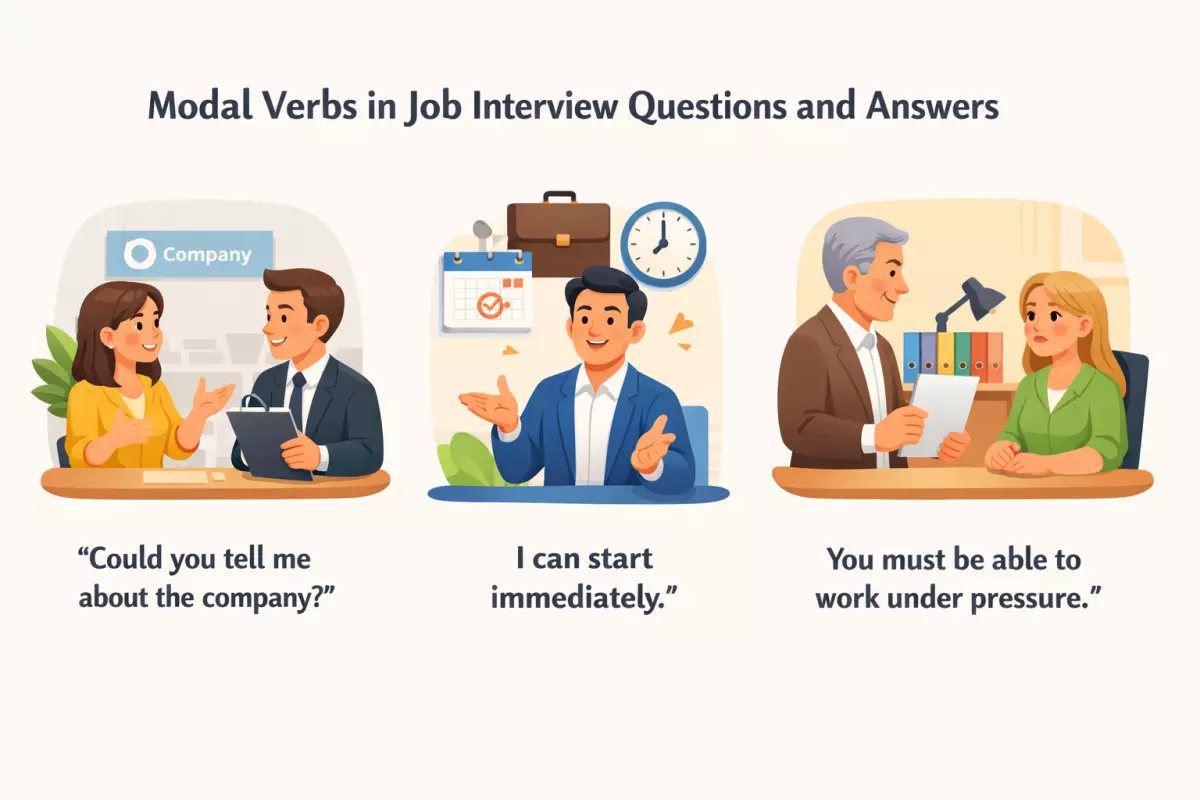
- Could you + verb…? → a polite request for detail: “Could you walk me through your process?”
- Would you + verb…? → checks willingness or preference: “Would you be open to relocating?”
- What would you do if…? → scenario-based problem-solving: “What would you do if a client changed requirements late?”
- How would you handle…? → evaluates method and communication: “How would you handle conflict on a team?”
- What should + subject + do…? → looks for best practice: “What should a manager do when performance drops?”
- When must + subject + verb…? → checks rule awareness: “When must you escalate an incident?”
- What might happen if…? → tests risk thinking: “What might happen if we skip QA?”
- How might you improve…? → invites ideas without demanding certainty: “How might you improve onboarding?”
- May I ask…? → formal tone (often used by interviewers themselves) before a sensitive topic.
Usage cues to notice in modal questions
- Could often sounds more courteous than can, especially in requests for explanation.
- Would commonly introduces hypotheticals and preferences; answers should describe a clear approach, not only an opinion.
- Might/May signal uncertainty; strong answers acknowledge possibilities and then state what you would check or decide next.
- Should invites principles and reasoning; interviewers listen for justification, not just the rule.
- Must/Have to point to obligations; good answers distinguish between policy requirements and flexible guidelines.
- Modal questions often expect structured responses: situation → action → result, plus a brief rationale for the choice.
How interviewers use modal verbs to ask about skills and experience
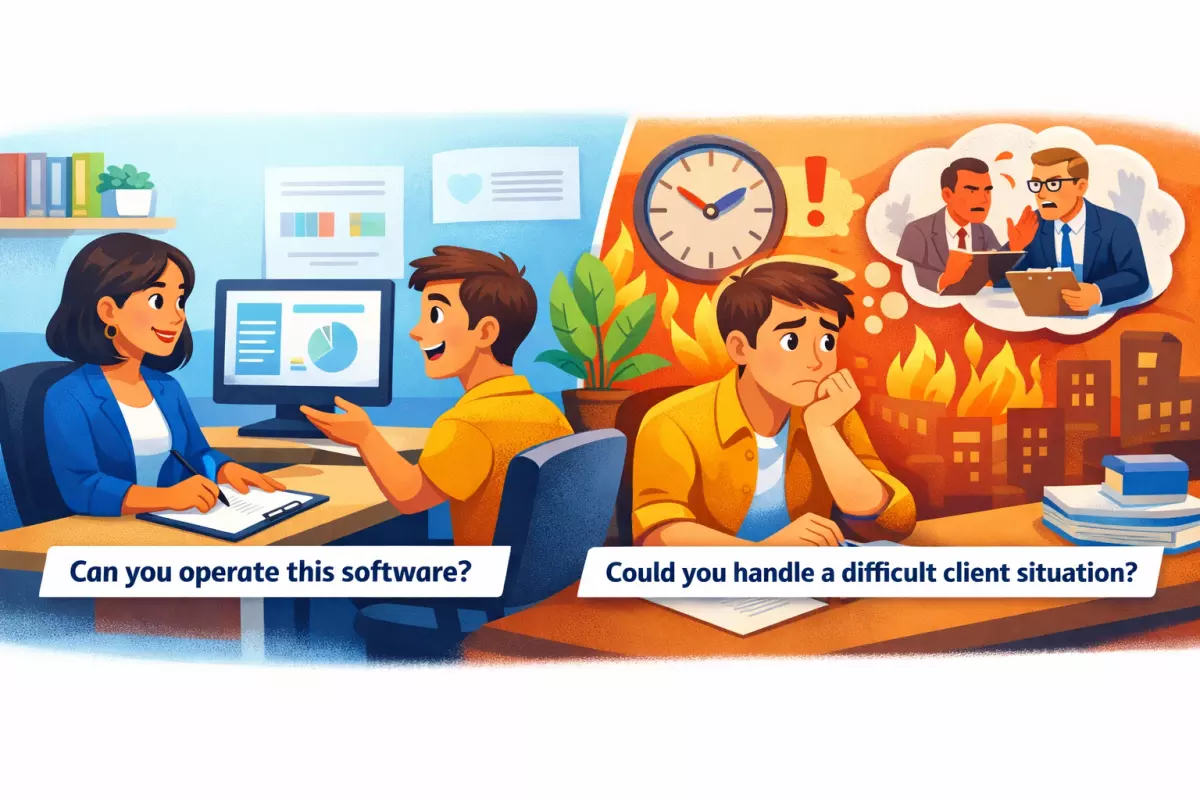
Interview questions often rely on modal verbs to test what you are able to do, what you have done before, and how you would handle realistic situations. The modal chosen signals the interviewer’s goal: measuring capability, checking permission/constraints, or exploring decision-making under pressure.
Common modal patterns and what they’re testing
- Can you…? checks present ability and practical competence (skills you can demonstrate now).
- Could you…? softens the request and often invites a more detailed explanation of process or problem-solving.
- Are you able to…? is a more formal ability check, sometimes used for specific requirements (travel, lifting, shifts).
- Have you been able to…? asks about proven capability over time, usually with obstacles or constraints.
- Would you…? explores preferences and likely behavior in hypothetical scenarios (judgment and fit).
- How would you…? focuses on method: steps, prioritization, and communication.
- What would you do if…? tests decision-making in a scenario, including trade-offs and escalation.
- May I ask you to…? is interviewer permission language; it frames a request politely and can introduce a task (e.g., a short role-play).
- Would you be willing to…? checks flexibility and boundaries (relocation, on-call work, occasional overtime).
- Should we expect you to…? asks for reliability and expectations (deadlines, availability, response times).
- Must you…? is rare, but may appear when discussing non-negotiable constraints (legal, compliance, safety).
Question stems interviewers use (with typical targets)
- Can you walk me through a time you solved a difficult problem? (ability + evidence)
- Can you give an example of leading a project end-to-end? (skill demonstration)
- Can you explain how you prioritize tasks under tight deadlines? (process)
- Could you describe your role in that project? (clarifying contribution)
- Could you share how you handled a conflict with a stakeholder? (communication)
- Are you able to work across time zones when needed? (constraint/availability)
- Have you been able to improve a metric or workflow in your last role? (impact over time)
- Would you be comfortable presenting to senior leadership? (confidence + experience)
- Would you consider taking on mentoring responsibilities? (willingness)
- How would you onboard yourself in the first two weeks? (planning)
- What would you do if you disagreed with a technical decision? (judgment + collaboration)
- May I ask you to complete a short exercise now? (polite request)
How candidates typically respond to ability and scenario modals
- For can/could questions, answers often follow: Yes + brief claim → example → result. This turns a simple ability check into evidence of experience.
- For would/how would questions, answers often follow: principle → steps → communication → fallback plan. This shows structured thinking rather than a guess.
- When the modal implies a constraint (e.g., able to, willing to, must), strong answers state limits clearly and propose alternatives: ✅ “I can do X; if Y happens, I can do Z.” rather than ❌ vague agreement.
Small grammar cues that change meaning
- Can = ability now; could = softer tone or past/general ability depending on context.
- Could you (polite request) differs from could you have (past possibility/critique), which is uncommon in interviews.
- Would you asks about likely choice; will you can sound like a commitment request and may feel more direct.
- Be able to often points to practical constraints (schedule, location, tools), not just skill level.
Examples of interview questions formed with can, could, and would
In interviews, these modal verbs help an interviewer ask about ability, past experience, and preferences in a polite, professional way. The most common pattern is modal + subject + base verb (for example, “Can you explain…?”). Below are practical question models you can recognize and practice answering.
Questions with can (ability, permission, practical possibility)
- Can you describe your current role in two minutes?
- Can you explain how you prioritize tasks when everything feels urgent?
- Can you walk me through a project you led from start to finish?
- Can you work effectively with minimal supervision?
- Can you manage competing deadlines without sacrificing quality?
- Can you use [tool/software] confidently in daily work?
- Can you collaborate with people from different teams or backgrounds?
- Can you give an example of a time you solved a difficult problem?
- Can you handle constructive feedback and adjust quickly?
- Can you travel if the role requires occasional trips?
- Can you start on [date] if an offer is made?
- Can you share your salary expectations for this position?
Questions with could (polite requests, past ability, hypothetical situations)
- Could you tell me about a challenge you faced and how you handled it?
- Could you clarify what you mean by “improved efficiency” on your resume?
- Could you give a specific example of your leadership style in action?
- Could you describe a time you had to influence someone without authority?
- Could you explain your decision-making process when data is incomplete?
- Could you share how you approach learning a new system or process?
- Could you outline the steps you would take to onboard into this role?
- Could you handle a situation where a stakeholder strongly disagrees with you?
- Could you work late occasionally during peak periods?
- Could you relocate if needed in the future?
- Could you provide references from recent supervisors or clients?
- Could you summarize what you think the main priorities would be in the first 90 days?
Questions with would (preferences, typical behavior, conditionals)
- Would you prefer working independently or as part of a team?
- Would you be comfortable presenting to senior leadership?
- Would you describe yourself as more detail-focused or big-picture focused?
- Would you be willing to take on responsibilities outside your job description when needed?
- Would you say your communication style is more direct or more diplomatic?
- Would you handle a conflict with a coworker differently now than in the past?
- Would you accept feedback that challenges your initial approach?
- Would you be open to a hybrid schedule, or do you prefer fully onsite/remote?
- Would you consider a contract-to-hire arrangement?
- Would you be willing to mentor a junior teammate?
- Would you choose the same career path again? Why or why not?
- Would you like to ask any questions about the role or the team?
Useful patterns to notice (and avoid)
- Base verb after the modal: ✅ “Could you describe…” ❌ “Could you described…”
- Politeness level: “Could you…” and “Would you…” usually sound more formal than “Can you…”.
- Common follow-ups: After a modal question, interviewers often add “Why?”, “How?”, or “What was the result?” to ask for evidence and outcomes.
How candidates use modal verbs when describing responsibilities
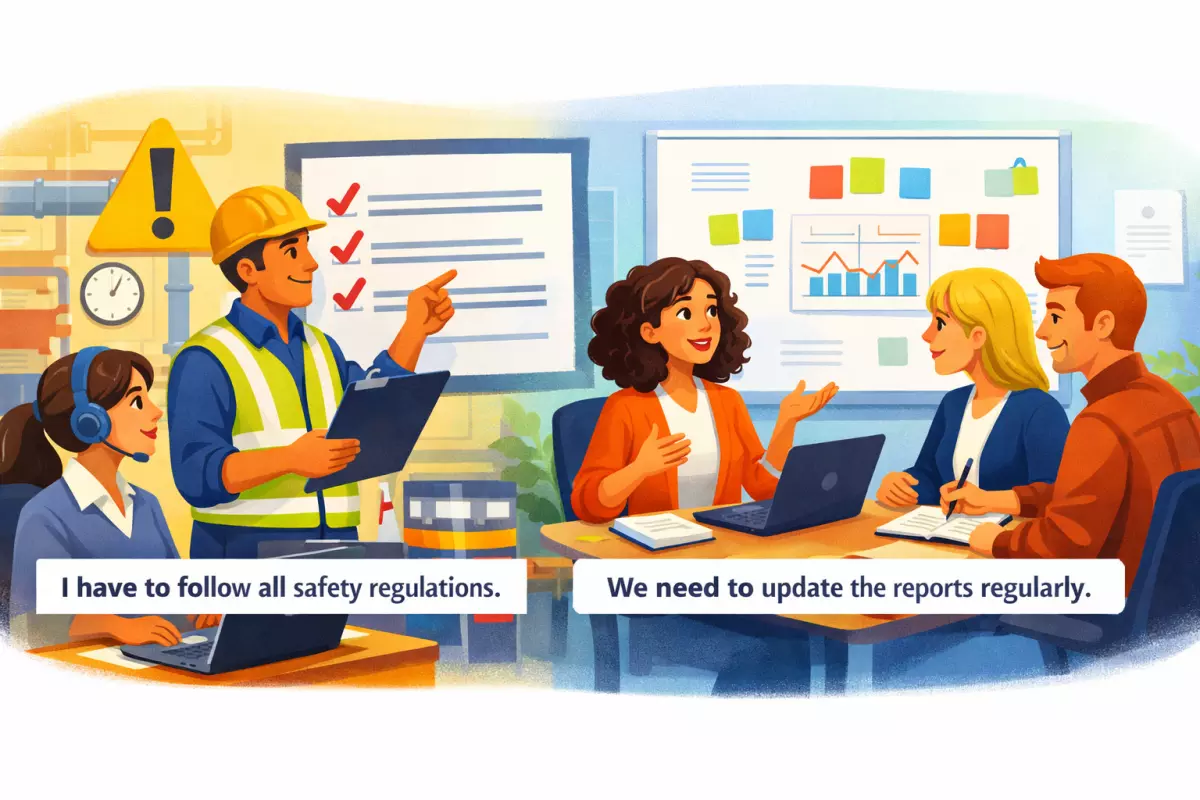
When candidates explain what they do at work, modal verbs help them show obligation, expectations, permission, ability, and typical processes. The key is choosing a modal that matches the real level of requirement and the amount of control the role gives you.
Common patterns candidates use
- Role requirement (non-negotiable): have to / must + base verb (often for compliance, safety, deadlines).
- Policy or process expectation: need to / are expected to + base verb (sounds procedural rather than forceful).
- Ability and capability: can / be able to + base verb (skills, tools, capacity).
- Conditional ability: can + base verb + condition (e.g., “when X happens,” “if Y is available”).
- Permission and limits: can / may + base verb (what the role is allowed to do).
- Advising or recommending: should / ought to + base verb (best practice, guidance, mentoring).
- Willingness and responsiveness: will / would + base verb (what you routinely do to support others).
- Polite responsibility framing: would + base verb (useful for describing duties without sounding rigid).
- Possibility and uncertainty: might / could + base verb (variable tasks, changing priorities).
- Risk and prevention: must not / can’t + base verb (prohibited actions, security rules).
- Frequency with modals: modal + adverb (e.g., “often,” “usually,” “occasionally”) to show how typical a duty is.
- Responsibility + outcome: modal + base verb + result clause (shows impact, not just tasks).
Side-by-side examples by meaning
| What the candidate wants to express | Typical modal patterns | Interview-style examples |
|---|---|---|
| Mandatory duty / compliance | must / have to + base verb | I have to follow the change-control process before deploying updates. |
| Expectation / standard procedure | need to / are expected to + base verb | We need to document incidents within 24 hours. |
| Ability / capability | can / be able to + base verb | I can troubleshoot API errors and isolate root causes quickly. |
| Permission / authority | can / may + base verb | As the on-call lead, I can approve emergency fixes after review. |
| Recommendation / best practice | should / ought to + base verb | For handoffs, we should include clear acceptance criteria. |
| Possibility / variability | might / could + base verb | During launches, I might shift priorities to handle escalations. |
| Prohibition / restriction | must not / can’t + base verb | We can’t share customer data outside approved channels. |
Accuracy tips that interviewers notice
- Match strength to reality: use must/have to for true requirements; use should for guidance, not rules.
- Avoid over-claiming authority: if you recommend but don’t decide, prefer “I can propose…” over “I must decide…”.
- Use be able to when the ability depends on conditions (resources, access, timing), not just skill.
- Keep form correct: modal + base verb. ✅ “I can manage vendors.” ❌ “I can managing vendors.”
- Show boundaries clearly with negatives: “We must not bypass approvals” communicates responsibility and risk awareness.
- Combine modals with outcomes: “I have to reconcile accounts so reports are accurate” makes the duty meaningful.
How modal verbs help responses sound polite and professional
In interview answers, modal verbs let you sound confident without sounding rigid. They help you soften claims, make proposals, and show openness to feedback. The key is choosing a modal that matches your intent: possibility, willingness, recommendation, or a careful limitation.
1) Use modals to soften strong statements
Direct sentences can sound absolute, which may come across as inflexible. Modals add a measured tone while keeping your point clear.
- ✅ “I can lead cross-functional projects” → capability without bragging.
- ✅ “I could take the lead on the first phase” → confident but not pushy.
- ❌ “I will lead everything” → can sound presumptive if not agreed.
- ✅ “That approach might reduce delays” → suggests an idea without overstating certainty.
- ✅ “This may be a better fit for the timeline” → slightly more formal than might.
2) Show flexibility and collaboration
Interviewers listen for how you work with others. Modals help you signal that you can adapt and coordinate, not just direct.
- “We can align on priorities in the first week.”
- “I could share a draft plan and get your feedback.”
- “We might need to involve Legal early to avoid rework.”
- “If needed, I can adjust my schedule during the launch period.”
- “I would coordinate with Sales before changing the messaging.”
3) Make suggestions without sounding like you are correcting someone
When discussing improvements, modals help you sound constructive. This is especially useful when you are asked how you would handle a problem in the role.
- “We could simplify the handoff by using one shared tracker.”
- “It might help to define the acceptance criteria earlier.”
- “You may want to consider a pilot before a full rollout.”
- “We can test two options and compare results.”
- “A quick retro could surface the main blockers.”
4) Use “would” to describe professional judgment and process
Would is a common choice for scenario questions because it sounds deliberate and methodical. It communicates what you typically do, without implying that your way is the only way.
- “I would start by clarifying the goal and constraints.”
- “I would gather input from stakeholders before deciding.”
- “I would flag the risk early and propose options.”
- “If the deadline is fixed, I would reduce scope rather than cut testing.”
5) Ask for clarification politely with modal questions
Modal questions keep your tone respectful while you collect information. They are useful both when answering and when you ask the interviewer questions.
- “Could you clarify what success looks like in the first 90 days?”
- “Would you prefer a short overview or a detailed example?”
- “May I ask how the team measures performance?”
- “Could I share a quick example from my last role?”
- “Would it be helpful if I walked through my process step by step?”
6) Avoid overusing “should” and “must” in answers
Should and must can sound judgmental or overly forceful if you use them to describe what others did wrong. When discussing past teams or employers, consider softer alternatives unless a strict rule is truly required.
- ❌ “They should have listened to me.” → sounds accusatory.
- ✅ “We could have aligned earlier to avoid confusion.”
- ❌ “You must change the process.” → too directive in an interview setting.
- ✅ “We might improve results by adjusting the process.”
- ✅ Use must mainly for non-negotiables: “We must comply with security requirements.”
As a pattern, pair modals with clear action verbs (“can improve,” “could coordinate,” “would prioritize”) and add a brief reason (“to reduce risk,” “to keep stakeholders aligned”). This keeps your language polite while still sounding decisive.
Situations where modal verbs soften statements during interviews
In interviews, modal verbs help you sound professional when you need to be direct but not blunt. They add tact, show openness, and reduce the risk of sounding defensive or overly absolute. The key pattern is simple: use a modal (can, could, would, might, may, should) to turn a hard claim or demand into a measured, cooperative statement.
1) When you need to disagree or correct a misunderstanding
Use modals to acknowledge the interviewer’s point while offering a different view. This keeps the tone collaborative rather than confrontational.
- ✅ “That’s a fair point; I might frame it a bit differently based on the data.” → softer than “You’re wrong.”
- ✅ “I could clarify what I meant by ‘ownership’ in that project.”
- ✅ “We may be using different definitions of ‘success’—here’s how we measured it.”
- ✅ “I would add one more context point before concluding.”
- ❌ “No, that’s not what happened.” → ✅ “That’s not quite how it played out; I can walk you through the timeline.”
2) When you want to show confidence without sounding absolute
Replacing “will” or “always” with modals like could, would, and should signals confidence plus realism. It sounds experienced: you expect good outcomes, but you understand constraints.
- ✅ “This approach should reduce cycle time, assuming the inputs stay consistent.”
- ✅ “I could contribute quickly because I’ve used similar tooling.”
- ✅ “That change might improve adoption, especially for new users.”
- ✅ “I would expect a learning curve in the first two weeks.”
- ❌ “This will definitely fix it.” → ✅ “This should fix it, and we can verify with a test.”
3) When discussing weaknesses, gaps, or mistakes
Modals help you take responsibility while keeping the focus on solutions. They also support a “next time” mindset, which interviewers often look for.
- ✅ “I could have escalated earlier; next time I would set a clearer checkpoint.”
- ✅ “I might have underestimated the integration effort, so I adjusted the plan.”
- ✅ “I should have communicated the risk sooner; I’ve since added a weekly risk review.”
- ✅ “That decision may have slowed delivery short-term, but it reduced defects later.”
- ❌ “It wasn’t my fault.” → ✅ “I could have influenced the outcome by aligning earlier.”
4) When making requests or negotiating (salary, scope, timeline)
Requests sound more respectful when framed as possibilities rather than demands. “Could” and “would” are common for polite negotiation, while “might” and “may” keep options open.
- ✅ “Could you share how success is measured in the first 90 days?”
- ✅ “Would it be possible to discuss the salary range for this role?”
- ✅ “Could we revisit the scope to match the timeline?”
- ✅ “I would be comfortable with X if we include Y (bonus, flexibility, development budget).”
- ✅ “We might be able to meet that date if we prioritize A over B.”
5) When proposing ideas without sounding pushy
Using could/might frames suggestions as options. This invites discussion and signals that you can collaborate rather than dictate.
- ✅ “We could start with a small pilot before scaling.”
- ✅ “One option might be to automate that step to reduce errors.”
- ✅ “We could align stakeholders with a short kickoff and a written brief.”
- ✅ “It may help to separate discovery from delivery in the schedule.”
- ❌ “We need to do it my way.” → ✅ “We could try this approach and compare results.”
6) When setting boundaries or declining politely
Modals let you be firm while staying courteous. Pair them with brief reasoning and, when possible, an alternative.
- ✅ “I would prefer to keep details confidential, but I can share the general process.”
- ✅ “I might not be the best fit for that specific tool, but I can learn it quickly.”
- ✅ “I could take that on, but it would mean deprioritizing X—how would you like to proceed?”
- ✅ “I may need clarification before committing to that timeline.”
- ❌ “No, I can’t.” → ✅ “I could do that with a later deadline or additional support.”
7) When answering behavioral questions with conditional language
Interview stories often include decisions made under uncertainty. “Would” and “could” are useful for describing decision rules and what you do in similar situations.
- ✅ “In that situation, I would first confirm priorities with the stakeholder.”
- ✅ “If the risk is high, we might pause release and run an extra check.”
- ✅ “I could give an example of how I handled conflicting feedback.”
- ✅ “I would typically document assumptions so the team can challenge them.”
As a quick rule: use could/would for politeness and collaboration, might/may for uncertainty and options, and should for measured recommendations. This combination keeps your answers clear while reducing unnecessary sharpness.
Exercises and practice activities using modal verbs in interview scenarios
Build accuracy by practicing the most common interview patterns: polite requests, ability claims, expectations, suggestions, and conditional problem-solving. Focus on how the modal changes the meaning (certainty, politeness, obligation, possibility) and on the grammar that follows it (base verb, perfect form, passive, or question word order).
1) Pattern drill: choose the best modal for the interviewer’s intention
Complete each sentence with one modal (or modal phrase) that best fits the context. Use: can, could, would, should, may, might, must, have to, need to.
- ________ you walk me through your decision-making process on your last project?
- In this role, you ________ collaborate with sales weekly, so clear updates are important.
- We’re not sure the deadline is realistic; we ________ need to renegotiate scope.
- What tools ________ you use to track tasks and risks?
- To succeed here, you ________ be comfortable presenting to non-technical stakeholders.
- ________ I ask about your availability to start?
- If a customer escalates, how ________ you respond in the first hour?
- You ________ share a time you handled conflicting priorities.
- Given the compliance rules, we ________ document every change request.
- Do you think you ________ take on occasional travel?
Show answers
- Could (polite request)
- have to / need to (role requirement)
- might / may (possibility)
- do not needed; best: do is auxiliary, but the task asks for a modal → can (“What tools can you use…?” = ability/option). In many interviews, “What tools do you use…?” is also natural without a modal.
- must / have to (strong necessity)
- May / Could (polite permission/request)
- would (typical conditional response)
- could (soft prompt) / can (direct prompt)
- must / have to (non-negotiable requirement)
- could / can (ability/willingness)
2) Grammar focus: base verb, perfect modal, and passive modal
Rewrite each sentence as instructed. Keep the meaning as close as possible.
- Rewrite with a polite request using could: “Tell me about a time you led a team.”
- Rewrite using a perfect modal to show a past possibility: “I missed the email because it went to spam.”
- Rewrite using a passive modal to emphasize the process: “We must review all pull requests.”
- Rewrite using should to give advice: “It is a good idea to clarify expectations early.”
- Rewrite using might to soften certainty: “This approach will reduce churn.”
- Rewrite using would for a hypothetical: “I handle a conflict by setting rules.”
Show answers
- Could you tell me about a time you led a team?
- It might have gone to spam, so I missed the email.
- All pull requests must be reviewed.
- You should clarify expectations early.
- This approach might reduce churn.
- I would handle a conflict by setting clear rules.
3) Spot the issue: fix common modal mistakes seen in interview answers
Correct each sentence. Pay attention to: no “to” after most modals, correct tense, and natural politeness.
- ❌ I can to manage multiple projects at once.
- ❌ I would can lead that initiative if needed.
- ❌ We must to finish by Friday.
- ❌ Could you to explain the gap in your resume?
- ❌ I should to have told my manager earlier.
- ❌ I might can join the call at 3.
- ❌ You mustn’t submit timesheets late (intended meaning: company rule says don’t).
- ❌ I may to start next Monday.
Show answers
- ✅ I can manage multiple projects at once.
- ✅ I could lead that initiative if needed. / I would be able to lead that initiative if needed.
- ✅ We must finish by Friday.
- ✅ Could you explain the gap in your resume?
- ✅ I should have told my manager earlier.
- ✅ I might be able to join the call at 3. / I may be able to join the call at 3.
- ✅ You must not submit timesheets late (formal). / You can’t submit timesheets late (common). Note: mustn’t can sound like strong personal prohibition; use carefully.
- ✅ I may start next Monday.
4) Mini role-play prompts (candidate responses) using targeted modals
Use these prompts to rehearse full answers. Aim for 2–4 sentences each, and include the modal in a natural way (not forced).
- Ability (can/could): Describe a skill you can apply immediately in this role.
- Polite negotiation (could/would): Ask whether the start date could be flexible and explain what you would propose.
- Advice (should): Explain what a new hire should do in their first two weeks to succeed.
- Possibility (may/might): Discuss a risk that might affect delivery and how you would reduce it.
- Obligation (must/have to/need to): Explain a compliance step you must follow in your work.
- Permission (may/could): Ask to clarify something sensitive (salary range, remote policy, relocation support).
- Hypothetical (would): Explain what you would do if two stakeholders disagreed on priorities.
- Past inference (must have / might have / can’t have): Comment on why a project slipped without blaming individuals.
- Softening (could/might): Offer an alternative approach: “We could…” / “We might…”
- Boundary-setting (can/can’t): State what you can commit to and what you can’t, with a constructive alternative.
5) Quick reference: high-frequency modal frames to memorize
- Could you + base verb…? (polite request)
- May I + base verb…? (polite permission)
- Can you + base verb…? (direct request)
- I can + base verb… (ability)
- I could + base verb… (ability in the past or softer claim)
- I would + base verb… (hypothetical plan)
- I would be able to + base verb… (capability in a condition)
- We should + base verb… (recommendation)
- We might + base verb… (tentative option)
- We may need to + base verb… (careful necessity)
- We have to + base verb… (practical requirement)
- We must + base verb… (strong obligation)
- It must have + past participle… (strong inference about the past)
- It might have + past participle… (uncertain inference about the past)
- It can’t have + past participle… (strong negative inference)