Using Adjectives in CVs and Job Applications

 Here we how to use adjectives effectively in professional documents, especially CVs. It lists strong and weak adjectives, gives tips for describing skills and achievements clearly, provides sample CV bullet points, and includes practice exercises.
To capture an employer’s attention, it is essential to thoughtfully describe yourself and your experiences, using language that highlights your strengths and achievements. Carefully selected descriptive words can make your resume or application stand out among many others by showcasing your skills, professionalism, and unique qualities. Whether detailing your accomplishments, outlining your responsibilities, or summarizing your goals, the way you present your background can significantly influence how potential employers perceive your suitability for the role.
Role of adjectives in professional documents
When crafting CVs and job applications, selecting the right descriptive words can transform basic statements into compelling achievements. Adjectives serve to highlight qualities, skills, and experiences, helping candidates stand out to employers. Rather than listing duties, using specific modifiers brings personality and detail, making professional narratives more persuasive and memorable.
Why adjectives matter in CVs and applications
Employers often scan documents quickly. Strategic use of descriptive language helps key strengths and accomplishments stand out. Well-chosen adjectives can:
- Clarify the nature of your skills (e.g., advanced technical abilities)
- Convey scope or scale (e.g., large-scale projects, complex challenges)
- Demonstrate soft skills and character (e.g., collaborative leader, dedicated team member)
- Show progression or improvement (e.g., innovative solutions, consistent results)
Common pitfalls: Overuse and vague adjectives
While modifiers add value, excessive or generic terms can weaken your message. Avoid words like "hardworking," "nice," or "good," which offer little insight. Instead, opt for specific, relevant descriptors that directly relate to the role.
Examples of effective adjectives for professional documents
- Analytical → She has an analytical mind and solves problems quickly.
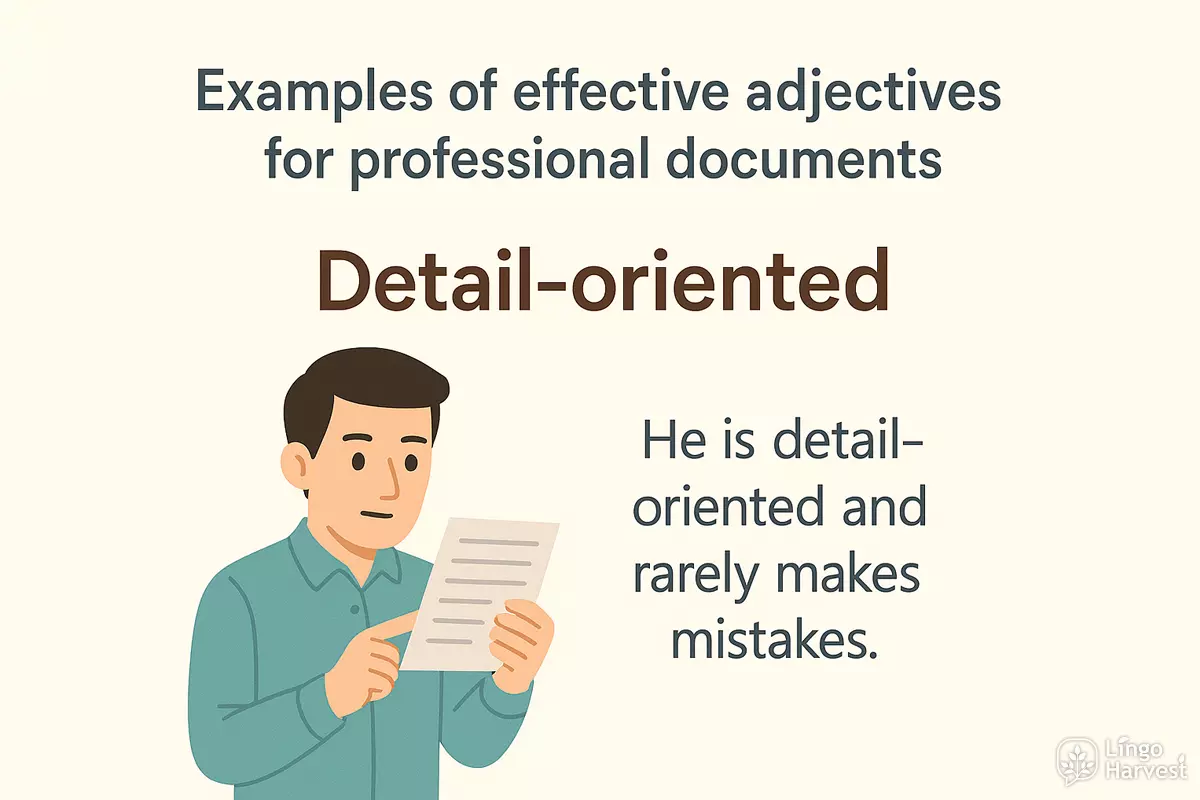
- Detail-oriented → He is detail-oriented and rarely makes mistakes.
- Proactive → She is proactive and always starts tasks before being asked.
- Strategic → They took a strategic approach to expanding the business.
- Resourceful → He is resourceful and finds solutions even with limited tools.
- Adaptable → She is adaptable and works well in changing environments.
- Efficient → He is efficient and completes projects ahead of schedule.
- Dependable → She is dependable and can be trusted with important tasks.
- Innovative → Their team is innovative and creates new ideas regularly.
- Motivated → He is highly motivated and pursues goals with energy.
- Results-driven → She is results-driven and focuses on measurable outcomes.
- Dynamic → He is dynamic and brings energy to every meeting.
- Collaborative → She is collaborative and enjoys working with others.
- Organized → He is organized and keeps everything in perfect order.
- Versatile → She is versatile and can handle many different tasks.
- Insightful → He gave an insightful comment that changed the discussion.
- Supportive → She is very supportive and helps new team members adapt.
- Meticulous → He is meticulous and checks every detail carefully.
- Persuasive → She is persuasive and often wins clients over.
- Resilient → He is resilient and quickly recovers from setbacks.
Comparing weak vs. strong adjective use
| Less Effective | Stronger Alternative |
|---|---|
| Good communicator | Articulate communicator |
| Hardworking employee | Dedicated professional |
| Nice teammate | Collaborative team player |
| Organized worker | Meticulous organizer |
| Creative | Innovative thinker |
Choosing adjectives thoughtfully helps convey your unique value and suitability for the position. They should be accurate and supported by examples in your experience, ensuring your application feels authentic and credible.
Positive and strategic adjectives for CVs
Choosing the right descriptive words can make your CV stand out, helping you communicate your strengths and character more clearly. Employers often look for evidence of both technical skills and personal qualities, so using targeted adjectives is a way to highlight what makes you a strong fit for the position.
Why word choice matters
Recruiters often scan CVs quickly, so concise and positive language can leave a strong impression. Adjectives should be selected to fit the role and context—avoid generic terms and focus on those that genuinely describe your abilities and style.
Examples of impactful adjectives
Here are some adjectives that can be particularly effective in describing your professional qualities and achievements:
- Adaptable → She is adaptable and adjusts quickly to new challenges.
- Analytical → He has an analytical approach to solving complex problems.
- Collaborative → They are collaborative and work well in team projects.
- Conscientious → She is conscientious and always completes tasks responsibly.
- Creative → He is creative and often proposes original ideas.
- Detail-oriented → She is detail-oriented and notices errors others miss.
- Diligent → He is diligent and puts steady effort into every assignment.
- Efficient → She is efficient and finishes her work quickly without sacrificing quality.
- Insightful → He made an insightful observation that helped solve the issue.
- Innovative → Their team is innovative and develops modern solutions.
- Meticulous → She is meticulous and checks every detail thoroughly.
- Organized → He is organized and keeps his workspace tidy and structured.
- Proactive → She is proactive and anticipates problems before they arise.
- Resourceful → He is resourceful and finds creative solutions with limited resources.
- Results-driven → She is results-driven and focuses on achieving measurable goals.
- Reliable → He is reliable and always meets his deadlines.
- Strategic → She takes a strategic approach when planning new initiatives.
- Supportive → He is supportive and helps colleagues when they struggle.
- Versatile → She is versatile and adapts to different roles easily.
- Visionary → He is visionary and has long-term ideas for the company’s growth.
Matching adjectives to job requirements
It’s important to align the adjectives you use with the specific competencies listed in the job description. For example, if a role emphasizes teamwork, words like “collaborative” or “supportive” are appropriate. For analytical roles, terms such as “methodical” or “insightful” may be more effective.
Common pitfalls to avoid
While it’s tempting to use as many positive words as possible, overloading your CV with adjectives can make it seem exaggerated or insincere. Choose words that you can back up with examples and avoid clichés like “hardworking” or “dynamic” unless you can demonstrate those qualities in context.
Adjectives for different strengths
| Strength Area | Sample Adjectives |
|---|---|
| Leadership | Decisive, Motivational, Visionary, Strategic, Supportive |
| Problem-solving | Analytical, Resourceful, Creative, Innovative, Insightful |
| Teamwork | Collaborative, Cooperative, Reliable, Adaptable, Empathetic |
| Organization | Meticulous, Efficient, Organized, Detail-oriented, Methodical |
| Communication | Articulate, Persuasive, Diplomatic, Responsive, Clear |
By being intentional with your language, you can better convey your suitability for the role and help your application stand out from the crowd. Always tailor your choices to the specific job and back them up with real examples from your experience.
Adjectives to avoid in formal applications
Choosing descriptive words wisely can make a significant difference in how your CV or job application is perceived. Some adjectives, while common in everyday conversation, may undermine your professionalism or credibility in a formal context. Overused, vague, or overly subjective terms often fail to communicate specific strengths and can leave employers unimpressed.
Why avoiding certain adjectives matters
Recruiters typically scan dozens of applications quickly. Generic or exaggerated adjectives can blend in or even create a negative impression. Instead of demonstrating your skills, these words may suggest a lack of self-awareness or originality. It’s better to focus on clear, evidence-based language.
Common adjectives to leave out
Here are some adjectives that frequently weaken job applications. These words tend to be either too broad, subjective, or hard to prove:
- Hardworking → Avoid vague: “I am hardworking.” Better: “I consistently met tight deadlines during quarterly reporting.”
- Nice → Avoid generic: “I am a nice person.” Better: “I build positive relationships with clients and colleagues.”
- Dynamic → Avoid empty: “I am dynamic.” Better: “I quickly adapt to fast-paced shifts in project priorities.”
- Passionate → Avoid cliché: “I am passionate about marketing.” Better: “I launched a campaign that boosted engagement by 40%.”
- Motivated → Avoid unsupported: “I am highly motivated.” Better: “I completed three certifications in six months.”
- Creative (without evidence) → “I am creative.” Better: “I designed a new onboarding system that reduced training time.”
- Innovative (if not backed up) → “I am innovative.” Better: “I introduced automation tools that saved 10 hours weekly.”
- Expert (unless you have credentials) → “I am an expert.” Better: “I have 7 years of experience and a certification in data analysis.”
- Best → Avoid exaggeration: “I am the best at my job.” Better: “I ranked in the top 5% based on performance reviews.”
- Excellent (unless paired with results) → “I deliver excellent work.” Better: “My reports reduced error rates by 25%.”
- Unique → Vague: “I am unique.” Better: “I combine UX design skills with data visualization experience.”
- Team-player (without context) → “I am a team player.” Better: “I collaborated with four departments to launch a cross-team project.”
- Results-oriented (without examples) → “I am results-oriented.” Better: “I increased client retention by 18% last year.”
- Go-getter → Cliché: “I'm a go-getter.” Better: “I initiated a pilot project that led to a new revenue stream.”
- Flexible (unless explained) → “I am flexible.” Better: “I managed both client support and data analysis during peak periods.”
- Efficient (without proof) → “I am efficient.” Better: “I streamlined workflow steps, reducing process time by 30%.”
- Strategic (if not demonstrated) → “I think strategically.” Better: “I built a 12-month roadmap that aligned with company KPIs.”
- Reliable (better shown through achievements) → “I am reliable.” Better: “I maintained a 100% attendance record last year.”
- Responsible (unless illustrated) → “I am responsible.” Better: “I managed a budget of $200,000 without overruns.”
- Talented (very subjective) → “I am talented.” Better: “My designs were selected for the company’s brand refresh.”
Better alternatives: show, don’t just tell
Whenever possible, replace generic adjectives with specific evidence or measurable achievements. Instead of simply claiming to be “creative,” mention a project where you introduced a new process. If you want to show you’re “hardworking,” describe a time you met a tight deadline or took on additional responsibilities.
Side-by-side examples
Below is a comparison of weak adjectives and more effective ways to communicate the same qualities:
| Weak Adjective | Stronger Alternative |
|---|---|
| Hardworking | Consistently met all project deadlines over 2 years |
| Creative | Developed a new onboarding process adopted by the team |
| Team-player | Collaborated with cross-functional teams to deliver a key product |
| Motivated | Volunteered to lead quarterly training sessions |
| Efficient | Reduced processing time by 15% through workflow improvements |
| Reliable | Maintained 100% attendance for 18 months |
| Innovative | Introduced a cost-saving initiative, reducing expenses by $5,000/year |
| Responsible | Managed a budget of $100,000 for annual events |
Summary
Steering clear of generic adjectives and opting for concrete examples or measurable outcomes will help your application stand out. Focus on what you have done and achieved, rather than relying on broad or unsubstantiated descriptors. This approach not only improves clarity but also builds trust with potential employers.
How to describe skills and achievements clearly
Describing your abilities and successes in a way that is both precise and engaging helps employers quickly understand your strengths. Instead of vague statements, use concrete language and well-chosen adjectives to give a vivid picture of your contributions. Focus on specifics, such as measurable results or unique qualities, to make your claims more credible.
Use Action-Oriented Adjectives and Strong Verbs
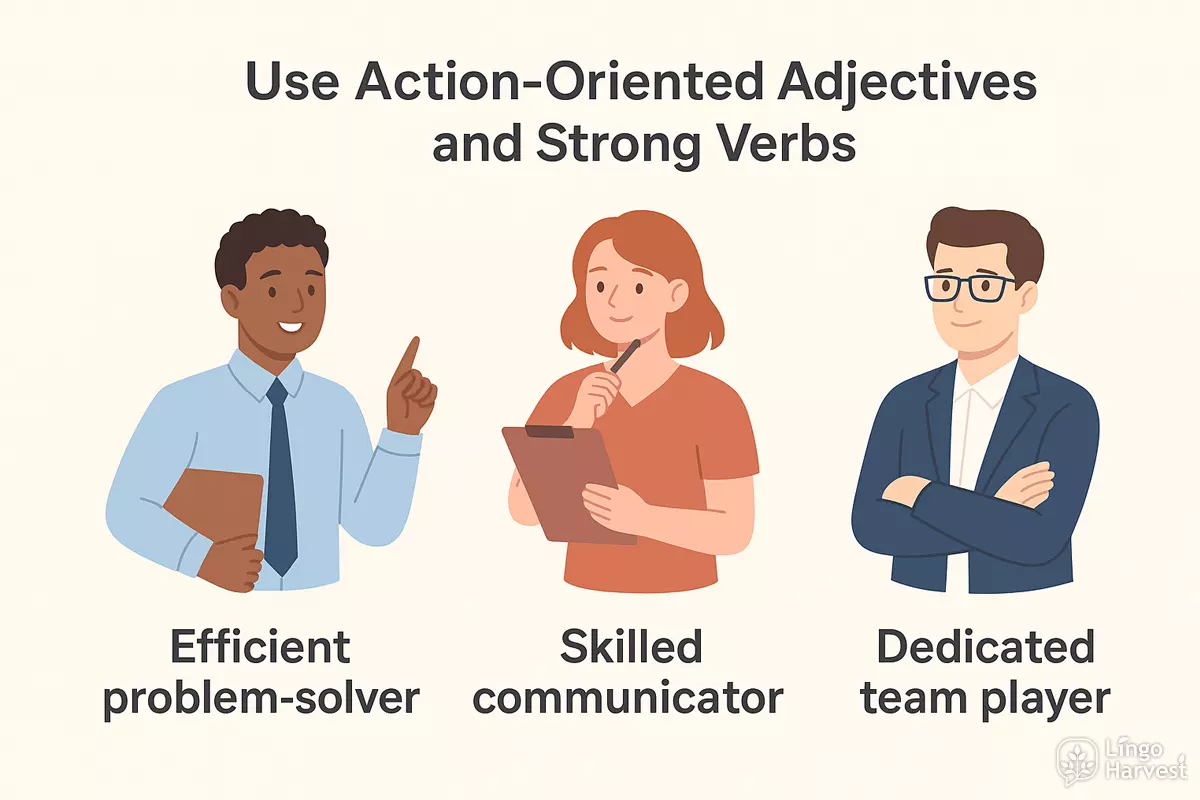
Pairing adjectives with dynamic verbs can make your responsibilities and results stand out. Consider these combinations:
- Efficient problem-solver
- Skilled communicator
- Dedicated team player
- Meticulous organizer
- Proactive leader
- Innovative thinker
- Reliable collaborator
- Analytical strategist
- Adaptable project manager
- Resourceful problem-solver
- Consistent high performer
- Results-driven specialist
- Supportive mentor
- Detail-oriented analyst
- Persuasive negotiator
- Dependable contributor
- Strategic planner
- Customer-focused representative
- Creative designer
- Motivated self-starter
Quantify Achievements Where Possible
Numbers and data add credibility and help the reader understand the scope of your accomplishments. For example:
- Increased sales by 20% in six months
- Managed a team of 8 people on a successful project
- Reduced processing time by 30% through workflow improvements
- Organized events attended by over 200 participants
- Trained 15 new employees in customer service protocols
Compare Vague and Clear Descriptions
Sometimes, the difference between a generic and a compelling CV entry is simply a matter of word choice. The table below highlights examples of unclear versus clear descriptions of skills and achievements:
| Vague Description | Clear, Specific Description |
|---|---|
| Worked on projects | Led three cross-departmental projects, meeting all deadlines |
| Good communication skills | Delivered persuasive presentations to clients, resulting in 4 new contracts |
| Responsible for sales | Consistently exceeded monthly sales targets by 15% |
| Helped customers | Provided prompt, effective solutions, earning 98% positive feedback |
| Did administrative work | Streamlined office procedures, reducing paperwork errors by 25% |
Tips for Effective Self-Presentation
- Start with a strong, relevant adjective that captures your approach or attitude.
- Follow with a specific skill or achievement, avoiding generic terms.
- Use numbers or results to add depth and proof.
- Tailor your language to match the requirements of the job.
- Keep your descriptions concise but informative—clarity is key.
Choosing impactful adjectives and backing them up with concrete examples will help your skills and achievements resonate with potential employers.
Examples from CV bullet points
When describing your achievements and responsibilities, the right adjective can help your application stand out. Adjectives clarify your strengths, highlight your approach, and show what makes your contributions unique. Here are some ways adjectives commonly appear in professional profiles and resumes.
Sample Adjectives in Action
- Led a dynamic team of five engineers on a complex software rollout.
- Developed an innovative marketing strategy that increased sales by 20%.
- Managed high-profile projects for international clients.
- Provided comprehensive training to new staff members.
- Streamlined inefficient administrative processes.
- Delivered consistent results in a fast-paced environment.
- Utilized advanced data analysis techniques to inform business decisions.
- Recognized for exceptional attention to detail.
- Offered timely solutions to customer issues.
- Maintained strict quality standards across all projects.
- Supported a diverse client base with tailored services.
- Played a key role in a successful product launch.
- Maintained positive relationships with vendors and partners.
- Introduced cost-effective measures that reduced expenses.
- Contributed creative ideas to team brainstorming sessions.
- Ensured reliable technical support for end users.
- Demonstrated proactive problem-solving abilities.
- Achieved outstanding customer satisfaction ratings.
Comparing Weak and Strong Adjective Use
Choosing the right modifier can make your statements more persuasive. Notice how stronger adjectives add impact compared to weaker or generic choices.
| Less Impactful | More Impactful |
|---|---|
| Worked on projects | Led complex projects |
| Helped customers | Delivered exceptional customer service |
| Did reports | Prepared detailed reports |
| Fixed problems | Provided innovative solutions |
| Worked in a team | Collaborated with a diverse team |
Tips for Using Adjectives Effectively
- Be specific: Choose words that accurately reflect your skills or achievements.
- Avoid overuse: Relying too heavily on adjectives can weaken your message.
- Match the job: Align your descriptions with the qualities sought in the job posting.
- Support with evidence: Whenever possible, back up adjectives with measurable results.
Selecting precise, relevant modifiers helps you communicate your value clearly and efficiently. By choosing your adjectives thoughtfully, you give employers a vivid sense of your professional strengths.
Practice: improve weak CV descriptions
Many CVs and job applications suffer from vague or generic statements that fail to showcase your real strengths. To stand out, it’s important to choose adjectives and action verbs that give a clear, powerful impression of your skills and achievements. Below, you’ll find examples of common weak phrases and strategies for rewriting them using more effective descriptive language.
Spotting Weak Descriptions
Phrases like "responsible for", "helped with", or "good communication skills" are often too broad. They don’t highlight your specific contributions or the impact you had in your role. Try to identify where your descriptions might be lacking detail or personality.
- Assisted with customer service → Provided attentive and proactive support to customers
- Worked on a team project → Collaborated in a cross-functional team to deliver a successful project
- Did office tasks → Efficiently managed administrative duties, improving office workflow
Adjectives to Enrich Your Descriptions
Incorporate adjectives that are specific and relevant to your field. Below is a list of adjectives you can use to strengthen your CV statements:
- Analytical → She takes an analytical approach to complex problems and identifies patterns quickly.
- Meticulous → He is meticulous and reviews every document for errors before submission.
- Proactive → She is proactive and starts preparing solutions before issues even arise.
- Resourceful → He is resourceful and always finds effective alternatives when tools are limited.
- Dynamic → She is dynamic and brings energy and creativity to every project.
- Dedicated → He is dedicated and consistently puts in extra effort to meet goals.
- Strategic → She develops strategic plans that align long-term goals with company priorities.
- Innovative → He is innovative and regularly suggests new ideas that improve workflow.
- Adaptable → She is adaptable and handles unexpected changes with ease.
- Efficient → He is efficient and completes tasks quickly without sacrificing accuracy.
- Detail-oriented → She is detail-oriented and spots issues others often miss.
- Results-driven → He is results-driven and focuses on measurable achievements and outcomes.
- Collaborative → She is collaborative and works well across different teams.
- Organized → He is organized and keeps all schedules, files, and tasks in perfect order.
- Versatile → She is versatile and takes on diverse tasks across multiple departments.
- Reliable → He is reliable and can always be counted on to deliver on time.
- Insightful → She provides insightful feedback that improves team decisions.
- Motivated → He is motivated and consistently pushes himself to grow and improve.
Practice Task: Rewrite Weak Statements
Try improving the following weak CV descriptions by adding specific adjectives and more precise language. Rewrite each one to make it stronger and more impressive:
- Worked in a shop
- Did reports for my manager
- Helped organize meetings
- Good at solving problems
- Responsible for social media
Show answers
- Provided attentive customer service and maintained organized displays in a busy retail environment.
- Prepared detailed and accurate reports for management, ensuring timely delivery of key information.
- Proactively coordinated and scheduled meetings, contributing to efficient team communication.
- Demonstrated strong analytical and creative problem-solving abilities in challenging situations.
- Managed engaging and effective social media campaigns to increase brand visibility.
Comparison Table: Weak vs. Improved Descriptions
| Weak Description | Improved Version |
|---|---|
| Did data entry | Accurately entered and maintained large volumes of data using advanced spreadsheet skills |
| Helped customers | Provided friendly and knowledgeable assistance, resolving customer issues efficiently |
| Organized files | Systematically organized and digitized records to enhance information retrieval |
| Worked on a project | Led a collaborative project team, delivering results ahead of schedule |
| Used Excel | Utilized advanced Excel functions to analyze and present complex data sets |
Review your own CV and look for opportunities to apply these techniques. Choose adjectives and verbs that truly reflect your strengths, and always aim for clarity and impact in your descriptions.