Modal Verbs Commonly Used in Professional Emails

 This article explains why modal verbs are common in professional emails, how they create polite requests and responses, and how they soften overly direct language. It gives examples with could, would, and may, shows how each changes tone, and includes rewrite exercises.
- Why modal verbs are common in professional email communication
- How modal verbs shape polite requests and responses
- Examples of email phrases with could, would, and may
- How modal verbs help avoid overly direct language in emails
- Situations where modal verbs clarify expectations or deadlines
- How tone changes depending on the modal verb chosen
- Exercises and practice activities rewriting email sentences with modal verbs
In workplace messages, the helping verbs you choose can make an email sound confident, polite, or too direct, so using them well matters. This article explains how can, could, would, and may shape requests, offers, and follow-ups in everyday situations. It focuses on tone and clarity so your meaning stays firm while your wording stays professional and easy to understand.
Why modal verbs are common in professional email communication
In workplace messages, writers often need to sound clear without sounding forceful. Modal verbs help manage that balance by adjusting certainty, politeness, urgency, and responsibility. They also make requests and recommendations easier to accept because the tone feels collaborative rather than commanding.
What modal verbs help you do in emails
- Soften requests so they read as professional and courteous: “Could you send the updated file?”
- Signal politeness without adding long explanations: “Would you mind confirming receipt?”
- Control directness when giving instructions: “You may proceed with the draft” vs. “Proceed with the draft.”
- Express uncertainty when information is incomplete: “The shipment might arrive on Friday.”
- Show reasonable confidence while leaving room for updates: “It should be ready by 3 PM.”
- Make suggestions that feel constructive, not critical: “We could simplify the timeline.”
- Offer help in a low-pressure way: “I can review the slides if helpful.”
- Ask for permission or confirm boundaries: “May I loop in Legal?”
- Set expectations and next steps: “We will share the notes after the meeting.”
- Indicate obligation when a requirement is real: “We must submit this by noon.”
- Reduce harshness in negative messages: “We may not be able to approve this today.”
- Frame risk and contingency planning: “Delays could occur if the vendor changes scope.”
- Negotiate timelines without sounding resistant: “We can deliver Monday, or we could deliver Friday with reduced scope.”
- Clarify rules and compliance: “You must complete the training before access is granted.”
Common patterns and where they appear
- Request + action: “Could you + verb…?” / “Would you + verb…?” (asking for a task)
- Permission + action: “May I + verb…?” / “Can I + verb…?” (checking if something is allowed)
- Offer + support: “I can + verb…” / “I could + verb…” (helping without pressure)
- Suggestion + option: “We could + verb…” / “We might + verb…” (proposing alternatives)
- Expectation + timeline: “It should + verb…” (setting a likely outcome)
- Requirement + policy: “We must + verb…” / “We have to + verb…” (stating non-negotiable obligations)
- Possibility + risk: “This may/might/could + verb…” (flagging uncertainty)
Choosing the right modal for the tone you need
- Could and would are common for polite requests, especially with people you do not manage directly.
- Can is straightforward and practical; it often sounds slightly more direct than could.
- May is more formal for permission and is useful in compliance-heavy contexts.
- Should works for recommendations and expected outcomes; it can sound judgmental if used to critique someone’s actions, so it is often paired with solutions.
- Must communicates strict obligation; use it when a deadline, policy, or safety requirement truly leaves no choice.
- Might signals uncertainty and is helpful when you want to avoid overpromising.
Mini examples: clearer tone with modals
- ✅ “Could you share the latest numbers by 2 PM?” → ❌ “Send the latest numbers by 2 PM.”
- ✅ “We might need to adjust the scope if the budget changes.” → ❌ “We will adjust the scope.” (when it is not certain)
- ✅ “You may proceed once Finance approves.” → ❌ “Proceed now.” (if approval is required)
- ✅ “We must submit the form today to meet the compliance deadline.” → ❌ “We should submit the form today.” (if it is mandatory)
How modal verbs shape polite requests and responses

In professional email, modal verbs help you control how direct or indirect a message feels. The same task (asking, requesting, declining, or confirming) can sound firm, neutral, or considerate depending on the modal you choose and the structure you attach it to.
Common patterns that soften requests
- Could you + base verb for a polite, standard request: “Could you share the updated timeline?”
- Would you + base verb for a slightly more formal tone: “Would you confirm receipt of the file?”
- Can you + base verb for a direct but still courteous ask (often internal teams): “Can you send the notes from the meeting?”
- May I + base verb to request permission (more formal): “May I schedule a follow-up call for Thursday?”
- Might I + base verb for extra deference (less common, very formal): “Might I ask for a brief extension?”
- Would it be possible to + base verb to reduce pressure: “Would it be possible to review this by Friday?”
- Could we + base verb to frame it as collaborative: “Could we align on the final scope today?”
- Would you mind + -ing to sound considerate (use carefully; it can feel wordy): “Would you mind forwarding this to the finance team?”
- Could you please + base verb to add courtesy; keep “please” once per request: “Could you please approve the draft?”
- Would you be able to + base verb to acknowledge constraints: “Would you be able to join for 15 minutes?”
- If you could + base verb to soften further (avoid stacking too many softeners): “If you could send the invoice today, that would help.”
- I’d appreciate it if you could + base verb for a grateful, formal request: “I’d appreciate it if you could confirm the attendee list.”
Choosing the right modal for tone and urgency
- Can focuses on ability and often reads as more direct; best for straightforward coordination and quick questions.
- Could adds distance and sounds more diplomatic; a safe default when writing to clients, senior stakeholders, or new contacts.
- Would works well for service-oriented requests and cooperation; it can feel more formal than “could” in some contexts.
- May signals permission and formality; useful when asking to proceed, share, or access something sensitive.
- Might is the most tentative; use it when you want to minimize pressure or when the request is a favor.
- Should expresses recommendation or expectation; use carefully because it can imply judgment: “You should…” may sound corrective.
- Must communicates obligation; reserve it for true requirements (policy, compliance) to avoid sounding harsh.
Response patterns that stay professional
- Accepting a request with “can/could”: “Yes, I can send that by 3 PM.” / “I could have it to you tomorrow morning.”
- Agreeing with “will/would”: “I will review and get back to you today.” / “I would be happy to take this on.”
- Offering options with “could”: “We could meet Wednesday afternoon or Thursday morning.”
- Making a careful commitment with “should”: “It should be ready by end of day.” (signals a likely outcome, not a guarantee)
- Declining politely with “won’t/can’t” plus an alternative: “I can’t join that call, but I can share feedback by email.”
- Deferring with “may need to”: “We may need to confirm with legal before we proceed.”
- Asking for clarification with “could”: “Could you clarify which version you’re referencing?”
- Setting boundaries with “would”: “I would prefer to keep this discussion in one thread.”
Common form pitfalls to avoid
- ✅ “Could you send the report?” → ❌ “Could you to send the report?” (no “to” after the modal)
- ✅ “Would you mind reviewing this?” → ❌ “Would you mind to review this?” (use -ing after “mind”)
- ✅ “May I ask a quick question?” → ❌ “May you…” (permission requests usually use “I/we”)
- ✅ “Could we reschedule?” → ❌ “Could we to reschedule?” (modal + base verb)
- ✅ “It should be ready tomorrow.” → ❌ “It should be ready yesterday.” (keep modals aligned with realistic time references)
Examples of email phrases with could, would, and may
In professional messages, these modals help you adjust tone: could often softens requests, would is useful for polite preferences and conditional phrasing, and may works well for permission and formal possibility. The patterns below show common sentence frames you can reuse and adapt.
Polite requests with could
- Could you please share the latest version of the document?
- Could you confirm whether the meeting is still scheduled for Thursday?
- Could you clarify which figures should be included in the report?
- Could you send the invoice to the billing address on file?
- Could you review the attached draft and let me know your feedback?
- Could we move the deadline to Friday to allow for final checks?
- Could we schedule a quick call to align on next steps?
- Could you let me know if there are any constraints we should consider?
- Could you advise on the best contact for this request?
- Could you update the ticket with the current status when you have a moment?
Preferences and conditional phrasing with would
- I would appreciate it if you could respond by end of day.
- Would you be able to join the call at 2:00 PM instead?
- Would you mind taking a look at the error message below?
- Would it be possible to add one more item to the agenda?
- I would recommend postponing the release until testing is complete.
- We would like to request access to the shared folder.
- If you would prefer, I can send a shorter summary.
- That would be helpful—thank you for checking.
- I would be grateful if you could confirm receipt of this email.
- Would you please forward this to the appropriate team?
Permission and formal possibility with may
- May I ask for a brief update on the timeline?
- You may reply directly to this email with any questions.
- May we proceed with the proposed approach?
- May I confirm the delivery address before we ship?
- Please note that the schedule may change due to availability.
- This issue may require additional approval from compliance.
- We may need to reschedule if the client is unavailable.
- May I share your contact details with the project lead?
- The attached file may be blocked by your security settings.
- May I request an extension until Monday?
Useful pattern notes (quick accuracy checks)
- Use could to soften a request: ✅ Could you send the file? ❌ Could you to send the file?
- Use would for polite questions and conditional tone: ✅ Would you be able to…? ❌ Would you can…?
- Use may for permission or formal possibility: ✅ May I…? / It may… ❌ May you please to…
- Combine modals carefully: prefer one main modal per clause (e.g., “I would appreciate it if you could…” works because each modal is in a different clause).
How modal verbs help avoid overly direct language in emails
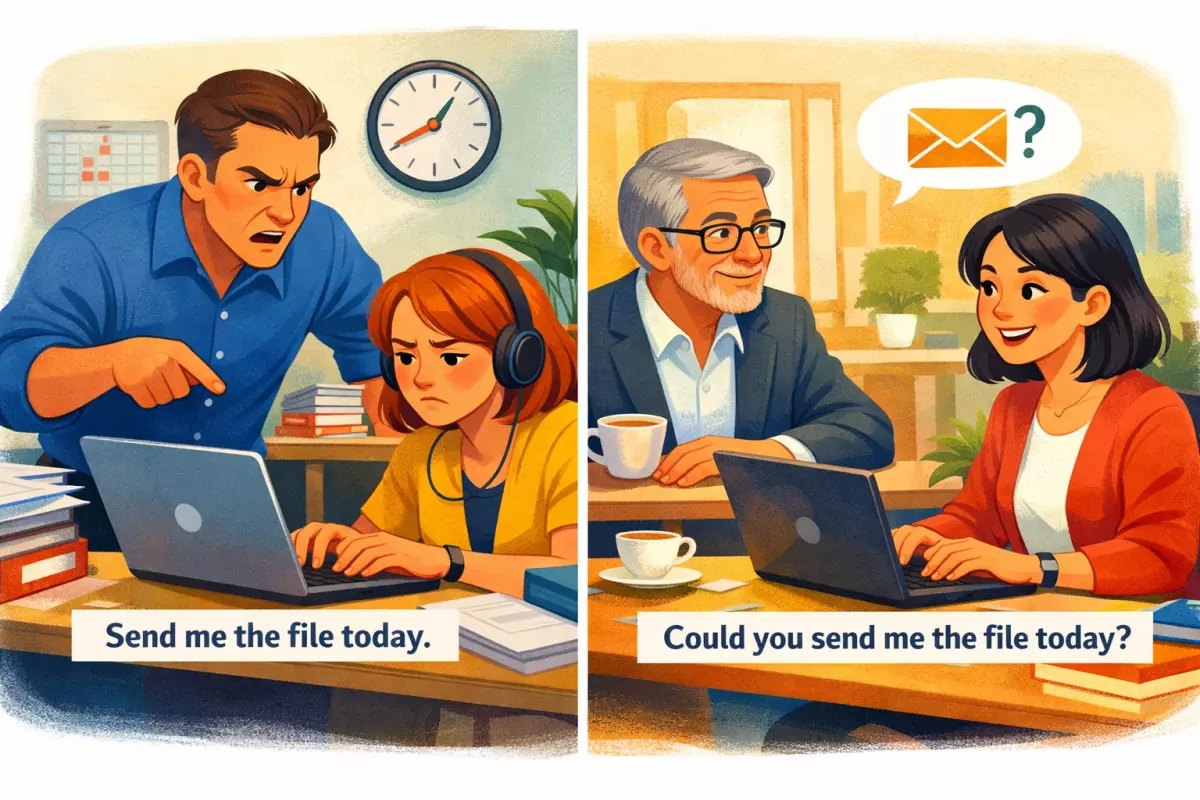
Modal verbs soften instructions and requests by adding choice, uncertainty, or conditionality. Instead of sounding like an order, the message reads as a professional suggestion or a polite ask. This is especially useful when you need action from someone who is busy, senior, or outside your team.
Common softening patterns (with practical rewrites)
- Use “could” to turn commands into requests: ❌ “Send me the file today.” → ✅ “Could you send me the file today?”
- Use “would” for polite, formal asks: ❌ “Explain your decision.” → ✅ “Would you be able to explain your decision?”
- Use “can” for simple, friendly requests: ❌ “Book the room.” → ✅ “Can you book the room?”
- Use “may” to add permission and formality: ❌ “I will call you at 3.” → ✅ “May I call you at 3?”
- Use “might” to reduce pressure when proposing: “We might consider moving the deadline to Friday.”
- Use “should” to give guidance without sounding absolute: “You should be able to access the folder now.”
- Use “would like” to express requests indirectly: “I would like to ask for an update on the timeline.”
- Use “could you please” for extra politeness (sparingly): “Could you please confirm receipt?”
- Use “can we” to share responsibility: “Can we review this together before sending?”
- Use “could we” to make collaboration feel optional, not forced: “Could we schedule 15 minutes to align?”
- Use “would it be possible” for sensitive requests: “Would it be possible to extend the deadline by one day?”
- Use “may I suggest” to introduce criticism tactfully: “May I suggest a shorter intro to keep the email focused?”
- Use “might be able to” to avoid overpromising: “I might be able to send a draft by end of day.”
- Use “should be” to soften certainty: “The report should be ready by Thursday.”
- Use “would you mind” for delicate asks (keep it short): “Would you mind sharing the final version?”
Where modals reduce friction most
- Delegating tasks: Choose “could/can” to request action without sounding like a directive.
- Chasing updates: Use “could you share” or “would you be able to update me” to keep the tone neutral.
- Disagreeing or correcting: “We might want to revisit…” or “Could we double-check…” signals cooperation.
- Setting expectations: “You should receive…” sounds helpful, while leaving room for exceptions.
- Making proposals: “We could…” and “We might…” invite discussion rather than forcing a decision.
Small grammar choices that change tone
- Question form is softer than statement form: “Could you review this?” is usually gentler than “You could review this.”
- Add a reason after the request: “Could you send the figures by 2 PM so I can finalize the slide?”
- Use conditional framing for constraints: “If you could send it by noon, that would help.”
- Avoid stacking too many softeners: “Would you possibly be able to maybe…” can sound hesitant; one modal is often enough.
- Match the modal to urgency: “Could you…” feels lighter; “Can you…” can feel more immediate; “Would you…” is more formal.
Situations where modal verbs clarify expectations or deadlines
When you need to set timelines, define responsibilities, or reduce ambiguity, modal verbs help you signal how firm a requirement is and what options exist. The key is matching the modal to the level of obligation (hard requirement vs. recommendation) and pairing it with time phrases, conditions, and next-step language.
Common workplace scenarios and the modal patterns that fit
- Requesting a deliverable by a specific date: Use could or would for polite requests; add a deadline phrase.
Example: “Could you send the revised draft by Thursday at 3 PM?” - Stating a non-negotiable deadline: Use must or need to to indicate a firm requirement.
Example: “We must submit the final version by 5 PM Friday.” - Assigning responsibility clearly: Use will for commitments and should for expected ownership.
Example: “Jordan will compile the feedback; I will update the deck.” - Confirming what someone is expected to do: Use should to express the standard expectation without sounding punitive.
Example: “You should receive the access invite within 24 hours.” - Setting a response-time expectation: Use please could / would for requests; use need to for urgent constraints.
Example: “Would you be able to confirm by end of day?” - Escalating urgency without sounding aggressive: Use need to + reason + time limit.
Example: “We need to finalize the attendee list today to meet the venue deadline.” - Clarifying optional vs. required steps: Use may / can for optional actions; must for mandatory ones.
Example: “You may add comments in the document, but you must approve the final change request.” - Setting conditions that change the deadline: Use can / could with “if” clauses to show dependency.
Example: “If we can get legal sign-off by Tuesday, we can publish on Wednesday.” - Offering a realistic timeline (without overpromising): Use should for likely outcomes; avoid will if there is uncertainty.
Example: “The updated report should be ready by tomorrow morning.” - Negotiating a deadline: Use could to propose alternatives and keep the tone collaborative.
Example: “Could we move the review to Monday, or do you need it this week?” - Creating a clear next step after a meeting: Use will for action items and by + time for precision.
Example: “I will send the minutes by 11 AM tomorrow.” - Preventing missed handoffs: Use should + sequence markers (“after,” “once,” “before”).
Example: “Once you submit the form, IT should activate the account within one business day.” - Communicating constraints or policies: Use must for compliance and cannot for prohibitions.
Example: “Invoices must include a PO number; we cannot process them without it.” - Following up on an overdue item: Use could / would plus a new concrete deadline; avoid vague “ASAP.”
Example: “Could you share the status update by 2 PM today?” - Reducing ambiguity in approvals: Use need / need to to specify what is required to proceed.
Example: “We need your approval by Wednesday to keep the launch date.”
Useful phrasing patterns that make timelines unambiguous
- Modal + action + deadline: “We need to confirm the numbers by noon.”
- Modal + action + reason + deadline: “We must lock the scope today to avoid rework.”
- Modal + action + time window: “You should receive the link within 30 minutes.”
- Modal + action + condition: “We can proceed if we can get sign-off by Tuesday.”
- Modal + action + fallback: “If you can’t join, could you send notes by end of day?”
- Commitment + checkpoint: “I will share a draft by Thursday and a final version on Friday.”
- Soft request + firm date: “Could you review this by Friday? If not, please suggest a time that works.”
To keep expectations clear, pair modals with specific time markers (“by 3 PM,” “before close of business,” “within two business days”) and avoid mixing signals (for example, pairing must with vague timing). When the situation is uncertain, prefer should or can and state the condition that affects the schedule.
How tone changes depending on the modal verb chosen
The modal you choose signals how much authority, urgency, and flexibility you’re bringing to a request or statement. In professional emails, small shifts (for example, can vs. could) can change a message from direct to diplomatic, or from tentative to firm.
Use the patterns below to match the relationship (peer, client, manager), the stakes (routine vs. time-sensitive), and the purpose (request, permission, suggestion, obligation, prediction).
- Can for straightforward ability or a practical request: “Can you send the updated file by 3 PM?” (efficient, neutral; can feel blunt in high-stakes situations).
- Could to soften requests and add politeness: “Could you share the updated file by 3 PM?” (more deferential; good for clients or first-time contacts).
- Would for courteous, service-oriented phrasing and preference: “Would you be able to review this today?” (polite and professional; often reads smoother than could in longer requests).
- Will to signal certainty or commitment: “I will send the draft by end of day.” (clear promise; can sound firm when used in requests: “Will you confirm receipt?”).
- May for formal permission or cautious possibility: “May I suggest an alternative approach?” (more formal; useful when you want to sound respectful and careful).
- Might for tentative possibility and low-pressure suggestions: “We might consider moving the meeting to Thursday.” (gentle; can sound indecisive if overused).
- Shall for traditional/formal proposals (less common in modern business email): “Shall we proceed with option B?” (can sound old-fashioned; works in some legal or UK-influenced contexts).
- Should for recommendations and expectations: “You should receive the confirmation shortly.” (helpful guidance; can sound judgmental if aimed at the reader: “You should have…”).
- Must for strong obligation and non-negotiable requirements: “All attendees must complete the form.” (authoritative; best for policy, compliance, safety, or deadlines that truly cannot move).
- Have to for practical necessity (often less harsh than must): “We have to submit this by Friday to meet the vendor’s cutoff.” (matter-of-fact; explains constraint).
- Need to for urgency with a collaborative tone: “We need to finalize the agenda today.” (direct but often reads as team-focused; still strong).
- Ought to for mild moral/expected action (rare in business email): “We ought to follow up with them.” (can sound informal or subjective; usually replace with should).
- Can’t / cannot for firm limits: “I can’t approve this without Finance’s sign-off.” (clear boundary; add a next step to keep it constructive).
- Couldn’t to soften a refusal or limitation: “I couldn’t approve this without Finance’s sign-off.” (less abrupt; may sound overly apologetic if repeated).
- Won’t to state refusal or a hard stop: “We won’t be able to extend the deadline.” (very firm; use carefully and ideally with a brief reason).
- Wouldn’t for tactful disagreement or to avoid sounding accusatory: “I wouldn’t recommend changing scope this late.” (professional caution; reduces confrontation).
Common tone patterns that readers notice
- Direct request: “Can you…?” / “Will you…?” → fastest, but can read as demanding without context.
- Polite request: “Could you…?” / “Would you…?” → adds respect and reduces pressure.
- Soft suggestion: “We might…” / “We could…” → invites discussion; useful for brainstorming.
- Recommendation: “We should…” → signals a preferred path without making it mandatory.
- Requirement: “We must…” / “We need to…” → communicates urgency or rules; best when truly necessary.
Small edits that change the feel without changing the meaning
- ✅ “Could you confirm by 2 PM?” (polite) → ❌ “Confirm by 2 PM.” (command-like without a relationship that supports it)
- ✅ “We need to decide today to meet the deadline.” (explains constraint) → ❌ “We must decide today.” (can sound abrupt if no context)
- ✅ “Would you be able to share an estimate?” (courteous) → ❌ “Can you share an estimate?” (fine, but less formal)
- ✅ “We might move the call to Thursday if that works.” (flexible) → ❌ “We will move the call to Thursday.” (sounds final)
Exercises and practice activities rewriting email sentences with modal verbs
Rewrite the sentences below to match the purpose (polite request, soft suggestion, obligation, or possibility). Focus on common email patterns such as modal + base verb, and modal questions (e.g., “Could you…?”). Keep the meaning, but adjust the tone.
1) Rewrite for polite requests (use could/would/can)
- Send me the updated slide deck today.
- Give me access to the shared drive.
- Reply by end of day.
- Move the meeting to Thursday.
- Tell me whether the client approved the quote.
- Check the attached file and confirm it’s correct.
Show answers
- Could you send me the updated slide deck today?
- Could you give me access to the shared drive?
- Would you be able to reply by end of day?
- Could we move the meeting to Thursday?
- Could you let me know whether the client approved the quote?
- Could you check the attached file and confirm it’s correct?
2) Rewrite to sound less direct (use might/could/may)
- This timeline is unrealistic.
- Your numbers are wrong.
- We can’t deliver that by Friday.
- This approach will not work.
- We need more information from your team.
- The report is missing key details.
Show answers
- This timeline might be difficult to meet.
- There could be an issue with the numbers.
- We may not be able to deliver that by Friday.
- This approach might not work as expected.
- We may need more information from your team.
- The report might be missing some key details.
3) Rewrite to express obligation and rules (use must/have to/need to)
- It is necessary to submit expenses by the 5th.
- It is required to use the new template.
- It is necessary for vendors to sign the NDA.
- It is required to reset your password every 90 days.
- It is necessary to get approval before contacting the client.
Show answers
- You need to submit expenses by the 5th.
- You have to use the new template.
- Vendors must sign the NDA.
- You have to reset your password every 90 days.
- We need to get approval before contacting the client.
4) Rewrite to make suggestions and next steps (use should/could/might want to)
- Schedule a quick call to align on scope.
- Review the contract language again.
- Add a short summary at the top of the email.
- Ask Finance to confirm the budget code.
- Send a calendar invite with an agenda.
- Follow up with the supplier tomorrow.
Show answers
- We could schedule a quick call to align on scope.
- You might want to review the contract language again.
- You should add a short summary at the top of the email.
- We could ask Finance to confirm the budget code.
- You should send a calendar invite with an agenda.
- We could follow up with the supplier tomorrow.
5) Pattern practice: choose the best modal for the intention
Rewrite each sentence twice: (A) very polite, (B) more direct but still professional. Use different modals in A and B.
- ___ you confirm receipt of this message?
- We ___ need to postpone the release due to testing.
- You ___ submit the form before access is granted.
- ___ we move forward with option B?
- I ___ be able to join after 3 p.m.
- We ___ review the risks before we commit.
Show answers
- (A) Could you confirm receipt of this message? (B) Can you confirm receipt of this message?
- (A) We might need to postpone the release due to testing. (B) We will need to postpone the release due to testing.
- (A) You will need to submit the form before access is granted. (B) You must submit the form before access is granted.
- (A) Could we move forward with option B? (B) Can we move forward with option B?
- (A) I might be able to join after 3 p.m. (B) I should be able to join after 3 p.m.
- (A) We should review the risks before we commit. (B) We must review the risks before we commit.
6) Quick checklist while rewriting
- Use modal + base verb: could send, would confirm, might need (not “could to send”).
- For requests, prefer question forms: “Could you…?” / “Would you…?”; add “please” only when it sounds natural.
- For uncertainty, choose might/could; for policy, choose must/have to/need to.
- To reduce bluntness, replace “is wrong” with “might be incorrect” or “could be off.”
- When setting expectations, “will need to” often sounds firm without being harsh.