Should Have vs Could Have vs Would Have Explained

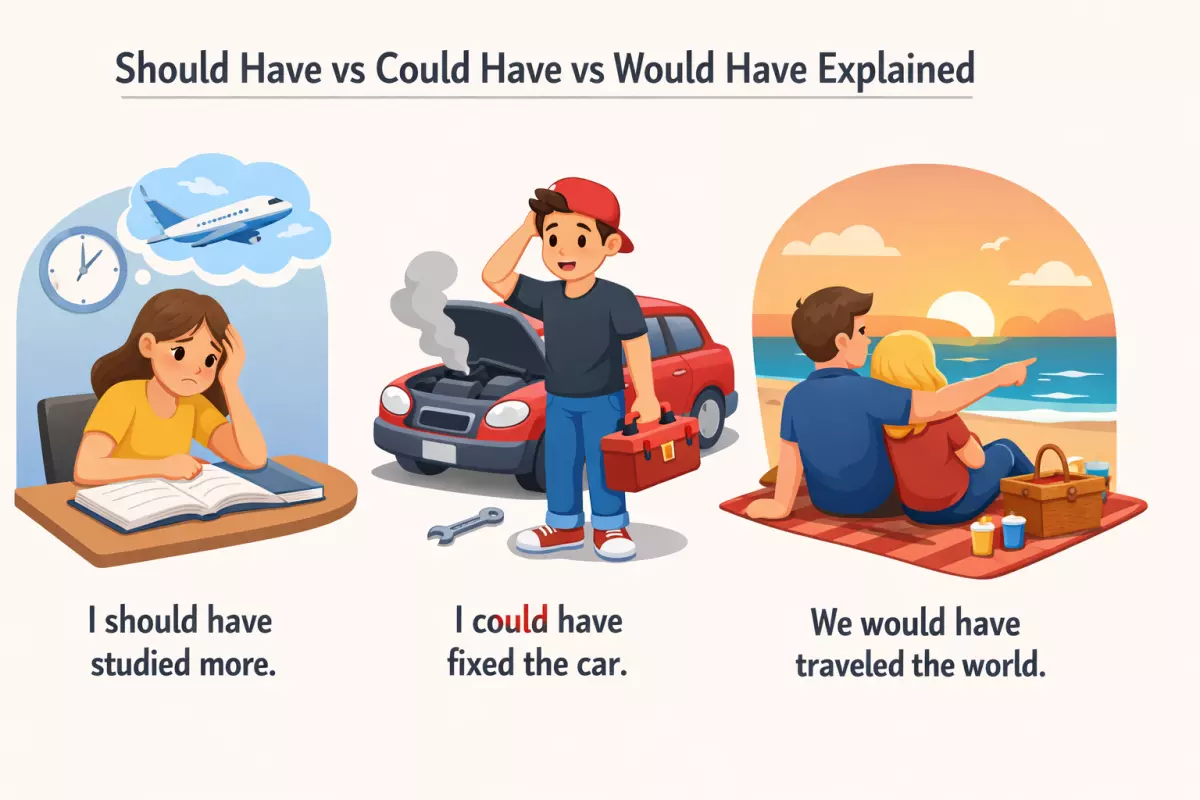 This article explains how modal perfect forms describe alternative past situations, what should have means when judging past actions, how could have points to missed possibilities or abilities, and how would have signals hypothetical past outcomes.
- How modal perfect forms describe alternative past situations
- The meaning of should have when judging past actions
- How could have highlights missed possibilities or abilities
- How would have appears in hypothetical past outcomes
- Sentence comparisons showing how the three forms change meaning
- Situations where speakers choose one modal perfect instead of another
- Exercises and practice activities comparing should have, could have, and would have
Confusing should have, could have, and would have can make talking about the past tricky, especially when you’re describing regrets, missed chances, or imagined outcomes. These forms clarify your meaning: should have expresses a judgment about what was right, could have shows an unused ability or possibility, and would have describes what you expected under certain conditions. With a few everyday examples in mind, choosing the right one becomes much easier.
How modal perfect forms describe alternative past situations
Modal + have + past participle is the standard pattern for talking about a past event that did not happen as described, or for judging a past situation from a later viewpoint. These forms often signal “an alternative past” (a different outcome, a missed chance, a past possibility, or a past prediction that didn’t come true).
Core form and what it implies
- Form: modal + have + past participle (V3) → should have done, could have done, would have done
- Time reference: the viewpoint is now (or later), but the action is earlier.
- Common implication: the speaker is not describing simple past facts; they are evaluating, imagining, or reconstructing what was possible or expected.
Three common meanings: obligation, ability/possibility, and hypothetical result
- Should have + V3 → past advice/expectation; often implies a mistake or regret.
- “You should have called earlier.” (Calling earlier was the better choice; you didn’t.)
- “I should have saved the file.” (Regret about a missed responsibility.)
- Could have + V3 → past ability or possibility; focuses on what was available as an option.
- “We could have taken the train.” (It was possible; we chose differently.)
- “She could have won.” (Winning was within reach, but didn’t happen.)
- Would have + V3 → hypothetical result or “future in the past”; often depends on a condition.
- “I would have helped if you’d asked.” (Help was conditional; the condition wasn’t met.)
- “They would have arrived on time, but traffic was terrible.” (Expected result blocked by a real past factor.)
Usage patterns that signal an alternative past
- With an if-clause (third conditional): if + past perfect → would/could/should have + V3
- “If I had known, I would have said something.”
- “If we had left earlier, we could have caught the show.”
- With “but” to show the blocker: would/could have + V3, but + past reason
- “I would have joined you, but I had a meeting.”
- “We could have finished, but the server crashed.”
- With “already / just / still” for timing nuance:
- “They should have already sent the invoice.” (Expectation not met by that time.)
- “I could have just stayed home.” (An easy alternative existed.)
- With “by + time” deadlines:
- “She should have been here by noon.” (Expectation about a deadline.)
- “We could have arrived by 8.” (Possible schedule, not achieved.)
Common learner errors (and fixes)
- ❌ “I should have went.” → ✅ “I should have gone.” (Use a past participle, not simple past.)
- ❌ “We could have to take a taxi.” → ✅ “We could have taken a taxi.”
- ❌ “If I would have known…” → ✅ “If I had known…” (In standard third conditional, the if-clause uses past perfect.)
- ❌ “He would have can help.” → ✅ “He could have helped.” / “He would have helped.” (Choose one modal; don’t stack modals.)
Expanded example set (quick pattern recognition)
- “You should have checked the address.” (missed responsibility)
- “I should have apologized sooner.” (regret)
- “They should have known better.” (criticism)
- “We could have booked online.” (unused option)
- “She could have told me.” (possible action not taken)
- “It could have been worse.” (alternative negative outcome avoided)
- “I would have stayed, but I felt sick.” (hypothetical blocked by a reason)
- “He would have agreed if the price was lower.” (conditional willingness)
- “The plan would have worked with more time.” (hypothetical evaluation)
- “If you had warned me, I could have prepared.” (condition enabling ability)
- “If we had listened, we would have avoided the mistake.” (condition enabling result)
- “You could have at least texted.” (possibility used for mild reproach)
- “I should have remembered your birthday.” (expectation)
- “They could have been delayed.” (possible explanation)
- “She would have passed, but she missed the exam.” (near-miss result)
The meaning of should have when judging past actions

Use should have to evaluate a past decision or event against an expected standard. It expresses that the “right” action (or a better outcome) did not happen, often with a sense of criticism, regret, or hindsight. The basic pattern is should have + past participle.
Core form and what it signals
- Form: should have + past participle (V3) → “should have called,” “should have studied,” “should have been.”
- Main meaning: a past obligation, expectation, or sensible choice that wasn’t met.
- Typical implication: the speaker judges the past action as wrong, careless, or suboptimal.
- Common contexts: advice after the fact, blame, self-criticism, reviews of mistakes, “lesson learned” statements.
Common usage patterns
- Criticizing a past action: “You should have checked the address before leaving.”
- Expressing regret: “I should have apologized earlier.”
- Pointing out a missed responsibility: “They should have paid the invoice on time.”
- Hindsight advice: “We should have booked tickets in advance.”
- Expectation about a past result: “The package should have arrived by Friday.”
- Passive voice for procedures/standards: “The form should have been signed by a supervisor.”
- With ‘already’ to stress lateness: “You should have already sent the email.”
- With ‘never’ for strong criticism: “You should never have said that in the meeting.”
- With ‘just’ to soften slightly: “You should have just told me the truth.”
- With ‘known’ for hindsight knowledge: “I should have known this would happen.”
Negative forms and their meanings
- shouldn’t have + past participle = the action happened, but it was a mistake: “I shouldn’t have shared that information.”
- should have not + past participle is possible but less natural than “shouldn’t have”: “You should have not ignored the warning” (more natural: “You shouldn’t have ignored the warning”).
- shouldn’t have been + adjective/noun = criticism of a past state: “He shouldn’t have been so rude.”
Examples (natural, everyday)
- “I should have brought a charger.”
- “You should have told me you were running late.”
- “She should have asked for clarification.”
- “We should have left earlier to avoid traffic.”
- “They should have backed up the files.”
- “The team should have practiced that scenario.”
- “He shouldn’t have interrupted the client.”
- “I shouldn’t have skipped breakfast.”
- “The report should have been reviewed before sending.”
- “The meeting should have started at 9.”
- “You should never have agreed to those terms.”
- “I should have listened more carefully.”
- “She shouldn’t have taken that risk.”
- “We should have confirmed the reservation.”
- “They shouldn’t have parked there.”
Frequent learner errors to avoid
- ❌ “I should have went.” → ✅ “I should have gone.”
- ❌ “She should has called.” → ✅ “She should have called.”
- ❌ “We should have to leave.” → ✅ “We should have left.”
- ❌ “You should have did it.” → ✅ “You should have done it.”
- ❌ “They should have been arrive by now.” → ✅ “They should have arrived by now.”
How could have highlights missed possibilities or abilities
Use could have + past participle to talk about an unreal past: a possibility that existed, an ability you had, or an alternative outcome that didn’t happen. It often suggests “it was possible, but it didn’t occur,” and the context decides whether the meaning is neutral (missed option) or critical (missed chance).
Core pattern
- Form: could have + past participle (V3) → could have gone, could have finished, could have been
- Time reference: past situations only (not present ability)
- Main idea: “It was possible/feasible then, but it didn’t happen.”
Common meanings in context
- Missed possibility (neutral): an option existed, but another option happened instead.
- Unused ability: someone had the capacity to do it, but didn’t use it.
- Near outcome: something almost happened, but circumstances prevented it.
- Counterfactual result: a different past result was possible under slightly different conditions.
- Soft criticism: implies a better choice was available (tone depends on wording).
Usage patterns that appear often
- With “but …” to contrast the unreal option with what really happened: “We could have left earlier, but we stayed.”
- With “if …” to show a condition that would have made it possible: “I could have helped if you had asked.”
- With time markers to anchor the past moment: “We could have met yesterday / last week / before the deadline.”
- With “easily / probably / possibly” to adjust certainty: “She could have easily won.”
- In questions to explore alternatives: “Could we have handled that differently?”
Examples (missed options and abilities)
- We could have taken the train, but we drove.
- I could have called you last night, but my phone died.
- They could have warned us earlier.
- She could have finished the report on time; she had all the data.
- He could have been a great teacher, but he chose a different career.
- The team could have won if they had defended better.
- You could have saved a lot of time by using the template.
- We could have avoided the traffic by leaving at six.
- I could have joined the meeting, but I was on a flight.
- The mistake could have caused a bigger problem, but it was caught early.
- She could have told the truth, yet she stayed silent.
- We could have asked for help; the support team was available.
- He could have learned faster with more practice.
- The project could have failed without that last-minute fix.
- I could have misunderstood your message.
- They could have been waiting outside the wrong entrance.
Frequent learner errors (and fixes)
- ❌ “could have went” → ✅ “could have gone” (use the past participle)
- ❌ “could had done” → ✅ “could have done”
- ❌ “I could have do it” → ✅ “I could have done it”
- ❌ “I could have done it yesterday” (when you mean you did) → use simple past: “I did it yesterday.”
Compared with should have (obligation/regret) and would have (hypothetical result), could have stays focused on feasibility in the past: what was possible or within someone’s ability, even if it never happened.
How would have appears in hypothetical past outcomes

Use would have + past participle to talk about an unreal past result: an outcome that did not happen because the past situation was different. It often follows (or is implied by) a condition, a missed opportunity, or a different decision.
Core pattern and what it signals
- Form: would have + past participle (would have gone, would have seen, would have finished).
- Main meaning: a hypothetical past consequence, not a real event.
- Common partner: an if-clause in the past perfect (If + had + past participle), or an implied condition.
- Typical logic: cause (unreal past) → result (would have + past participle).
Common sentence frames
- If + had + past participle, + would have + past participle.
✅ If I had known, I would have helped. - Would have + past participle + if + had + past participle.
✅ I would have helped if I had known. - Without / but for + noun, + would have + past participle.
✅ Without your advice, I would have made the same mistake. - Otherwise / or else + would have + past participle (condition is implied).
✅ We left early; otherwise we would have missed the train. - With more time/money/support, + would have + past participle.
✅ With more time, they would have finished the project.
Examples of hypothetical past results (varied contexts)
- If she had taken the earlier flight, she would have arrived before the storm.
- We would have bought the house if the inspection had gone better.
- He would have apologized, but he didn’t realize how upset you were.
- Without the map, we would have gotten lost in the old town.
- I would have called you, but my phone battery died.
- If they had trained properly, they would have won the final.
- The meeting would have started on time if the presenter had shown up.
- Otherwise, the package would have been returned to the sender.
- With clearer instructions, I would have completed the form correctly.
- If you had told me earlier, I would have changed my plans.
- She would have passed the exam if she had slept the night before.
- We would have stayed longer, but the hotel was fully booked.
- But for the traffic, they would have made it to the concert.
- If the weather had held, we would have eaten outside.
- The team would have launched sooner if funding had been approved.
Common mistakes to avoid
- Mixing time frames in the condition/result.
❌ If I knew, I would have helped. (past simple + would have)
✅ If I had known, I would have helped. - Using would have in the if-clause (in standard conditional grammar).
❌ If she would have studied, she would have passed.
✅ If she had studied, she would have passed. - Confusing a hypothetical result with a real past event.
✅ I would have gone (but I didn’t).
✅ I went (I actually did).
In short, this structure is the default way to express “that past outcome didn’t happen, but it was the expected result under different past conditions.” It’s especially common in explanations, regrets, and reasoning about how one change in the past could have led to a different ending.
Sentence comparisons showing how the three forms change meaning
These three modal-perfect patterns often talk about the past, but they do different jobs: should have evaluates (duty/regret), could have shows past possibility/ability, and would have expresses a hypothetical result or a past “future in the past.” The quickest way to see the difference is to hold the situation constant and swap the modal.
| Situation | Should have (judgment/regret) | Could have (possibility/ability) | Would have (hypothetical result / expected outcome) |
|---|---|---|---|
| Missed the train | I should have left earlier. | I could have caught it if I’d run. | I would have caught it if the bus had been on time. |
| Forgot to call | You should have called me. | You could have called me (you had the chance). | I would have helped if you’d called. |
| Exam preparation | I should have studied more. | I could have passed even without extra study (it was possible). | I would have passed if I had studied more. |
| Lost keys | I should have put them in my bag. | I could have left them at the office. | I would have found them sooner if I’d retraced my steps. |
| Bad weather plan | We should have checked the forecast. | We could have stayed home (that option existed). | We would have stayed home if we’d known it would storm. |
| Job application | You should have applied earlier. | You could have applied to more places. | You would have gotten an interview if your CV had been clearer. |
| Meeting delay | They should have told us about the delay. | They could have told us (they had time/means). | We would have waited at home if they’d told us. |
| Restaurant choice | We should have booked a table. | We could have gone somewhere else. | We would have eaten earlier if we’d booked. |
How to read the pattern changes
- Should have + past participle adds evaluation: it implies the “better” action was available, but didn’t happen (often regret, criticism, or advice about the past).
- Could have + past participle highlights that something was possible: it focuses on options/ability, not on what was morally or practically best.
- Would have + past participle typically needs a condition (stated or implied): it describes the result in an unreal past situation, or what was expected to happen.
Quick diagnostic questions
- If you mean “That was the right thing to do (but it didn’t happen),” choose should have.
- If you mean “It was possible / one option existed,” choose could have.
- If you mean “That would be the result if the past condition were different,” choose would have.
Situations where speakers choose one modal perfect instead of another
Speakers pick should have, could have, or would have based on what they want to highlight: obligation and criticism, possibility and ability, or a hypothetical result and its conditions. The time is past in all three; the difference is the speaker’s attitude toward that past event.
Common contexts and the modal perfect that fits best
- Giving a past recommendation (often with mild criticism) → use “should have”
Example: “You should have called me before you left.” - Saying something was the right thing to do, but it didn’t happen → “should have”
Example: “We should have booked earlier.” - Expressing regret about a past choice → “should have”
Example: “I should have taken that job.” - Blaming someone for a preventable mistake → “should have” (stronger tone)
Example: “He should have checked the address.” - Noting a missed opportunity or an option that existed → use “could have”
Example: “We could have taken the earlier train.” - Talking about past ability or capacity (it was possible for someone to do it) → “could have”
Example: “She could have solved it if she’d had more time.” - Speculating about a past possibility when you’re not sure what happened → “could have”
Example: “They could have missed the turn.” - Pointing out that a bad outcome was avoidable (without directly judging) → “could have”
Example: “That could have been avoided with a backup.” - Describing a hypothetical past result (the outcome in an unreal past scenario) → use “would have”
Example: “I would have helped, but I was out of town.” - Explaining a past decision with a condition (“but…”) → “would have”
Example: “We would have joined you, but we had tickets already.” - Third conditional patterns (if + past perfect → would have + past participle) → “would have”
Example: “If you had told me, I would have come.” - Predicting a past outcome from a past viewpoint (what you expected to happen) → “would have”
Example: “I thought the meeting would have ended by noon.” - Polite refusal or justification about the past → “would have”
Example: “I would have replied sooner, but my inbox was down.” - Comparing two past alternatives: duty vs option → “should have” vs “could have”
Example: “You should have apologized. You could have at least texted.” - Comparing option vs hypothetical outcome → “could have” vs “would have”
Example: “We could have driven, but it would have taken six hours.” - Responding to “Why didn’t you…?” questions
Use “should have” to accept fault: “I should have.”
Use “could have” to show it was possible: “I could have, but I didn’t think of it.”
Use “would have” to show willingness blocked by circumstances: “I would have, but I couldn’t.” - When “could have” is misunderstood as “didn’t”
“Could have” often implies the action did not happen, but the focus is on possibility: “I could have gone (but I didn’t).” - When “should have” sounds too harsh → soften with “could have”
Example: “You could have warned me” (suggestion) vs “You should have warned me” (stronger judgment). - When you want to avoid assigning responsibility → prefer “could have”
Example: “The file could have been deleted by accident.” - When you want to show intention or willingness, not just possibility → prefer “would have”
Example: “I would have stayed longer, but my ride arrived.”
Quick reminders that affect the choice
- “Should have” centers on what was advisable or expected; it often carries evaluation.
- “Could have” centers on available options, ability, or uncertainty about what happened.
- “Would have” centers on an unreal past result, usually tied to a condition (explicit or implied).
- ✅ “I would have gone if I had known.” ❌ “I could have gone if I had known.” (Possible, but it shifts focus from hypothetical result to mere possibility.)
Exercises and practice activities comparing should have, could have, and would have
Use the activities below to practice choosing the right modal perfect form for past situations. Focus on the pattern modal + have + past participle and the meaning: advice/criticism (should have), past possibility/ability (could have), and hypothetical result or willingness (would have).
1) Choose the best option (should have / could have / would have)
- I missed the early train. I ______ left the house five minutes earlier.
- We ______ taken a taxi, but we decided to walk to save money.
- She ______ told you, but she didn’t want to hurt your feelings.
- If you had called me, I ______ helped you with the move.
- He ______ been more careful with that glass; now it’s broken.
- They ______ won the match, but they made too many mistakes in the last set.
- I ______ gone to the meeting, but I was stuck in traffic.
- If I had known about the delay, I ______ stayed at home longer.
- You ______ backed up the files before updating the system.
- We ______ met earlier, but we didn’t know we were in the same city.
- She ______ accepted the offer, but the salary was too low.
- He ______ apologized, but he chose to ignore the issue.
Show answers
- should have
- could have
- could have
- would have
- should have
- could have
- could have
- would have
- should have
- could have
- could have
- could have
2) Match the meaning to the sentence
For each item, label it as A, B, or C.
- You should have checked the address before you left.
- I could have finished earlier, but the software kept crashing.
- I would have joined you, but I had a deadline.
- They should have listened to the warnings.
- She could have been an excellent lawyer; she’s very persuasive.
- We would have arrived on time if the bus hadn’t broken down.
- He could have called, but he didn’t.
- You should have worn a helmet.
- I would have said yes if I’d understood the terms.
- A = past advice/criticism (the “right” action wasn’t done)
- B = past possibility/ability (an option existed, but it didn’t happen or wasn’t certain)
- C = hypothetical past result/willingness (often with an if-clause)
Show answers
- A
- B
- C
- A
- B
- C
- B
- A
- C
3) Correct the form (modal + have + past participle)
Each sentence has a common error (wrong verb form, missing “have,” or incorrect modal). Rewrite it correctly.
- You should have went to the doctor.
- We could gone earlier, but we waited for Sam.
- If I knew, I would have told you yesterday.
- He would have helped if you asked him.
- She could have to called me.
- They should have been finish by now.
- I would have went, but I was exhausted.
- You should have to back up your phone.
- He could have fixed it, but he don’t have the tools.
- If you had told me, I could have came earlier.
Show answers
- You should have gone to the doctor.
- We could have gone earlier, but we waited for Sam.
- If I had known, I would have told you yesterday.
- He would have helped if you had asked him.
- She could have called me.
- They should have finished by now.
- I would have gone, but I was exhausted.
- You should have backed up your phone.
- He could have fixed it, but he didn’t have the tools.
- If you had told me, I could have come earlier.
4) Build your own sentences from prompts
Use each prompt to write one sentence. Keep the meaning in mind: “should have” for regret/criticism, “could have” for an unrealized option, and “would have” for an imagined past outcome.
- (missed deadline / plan better) → use should have
- (had time / didn’t take the course) → use could have
- (if / not raining / go for a walk) → use would have
- (forgot passport / check bag) → use should have
- (was able to / didn’t mention it) → use could have
- (if / you ask / I help) → use would have
5) Quick usage checklist for self-editing
- Use should have + past participle to judge a past choice: “You should have saved your work.”
- Use could have + past participle for a past option or uncertain past: “We could have taken the earlier bus.”
- Use would have + past participle for an unreal past result, often with a condition: “I would have gone if I’d been free.”
- Don’t drop have: ❌ “should went” → ✅ “should have gone.”
- Use a real past participle: “done,” “gone,” “seen,” “taken,” “written,” not the simple past.
- In conditional sentences, keep time consistent: “If I had known, I would have…” (not “If I knew, I would have…”).