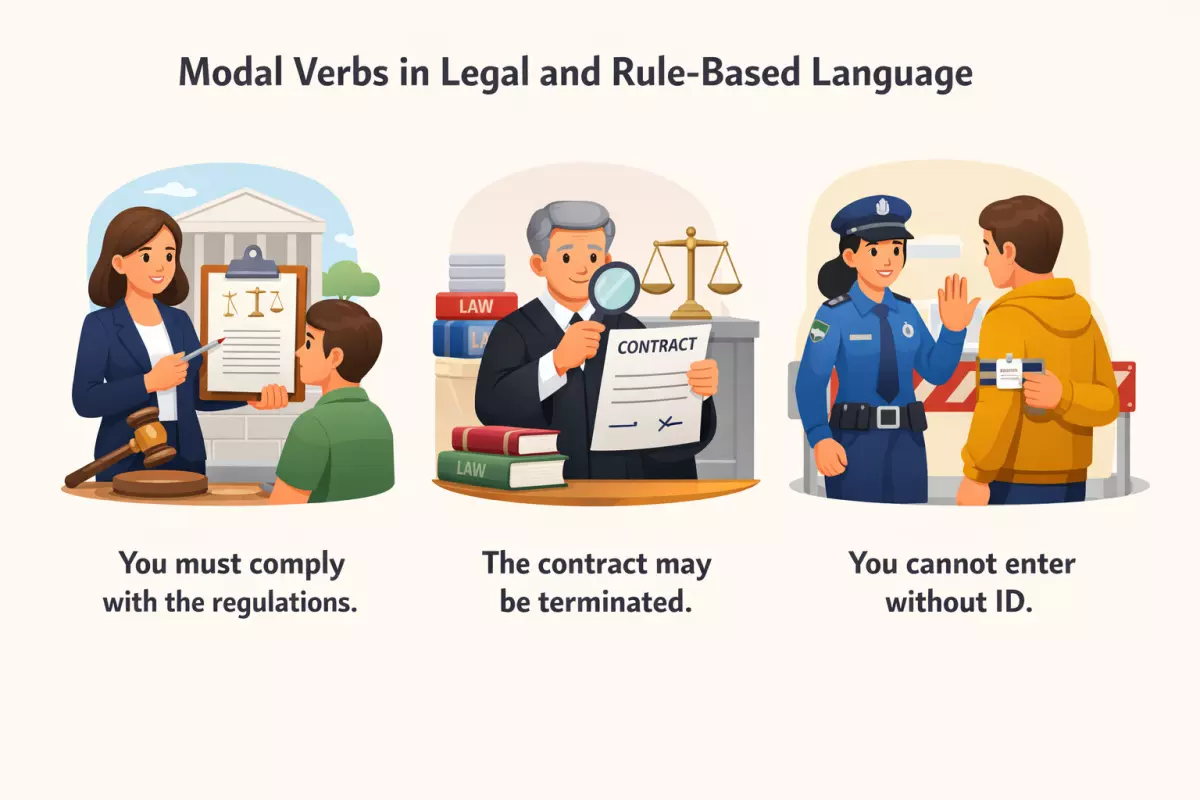
Modal Verbs in Legal and Rule-Based Language

 This article explains why legal and regulatory writing leans on modal verbs, which modals define rights, duties, and permissions, and how shall, must, and may can change interpretation. It shows examples where tiny modal shifts alter rules, plus practice exercises.
- Why legal and regulatory writing depends heavily on modal verbs
- Key modal verbs that define rights, duties, and permissions
- How verbs such as shall, must, and may affect legal interpretation
- Examples showing how small modal changes alter the meaning of a rule
- How modal verbs establish obligation or limitation in legal statements
- Situations where legal language relies on precise modal choice
- Exercises and practice activities analyzing modal verbs in rule-based language
In contracts and rulebooks, small helper verbs can quietly change what people are allowed, required, or forbidden to do, which is why this topic matters. If you have ever noticed that must feels stronger than should, or that may signals permission, you are already reading legal meaning. We will practice spotting these cues so you can interpret duties, rights, and limits with confidence in real situations.
Why legal and regulatory writing depends heavily on modal verbs
Rule-based texts need a compact way to express obligation, permission, prohibition, and conditional outcomes. Modal verbs do that work efficiently: they set the level of force behind a sentence and signal whether something is mandatory, optional, or merely possible. Because a small change in force can change legal effect, drafters rely on predictable modal patterns and try to keep them consistent across a document.
What modals do in rules: force, scope, and consequences
- Assign duties: using forms that create a binding requirement (most commonly must).
- Grant permission: allowing an action without requiring it (often may).
- Express prohibition: stating what is not allowed (e.g., must not).
- Describe conditions: linking a trigger to an outcome (e.g., “If X occurs, Y must follow”).
- Define authority: indicating who has power to decide or act (“The agency may…”).
- Limit discretion: distinguishing between optional choices and required steps (“may” vs “must”).
- Manage risk and uncertainty: indicating possibility rather than commitment (e.g., can, could in some drafting contexts).
- Control timing: pairing modals with time markers (“must within 30 days,” “may at any time”).
- Set standards of conduct: specifying what compliance looks like (“must maintain records”).
- Clarify exceptions: carving out cases where the main rule does not apply (“must… unless…”).
Common drafting patterns that rely on modals
- Rule statement: “A person must [do X].”
- Prohibition: “A person must not [do X].” (often preferred over “may not” when the intent is a ban)
- Permission: “A person may [do X].”
- Conditional duty: “If [condition], the person must [do X].”
- Conditional permission: “If [condition], the person may [do X].”
- Authority + process: “The regulator may [take action] after [notice/hearing].”
- Requirement + method: “The operator must [do X] by [method/standard].”
- Requirement + timeframe: “The applicant must submit [item] within [time period].”
- Exception structure: “A person must [do X], unless [exception].”
- Safe harbor: “A person is deemed compliant if they must/may [follow listed steps].”
- Cross-reference control: “The party must comply with section [Y].”
- Definition-like constraint: “For purposes of this rule, [term] must include…”
Modal choice affects interpretation
- Must is typically used for non-negotiable obligations; it signals that compliance is required, not recommended.
- May is typically used for discretion or permission; it signals that the actor is allowed to do something but is not compelled.
- Shall appears in many older statutes and contracts; in modern drafting it is often avoided because it can be read as future tense, a duty, or a condition depending on context.
- Should usually signals guidance or best practice rather than a binding rule; in enforceable texts it can create ambiguity about whether a duty exists.
- Can often describes capability or factual possibility; when used as permission it can blur whether the text is granting authority or stating capacity.
Consistency reduces ambiguity
- Use one modal for one function across the document (e.g., “must” for duties, “may” for discretion) so readers do not have to infer shifting levels of force.
- Avoid mixing modals that compete in meaning (e.g., “may” and “shall” for the same kind of requirement) unless the difference is intentional and explained by structure.
- Place the modal close to the main verb and keep conditions clearly bracketed (“If…,” “unless…,” “only if…”) so the scope of the obligation is easy to track.
- Prefer direct negative forms for bans: ✅ “must not” ❌ “may not” (when the goal is to clearly express prohibition rather than lack of permission).
Key modal verbs that define rights, duties, and permissions

Legal and rule-based writing relies on a small set of modal verbs to signal whether something is mandatory, allowed, prohibited, or merely possible. The choice of modal affects enforceability, so many drafting systems restrict which modals are acceptable and how they should be interpreted.
-
Must (obligation; non-optional duty)
Use must to impose a binding requirement on the subject. It is the clearest way to express a duty and is commonly preferred over “shall” in modern drafting.
- Pattern: Subject + must + base verb (no “to”): “The tenant must pay rent on the first day of each month.”
- For conditions: “If the system fails, the operator must notify the administrator within 1 hour.”
- Common pitfall: avoid weakening with softeners like “must try to” unless the duty is genuinely only to attempt.
-
Must not / may not (prohibition)
Use must not for a clear ban. May not is also used for prohibition in many rule sets, but it can be misread as “might not” in general English, so some drafters avoid it unless the document defines it.
- ✅ “Users must not share passwords.” → unambiguous prohibition
- ✅ “A bidder may not withdraw the offer after submission.” → prohibition by rule (ensure context makes it clear)
- ❌ “A bidder may withdraw…” when the intent is to prohibit withdrawal
-
May (permission; discretionary power)
Use may to grant permission or discretion. It signals that the actor is allowed to do something but is not required to do it.
- Pattern: “The authority may grant an extension.” (discretion)
- Permission with limits: “The customer may cancel within 14 days, provided that the goods are unused.”
- Drafting tip: when discretion is intended, avoid pairing “may” with language that sounds mandatory (for example, “may … and shall …” in the same sentence) unless carefully structured.
-
Shall (traditional duty; sometimes future or entitlement)
Shall is widely used in older contracts to impose obligations, but it is also used to indicate future actions or to state how a document operates. Because it can carry multiple meanings, many style guides limit it or replace it with “must” (duty) and the present tense (statements of operation).
- Duty use (traditional): “The supplier shall deliver the goods by 30 June.”
- Document operation: “This agreement shall terminate upon written notice.” (often clearer as “terminates”)
- Entitlement framing: “The employee shall be entitled to…” (often clearer as “is entitled to”)
-
Should (recommendation; expectation; non-binding guidance)
Use should for guidance, best practice, or an expected course of action that is not strictly enforceable. In compliance contexts, “should” can create ambiguity if readers treat it as mandatory.
- Guidance: “Reports should include supporting documentation.”
- Expectation: “The parties should attempt to resolve disputes informally.”
- Clarity check: if noncompliance triggers a penalty, replace “should” with “must.”
-
Can (capability or practical possibility; sometimes informal permission)
Can usually describes ability or capacity, not legal permission. In rules, it is sometimes used informally to mean “is allowed to,” but that can blur the line between what is possible and what is permitted.
- Capability: “The device can store up to 1,000 records.”
- ❌ Permission ambiguity: “Members can vote online.” (Is it allowed, or merely technically possible?)
- ✅ Clear permission alternative: “Members may vote online.”
-
Will (future action; promise; operational certainty)
Will is used for future events, commitments, or statements about what a system or party is expected to do. It is not the standard modal for imposing a duty, because it can read as prediction rather than requirement.
- Commitment: “The provider will issue a refund within 10 business days.”
- System behavior: “The application will log all access attempts.”
- Enforceability check: if the intent is a strict obligation, consider “must” instead of “will.”
-
Need not (absence of obligation)
Need not indicates that an action is not required. It is useful when a rule removes a duty in a defined situation.
- Pattern: “Applicants need not submit original documents.”
- Conditional relief: “If payment is made electronically, the customer need not provide a receipt.”
- Alternative phrasing: “is not required to” can be clearer for some audiences.
-
Ought to (rare; moral or normative expectation)
Ought to expresses a strong recommendation or moral expectation, but it is uncommon in formal legal drafting because it can sound subjective and may not map neatly to enforceable duties.
- Normative guidance: “Officials ought to avoid conflicts of interest.”
- Drafting caution: if the document is intended to be enforceable, “should” (guidance) or “must” (duty) is usually more precise.
-
Common drafting patterns that reduce ambiguity
Consistency matters more than variety. Many rule sets adopt a small “modal vocabulary” and apply it predictably across the document.
- Obligation: “A must do X” rather than “A shall do X” mixed with “A will do X.”
- Permission: “A may do X” rather than “A can do X” when the intent is authorization.
- Prohibition: “A must not do X” rather than relying on context-dependent negatives.
- Guidance: “A should do X” only when noncompliance does not create breach or penalty.
- Define modals if needed: a definitions section can specify that “may” is discretionary and “must” is mandatory, especially in technical policies.
How verbs such as shall, must, and may affect legal interpretation
Modal verbs often determine whether a sentence creates a duty, grants discretion, or simply predicts what will happen. Courts and regulators commonly treat these words as signals of legal effect, so small drafting choices can change who is required to do what, when, and with what consequences.
Common legal meanings and drafting patterns
- “Must” typically expresses an obligation: it sets a mandatory requirement and is read as leaving no discretion.
- “Shall” is traditionally used to impose a duty, but it is also a frequent source of ambiguity because it is sometimes used to mean “will,” “may,” or “is entitled to.”
- “May” usually grants permission or discretion: it authorizes an action but does not require it.
- “May not” generally creates a prohibition (not permitted). In some contexts, drafters mistakenly use it to mean “might not,” which can confuse whether the rule is banning conduct or describing possibility.
- “Should” often indicates a recommendation or expectation rather than a binding duty, unless the surrounding scheme clearly treats it as mandatory.
- “Will” is best reserved for statements of future action or commitment (often in contracts), not for imposing duties on the other party.
- “Can” signals capability or factual possibility, not legal permission; using it for authorization can weaken enforceability.
- Condition + modal (“If X occurs, the party must…”) narrows the duty to a triggering event and helps avoid overbreadth.
- Exception + modal (“A party must…, except that it may…”) creates a baseline obligation with a defined carve-out; unclear placement of exceptions is a common dispute driver.
- Subject clarity matters: “The report must be filed” can invite argument over who must file it; “The Licensee must file the report” is harder to evade.
- Time words + modal (“must within 10 days”) usually create enforceable deadlines; vague timing (“promptly,” “as soon as practicable”) introduces interpretive flexibility.
- Consequences language strengthens mandatory rules: pairing “must” with an explicit consequence reduces debate about remedies (“If the party fails to…, the other party may…”).
- Mixing modals in one sentence can blur meaning (“shall and may” together); separating duties and permissions into distinct sentences is clearer.
- Passive voice can dilute accountability (“must be delivered”); active voice with a named actor reduces interpretive room.
Side-by-side comparison of typical legal readings
| Modal verb | Typical legal effect | Drafting risk | Example pattern |
|---|---|---|---|
| Must | Mandatory duty (requirement) | Low ambiguity, but can be overbroad if triggers/exceptions are unclear | The Contractor must maintain insurance during the Term. |
| Shall | Often treated as mandatory, but meaning varies by context and jurisdiction | High ambiguity (duty vs. future tense vs. entitlement) | The Contractor shall maintain insurance during the Term. |
| May | Permission or discretion (authorization) | Disputes when parties expect a duty; “may not” can be misread as possibility | The Customer may terminate upon 30 days’ notice. |
| Should | Recommendation or expectation | Unclear enforceability unless the document treats it as binding | The parties should attempt to resolve disputes informally. |
| Will | Future action/commitment; prediction | Weak for imposing duties on another party; can be read as descriptive | The Supplier will provide monthly status reports. |
Interpretation pitfalls to watch for
- “Shall” used for entitlement: “The tenant shall have the right to…” is often clearer as “The tenant may…” or “The tenant is entitled to…,” depending on whether discretion exists.
- “May” used when a duty is intended: If performance is required, “may” invites the argument that the actor can choose not to perform.
- Negatives and scope: “A party may not disclose…” (prohibition) is different from “A party is not required to disclose…” (no duty). Keeping these distinct avoids disputes.
- Conflicting clauses: A general “must” clause can be undermined by a later “may” clause unless the hierarchy is explicit (for example, “Notwithstanding Section X…”).
- Remedies vs. permissions: “The non-breaching party may terminate” grants an option; it does not automatically terminate the agreement. If automatic termination is intended, the clause needs that mechanism stated.
Examples showing how small modal changes alter the meaning of a rule

In legal drafting and rule-based writing, swapping one modal verb for another can change a sentence from mandatory to optional, from permission to prohibition, or from a firm duty to a weaker expectation. The examples below highlight common patterns where a small change creates a large shift in legal effect.
| Modal change | How the rule’s force changes | Example pair (A → B) |
|---|---|---|
| shall → may | Obligation becomes discretion (duty → option). | A: “The tenant shall pay rent on the first day of each month.” → B: “The tenant may pay rent on the first day of each month.” |
| must → should | Hard requirement becomes recommendation; enforcement becomes less clear. | A: “Users must reset their password every 90 days.” → B: “Users should reset their password every 90 days.” |
| may → may not | Permission becomes prohibition; a single “not” flips the rule. | A: “Employees may work remotely on Fridays.” → B: “Employees may not work remotely on Fridays.” |
| can → may | Ability/capacity becomes permission/authorization (capability → legal allowance). | A: “The system can store biometric data.” → B: “The system may store biometric data.” |
| will → shall | Prediction or statement of future conduct becomes a binding duty. | A: “The supplier will deliver within 10 days.” → B: “The supplier shall deliver within 10 days.” |
| must → will | Requirement becomes a description of expected behavior; remedies may weaken. | A: “The contractor must maintain insurance.” → B: “The contractor will maintain insurance.” |
| shall → should | Mandatory language becomes advisory; compliance may become arguable. | A: “Notices shall be sent by registered mail.” → B: “Notices should be sent by registered mail.” |
| may → must | Discretion becomes obligation; the actor loses choice. | A: “The agency may inspect records.” → B: “The agency must inspect records.” |
| must → may (with “only if”) | Duty becomes conditional permission; the condition shifts from trigger to gate. | A: “You must submit ID before entry.” → B: “You may enter only if you submit ID.” |
| must not → may not | Both prohibit, but “must not” is typically clearer as a strict ban. | A: “Participants must not share exam content.” → B: “Participants may not share exam content.” |
| may → is entitled to | Permission/discretion becomes a right of the subject (stronger claim). | A: “A customer may request a refund within 14 days.” → B: “A customer is entitled to a refund within 14 days.” |
| should → is required to | Best practice becomes enforceable obligation. | A: “Drivers should report accidents immediately.” → B: “Drivers are required to report accidents immediately.” |
Usage patterns to watch for when revising a rule
- Obligation vs. discretion: “must/shall” typically imposes a duty; “may” usually grants a choice. Replacing one with the other changes who controls the outcome.
- Permission vs. capability: “can” often describes what is possible, not what is authorized. If the sentence is about legal permission, “may” is usually the clearer fit.
- Prohibition strength: “must not” is often read as a strict ban; “may not” can also prohibit, but in some contexts readers confuse it with “might not.”
- Predictions vs. commitments: “will” can read like a forecast or policy statement. If the intent is a binding requirement, use a duty form rather than a future-tense feel.
- Softening effects: “should” signals guidance. If enforcement, audits, penalties, or breach findings depend on the sentence, a recommendation may be too weak.
- Conditional framing: “must do X before Y” and “may do Y only if X” can point to similar behavior but allocate power differently (a prerequisite duty vs. a gate to permission).
- Hidden discretion: Adding “may” to an enforcement clause (“The authority may impose a fine”) can convert an expected consequence into an optional one.
- Scope creep through modals: “may” paired with broad verbs (“may use,” “may access”) can unintentionally widen permissions unless narrowed by conditions or defined terms.
How modal verbs establish obligation or limitation in legal statements
Legal drafting uses modal verbs to set the force of a rule: whether something is mandatory, permitted, prohibited, or conditional. Small shifts in modality can change who must act, when they must act, and what exceptions apply, so patterns are typically kept consistent within a document.
Core modals and what they typically signal
| Modal / construction | Typical legal effect and drafting notes |
|---|---|
| shall | Traditionally used for obligation, but often avoided in modern drafting because it can be read as future tense or as a weak directive. If used, keep it strictly for duties imposed on a party. |
| must | Clear obligation. Common in modern rules and policies for non-discretionary requirements. |
| may | Permission or discretion. Use when the actor is allowed, but not required, to do something. |
| may not | Prohibition in many drafting styles, but can be misread as “might not.” For strict bans, many drafters prefer “must not.” |
| must not | Unambiguous prohibition. Useful for compliance rules and safety constraints. |
| should | Recommendation or expectation, not a binding duty unless the document explicitly defines it as mandatory. Use carefully in enforceable texts. |
| will | Often used for statements of future action or policy intent; can also indicate a party’s undertaking in contracts, but may be less forceful than “must.” |
| is/are required to | Obligation phrased without a modal. Can be useful to avoid debates over “shall,” but still needs a clear actor and condition. |
Common patterns that create obligation
- Actor + must + base verb: “The Licensee must maintain records for five years.”
- Actor + is required to + base verb: “The Contractor is required to provide proof of insurance.”
- Condition + actor + must: “If the device fails inspection, the Operator must remove it from service.”
- Time limit + must: “The Applicant must respond within 10 business days.”
- Single duty, single sentence: one obligation per clause reduces disputes about scope and sequencing.
- Defined trigger events: obligations become clearer when tied to an event (“upon receipt,” “after notice,” “before shipment”).
- Explicit responsible party: avoid passive voice that hides the actor (✅ “The Supplier must…” ❌ “Records must be kept…”).
- Exhaustive vs. minimum duties: use “must include” for required elements; use “at a minimum” only when additional items are allowed.
Patterns that impose limits, prohibitions, or boundaries
- Actor + must not + base verb: “Employees must not disclose confidential information.”
- No-permission framing: “A user may not access restricted areas without authorization.” (ensure the document’s style guide treats “may not” as prohibition).
- Scope limiters: “may only,” “must only,” and “shall only” narrow the permitted action: “The Agency may only use the data for auditing.”
- Purpose limits: “solely for,” “only to the extent necessary,” and similar phrases constrain use even when an action is allowed.
- Quantity and threshold limits: “must not exceed,” “may not exceed,” “no more than,” “at most.”
- Location or channel limits: “must be submitted via the portal,” “may be delivered by courier only.”
- Exception structure: “must not … unless …” creates a default ban with a carve-out; ensure the exception conditions are precise.
- Reservation of discretion: “may, in its sole discretion,” signals broad choice; define any required factors if discretion is meant to be reviewable.
Drafting choices that reduce ambiguity
- Keep “may” for permission and “must” for duty: mixing them for the same type of rule invites arguments about enforceability.
- Avoid “shall” unless the document defines it: if retained, use it consistently and only for mandatory duties, not for predictions or descriptions.
- Be careful with “should”: it often reads as guidance, not a requirement; use it for best practices, not compliance triggers.
- Place conditions up front when they are essential: “If X, the party must Y” makes the trigger harder to miss than burying it at the end.
- Use parallel grammar for parallel rules: consistent modal choice across similar clauses helps readers interpret strength uniformly.
- Define permission boundaries explicitly: when granting discretion (“may”), add limits (time, purpose, process) if the discretion is not intended to be open-ended.
- Separate duty from remedy: state the obligation with the modal, then state consequences in a separate clause to avoid muddling meaning.
Situations where legal language relies on precise modal choice
In legal and rule-based writing, modal verbs do more than signal tone; they allocate duties, grant permissions, set conditions, and define consequences. Small shifts (for example, from must to may) can change whether a clause is mandatory, optional, or merely descriptive.
Common drafting situations where the modal carries legal weight
- Creating an obligation (non-negotiable duty): Use must to impose a requirement on a party or system. Avoid shall unless your drafting convention defines it clearly and uses it consistently.
- Stating a prohibition: Use must not for clear bans. Prefer it over may not, which can be read as either “is not permitted to” or “might not.”
- Granting permission or discretion: Use may when a party is allowed, but not required, to act (discretion). This is common in administrative powers, optional remedies, and configurable system behavior.
- Expressing entitlement (a right): Use patterns like “A party may request…” or “A party is entitled to…” depending on whether the right is automatic or conditional. If approval is required, clarify who decides.
- Setting conditions (triggering rules): Use may carefully in conditional clauses. “If X occurs, Y may terminate” signals a choice; “If X occurs, Y must terminate” signals an automatic result.
- Defining prerequisites for validity: Use must to mark conditions that have to be satisfied for something to be effective (e.g., “Notice must be in writing”). Pair with timing and delivery details to reduce disputes.
- Allocating responsibility in procedures: Use must to assign who performs each step (“The Registrar must issue a receipt within 5 days”). Avoid passive voice when it hides the actor.
- Handling exceptions and carve-outs: Use “must … unless …” for a default rule with a narrow exception. Use “may … only if …” to restrict discretion to defined circumstances.
- Describing future events vs. imposing duties: Use will for predictions or statements of future fact (“The system will generate a log file”), not to create obligations. If it is a requirement, use must.
- Stating internal policy vs. enforceable rules: Use should for guidance or best practice, not for binding terms. If noncompliance has consequences, the clause usually needs must.
- Defining standards of performance: Use “must be” for objective requirements and “should” for targets. If a standard is subjective, specify who assesses it and by what criteria.
- Specifying timelines and deadlines: Pair modals with time expressions. “The supplier must deliver within 10 days” is enforceable; “The supplier should deliver within 10 days” is typically aspirational.
- Creating remedies and enforcement options: “The customer may terminate” grants a remedy; “The customer must terminate” is unusual and should be used only when termination is compulsory (e.g., compliance triggers).
- Limiting authority: Use “may … only …” to confine a power to specific grounds. Without “only,” a reader may argue the list is illustrative rather than exhaustive.
- Interpreting “shall” in legacy clauses: If shall appears, determine whether it functions as obligation, future tense, or entitlement. Rewrite to must, will, or “is entitled to” to remove ambiguity.
Quick contrasts that frequently cause disputes
- ✅ “The tenant must pay rent on the first day of each month.” → duty
❌ “The tenant shall pay…” (can be read inconsistently across documents and jurisdictions) - ✅ “The user must not disclose credentials.” → prohibition
❌ “The user may not disclose…” (can be misread as uncertainty) - ✅ “The authority may issue a permit if the criteria are met.” → discretion remains
✅ “The authority must issue a permit if the criteria are met.” → mandatory outcome - ✅ “The system will display an error message when validation fails.” → descriptive behavior
✅ “The system must display…” → compliance requirement
When choosing a modal, match it to the legal function: obligation (must), prohibition (must not), permission/discretion (may), recommendation (should), and prediction or declared future behavior (will). Then reinforce the choice with clear actors, conditions, and time limits so the rule reads the same way to every reader.
Exercises and practice activities analyzing modal verbs in rule-based language
Focus on what the modal is doing in the rule: imposing an obligation, granting permission, setting a condition, stating a recommendation, or describing capability. In legal and policy drafting, small shifts (for example, must vs. should) can change whether a sentence reads as binding or merely advisory.
1) Identify the rule force (obligation, permission, prohibition, discretion)
- Label each modal as: obligation, prohibition, permission, discretion, or recommendation.
- Then underline the actor (who must/ may do it) and circle the action (what must/ may happen).
- Finally, note any condition introduced by if, unless, until, or provided that.
- The applicant must submit the form within 10 days of receipt of the notice.
- Employees may request remote work up to two days per week.
- The contractor must not disclose confidential information to third parties.
- The agency may extend the deadline if the delay results from a system outage.
- Members should report suspected fraud promptly.
- Visitors shall present identification at the security checkpoint.
- A licensee may not operate after the permit expires.
- The board can convene an emergency meeting on 24 hours’ notice.
Show answers
- Obligation
- Permission
- Prohibition
- Discretion (conditional permission exercised by the agency)
- Recommendation
- Obligation (in many drafting systems, shall is treated as mandatory)
- Prohibition
- Capability/authority (often reads as institutional power; check whether the text intends discretion)
2) Rewrite for consistent drafting (reduce ambiguity)
Rewrite each sentence to match a single, consistent convention: use must for mandatory duties, must not for prohibitions, and may for permissions/discretion. Keep the meaning the same unless the instruction says to change the strength.
- The tenant shall pay rent on the first day of each month.
- Users should not share their passwords.
- The inspector may require additional documents in all cases.
- Participants can submit feedback within 30 days.
- The supplier shall not subcontract without prior written consent.
- Staff may wear identification badges while on site.
- The system will retain logs for 90 days.
- Applicants must provide a photo ID, and they may provide a passport instead.
Show answers
- The tenant must pay rent on the first day of each month.
- Users must not share their passwords. (If the intent is a strict rule rather than advice.)
- The inspector must require additional documents in all cases. (Because “in all cases” removes discretion.)
- Participants may submit feedback within 30 days. (Permission rather than ability.)
- The supplier must not subcontract without prior written consent.
- Staff must wear identification badges while on site. (If it is a requirement; if it is optional, keep may.)
- The system must retain logs for 90 days. (If it is a compliance requirement; otherwise keep will as a description.)
- Applicants must provide a photo ID, and they may provide a passport instead.
3) Spot “false permission” and “hidden obligation” patterns
In rules, some structures look optional but function as mandatory, or vice versa. Use these checks to diagnose what the text really requires.
- “May … only if …” often functions like a prohibition except under stated conditions. Test by rewriting as “must not … unless …”.
- “May be required” can hide who has the power to require. Ask: required by whom, and under what criteria?
- “Can” may describe physical/technical capability, or it may be used loosely for permission. Replace with may if the rule is granting authorization.
- “Shall” can be mandatory, but in some documents it is used for future description. Check whether a human actor is being directed (duty) or whether the text is predicting a process (description).
- “Will” often describes system behavior; it is not automatically a duty. If compliance depends on it, consider whether the system operator must ensure the behavior.
- “Should” signals advice or best practice; if enforcement is intended, replace with must.
- Double modals (for example, “may be able to”) tend to weaken clarity. Decide whether the rule is about permission (may) or capability (can).
- Passive voice (“must be submitted”) can hide the responsible party. Add an explicit actor where possible.
- Exceptions (“except that…”, “unless…”) can invert the default rule. Identify the baseline first, then the carve-out.
- Scope words (“at least”, “no later than”, “immediately”) change the practical burden even when the modal stays the same.
- Definitions can override modal meaning (for example, a defined term “Required” might be tied to enforcement). Check defined terms before interpreting strength.
- Sanctions clause can effectively convert “should” into “must” in practice; compare the modal sentence with the penalty section.
4) Minimal-pair analysis (choose the better modal)
For each pair, select the version that best matches a binding rule in a policy or contract, then state what changes in interpretation between the two. Prefer the option that makes enforcement and discretion easiest to read.
- A) The user should change the password every 90 days. B) The user must change the password every 90 days.
- A) The committee may approve the request. B) The committee must approve the request.
- A) The vendor can access the portal after registration. B) The vendor may access the portal after registration.
- A) The tenant shall keep the premises clean. B) The tenant must keep the premises clean.
- A) The licensee may not transfer the license. B) The licensee must not transfer the license.
- A) Records will be retained for 7 years. B) The company must retain records for 7 years.
Show answers
- B (binding duty vs advice).
- Depends on intent: A (discretion) vs B (mandatory approval; removes judgment).
- B if the sentence grants authorization; A if it describes technical capability.
- B for clearer modern obligation wording; A may be acceptable in some drafting systems but can be disputed.
- Either can express prohibition; many drafters prefer must not for clarity and consistency.
- B if it is a compliance requirement with an accountable actor; A reads as descriptive and may be unenforceable by itself.
5) Clause audit checklist (apply to any rule set)
- Confirm each obligation uses one modal consistently (avoid mixing shall and must without a reason).
- Ensure every prohibition is explicit (must not or may not) and has clear scope (what action is barred).
- For permissions, verify who holds the discretion and whether criteria are stated (to avoid arbitrary decisions).
- Replace vague time triggers (“promptly”) with measurable triggers where possible (“within 5 business days”).
- Check that conditions and exceptions are placed next to the modal clause they modify.
- Identify any sentence where enforcement depends on a descriptive modal (will) and decide whether to restate as a duty.
- Remove unnecessary hedging (“may possibly”, “may be able to”) unless uncertainty is legally intended.
- Make the responsible party explicit, especially in passive constructions.