English Tense Frequency Analyzer with Sentence Analysis

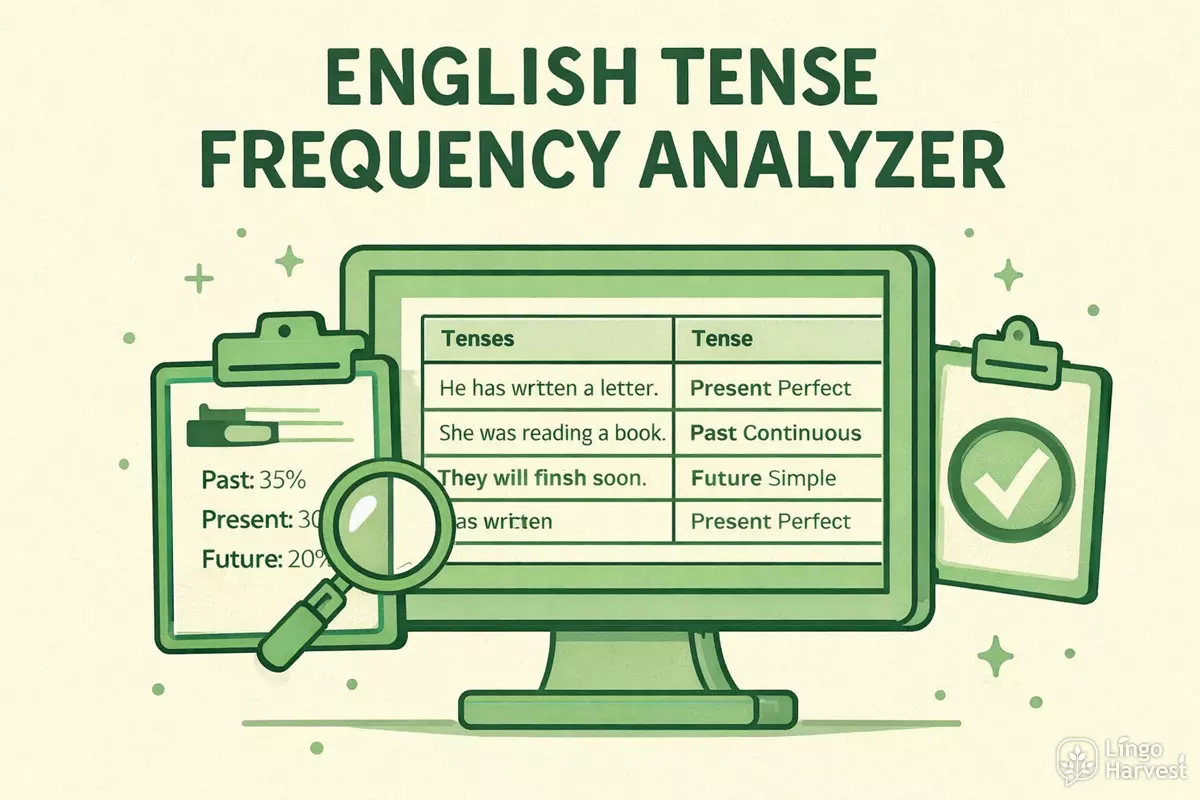 English Tense Frequency Analyzer is a professional text analysis tool that automatically detects and counts verb tenses in English writing. It identifies dominant tense patterns, passive and modal forms, non-finite constructions, and shows a clear sentence-by-sentence breakdown, making it ideal for linguistic analysis, teaching, and advanced grammar study.
- What this analyzer does
- Disclaimer and limitations
- How to use the tool step by step
- What tenses and verb groups it can detect
- Dominant tense and what it means
- Time axis balance: present, past, future, modal, non-finite
- Form groups summary: Simple, Continuous, Perfect, Passive, Modal, Non-finite
- Sentence-by-sentence breakdown and verb phrase table
- Who this tool is useful for
- FAQ: popular questions and answers
What this analyzer does
English Tense Frequency Analyzer is a professional text-level tool designed to identify and quantify verb tense usage in English writing. Instead of performing surface-level grammar checks, it focuses on meaningful tense patterns that reveal how time, sequence, and perspective are structured across a text.
The analyzer processes your text sentence by sentence, detects verb phrases, classifies them by tense and form, and then aggregates the results into clear statistics. This allows you to see not just which tenses appear, but how dominant they are and how they interact within the overall narrative or argument.
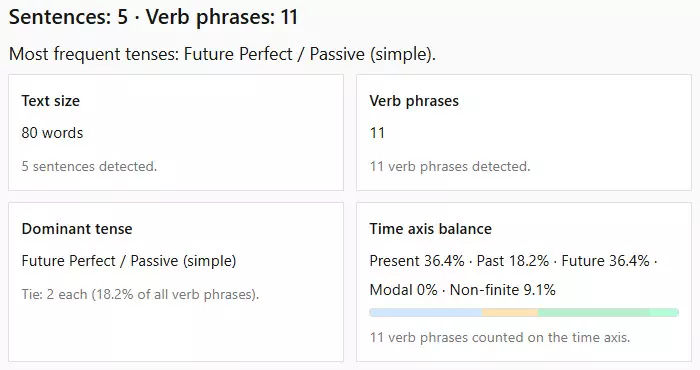
At a high level, the tool allows you to:
- Measure how frequently each English tense is used in a text
- Identify the dominant tense or competing tense patterns
- Analyze time distribution across present, past, future, modal, and non-finite forms
- Inspect verb phrases inside individual sentences
- Understand stylistic and structural choices in writing
Unlike simple grammar checkers, this analyzer is built for linguistic analysis, teaching, editing, and advanced learning. It is especially useful when working with longer texts where overall tense balance matters more than isolated grammatical correctness.
Disclaimer and limitations
This analyzer is intentionally designed to prioritize informative tense patterns over exhaustive grammatical tagging. Its goal is to reflect how time and aspect function at the level of the whole text, not to label every possible verb occurrence.
Important limitations to understand before using the results:
- The tool focuses on meaningful verb phrases (Perfect, Continuous, Passive, Modal, Future)
- Some simple Present Simple constructions may be intentionally ignored
- Glossary-style sentences, definitions, and generic statements may produce fewer detections
- The analyzer is not a full grammar checker and does not validate sentence correctness
For example, descriptive or definitional Present Simple sentences such as general facts, headings, labels, or explanatory fragments may be skipped to reduce statistical noise. This is a deliberate design choice that improves accuracy when analyzing narrative flow, academic writing, reports, or essays.
Because of this approach, small omissions in simple forms do not affect the overall interpretation of a text’s temporal structure. The analyzer should be used to understand trends, dominance, and balance — not to count every verb mechanically.
How to use the tool step by step
Using the English Tense Frequency Analyzer is straightforward, but to get the most accurate and meaningful results, it is important to follow a clear workflow. The tool is designed for full texts, not isolated sentences.
Step-by-step usage:
- Paste your English text into the input field. This can be an essay, article, report, story, or academic passage.
- Check the text size. The analyzer supports up to 5,000 words, which is sufficient for most real-world texts.
- Adjust the options if needed:
- Include or exclude non-finite forms (infinitives and -ing forms)
- Exclude infinitives from dominant tense calculation
- Enable or disable sentence-by-sentence breakdown
- Ignore adjectival past participles (advanced linguistic setting)
- Click “Analyze tenses” to start the analysis.
- Review the summary showing total sentences, verb phrases, dominant tense, and time axis balance.
- Explore detailed tables for tense distribution, form groups, and individual sentences.
For best results, avoid extremely short texts or lists of disconnected phrases. The analyzer works most effectively when there is enough context to establish tense patterns.
What tenses and verb groups it can detect
The analyzer detects a wide range of English verb constructions and groups them in a way that reflects both grammatical form and temporal meaning. It focuses on verb phrases, not isolated verb tokens.
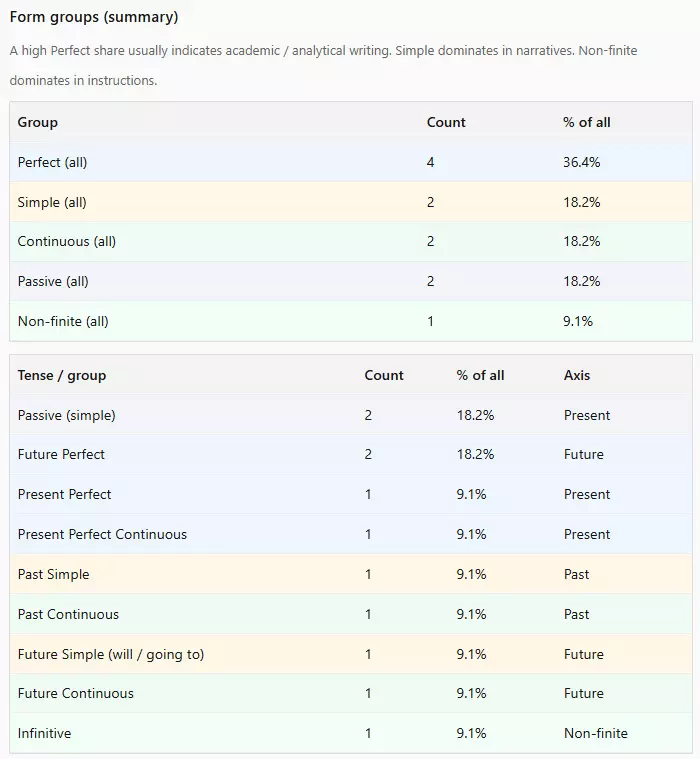
The following tense categories are supported:
- Simple tenses (Present Simple, Past Simple)
- Continuous tenses (Present Continuous, Past Continuous)
- Perfect tenses (Present Perfect, Past Perfect)
- Perfect Continuous forms
- Future constructions (will / going to, Future Perfect, Future Continuous)
- Modal constructions (modal + base, modal perfect, modal passive)
- Passive voice (simple, continuous, perfect, modal passive)
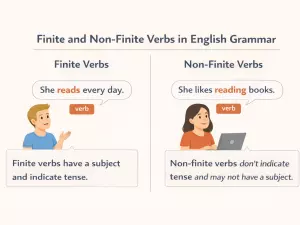
- Non-finite forms (infinitives, -ing forms, past participles)
Each detected verb phrase is assigned to both a specific tense label and a broader form group, allowing you to analyze texts at different levels of abstraction.
| Category | Examples of detected forms | Analytical purpose |
|---|---|---|
| Simple | works, wrote | General statements, narratives |
| Perfect | has written, had completed | Experience, result, sequence |
| Continuous | is working, was studying | Process and duration |
| Passive | was written, has been completed | Focus on action or result |
| Non-finite | to write, writing, written | Instructions, abstraction |
This structured detection allows the analyzer to highlight stylistic differences between narrative, academic, instructional, and analytical texts without overwhelming the user with unnecessary grammatical detail.
Dominant tense and what it means
One of the key insights provided by this analyzer is the dominant tense. This is the tense that appears most frequently among all detected verb phrases and therefore represents the primary temporal perspective of the text.
Identifying the dominant tense helps you understand how a text is structured in time and how consistently the author maintains a grammatical viewpoint.
What the dominant tense can indicate:
- Present Simple dominance often appears in explanations, definitions, and instructional texts
- Past Simple dominance is typical for narratives, case studies, and historical descriptions
- Present Perfect dominance suggests analytical or academic writing focused on results and experience
- Future dominance is common in planning documents, forecasts, and proposals
- Modal dominance indicates recommendations, rules, or speculative writing
If two or more tenses share the highest frequency, the analyzer reports a tie. This often reflects a mixed writing style or deliberate tense variation.
You can optionally exclude infinitives from dominant tense calculations to prevent instructional texts from being skewed by frequent to + verb constructions.
Time axis balance: present, past, future, modal, non-finite
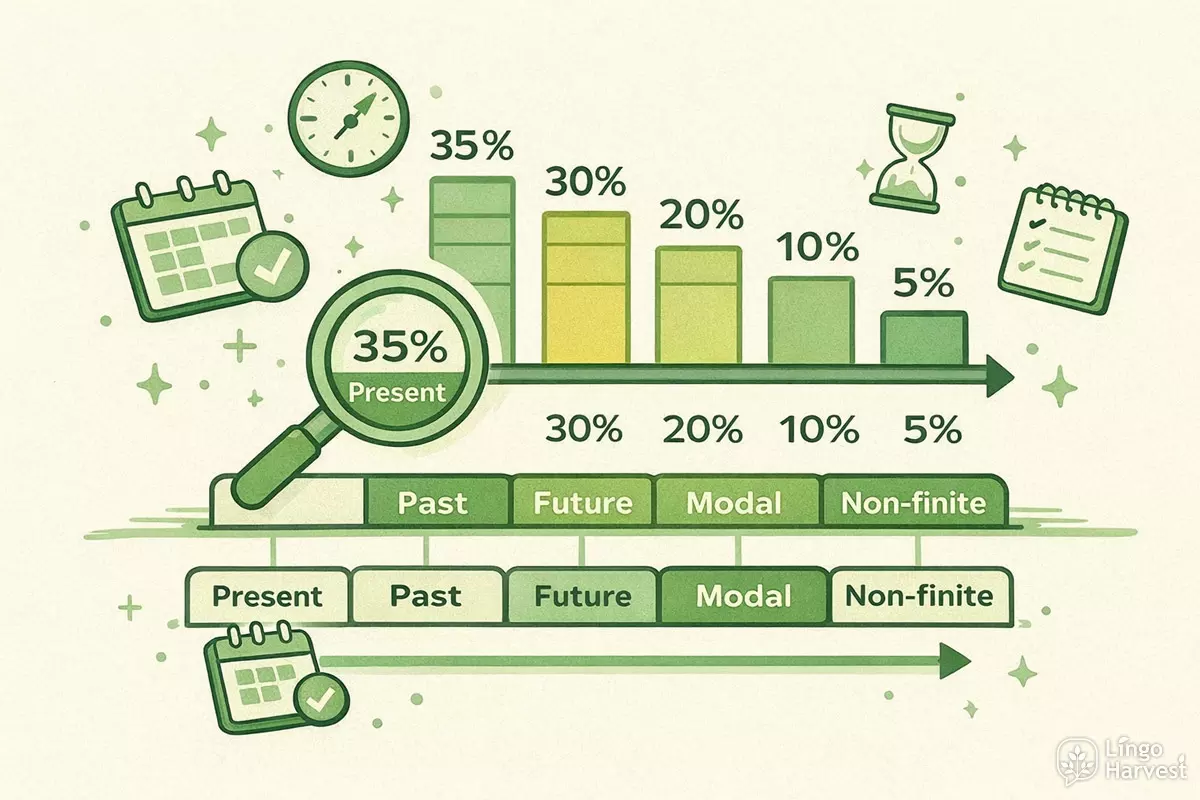
Beyond individual tenses, the analyzer visualizes how verb phrases are distributed across the time axis. Each detected verb phrase is assigned to one of five temporal categories.
The time axis consists of:
- Present – current states, habits, ongoing actions
- Past – completed or historical actions
- Future – planned or predicted actions
- Modal – possibility, obligation, recommendation
- Non-finite – infinitives and participles without tense marking
The visual bar and percentage values make it easy to compare how strongly a text is anchored in a particular time frame.
| Axis category | Typical usage | Common text types |
|---|---|---|
| Present | Facts, explanations, habits | Tutorials, definitions |
| Past | Narration, reporting | Stories, case studies |
| Future | Planning, forecasting | Proposals, roadmaps |
| Modal | Advice, obligation | Guidelines, policies |
| Non-finite | Abstract actions | Instructions, outlines |
This axis-based view is especially useful for editors and teachers who want to assess whether a text maintains a coherent temporal perspective or shifts unintentionally between time frames.
Form groups summary: Simple, Continuous, Perfect, Passive, Modal, Non-finite
To make tense analysis easier to interpret, the analyzer groups individual tenses into broader form groups. This abstraction helps you understand the grammatical profile of a text without getting lost in fine-grained labels.
The main form groups are:
- Simple – basic factual or narrative statements
- Continuous – actions in progress or temporary situations
- Perfect – results, experience, and sequence in time
- Passive – focus on actions or outcomes rather than agents
- Modal – obligation, possibility, advice, or prediction
- Non-finite – infinitives and participles without tense marking
Each group is summarized with a total count and percentage share of all detected verb phrases. This makes it easy to compare stylistic tendencies between texts.
| Form group | What it reflects | Typical writing style |
|---|---|---|
| Simple | Direct statements | Narrative, descriptive |
| Perfect | Results and experience | Academic, analytical |
| Continuous | Processes in progress | Explanatory, narrative |
| Passive | Actions without focus on actor | Scientific, formal |
| Modal | Rules and evaluation | Guidelines, recommendations |
| Non-finite | Abstract or instructional actions | Manuals, outlines |
This summary view is particularly helpful when comparing multiple texts or evaluating whether a piece of writing matches the expected style for its genre.
Sentence-by-sentence breakdown and verb phrase table
For deeper analysis, the analyzer provides a sentence-by-sentence breakdown. Each sentence is listed separately, along with the verb phrases detected inside it.
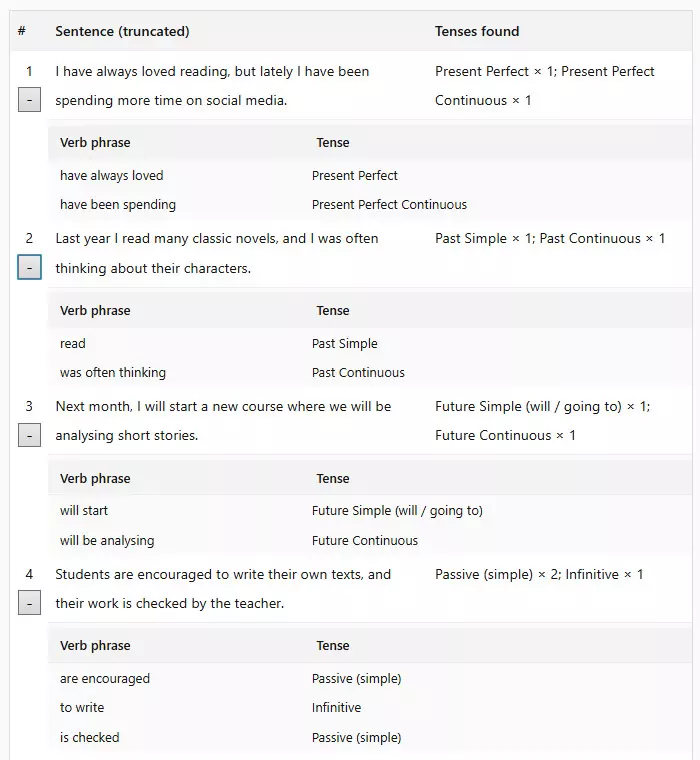
This feature allows you to move from high-level statistics to precise grammatical inspection without leaving the page.
In the sentence breakdown, you can:
- See which tenses appear in each sentence
- Identify sentences with mixed or conflicting tense usage
- Expand a sentence to view its exact verb phrases
- Understand how tense variation contributes to meaning
When expanded, each sentence displays a table of detected verb phrases together with their classified tense. This makes it easy to locate problematic constructions or study advanced patterns in authentic text.
For long texts, the table can be collapsed or expanded to maintain readability while preserving access to detailed data.
This level of transparency is especially valuable for teachers, editors, and advanced learners who want to connect abstract tense statistics with concrete examples.
Who this tool is useful for
English Tense Frequency Analyzer is designed for users who need more than basic grammar correction. It is most effective when analyzing complete texts where tense choice reflects structure, intent, and style.

This tool is especially useful for:
- English teachers and tutors – to demonstrate tense patterns, explain stylistic choices, and analyze student writing objectively.
- Advanced learners (B2–C2) – to understand how real texts use tense beyond textbook rules.
- Editors and proofreaders – to detect unintended tense shifts or inconsistent time perspective.
- Academic writers and researchers – to evaluate tense usage in essays, papers, and reports.
- Content writers and journalists – to ensure clarity and consistency in narrative or analytical texts.
Because the analyzer works at the text level, it is particularly valuable in contexts where overall tense balance matters more than individual sentence accuracy. It helps answer questions such as “Is this text too narrative?”, “Is it overly instructional?”, or “Does it maintain a consistent analytical perspective?”.
The tool is not intended for beginners or for checking isolated grammar rules. Its strength lies in revealing patterns that are otherwise difficult to see without manual linguistic analysis.
FAQ: popular questions and answers
Below are answers to the most common questions about how the English Tense Frequency Analyzer works and how to interpret its results.
1. Why does the analyzer sometimes miss simple Present Simple verbs?
This is intentional. The tool prioritizes meaningful tense patterns and may ignore generic or descriptive Present Simple constructions (definitions, labels, glossary-style sentences) to reduce noise in text-level statistics.
2. Is this a grammar checker?
No. The analyzer does not check grammatical correctness or suggest fixes. It analyzes tense usage patterns across a text and should be used for interpretation, not correction.
3. Can I use it for very short texts?
Short texts may produce limited or misleading results. The analyzer works best with paragraphs, essays, articles, or multi-sentence passages where tense distribution is meaningful.
4. How accurate is the tense detection?
The tool uses advanced heuristics to detect complex verb phrases with high accuracy. However, like any automated linguistic system, it may occasionally simplify edge cases or ambiguous constructions.
5. Should I include non-finite forms in the analysis?
Including non-finite forms is useful for instructional or technical texts. For narrative or analytical writing, excluding infinitives from dominance calculations often produces clearer results.
6. Can this tool replace manual linguistic analysis?
No, but it can significantly speed it up. The analyzer provides structured data and visual summaries that support deeper human interpretation rather than replacing it.