Present Perfect Passive: Has Been Done

 Here we the present perfect passive: what it means, how has been and have been form it, and when to use it for results, life experience, and recent changes. It also explains questions, negatives, time markers, common mistakes, the difference from the past simple passive, plus practice and an FAQ.
- What the present perfect passive means
- How has been and have been build passive forms
- When results matter more than the exact time
- Life experience and recent changes in passive sentences
- Present perfect passive vs past simple passive
- Questions and negatives with has been done
- Time markers: already, yet, just, and never
- Common errors with been and past participles
- Practice set: complete present perfect passive forms
- FAQ: has been done in English
Use this tense when you want to show that something has been completed, but the action itself matters more than the person who did it. It is useful for talking about present results, like a report being finished, a road being repaired, or dinner being prepared. When you notice it in daily life, the structure begins to feel practical, clear, and much more natural than it may seem at first.
What the present perfect passive means
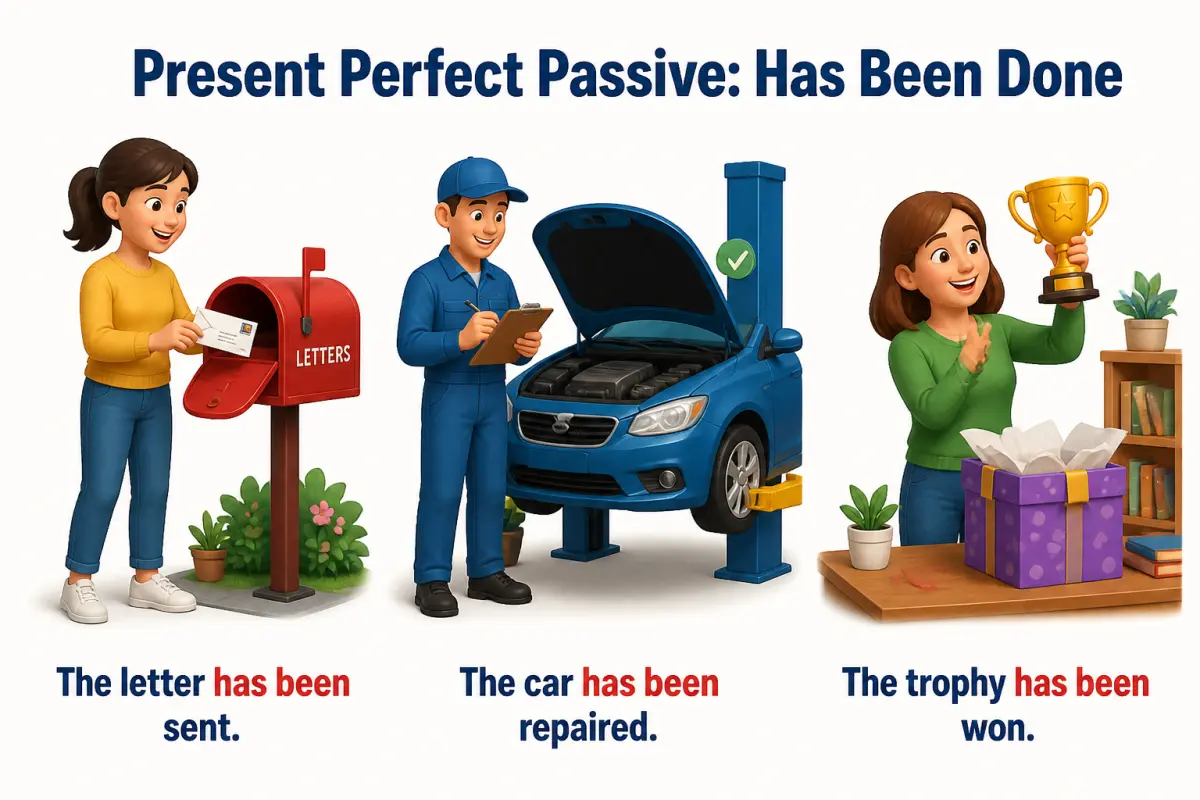
This form is used when an action happened in the past, but the speaker is interested mainly in the result now, not in who did the action. Compare these two ideas: “Someone has cleaned the office” and “The office has been cleaned.” The second sentence moves the focus away from the person and puts attention on the office and its present state.
You will often hear this structure in workplaces, schools, news reports, notices, and formal writing because the action matters more than the actor. For example: “Your order has been shipped.” “The road has been repaired.” “All exam papers have been checked.” In each case, the action is complete, and the result is relevant now.
The passive voice is especially useful when:
- the doer is unknown: “My bike has been stolen.”
- the doer is obvious: “The classroom has been painted.”
- the doer is not important: “The documents have been uploaded.”
- you want a more formal tone: “Several changes have been made to the policy.”
Notice the meaning carefully: this is not just “past.” It connects the completed action to the present moment. If the library has been closed, it matters now because people cannot enter. If your application has been accepted, that result affects your current situation.
Teacher note: Many learners understand the form faster when they ask one simple question: “What is true now because of this past action?” If you can answer that, you are probably using this tense for the right reason.
If you want a wider review of how the active forms work before turning them into the passive, it helps to look at present perfect forms and how they express a present connection.
How has been and have been build passive forms
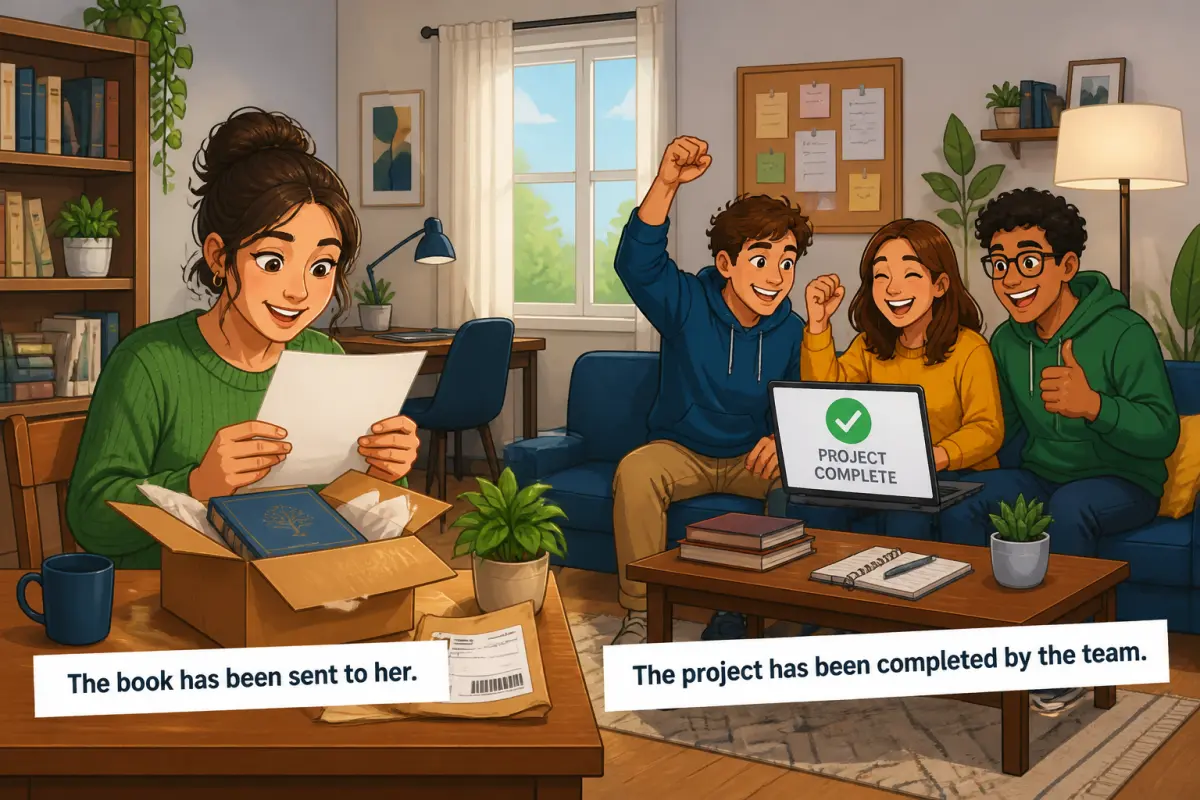
The pattern is straightforward once you separate it into parts. We use has/have + been + past participle. The subject receives the action, so the final verb must be a past participle such as done, written, sent, broken, or chosen.
The only part that changes for agreement is has or have. Use has been with singular third-person subjects like he, she, it, the room, my phone, the report. Use have been with I, you, we, they, and plural nouns. The word been never changes in this structure.
| Subject | Form | Example |
|---|---|---|
| He / She / It / singular noun | has been + past participle | The door has been locked. |
| I / You / We / They | have been + past participle | The files have been copied. |
| Uncountable noun | has been + past participle | The information has been updated. |
| Plural noun | have been + past participle | The invitations have been printed. |
Here are some full examples from real situations:
- My parcel has been delivered.
- The windows have been washed.
- The final decision has been announced.
- The seats have been reserved.
- The kitchen has been cleaned.
Be careful not to mix this structure with other perfect forms. “Has done” is active. “Has been done” is passive. Compare:
- Maria has written the email. (active)
- The email has been written. (passive)
If you need a broader overview of passive patterns across tenses, a good passive form guide can help you see where this structure fits.
When results matter more than the exact time
This tense is natural when the exact moment is not the main point. You may know that something happened, but you care more about the present result. For example, “The meeting room has been prepared” tells us the room is ready now. The sentence does not need a specific time such as at 9:15 or yesterday afternoon.
English often chooses the present perfect passive in situations where someone gives an update, reports progress, or explains the current state of something. That is why it is common in business emails, service messages, and school announcements. “Your request has been approved.” “The syllabus has been revised.” “Dinner has been served.” The listener usually wants to know the present consequence, not the schedule of the action.
Look at these result-focused uses:
- All the lights have been turned off, so the building looks closed.
- The payment has been received, so your registration is complete.
- The mistake has been corrected, so the report is ready to send.
- The path has been cleared, so hikers can use it again.
Do not add a finished past time such as yesterday, last week, or in 2022 with this use. Those time expressions usually push you toward the past simple passive instead. You can say, “The path was cleared yesterday,” but not normally “The path has been cleared yesterday.”
Teacher note: In class, I often tell students to imagine a hand pointing at the present moment. If the sentence gives a current update, the present perfect passive is often the best choice.
This present connection comes from the wider perfect aspect, which links a past action to a present state or relevance.
Life experience and recent changes in passive sentences
The same structure can describe life experience, especially when the subject is the thing that received the action. This is less personal than the active voice, but very common. For example, “This novel has been translated into twelve languages” describes its experience up to now. “Our team’s work has been recognized internationally” shows something achieved during a period leading to the present.
It is also useful for recent changes, especially when something is new, updated, improved, moved, or replaced. In these cases, the sentence often sounds like an announcement. “The menu has been changed.” “The website has been redesigned.” “Several bus stops have been moved.” The exact time may be recent, but the focus stays on the new situation now.
Here are examples of life experience in passive form:
- This painting has been exhibited in Paris, Seoul, and Mexico City.
- The song has been played millions of times online.
- Her research has been cited in many academic journals.
- That castle has been visited by tourists from all over the world.
And here are examples of recent changes:
- The company logo has been updated.
- The old machines have been replaced.
- The staff schedule has been changed.
- The security system has been improved.
In conversation, these sentences often answer practical questions:
- Why does the home page look different? — It has been redesigned.
- Why are there new desks here? — The classrooms have been reorganized.
- Why is this museum so famous? — It has been featured in several travel programs.
Present perfect passive vs past simple passive
This is one of the most important contrasts for learners. Both forms are passive, but they answer different kinds of questions. The present perfect passive connects the action to now. The past simple passive places the action at a finished past time.
If you mention a specific finished time, the past simple passive is usually the right choice. If you give a present update without focusing on exact time, the present perfect passive is usually better.
| Meaning focus | Present perfect passive | Past simple passive |
|---|---|---|
| Current result | The contract has been signed. | The contract was signed on Monday. |
| Current availability | The last tickets have been sold. | The last tickets were sold yesterday morning. |
| Current condition | The hole has been filled. | The hole was filled after the storm. |
| Current status | The forms have been submitted. | The forms were submitted before lunch. |
Study these pairs carefully:
- The office has been moved to a larger building. / The office was moved in April.
- The problem has been solved. / The problem was solved during yesterday’s meeting.
- The bridge has been reopened. / The bridge was reopened at 6 a.m.
In each pair, the first sentence is a present update. The second gives a historical fact or completed past event with a time reference.
Three more contrasts show the difference clearly:
- The package has been sent. / The package was sent two hours ago.
- The final version has been approved. / The final version was approved last Friday.
- The room has been cleaned. / The room was cleaned before the guests arrived.
A common learner problem is choosing the present perfect passive just because the action is recent. “Recent” is not enough by itself. Ask: do I care about the present result, or am I placing the action in past time? That question usually gives you the correct tense.
Questions and negatives with has been done
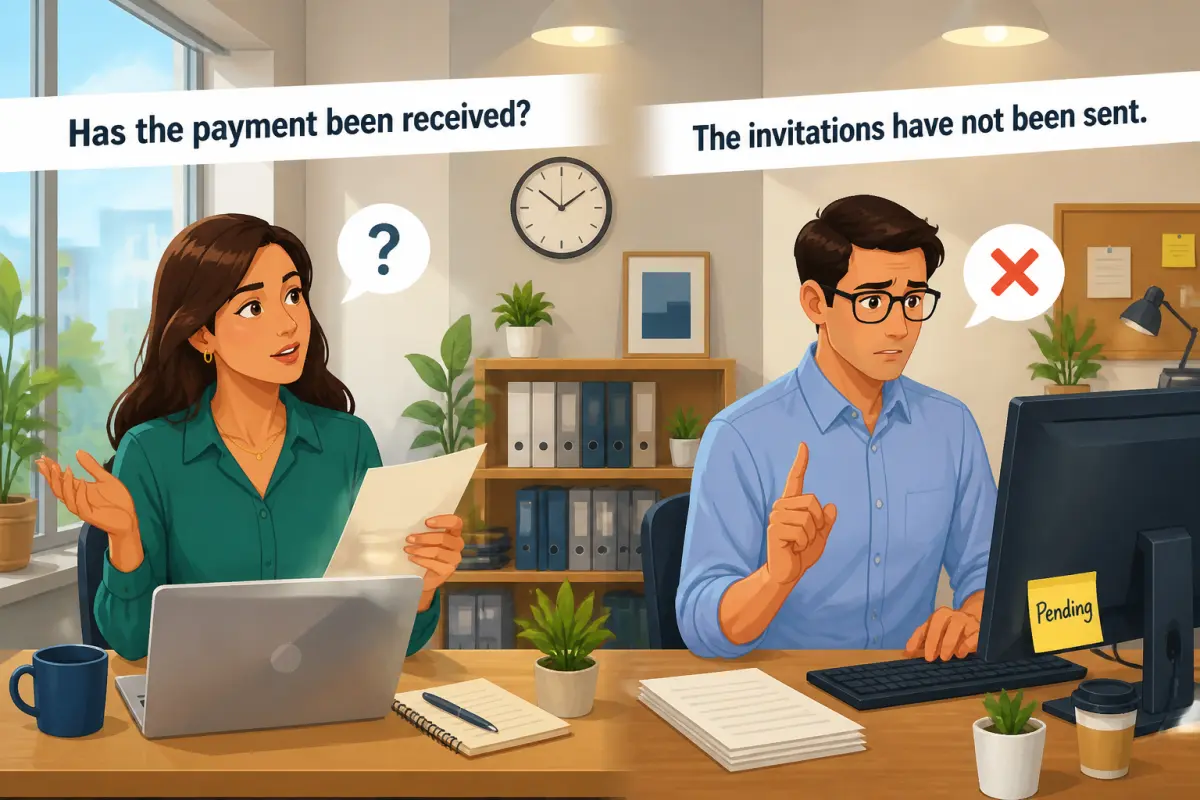
To make questions, move has or have before the subject. To make negatives, add not after has or have. The rest of the structure stays the same: been + past participle.
These forms are common in practical communication: checking progress, confirming whether something is finished, or saying that something still has not happened. They are especially useful in emails, office conversations, customer service, and class administration.
Question patterns:
- Has the payment been received?
- Have the invitations been sent?
- Has your article been published yet?
- Have the students been informed about the change?
Negative patterns:
- The payment has not been received.
- The invitations have not been sent.
- The article hasn’t been published yet.
- The students haven’t been informed yet.
Short answers are simple:
- Has the table been booked? — Yes, it has. / No, it hasn’t.
- Have the copies been made? — Yes, they have. / No, they haven’t.
You can also ask information questions:
- Why has the flight been delayed?
- Where have the documents been stored?
- How many times has this recipe been tested?
- Who has the complaint been passed to?
That last type can feel awkward because passive questions sometimes end with a preposition. This is normal in everyday English: “Who has it been sent to?” sounds much more natural than an over-formal alternative.
Teacher note: When students make question mistakes here, the problem is usually word order. Train your ear with fixed chunks such as “Has it been...?” and “Have they been...?” until the pattern feels automatic.
If question formation still feels difficult, reviewing present perfect questions can make the passive pattern much easier to build.
Time markers: already, yet, just, and never
These words are very common with the present perfect passive because they help show completion, expectation, recency, or life experience. Their position matters, and the meaning changes slightly depending on which one you choose.
Already shows that something happened before expected or before now. Yet is common in negatives and questions, especially when we expect something to happen soon. Just means a very short time ago. Never means at no time before now.
- The meals have already been prepared.
- Has the email been sent yet?
- The room has just been painted.
- This topic has never been discussed in class before.
Typical positions:
- already: after has/have, before been or before the participle in some contexts — “The results have already been announced.”
- yet: usually at the end in questions and negatives — “The food hasn’t been served yet.”
- just: after has/have — “The keys have just been found.”
- never: after has/have — “That suggestion has never been accepted.”
Here are more natural examples:
- The report has already been shared with the manager.
- Have all the chairs been arranged yet?
- The issue has just been fixed by the IT team.
- Her name has never been included on the list.
- The windows haven’t been cleaned yet.
- The announcement has already been posted online.
One practical warning: in American English, people sometimes use the past simple with just in conversation, but learners should first master the standard present perfect use: “It has just been delivered.” That form is widely accepted and safe in both speaking and writing.
Common errors with been and past participles
Most mistakes in this tense come from three areas: leaving out been, using the wrong participle, and confusing active and passive forms. These errors are easy to understand once you know what to check.
The safest method is to test the structure in order: subject + has/have + been + past participle. If one part is missing, the sentence is probably wrong.
1. Leaving out been
- ❌ The message has sent. / ✅ The message has been sent.
- ❌ The rooms have cleaned. / ✅ The rooms have been cleaned.
- ❌ My application has accepted. / ✅ My application has been accepted.
This mistake happens because learners remember “has/have + past participle” from the active voice and forget that the passive needs been in the middle.
2. Using the wrong past participle
- ❌ The letter has been wrote. / ✅ The letter has been written.
- ❌ The cake has been ate. / ✅ The cake has been eaten.
- ❌ The project has been did. / ✅ The project has been done.
Regular verbs are easier: cleaned, painted, finished, delivered. Irregular verbs need extra attention. If this is a weak area for you, spend time on irregular participles because they appear constantly in passive forms.
3. Mixing active and passive patterns
- ❌ The manager has approved the form? if you mean the form received the action and the manager is not the focus. / ✅ The form has been approved.
- ❌ The dinner has cooked. / ✅ The dinner has been cooked.
- ❌ The problem has solved. / ✅ The problem has been solved.
4. Wrong choice of has or have
- ❌ The files has been deleted. / ✅ The files have been deleted.
- ❌ The news have been reported. / ✅ The news has been reported.
- ❌ My glasses has been found. / ✅ My glasses have been found.
5. Using present perfect passive with finished past time
- ❌ The invoice has been paid yesterday. / ✅ The invoice was paid yesterday.
- ❌ The bridge has been opened last year. / ✅ The bridge was opened last year.
- ❌ The essay has been submitted at 8:00. / ✅ The essay was submitted at 8:00.
Teacher note: If a student writes a wrong passive sentence, I usually ask them to underline the three essential pieces: has/have, been, participle. This small habit catches a surprising number of errors immediately.
Practice set: complete present perfect passive forms
Use these exercises to check three different skills: choosing the correct structure, changing active sentences into passive ones, and spotting common errors. Try to answer before opening the solutions. The more carefully you build each form, the faster this tense will become automatic.
Pay close attention to subject agreement, the position of been, and the past participle. In the second and third sets, think about meaning as well as form.
Practice 1: Choose the correct form
- The door (has been lock / has been locked / have been locked).
- The emails (has been sent / have been sent / have sent).
- My bag (has been find / has been found / have been found).
- The reports (have been checked / has been checked / have checked).
- The meeting room (has just been cleaned / have just been cleaned / has just cleaned).
- The prizes (have already been given / has already been given / have already gave).
- The window (has been break / has been broken / have been broken).
- All the names (have been added / has been added / have added).
- The schedule (has not been changed / have not been changed / has not changed).
- These products (have been made / has been made / have been make).
Show answers
- has been locked
- have been sent
- has been found
- have been checked
- has just been cleaned
- have already been given
- has been broken
- have been added
- has not been changed
- have been made
Practice 2: Rewrite in the present perfect passive
- Someone has canceled the class.
- They have painted the fence.
- Someone has stolen my passport.
- The company has announced the results.
- They have repaired the elevator.
- Someone has delivered the flowers.
- The editor has changed the headline.
- They have closed several shops.
- Someone has copied the files.
- The chef has prepared the desserts.
Show answers
- The class has been canceled.
- The fence has been painted.
- My passport has been stolen.
- The results have been announced.
- The elevator has been repaired.
- The flowers have been delivered.
- The headline has been changed.
- Several shops have been closed.
- The files have been copied.
- The desserts have been prepared.
Practice 3: Spot and correct the error
- The bill has paid.
- These chairs has been moved.
- The speech has been gave.
- The results have been announced yesterday.
- My keys have been find.
- The room has not been prepare yet.
- Has the letters been printed?
- The new policy have been explained.
- The order has been took by the waiter.
- The lights has just been turned off.
Show answers
- The bill has been paid.
- These chairs have been moved.
- The speech has been given.
- The results were announced yesterday.
- My keys have been found.
- The room has not been prepared yet.
- Have the letters been printed?
- The new policy has been explained.
- The order has been taken by the waiter.
- The lights have just been turned off.
FAQ: has been done in English
Below are common learner questions that usually appear after the main rule is clear.
1. Can I say who did the action in this tense?
Yes. You can add the doer with by if that information matters: “The mural has been painted by local artists.” But in many passive sentences, the doer is left out because it is unknown, obvious, or unimportant.
2. Is this form only formal?
No. It is common in formal writing, but it is also natural in everyday speech: “The food has been ordered,” “Your phone has been fixed,” “The table has been booked.” What changes is not the grammar, but the situation and tone.
3. Can I use this tense with all verbs?
Only with verbs that can be passive, which means the verb must normally take an object in the active voice. You can say “The car has been washed,” because someone can wash a car. But many intransitive verbs do not form normal passives, so sentences like “has been arrived” are wrong.
4. What is the difference between has been done and is done?
Has been done highlights a completed action with present relevance. Is done usually describes a current state, routine, or general fact. Compare: “The homework has been done” means it is completed now. “The homework is done online” means that is the normal method.
5. Can I use contractions in negative forms?
Yes. In speech and informal writing, contractions are very common: “hasn’t been sent,” “haven’t been checked.” In very formal writing, full forms may sound better: “has not been sent.” Both are grammatically correct.
6. Why do I sometimes hear get instead of be?
English sometimes uses get in informal passive expressions: “The window has got broken” is not standard here, but “The window got broken” appears in other tense patterns. For learners, it is safer to master the regular be-passive first: “The window has been broken.”
7. Can the subject be a person?
Absolutely. Passive sentences are not only for things. You can say, “She has been invited to the conference,” “They have been informed about the delay,” or “He has been chosen for the team.” The key point is that the subject receives the action.
8. How can I sound more natural when using this form?
Use it for real updates, not just grammar practice. It sounds natural in contexts like email, travel, work, school, and customer service: “Your booking has been confirmed,” “The assignment has been uploaded,” “The gate has been changed.” Also, learn it in chunks such as has been sent, has been approved, have been informed, and hasn’t been done yet.