Historical Development of English Verb Forms

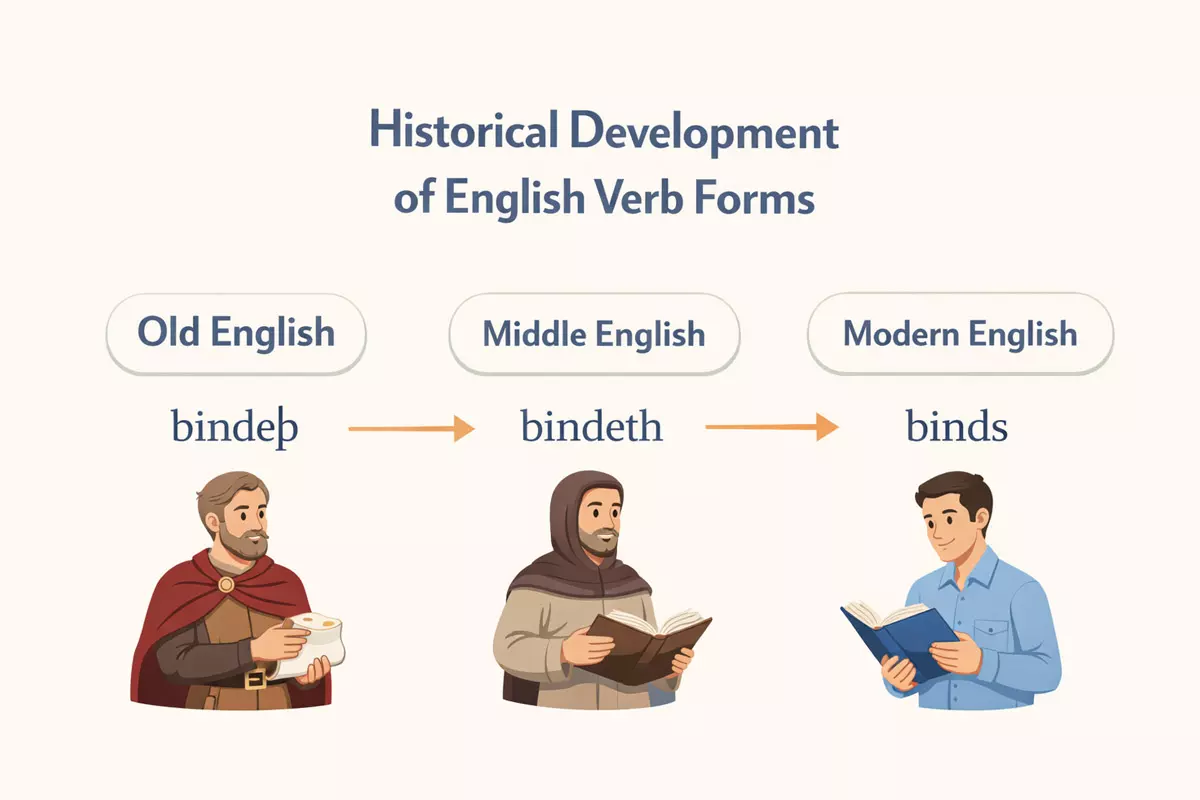 Here we how English verb forms evolved, covering the transition from Old to Modern English, the simplification of endings and agreement, changes in tense and aspect, the rise of auxiliaries, and how irregular verbs persisted.
- Why English verb forms changed over time
- From Old English to Modern English verbs
- Loss of endings and simpler verb agreement
- Changes in tense and aspect expression
- Rise of auxiliaries: do, have, be, will
- How irregular verbs survived historical change
- Major milestones in verb system development
- Homework: timeline and examples practice
The evolution of English verbs over the centuries highlights a remarkable process of adaptation influenced by cultural contact, technological change, and shifts in social norms. As the language absorbed words and structures from other tongues, verbs often changed form or meaning, sometimes becoming regularized or acquiring new uses. This ongoing transformation reflects how speakers shape language to fit their needs, making the study of verb evolution a window into the broader history of English and its capacity for change.
Why English verb forms changed over time
English verbs have not always looked or sounded like they do today. The evolution of their forms is rooted in a mix of historical events, language contact, and internal simplification. Influences from Old Norse, Norman French, and the natural tendency for speakers to favor easier patterns have all left their mark. Let’s break down some of the main factors that led to these changes.
Language Contact and Borrowing
When English speakers encountered other languages, especially during the Viking invasions and the Norman Conquest, they absorbed new words and forms. This exposure often led to blending and simplification as speakers tried to communicate across linguistic boundaries.
- Old Norse: Introduced verbs and endings that merged with native patterns.
- Norman French: Brought vocabulary and sometimes new grammatical constructions.
- Latin: Influenced scholarly and religious language, affecting verb usage in formal contexts.
Loss of Inflections
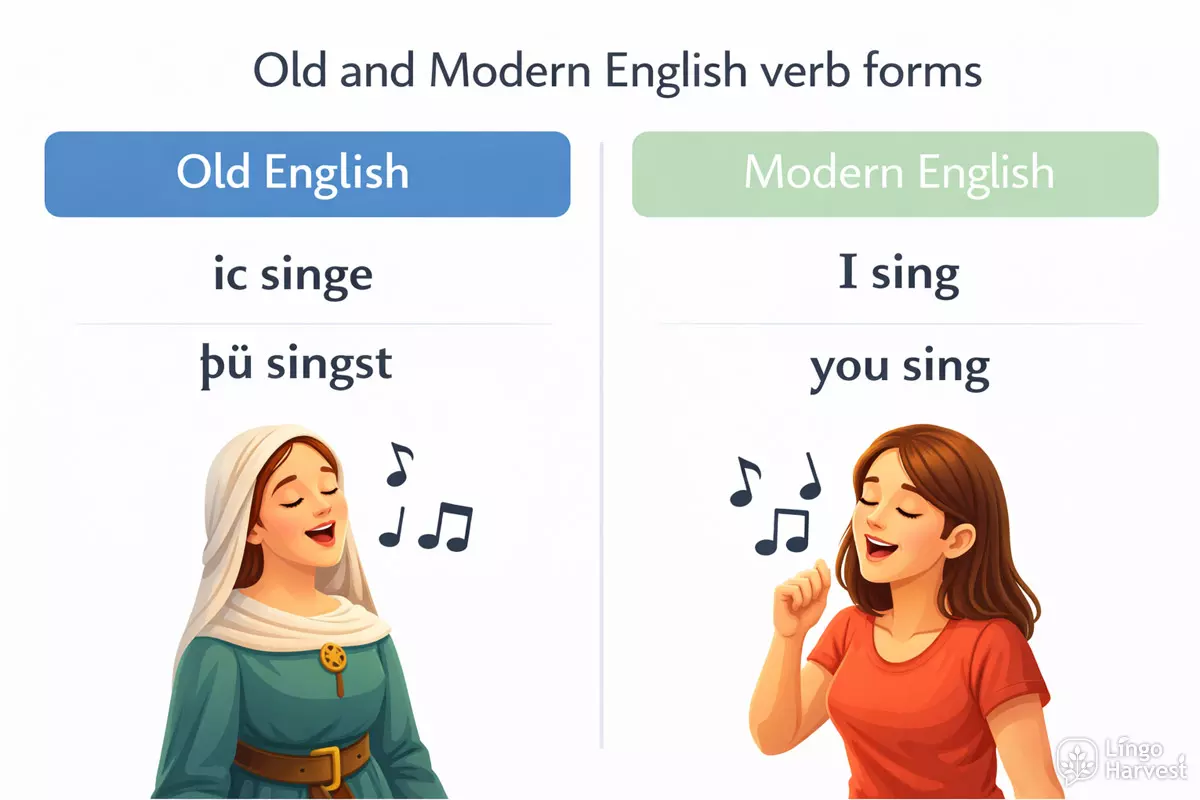
Old English verbs used to have a rich system of endings that showed person, number, and tense. Over time, these endings eroded, making verb forms simpler and more regular. For example, Old English had distinct endings for "I walk," "you walk," and "he walks," but many of these distinctions faded.
| Old English | Modern English | Meaning |
|---|---|---|
| ic singe | I sing | first person singular |
| þū singst | you sing | second person singular |
| hē singþ | he sings | third person singular |
| wē singaþ | we sing | first person plural |
| gē singaþ | you (pl.) sing | second person plural |
| hīe singaþ | they sing | third person plural |
| ic lufie | I love | first person singular |
| þū lufast | you love | second person singular |
| hē lufaþ | he loves | third person singular |
| wē lufiaþ | we love | first person plural |
| gē lufiaþ | you (pl.) love | second person plural |
| hīe lufiaþ | they love | third person plural |
Sound Changes and Regularization
Pronunciation shifts also played a role. As certain sounds became harder to distinguish, endings were dropped or merged. Additionally, irregular verbs often became regular as speakers generalized common patterns.
- Old strong verbs like "helpan" became regular ("helped" instead of "holp").
- Past-tense endings unified around "-ed" for most regular verbs.
- Some verbs retained irregular forms due to high frequency (e.g., "go" → "went").
Social and Cultural Influences
Social changes, such as increasing literacy and the influence of printed texts, promoted more standardized forms. At the same time, regional dialects and informal speech contributed to ongoing variation and innovation.
- Standardization through printing and education.
- Persistence of dialectal differences in spoken English.
- Adoption of new forms from popular usage and media.
In short, shifts in verb forms happened because of a blend of outside influences, natural tendencies toward simplification, and ongoing adaptation by speakers. The result is the modern English verb system, which continues to evolve.
From Old English to Modern English verbs
The evolution of English verb forms spans more than a thousand years, reflecting deep changes in both structure and usage. In the earliest stages, Old English verbs were highly inflected, relying on endings to show tense, person, and number. Over time, these inflections gradually simplified, leading to the more analytic patterns we see in present-day English.
Major Shifts in Verb Structure
Old English verbs fell into two main groups: strong and weak. Strong verbs changed their vowel to indicate tense (such as singan → sang), while weak verbs added dental endings like -ed. As the language developed, the distinction blurred, with many strong verbs becoming weak or regularized.
- Old English: Highly inflected, complex endings
- Middle English: Gradual loss of inflections, increased use of auxiliary verbs
- Early Modern English: Standardization of -ed for the past tense
- Modern English: Predominantly regular verbs, with some strong/irregular forms retained
Examples of Verb Changes Over Time
The table below illustrates how common verbs have shifted from their Old English forms to their modern equivalents, showing both regularization and retention of irregular patterns.
| Old English | Modern English | Type of Change |
|---|---|---|
| helpan (holp, holpen) | help (helped, helped) | Strong to regular |
| singan (sang, sungen) | sing (sang, sung) | Strong (irregular) retained |
| lufian (lufode, lufod) | love (loved, loved) | Weak to regular |
| cuman (com, cumen) | come (came, come) | Irregular retained |
| findan (fand, funden) | find (found, found) | Strong to irregular |
| secgan (sæde, sæd) | say (said, said) | Weak to irregular |
| bringan (brohte, broht) | bring (brought, brought) | Weak to irregular |
Loss of Inflections and Rise of Auxiliaries
Another major development was the loss of personal and number endings. Old English distinguished between singular and plural in several forms, but by Modern English, most verbs use the same form for all persons except the third person singular present (-s). The rise of auxiliary verbs like do, have, and will filled in many grammatical functions previously handled by inflection.
- Use of do for questions and negatives (e.g., "Do you know?")
- Expansion of have for perfect tenses ("I have seen")
- Future tense now commonly expressed with will ("She will go")
- Continuous aspect developed with be + -ing ("He is running")
In summary, the verb system of English underwent dramatic simplification and innovation, shifting from a synthetic to a largely analytic language. This process has resulted in the diverse and, at times, irregular verb forms that characterize English today.
Loss of endings and simpler verb agreement
A defining change in the history of English verbs was the gradual reduction of inflectional endings. Old English verbs had a rich system of endings to indicate person, number, and tense. Over time, these endings were lost or merged, leading to a streamlined verb system. This simplification made English verb morphology much less complex compared to many related languages.
From Complex to Minimal Endings
In Old English, verb forms changed depending on who was performing the action. For instance, "singan" (to sing) had different endings for "I sing," "you sing," "he/she sings," and so on. Today, most verbs in Modern English use the same form for all persons except the third person singular in the present tense, which typically adds only -s (e.g., "he sings").
| Old English | Modern English |
|---|---|
| ic singe (I sing) | I sing |
| þu singst (you sing) | you sing |
| he singeþ (he sings) | he sings |
| we singaþ (we sing) | we sing |
| ge singaþ (you all sing) | you sing |
| hie singaþ (they sing) | they sing |
Key Effects of Endings Reduction
- The same verb form is now used for most subjects in the present tense.
- Past tense endings have also been streamlined, with -ed replacing a variety of earlier forms.
- Agreement between subject and verb is mostly limited to the third person singular in the present.
- Irregular verbs retain some older patterns, but regular verbs follow a consistent rule.
Examples of Simplified Verb Agreement
- I walk / you walk / we walk / they walk
- He walks (third person singular adds -s)
- She jumped / they jumped (past tense, all forms use -ed)
- I eat / she eats
- We play / he plays
- You write / she writes
- They dance / he dances
- You work / she works
- We talk / he talks
- I read / she reads
- They cook / he cooks
- We run / she runs
This transformation has made English verbs easier to use, but it also means the language relies more on word order and auxiliary verbs to express meaning. The erosion of inflectional endings is a hallmark of the shift from Old to Modern English and a major factor in what makes English distinct among Germanic languages.
Changes in tense and aspect expression
Over the centuries, the ways English verbs convey time and manner of action have undergone significant transformation. Earlier stages of the language, such as Old English, relied heavily on inflections to distinguish when events occurred and whether actions were ongoing or completed. As the language evolved, these inflections diminished, giving rise to new methods for expressing temporal and aspectual distinctions.
From inflections to periphrasis
Originally, Old English marked tense and aspect primarily through verb endings. For example, different suffixes indicated past or present, while separate forms could show perfective or imperfective meaning. As inflectional endings eroded, English began to use auxiliary verbs—such as have, be, and will—to build up new verb phrases that express tense and aspect combinations.
Key developments in verb forms
- The emergence of the progressive aspect (e.g., is running) using be + -ing, which was rare or absent in Old English.
- The grammaticalization of the perfect aspect (e.g., has walked) using have + past participle.
- Shift from synthetic forms (single-word verbs) to analytic constructions (multi-word verbs).
- Loss of distinct endings for person and number in most verb forms.
- Development of new future constructions, such as will and shall plus infinitive.
- Reduction in use of strong (vowel-changing) verbs, with weak (regular) forms becoming dominant.
- Expansion of modal auxiliaries (e.g., can, may, must) to express mood and aspect nuances.
- Replacement of earlier aspectual distinctions with new periphrastic patterns (e.g., used to for habitual past).
- Increased reliance on word order and auxiliary verbs over inflectional endings.
- Rise of contracted forms in spoken English, affecting tense and aspect marking (e.g., he’s gone).
Comparing Old and Modern English Patterns
| Old English | Modern English |
|---|---|
| ic eom writende (I am writing) – rare usage | I am writing – common progressive aspect |
| ic hæfde gewriten (I had written) – perfective with have | I have written – perfect aspect with have |
| ic wrat (I wrote) – inflected verb for past tense | I wrote – simple past, no person or number marking |
| No dedicated future tense (context or adverbs used) | I will write – future expressed with modal auxiliary |
These changes reflect broader trends in English, shifting from a system rich in inflections to one that depends on auxiliary verbs and strict word order. The modern verb system is more analytic, with tense and aspect distinctions often made through auxiliary constructions rather than endings on the verb itself.
Rise of auxiliaries: do, have, be, will
Auxiliary verbs such as do, have, be, and will dramatically changed the structure of English from its earlier forms. In Old English, verb tense, aspect, and mood were mainly expressed through inflectional endings. Over time, these endings eroded, and new means were needed to express grammatical relationships. This gap led to the increasing use of auxiliaries, which now play a central role in forming questions, negatives, passives, and various tenses.
Emergence and Functions of Key Auxiliaries
Each auxiliary verb developed a unique grammatical function as English evolved:
- Do: Introduced for question formation and negation (e.g., "Do you know?", "I do not agree"), especially after the loss of distinctive verb endings.
- Have: Became the standard marker for the perfect aspect ("I have eaten"), replacing older forms that relied on inflection.
- Be: Used to form passive voice ("The book was written") and progressive aspect ("She is running").
- Will: Emerged from a verb meaning "to want" and gradually became the primary future tense auxiliary ("I will go").
Key Developments in Usage
The adoption of these verbs as auxiliaries was not instantaneous. Their integration into standard grammar occurred gradually, often overlapping with older constructions for several centuries. For example, in Middle English, both "I have seen" and "I saw" could express a completed action, but the auxiliary construction became dominant over time.
Below is a comparison of core auxiliary uses in modern English:
| Auxiliary | Primary Grammatical Role | Example |
|---|---|---|
| Do | Questions, Negation | Do you understand? / I do not know. |
| Have | Perfect Aspect | She has finished. |
| Be | Progressive & Passive | They are leaving. / The door was opened. |
| Will | Future Tense | We will arrive soon. |
Examples of Auxiliary Patterns
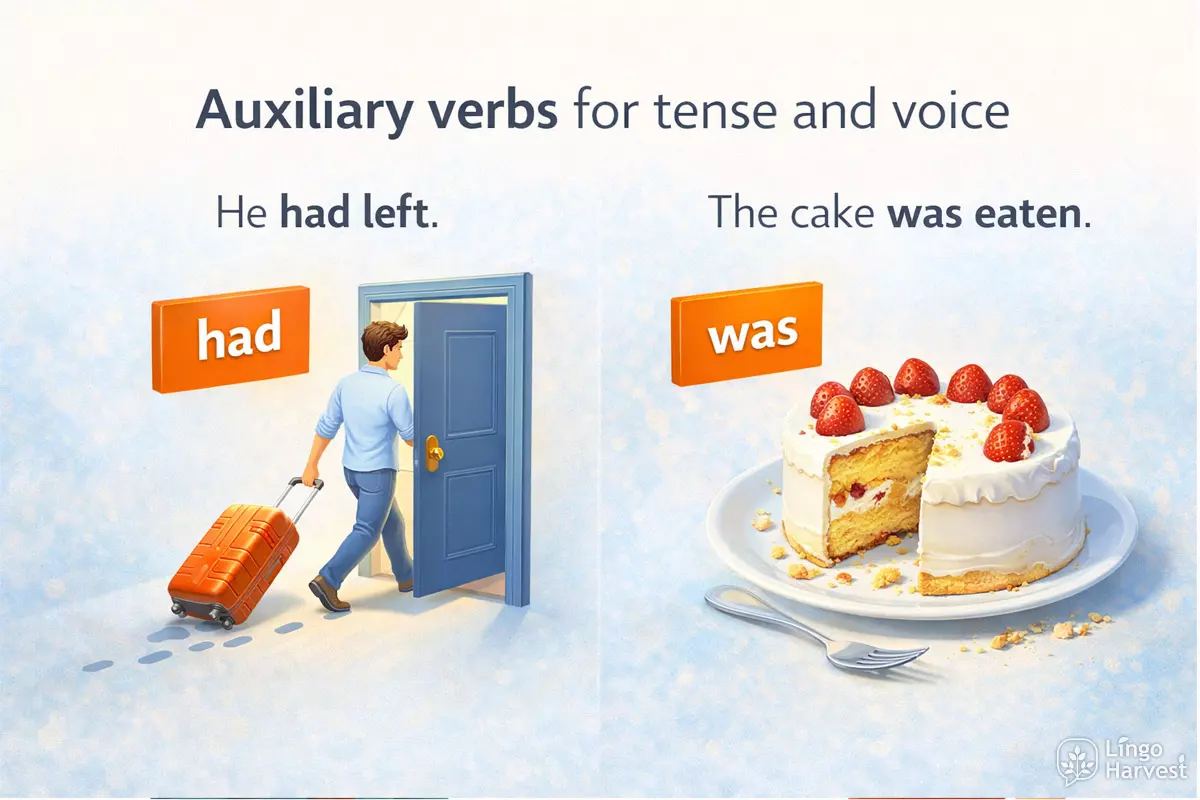
Modern English relies on these verbs for a remarkable range of verb forms. Here are several patterns where auxiliaries are essential:
- Do-support in negative statements: "She does not sing."
- Do-support in questions: "Did you see that?"
- Have for present perfect: "They have gone."
- Have for past perfect: "He had left."
- Be for passive voice: "The cake was eaten."
- Be for progressive aspect: "I am learning."
- Will for simple future: "You will succeed."
- Will for future continuous: "She will be waiting."
- Be + being + past participle: "The house is being built."
- Have + been + -ing: "We have been working."
- Do for emphasis: "I do like tea."
- Have + to + verb (obligation): "I have to leave."
This shift from inflection to auxiliary-based constructions is one of the defining features of the historical development of English verbs, enabling greater analytic clarity and flexibility in expressing time, aspect, and voice.
How irregular verbs survived historical change
Irregular verbs in English offer a fascinating window into the language’s past. While regular verbs tend to follow predictable patterns, the survival of irregular forms is the result of a complex interplay between frequency, analogy, and historical sound changes. Many of today’s irregular verbs trace their origins to Old English strong verbs, which formed their past tenses through internal vowel changes rather than by adding a simple ending.
Why some verbs resisted regularization
The most commonly used verbs in everyday speech—such as be, have, go, and come—have remained irregular because their frequency helped preserve traditional forms. When a word is used constantly, speakers are less likely to alter its structure, and children hear these forms so often that they learn them as exceptions. Less frequent verbs, by contrast, are more likely to become regular over time.
- High-frequency verbs retain their original, irregular patterns.
- Rare verbs often lose irregular forms and adopt regular endings.
- Sound changes sometimes created new irregularities or obscured old patterns.
- Analogy—where verbs imitate the forms of others—occasionally led to irregular verbs becoming regular, or vice versa.
Patterns and classes of irregularity
English irregular verbs are not random; many fit into traditional classes based on how their vowels change. Here’s a look at some representative patterns:
| Present | Past | Past Participle | Pattern Type |
|---|---|---|---|
| sing | sang | sung | i–a–u (ablaut) |
| begin | began | begun | i–a–u (ablaut) |
| drive | drove | driven | i–o–i (ablaut) |
| catch | caught | caught | vowel+consonant change |
| bring | brought | brought | vowel+consonant change |
| run | ran | run | vowel change only |
| cut | cut | cut | no change |
| go | went | gone | suppletion |
| be | was/were | been | suppletion |
| make | made | made | vowel+consonant change |
Forces shaping irregular verbs today
Language change continues, but the most entrenched irregular verbs remain, protected by their ubiquity and the persistence of traditional usage. Meanwhile, English learners and native speakers alike continue to memorize these forms, passing them on to new generations. While some irregular verbs may eventually become regular, the core group is likely to endure as a living reminder of English’s historical roots.
Major milestones in verb system development
English verbs have undergone significant transformations across centuries, reflecting shifts in both grammar and pronunciation. Understanding these key changes helps illustrate how the language moved from a highly inflected system to the more analytic structure we recognize today.
Old English: Strong vs. Weak Verbs
Early English distinguished between strong verbs, which formed their past tense and past participle through vowel changes (ablaut), and weak verbs, which relied on dental suffixes like -ed or -t. This period featured a rich array of verb endings, marking person, number, and tense explicitly.
- Strong verbs: sing → sang → sung
- Weak verbs: love → loved → loved
- Distinct endings for 1st, 2nd, 3rd person
- Multiple tense forms marked by inflection
Middle English: Simplification and Analogy
During the Middle English period, many complex verb endings were lost. Analogy led to the spread of weak verb patterns, causing some strong verbs to adopt regular endings. Periphrastic constructions, using auxiliary verbs, began to increase in frequency.
- Loss of many inflectional endings
- Emergence of do-support in questions and negatives
- Growth of continuous aspect (be + -ing)
- Increased use of modal verbs (can, shall, will)
Early Modern English: Auxiliaries and Tense Expansion
The rise of auxiliary verbs allowed for more nuanced expression of tense, aspect, and mood. The verb system expanded to include new perfect and progressive forms, and modal verbs acquired clearer functions.
- Development of the present perfect (have + past participle)
- Establishment of the future tense with will and shall
- Standardization of the progressive aspect (be + -ing)
- Use of do as a general auxiliary
Modern English: Regularization and Innovation
Contemporary usage has further regularized verb forms, though some irregularities persist. The verb system now relies more on word order and auxiliary verbs than on inflection. New forms and constructions continue to emerge, especially in informal varieties of English.
| Old English | Modern English | Change |
|---|---|---|
| Ic singe (I sing) | I sing | Loss of personal ending |
| Þu sungest (you sang) | You sang | Uniformity of verb forms |
| He hæfde gesungen (he had sung) | He had sung | Persistence of perfect aspect |
| Ic wille singan (I will sing) | I will sing | Modal verbs for future |
Summary of Key Changes
- Reduction of inflectional endings
- Regularization of past tense forms
- Expansion of auxiliary verb usage
- Development of progressive and perfect aspects
- Stabilization of word order for grammatical meaning
These successive shifts have shaped the flexible, yet relatively simple, verb system of present-day English, making it distinct from its Germanic relatives and earlier forms.
Homework: timeline and examples practice
Understanding how English verb forms have changed over time helps us appreciate the language’s flexibility and complexity. For practice, let’s explore a timeline of major developments, then use example sentences to spot these changes in context. These tasks will help reinforce how verbs evolved from Old English to Modern English.
Timeline of Key Changes in English Verb Forms
- Old English (c. 450–1150): Highly inflected verbs, multiple endings for person and number, strong (irregular) and weak (regular) verb classes.
- Middle English (c. 1150–1500): Loss of many inflectional endings, simplification of conjugations, emergence of -ed for past tense.
- Early Modern English (c. 1500–1700): Regularization of verbs, auxiliary verbs (“do”, “have”, “will”) become common in questions and negatives.
- Modern English (1700–present): Further regularization, most verbs use -ed for past tense, irregular verbs persist but are limited in number.
Practice: Match the Example to Its Period
Below are sample sentences using verb forms from different historical stages. Identify which period each belongs to.
- “Ic eom gān.”
- “He hath spoken.”
- “She went to town yesterday.”
- “Thou goest swiftly.”
- “They do not know the answer.”
- “Hwæt! Wē Gār-Dena in ġeār-dagum.”
- “And smale fowles maken melodye.”
- “Wherefore art thou Romeo?”
- “The experiment was conducted under controlled conditions.”
- “I shall return before nightfall.”
Show answers
- Old English
- Early Modern English
- Modern English
- Middle English
- Modern English
- Old English
- Middle English
- Early Modern English
- Modern English
- Early Modern English
Verb Form Comparison Table
Let’s compare how verbs changed from Old to Modern English using the verb “to speak” as an example:
| Period | Example Form | Notes |
|---|---|---|
| Old English | sprecan (infinitive), spræc (past singular) | Strong verb, multiple endings |
| Middle English | speken (infinitive), spak (past singular) | Inflections simplified, vowel change remains |
| Early Modern English | speak (infinitive), spoke (past) | Past tense standardized, “spoke” replaces “spak” |
| Modern English | speak (infinitive), spoke (past), spoken (past participle) | Current forms, participle in use |
Rewrite the Sentences
Rewrite each Modern English sentence below using an older verb form or structure, based on the timeline above.
- I have spoken to him.
- They do not know the answer.
- She goes quickly.
- We spoke yesterday.
- He has finished the work.
- You are mistaken.
- I will tell you the truth.
- They did not understand the message.
- She sees the problem clearly.
- We have completed the task.
Show answers
- I hath spoken to him. (Early Modern English)
- They know not the answer. (Early Modern / archaic negation)
- She goeth swiftly. (Middle / Early Modern English)
- We spake yesterday. (Middle English)
- He hath finished the work. (Early Modern English)
- Thou art mistaken. (Early Modern English, second person singular)
- I shall tell thee the truth. (Early Modern English)
- They understood not the message. (Early Modern / archaic word order)
- She seeth the problem clearly. (Middle / Early Modern English)
- We have fulfilled the task. (Early Modern English lexical choice)
Extra Challenge: List of Irregular Verbs That Survived
Try to write down as many common irregular verbs in Modern English as you can. Here are some to get started:
- be – was/were – been
- go – went – gone
- have – had – had
- see – saw – seen
- take – took – taken
- come – came – come
- give – gave – given
- find – found – found
- get – got – gotten/got
- write – wrote – written
- run – ran – run
- drink – drank – drunk
- sing – sang – sung
- swim – swam – swum
- break – broke – broken
- choose – chose – chosen
- begin – began – begun
- drive – drove – driven
By reviewing these timelines and examples, you’ll deepen your understanding of how English verb forms have shifted across the centuries.