Finite and Non-Finite Verbs in English Grammar

 This article defines finite and non-finite verbs, explains how finite verbs indicate tense and agreement, and describes types and functions of non-finite forms like infinitives, gerunds, and participles.
- What finite and non-finite verbs are
- How finite verbs show tense and agreement
- Types of non-finite forms: infinitives, gerunds, participles
- Functions of non-finite verbs in sentences
- Common mistakes with finite and non-finite forms
- Finite vs non-finite in complex sentences
- Typical learner problems and fixes
- Practice exercises on finite and non-finite verbs
Understanding verb behavior in English is essential for clear communication, particularly when differentiating between verbs that indicate tense and those that do not. By examining these two categories—finite verbs, which show tense, and non-finite verbs, which do not—learners can better grasp how sentences are structured and how meaning is conveyed. Recognizing these differences allows for more precise expression and helps avoid common grammatical errors, ultimately leading to improved writing and speaking skills.
What finite and non-finite verbs are
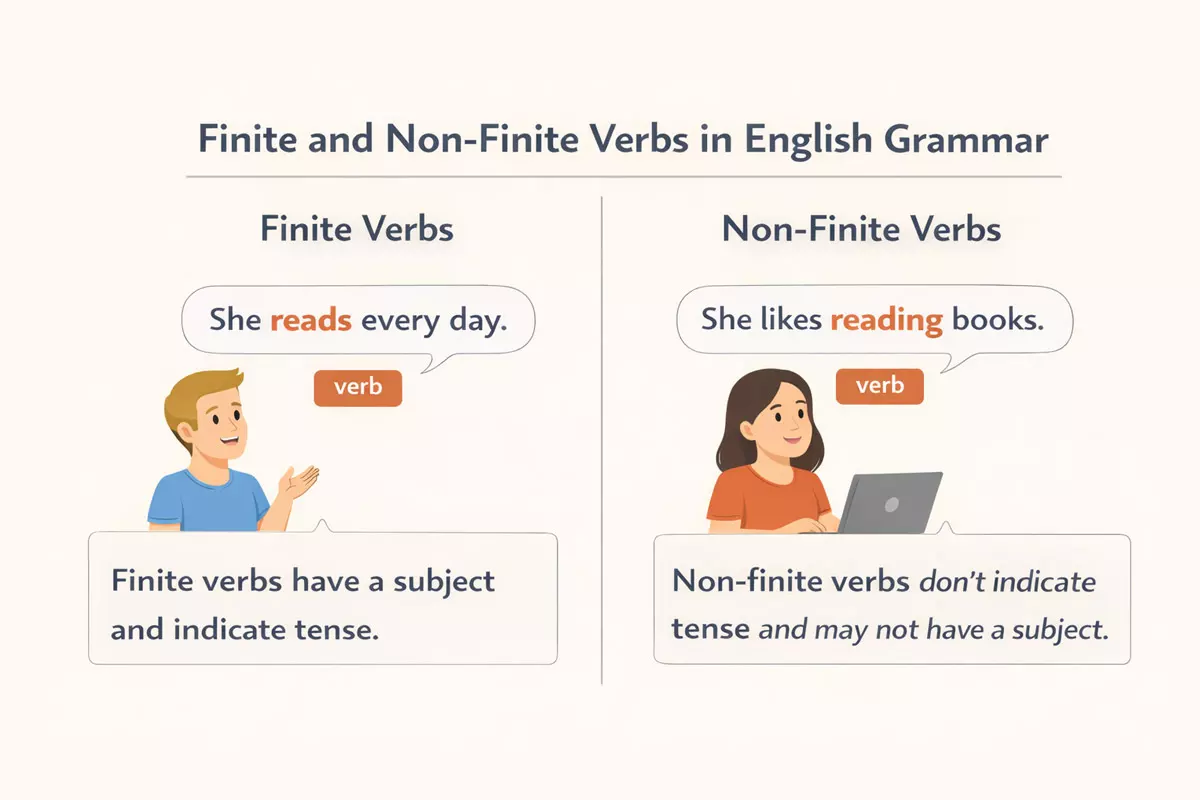
Understanding the difference between finite and non-finite verbs helps you analyze sentences and clarify meaning in English. At the most basic level, a finite verb shows tense (such as present or past), agrees with the subject, and can stand as the main verb of a sentence. In contrast, non-finite verbs do not show tense or subject agreement and cannot function as the main verb in an independent clause.
Finite verbs: definition and features
Finite verbs carry the grammatical information for tense (when something happens), person (who is doing the action), and number (singular or plural). This means they change form depending on the subject and the time of the action. They are essential for forming complete sentences. For example:
- She walks to school every day.
- They played football yesterday.
- I am reading a book.
In each case, the verb changes to match the subject and the tense.
Non-finite verbs: definition and forms
Non-finite verbs do not show tense, number, or person. Instead, they often act as nouns, adjectives, or adverbs in a sentence. There are three main types:
- Infinitives (to + base verb): to eat, to run, to be
- Gerunds (verb + -ing, used as nouns): eating, running, being
- Participles (present: -ing, past: -ed/-en): walking, eaten, taken
Examples:
- He likes to swim.
- Running is fun.
- The broken window was repaired.
Key differences at a glance
The following table summarizes the main contrasts:
| Finite Verbs | Non-Finite Verbs |
|---|---|
| Show tense (past, present, future) | Do not show tense |
| Agree with subject (person/number) | No subject-verb agreement |
| Can form a complete sentence | Cannot stand alone as main verb |
| Example: She runs. | Example: Running is healthy. |
| Required for independent clauses | Often used as nouns, adjectives, or adverbs |
Common examples for practice
Here are some more verbs in both forms to help you recognize them in context:
- Finite: eats, drove, was, sing, will go, has finished, do, saw, thinks, is coming
- Non-finite: eating, driven, to sing, gone, seeing, to have finished, having done, being, taken, to be
Recognizing whether a verb is finite or non-finite is crucial for understanding sentence structure, identifying subjects and predicates, and mastering more advanced grammar topics.
How finite verbs show tense and agreement
Finite verbs are central to expressing time and matching subjects in English sentences. Unlike non-finite forms, these verbs change their form to reflect when an action happens (tense) and who or what is doing it (agreement). This means that the verb adapts based on whether the subject is singular or plural and whether it refers to the first, second, or third person.
Tense: Placing Actions in Time
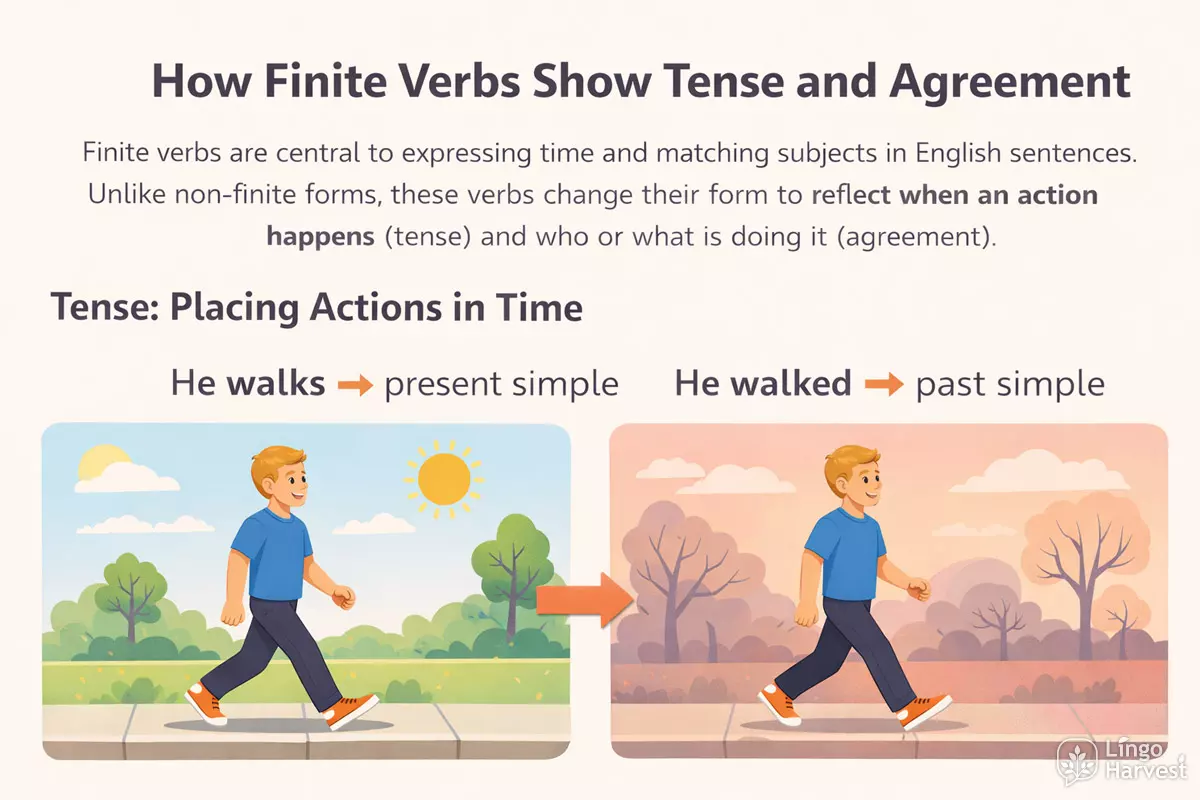
Tense is about when something occurs. English finite verbs mark tense with changes in their endings or with auxiliary verbs. For instance, regular verbs often add -ed for the past, while irregular verbs use unique forms (like went for go). The presence of tense is a defining feature of finite verbs.
- He walks → present simple
- He walked → past simple
- She is singing → present continuous
- They were waiting → past continuous
- They have eaten → present perfect
- She had finished → past perfect
- You will travel → future simple
- He is going to leave → future (going to)
- They will have arrived → future perfect
- She has been working → present perfect continuous
- He had been studying → past perfect continuous
- I would help → conditional
- The letter was written → past passive
- The work is being done → present continuous passive
Agreement: Matching Subject and Verb
Subject-verb agreement ensures the verb form aligns with the subject's number and person. This is most noticeable in the present tense, where third person singular subjects (he, she, it) typically require an -s ending.
- I run → he/she/it runs
- They play → he/she/it plays
- We have → he/she/it has
- You go → he/she/it goes
- I watch → he/she/it watches
- They study → he/she/it studies
- We do → he/she/it does
- I fix → he/she/it fixes
Common Finite Verb Patterns
Here is a comparison of how finite verbs change according to tense and agreement in English, using the verb to eat as an example:
| Subject | Present | Past | Present Perfect | Future |
|---|---|---|---|---|
| I | I eat | I ate | I have eaten | I will eat |
| He/She/It | He eats | He ate | He has eaten | He will eat |
| We/They | They eat | They ate | They have eaten | They will eat |
| You | You eat | You ate | You have eaten | You will eat |
Key Takeaways
- Finite verbs always show tense—past, present, or future.
- They change form to match the subject in number and person.
- Only the main verb in a simple English sentence is finite; other verbs (like infinitives or participles) do not show tense or agreement.
- Modal verbs (can, will, must) are finite because they indicate tense and agree with the subject.
- Agreement errors are common in writing, especially with compound or inverted subjects.
Recognizing these patterns makes it easier to construct clear, grammatically correct sentences, and to spot mistakes involving tense or subject-verb agreement.
Types of non-finite forms: infinitives, gerunds, participles
English verbs have several forms that do not show tense, number, or person. These are known as non-finite forms, and they function in different ways within sentences. The three main varieties are infinitives, gerunds, and participles. Each has specific uses and patterns you’ll see often in English grammar.
Infinitives
An infinitive is the base form of a verb, usually preceded by “to” (e.g., to eat, to run). Infinitives can act as nouns, adjectives, or adverbs. For example, in “She wants to learn,” the infinitive phrase acts as the object of the verb. Sometimes, the “to” is omitted (the bare infinitive), especially after modal verbs (can go, must see).
- to read → She likes to read before bed.
- to write → He wants to write a novel.
- to understand → They tried to understand the problem.
- to play → She hopes to play in the final.
- to help → He offered to help his friend.
- to discover → We want to discover something new.
- to finish → She decided to finish the report today.
- to begin → He was ready to begin the lesson.
- to watch → They plan to watch the match tonight.
- to explain → She tried to explain the rule clearly.
Gerunds
A gerund is the -ing form of a verb used as a noun. Gerunds can serve as the subject, object, or complement in a sentence. For example, in “Swimming is fun,” the gerund “swimming” is the subject. Gerunds are also common after certain verbs and prepositions (e.g., “enjoy reading,” “interested in learning”).
- eating → Eating late makes me tired.
- reading → Reading improves your vocabulary.
- singing → Singing helps her relax.
- traveling → Traveling teaches you about cultures.
- studying → Studying regularly brings better results.
- writing → Writing every day improves your style.
- teaching → Teaching requires patience.
- walking → Walking after dinner is healthy.
- listening → Listening carefully avoids mistakes.
- running → Running in the morning gives energy.
Participles
Participles come in two types: present participles (ending in -ing) and past participles (usually ending in -ed, -en, or other irregular forms). Both participle forms act as adjectives or parts of verb phrases. For instance, “The broken window” uses a past participle as an adjective, while “She is reading a book” uses a present participle in a continuous verb tense.
- Present participles: going, eating, laughing, dancing, sleeping
- Past participles: broken, eaten, written, seen, gone
| Form | Main Function | Example |
|---|---|---|
| Infinitive (to + base verb) | Noun, adjective, adverb | She hopes to win. |
| Gerund (-ing form) | Noun | Reading helps you learn. |
| Present participle (-ing form) | Adjective, verb tense | The crying child needs help. |
| Past participle (-ed/-en or irregular) | Adjective, verb tense | The broken vase was expensive. |
Understanding how infinitives, gerunds, and participles function will help you recognize their roles in sentences and use them more flexibly in your own writing. Each form contributes in unique ways, either by adding detail, connecting ideas, or shifting the focus from action to concept.
Functions of non-finite verbs in sentences
Non-finite verbs—such as infinitives, gerunds, and participles—serve diverse grammatical roles beyond simply expressing tense or subject agreement. Unlike finite forms, these verbals help add detail, indicate purpose or reason, and build more complex sentence structures. They allow for flexibility in combining ideas, making English both efficient and expressive.
Common Roles of Non-Finite Verbs
- Subjects: Gerunds and infinitives often act as the subject of a sentence. Example: Swimming is excellent exercise.
- Objects: These forms can function as direct objects. Example: She enjoys reading.
- Complements: Non-finite verbs may complete the meaning after certain verbs or adjectives. Example: He seems to know the answer.
- Adjectival modifiers: Participles describe nouns by adding information. Example: The broken window needs repair.
- Adverbial modifiers: Infinitives and participial phrases can modify verbs, indicating time, reason, or condition. Example: To win the prize, you must work hard.
- Objects of prepositions: Gerunds are frequently used after prepositions. Example: She is interested in learning French.
- Reduced relative clauses: Participles can shorten relative clauses. Example: The man standing by the door is my uncle.
- Expressing purpose: Infinitives often show why something is done. Example: He went to the store to buy bread.
- Expressing result or consequence: Participial phrases can indicate outcomes. Example: Left alone, the dog barked.
- Impersonal constructions: Infinitives are used in patterns like "It is important to arrive early."
Examples of Non-Finite Verb Uses
| Non-Finite Form | Example in a Sentence |
|---|---|
| Infinitive as subject | To travel broadens the mind. |
| Gerund as object | They suggested meeting earlier. |
| Present participle as adjective | The running water soothed her. |
| Past participle as reduced relative clause | The cake baked yesterday was delicious. |
| Infinitive as adverbial modifier | He paused to think. |
| Gerund as object of preposition | She is fond of dancing. |
Summary
Non-finite verb forms expand the expressive power of English sentences. By functioning as subjects, objects, modifiers, and more, they weave together ideas and clarify relationships. Recognizing these patterns not only improves your grammar but also helps you understand and produce richer, more varied sentences.
Common mistakes with finite and non-finite forms
Mixing up verbs that function as the main part of a clause with those that do not is a frequent source of confusion for learners. Many errors arise because the difference isn’t always obvious at first glance. Students often struggle with identifying when a verb should agree with the subject or when it should remain unchanged, especially in complex sentences.
Frequent areas of confusion
- Using a participle or infinitive when a main verb is required
- Forgetting subject-verb agreement with finite verbs
- Adding tense to non-finite forms (e.g., “to walked” instead of “to walk”)
- Misplacing non-finite clauses in a sentence, leading to awkward or unclear meaning
- Confusing gerunds with present participles
- Incorrectly identifying the verb form in embedded clauses
- Omitting auxiliary verbs in complex tenses
- Using non-finite forms as the only verb in a main clause
- Switching tenses within a sentence unnecessarily
- Mistaking infinitives for finite verbs in questions or negatives
- Overusing finite verbs in subordinate clauses where non-finite forms are better
- Using bare infinitives after verbs that require “to”
- Redundancy by repeating the subject in non-finite clauses
Comparing finite and non-finite verb errors
| ❌ Error Example | ✅ Correction |
|---|---|
| He enjoys to swim in the morning. | He enjoys swimming in the morning. |
| She wanted that she goes home early. | She wanted to go home early. |
| To walked in the park is relaxing. | To walk in the park is relaxing. |
| Reading books helps you learning. | Reading books helps you learn. |
| He is interesting in play football. | He is interested in playing football. |
| I want she comes with us. | I want her to come with us. |

Tips to avoid mistakes
- Check if the verb shows tense and agrees with the subject—if so, it’s finite.
- Remember, only finite verbs can be the main verb in an independent clause.
- Use gerunds (verb + -ing) after certain verbs like “enjoy,” “avoid,” or “consider.”
- After modal verbs (“can,” “should,” etc.), use the base form, not -ing or “to” forms.
- Infinitives (“to” + verb) often follow adjectives, certain verbs, and “too/enough” constructions.
- Practice identifying finite and non-finite forms in real sentences to improve accuracy.
Understanding these typical pitfalls makes it easier to write clear, correct sentences and build more advanced grammar skills.
Finite vs non-finite in complex sentences
When dealing with complex sentences in English, verbs can function in different ways depending on whether they are finite or non-finite. Finite verbs typically act as the main verb in an independent clause, showing tense and agreeing with the subject. In contrast, non-finite verbs (such as infinitives, participles, and gerunds) don’t indicate tense or subject agreement, and often appear in subordinate clauses or as part of verb phrases.
How finite and non-finite verbs interact in clauses
In multi-clause sentences, the main clause almost always contains a finite verb, while subordinate clauses or phrases can include non-finite forms. This structure allows English speakers to add detail, express time relationships, or show cause and effect without repeating the main verb’s tense or subject.
- Finite verb in main clause + non-finite verb in subordinate clause: She plans to travel next year.
- Non-finite participle phrase: Having finished his homework, he went outside.
- Gerund as subject: Running is good for health.
- Infinitive of purpose: She called to ask a question.
- Adverbial participle: He sat reading a book.
- Relative clause with finite verb: The man who lives next door is friendly.
- Infinitive as object: They want to win.
- Finite verb with non-finite complement: I saw her dancing.
- Non-finite clause after preposition: She is interested in learning French.
- Finite verb in reported speech: He said that he was leaving.
- Absolute phrase: The weather permitting, we will go hiking.
- Non-finite clause expressing reason: Not knowing the answer, she remained silent.
Comparison of finite and non-finite verb roles
| Finite Verb | Non-Finite Verb |
|---|---|
| Shows tense (e.g., walks, walked) | No tense (e.g., walking, to walk) |
| Agrees with subject | No subject agreement |
| Main verb in a clause | Can act as noun, adjective, or adverb |
| Needed for a complete sentence | Often found in phrases or subordinate clauses |
Recognizing how these verb forms function together helps you build sentences that are both varied and precise. Mastering the distinction is especially important for writing clear, nuanced English, as it allows for smoother combinations of ideas within a single sentence.
Typical learner problems and fixes
Many English learners find it tricky to distinguish between finite and non-finite verbs, especially when forming sentences or identifying verb forms in context. The difference is important because it affects tense, agreement, and sentence structure. Let's look at common stumbling blocks and practical ways to overcome them.
Confusing Finite and Non-Finite Forms
One major source of confusion is recognizing whether a verb is finite (showing tense and agreeing with the subject) or non-finite (not showing tense or agreement). This is especially challenging with verbs like to be, to have, and modal verbs. Learners often mix up gerunds, infinitives, and participles.
| Problem | Example & Correction |
|---|---|
| Using a non-finite verb as the main verb in a sentence | ❌ She going to school. ✅ She is going to school. |
| Confusing gerunds and participles | ❌ I am interesting in music. ✅ I am interested in music. |
| Incorrect infinitive usage after certain verbs | ❌ I enjoy to swim. ✅ I enjoy swimming. |
| Subject-verb agreement with finite verbs | ❌ He go to work. ✅ He goes to work. |
| Misplacing non-finite clauses | ❌ Walking to the park, the rain started. ✅ While I was walking to the park, the rain started. |
Common Error Patterns
- Omitting the auxiliary verb in continuous or perfect tenses
- Using a base verb form when a gerund or infinitive is required
- Incorrectly matching subject and verb in number or tense
- Placing participial phrases incorrectly, leading to dangling modifiers
- Choosing the wrong non-finite form after certain expressions (e.g., "look forward to meeting" vs. "look forward to meet")
- Overusing infinitives where gerunds are needed, and vice versa
- Confusing regular and irregular participle forms
- Forgetting that non-finite verbs do not show tense or subject agreement
Strategies for Improvement
To get better at identifying and using finite and non-finite verbs:
- Practice identifying the main verb in a sentence and checking if it shows tense and agrees with the subject.
- Memorize which verbs are followed by gerunds versus infinitives.
- Review common irregular past participles and their correct usage.
- Rewrite sentences, replacing incorrect verb forms with the correct finite or non-finite version.
- Pay attention to how non-finite clauses are attached to main clauses, avoiding misplaced modifiers.
- Use grammar checking tools to spot subject-verb agreement and tense issues.
With regular practice and careful attention to context, learners can gradually master the distinction between these verb types and express themselves more accurately in English.
Practice exercises on finite and non-finite verbs
Understanding how to distinguish between finite and non-finite verbs is essential for sentence analysis and correct verb usage. The following interactive tasks and examples will help you apply what you've learned and recognize these verb forms in context.
Identify the Verb Form
Read each sentence below and decide whether the highlighted verb is finite or non-finite.
- She runs every morning before breakfast.
- Walking to school is good exercise.
- The children were playing in the park.
- He hopes to win the prize.
- We visited the museum last weekend.
- The book placed on the table belongs to me.
- They are studying for the test.
- Reading before bed helps me relax.
- She has written three emails today.
- The man waiting outside is my teacher.
Show answers
- Finite
- Non-finite
- Finite
- Non-finite
- Finite
- Non-finite
- Finite
- Non-finite
- Finite
- Non-finite
Rewrite the Sentences
Rewrite each sentence, changing the finite verb to a non-finite verb or vice versa as indicated.
- He eats an apple. (Change to non-finite)
- To swim in the lake is fun. (Change to finite)
- The dog barked loudly. (Change to non-finite)
- Having finished his homework, Tom went out. (Change to finite)
- She reads every evening. (Change to non-finite)
- To travel alone can be exciting. (Change to finite)
- The baby cried loudly. (Change to non-finite)
- Being tired, he went to bed early. (Change to finite)
- They work in an office. (Change to non-finite)
- To learn new languages is useful. (Change to finite)
Show answers
- He likes eating an apple.
- She swims in the lake for fun.
- The dog kept barking loudly.
- Tom finished his homework and went out.
- She enjoys reading every evening.
- She travels alone quite often.
- The baby started crying loudly.
- He was tired, so he went to bed early.
- They like working in an office.
- People learn new languages for many reasons.
Examples of Finite and Non-Finite Verbs in Sentences
Here are more examples to help you recognize both types of verb forms. Study the sentences and notice how the verb form functions in each.
- They study English every day. (finite)
- Studying English improves your skills. (non-finite)
- Maria was reading a novel. (finite)
- He wants to travel the world. (non-finite)
- The letter sent yesterday was important. (non-finite)
- We are ready to start. (finite)
- She enjoys singing. (non-finite)
- They have finished their project. (finite)
- The boy playing outside is my brother. (non-finite)
- I walked to the store. (finite)
Quick Comparison Table
| Finite Verb Examples | Non-Finite Verb Examples |
|---|---|
| She writes letters. | Writing letters is her hobby. |
| They have eaten dinner. | They left after eating dinner. |
| I am tired. | To be tired is normal after work. |
| He walks home. | Walked home, he felt happy. |
| We play chess. | Playing chess helps concentration. |
Practice: Spot the Non-Finite Verb
In each sentence, identify the non-finite verb(s).
- After finishing his meal, John left the restaurant.
- She wants to join the club this year.
- The cake baked by my mother was delicious.
- I saw him running down the street.
- Before leaving the house, she checked the door.
- He decided to study medicine at university.
- The letter written by her arrived yesterday.
- We heard them singing in the hall.
- After closing the window, she sat down.
- The man standing near the door is my uncle.
Show answers
- finishing
- to join
- baked
- running
- leaving
- to study
- written
- singing
- closing
- standing
By practicing with these exercises, you can sharpen your ability to distinguish between finite and non-finite verb forms in English sentences. This skill is valuable for both writing and grammar analysis.