From Active to Passive: How to Rewrite Sentences

 Learn how to rewrite active sentences in passive voice step by step: find the object, move it to the front, change the verb form, handle by-phrases, and avoid common grammar mistakes.
- What active-to-passive rewriting means
- Step 1: Find the object of the active sentence
- Step 2: Move the object to subject position
- Step 3: Change the verb into passive form
- Step 4: Add or remove the by-phrase
- Active to passive tense table
- Rewriting questions, negatives, and modals
- Sentences you cannot rewrite naturally
- Common active-to-passive rewriting mistakes
- Homework: active to passive practice
- FAQ: rewriting active sentences in passive voice
Rewriting active sentences in passive voice is one of the most useful grammar skills in English. It helps you understand sentence structure, control focus, write more formally when needed, and avoid common grammar mistakes in tests, essays, reports, and workplace writing.
The basic idea is simple: in an active sentence, the subject does the action. In a passive sentence, the subject receives the action. But when you actually rewrite sentences, several things change at the same time: the object moves, the verb form changes, the doer may become a by-phrase, and the tone of the sentence may become more formal or neutral.
- Active: The assistant printed the documents.
- Passive: The documents were printed by the assistant.
The action is the same, but the sentence now focuses on the documents, not the assistant. This is why active-to-passive rewriting is not only a grammar exercise. It is also a way to change what the reader notices first.
What active-to-passive rewriting means
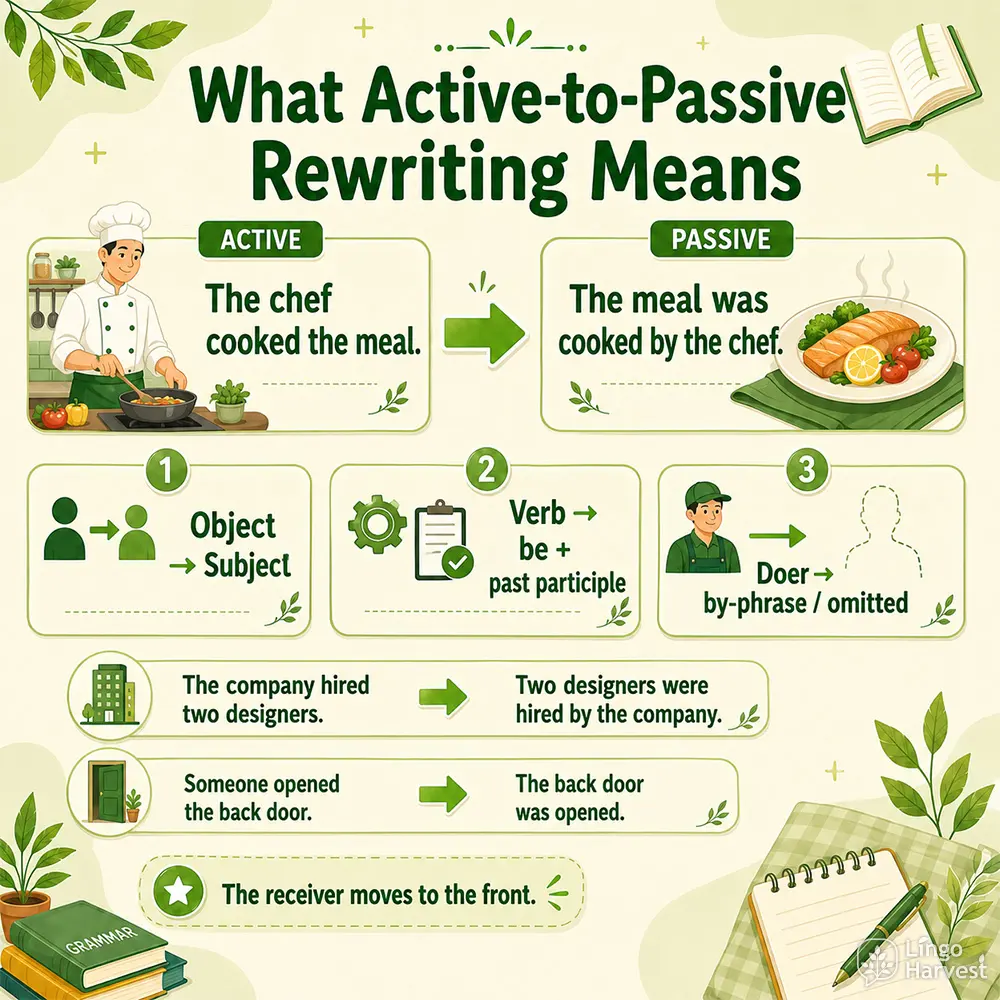
To rewrite an active sentence in passive voice, you usually take the object of the active sentence and make it the subject of the new sentence.
- Active: The chef cooked the meal.
- Passive: The meal was cooked by the chef.
In the active sentence, the chef is the subject and does the action. In the passive sentence, the meal becomes the subject, but it receives the action. This is the key change.
If you already know the general difference between active and passive voice, rewriting becomes easier because you understand why the sentence changes, not just how it changes.
| Active sentence part | Passive sentence part | Example | What happens? |
|---|---|---|---|
| Subject / doer | By-phrase or omitted agent | The chef → by the chef | The doer moves later or disappears. |
| Active verb | be + past participle | cooked → was cooked | The verb changes into passive structure. |
| Object / receiver | Subject | the meal → The meal | The receiver moves to the front. |
Here are three quick examples:
- Active: The company hired two designers. → Passive: Two designers were hired by the company.
- Active: Someone opened the back door. → Passive: The back door was opened.
- Active: The teacher corrected the essays. → Passive: The essays were corrected by the teacher.
Notice that the passive sentence does not always need by someone. If the doer is unknown or unimportant, English often leaves it out.
Step 1: Find the object of the active sentence
The first step is to find the object. This is the word or phrase that receives the action in the active sentence.
Ask this question:
Subject + verb + what / whom?
- The artist painted what? → the portrait
- The manager called whom? → the client
- The storm damaged what? → the roof
Now we can rewrite:
- Active: The artist painted the portrait. → Passive: The portrait was painted by the artist.
- Active: The manager called the client. → Passive: The client was called by the manager.
- Active: The storm damaged the roof. → Passive: The roof was damaged by the storm.
Teacher tip: if you cannot find a clear object, stop before rewriting. Passive voice normally needs an object in the active sentence. Without an object, there is usually nothing to move to the front.
This is why it is useful to understand transitive and intransitive verbs. Transitive verbs take objects and can often become passive. Intransitive verbs do not take direct objects, so they usually cannot be rewritten in passive voice.
| Active sentence | Object? | Can we rewrite it in passive? | Passive version |
|---|---|---|---|
| The team finished the project. | the project | Yes | The project was finished by the team. |
| The baby slept peacefully. | No direct object | No normal passive | Not natural: The baby was slept peacefully. |
| The driver stopped the car. | the car | Yes | The car was stopped by the driver. |
| The accident happened yesterday. | No direct object | No normal passive | Not natural: The accident was happened yesterday. |
Step 2: Move the object to subject position
After you find the object, move it to the beginning of the sentence. It becomes the new subject.
- Active: The technician repaired the laptop.
- Object: the laptop
- Passive start: The laptop...
Now continue with the passive verb:
- Passive: The laptop was repaired by the technician.
Here are more examples:
- Active: The students cleaned the classroom. → Passive start: The classroom... → Passive: The classroom was cleaned by the students.
- Active: The director approved the plan. → Passive start: The plan... → Passive: The plan was approved by the director.
- Active: Someone deleted the file. → Passive start: The file... → Passive: The file was deleted.
The new subject must agree with the form of be. This means singular subjects usually take is or was, while plural subjects usually take are or were.
| Active object | Passive subject | Correct passive verb | Example |
|---|---|---|---|
| the letter | The letter | was sent | The letter was sent yesterday. |
| the letters | The letters | were sent | The letters were sent yesterday. |
| the answer | The answer | is checked | The answer is checked automatically. |
| the answers | The answers | are checked | The answers are checked automatically. |
Do not keep the old object after the passive verb. Once the object moves to the front, it should not appear again as an object.
- ❌ “The laptop was repaired it by the technician.”
- ✅ “The laptop was repaired by the technician.”
- ❌ “The classroom was cleaned it by the students.”
- ✅ “The classroom was cleaned by the students.”
Step 3: Change the verb into passive form
The passive verb form is:
be + past participle
The tense is shown by the form of be. The main verb becomes the past participle.
- repair → was repaired
- write → was written
- send → was sent
- choose → was chosen
- build → was built
Many students make mistakes because they move the object correctly but do not change the verb correctly. If you need a broader overview of forms, review passive voice verb forms, because tense control is the hardest part of active-to-passive rewriting.
Present simple
- Active: They clean the office every day.
- Passive: The office is cleaned every day.
- Active: The company sells these products online.
- Passive: These products are sold online.
Past simple
- Active: The mechanic fixed the car.
- Passive: The car was fixed by the mechanic.
- Active: The workers painted the walls.
- Passive: The walls were painted by the workers.
Present perfect
- Active: The team has completed the task.
- Passive: The task has been completed by the team.
- Active: Someone has changed the password.
- Passive: The password has been changed.
Future with will
- Active: They will announce the results tomorrow.
- Passive: The results will be announced tomorrow.
- Active: The school will send the certificates next week.
- Passive: The certificates will be sent next week.
Step 4: Add or remove the by-phrase
The old active subject becomes the agent in passive voice. If you include it, use by.
- Active: The architect designed the building.
- Passive: The building was designed by the architect.
But do not add the by-phrase automatically. In many passive sentences, the agent is not needed.
| Active sentence | Passive sentence | Keep by-phrase? | Reason |
|---|---|---|---|
| Someone stole my phone. | My phone was stolen. | No | The doer is unknown. |
| The police arrested the man. | The man was arrested. | Usually no | The doer is obvious. |
| People speak English in many countries. | English is spoken in many countries. | No | “By people” adds nothing useful. |
| A famous scientist discovered the method. | The method was discovered by a famous scientist. | Yes | The agent is important. |
Use by when the doer gives useful, surprising, or necessary information:
- The song was written by a ten-year-old child.
- The bridge was designed by a local engineer.
- The mistake was found by a student, not by the teacher.
Do not confuse by with with. In passive sentences, by usually introduces the doer. With usually introduces a tool, instrument, or material. This is explained in more detail in the guide to prepositions in passive voice.
- ✅ “The letter was written by Emma.” Emma did the action.
- ✅ “The letter was written with a fountain pen.” The pen was the tool.
- ❌ “The letter was written by a fountain pen.” This sounds as if the pen acted like a person.
Active to passive tense table
When rewriting sentences, keep the original tense. Do not change past simple into present simple or present perfect into past simple unless the meaning also changes. The tense should stay the same, but the verb structure becomes passive.
| Tense / form | Active sentence | Passive sentence | Passive pattern |
|---|---|---|---|
| Present simple | They check the machines daily. | The machines are checked daily. | am / is / are + past participle |
| Past simple | They checked the machines yesterday. | The machines were checked yesterday. | was / were + past participle |
| Present continuous | They are checking the machines now. | The machines are being checked now. | am / is / are being + past participle |
| Past continuous | They were checking the machines at noon. | The machines were being checked at noon. | was / were being + past participle |
| Present perfect | They have checked the machines. | The machines have been checked. | has / have been + past participle |
| Past perfect | They had checked the machines before the test. | The machines had been checked before the test. | had been + past participle |
| Future with will | They will check the machines tomorrow. | The machines will be checked tomorrow. | will be + past participle |
| Going to future | They are going to check the machines. | The machines are going to be checked. | am / is / are going to be + past participle |
Here are three important points from the table:
- The past participle stays the same: checked, written, sent, built.
- The form of be changes according to the tense.
- The object of the active sentence becomes the subject of the passive sentence.
With continuous forms, remember to add being:
- ❌ “The machines are checked now” if you mean the action is happening right now.
- ✅ “The machines are being checked now.”
- ❌ “The road was repaired when I passed.” if you mean the repair was in progress at that moment.
- ✅ “The road was being repaired when I passed.”
Rewriting questions, negatives, and modals
Active-to-passive rewriting becomes more challenging when the sentence is a question, a negative sentence, or a modal sentence. The same rules still apply, but word order matters more.
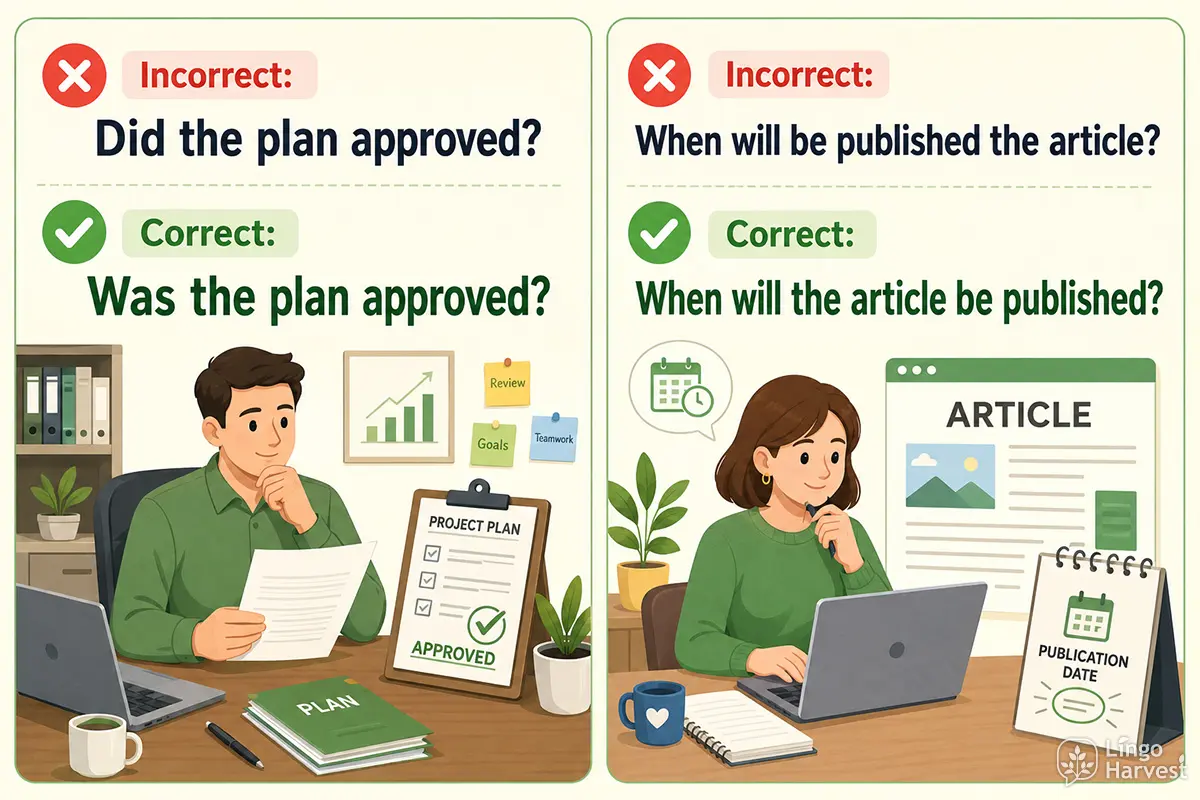
Rewriting questions
In passive questions, the auxiliary verb goes before the subject.
- Active: Did they approve the plan?
- Passive: Was the plan approved?
- Active: When will they publish the article?
- Passive: When will the article be published?
- Active: Why did they cancel the meeting?
- Passive: Why was the meeting cancelled?
Notice that the passive question uses the passive auxiliary pattern:
- Was the plan approved?
- Will the article be published?
- Has the report been checked?
Rewriting negative sentences
In negative passive sentences, not usually goes after the first auxiliary verb.
- Active: They did not invite us.
- Passive: We were not invited.
- Active: The company has not paid the invoice.
- Passive: The invoice has not been paid.
- Active: They will not change the rules.
- Passive: The rules will not be changed.
Rewriting modal sentences
With modal verbs, use this passive pattern:
modal + be + past participle
- Active: You must complete the form.
- Passive: The form must be completed.
- Active: They should review the instructions.
- Passive: The instructions should be reviewed.
- Active: We can solve the problem quickly.
- Passive: The problem can be solved quickly.
Modal passive structures are common in rules, instructions, workplace policies, academic English, and formal notices. For more examples, see passive modal verbs.
| Active modal sentence | Passive modal sentence | Meaning |
|---|---|---|
| You must submit the application today. | The application must be submitted today. | Requirement |
| They should clean the equipment after use. | The equipment should be cleaned after use. | Advice / rule |
| We can open the file on any device. | The file can be opened on any device. | Possibility |
| They may delay the flight. | The flight may be delayed. | Formal possibility |
Sentences you cannot rewrite naturally
Not every active sentence can become a natural passive sentence. Passive voice usually requires a direct object. If the verb does not take a direct object, passive rewriting often creates an incorrect sentence.
1. Intransitive verbs
- ❌ “The accident was happened yesterday.”
- ✅ “The accident happened yesterday.”
- ❌ “The airport was arrived at by the tourists.”
- ✅ “The tourists arrived at the airport.”
- ❌ “The bed was slept by the child.”
- ✅ “The child slept in the bed.”
2. Linking verbs
Verbs such as be, seem, become, and feel usually do not form passive voice in the normal active-to-passive way.
- ❌ “Happy was seemed by her.”
- ✅ “She seemed happy.”
- ❌ “A doctor was become by him.”
- ✅ “He became a doctor.”
3. Sentences where passive sounds unnatural
Some passive sentences are grammatically possible but stylistically poor. If active voice is clearer, use active voice.
- Heavy: “A decision was made by the team to restart the project.”
- Clearer: “The team decided to restart the project.”
- Heavy: “A suggestion was made by Anna during the meeting.”
- Clearer: “Anna suggested something during the meeting.”
Good rewriting is not about forcing every sentence into passive voice. It is about knowing when passive voice is possible and when it is useful.
Common active-to-passive rewriting mistakes
Here are the most common mistakes students make when rewriting active sentences in passive voice.
1. Forgetting be
The past participle cannot usually stand alone in passive voice. You need the correct form of be.
- ❌ “The window broken yesterday.” → ✅ “The window was broken yesterday.”
- ❌ “The documents signed this morning.” → ✅ “The documents were signed this morning.”
- ❌ “The room cleaned before the guests arrived.” → ✅ “The room was cleaned before the guests arrived.”
2. Using the wrong participle
Passive voice uses the past participle, not the base verb.
- ❌ “The email was send this morning.” → ✅ “The email was sent this morning.”
- ❌ “The report was write by the assistant.” → ✅ “The report was written by the assistant.”
- ❌ “The money was stole from the office.” → ✅ “The money was stolen from the office.”
3. Repeating the object
When the object becomes the subject, do not repeat it later in the sentence.
- ❌ “The cake was eaten it by the children.” → ✅ “The cake was eaten by the children.”
- ❌ “The car was repaired it yesterday.” → ✅ “The car was repaired yesterday.”
- ❌ “The file was deleted it by mistake.” → ✅ “The file was deleted by mistake.”
4. Choosing the wrong form of be
The passive subject controls the form of be.
- ❌ “The letters was sent yesterday.” → ✅ “The letters were sent yesterday.”
- ❌ “The letter were sent yesterday.” → ✅ “The letter was sent yesterday.”
- ❌ “The answers is checked automatically.” → ✅ “The answers are checked automatically.”
5. Placing adverbs awkwardly
Adverbs often go between the auxiliary and the past participle, or at the end of the sentence. This is a common issue in adverb placement in passive voice.
- ✅ “The contract was carefully reviewed.”
- ✅ “The contract was reviewed carefully.”
- ❌ “The contract carefully was reviewed.”
- ✅ “The issue has been fully explained.”
- ✅ “The issue has been explained fully.”
- ❌ “The issue has fully been explained.” This may sound awkward in many contexts.
6. Using passive when active is better
Passive voice is useful, but it can make writing heavy if the doer is important and known.
- Too heavy: “The final answer was given by Maria.” → Clearer: “Maria gave the final answer.”
- Too indirect: “The mistake was noticed by the editor.” → Clearer: “The editor noticed the mistake.”
- Too formal: “The new rule was explained by the teacher.” → Clearer: “The teacher explained the new rule.”
Homework: active to passive practice
1. Rewrite Active Sentences in Passive Voice
Rewrite each active sentence in passive voice. Use a by-phrase only when it sounds useful.
- The technician repaired the computer.
- Someone stole my bicycle.
- The company will announce the results tomorrow.
- The teacher has checked the homework.
- The storm damaged several houses.
- A famous writer wrote this story.
- They are cleaning the windows now.
- The chef prepared the soup.
- The committee approved the proposal.
- People speak English in many countries.
Show answers
- The computer was repaired by the technician.
- My bicycle was stolen.
- The results will be announced tomorrow.
- The homework has been checked by the teacher.
- Several houses were damaged by the storm.
- This story was written by a famous writer.
- The windows are being cleaned now.
- The soup was prepared by the chef.
- The proposal was approved by the committee.
- English is spoken in many countries.
2. Choose the Correct Passive Form
Choose the correct passive form for each sentence.
- The message ___ yesterday. (sent / was sent / was send)
- The rooms ___ every morning. (clean / are cleaned / was cleaned)
- The project ___ next month. (will finish / will be finished / will finished)
- The documents ___ already. (have signed / have been signed / have been sign)
- The bridge ___ right now. (is repaired / is being repaired / has repaired)
- The answer ___ carefully. (should check / should be checked / should checked)
- The report ___ before the meeting started. (had been printed / had printed / was print)
- The new rules ___ soon. (are going to announce / are going to be announced / announced)
- The office ___ by the manager yesterday. (was locked / locked / was lock)
- The emails ___ automatically every night. (send / are sent / are send)
Show answers
- was sent
- are cleaned
- will be finished
- have been signed
- is being repaired
- should be checked
- had been printed
- are going to be announced
- was locked
- are sent
3. Spot the Error
Some of the following passive sentences contain mistakes. Find and correct any errors:
- The package was delivered this morning.
- The window broken last night.
- The report was write by an expert.
- The meeting will be postponed.
- The accident was happened yesterday.
- The files have been deleted.
- The form must completed today.
- The letters were sent yesterday.
- The car was repaired it by the mechanic.
- The contract was carefully reviewed.
Show answers
- Correct
- The window was broken last night.
- The report was written by an expert.
- Correct
- The accident happened yesterday.
- Correct
- The form must be completed today.
- Correct
- The car was repaired by the mechanic.
- Correct
FAQ: rewriting active sentences in passive voice
1. How do you change active voice to passive voice?
Find the object of the active sentence, move it to the subject position, change the verb to be + past participle, and add a by-phrase only if the doer is important.
2. What is the formula for active to passive rewriting?
The basic pattern is: active object + be + past participle + by + active subject. For example, “The chef cooked the meal” becomes “The meal was cooked by the chef.”
3. Do I always need to include by in passive voice?
No. Use by only when the doer is important, surprising, or necessary. If the doer is unknown, obvious, or unimportant, the by-phrase is usually omitted.
4. Can every active sentence become passive?
No. Passive voice normally needs a direct object. Sentences with verbs like happen, arrive, sleep, and die usually cannot be rewritten in passive voice naturally.
5. What happens to the tense in passive voice?
The tense stays the same, but it appears in the form of be. For example, present simple becomes is / are done, past simple becomes was / were done, and present perfect becomes has / have been done.
6. How do you rewrite modal sentences in passive voice?
Use modal + be + past participle. For example, “You must complete the form” becomes “The form must be completed.”
7. What is the most common mistake in active-to-passive rewriting?
The most common mistake is forgetting the verb be. Learners often write “The letter sent yesterday” instead of the correct passive form: “The letter was sent yesterday.”
8. When should I not rewrite a sentence in passive voice?
Do not rewrite a sentence in passive voice if active voice is clearer, more direct, or more natural. If the doer is important and known, active voice is often the better choice.