Be + Past Participle: The Core Passive Pattern

 Here we how be + past participle forms the passive voice and how be changes with tense, number, and subject. It also explains regular and irregular participles, passive statements, negatives and questions, common mistakes, practice, and an FAQ.
- Why be + past participle creates the passive voice
- How be changes for tense, number, and subject
- Regular and irregular past participles in passive forms
- Be + past participle vs simple past verb forms
- How to build affirmative passive sentences
- Negative passive sentences with not after be
- Passive questions with be before the subject
- Common mistakes with missing be or wrong participles
- Sentence-building practice with be + past participle
- FAQ
One of the easiest ways to understand the English passive voice is to look at the pattern be + past participle. You see it in everyday sentences such as “The door is closed,” “My bag was stolen,” “The report has been finished,” and “The results will be announced tomorrow.”
This pattern is practical because it changes the focus of the sentence. Instead of putting attention on the person who does the action, English often puts attention on the person or thing affected by the action. Once learners understand what be does and what the past participle does, passive sentences become much easier to build, read, and correct.
Why be + past participle creates the passive voice
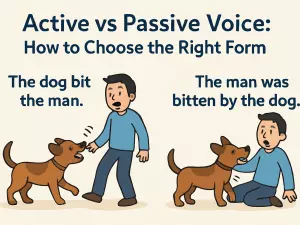
The passive voice is used when the subject receives an action instead of doing it. In the sentence “The kitchen was cleaned,” the kitchen did not clean anything. It received the action. The person who cleaned it may be unknown, obvious, or simply not important.
The pattern has two main parts. The verb be carries the grammar of the sentence: tense, number, agreement, and question or negative form. The past participle carries the main action meaning: cleaned, written, broken, sent, made, chosen. Together, they create the passive structure.
- Someone cleaned the kitchen. → The kitchen was cleaned.
- The company sent the email. → The email was sent.
- People speak English here. → English is spoken here.
In each passive sentence, the receiver moves to the front. This is the key difference between active and passive voice. For a wider comparison of focus and sentence meaning, see the guide to active and passive voice.
| Sentence | Voice | Subject role | Focus |
|---|---|---|---|
| Someone closed the door. | Active | The subject does the action. | The doer |
| The door was closed. | Passive | The subject receives the action. | The result |
| The teacher corrected the tests. | Active | The subject does the action. | The teacher |
| The tests were corrected. | Passive | The subject receives the action. | The tests |
The passive is especially common when the doer is unknown, obvious, or not worth mentioning.
- Unknown doer: My bike was taken last night.
- Obvious doer: The suspect was arrested. We normally assume the police did it.
- Unimportant doer: These products are made in Vietnam.
Teacher note: Many learners think passive voice is only for formal writing. In reality, native speakers use it every day: “Your order has been shipped,” “No pets are allowed,” “I was told to wait.”
How be changes for tense, number, and subject

The past participle usually stays the same, but be changes. This is the part many learners underestimate. If the subject is singular, plural, present, past, future, or perfect, the form of be must show that clearly.
Compare these examples:
- The room is cleaned every day.
- The rooms are cleaned every day.
- The room was cleaned yesterday.
- The rooms were cleaned yesterday.
- The room has been cleaned already.
The main verb is still the past participle cleaned, but the auxiliary changes: is, are, was, were, has been. This is why a good understanding of passive voice verb forms is so important when writing or correcting passive sentences.
| Tense or form | Passive pattern | Example |
|---|---|---|
| Present simple | am / is / are + past participle | The bills are paid online. |
| Past simple | was / were + past participle | The window was broken in the storm. |
| Future | will be + past participle | The results will be announced tomorrow. |
| Present perfect | has / have been + past participle | The package has been delivered. |
| Modal passive | modal + be + past participle | Phones must be turned off. |
Subject agreement matters most in the present and past simple:
- I am invited, not I is invited.
- She is chosen, not She are chosen.
- They were delayed, not They was delayed.
Passive forms can also describe either an action or a state, depending on context:
- The office is closed at 6 p.m. This can describe a regular closing action or rule.
- The office is closed now. This describes the current state.
The same form can sometimes have two possible readings. In real communication, the surrounding words usually make the meaning clear.
Regular and irregular past participles in passive forms
The second part of the passive pattern is the past participle. With regular verbs, this is usually straightforward because the past simple and the past participle look the same: cleaned, opened, painted, invited, checked.
- The room was cleaned.
- The door was opened.
- The walls were painted.
- We were invited.
Irregular verbs need more attention. In passive sentences, you need the past participle, not the base verb and not always the past simple form. This is where mistakes like “was wrote,” “were took,” and “was chose” appear.
| Base verb | Past simple | Past participle | Passive example |
|---|---|---|---|
| write | wrote | written | The note was written by hand. |
| take | took | taken | The photo was taken at sunset. |
| choose | chose | chosen | A new manager was chosen. |
| build | built | built | The bridge was built in 1998. |
| make | made | made | The cake was made this morning. |
A useful habit is to learn irregular verbs in three forms. For passive grammar, the third form is the one you need most often.
- break – broke – broken: My glasses were broken.
- send – sent – sent: The documents were sent yesterday.
- give – gave – given: We were given extra time.
- see – saw – seen: The mistake was seen immediately.
- do – did – done: The work is done.
Teacher note: If you are not sure about an irregular verb, do not guess in writing. Check the third form. One wrong participle can make an otherwise clear passive sentence sound weak.
Be + past participle vs simple past verb forms
This contrast causes confusion because both forms can talk about the past, but they are not the same grammar. Simple past is usually active: “Someone closed the shop.” The pattern be + past participle is passive: “The shop was closed.”
Use a simple test: ask whether the subject does the action or receives the action.
- She painted the fence. The subject does the action.
- The fence was painted. The subject receives the action.
- They cancelled the meeting. The subject does the action.
- The meeting was cancelled. The subject receives the action.
Now compare similar-looking forms:
- The company hired Sam. This is active. The company did the action.
- Sam was hired. This is passive. Sam received the action.
- The storm damaged several cars. This is active.
- Several cars were damaged. This is passive.
- My aunt mailed the invitation. This is active.
- The invitation was mailed last week. This is passive.
A common mistake is leaving out be and writing a sentence that looks like passive but is not complete.
- ❌ The meeting cancelled yesterday. → ✅ The meeting was cancelled yesterday.
- ❌ The essay wrote in pencil. → ✅ The essay was written in pencil.
- ❌ The tickets sold online. → ✅ The tickets were sold online.
Another useful point: a past participle does not automatically mean passive voice. In “I have written the email,” the word “written” is part of the present perfect active. For the core passive pattern, you need a form of be: “The email was written.”
How to build affirmative passive sentences
To build a positive passive sentence, start with the person or thing that receives the action. Then choose the correct form of be. After that, add the past participle. If the doer matters, you can add it with a by phrase.
The basic pattern is:
- receiver + be + past participle
- receiver + be + past participle + by + doer
Examples:
- The classroom is cleaned every evening.
- This app was designed for beginners.
- The final decision will be made next week.
- Our names were called one by one.
- The article was translated by a colleague.
When changing active voice into passive voice, move the object into subject position:
- Active: The receptionist answered the phone. Passive: The phone was answered.
- Active: A technician fixed my laptop. Passive: My laptop was fixed.
- Active: The school emailed the parents. Passive: The parents were emailed.
Only verbs that take an object can usually be rewritten in passive voice naturally. This is why learners often need to understand the difference between transitive and intransitive verbs before doing passive transformations. If a verb has no object, there may be nothing to move into the passive subject position.
- Correct active: The accident happened yesterday.
- Wrong passive: The accident was happened yesterday.
Use by only when the doer adds useful information. If the doer is obvious or unimportant, leave it out.
- The mural was painted by local students. The doer adds useful information.
- The street was repaired. No need to add “by the workers” unless that detail matters.
When the passive sentence includes tools, materials, or agents, prepositions can become tricky. For example, “written by Emma” and “written with a pen” do not mean the same thing. This is explained more fully in the guide to prepositions in passive voice.
Teacher note: In student writing, I often see too many by-phrases. Good passive writing is often shorter, not longer. If the doer adds nothing useful, remove it.
Negative passive sentences with not after be

Negative passive sentences are built in a regular way: put not after the form of be. Do not put not after the participle. The negative belongs to the auxiliary part of the passive structure.
- The package was not delivered.
- The room is not cleaned on Sundays.
- The forms have not been signed yet.
- The password cannot be shared.
- Pets are not allowed in this building.
Contractions are common in everyday English:
- is not invited → isn't invited
- was not delivered → wasn't delivered
- are not printed → aren't printed
- has not been approved → hasn't been approved
Compare these wrong and correct forms:
- ❌ The package not was delivered. → ✅ The package was not delivered.
- ❌ The room is cleaned not. → ✅ The room is not cleaned.
- ❌ The files have been not uploaded. → ✅ The files have not been uploaded.
In speech, learners sometimes avoid negative passive forms because they feel long. That is normal at first. Practice short chunks such as “isn't allowed,” “wasn't sent,” and “hasn't been checked.” These chunks become automatic with repetition.
Passive questions with be before the subject
To ask a passive question, move the auxiliary before the subject. In simple passive forms, that auxiliary is usually a form of be: “Was the email sent?” “Are the tables reserved?”
If the tense has more than one auxiliary, move the first auxiliary:
- The order has been confirmed. → Has the order been confirmed?
- The guests will be picked up. → Will the guests be picked up?
- This file can be opened. → Can this file be opened?
Yes/no questions:
- Is breakfast included?
- Were the lights turned off?
- Has the payment been received?
- Should this message be forwarded?
Wh- questions:
- When was the building completed?
- Why were the students moved to another room?
- How is this word pronounced?
- Where were these photos taken?
Notice the word order in these common mistakes:
- ❌ Why the meeting was cancelled? → ✅ Why was the meeting cancelled?
- ❌ When the package was delivered? → ✅ When was the package delivered?
- ❌ Has been the form signed? → ✅ Has the form been signed?
Passive questions with modal verbs follow the same logic: modal first, then subject, then be + past participle. This is common in rules, requests, and formal situations. For more examples, see passive modal verbs.
Teacher note: If passive questions feel difficult, build the statement first and then invert the auxiliary. Start with “The report was printed,” then turn it into “Was the report printed?”
Common mistakes with missing be or wrong participles
The two biggest passive mistakes are predictable: learners forget be, or they choose the wrong participle. Both mistakes happen because the passive has two parts and students often remember only one of them.
1. Missing be
A past participle alone cannot usually carry the passive sentence.
- ❌ The documents sent yesterday. → ✅ The documents were sent yesterday.
- ❌ My phone stolen on the train. → ✅ My phone was stolen on the train.
- ❌ English spoken in many countries. → ✅ English is spoken in many countries.
2. Wrong participle after be
After be in the passive, you need the past participle, not the base form and not always the past simple.
- ❌ The letter was write in a hurry. → ✅ The letter was written in a hurry.
- ❌ The children were took home early. → ✅ The children were taken home early.
- ❌ The winner was chose last night. → ✅ The winner was chosen last night.
3. Wrong form of be
The form of be must agree with the subject and tense.
- ❌ The keys was found. → ✅ The keys were found.
- ❌ The soup are served at noon. → ✅ The soup is served at noon.
- ❌ The rooms is cleaned daily. → ✅ The rooms are cleaned daily.
4. Mixing active and passive patterns
Do not put an active object after a passive structure in a way that breaks the sentence.
- ❌ The manager was approved the plan. → ✅ The manager approved the plan. / ✅ The plan was approved.
- ❌ The driver was delivered the package. → ✅ The driver delivered the package. / ✅ The package was delivered.
- ❌ The teacher was explained the rule. → ✅ The teacher explained the rule. / ✅ The rule was explained.
5. Awkward adverb placement
Adverbs often go between the auxiliary and the participle, or at the end of the sentence. If the adverb is placed badly, the passive sentence may sound unnatural. This is a common issue in adverb placement in passive voice.
- Natural: The contract was carefully reviewed.
- Also natural: The contract was reviewed carefully.
- Awkward: The contract carefully was reviewed.
6. Using passive when active is better
Grammatically possible does not always mean stylistically good. If the doer is the real topic, active voice often sounds more natural.
- Too heavy: The email was written by me yesterday.
- More natural: I wrote the email yesterday.
- Too heavy: The party was enjoyed by everyone.
- More natural: Everyone enjoyed the party.
Use the passive when the receiver of the action deserves the spotlight. Use the active when the doer is the real topic.
Sentence-building practice with be + past participle
Practice is where this pattern becomes automatic. The goal is not only to recognize passive grammar, but to build it quickly and accurately. Work slowly at first: identify the receiver, choose the correct form of be, then add the correct participle.
The three sets below train different skills: choosing the correct form, transforming active into passive, and correcting errors. Try to answer before opening the key.
1. Choose the correct form
Choose the correct word or form in brackets.
- The tickets (is / are / was) printed every Friday.
- My passport (was / were / is) checked at the border.
- The room has been (clean / cleaned / cleaning) already.
- These shoes were (make / made / making) in Italy.
- The meeting will be (hold / held / holding) online.
- The food is not (serve / served / serving) after 10 p.m.
- When was the message (send / sent / sending)?
- The windows were (break / broke / broken) during the storm.
- This medicine must be (take / took / taken) with water.
- The invitations have not been (write / wrote / written) yet.
Show answers
- are
- was
- cleaned
- made
- held
- served
- sent
- broken
- taken
- written
2. Rewrite the sentences in the passive
Change each active sentence into a natural passive sentence.
- The staff locks the front door at 8 p.m.
- A neighbor found my wallet.
- The editor changed the headline.
- They will announce the winners tomorrow.
- Someone has moved my chair.
- The hotel serves breakfast until 11.
- A mechanic repaired the brakes.
- The school did not cancel the trip.
- Did the company send the contract?
- Why did they reject her application?
Show answers
- The front door is locked at 8 p.m.
- My wallet was found.
- The headline was changed.
- The winners will be announced tomorrow.
- My chair has been moved.
- Breakfast is served until 11.
- The brakes were repaired.
- The trip was not cancelled.
- Was the contract sent?
- Why was her application rejected?
3. Spot and correct the error
Each sentence contains a passive voice mistake. Rewrite it correctly.
- The forms submitted yesterday.
- The photo was took by my cousin.
- These boxes is delivered on Mondays.
- Why the order was cancelled?
- The report has not been finish.
- My name were spelled wrong on the list.
- The door not was opened.
- The lesson is gave online.
- Was the lights turned off?
- The guests have been not invited yet.
Show answers
- The forms were submitted yesterday.
- The photo was taken by my cousin.
- These boxes are delivered on Mondays.
- Why was the order cancelled?
- The report has not been finished.
- My name was spelled wrong on the list.
- The door was not opened.
- The lesson is given online.
- Were the lights turned off?
- The guests have not been invited yet.
FAQ
1. Can I use the passive without saying who did the action?
Yes. This is one of the main reasons to use passive voice. In “My car was damaged,” the doer is unknown or not important. Add a by-phrase only when it gives useful information: “My car was damaged by a falling branch.”
2. Is every sentence with a past participle passive?
No. A past participle appears in several structures. “I have finished my homework” is active present perfect, not passive. “My homework was finished at nine” is passive because it uses a form of be plus a past participle.
3. Can passive sentences be used in conversation?
Yes. Passive sentences are common in conversation: “I was born in July,” “We were told to wait,” “Is breakfast included?” Formal writing uses passive voice too, but the structure is not limited to formal English.
4. What is the difference between “The shop is closed” and “The shop was closed”?
“The shop is closed” usually refers to the present situation. “The shop was closed” places the situation in the past. The participle stays the same; the time changes through the form of be.
5. Do I always need “by” in passive sentences?
No. “The road was repaired” is complete. Add by only when the doer matters: “The road was repaired by local volunteers.” If the doer is obvious or unimportant, repeating it can sound unnecessary.
6. Why is “was wrote” wrong but “was made” correct?
Passive grammar needs the past participle. For “write,” the participle is “written,” so the correct form is “was written.” For “make,” the past simple and participle are both “made,” so “was made” is correct.
7. Can I make passive sentences with modal verbs?
Yes. The pattern is modal + be + past participle: “The form must be signed,” “The problem can be solved,” “Seats should be booked early.” This is very common in rules, advice, and instructions.
8. Is “got broken” the same as “was broken”?
Not exactly. “Was broken” is the standard passive form. “Got broken” is more informal and often suggests something happened accidentally or unexpectedly. For conversational examples, see the guide to get-passive forms.