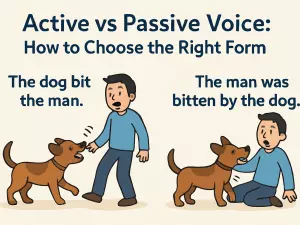
Active vs Passive Voice: What Changes in a Sentence

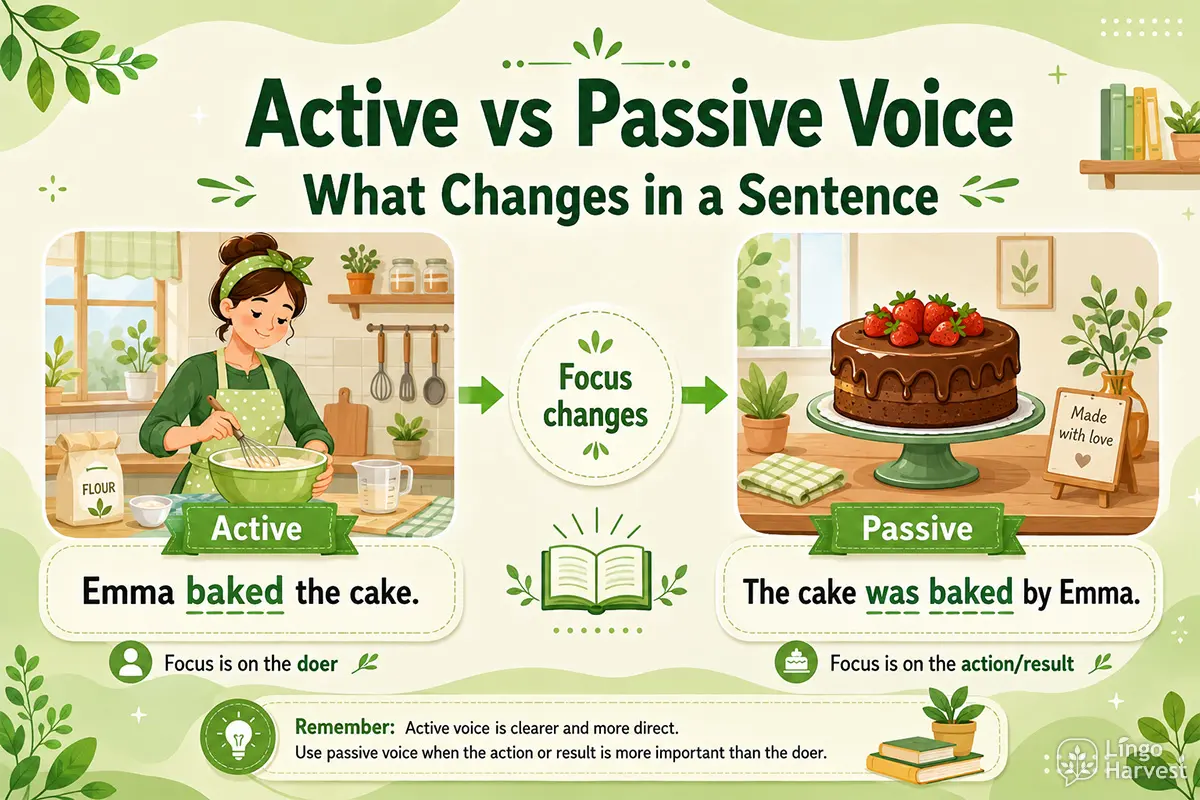 Learn how active and passive voice change English sentences: subject, object, verb form, focus, tone, by-phrases, and meaning, with clear examples and teacher-style explanations.
- What active and passive voice mean
- The three main sentence changes
- How subject and object roles change
- How the verb form changes
- How focus, meaning, and tone change
- What happens to the agent and by-phrase
- Active vs passive in questions, negatives, and modals
- When active or passive voice is better
- Common mistakes when changing voice
- Homework: active and passive voice practice
- FAQ: active vs passive voice
Active and passive voice are not just two different grammar patterns. They are two different ways of organizing information in a sentence. When you change an active sentence into a passive one, the action may stay the same, but the focus, word order, verb form, tone, and sometimes even the emotional effect of the sentence can change.
Compare these two sentences:
- Active: The assistant sent the invoice.
- Passive: The invoice was sent by the assistant.
The action is the same: someone sent an invoice. But the sentence now points the reader’s attention to a different place. In the active sentence, the assistant feels important. In the passive sentence, the invoice feels important. This is the heart of the active/passive difference.
What active and passive voice mean
In active voice, the subject does the action. In passive voice, the subject receives the action or is affected by it.
- Active: The students cleaned the classroom.
- Passive: The classroom was cleaned by the students.
In the active sentence, the students are the subject, and they do the action. In the passive sentence, the classroom becomes the subject, but it does not do the action. It receives the action.
This is why active and passive voice should be understood as a choice of focus, not only as a grammar transformation. A correct passive sentence may still be a poor choice if active voice would sound clearer. A correct active sentence may also be less effective if the result or object matters more than the doer.
| Voice | Subject does what? | Main focus | Example |
|---|---|---|---|
| Active voice | The subject does the action | The doer | The chef prepared the meal. |
| Passive voice | The subject receives the action | The receiver / result | The meal was prepared by the chef. |
Here are a few more simple pairs:
- Active: A journalist interviewed the mayor. → Passive: The mayor was interviewed by a journalist.
- Active: The company released a new app. → Passive: A new app was released by the company.
- Active: Someone changed the password. → Passive: The password was changed.
Notice the last example. The passive sentence does not say by someone because that phrase is unnecessary. In English, passive voice is often used exactly when the doer is unknown, unimportant, obvious, or not the point of the message.
The three main sentence changes
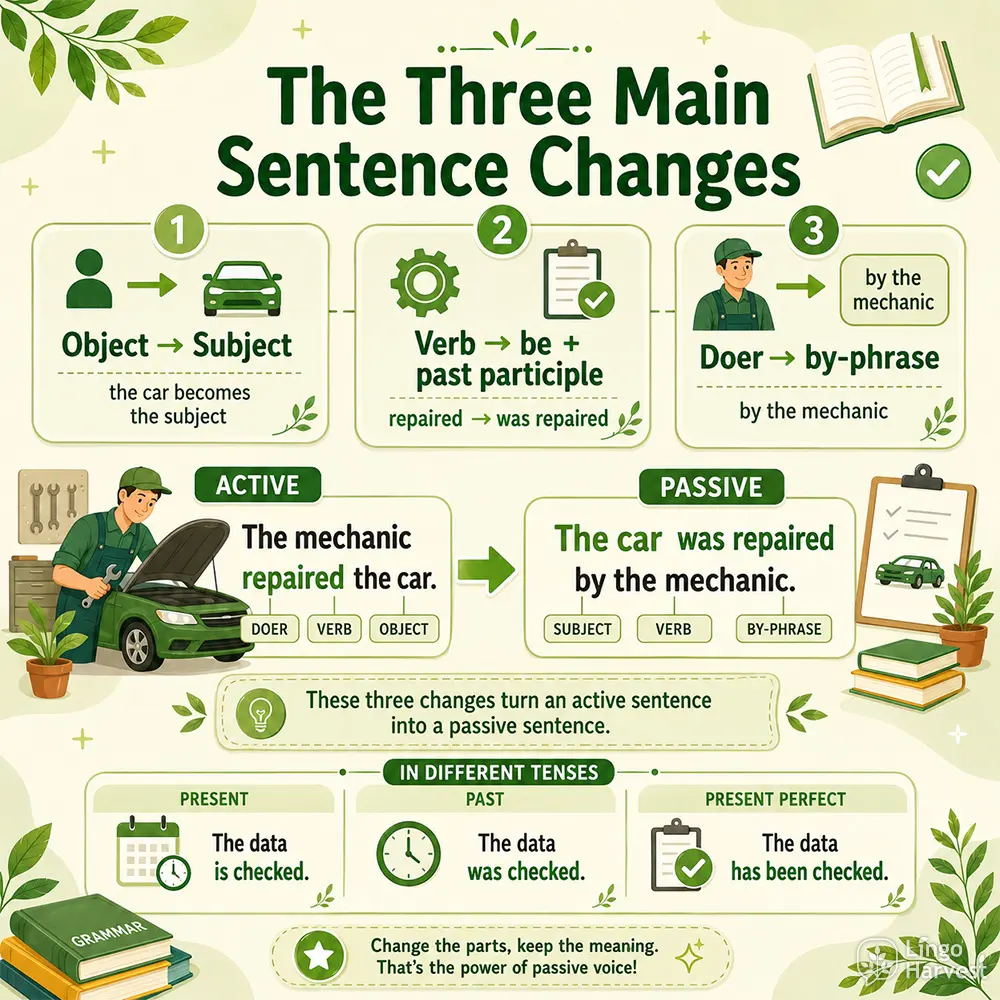
When a sentence changes from active to passive, three things usually happen:
- The object of the active sentence becomes the subject of the passive sentence.
- The verb changes to a form of be + past participle.
- The active subject becomes a by-phrase or disappears completely.
Let’s take one sentence and follow the changes carefully:
- Active: The mechanic repaired the car.
- Object in active sentence: the car
- Passive subject: The car
- Passive verb: was repaired
- Optional agent: by the mechanic
- Passive: The car was repaired by the mechanic.
| Part of sentence | Active sentence | Passive sentence | What changed? |
|---|---|---|---|
| Subject | The mechanic | The car | The receiver becomes the subject. |
| Verb | repaired | was repaired | The verb becomes be + past participle. |
| Object | the car | No direct object after the passive verb | The object has moved to the front. |
| Doer / agent | The mechanic | by the mechanic | The doer moves into a by-phrase. |
Here is the same pattern in several tenses:
- Active: The team checks the data every morning. → Passive: The data is checked every morning.
- Active: The team checked the data yesterday. → Passive: The data was checked yesterday.
- Active: The team has checked the data. → Passive: The data has been checked.
The main idea does not change: the data receives the action. But the grammar changes because passive voice must show tense through the auxiliary verb.
How subject and object roles change
The biggest structural change is this: the active object becomes the passive subject.
Active voice usually follows this pattern:
doer + action + receiver
Passive voice usually follows this pattern:
receiver + be + past participle + by doer
- Active: The designer created the logo.
- Passive: The logo was created by the designer.
In active voice, the sentence begins with the person who performs the action. In passive voice, the sentence begins with the thing affected by the action. This may look like a small grammatical movement, but it strongly changes how the sentence feels.
Teacher tip: before changing active to passive, find the direct object first. If there is no direct object, normal passive voice usually will not work. Ask: “The verb affects what or whom?”
Look at these examples:
- Active: The editor corrected the article. → Passive: The article was corrected by the editor.
- Active: The storm destroyed the bridge. → Passive: The bridge was destroyed by the storm.
- Active: The teacher gave the students clear instructions. → Passive: The students were given clear instructions.
Some active sentences have two objects. In that case, English may allow two passive versions, but one often sounds more natural.
- Active: The manager offered Mia a new position.
- Passive 1: Mia was offered a new position.
- Passive 2: A new position was offered to Mia.
The first passive version sounds more natural in everyday English because it keeps the person, Mia, as the main focus. This is a good example of why passive voice is not only a rule. It is also a choice about what you want to put at the front of the sentence.
How the verb form changes
The verb is the part that changes most visibly. Active voice uses the normal tense form of the main verb. Passive voice uses:
be + past participle
- make → is made / was made / has been made / will be made
- write → is written / was written / has been written / will be written
- send → is sent / was sent / has been sent / will be sent
The tense does not disappear. It moves into the form of be. This is one of the most important points when learning passive voice verb forms: the past participle stays the same, but the auxiliary changes.
| Tense | Active voice | Passive voice | What changes? |
|---|---|---|---|
| Present simple | They deliver the packages. | The packages are delivered. | deliver → are delivered |
| Past simple | They delivered the packages. | The packages were delivered. | delivered → were delivered |
| Present continuous | They are delivering the packages. | The packages are being delivered. | are delivering → are being delivered |
| Present perfect | They have delivered the packages. | The packages have been delivered. | have delivered → have been delivered |
| Future with will | They will deliver the packages. | The packages will be delivered. | will deliver → will be delivered |
The most common student mistake is to change the word order but forget the correct passive verb form.
- ❌ “The package delivered yesterday.”
- ✅ “The package was delivered yesterday.”
- ❌ “The results will announced soon.”
- ✅ “The results will be announced soon.”
- ❌ “The rooms are cleaning now.”
- ✅ “The rooms are being cleaned now.”
In passive voice, the verb must show both the tense and the passive structure. If one of those pieces is missing, the sentence will not sound complete.
How focus, meaning, and tone change
Active and passive voice can describe the same event, but they do not always communicate the same message. The information may be similar, but the focus changes.
- Active: The intern found the error.
- Passive: The error was found by the intern.
The active sentence sounds like a small story about the intern. The passive sentence sounds like a report about the error. Both are grammatically correct. The better sentence depends on what your paragraph is about.
Focus on the doer
- Active: Dr. Patel developed the new method.
- Why active works: Dr. Patel is important, so she should appear first.
Focus on the result
- Passive: The new method was developed after three years of testing.
- Why passive works: The method is important, not necessarily the person who developed it.
Focus on tact
- Very direct: You entered the wrong address.
- More neutral: The wrong address was entered.
The passive sentence can sound less accusatory. This is why passive voice appears in customer service, workplace communication, formal notices, and official writing.
Passive voice also affects how pronouns work in later sentences. For example, if you write “The proposal was rejected,” the next sentence can naturally continue with “It will be reviewed again next month.” In this way, passive voice can help keep the same topic moving through a paragraph. This is one reason why pronouns in passive voice matter for clear writing and smooth reference.
What happens to the agent and by-phrase
The agent is the person, group, or thing that performs the action. In active voice, the agent is usually the subject.
- Active: The police arrested the suspect.
In passive voice, the agent may appear after by:
- Passive: The suspect was arrested by the police.
But in many passive sentences, the agent disappears because it is unknown, obvious, general, or not important.
| Reason to omit the agent | Active idea | Natural passive sentence | Why no by-phrase? |
|---|---|---|---|
| Unknown doer | Someone stole my laptop. | My laptop was stolen. | We do not know who did it. |
| Obvious doer | The police arrested him. | He was arrested. | “By the police” is usually clear from context. |
| General doer | People speak English worldwide. | English is spoken worldwide. | “By people” adds no useful information. |
| Unimportant doer | A worker replaced the sign. | The sign was replaced. | The result matters more than the worker. |
Use the by-phrase when the doer adds useful information:
- The novel was written by a seventeen-year-old student.
- The bridge was designed by a famous architect.
- The decision was supported by all department heads.
Do not add by automatically. A heavy passive sentence with an unnecessary agent often sounds less natural than a simple active sentence.
- Too heavy: “The report was finished by our team before lunch.”
- Better if the doer matters: “Our team finished the report before lunch.”
- Better if the result matters: “The report was finished before lunch.”
Also remember that by is not used for every extra detail in passive voice. Tools, instruments, and materials often need with, not by. If this part feels confusing, it is worth reviewing prepositions in passive voice, because the wrong preposition can make a correct passive structure sound strange.
- ✅ “The letter was written by Anna.” Anna is the agent.
- ✅ “The letter was written with a black pen.” The pen is the tool.
- ❌ “The letter was written by a black pen.” This sounds as if the pen acted like a person.
Active vs passive in questions, negatives, and modals
The active/passive difference also affects questions, negatives, and sentences with modal verbs. The same idea remains: the receiver becomes the subject, and the verb becomes passive.
Questions
- Active: Did they approve the plan?
- Passive: Was the plan approved?
- Active: When will they announce the results?
- Passive: When will the results be announced?
- Active: Why did they cancel the event?
- Passive: Why was the event cancelled?
In passive questions, the auxiliary verb comes before the subject, just like in other English questions.
Negatives
- Active: They did not inform the clients.
- Passive: The clients were not informed.
- Active: The company has not updated the policy.
- Passive: The policy has not been updated.
- Active: They will not replace the old equipment.
- Passive: The old equipment will not be replaced.
In negative passive sentences, not usually goes after the first auxiliary verb: was not sent, has not been checked, will not be changed.
Modals
With modal verbs, the passive structure is:
modal + be + past participle
- Active: You must submit the form today.
- Passive: The form must be submitted today.
- Active: They should check the details carefully.
- Passive: The details should be checked carefully.
- Active: We can solve the problem in two ways.
- Passive: The problem can be solved in two ways.
This pattern is especially common in rules, instructions, formal notices, workplace policies, and academic writing. For more focused practice, passive modal verbs are useful because they show obligation, possibility, permission, advice, and criticism in passive structures.
| Active modal sentence | Passive modal sentence | Meaning |
|---|---|---|
| You must complete the form. | The form must be completed. | Requirement |
| They should review the instructions. | The instructions should be reviewed. | Advice / best practice |
| We can fix the issue remotely. | The issue can be fixed remotely. | Possibility / ability |
| They may change the schedule. | The schedule may be changed. | Formal possibility |
When active or passive voice is better
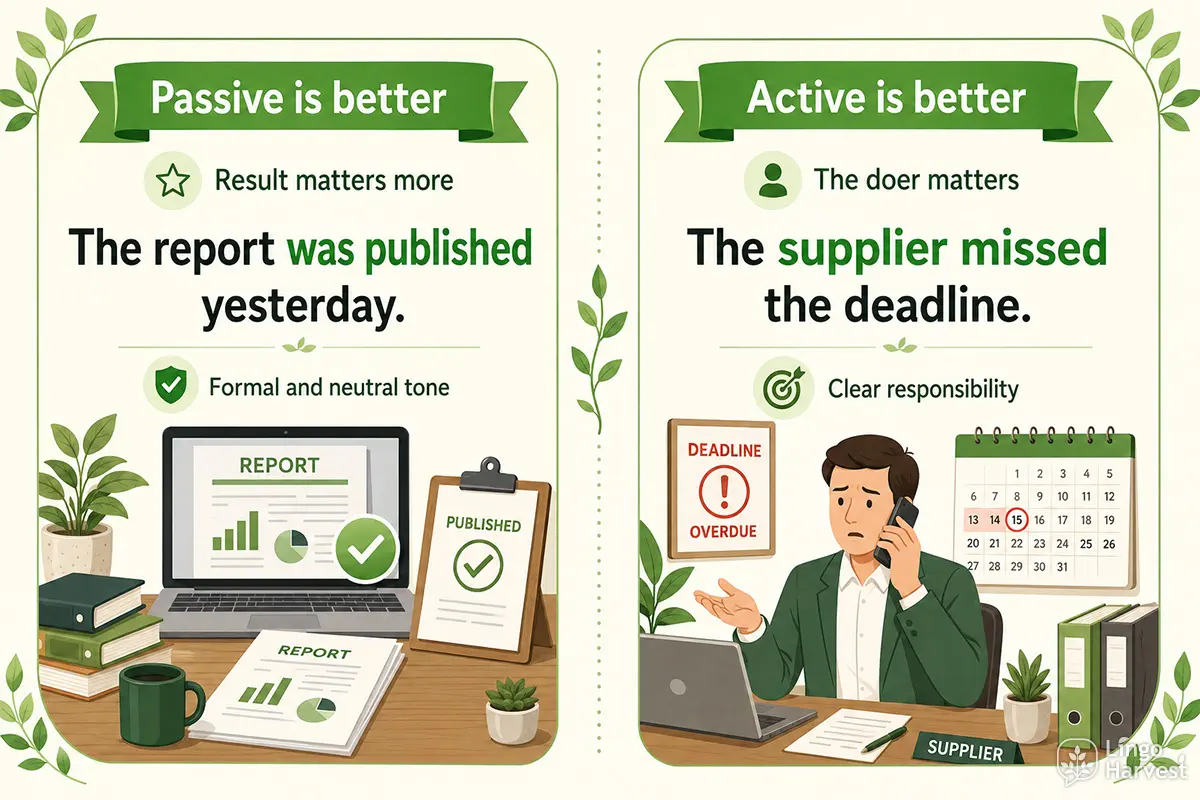
Students often hear advice like “Avoid passive voice.” That advice is too simple. A better rule is: use active voice when the doer matters, and use passive voice when the receiver, result, process, or tone matters more.
| Choose active voice when... | Choose passive voice when... |
|---|---|
| The doer is important. | The result is more important than the doer. |
| You want direct, clear, energetic writing. | You want formal, neutral, or tactful writing. |
| You are telling a story with clear actors. | You are describing a process, rule, report, or result. |
| You know who did the action and want to mention them. | The doer is unknown, obvious, or not necessary. |
Active voice is usually better for clear responsibility
- Weak: “Several errors were made during the update.”
- Clearer: “The update team made several errors.”
- Weak: “The deadline was missed.”
- Clearer: “The supplier missed the deadline.”
- Weak: “The instructions were ignored.”
- Clearer: “Several employees ignored the instructions.”
When responsibility matters, active voice is usually more honest and direct.
Passive voice is usually better for results and processes
- Natural: “The samples were tested at room temperature.”
- Natural: “The application was rejected because one document was missing.”
- Natural: “The road will be closed for repairs next week.”
These sentences are natural because the result or process is more important than the person doing the action.
Passive voice is useful for tact
- Direct: “You sent the wrong file.”
- More tactful: “The wrong file was sent.”
- Direct: “You entered the incorrect code.”
- More neutral: “The incorrect code was entered.”
- Direct: “You did not complete the form.”
- More formal: “The form was not completed.”
In real communication, passive voice can soften blame. This does not mean we should hide responsibility. It means English gives us grammar tools for different levels of directness.
Common mistakes when changing voice
Changing active to passive is not difficult once you know the pattern, but several mistakes appear again and again. Here are the ones I correct most often as a teacher.
1. Forgetting the verb be
Passive voice needs a form of be. The past participle alone is not enough.
- ❌ “The window broken yesterday.” → ✅ “The window was broken yesterday.”
- ❌ “The documents signed this morning.” → ✅ “The documents were signed this morning.”
- ❌ “The room cleaned before the guests arrived.” → ✅ “The room was cleaned before the guests arrived.”
2. Using the wrong past participle
Passive voice uses the past participle, not the base verb. This is especially important with irregular verbs.
- ❌ “The email was send this morning.” → ✅ “The email was sent this morning.”
- ❌ “The report was write by the assistant.” → ✅ “The report was written by the assistant.”
- ❌ “The money was stole from the office.” → ✅ “The money was stolen from the office.”
3. Trying to make passive voice from an intransitive verb
Passive voice normally needs a direct object. Verbs such as happen, arrive, sleep, and die do not usually become passive.
- ❌ “The accident was happened yesterday.” → ✅ “The accident happened yesterday.”
- ❌ “The station was arrived at 8 p.m.” → ✅ “We arrived at the station at 8 p.m.”
- ❌ “The bed was slept by the child.” → ✅ “The child slept in the bed.”
4. Keeping the active object after the passive verb
After the active object becomes the passive subject, do not repeat it again as an object.
- ❌ “The meal was prepared it by the chef.” → ✅ “The meal was prepared by the chef.”
- ❌ “The report was checked it yesterday.” → ✅ “The report was checked yesterday.”
- ❌ “The house was painted it last summer.” → ✅ “The house was painted last summer.”
5. Using passive voice when active voice is clearer
Passive voice is useful, but if the doer is important and known, active voice often sounds stronger.
- Too heavy: “A decision was made by the team to delay the launch.” → Clearer: “The team decided to delay the launch.”
- Too indirect: “The mistake was noticed by Sarah during the final check.” → Clearer: “Sarah noticed the mistake during the final check.”
- Too formal: “The new policy was explained by the manager at the meeting.” → Clearer: “The manager explained the new policy at the meeting.”
6. Placing adverbs awkwardly
Adverbs often sit between the auxiliary and the past participle in passive voice, especially when they describe the manner of the action. This is why adverb placement in passive voice is worth learning separately.
- ✅ “The contract was carefully reviewed.”
- ✅ “The contract was reviewed carefully.”
- ❌ “The contract carefully was reviewed.”
- ✅ “The data has been thoroughly checked.”
- ✅ “The data has been checked thoroughly.”
- ❌ “The data has thoroughly been checked.” This may sound awkward in many everyday contexts.
Editing tip: after you change active to passive, read the sentence once for grammar and once for style. Grammar asks, “Is the structure correct?” Style asks, “Is this the clearest voice for this message?”
Homework: active and passive voice practice
1. Change Active to Passive
Rewrite each active sentence in passive voice. Include the by-phrase only when it is useful.
- The technician fixed the printer.
- Someone stole my backpack.
- The company will publish the results tomorrow.
- The teacher has checked all the tests.
- The storm damaged the roof.
- A famous director made this film.
- They are updating the website now.
- The chef prepared three desserts.
- The committee approved the plan.
- People speak English in many countries.
Show answers
- The printer was fixed by the technician.
- My backpack was stolen.
- The results will be published tomorrow.
- All the tests have been checked by the teacher.
- The roof was damaged by the storm.
- This film was made by a famous director.
- The website is being updated now.
- Three desserts were prepared by the chef.
- The plan was approved by the committee.
- English is spoken in many countries.
2. Choose Active or Passive
Choose the more natural sentence for each situation.
- You want to emphasize who solved the problem: “Maya solved the problem” / “The problem was solved by Maya.”
- You do not know who broke the window: “Someone broke the window” / “The window was broken.”
- You are writing a science procedure: “We heated the solution” / “The solution was heated.”
- You want to sound tactful in customer service: “You entered the wrong number” / “The wrong number was entered.”
- You are telling a story about Anna: “Anna found the hidden key” / “The hidden key was found by Anna.”
- The doer is obvious: “The police arrested the suspect” / “The suspect was arrested.”
- You want direct responsibility: “The supplier missed the deadline” / “The deadline was missed by the supplier.”
- The result matters more than the worker: “A worker replaced the sign” / “The sign was replaced.”
- You are giving a clear instruction: “Submit the form by Friday” / “The form should be submitted by Friday.”
- You are reporting a formal decision: “They rejected the application” / “The application was rejected.”
Show answers
- Maya solved the problem.
- The window was broken.
- The solution was heated.
- The wrong number was entered.
- Anna found the hidden key.
- The suspect was arrested.
- The supplier missed the deadline.
- The sign was replaced.
- Both are possible. “Submit the form by Friday” is more direct; “The form should be submitted by Friday” is more formal.
- The application was rejected.
3. Spot the Error
Some of the following sentences contain mistakes in active/passive structure. Find and correct any errors:
- The invitation was sent yesterday.
- The meeting will postponed until Monday.
- The accident was happened near the station.
- The documents have been signed.
- The report was write by an expert.
- The package was delivered this morning.
- The form must completed before noon.
- The cake was eaten by the children.
- The room cleaned before we arrived.
- The decision was made by the director.
Show answers
- Correct
- The meeting will be postponed until Monday.
- The accident happened near the station.
- Correct
- The report was written by an expert.
- Correct
- The form must be completed before noon.
- Correct
- The room was cleaned before we arrived.
- Correct
FAQ: active vs passive voice
1. What is the main difference between active and passive voice?
In active voice, the subject does the action: “The chef cooked the meal.” In passive voice, the subject receives the action: “The meal was cooked by the chef.”
2. What changes first when active becomes passive?
The object of the active sentence usually becomes the subject of the passive sentence. For example, in “They repaired the car,” the object is “the car.” In passive voice, it becomes the subject: “The car was repaired.”
3. Does the meaning change in passive voice?
The basic event often stays the same, but the focus changes. Active voice highlights the doer. Passive voice highlights the receiver, result, process, or situation.
4. Is passive voice always more formal?
Passive voice often sounds more formal, especially in reports, academic writing, rules, and notices. However, passive voice can also appear in everyday speech, especially in sentences like “My phone was stolen” or “We got delayed.”
5. Should I avoid passive voice in writing?
No. You should avoid unnecessary passive voice, not passive voice itself. Use active voice for direct, clear responsibility. Use passive voice when the result, object, process, or tactful tone matters more.
6. Why is the by-phrase sometimes missing?
The by-phrase is omitted when the doer is unknown, obvious, too general, or not important. “My wallet was stolen” is natural because the speaker probably does not know who stole it.
7. Can every active sentence become passive?
No. Passive voice normally needs a verb with a direct object. Sentences with verbs such as “happen,” “arrive,” “sleep,” and “die” usually cannot become passive in standard English.
8. What is the easiest way to check a passive sentence?
Look for three things: a receiver as the subject, a correct form of be, and a past participle. Then ask a style question: “Is this passive sentence clearer than the active version?”