Passive Voice in English: Rules, Meaning and Use

 A clear teacher-style guide to passive voice in English: how it is formed, when to use it, when to avoid it, and how to practice it confidently.
- What passive voice means
- How passive voice is formed
- Passive voice in English tenses
- When to use passive voice naturally
- Using the by-phrase and agent
- Passive with modals, get, and reporting verbs
- Common passive voice mistakes
- Active vs passive: style choice
- Homework: passive voice practice
- FAQ: passive voice in English
Passive voice is one of those grammar topics that looks simple in a table but becomes much more interesting in real English. Students often learn the basic formula “be + past participle” and then wonder: When should I actually use it? Is passive voice formal? Is it bad style? Why do native speakers say “I got invited” instead of “I was invited”?
In this guide, we will treat passive voice not as a mechanical transformation exercise, but as a tool for changing focus, tone, and information flow. You will learn the rules, the meaning, the most common forms, and the typical mistakes that English learners make. I will also give you teacher-style examples, correction notes, and practice tasks with answers.
What passive voice means in English
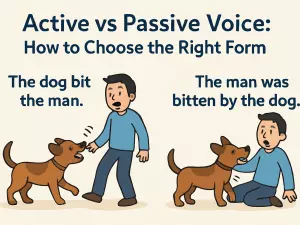
In an active sentence, the subject does the action. In a passive sentence, the subject receives the action or is affected by it.
- Active: The technician repaired the laptop.
- Passive: The laptop was repaired by the technician.
The basic information is almost the same, but the focus changes. In the active sentence, we are interested in the technician. In the passive sentence, we are interested in the laptop. This is why the choice between active and passive voice is not just grammar; it is also a writing and speaking choice.
Look at another pair:
- Active: Someone stole my bike last night.
- Passive: My bike was stolen last night.
The passive version sounds natural because the speaker probably does not know who stole the bike. The important thing is the result: the bike is gone. In everyday English, this is one of the most common reasons for passive voice: the doer is unknown, unimportant, obvious, or deliberately not mentioned.
A simple teacher test is this: ask yourself, “What do I want the reader to notice first?” If the answer is the person or thing receiving the action, passive voice may be the better choice.
How passive voice is formed
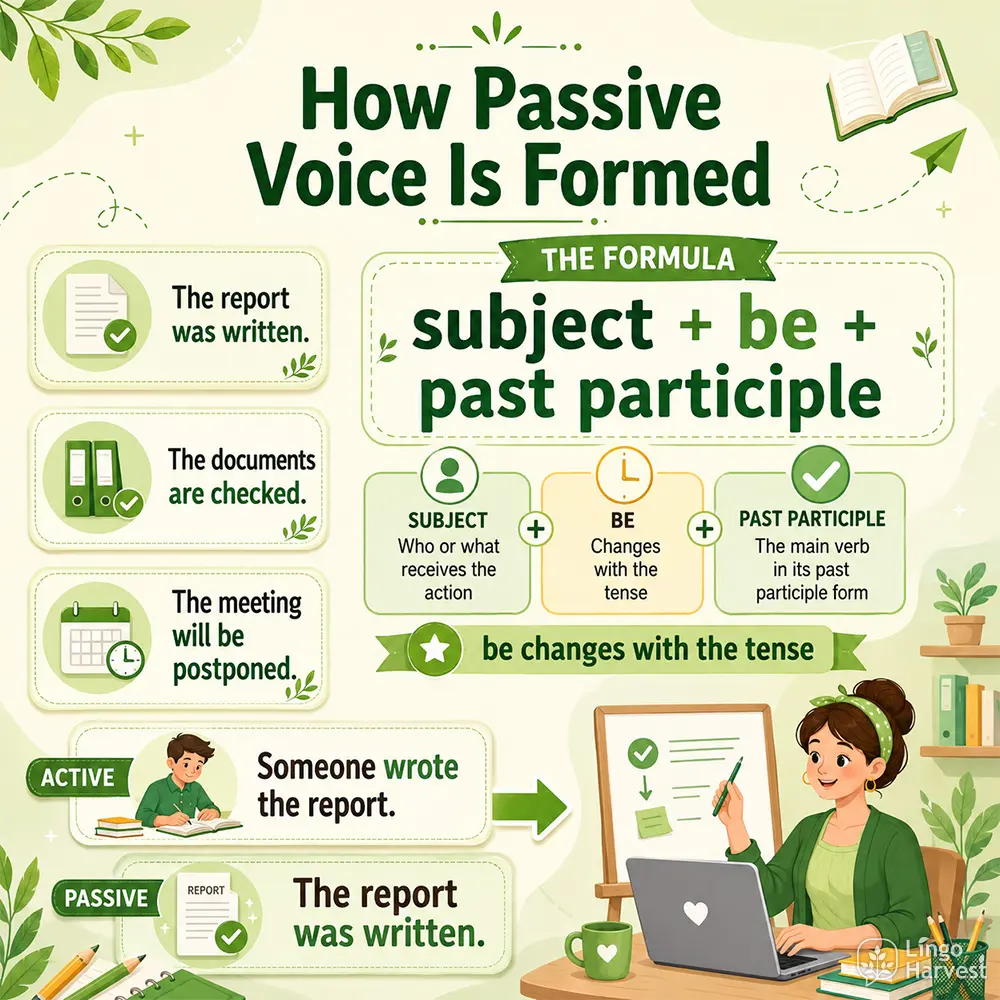
The main passive voice formula is:
subject + be + past participle
- The report was written yesterday.
- The documents are checked every morning.
- The window has been broken.
- The meeting will be postponed.
The verb be changes according to the tense. The past participle stays the same. That is the key rule. In the sentence “The files were deleted,” the tense is shown by were, not by deleted.
Teacher tip: when students make passive voice mistakes, the problem is usually not the idea of passive voice. The problem is often one of three things: the wrong form of be, the wrong past participle, or using passive voice with a verb that does not take an object.
| Sentence type | Passive structure | Example | Teacher note |
|---|---|---|---|
| Positive | subject + be + past participle | The room was cleaned. | The subject receives the action. |
| Negative | subject + be + not + past participle | The room was not cleaned. | Put not after the form of be. |
| Yes/no question | be + subject + past participle? | Was the room cleaned? | Move be before the subject. |
| Wh-question | question word + be + subject + past participle? | When was the room cleaned? | The participle stays after the subject. |
To make a passive sentence from an active sentence, follow this pattern:
- Find the object of the active sentence.
- Move that object to the subject position.
- Use the correct form of be.
- Add the past participle of the main verb.
- Add by + agent only if the doer is important.
Example:
- Active: The manager approved the request.
- Object: the request
- Passive: The request was approved by the manager.
Now notice a very important limitation: only verbs that can take an object can normally become passive.
- ✅ “They opened the door.” → “The door was opened.”
- ❌ “He arrived the station.” → wrong, because arrive does not take a direct object.
- ✅ “He arrived at the station.” → active only in normal English.
Passive voice in English tenses
Passive voice can appear in many tenses, but some forms are much more common than others. The most useful ones for learners are present simple passive, past simple passive, present perfect passive, future passive, and modal passive. Continuous passive forms are also common in news, business, and formal writing.
The following table shows the most important passive forms. The same core structure is behind every form: be + past participle. For a compact reference on forms and examples, you can also review passive voice verb forms.
| Tense / form | Passive structure | Active example | Passive example |
|---|---|---|---|
| Present simple | am / is / are + past participle | They process the orders daily. | The orders are processed daily. |
| Past simple | was / were + past participle | They built the bridge in 1998. | The bridge was built in 1998. |
| Present continuous | am / is / are being + past participle | They are updating the system. | The system is being updated. |
| Past continuous | was / were being + past participle | They were repairing the road. | The road was being repaired. |
| Present perfect | has / have been + past participle | They have changed the schedule. | The schedule has been changed. |
| Past perfect | had been + past participle | They had locked the door before we arrived. | The door had been locked before we arrived. |
| Future with will | will be + past participle | They will announce the results tomorrow. | The results will be announced tomorrow. |
| Future with going to | am / is / are going to be + past participle | They are going to replace the old signs. | The old signs are going to be replaced. |
Some passive forms are grammatically possible but heavy in real communication. For example, perfect continuous passive forms such as “The project has been being reviewed” sound awkward and are usually avoided. Native speakers normally choose a simpler structure:
- ❌ “The project has been being reviewed for three weeks.”
- ✅ “The project has been under review for three weeks.”
- ✅ “They have been reviewing the project for three weeks.”
Good grammar is not only about what is possible. It is also about what sounds natural.
When to use passive voice naturally
Passive voice is useful when the receiver of the action is more important than the doer. It is common in formal writing, academic English, news, signs, notices, instructions, procedures, and situations where the speaker wants to sound tactful or neutral.
1. When the doer is unknown
- My wallet was stolen on the train.
- The front gate was damaged during the night.
- Several files were deleted by mistake.
In these examples, we either do not know who did the action or the doer is not the main point.
2. When the doer is obvious
- The suspect was arrested last night.
- The patient was taken to hospital.
- The exam papers will be collected at the end of the test.
We do not need to say “by the police,” “by the ambulance team,” or “by the teacher” if the context already makes it clear.
3. When the process matters more than the person
- The samples were heated to 90 degrees.
- The mixture was stirred for five minutes.
- The results were compared with last year’s data.
This is why passive voice is very common in scientific and technical writing. The writing focuses on the procedure, not on the researcher personally.
4. When the speaker wants to be tactful
- Active and direct: “You entered the wrong password.”
- More neutral: “The wrong password was entered.”
The passive version avoids blaming the listener directly. This is common in customer service, workplace communication, and formal notices.
5. When the sentence should start with known information
In good writing, we often put familiar information first and new information later. Passive voice helps with this.
- Previous sentence: The museum has a rare collection of letters.
- Smooth continuation: The letters were written by soldiers during the war.
Starting the second sentence with “The letters” creates a clear connection. If we wrote “Soldiers wrote the letters during the war,” the sentence would still be correct, but the paragraph would flow less smoothly.
Using the by-phrase and agent
The agent is the person, group, or thing that does the action. In passive voice, the agent can be added with by:
- The painting was restored by a local artist.
- The song was written by a fifteen-year-old student.
- The mistake was noticed by the editor.
However, many passive sentences do not need a by-phrase. In fact, unnecessary by-phrases often make writing sound heavy.
| Situation | Use by-phrase? | Example | Why |
|---|---|---|---|
| The agent is important or surprising | Yes | The mural was painted by the students. | The doer adds meaningful information. |
| The agent is unknown | No | My phone was stolen. | We do not know who did it. |
| The agent is obvious | No | The man was arrested. | “By the police” is usually unnecessary. |
| The agent is too general | No | English is spoken in many countries. | “By people” adds nothing useful. |
A common mistake is using by when English needs another preposition. For example, tools and materials often use with, not by. This topic connects closely with prepositions in passive voice, because the wrong preposition can make an otherwise correct passive sentence sound unnatural.
- ✅ “The letter was written by Maya.” Maya is the person who wrote it.
- ✅ “The letter was written with a fountain pen.” The pen is the tool.
- ❌ “The letter was written by a fountain pen.” This sounds as if the pen acted like a person.
Another useful distinction:
- by = the doer of the action
- with = the tool, material, or instrument
- in = language, style, or medium
- The email was written by the assistant.
- The form was completed with a black pen.
- The message was written in French.
Passive with modals, get, and reporting verbs
Passive voice is not limited to simple tenses. It also appears with modal verbs, the informal verb get, and reporting structures such as “is said to” or “is believed to.”
Passive voice with modal verbs
The structure is:
modal verb + be + past participle
- The application must be submitted by Friday.
- The instructions should be read carefully.
- The password can be changed in your account settings.
- The meeting may be postponed if the weather gets worse.
For past meaning, use:
modal verb + have been + past participle
- The package should have been delivered yesterday.
- The error could have been avoided.
- The document must have been saved automatically.
This is a very practical structure in rules, instructions, criticism, and speculation. More detailed examples of passive modal verbs are especially useful for intermediate and advanced learners.
| Modal passive | Meaning | Example |
|---|---|---|
| must be done | Strong obligation | The form must be signed. |
| should be done | Recommendation | The answer should be explained clearly. |
| can be done | Possibility / ability | The file can be opened on any device. |
| may be done | Formal possibility | The schedule may be changed. |
| should have been done | Past criticism or regret | The warning should have been given earlier. |
Get passive in everyday English
In conversation, English speakers often use get + past participle instead of be + past participle, especially when something happens suddenly, unexpectedly, accidentally, or as a personal experience.
- He got promoted last month.
- We got stuck in traffic.
- My suitcase got lost at the airport.
- She got invited to the conference.
The get passive is more informal than the be-passive. It is very natural in speech, but it may sound too casual in academic or official writing.
- Formal: The documents were approved yesterday.
- Conversational: The documents got approved yesterday.
Passive reporting structures
English also uses passive voice to report opinions, beliefs, claims, and public information without naming a specific speaker.
- It is believed that the painting is over 300 years old.
- The company is expected to announce new prices soon.
- The actor is said to be working on a new film.
- The rules are known to be strict.
These structures are common in news, academic writing, and formal reports. They let the writer present information without saying exactly who believes, expects, or says it.
Common passive voice mistakes
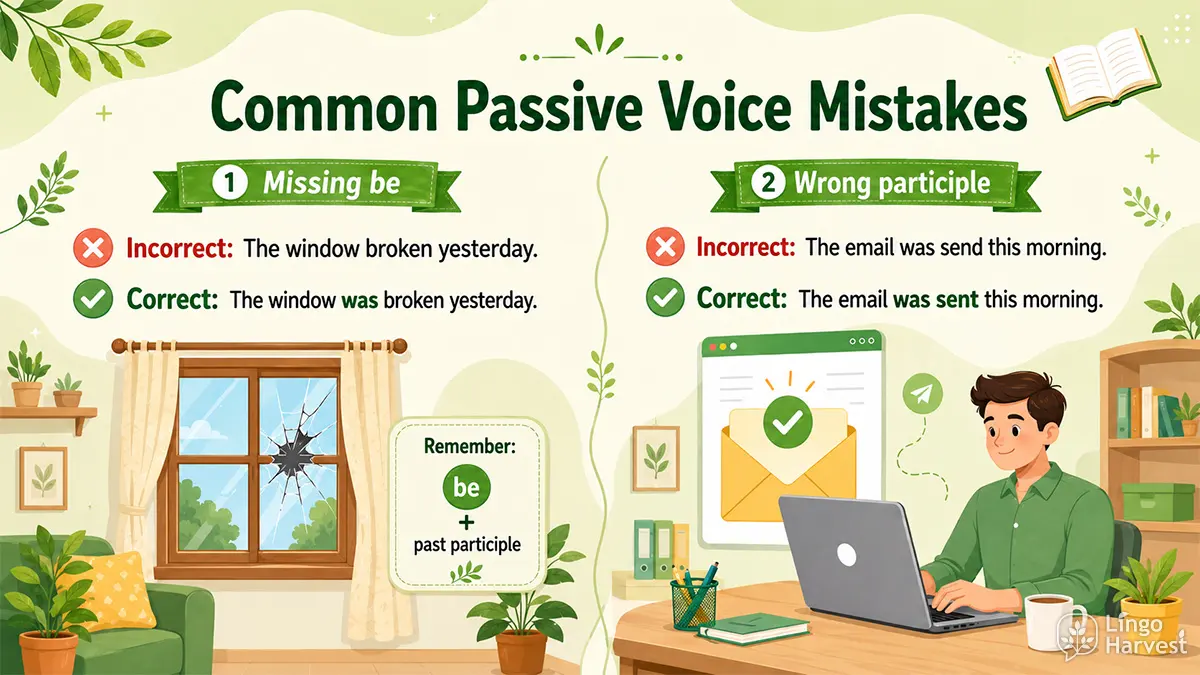
Passive voice mistakes usually come from form, verb choice, or word order. Let’s look at the most common ones.
1. Forgetting the verb be
One of the most common passive voice mistakes is leaving out the verb be. In passive voice, the past participle cannot stand alone. You need the correct form of be before it.
- ❌ “The window broken yesterday.” → ✅ “The window was broken yesterday.”
- ❌ “The documents signed this morning.” → ✅ “The documents were signed this morning.”
- ❌ “The room cleaned before the guests arrived.” → ✅ “The room was cleaned before the guests arrived.”
In standard passive voice, the form of be is necessary. Without it, the sentence sounds incomplete because English needs a tense marker before the past participle.
2. Using the wrong participle
Passive voice uses the past participle, not the base form of the verb. This is easy with regular verbs like cleaned or opened, but irregular verbs need special attention.
- ❌ “The email was send this morning.” → ✅ “The email was sent this morning.”
- ❌ “The report was write by the assistant.” → ✅ “The report was written by the assistant.”
- ❌ “The money was stole from the office.” → ✅ “The money was stolen from the office.”
Remember: passive voice uses the third verb form. If the verb is irregular, do not guess from the base form. Check forms such as send → sent, write → written, steal → stolen, take → taken, and choose → chosen.
3. Making passive voice from an intransitive verb
Not every English verb can be used in passive voice. Passive voice normally needs a verb that takes a direct object. Verbs such as arrive, happen, sleep, die, and exist do not usually become passive because there is no object to move into the subject position.
- ❌ “The station was arrived at 8 p.m.” → ✅ “We arrived at the station at 8 p.m.”
- ❌ “The accident was happened yesterday.” → ✅ “The accident happened yesterday.”
- ❌ “The bed was slept by the child.” → ✅ “The child slept in the bed.”
A useful teacher trick is to ask: “Can this verb answer the question what? or whom?” For example, open what? — the door. So passive is possible: “The door was opened.” But happen what? does not work, so normal passive voice is not possible.
4. Using passive voice when active voice is clearer
Passive voice is useful, but it is not always the best choice. If the doer is important, known, and easy to name, active voice often sounds clearer, stronger, and more natural.
- Too heavy: “A decision was made by the team to delay the launch.” → Clearer: “The team decided to delay the launch.”
- Too indirect: “The mistake was noticed by Sarah during the final check.” → Clearer: “Sarah noticed the mistake during the final check.”
- Too formal: “The new policy was explained by the manager at the meeting.” → Clearer: “The manager explained the new policy at the meeting.”
Passive voice can make writing sound formal, neutral, or tactful, but too much passive voice may make the sentence feel distant or slow. When the person doing the action matters, active voice is usually cleaner.
5. Placing adverbs awkwardly
Adverbs often sit between be and the past participle, especially when they describe how the action is done. This is a common detail in adverb placement in passive voice.
- ✅ “The data was carefully reviewed.”
- ✅ “The data was reviewed carefully.”
- Less natural in many contexts: “The data carefully was reviewed.”
| Mistake | Why it is wrong | Correct version |
|---|---|---|
| The room cleaned yesterday. | Missing form of be | The room was cleaned yesterday. |
| The package was deliver. | Wrong verb form | The package was delivered. |
| The accident was happened. | Happen is intransitive | The accident happened. |
| The letter was written by a pen. | Wrong preposition for tool | The letter was written with a pen. |
| The report was carefully been checked. | Wrong word order | The report has been carefully checked. |
Active vs passive: style choice
Many learners ask, “Should I avoid passive voice?” The answer is no. You should avoid unnecessary passive voice, not passive voice itself.
Here is the teacher-style decision guide I use with students:
| Question | Choose active if... | Choose passive if... |
|---|---|---|
| Who is important? | The doer matters most. | The receiver/result matters most. |
| Is the doer known? | You know who did it and want to say it. | The doer is unknown or irrelevant. |
| What tone do you need? | You want direct, clear, personal writing. | You want formal, neutral, or tactful writing. |
| What is the context? | Stories, conversations, instructions with clear actors. | Reports, procedures, news, signs, academic writing. |
Compare these examples:
- Better active: “Our support team answered your question.”
- Less personal: “Your question was answered by our support team.”
In customer support, the active sentence sounds warmer and more human. But in another situation, passive is better:
- Too direct: “You damaged the equipment.”
- More neutral: “The equipment was damaged.”
Here, passive voice helps reduce blame. This does not mean we hide responsibility in every situation. It means grammar can help control tone.
One practical editing habit: after writing a passive sentence, ask, “Would this be clearer in active voice?” If yes, change it. If no, keep the passive. That is how mature writing works.
Homework: passive voice practice
1. Change Active to Passive
Rewrite each active sentence in passive voice. Include the by-phrase only when it sounds useful.
- The chef prepared the soup.
- Someone broke the classroom window.
- The company will publish the report tomorrow.
- They have cancelled the morning flight.
- The teacher explains the rule every year.
- A famous architect designed this building.
- The storm damaged several houses.
- They are repairing the elevator now.
- The committee has approved the proposal.
- People speak English in many countries.
Show answers
- The soup was prepared by the chef.
- The classroom window was broken.
- The report will be published tomorrow.
- The morning flight has been cancelled.
- The rule is explained every year.
- This building was designed by a famous architect.
- Several houses were damaged by the storm.
- The elevator is being repaired now.
- The proposal has been approved by the committee.
- English is spoken in many countries.
2. Choose the Correct Passive Form
Choose the correct passive form for each sentence.
- The documents ___ yesterday. (were signed / signed / are sign)
- The room ___ every Friday. (cleans / is cleaned / was cleaning)
- The results ___ next week. (will announce / will be announced / were announce)
- The bridge ___ since March. (has closed / has been closed / is closing)
- The emails ___ right now. (are being sent / are sent yesterday / were sending)
- The mistake ___ earlier. (should have been noticed / should noticed / should be noticing)
- The old computers ___ soon. (are going to replace / are going to be replaced / replace)
- The package ___ by the time we arrived. (had delivered / had been delivered / was delivering)
- This word ___ in formal English. (is rarely used / rarely uses / is rarely using)
- The final decision ___ by the director. (must approve / must be approved / must approved)
Show answers
- were signed
- is cleaned
- will be announced
- has been closed
- are being sent
- should have been noticed
- are going to be replaced
- had been delivered
- is rarely used
- must be approved
3. Spot the Error
Some of the following passive sentences contain mistakes. Find and correct any errors:
- The door was opened by the security guard.
- The problem was happened yesterday.
- The invitation was send last week.
- The project has been completed.
- The window was broken with a stone.
- The meeting will postponed until Monday.
- The answer should be written in pencil.
- The phone got stolen at the beach.
- The report was carefully been checked.
- The students were given clear instructions.
Show answers
- Correct
- The problem happened yesterday.
- The invitation was sent last week.
- Correct
- Correct
- The meeting will be postponed until Monday.
- Correct
- Correct
- The report has been carefully checked.
- Correct
FAQ: passive voice in English
1. What is passive voice in simple words?
Passive voice means that the subject receives the action instead of doing it. In “The cake was eaten,” the cake did not do the action. The cake received the action.
2. What is the main passive voice formula?
The main formula is subject + be + past participle. The form of be changes with the tense: is made, was made, has been made, will be made.
3. When should I use passive voice?
Use passive voice when the receiver of the action is more important than the doer, when the doer is unknown, when the doer is obvious, or when you want a formal, neutral, or tactful tone.
4. Is passive voice bad English?
No. Passive voice is not bad English. It becomes a problem only when it is overused or when it makes a sentence less clear. In many contexts, especially reports, procedures, and academic writing, passive voice is natural and useful.
5. Do I always need to use by in passive voice?
No. Use by only when the doer is important or surprising. “The painting was stolen” is complete if we do not know who stole it. “The painting was stolen by a museum employee” adds important information.
6. What is the difference between was done and got done?
Was done is neutral and works in most styles. Got done is more informal and often emphasizes that something happened, sometimes unexpectedly: “My car got scratched,” “He got promoted,” “We got delayed.”
7. Can every English verb be passive?
No. Passive voice normally works with verbs that take an object, such as write, build, open, and repair. Verbs like happen, arrive, and sleep do not usually form passive voice because they do not have a direct object.
8. What is the fastest way to practice passive voice?
Start with simple active sentences that have a clear object. Change the object into the subject, add the correct form of be, and use the past participle. Then ask whether the passive version sounds more useful than the active one. That final style check is what makes the practice truly effective.