Shared and Group Possessives Like John and Mary’s Car

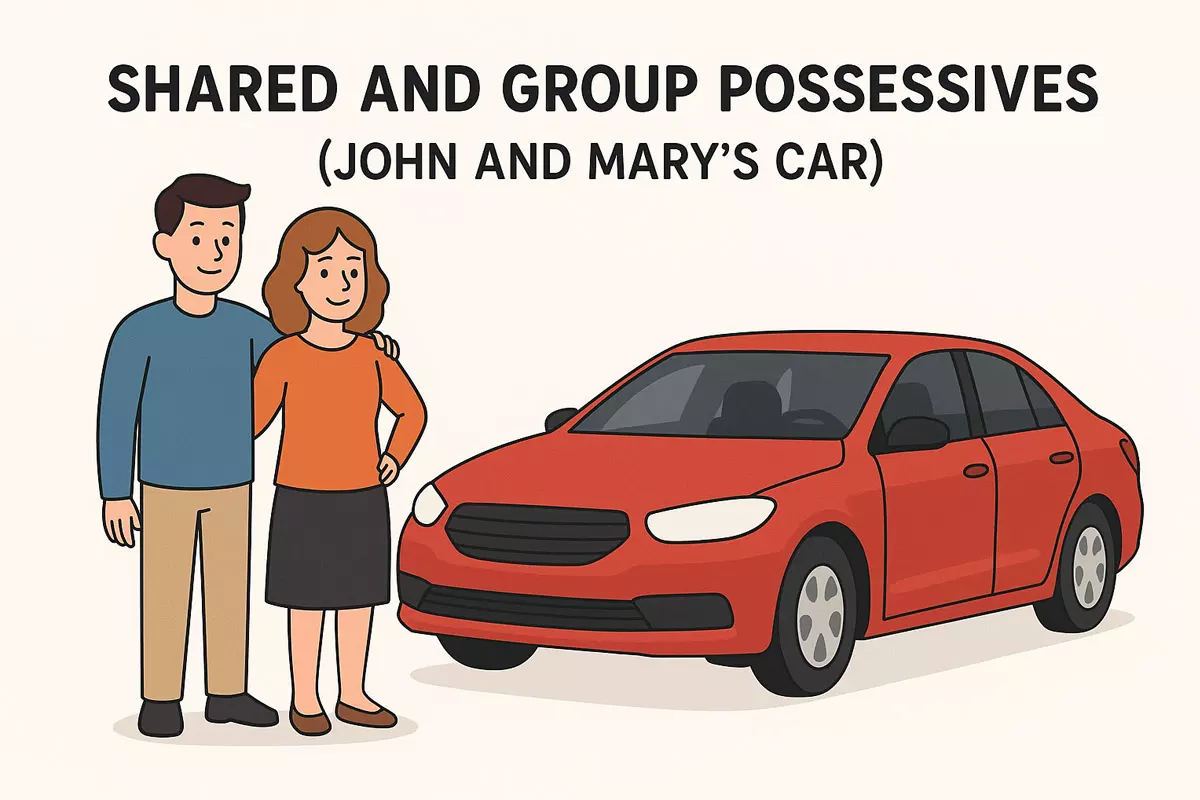 Here we the difference between shared and individual possession, how to form each type with apostrophes, how meaning changes, possessives with group or compound subjects, frequent learner mistakes, and includes practice rewriting sentences.
- Difference between shared and individual possession
- Forming shared possessives with one apostrophe
- Forming separate possessives with two apostrophes
- Meaning changes between shared and separate ownership
- Possessives with group and compound subjects
- Common learner errors with double ownership
- Practice: rewrite sentences to show shared or separate possession
Understanding how to correctly show ownership when more than one person is involved can be challenging, especially in situations like a vehicle jointly owned by John and Mary. In English, group possessive forms help clarify ownership. For example, if John and Mary own the car together, you would write John and Mary’s car to indicate joint possession. However, if they own separate cars, you would say John’s and Mary’s cars. Mastering these rules ensures clear and accurate communication about shared or individual ownership.
Difference between shared and individual possession
Understanding whether a possessive applies to one owner or multiple owners together is essential for clarity in English. The way you structure possessive phrases changes the meaning of a sentence, especially with more than one person involved. This distinction is particularly important when describing ownership or relationships to objects.
Shared Possession
When two or more people own something jointly, only the final name in the series receives the apostrophe + s. This signals that the item belongs to both (or all) people together. For example, John and Mary’s car means both John and Mary share ownership of the same car.
- Jack and Jill’s house (they live together in one house)
- Anna, Ben, and Carl’s project (all three worked on one project)
- Mom and Dad’s anniversary (they share the same anniversary)
- Lucy and Tom’s dog (one dog owned by both)
Individual Possession
If each person owns their own separate item, each name needs its own apostrophe + s. This pattern shows that the possessions are not shared, but individually held. For example, John’s and Mary’s cars means John has a car and Mary has a different car.
- Jack’s and Jill’s houses (each owns a different house)
- Anna’s, Ben’s, and Carl’s projects (each person completed their own project)
- Mom’s and Dad’s birthdays (each has a different birthday)
- Lucy’s and Tom’s dogs (each owns a different dog)
Quick Comparison
| Pattern | What It Means | Example |
|---|---|---|
| Shared (apostrophe on last name only) | Joint ownership: one thing owned together | Sam and Alex’s laptop (one laptop) |
| Individual (apostrophe on each name) | Separate ownership: each has their own | Sam’s and Alex’s laptops (two laptops) |
This difference can affect the meaning of a sentence, so using the correct form helps avoid confusion. Remember: for joint ownership, use a single apostrophe + s at the end; for separate ownership, add it to each name.
Forming shared possessives with one apostrophe
When two or more people own something together, English usually shows this with a single apostrophe and s after the last name in the group. This signals that the possession belongs to both (or all) individuals as a group, not separately. For example, when you say “John and Mary’s car,” it means they own the car together.
How to combine names for joint ownership
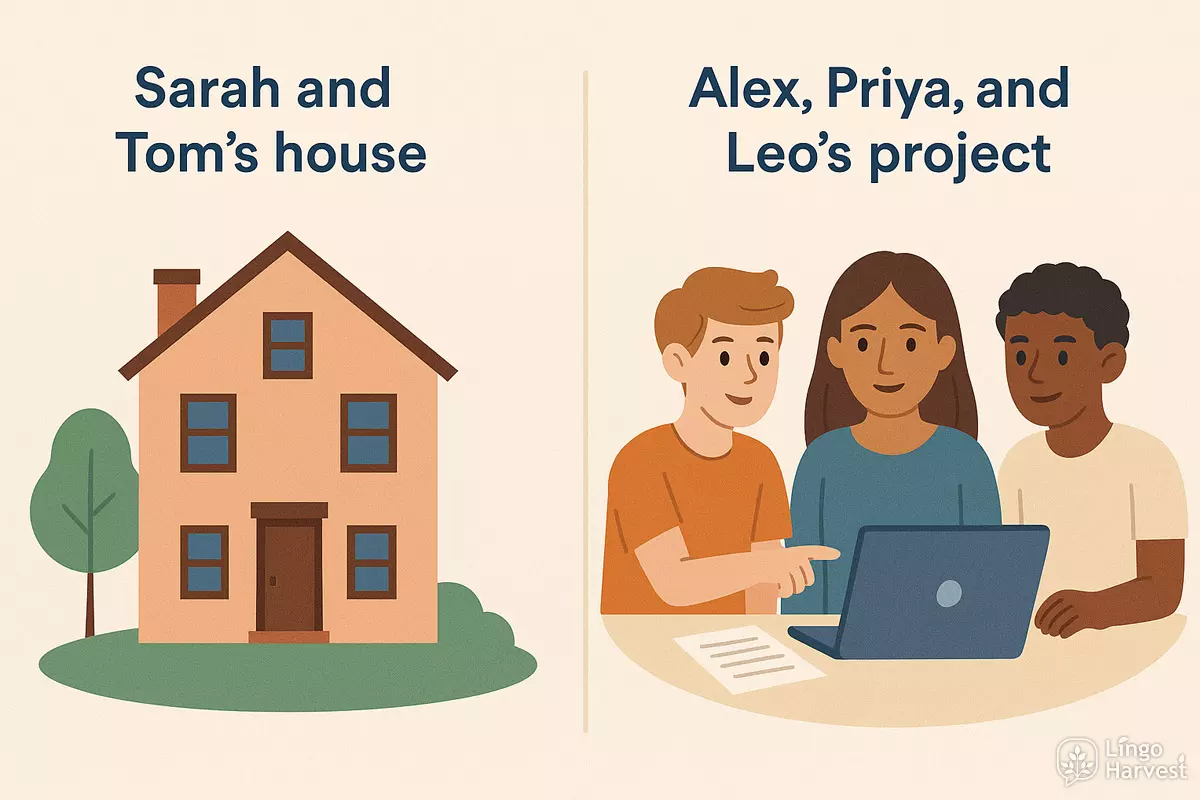
To indicate joint possession, only add the apostrophe and s to the last name in the series. Here are some common patterns:
- Sarah and Tom’s house
- Alex, Priya, and Leo’s project
- Mom and Dad’s anniversary
- Jack and Jill’s bucket
- Emma and Noah’s dog
- Chris and Pat’s restaurant
- Anna, Brian, and Carla’s plan
- Grandma and Grandpa’s garden
- Lisa and Mark’s wedding
- Ben, Sam, and Mia’s apartment
- Olivia and Ethan’s trip
- Rosa and Miguel’s bakery
- Peter, Paul, and Mary’s band
- Julie and Eric’s baby
- Jasmine and Leo’s invitation
- Teachers and students’ agreement
Tips for clarity
If each person owns something individually, the apostrophe and s should be added to each name. For instance, “John’s and Mary’s cars” means each has a separate car. But for shared ownership, keep the marker only on the last name.
Quick comparison: joint vs. separate possession
| Joint Possession (Shared Ownership) |
Separate Possession (Individual Ownership) |
|---|---|
| Jane and Oliver’s cat (They own one cat together) |
Jane’s and Oliver’s cats (Each owns a different cat) |
| Mike and Steve’s shop (They run one shop together) |
Mike’s and Steve’s shops (Each has a separate shop) |
| Sara and Kim’s idea (One idea shared by both) |
Sara’s and Kim’s ideas (Each has her own idea) |
| Paul and Rita’s boat (They co-own the boat) |
Paul’s and Rita’s boats (Each owns a boat) |
Understanding where to place the apostrophe helps avoid confusion and ensures your writing clearly reflects whether something is owned together or separately.
Forming separate possessives with two apostrophes
When two or more people or entities own things individually, English shows this by placing an apostrophe + s after each name. This signals that each person has their own item, rather than sharing a single one. For example, if both John and Mary have their own cars, you would write "John's and Mary's cars." This construction is different from a shared possessive, where only the second name gets the apostrophe.
When to Use Separate Possessives
Use separate possessives when each person owns something independently. This is common when talking about items like books, rooms, or opinions. If the ownership is not joint, each name should be marked with its own apostrophe.
- Sarah’s and Tom’s laptops (Sarah has a laptop, and Tom has a different one)
- Alice’s and Ben’s desks (Each has their own desk)
- Emma’s and Olivia’s ideas (Each has contributed individual ideas)
- James’s and Susan’s offices (They do not share the same office)
- Rachel’s and Mark’s birthdays (They celebrate on different days)
- Linda’s and Greg’s reports (Separate documents by each)
- David’s and Carol’s children (Each parent has children from previous relationships)
- Mike’s and Jennifer’s opinions (Distinct viewpoints)
- Anna’s and Leo’s awards (Each received an award)
- Lisa’s and Paul’s keys (Each has their own set)
- Ryan’s and Katie’s addresses (Separate residences)
- Tom’s and Jerry’s plans (Each has their own plans)
- Jack’s and Jill’s homework (They completed different assignments)
- Peter’s and Mary’s lunchboxes (Each brings their own)
- Chris’s and Pat’s shoes (Not a shared pair)
How Separate Possessives Differ from Shared Possessives
It’s important to distinguish between items owned together and those owned individually. In a shared possessive, only the last name takes the apostrophe, as in "John and Mary’s car" (one car shared by both). If the apostrophe + s appears after both names, it shows division of ownership.
Quick Reference: Separate vs. Shared Possessives
| Form | Meaning |
|---|---|
| John’s and Mary’s cars | Each owns a car individually |
| John and Mary’s car | One car owned jointly |
| Tim’s and Alex’s ideas | Each has their own ideas |
| Tim and Alex’s idea | One idea shared by both |
| Sara’s and Mike’s reports | Individual reports |
| Sara and Mike’s report | One report by both |
This approach helps clarify ownership and avoids ambiguity in writing. Always consider whether the people or entities mentioned possess the item(s) together or separately before deciding where to place apostrophes.
Meaning changes between shared and separate ownership
Ownership in English can be expressed in subtly different ways depending on how possessive forms are constructed, especially with group possessives like “John and Mary’s car” versus “John’s and Mary’s cars.” These differences are not just stylistic—they actually signal whether people share something or each person has their own.
How possessive structure changes interpretation
When only the second name in a compound subject takes the possessive ’s (as in “John and Mary’s car”), it usually means one thing is owned together. If both names take ’s (as in “John’s and Mary’s cars”), it indicates separate ownership—each has their own car.
- John and Mary’s car = one car owned by both John and Mary
- John’s and Mary’s cars = John owns a car, Mary owns a car (possibly two different cars)
Examples highlighting the difference
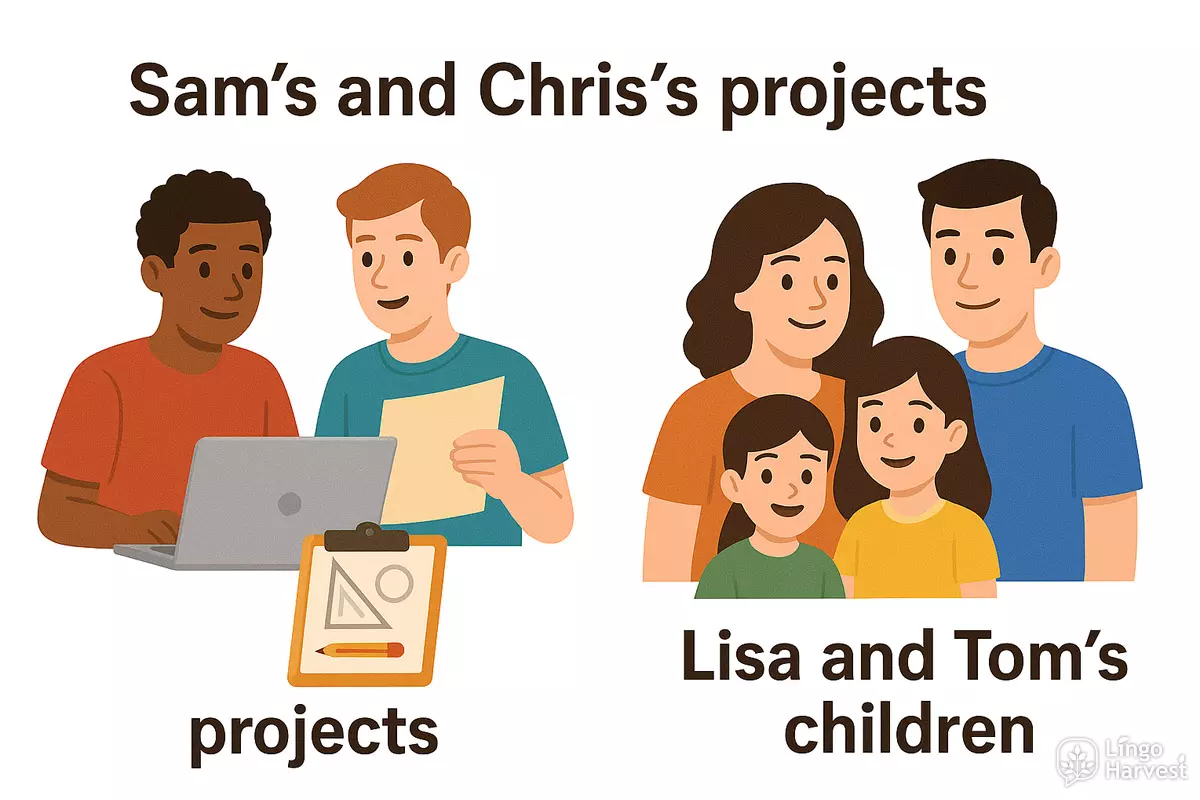
The pattern applies to a variety of nouns and contexts. Here are some examples that show how small changes in possessive structure alter meaning:
- Anna and Leo’s house → one house shared by Anna and Leo
- Anna’s and Leo’s houses → Anna owns one house, Leo owns another
- Sam and Chris’s project → a project they worked on together
- Sam’s and Chris’s projects → each has their own project
- Lisa and Tom’s children → children of both Lisa and Tom
- Lisa’s and Tom’s children → Lisa’s children (possibly from a different relationship) and Tom’s children
- Emma and Jake’s wedding → a wedding for both Emma and Jake
- Emma’s and Jake’s weddings → separate weddings (perhaps not to each other)
- Claire and Ben’s opinions → shared opinions, or opinions held by both
- Claire’s and Ben’s opinions → individual opinions of Claire and Ben
- Nina and Paul’s restaurant → a restaurant they co-own
- Nina’s and Paul’s restaurants → each owns a different restaurant
- David and Mia’s anniversary → a shared milestone
- David’s and Mia’s anniversaries → separate anniversaries (not necessarily as a couple)
- Olivia and Mark’s dog → one dog they both care for
- Olivia’s and Mark’s dogs → each person has their own dog(s)
- Rachel and Steve’s decision → a decision made together
- Rachel’s and Steve’s decisions → separate, individual decisions
Summary table: Shared vs. separate possession
| Pattern | Interpretation |
|---|---|
| John and Mary’s car | One car jointly owned by both |
| John’s and Mary’s cars | Each owns their own car (two cars) |
| Lisa and Tom’s children | Children shared as parents |
| Lisa’s and Tom’s children | Children from separate families or relationships |
| Nina and Paul’s restaurant | One restaurant co-owned |
| Nina’s and Paul’s restaurants | Each has a separate restaurant |
| Emma and Jake’s wedding | One wedding for both |
| Emma’s and Jake’s weddings | Separate weddings (not necessarily to each other) |
Key points to remember
- Possession markers (’s) on only the last item typically indicate joint possession.
- Adding ’s to each name signals individual ownership.
- This distinction can change the meaning of a sentence significantly.
Understanding these structures ensures clarity—so listeners or readers know if something is shared or individually possessed.
Possessives with group and compound subjects
Understanding how to show possession when more than one person or thing is involved can be tricky. The rules change depending on whether the people share something or have separate items. The placement of the apostrophe and the letter "s" is key to making your meaning clear.
Shared vs. Separate Ownership
When two or more people collectively own something, only the last name in the group receives the possessive ending. If each person owns their own item, you add the possessive form to each name. This subtle difference makes your writing precise. Consider these examples:
- John and Mary’s car (they share one car)
- John’s and Mary’s cars (each has a car)
- Sarah, Mike, and Tom’s house (one house owned together)
- Sarah’s, Mike’s, and Tom’s houses (each owns a separate house)
- Emma and Lisa’s project (they worked on one project together)
- Emma’s and Lisa’s projects (each did their own project)
- Jack and Jill’s bakery (they co-own a bakery)
- Jack’s and Jill’s bakeries (each owns a different bakery)
- My parents’ advice (advice from both parents together)
- My mother’s and father’s advice (advice from each parent, possibly different)
Compound Subjects with Nouns and Pronouns
If a compound subject includes a noun and a pronoun, the possessive form usually applies to both, but the pronoun must be in its possessive form already. For example:
- Sam and her brother’s apartment (they share one apartment)
- My friend’s and my opinions (separate opinions)
- Alex’s and your schedules (each person’s schedule)
- Alex and your schedule (a schedule you share)
Quick Reference: Forming Group Possessives
| Pattern | Example | Meaning |
|---|---|---|
| Shared ownership: add ’s to the last name only | Lucy and Tim’s garden | One garden, owned by both |
| Separate ownership: add ’s to each name | Lucy’s and Tim’s gardens | Two gardens, each owns one |
| Group possessive with plural noun | The teachers’ lounge | Lounge for all teachers |
| Compound with pronoun | My sister’s and my bicycles | Each person has a bicycle |
Correctly placing possessive endings helps readers understand whether people are sharing something or each has their own. This attention to detail is especially important in academic, professional, or clear everyday writing.
Common learner errors with double ownership
When English learners try to show that two or more people share something, confusion often arises with possessive forms. This happens because English has specific rules for expressing joint versus separate ownership, and the difference changes the meaning of a sentence. Misunderstandings can lead to sentences that sound odd or even change the intended sense.
Mixing up joint and separate possession
A frequent mistake is using the possessive form incorrectly when talking about items owned by two people together versus things owned by each person individually. For example:
- Saying John’s and Mary’s car when they share one car (should be John and Mary’s car).
- Writing Sarah and Tom’s books when each has their own set of books (should be Sarah’s and Tom’s books).
Overusing the apostrophe
Learners sometimes add unnecessary apostrophes to both names when only one is needed for shared ownership. Remember, only the last name in the series gets the ’s if the thing is owned together.
Omitting the possessive marker
Another error is leaving out the possessive ’s entirely, such as writing Anna and Mike car instead of Anna and Mike’s car.
Examples: Correct vs. Incorrect Forms
Below is a summary of typical mistakes and their correct forms, highlighting how meaning changes depending on the structure:
| Incorrect Form | Correct Form |
|---|---|
| John’s and Mary’s car (if they share one car) | John and Mary’s car |
| Anna and Mike’s cars (if each owns a car) | Anna’s and Mike’s cars |
| Jake and Lily’s house (if they each own a house) | Jake’s and Lily’s houses |
| Sarah’s and Tom’s cat (if they share one cat) | Sarah and Tom’s cat |
| Emily and Robert car | Emily and Robert’s car |
| Lisa’s and Paul’s dogs (if they have one dog together) | Lisa and Paul’s dog |
| Mike’s and Jenny’s room (if they share one room) | Mike and Jenny’s room |
| Alex and Sam’s bikes (if each has their own bike) | Alex’s and Sam’s bikes |
Other pitfalls to watch for
Learners also run into trouble with:
- Using the possessive ’s with inanimate objects in these structures (e.g., the table and chair’s legs instead of the legs of the table and chair).
- Applying these rules to longer phrases or complex groupings, which often require rephrasing for clarity.
- Forgetting to match the verb or pronoun number to the actual owners (singular vs. plural).
Careful attention to these patterns helps avoid ambiguity and ensures your meaning is clear when talking about things that belong to more than one person.
Practice: rewrite sentences to show shared or separate possession
Understanding how to indicate whether two people own something together or separately is essential for clarity in writing. The way you place the apostrophe and "s" in group possessives changes the meaning of the sentence. Let's practice by looking at sentences where you will need to rewrite them to show either joint ownership or individual ownership.
Instructions
For each sentence below, decide if the original shows shared or separate possession. Then, rewrite the sentence to show the opposite meaning. Pay close attention to where the apostrophe is placed.
- John and Mary's bikes are parked outside.
- Anna's and Tom's rooms are on different floors.
- Lisa and Mark's presentation was well-received.
- Jessica's and Brian's laptops need repairs.
- Susan and Paul's house is on Main Street.
- Mike's and Sarah's photos won awards.
- Ben and Carla's restaurant opens at noon.
- David's and Emma's projects are due Friday.
- Rachel and Tim's dog is very friendly.
- Olivia's and Ethan's books are on the table.
Show answers
- Separate: John’s and Mary’s bikes are parked outside. Shared: John and Mary’s bike is parked outside.
- Shared: Anna and Tom’s room is on a different floor.
- Separate: Lisa’s and Mark’s presentations were well-received.
- Shared: Jessica and Brian’s laptop needs repair.
- Separate: Susan’s and Paul’s houses are on Main Street.
- Shared: Mike and Sarah’s photo won an award.
- Separate: Ben’s and Carla’s restaurants open at noon.
- Shared: David and Emma’s project is due Friday.
- Separate: Rachel’s and Tim’s dogs are very friendly.
- Shared: Olivia and Ethan’s book is on the table.
Common Patterns
Here are some typical ways to rewrite phrases to indicate joint or individual ownership:
- Joint possession: Only the last name gets an apostrophe + s (e.g., Sam and Jane’s apartment means they share one apartment).
- Individual possession: Each name gets an apostrophe + s (e.g., Sam’s and Jane’s apartments means each owns a different apartment).
- When using plural items, check if the thing owned is singular or plural to clarify meaning.
- For three or more people: Tom, Lisa, and Kevin’s idea (shared), Tom’s, Lisa’s, and Kevin’s ideas (separate).
- If the ownership is mixed or unclear, reword for clarity (e.g., Each student’s assignment vs. The students’ group project).
Practice Table: Shared vs. Separate Possession
| Original Sentence | Rewritten for Opposite Possession |
|---|---|
| Kate and Leo’s car is new. | Kate’s and Leo’s cars are new. |
| Emily’s and Jack’s offices are on the same floor. | Emily and Jack’s office is on the same floor. |
| Sarah and Tom’s garden is beautiful. | Sarah’s and Tom’s gardens are beautiful. |
| Alex’s and Mia’s desks are messy. | Alex and Mia’s desk is messy. |
| Brian and Lisa’s project was successful. | Brian’s and Lisa’s projects were successful. |
Try creating your own examples using the patterns above to reinforce your understanding of shared and separate possession in English.