Lexical Density Calculator: Measure Content vs Function Words

 The Lexical Density Calculator helps you understand how information-rich your text is by comparing content words and function words. It is useful for academic writing, technical documentation, SEO content, and clarity checks. Paste any English text to instantly see lexical density, vocabulary variety, and writing style insights.
What Is Lexical Density?
Lexical density measures how much meaningful information a text contains. It is calculated as the percentage of content words (nouns, main verbs, adjectives, adverbs) relative to the total number of words.
Texts with higher lexical density tend to be more informative and compact, while texts with lower lexical density are usually easier to read and closer to spoken language. This metric is widely used in linguistics, academic writing, technical documentation, and professional content evaluation.
In simple terms:
- High lexical density → information-heavy, formal, academic or technical text
- Medium lexical density → balanced, clear, instructional writing
- Low lexical density → conversational, narrative, or user-friendly text
| Word Type | Description | Examples |
|---|---|---|
| Content words | Carry the main meaning of the sentence | analysis, develop, system, efficient |
| Function words | Grammatical connectors and structure words | the, is, and, to, of |
Understanding lexical density helps writers adjust tone, clarity, and complexity depending on the audience — whether writing for students, professionals, or general readers.
| Text Type | Typical Lexical Density | Purpose |
|---|---|---|
| Spoken conversation | 25–35% | Easy interaction, storytelling |
| General web content | 35–45% | Clear explanation, readability |
| Technical or academic writing | 45–60%+ | Dense information delivery |
How the Lexical Density Calculator Works
The Lexical Density Calculator automatically analyzes your English text by separating content words from function words using a stopword-based linguistic approach.
After processing the text, the tool provides both numerical metrics and qualitative interpretation to help you understand not only how dense the text is, but also what that means in practice.
The calculation follows this basic logic:
- Tokenize the text into individual words
- Classify words as content or function words
- Count total words and content words
- Calculate lexical density as a percentage
| Metric | What It Shows |
|---|---|
| Lexical Density (%) | How information-rich the text is |
| Content Words | Number of meaning-carrying words |
| Function Words | Number of grammatical structure words |
| TTR (Type–Token Ratio) | Vocabulary variety and repetition level |
In addition, the calculator highlights the most frequent content words and most frequent function words, giving you a clear picture of vocabulary focus and stylistic balance.
| Result Component | Why It Matters |
|---|---|
| Top content words | Shows key topics and semantic focus |
| Top function words | Helps identify structural repetition |
| Color-coded density level | Quick visual interpretation |
All calculations are performed instantly in the browser request, making the tool suitable for quick checks, editing workflows, and educational use.
How to Use the Calculator
The Lexical Density Calculator is designed for fast and intuitive use. You do not need any linguistic background to get meaningful results.
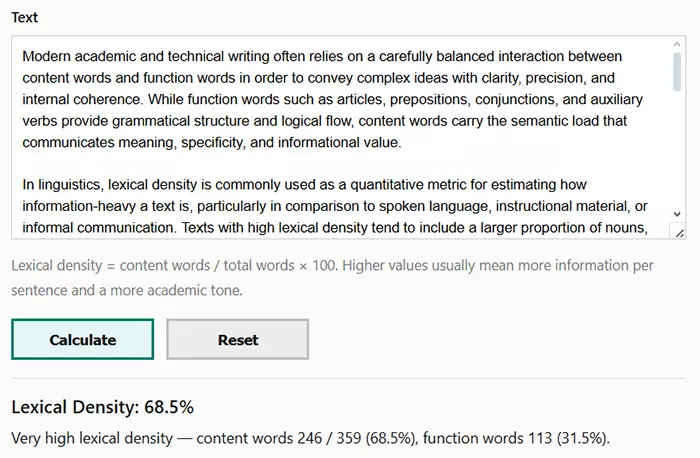
Follow these simple steps:
- Paste your English text into the input field
- Click the Calculate button
- Review the lexical density score and detailed breakdown
The calculator supports:
- Academic and technical writing
- Blog posts and web content
- Documentation, manuals, and instructions
- Student essays and ESL writing practice
For best accuracy, use complete sentences rather than short fragments. Very short texts may not reflect real writing patterns and can distort the results.
If you want to compare multiple drafts, analyze each version separately and observe how lexical density changes as you revise wording and structure.
How to Interpret the Results
After analysis, the calculator presents both numerical values and qualitative explanations to help you understand your text.
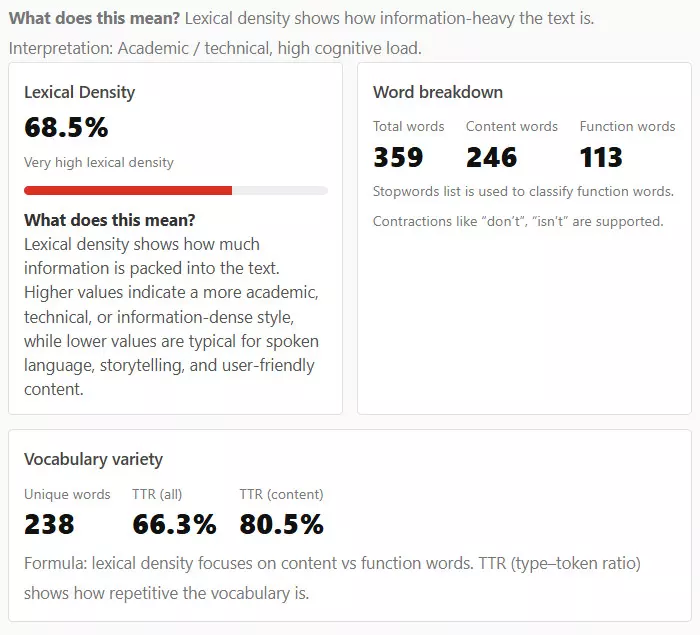
The main metric is lexical density (%). It shows how much of the text consists of content words. However, higher is not always better — the optimal level depends on your goal.
General interpretation guidelines:
- Below 35% — conversational, narrative, or beginner-friendly style
- 35–45% — balanced informational writing
- 45–55% — dense instructional or professional content
- Above 55% — academic or highly technical writing
In addition to lexical density, pay attention to:
- Content vs function word counts — shows structural balance
- Top content words — reveals topic focus and terminology
- TTR (Type–Token Ratio) — indicates vocabulary variety and repetition
A text with extremely high lexical density may feel heavy or difficult to process, while very low density can signal vague or overly simplistic writing. Use the results as a diagnostic tool, not a strict rule.
The most effective writing usually falls within a range that matches the expectations and reading level of its intended audience.
Who Should Use This Tool
The Lexical Density Calculator is designed for anyone who works with English texts and wants to improve clarity, effectiveness, or stylistic consistency.
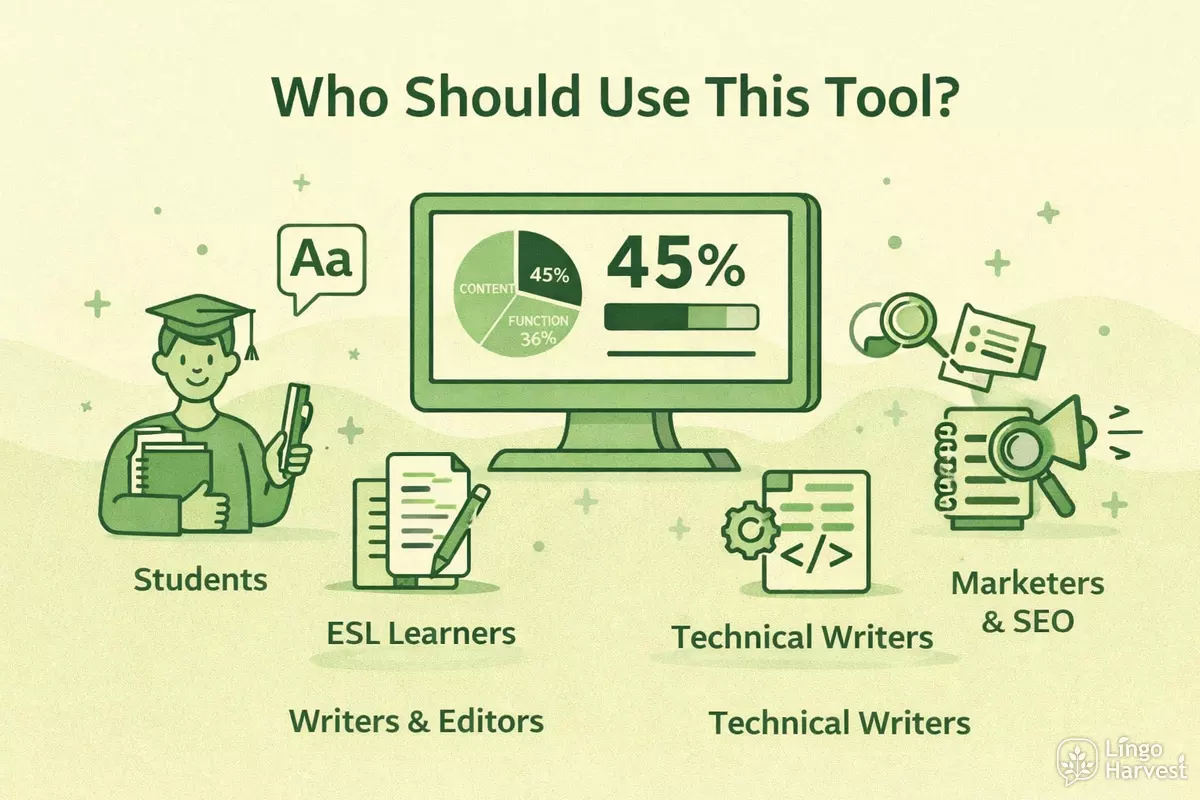
This tool is especially useful for:
- Students — to adjust essay style for academic requirements
- ESL learners — to understand why a text feels difficult or easy to read
- Writers and editors — to balance readability and information density
- Technical writers — to control complexity in documentation
- Content marketers and SEO specialists — to align tone with audience intent
In educational contexts, lexical density helps explain why some texts feel overwhelming even when grammar is correct. In professional contexts, it helps avoid overly dense or overly vague writing.
Rather than relying on intuition alone, this tool provides a measurable way to evaluate writing style and make targeted improvements.
Lexical Density and Writing Style
Lexical density plays a key role in shaping how a text is perceived by readers. It directly affects readability, cognitive load, and overall tone.
Different writing styles naturally gravitate toward different density levels:
- Narrative and storytelling — lower density, more function words
- Instructional content — medium density, balanced structure
- Academic and technical writing — higher density, precise terminology
Increasing lexical density usually involves:
- Replacing vague phrases with precise terms
- Reducing unnecessary fillers and repetitions
- Using nouns and main verbs instead of weak verb constructions
However, pushing density too high can reduce accessibility. Effective writing is not about maximizing lexical density, but about matching it to the reader’s expectations and purpose of the text.
By analyzing multiple drafts, you can use lexical density as a feedback signal to fine-tune style without sacrificing clarity or engagement.
Questions and Answers
- What is a good lexical density score?
There is no single “perfect” score. For general web content and instructional writing, a lexical density between 35% and 45% is usually effective. Academic and technical texts often fall between 45% and 55%, while conversational or narrative texts tend to be lower. - Is higher lexical density always better?
No. Higher lexical density means more information per sentence, but it also increases cognitive load. Extremely dense texts can feel heavy, difficult, or inaccessible. The best lexical density depends on the audience and purpose, not on maximizing the number. - Why does academic writing have higher lexical density?
Academic texts rely heavily on nouns, precise terminology, and complex ideas, which increases the proportion of content words. Function words are still necessary, but they play a smaller role compared to everyday spoken language. - Can lexical density help improve clarity?
Yes. A very low lexical density may indicate vague wording or excessive filler, while extremely high density may signal overcompression. Reviewing the score helps writers find a clearer balance between precision and readability. - How is lexical density different from readability scores?
Readability formulas focus on sentence length and word complexity, while lexical density focuses on word function and information load. A text can be grammatically simple yet highly dense, or complex but low in density. - Does text length affect lexical density?
Very short texts may produce unstable results. Lexical density becomes more reliable with longer samples, as they better reflect consistent writing patterns and vocabulary use. - Can ESL learners use lexical density for practice?
Absolutely. ESL learners can compare drafts to see how adding content words increases precision, or how simplifying structure reduces density. It is a practical way to understand why some texts feel harder to read. - Why do spoken texts usually have low lexical density?
Spoken language relies more on pronouns, auxiliary verbs, and connectors. These function words support interaction and flow but carry less standalone meaning, resulting in lower lexical density. - Should I edit my text based only on this calculator?
No. Lexical density should be used as a diagnostic tool, not a strict rule. Always combine the results with human judgment, audience expectations, and the overall purpose of the text.