Parallel Structure in Advanced Writing: Achieving Balance and Logic

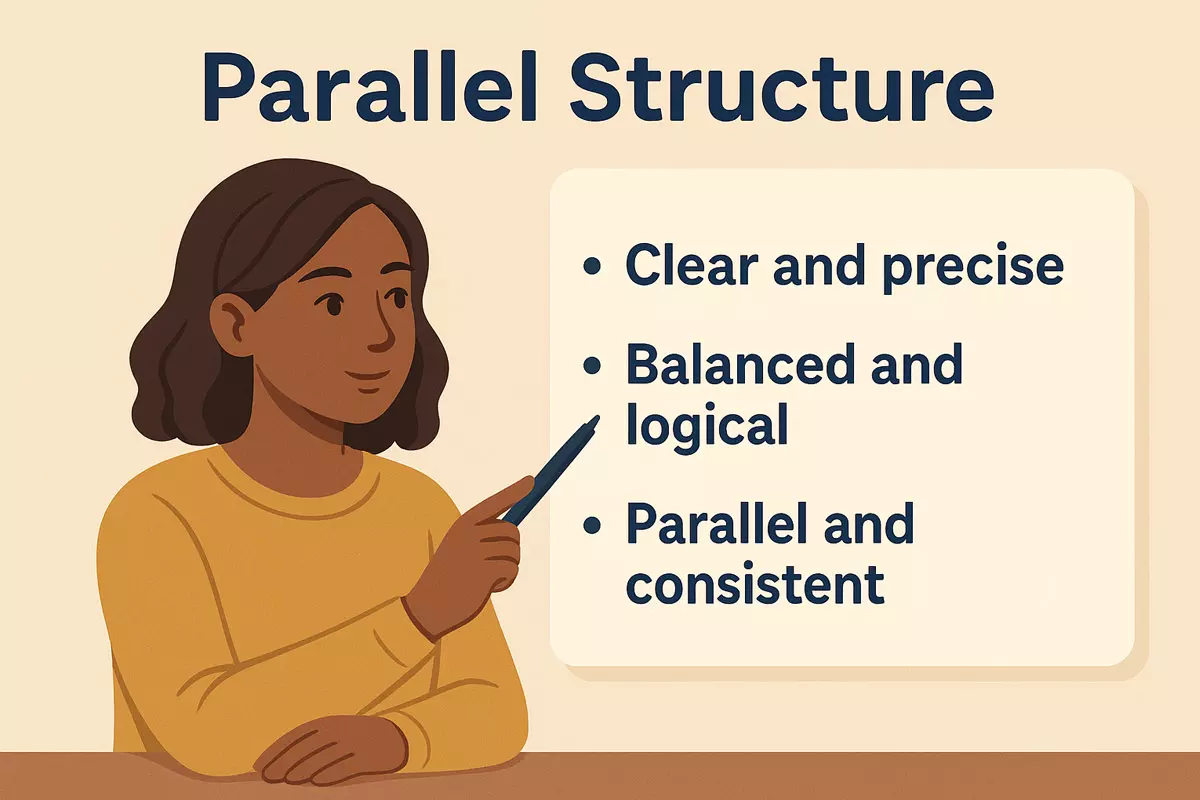 The article defines parallelism in grammar, shows how to use it in lists, series, contrasts, and paired structures, highlights its importance in academic and persuasive writing, and provides practice editing sentences to fix faulty parallelism.
Crafting sentences with balanced grammatical elements is a subtle yet powerful way to enhance both clarity and coherence in sophisticated writing, allowing your ideas to flow more logically and making your arguments easier to follow. By mastering this technique, you not only polish your prose but also guide readers smoothly through complex concepts, ensuring that each point connects naturally to the next. This attention to sentence structure helps maintain the reader's interest and comprehension, ultimately elevating the overall quality of your writing.
What parallelism means in grammar
Parallelism in grammar refers to using the same pattern of words or structure to show that two or more ideas have the same level of importance. This technique is essential in advanced writing because it creates balance and clarity, making sentences easier to read and understand. When similar elements in a sentence or list follow the same grammatical form, readers can process information more smoothly.
Why parallel structure matters
Maintaining consistent patterns in sentences not only improves readability but also helps writers avoid awkwardness and ambiguity. For instance, when listing actions, qualities, or items, using parallel forms enhances the logical flow and rhythm of your writing.
Common uses of parallelism
- Coordinating conjunctions: Linking words or phrases with and, but, or
- Lists and series: Presenting multiple items in a uniform way
- Comparisons: Using than or as with comparable structures
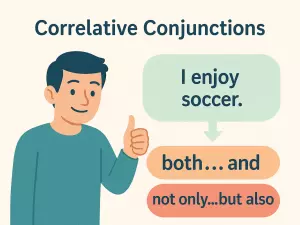
- Paired constructions: Phrases like either...or, not only...but also
- Correlative conjunctions: Ensuring both parts match grammatically
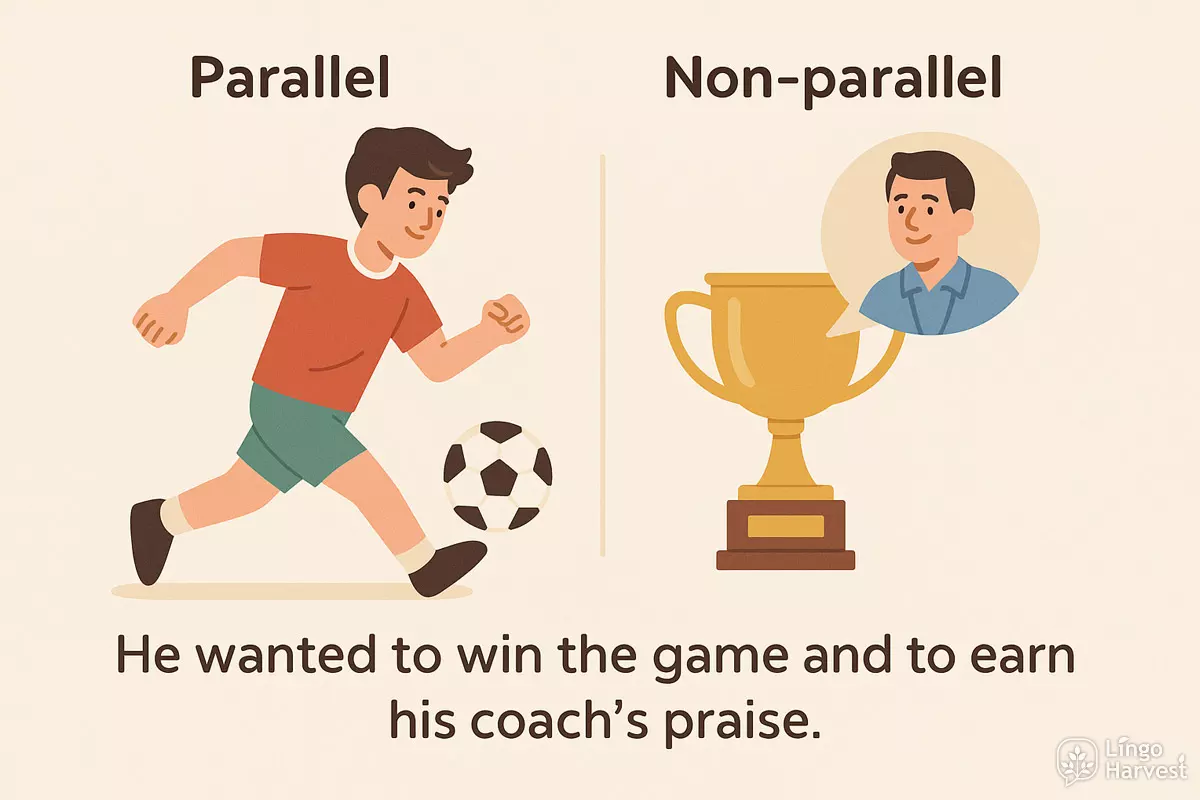
Examples of parallel and non-parallel structure
| Non-Parallel Example | Parallel Example |
|---|---|
| She likes reading, to swim, and biking. | She likes reading, swimming, and biking. |
| He wanted to win the game and for his coach to praise him. | He wanted to win the game and to earn his coach’s praise. |
| The manager said that the team should work quickly, efficiently, and with accuracy. | The manager said that the team should work quickly, efficiently, and accurately. |
| My goals are to learn French, traveling to Spain, and to write a novel. | My goals are to learn French, to travel to Spain, and to write a novel. |
Patterns commonly used for parallelism
- Infinitives: to run, to jump, to write
- Gerunds: running, jumping, writing
- Noun phrases: the first step, the second step, the final step
- Adjectives: creative, resourceful, diligent
- Clauses: what you see, what you believe, what you achieve
- Simple verbs: eat, sleep, repeat
- Prepositional phrases: in the morning, at noon, by evening
- Paired words: either this or that, not only smart but also hardworking
- Comparative forms: faster than, stronger than, more reliable than
- Questions: Where are you going? What are you doing? When will you return?
In summary, achieving parallel structure means repeating similar grammatical forms within a sentence or passage. This approach supports logical progression and reinforces the relationship between ideas, which is crucial in sophisticated, persuasive, or academic writing.
Parallel structures in lists and series
Maintaining consistent grammatical forms is essential when presenting multiple items within a sentence. Whether you are enumerating actions, qualities, or objects, using matching patterns ensures your writing is clear and logical. Readers can follow your argument more easily, and your prose feels balanced and purposeful.
Why is parallelism important in lists?
When items in a sequence share the same structure, your writing sounds more natural and is easier to process. Without this balance, lists may appear awkward or confusing, and your intended meaning can become unclear. Parallelism in series is especially important in academic, technical, and professional contexts where clarity is paramount.
Common patterns for parallel construction
Writers typically use parallel structure with verbs, nouns, adjectives, or entire phrases. Here are some frequent patterns:
- Coordinating verbs: to run, to jump, and to swim
- Matching noun forms: efficiency, precision, and consistency
- Adjective lists: quick, careful, and thorough
- Phrases: in the morning, during lunch, after work
- Infinitive phrases: to analyze data, to interpret results, to draw conclusions
- Gerunds: reading, writing, and editing
- Full clauses: She likes that he listens, that he cares, and that he supports her.
- Questions: Where are we going, what should we bring, and who will join us?
- Prepositional phrases: under the table, over the bridge, through the tunnel
- Comparative forms: faster, higher, stronger
Spotting and fixing faulty structures
Problems arise when elements in a list are not in the same grammatical format. This can cause confusion or make the sentence sound unbalanced. Consider these examples:
- ❌ She likes swimming, to read, and biking.
- ✅ She likes swimming, reading, and biking.
The revised version aligns all items as gerunds, making the sentence smoother.
Comparison of parallel and non-parallel lists
| Non-Parallel Example | Parallel Example |
|---|---|
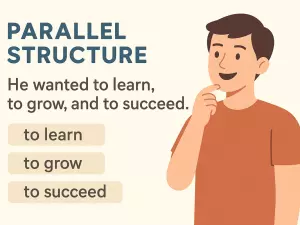
| He wanted to learn, growing his skills, and success. | He wanted to learn, to grow, and to succeed. |
| The project requires planning, to execute, and reviewing. | The project requires planning, executing, and reviewing. |
| Our goals are innovation, being efficient, and to expand. | Our goals are to innovate, to be efficient, and to expand. |
| He is smart, works hard, and ambition. | He is smart, hardworking, and ambitious. |
Tips for maintaining parallel form
- Identify the type of words or phrases in your series.
- Check that each item matches in grammatical form.
- Revise any element that stands out or breaks the pattern.
- Read your sentence aloud to spot awkwardness.
- When using correlative conjunctions (not only…but also, either…or), ensure both sides are parallel.
Consistent structure in lists and sequences not only clarifies your message but also demonstrates control and sophistication in your writing.
Parallelism in paired structures and contrasts
Consistent structure is especially important in sentences that include pairs or contrasts. When two or more elements are joined by coordinating conjunctions (like "and," "or," "but"), or when you’re contrasting ideas, aligning grammatical forms helps maintain clarity and flow. This approach not only improves readability, but also strengthens logical relationships between ideas.
Common Patterns in Paired Structures
Writers often use parallelism when connecting related ideas, making comparisons, or highlighting differences. To illustrate, notice how the grammatical form remains consistent across both sides of each pair:
- She prefers reading to writing.
- He wanted to win and to celebrate.
- The committee must approve or reject the proposal.
- We were not only surprised but also delighted.
- The solution was simple yet effective.
- They will either attend the meeting or submit a report.
- He is as skilled in analysis as in presentation.
- She is more interested in research than in teaching.
- The results were not only unexpected but also encouraging.
- We can stay here or go home.
- Her explanation was clear and concise.
- The team needed energy, focus, and patience.
- He likes to swim and to hike.
- They tried to negotiate but failed.
- The company must innovate or risk falling behind.
- You can either call me or email me.
- The room was not only spacious but also bright.
- She spoke calmly and confidently.
Contrasts and Comparisons: Achieving Balance
When drawing contrasts, parallelism helps clarify how the elements differ or relate. This is especially useful in academic and professional writing, where precise comparisons matter.
| Nonparallel Example | Parallel Revision |
|---|---|
| She likes hiking and to swim. | She likes hiking and swimming. |
| The project was challenging but also required creativity. | The project was challenging but also creative. |
| He is responsible for managing the team and to write reports. | He is responsible for managing the team and writing reports. |
| You can either start the process now or waiting until tomorrow. | You can either start the process now or wait until tomorrow. |
| Not only did she complete the work, but also was praised. | Not only did she complete the work, but she was also praised. |
Tips for Using Parallel Structure in Contrasts
- Match nouns with nouns, verbs with verbs, and phrases with similar phrases.
- Keep prepositions consistent across paired elements.
- When using correlative conjunctions (either/or, not only/but also, both/and), ensure symmetry in form.
- Read sentences aloud to catch imbalances that may not be obvious in writing.
- Revise awkward constructions by aligning grammatical forms.
Role in academic and persuasive writing
Parallel structure plays a crucial part in making scholarly and argumentative texts more logical and readable. By ensuring that ideas are presented in a consistent grammatical format, writers help readers follow complex arguments and draw clear connections between points. This technique is not just about style; it directly impacts clarity, emphasis, and the perception of professionalism in advanced writing.
Enhancing Clarity and Flow
Consistency in sentence structure helps readers process information more efficiently. When similar ideas are expressed in parallel form, it reduces cognitive load, making it easier to compare and contrast arguments, evidence, or concepts. For example, listing research objectives as "to analyze, to compare, and to evaluate" is much clearer than mixing forms such as "to analyze, comparison, and evaluating."
Increasing Persuasive Impact
In persuasive genres, balanced structures heighten the force of arguments. Parallelism draws attention to key points and can make claims more memorable. It also signals to the reader that the writer is careful and methodical, which can increase trust in the argument being presented.
Common Patterns Used in Advanced Writing
- Coordinating ideas (e.g., "The experiment was precise, controlled, and repeatable.")
- Presenting alternatives (e.g., "Students may choose to write an essay, deliver a presentation, or design a project.")
- Comparisons and contrasts (e.g., "While one approach is efficient, the other is thorough.")
- Enumerating evidence (e.g., "The study revealed increased accuracy, reduced costs, and higher satisfaction.")
- Structuring thesis statements ("This paper will examine the causes, effects, and solutions of urban sprawl.")
- Framing research questions ("Does the policy improve access, reduce inequality, and promote sustainability?")
- Concluding arguments ("In summary, the findings are reliable, relevant, and significant.")
- Setting up contrasts ("Not only was the method efficient, but it was also cost-effective.")
- Describing processes ("The system records data, analyzes trends, and generates reports.")
- Outlining recommendations ("We recommend increasing funding, expanding outreach, and improving training.")
- Describing characteristics ("The model is robust, scalable, and user-friendly.")
- Listing limitations ("The study is limited by sample size, duration, and regional scope.")
- Summarizing findings ("Participants reported feeling more confident, motivated, and engaged.")
- Stating purposes ("The goal is to inform, to persuade, and to inspire.")
- Highlighting benefits ("This approach saves time, reduces errors, and enhances accuracy.")
Parallel Structure in Academic vs. Persuasive Contexts
| Academic Writing | Persuasive Writing |
|---|---|
| Clarifies complex concepts and relationships; supports logical progression of ideas | Emphasizes arguments; makes claims more memorable and impactful |
| Used in thesis statements, enumerated lists, and comparative analysis | Highlights calls to action, contrasts, and rhetorical devices |
| Promotes objectivity and coherence in research reports | Creates rhythm and unity in speeches, opinion pieces, and debates |
| Reduces ambiguity in technical explanations | Builds emotional appeal and reinforces key messages |
Mastering parallel construction helps writers at advanced levels produce work that is not only structurally sound but also more convincing and easier to follow. Whether composing a dissertation or crafting a persuasive editorial, attention to balanced forms fosters both logic and reader engagement.
Spotting and fixing faulty parallelism
Identifying problems with parallel structure often begins by examining items in a list or series to see if they share the same grammatical form. When elements are not balanced, sentences can sound awkward or unclear. Writers aiming for clarity and elegance should learn to recognize where the structure breaks down.
Common signs of faulty parallelism
- Mixed verb forms (e.g., “to run, jogging, and walks”)
- Inconsistent noun or adjective patterns
- Unmatched prepositional phrases
- Shifting from active to passive voice within the same series
- Combining phrases and clauses unevenly
Strategies for correction
Start by isolating each item in the series. Ask: Do they match in tense, number, and grammatical type? If not, revise so that every element aligns.
- Make verbs consistent: Replace “to read, writing, and play” with “to read, to write, and to play.”
- Balance noun phrases: Instead of “the manager, the assistant, and working overtime,” use “the manager, the assistant, and the intern.”
- Align prepositions: Change “in the park, at the beach, and swimming” to “in the park, at the beach, and in the pool.”
- Unify comparative structures: “She is smarter, more diligent, and has creativity” should become “She is smarter, more diligent, and more creative.”
Typical parallelism errors and improved versions
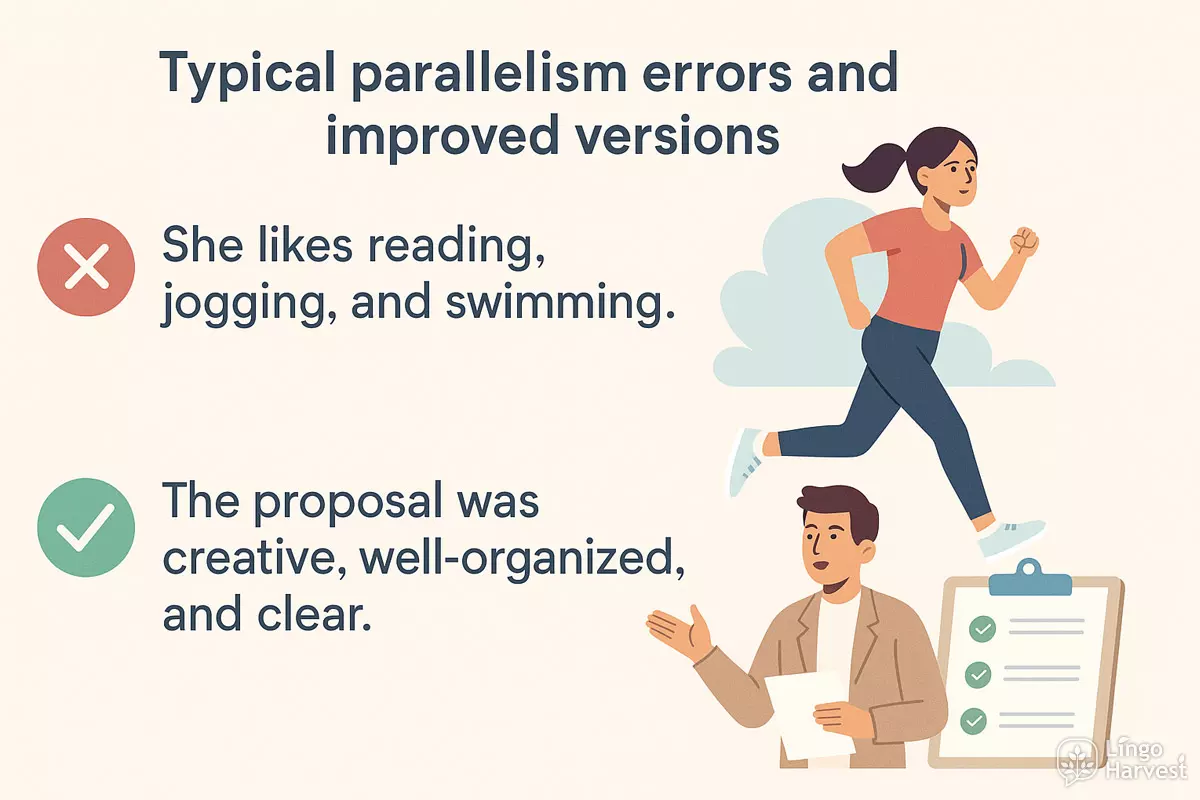
Below is a comparison of sentences with faulty structure and their corrected forms:
| Faulty Example | Corrected Parallel Structure |
|---|---|
| She likes reading, to jog, and swimming. | She likes reading, jogging, and swimming. |
| The proposal was creative, well-organized, and had clarity. | The proposal was creative, well-organized, and clear. |
| He wanted to learn quickly, efficiently, and with accuracy. | He wanted to learn quickly, efficiently, and accurately. |
| My goals are to finish the project, writing the report, and presenting the findings. | My goals are to finish the project, write the report, and present the findings. |
| We discussed the budget, scheduling, and how we would market the product. | We discussed the budget, the schedule, and the marketing plan. |
| He enjoys hiking, to swim, and biking. | He enjoys hiking, swimming, and biking. |
| The tasks include analyzing data, to write summaries, and creating charts. | The tasks include analyzing data, writing summaries, and creating charts. |
| She is responsible for filing documents, managing schedules, and she answers phones. | She is responsible for filing documents, managing schedules, and answering phones. |
| This course will improve your writing, speaking, and how you listen. | This course will improve your writing, speaking, and listening. |
| He values honesty, being punctual, and diligence. | He values honesty, punctuality, and diligence. |
Quick checklist for revising sentences
- Check all items in a list for matching grammatical forms.
- Keep verb tenses and voices consistent.
- Align noun, adjective, or adverb forms in series.
- Revise mixed phrases so that each element mirrors the others structurally.
- Read sentences aloud—imbalances often become more noticeable by ear.
By developing an eye for these imbalances and practicing revision, writers can ensure their sentences flow logically and persuasively. Consistent structure leads to greater clarity and professionalism in advanced writing.
Practice: edit sentences and paragraphs for parallel structure
Strong parallel structure gives writing clarity and rhythm. In this section, you'll work through examples and exercises to identify and correct faulty parallelism in both sentences and paragraphs. By editing for balance, you ensure your points are logical and easy to follow.
Spotting Parallelism Errors
Writers often struggle with lists, comparisons, and paired ideas. Look for places where items in a series, clauses, or phrases should match in form. Notice how mismatches can make writing awkward or unclear.
- She likes reading, to swim, and biking. ❌
- He wanted to learn quickly, efficiently, and with thoroughness. ❌
- The committee needs to decide on the budget, set the agenda, and preparing the schedule. ❌
Now, try your hand at recognizing and fixing similar errors.
- Rewrite the following sentences for parallelism:
- My goals are to finish my thesis, finding a job, and to travel abroad.
- The project requires careful planning, patience, and to be creative.
- She enjoys hiking, to paint, and playing chess.
- His responsibilities include managing staff, overseeing budgets, and to conduct meetings.
- Edit the paragraph below to improve its parallel structure: The new program will reduce costs, improve productivity, and the workers will feel more satisfied. Our aim is increasing efficiency, to decrease errors, and creating an environment that supports learning.
Comparison Table: Faulty vs. Parallel Structures
| Faulty Structure | Parallel Structure |
|---|---|
| She wanted to sing, dancing, and to act. | She wanted to sing, dance, and act. |
| Our mission is to inspire, educating, and growth. | Our mission is to inspire, educate, and grow. |
| The report was thorough, concise, and accuracy. | The report was thorough, concise, and accurate. |
| He is talented, hardworking, and has creativity. | He is talented, hardworking, and creative. |
| She likes to jog, swimming, and to cycle. | She likes to jog, swim, and cycle. |
Editing for Parallelism: Practice Set
Below are more sentences. Identify and correct the lack of parallel structure:
- He promised to call, write, and that he would visit.
- Improving communication, to reduce confusion, and building trust are our priorities.
- The teacher asked us to read the chapter, summarizing the main points, and to answer the questions.
- Her hobbies include painting, to dance, and cooking.
Show answers
- He promised to call, write, and visit.
- Improving communication, reducing confusion, and building trust are our priorities.
- The teacher asked us to read the chapter, summarize the main points, and answer the questions.
- Her hobbies include painting, dancing, and cooking.
Editing for parallelism is a skill that improves with practice. As you revise your own writing, look for opportunities to align grammatical forms, especially in lists, headings, and repeated sentence structures.