How to Form Questions in the Past Simple Tense

 Here we how to form past simple questions, including using did, yes/no and WH-questions, and handling regular and irregular verbs. It also discusses time expressions, common mistakes, and offers practice exercises to check your understanding.
If you want to ask about events that have already happened, it's important to know how to form questions about past actions. Mastering this skill will make your English conversations clearer and more effective. To ask about earlier experiences, you typically use the past simple or present perfect tense, depending on the context. For example, you might ask, "Did you see the movie last night?" or "Have you ever traveled abroad?" Practicing these structures will help you feel more confident when discussing past events in English.
Past Simple Question Structure
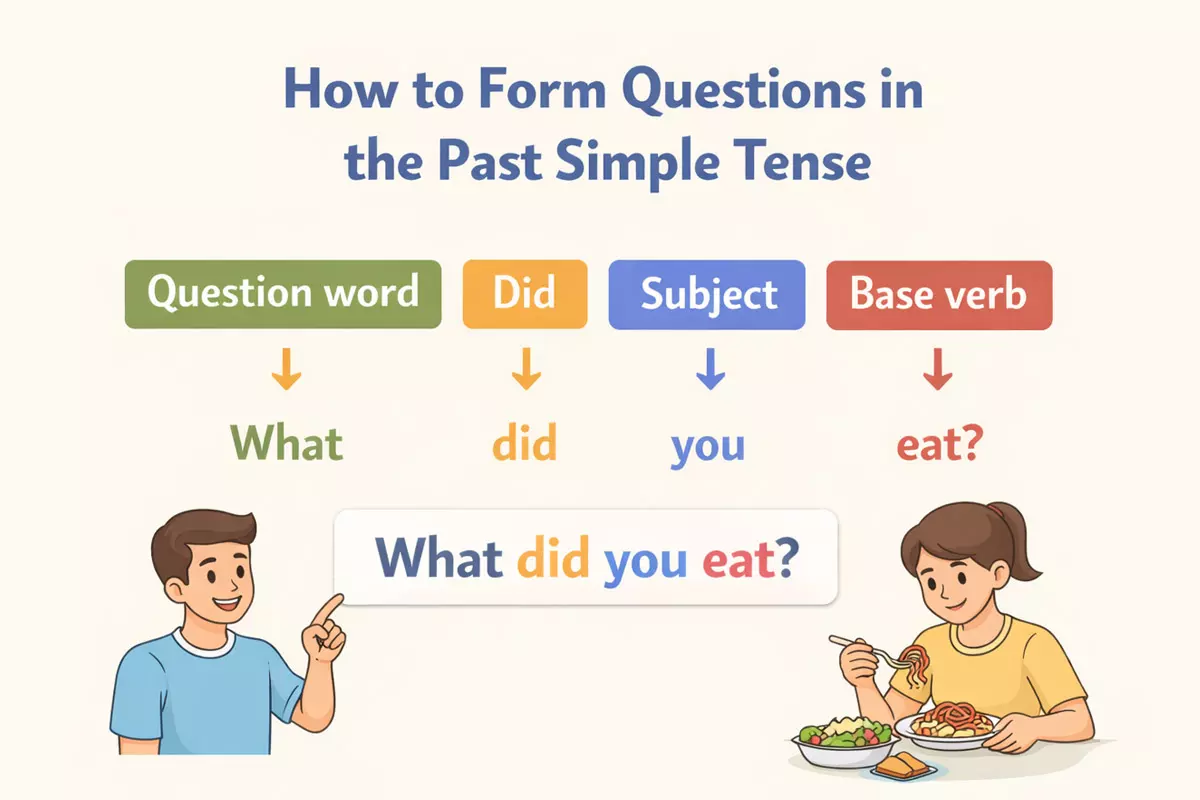
Understanding how to ask questions about the past is essential for clear communication in English. When you want to find out about actions or events that happened before now, you typically use a specific word order and auxiliary verb. The basic formula for forming yes/no questions in this tense is: Did + subject + base form of the verb + ...? For questions that ask for specific information, you simply add a question word (like what, where, when, why, who, or how) at the beginning of the sentence.
Key Elements of Past Simple Questions
- Did is always used, regardless of the subject.
- The subject (person or thing doing the action) comes after "did".
- The main verb always appears in its base form (not past tense).
- For wh- questions, the question word comes at the start.
Common Patterns and Examples
| Type | Question Example | Short Answer |
|---|---|---|
| Yes/No | Did you call her? | Yes, I did. / No, I didn’t. |
| What | What did he eat? | He ate pasta. |
| Where | Where did they go? | They went to the park. |
| When | When did it start? | It started at 8pm. |
| Why | Why did you leave? | Because I was tired. |
| Who (object) | Who did she invite? | She invited Sam. |
| How | How did you fix it? | I used glue. |
| Who (subject) | Who broke the vase? | Tom broke it. |
| Which | Which book did you read? | I read the red one. |
| Whose | Whose keys did you find? | Sarah’s keys. |
Important Points to Remember
- Never use the past tense form of the verb after "did". It should always be the base form (e.g., Did you went? ❌ vs. Did you go? ✅).
- For questions where "who" is the subject, "did" is not used (e.g., Who called you? not Who did called you?).
- Short answers use "did" or "didn’t" (e.g., Yes, she did. / No, they didn’t.).
- Negative questions are possible: Didn’t you see the sign?
- With irregular verbs, the form after "did" still stays as the base: Did you eat? not Did you ate?
Mastering these structures will help you confidently form questions about past events, whether you’re having a conversation, writing, or taking a test.
Using Did in Questions
To form questions in the past simple tense, English relies on the auxiliary verb did. This helper word signals that the question is about a past event, and it works with all subjects—there’s no need to change it for singular or plural forms. After did, use the base form of the main verb, not the past tense. This rule is key to making grammatically correct past simple questions.
Basic Structure
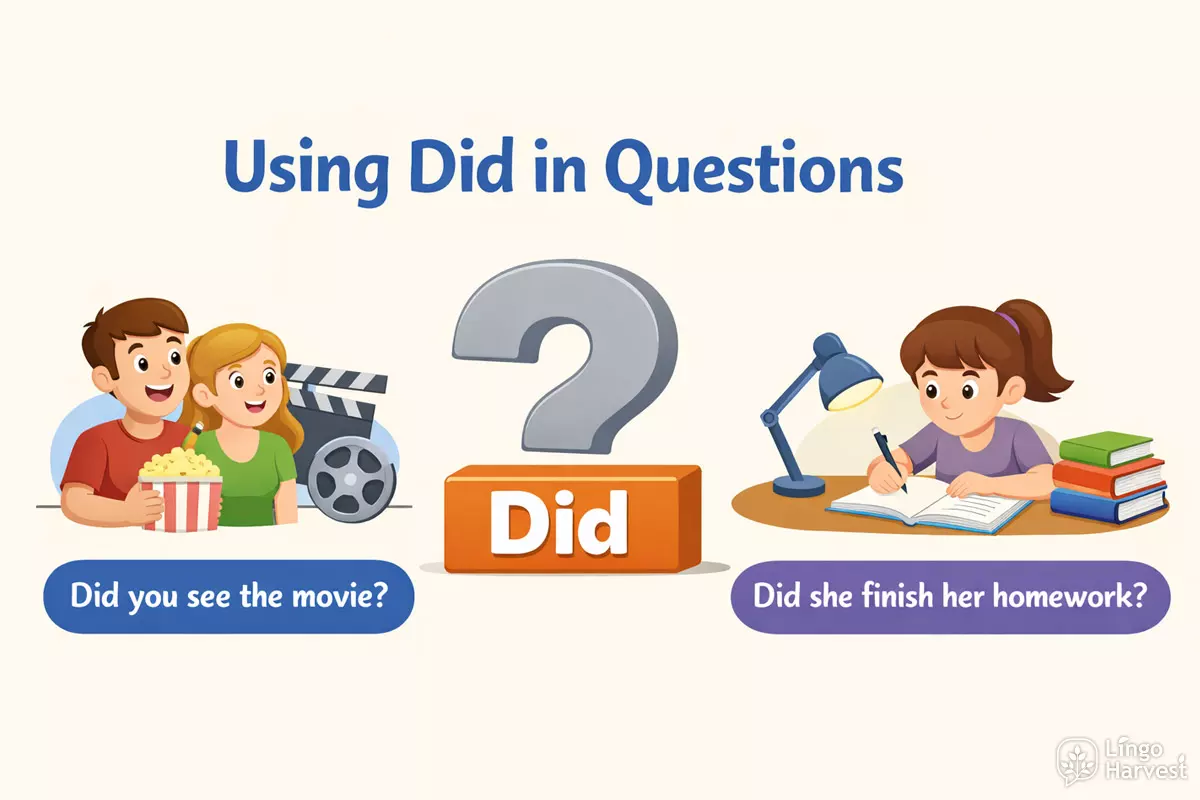
The standard format is:
- Did + subject + base verb + (rest of the sentence)?
For example:
- Did you see the movie? → Yes, I did.
- Did she finish her homework? → Yes, she did.
- Did they travel last summer? → Yes, they did.
Notice that the main verb does not take the -ed ending in the question form. This is because did already marks the past tense.
Common Question Words
When asking for specific information, question words often come before did:
- What did you eat for breakfast? → I ate cereal.
- Where did he go after work? → He went home.
- When did they arrive? → They arrived yesterday.
- Why did she leave early? → Because she felt sick.
- How did you fix the problem? → I fixed it by restarting the system.
Examples with Different Subjects and Verbs
Using a variety of subjects and main verbs can help you see how the pattern stays the same:
- Did I lock the door? → Yes, you did.
- Did we win the game? → Yes, we did.
- Did it rain yesterday? → No, it didn’t.
- Did John call you? → Yes, he did.
- Did the children enjoy the trip? → Yes, they did.
- Did your parents know about the plan? → No, they didn’t.
- Did that restaurant open last month? → Yes, it did.
- Did anyone help you? → Yes, someone did.
- Did the meeting start on time? → Yes, it did.
- Did you understand the instructions? → Yes, I did.
Summary Table: Statement vs. Question Forms
| Statement (Past Simple) | Question (Past Simple) |
|---|---|
| She played tennis. | Did she play tennis? |
| They visited London. | Did they visit London? |
| He watched TV. | Did he watch TV? |
| We studied French. | Did we study French? |
| You cooked dinner. | Did you cook dinner? |
Points to Remember
- Don’t use the past tense of the main verb after did (❌ Did you went? ✅ Did you go?).
- Use did for all subjects, including I, you, he, she, it, we, and they.
- For yes/no questions, start directly with did; for information questions, add a question word first.
Mastering this structure will help you easily ask about past events in English.
Yes/No Questions in Past Simple
To ask a question that can be answered with "yes" or "no" about a finished action or event in the past, English uses the auxiliary verb did followed by the base form of the main verb. This structure is the same for all subjects (I, you, he, she, it, we, they), which makes it simple to form these types of questions.
Basic Structure
The typical pattern is: Did + subject + base verb + (rest of sentence)? Notice that the main verb does not change form, even for third-person singular subjects.
| Question | Short Answer |
|---|---|
| Did you see the movie? | Yes, I did. / No, I didn’t. |
| Did they finish the project? | Yes, they did. / No, they didn’t. |
| Did she call you? | Yes, she did. / No, she didn’t. |
| Did it rain yesterday? | Yes, it did. / No, it didn’t. |
| Did we miss the bus? | Yes, we did. / No, we didn’t. |
Forming Yes/No Questions: Common Examples
- Did you eat breakfast this morning? → Yes, I did.
- Did he understand the instructions? → Yes, he did.
- Did they travel last summer? → Yes, they did.
- Did your brother study for the test? → Yes, he did.
- Did the team win the match? → Yes, they did.
- Did she enjoy the concert? → Yes, she did.
- Did we lock the door? → Yes, we did.
- Did the teacher explain the lesson? → Yes, she did.
- Did your parents visit Paris? → Yes, they did.
- Did I leave my keys here? → Yes, you did.
- Did Tom finish his homework? → Yes, he did.
- Did Anna call her friend? → Yes, she did.
- Did the cat catch the mouse? → Yes, it did.
- Did you remember the meeting? → Yes, I did.
- Did it snow last night? → Yes, it did.
Key Points to Remember
- Always use did for all subjects—no need to change for he/she/it.
- The main verb stays in its base form (not past tense) after did.
- Short answers usually repeat did or didn’t for clarity.
- Negative questions use didn’t (e.g., "Didn’t you see the message?").
Mastering this pattern will help you ask clear, concise questions about past events and understand responses easily.
WH-Questions in Past Simple
To ask about specific details in the past, English uses questions starting with words like what, when, where, who, why, and how. These are often called “question words” or “WH-words.” In the past simple tense, these questions usually begin with a WH-word, followed by did (for most verbs), and then the subject and the base form of the verb.
Basic Structure
The typical word order is: WH-word + did + subject + base verb + ...? For example: “Where did you go yesterday?” This pattern helps you ask about actions or details that happened in the past, focusing on different aspects depending on the WH-word you use.
Common WH-Words and Their Uses
- What – asks about things or actions (“What did she say?”)
- Where – inquires about places (“Where did they meet?”)
- When – focuses on time (“When did you arrive?”)
- Why – seeks reasons (“Why did he leave?”)
- Who – asks about people (see below for special rules)
- Which – asks for a choice (“Which book did you buy?”)
- How – asks about manner or process (“How did you fix it?”)
Special Case: “Who” as Subject
When who is the subject of the question, you do not use did. Instead, simply use the past form of the verb after who. For example, “Who broke the window?” Here, “who” replaces the subject, and the verb takes the regular past tense form.
| WH-Word | Example Question (Past Simple) |
|---|---|
| What | What did you eat for lunch? |
| Where | Where did they go on holiday? |
| When | When did she call you? |
| Why | Why did he laugh? |
| Who (as subject) | Who visited you last week? |
| Which | Which movie did you watch? |
| How | How did you solve the problem? |
Examples for Practice
- What did you find at the market? → I found some fresh fruit.
- Where did she learn English? → She learned it at school.
- When did they finish the project? → They finished it last week.
- Why did you choose that option? → Because it was the best choice.
- Who opened the door? → John opened the door.
- Which team won the match? → The home team won.
- How did he get here? → He came by train.
- What did the teacher say? → She gave us instructions.
- Where did you put my keys? → I put them on the table.
- When did your family move here? → We moved here in 2020.
- Why did it happen? → Because of a mistake.
- Who made this cake? → My sister made it.
- How did you know the answer? → I checked the notes.
Understanding how to form these questions allows you to gather information about past events in a clear and accurate way. Pay attention to the word order and the role of did, except when “who” is the subject.
Regular and Irregular Verbs in Questions
Forming questions in the past simple tense follows the same basic structure for both regular and irregular verbs. The auxiliary verb did is always used, regardless of whether the main verb is regular or irregular. This means the main verb stays in its base form in questions, and you do not need to change it according to its regular or irregular type.
How It Works
To create a question, start with did, followed by the subject, and then the base form of the verb. The pattern is:
- Did + subject + base form of verb + rest of the sentence?
This structure keeps things straightforward. You do not add -ed to regular verbs, nor do you use the irregular past form in questions. Whether the verb is "walk" (regular) or "go" (irregular), the question structure is the same.
Examples With Regular and Irregular Verbs

Here are some sample questions using both types of verbs:
- Did you play football yesterday? (regular)
- Did she visit her grandmother? (regular)
- Did they arrive on time? (regular)
- Did he call you last night? (regular)
- Did you go to the party? (irregular)
- Did he eat breakfast this morning? (irregular)
- Did they see the movie? (irregular)
- Did you find your keys? (irregular)
- Did we meet before? (irregular)
- Did she have any questions? (irregular)
Key Differences in Verb Forms
The main difference between regular and irregular verbs appears in positive sentences, not in questions. In questions, both types use the base form after did. For comparison, look at these patterns:
| Statement (Past Simple) | Question (Past Simple) |
|---|---|
| She walked to school. | Did she walk to school? |
| He saw a cat. | Did he see a cat? |
| They played chess. | Did they play chess? |
| We ate lunch. | Did we eat lunch? |
Common Mistakes to Avoid
- Don’t use the past form of the main verb after did (❌ Did you went home?).
- Always use the base form after did (✅ Did you go home?).
- Remember that this rule applies to both regular and irregular verbs.
In summary, when forming questions in the past simple tense, there is no need to worry about whether a verb is regular or irregular. The auxiliary did takes care of the tense, and the main verb stays in its base form.
Time Expressions in Past Questions
When forming questions in the past simple tense, certain words and phrases help clarify when something happened. These time markers often appear at the end of the question, but can sometimes come at the beginning for emphasis. Using them correctly makes your questions clearer and more precise.
Common Past Time Markers
Here are some frequent time expressions used in past simple questions. Including these helps specify the moment or period you’re asking аbout:
- yesterday → Did you work yesterday?
- last night → Did she call you last night?
- last week → Did they finish the report last week?
- two days ago → Did you meet him two days ago?
- in 2010 → Did you live here in 2010?
- when you were a child → Did you play this game when you were a child?
- this morning → Did he send the email this morning?
- a few minutes ago → Did the bus leave a few minutes ago?
- on Monday → Did you have a test on Monday?
- at the weekend → Did you visit your family at the weekend?
- last summer → Did you travel abroad last summer?
- the day before yesterday → Did it rain the day before yesterday?
- earlier today → Did you talk to your manager earlier today?
- in the past → Did people use this tool in the past?
- during your vacation → Did you learn any new words during your vacation?
- at 8 o’clock → Did the meeting start at 8 o’clock?
Where to Place Time Expressions in Questions
Most of the time, time markers come at the end of the question. However, placing them at the start can add emphasis or make the time reference clearer. Compare these examples:
| Question | Time Expression Position |
|---|---|
| Did you see the movie last night? | End of question |
| Last night, did you see the movie? | Beginning of question |
| Where did you go on Friday? | End of question |
| On Friday, where did you go? | Beginning of question |
Questions Without Specific Time Expressions
Sometimes, you can leave out a time marker if the context is clear, or if you are asking generally about the past. For example, “Did you meet her?” or “What did you eat?” If you want to know exactly when something happened, use “when” in your question: “When did you meet her?”
Tips for Using Past Time Markers
- Use “ago” with a number: “Did you call me two hours ago?”
- Use “last” with days, weeks, months, or years: “Did you travel last summer?”
- Use “in” with years or months: “Did you move here in 2019?”
- For more detail, combine time markers: “Did you see him at 6 p.m. last night?”
Adding the right time expressions makes your past simple questions easier to understand and answer. Try mixing different markers to ask about specific events or periods in the past.
Common Learner Mistakes
When trying to form questions in the past simple tense, English learners can run into a number of pitfalls. These issues often come from confusing word order, misusing auxiliary verbs, or mixing up verb forms. Being aware of these frequent errors can help you avoid them and build confidence in your questioning skills.
Typical Errors with "Did" and Verb Forms
A major source of confusion is how to use "did" with the base form of the main verb. Many students accidentally use the past tense after "did," which leads to incorrect sentences. For example, "Did you went to the store?" is a mistake. The correct version is "Did you go to the store?" because "did" already shows the past tense.
Word Order Mistakes
Word order can also trip up learners. Questions in the past simple require the auxiliary "did" at the start, followed by the subject and then the base verb. Forgetting this order often results in statements rather than questions, or in awkward constructions.
| ❌ Incorrect Question | ✅ Correct Question |
|---|---|
| Did you went home? | Did you go home? |
| Went you to the party? | Did you go to the party? |
| You did see her? | Did you see her? |
| Did he played football? | Did he play football? |
| Did Anna was late? | Was Anna late? |
Confusing "Be" with Regular Verbs
Another common issue is mixing up how to ask questions with the verb "be" compared to other verbs. For most verbs, "did" is used, but with "was/were," the auxiliary comes first and "did" is not used. For example, "Was she at the meeting?" is correct, not "Did she was at the meeting?"
Omitting "Did" or Using It Unnecessarily
Sometimes learners forget to use "did" in past simple questions, or they use it when it’s not needed. The following list summarizes typical mistakes:
- Forgetting "did": You go to school yesterday? → Did you go to school yesterday?
- Adding "did" with "was/were": Did you were tired? → Were you tired?
- Using past tense verb after "did": Did they finished the job? → Did they finish the job?
- Incorrect word order: You did see the movie? → Did you see the movie?
- Extra auxiliary: Did did you go? → Did you go?
- Using "do/does" instead of "did": Do you go to the concert yesterday? → Did you go to the concert yesterday?
- Mixing up time expressions: Did you went tomorrow? (should be "yesterday" or another past time marker)
Summary
Mastering question formation in the past simple tense takes practice with auxiliary verbs, word order, and verb forms. By recognizing these typical challenges, you can focus your efforts and ask questions clearly and correctly.
Practice Exercises and Self-Check
Ready to test your understanding of forming questions in the past simple? The following activities will help you check your grasp of word order, auxiliary use, and question formation for both regular and irregular verbs. Try to answer without looking up the rules, then check your responses at the end of each section.
1. Rewrite Statements as Past Simple Questions
Turn each sentence below into a correct yes/no question in the past simple tense. Pay attention to the subject, verb, and the use of "did."
- She visited her grandparents last weekend.
- They played football in the park yesterday.
- He found his keys under the sofa.
- You watched the movie on Friday.
- The teacher explained the lesson clearly.
- We finished the project on time.
- Anna cooked dinner for her family.
- They moved to a new apartment last month.
- He bought a new phone yesterday.
- I met my old friend at the café.
Show answers
- Did she visit her grandparents last weekend?
- Did they play football in the park yesterday?
- Did he find his keys under the sofa?
- Did you watch the movie on Friday?
- Did the teacher explain the lesson clearly?
- Did you finish the project on time?
- Did Anna cook dinner for her family?
- Did they move to a new apartment last month?
- Did he buy a new phone yesterday?
- Did you meet your old friend at the café?
2. Wh- Questions Practice
For each sentence, create a question starting with the given word. Make sure to use the correct past simple form.
- They bought a new car. (What)
- She traveled to Spain. (Where)
- Tom finished his homework at 8 PM. (When)
- He called his friend because he needed help. (Why)
- The dog barked loudly. (How)
- We met at the station. (Where)
- Anna chose this dress. (Which)
- They arrived late. (Why)
- He learned English online. (How)
- The movie started at 9 PM. (When)
Show answers
- What did they buy?
- Where did she travel?
- When did Tom finish his homework?
- Why did he call his friend?
- How did the dog bark?
- Where did you meet?
- Which dress did Anna choose?
- Why did they arrive late?
- How did he learn English?
- When did the movie start?
3. Identify the Error
Each sentence below contains a mistake in forming a past simple question. Find and correct the error.
- Did you went to the concert last night?
- Where did she travels last summer?
- Did they eats dinner at home?
- What did happened here?
- Did he bought a new laptop?
- When did they arrived?
- Did she saw the message?
- Why did you were late?
- Did we finished the task?
- How did he fixed the problem?
Show answers
- Did you go to the concert last night?
- Where did she travel last summer?
- Did they eat dinner at home?
- What happened here?
- Did he buy a new laptop?
- When did they arrive?
- Did she see the message?
- Why were you late?
- Did we finish the task?
- How did he fix the problem?
4. Past Simple Question Patterns
Review the common structures for forming questions. The table below summarizes the typical forms you will use.
| Type | Example |
|---|---|
| Yes/No Question | Did she call you? |
| Wh- Question (object) | What did you see? |
| Wh- Question (subject) | Who broke the window? |
| Why/How/When Question | Why did they leave early? |
5. Self-Check: Create Your Own
Write three original questions in the past simple tense. Try to include at least one yes/no question and two Wh- questions using different question words.
Show answers
Examples:
- Did you enjoy the party?
- Where did you go on holiday?
- When did they finish the project?