Auxiliary Verbs in English Questions: Do, Does, Did

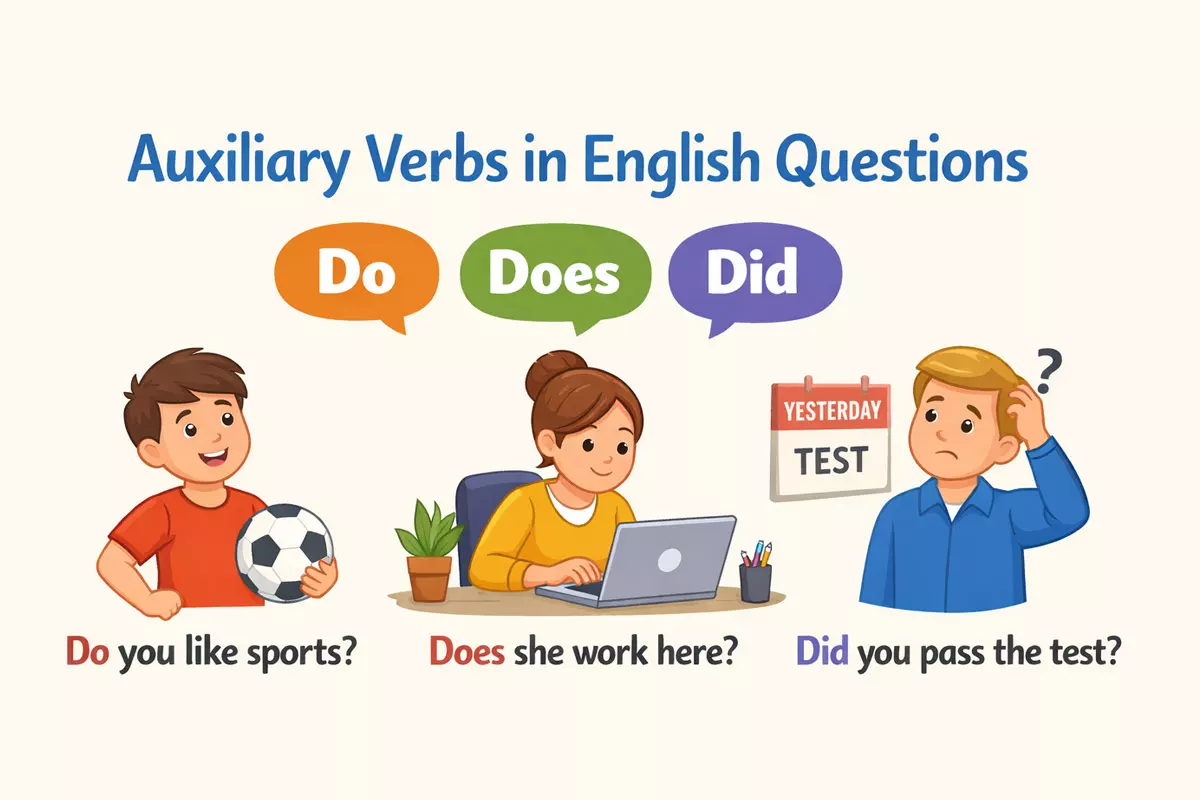 Here we the use of auxiliary verbs do, does, and did in forming questions, explains both yes/no and WH-question structures, highlights common mistakes learners make, and provides practice exercises with self-checks for improvement.
Many learners find forming questions in English challenging, particularly when it involves the correct use of helping verbs such as do, does, and did. These words are essential for creating questions in the present and past simple tenses, and knowing when to use each one can greatly improve your ability to communicate clearly. For example, use do with plural subjects and I or you, does with he, she, or it, and did for all subjects in the past tense. Mastering this aspect of English grammar will help you ask questions more naturally and confidently in daily conversations.
Role of Auxiliary Verbs in Questions
Auxiliary verbs like do, does, and did play a crucial part in forming questions in English, especially when there is no other helping verb present. These words help invert the subject and the main verb, which is necessary for standard question structure in English. Without an auxiliary, many sentences would sound more like statements than questions.
How "Do", "Does", and "Did" Help Form Questions
When constructing yes/no or wh- questions in the present simple or past simple tense, we use these auxiliaries to shift the main verb to its base form. The choice between do, does, and did depends on the subject and the tense.
- Do – used with plural subjects and "I", "you", "we", "they" in the present simple.
- Does – used with third-person singular subjects ("he", "she", "it") in the present simple.
- Did – used with all subjects in the past simple.
Examples of Questions with Auxiliary Verbs
Here are some common patterns and examples showing how these auxiliaries appear in different contexts:
- Do you like chocolate? → Yes, I do.
- Does she work here? → Yes, she does.
- Did they finish the project? → Yes, they did.
- Do we need to leave now? → Yes, we do.
- Does it rain often in April? → Yes, it does.
- Did you see the movie? → No, I didn’t.
- Do cats like water? → No, they don’t.
- Does John play tennis? → Yes, he does.
- Did she call you? → Yes, she did.
- Do the trains run on time? → Yes, they do.
- Did he understand the instructions? → Yes, he did.
- Does your phone have a camera? → Yes, it does.
- Do I have to complete this today? → Yes, you do.
- Did we lock the door? → Yes, we did.
- Does this bus go to the airport? → Yes, it does.
- Did you enjoy your meal? → Yes, I did.
Key Functions of Auxiliary Verbs in Interrogative Sentences
- Marking the sentence as a question rather than a statement.
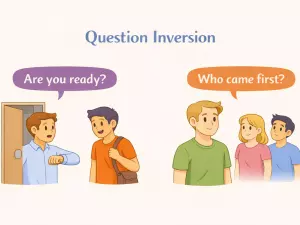
- Allowing subject-verb inversion (e.g., "You like pizza." → "Do you like pizza?")
- Enabling question formation when there is no other auxiliary present.
- Supporting negation in questions ("Don't you agree?").
| Auxiliary | Example Question | Subject | Tense |
|---|---|---|---|
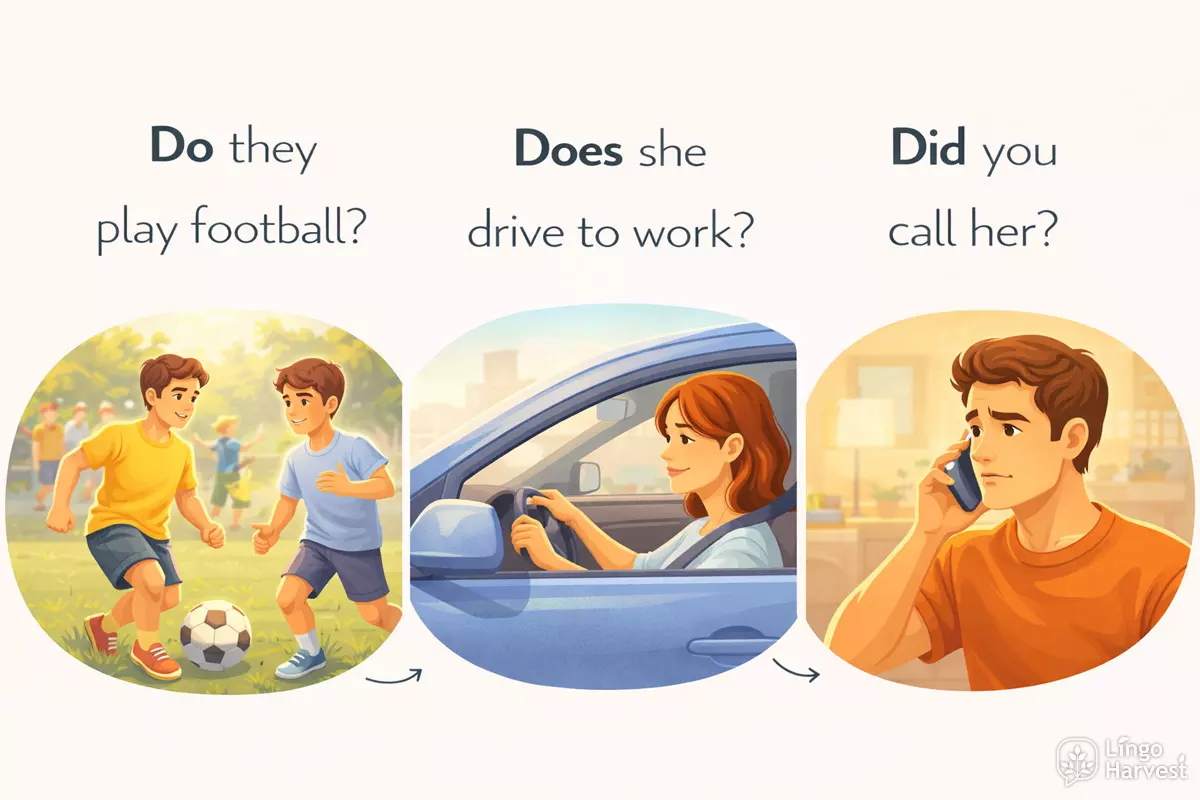
| Do | Do they play football? | They | Present Simple |
| Does | Does she drive to work? | She | Present Simple |
| Did | Did you call her? | You | Past Simple |
| Do | Do we have enough time? | We | Present Simple |
| Did | Did it rain last night? | It | Past Simple |
Understanding how these helpers work makes it easier both to ask questions and to recognize the structure in conversation or writing. They are essential for clarity and correctness in English interrogatives.
Using Do in Questions
When forming questions in English, the auxiliary verb do plays a crucial role for most verbs in the present simple tense, except for the verb “to be” and modal verbs. It helps turn a statement into a yes/no or wh-question by moving to the front of the sentence before the subject. This structure is essential for clarity and correctness in everyday conversation.
Basic Structure
To make a question with do, start with do, followed by the subject, then the base form of the main verb. For example: “Do you play tennis?” This pattern applies to all subjects except third person singular (he, she, it), where “does” is used instead.
Common Patterns and Examples
- Do I need a ticket? → Yes, you do.
- Do you like coffee? → Yes, I do.
- Do we have homework? → Yes, we do.
- Do they understand the rules? → Yes, they do.
- Do people often visit this park? → Yes, they do.
- Do cats sleep a lot? → Yes, they do.
- Do students ask questions? → Yes, they do.
- Do the lights work? → Yes, they do.
- Do friends help each other? → Yes, they do.
- Do cars pollute the air? → Yes, they do.
- Do parents worry about their children? → Yes, they do.
- Do birds migrate in winter? → Yes, they do.
- Do shops open on Sundays? → Yes, they do.
- Do trains arrive on time? → Yes, they do.
- Do you remember his name? → Yes, I do.
- Do teams practice every week? → Yes, they do.
Forming Wh-Questions with "Do"
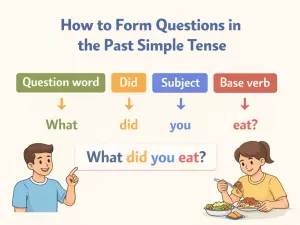
Wh-questions use a question word (what, where, when, why, who, how) before the auxiliary do. The structure is: Wh-word + do + subject + base verb. For instance, “Where do you live?” or “Why do we study English?”
- What do you want? → I want a coffee.
- Where do they go after school? → They go home.
- When do we start? → We start at nine.
- Why do dogs bark? → Because they sense danger.
- How do you spell your name? → I spell it slowly.
- Which books do you read? → I read history books.
Short Answers
When answering yes/no questions formed with do, use do or don’t in short responses. For example, “Do you like music?” – “Yes, I do.” or “No, I don’t.”
Typical Mistakes
- Omitting do: ❌ You like pizza? (Correct: ✅ Do you like pizza?)
- Using do with “to be”: ❌ Do you are ready? (Correct: ✅ Are you ready?)
- Adding do with modal verbs: ❌ Do you can swim? (Correct: ✅ Can you swim?)
Summary Table: Present Simple Questions with "Do"
| Subject | Question Example |
|---|---|
| I / you / we / they | Do you speak English? |
| he / she / it | Does she play guitar? |
| plural nouns | Do students study math? |
| singular nouns | Does the dog bark? |
Using do in present simple questions is essential for grammatical accuracy and clear communication. Practice different subjects and question forms to build confidence using this auxiliary in both yes/no and wh-questions.
Using Does in Questions
When forming questions in the present simple tense for third-person singular subjects, English speakers use the auxiliary verb does. This form is specifically required when the subject is he, she, it, or any singular noun. The main verb that follows does always appears in its base form, not the -s or -es form typically used in affirmative sentences with third-person singular.
Basic Structure
The typical word order for these questions is: Does + subject + base verb + (rest of sentence)? For example, “Does he play tennis?” or “Does the cat like milk?” This structure helps signal that the question is about someone or something other than yourself or a group.
Common Examples
- Does she work here? → Yes, she does.
- Does it rain often in April? → Yes, it does.
- Does your brother speak French? → Yes, he does.
- Does the train stop at this station? → Yes, it does.
- Does Anna know the answer? → Yes, she does.
- Does the movie start at seven? → Yes, it does.
- Does this pen belong to you? → Yes, it does.
- Does he need any help? → No, he doesn’t.
- Does your phone have a camera? → Yes, it does.
- Does the shop open on Sundays? → Yes, it does.
- Does her idea make sense? → Yes, it does.
- Does your dog bark at strangers? → Yes, it does.
- Does it snow in your city? → No, it doesn’t.
- Does the recipe include eggs? → Yes, it does.
- Does your friend live nearby? → Yes, he does.
- Does the bus arrive on time? → Yes, it does.
- Does the school offer art classes? → Yes, it does.
- Does this computer run fast? → Yes, it does.
Short Answers
To answer these questions, use Yes, (subject) does or No, (subject) doesn’t. The main verb is not repeated in the short answer.
- Does she play piano? → Yes, she does. / No, she doesn’t.
- Does it work? → Yes, it does. / No, it doesn’t.
Comparison with “Do” and “Did”
To clarify how does fits into broader question forms, see the table below comparing auxiliary verb use for different subjects and tenses:
| Subject | Present Simple | Past Simple |
|---|---|---|
| I / you / we / they | Do | Did |
| He / she / it | Does | Did |
| Singular noun (e.g. the dog) | Does | Did |
| Plural noun (e.g. the students) | Do | Did |
Key Points to Remember
- Use does only with third-person singular subjects in present simple questions.
- The main verb after does stays in its base form.
- For other subjects, use do; for the past, use did for all subjects.
Using Did in Questions
“Did” is the past tense form of the auxiliary verb “do.” It plays a crucial role in forming questions about completed actions or events. When asking about something that happened before now, “did” helps you create a grammatically correct interrogative sentence. This structure is used regardless of the subject—whether it’s “I,” “you,” “he,” “she,” “we,” or “they”—and the main verb always appears in its base form after “did.”
How to Structure Past Simple Questions with “Did”
The typical word order for these questions is: Did + subject + base verb + rest of sentence? This pattern is consistent, making it straightforward to build questions about the past. For example, instead of saying “You went to the store?” (which is not standard), you would ask, “Did you go to the store?”
| Affirmative Statement | Corresponding Question with “Did” |
|---|---|
| You saw the movie. | Did you see the movie? |
| She finished her homework. | Did she finish her homework? |
| They played football. | Did they play football? |
| He called his friend. | Did he call his friend? |
| I ate breakfast. | Did I eat breakfast? |
Common Patterns and Examples
- Did you remember to lock the door? → Yes, I did.
- Did she enjoy the concert? → Yes, she did.
- Did they arrive on time? → Yes, they did.
- Did we miss the bus? → No, we didn’t.
- Did he understand the question? → Yes, he did.
- Did I leave my keys here? → Yes, you did.
- Did your parents call? → Yes, they did.
- Did it rain last night? → No, it didn’t.
- Did the teacher explain the lesson? → Yes, she did.
- Did anyone help you? → Yes, someone did.
- Did the package arrive? → Yes, it did.
- Did you meet her at the party? → Yes, I did.
- Did the dog bark? → Yes, it did.
- Did the team win? → Yes, they did.
- Did the store open early? → No, it didn’t.
Important Tips
- Always use the base form of the main verb after “did” (for example, “Did she go?” not “Did she went?”).
- “Did” works with all subjects—no need to change its form.
- Short answers often repeat “did” (e.g., “Yes, I did.✅” or “No, she didn’t.❌”).
Mastering this structure helps you ask clear, accurate questions about the past in English, whether in casual conversation or more formal settings.
Yes/No Questions with Do/Does/Did
Forming questions that can be answered with "yes" or "no" in English often relies on auxiliary verbs such as "do," "does," and "did." These auxiliaries help structure queries in the present simple and past simple tenses, making it clear that a question is being asked rather than a statement being made. In these constructions, the auxiliary is placed at the beginning of the sentence, followed by the subject and the base form of the main verb.
Present Simple: "Do" and "Does"
When asking about routines, habits, or facts in the present, "do" is used with plural subjects and "I/you/we/they," while "does" is used with singular third-person subjects ("he," "she," "it"). The main verb always appears in its base form, regardless of the subject.
| Auxiliary | Example Question |
|---|---|
| Do | Do you like coffee? |
| Do | Do they play soccer? |
| Does | Does she speak French? |
| Does | Does it work properly? |
| Do | Do we have time? |
| Does | Does John drive to work? |
Past Simple: "Did"
To ask about events or actions that happened in the past, "did" is used for all subjects. The main verb remains in its base form, not the past tense.
- Did you see the movie? → Yes, I did.
- Did she call last night? → Yes, she did.
- Did they finish their homework? → Yes, they did.
- Did it rain yesterday? → No, it didn’t.
- Did we meet before? → Yes, we did.
- Did he enjoy the concert? → Yes, he did.
Short Answers
Responses to these types of questions often use the same auxiliary verb, followed by the subject. Positive answers include "yes," while negative answers use "no" plus "not" or the contraction.
- ✅ Yes, I do. / ❌ No, I don't.
- ✅ Yes, she does. / ❌ No, she doesn't.
- ✅ Yes, we did. / ❌ No, we didn't.
Common Mistakes to Avoid
Some learners accidentally use the main verb in the wrong form, or forget the auxiliary altogether. Here are typical errors to watch out for:
- ❌ Do you likes pizza? → Do you like pizza?
- ❌ Did she went home? → Did she go home?
- ❌ She does plays tennis? → Does she play tennis?
Mastering these structures makes everyday conversation and information gathering in English much clearer and smoother. Practice with a variety of subjects and verbs to become comfortable with the patterns.
WH-Questions with Auxiliaries
When forming questions in English that begin with words like who, what, where, when, why, and how, auxiliary verbs such as do, does, and did play a crucial role. These auxiliaries help create grammatical questions, especially when the question targets information other than the subject. The structure typically places the auxiliary verb before the subject, right after the WH-word.
Basic Structure for WH-Questions

To build these questions, follow this order: WH-word + auxiliary + subject + main verb + (rest of sentence)? This pattern is used for most present and past simple questions, except when the WH-word refers to the subject itself.
- What do you want for lunch? → I want a sandwich.
- Where does she work? → She works downtown.
- When did they arrive? → They arrived last night.
- Why do we need this? → Because it’s important.
- How does it work? → It works automatically.
- Who did you meet at the party? → I met my old friend.
- What did he say? → He said he was busy.
- When do classes start? → They start on Monday.
- Where did you put my keys? → I put them on the table.
- Why does this matter? → Because it affects everyone.
- How did they fix the problem? → They updated the system.
- What does this word mean? → It means “important.”
- Why did you call? → Because I needed help.
- When does the store open? → It opens at 9 a.m.
- Where do we go from here? → We go straight ahead.
Comparing Present and Past Forms
Notice how the auxiliary changes depending on whether you are asking about the present or the past. Do and does are for present simple, while did is for past simple. The main verb always stays in its base form after the auxiliary, regardless of tense.
| WH-Word | Present Simple | Past Simple |
|---|---|---|
| What | What do you want? | What did you want? |
| Where | Where does she live? | Where did she live? |
| When | When do we start? | When did we start? |
| Why | Why does it matter? | Why did it matter? |
| How | How do they know? | How did they know? |
Special Case: Subject Questions
When the WH-word represents the subject, the auxiliary is not needed. For example, Who called you? (not Who did call you?) or What happened?. In these cases, the question word itself is the subject, so the structure is simplified.
- Who broke the window?
- What caused the delay?
- Who lives here?
- What made you laugh?
Understanding when and how to use auxiliaries with WH-words is essential for forming correct and natural English questions. Practice with different subjects and tenses helps reinforce these patterns.
Typical Learner Mistakes
Learners often find it tricky to use “do,” “does,” and “did” correctly when forming questions in English. The confusion usually centers around verb tenses, subject-verb agreement, and whether or not to use the auxiliary at all. Mixing up these elements can make questions sound awkward or incorrect.
Omitting the Auxiliary
Leaving out “do,” “does,” or “did” is a frequent problem, especially for speakers of languages that don’t use question auxiliaries. For example, saying “You like pizza?” instead of “Do you like pizza?” can cause confusion in formal contexts.
Incorrect Subject-Verb Agreement
Choosing the right auxiliary depends on the subject. “Does” is for third-person singular subjects, while “do” is for all others. Mixing these up leads to mistakes like “Do she like chocolate?” or “Does they play football?”
Using the Wrong Tense
Another issue is using the present form when the question is about the past. Learners might ask “Do you went to the store?” instead of “Did you go to the store?” This happens because the main verb should always stay in its base form after the auxiliary.
Double Marking Tense
A common error is to mark the past tense on both the auxiliary and the main verb, resulting in sentences like “Did you saw the movie?” instead of the correct “Did you see the movie?”
Forgetting to Invert Subject and Auxiliary
Sometimes, learners forget to invert the subject and the auxiliary verb in questions, producing statements like “You do like apples?” instead of “Do you like apples?”
Confusing Yes/No and Wh- Questions
Learners may struggle to apply auxiliaries correctly in different question types. For example, “Where you do live?” instead of “Where do you live?”
Examples of Common Errors and Corrections
| ❌ Incorrect Question | ✅ Correct Form |
|---|---|
| You like music? | Do you like music? |
| Does they come here often? | Do they come here often? |
| Did you went home? | Did you go home? |
| Where you do work? | Where do you work? |
| Do she need help? | Does she need help? |
| Did he eats breakfast? | Did he eat breakfast? |
| What you did yesterday? | What did you do yesterday? |
| She does like cats? | Does she like cats? |
- Using “do” instead of “does” with he, she, or it
- Adding -ed to the main verb after “did”
- Leaving out “do/does” in present simple questions
- Not inverting the auxiliary and subject
- Using “did” for present tense questions
- Forgetting to use the base form of the verb after the auxiliary
- Confusing word order in Wh- questions
Paying attention to these typical pitfalls and checking question structure can help learners form more accurate and natural questions in English.
Practice Exercises and Self-Check
Understanding how to use "do," "does," and "did" in questions is essential for clear English communication. The following exercises are designed to help you test and reinforce your grasp of these auxiliary verbs in forming questions. Try each activity before checking the answers.
1. Choose the Correct Auxiliary Verb
Select the right word ("do," "does," or "did") to complete each question.
- ______ you like chocolate?
- ______ she play the piano?
- ______ they visit last summer?
- ______ your brother speak Spanish?
- ______ we need to bring anything?
- ______ it rain yesterday?
- ______ he work on weekends?
- ______ you see the movie?
- ______ the students understand the lesson?
- ______ your parents call you?
Show answers
1. Do2. Does
3. Did
4. Does
5. Do
6. Did
7. Does
8. Did
9. Do
10. Did
2. Make Questions from Statements
Rewrite each statement as a question, using the correct auxiliary verb.
- She likes to read.
- You visited Paris.
- They play soccer.
- He finished his homework.
- The train leaves at 9 AM.
- We need more time.
- Anna speaks Spanish.
- They watched the movie.
- He works on weekends.
- The shop opened early.
Show answers
- Does she like to read?
- Did you visit Paris?
- Do they play soccer?
- Did he finish his homework?
- Does the train leave at 9 AM?
- Do we need more time?
- Does Anna speak Spanish?
- Did they watch the movie?
- Does he work on weekends?
- Did the shop open early?
3. Spot the Mistake
Each sentence below contains a mistake with "do," "does," or "did." Identify and correct it.
- Did she goes to the party?
- Do he like pizza?
- Does they live here?
- Did you saw the news?
- Do she understand the rules?
- Does we have enough time?
- Did he finished the task?
- Do it work properly?
- Does they know the answer?
- Did you went home early?
Show answers
- Did she go to the party?
- Does he like pizza?
- Do they live here?
- Did you see the news?
- Does she understand the rules?
- Do we have enough time?
- Did he finish the task?
- Does it work properly?
- Do they know the answer?
- Did you go home early?
4. Quick Reference Table: Auxiliary Verbs in Questions
Here’s a summary of when to use each auxiliary verb in present and past simple questions.
| Auxiliary Verb | When to Use | Example Question |
|---|---|---|
| Do | Present Simple, I/you/we/they | Do they play chess? |
| Does | Present Simple, he/she/it | Does she know the answer? |
| Did | Past Simple, all subjects | Did you call him? |
5. Create Your Own Questions
Try making at least three questions for each auxiliary verb ("do," "does," "did") using your own ideas. This will reinforce your confidence in choosing the right word.
Show answers
Answers will vary. Example questions:Do you like music?
Do they work here?
Do we need tickets?
Does he play guitar?
Does it snow here?
Does your friend live nearby?
Did you finish the book?
Did she call you?
Did they arrive on time?
Practice forming and identifying questions with these auxiliaries to become more fluent and accurate in English conversations.