How Long Does It Take to Learn English?

 This English learning time calculator helps you estimate how long it will take to reach your target CEFR level based on your native language, current level, and weekly study intensity. You can also set a target date and get the required pace — hours per week and minutes per study day.
What this calculator does
English Learning Time Calculator estimates how long it may take you to reach a target CEFR level (A1–C2) based on 3 key factors: your starting level, your native-language difficulty group, and your weekly study intensity.
You get two practical outputs:
- Timeline mode — shows the estimated duration (years, months, days), total hours required, and an estimated completion date.
- Plan by deadline — lets you choose a target date and calculates the required pace (hours per week and minutes per study day).
What makes it useful
- Turns a vague goal (“reach B2”) into a clear time estimate.
- Shows how your study intensity changes the timeline.
- Helps you plan a realistic schedule around work or school.
- Builds a milestone roadmap, so you see progress on the way (A2, B1, B2, etc.).
Important: the calculator is a planning tool, not a promise. Real progress depends on the quality of study (speaking practice, feedback, consistency), not only hours.
Inputs: levels, language difficulty, intensity
The calculator asks for a few inputs. Each one directly affects your total hours and the estimated timeline.

1. Your native language difficulty group
This setting applies a multiplier to the base CEFR hour difference between your current and target levels. The idea is simple: for some learners, reaching the same level typically requires more total study time.
| Difficulty group | Multiplier | Languages (examples) | What it means in practice |
|---|---|---|---|
| Easier | 1.0 | Dutch, German, Afrikaans, Swedish, Norwegian, Danish, French, Spanish, Italian, Portuguese, Romanian | Base estimate (no increase) |
| Medium | 1.2 | Russian, Ukrainian, Belarusian, Polish, Czech, Slovak, Bulgarian, Serbian, Croatian, Turkish, Greek, Georgian | About 20% more hours than base |
| Challenging | 1.5 | Hindi, Urdu, Bengali, Punjabi, Thai, Vietnamese, Hebrew, Persian (Farsi), Malay, Indonesian, Tamil | About 50% more hours than base |
| Most difficult | 2.0 | Chinese (Mandarin/Cantonese), Japanese, Korean, Arabic, Cantonese, Vietnamese (tone-heavy), Burmese, Khmer, Lao | About 2 times the base hours |
These difficulty groups are rough averages based on how linguistically distant a native language is from English. Individual results vary — consistency, feedback, and speaking practice often matter more than the multiplier.
Why some native languages need more time to learn English:
- Different writing system — learners may need extra time to read and recognize words (for example, non-Latin scripts).
- Different sounds — some English sounds don’t exist in the native language, so listening and pronunciation take longer.
- Different word order — if sentence structure is very different, speaking and writing feel less “automatic” at first.
- No articles in the native language — “a” and “the” can be hard to master when they don’t exist in your language.
- Different tense and grammar habits — English time forms and grammar patterns may require more repetition to become natural.
- Less shared vocabulary — fewer familiar international word roots means vocabulary building can be slower.
2. Your current level and target level
You choose a starting point and a goal level. The calculator uses step values (A1, A2, B1, B2, C1, C2) and estimates the hours needed to move from one level to the next.
Practical guideline for goals:
- B1 — basic everyday communication and survival English.
- B2 — confident work and study communication (common target).
- C1 — advanced, academic, and professional fluency.
3. Weekly study intensity and study days
You set:
- Hours per week (slider)
- Study days per week (slider)
These two values are used to produce your daily plan (minutes per day) and to estimate a completion date.
How the timeline is calculated
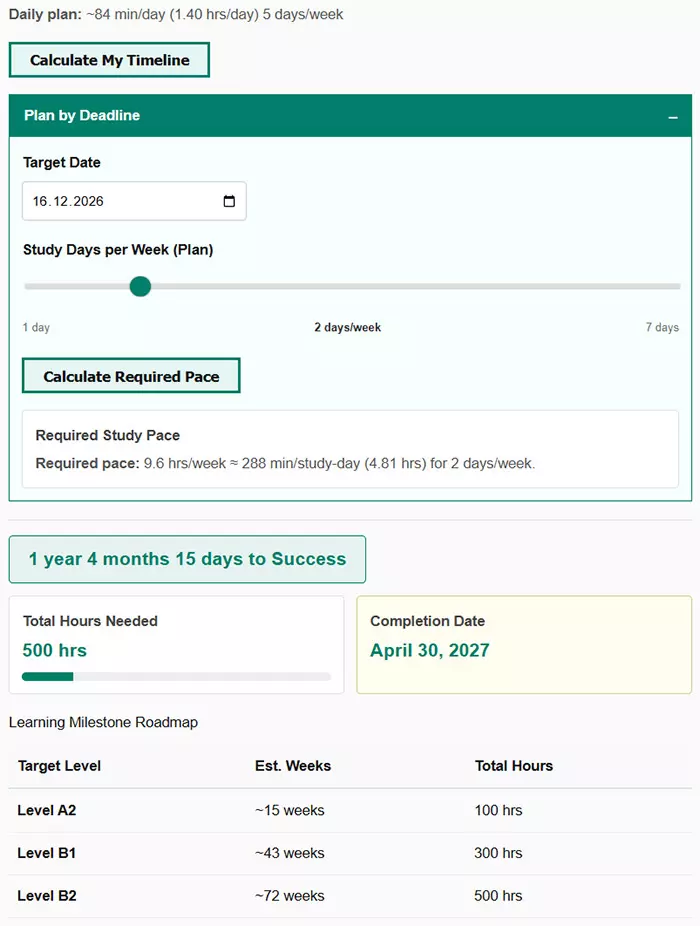
The calculator estimates your timeline in a simple, transparent way. It starts from CEFR “hour differences” between levels and then adjusts them using your native-language difficulty multiplier and your weekly study intensity.
Step 1 — Calculate total hours needed
Total hours are computed as:
(Target level hours – Current level hours) × Difficulty multiplier
So if you move from B1 to B2, the calculator takes the CEFR step difference and scales it by the selected difficulty group.
Step 2 — Convert hours to weeks
Weekly intensity is the number of hours you plan to study per week. The calculator converts total hours into weeks:
Total weeks = Total hours needed ÷ Hours per week
Step 3 — Convert weeks into calendar time
To produce a calendar-friendly duration, weeks are converted into days, then into an approximate years/months/days format:
- Days ≈ Total weeks × 7
- Years ≈ Days ÷ 365
- Months ≈ Remaining days ÷ 30
This gives you a human-readable result like:
- “1 year 2 months 10 days to Success”
Note: months are approximated as 30 days for readability. Real life progress is still driven by weekly consistency.
Daily plan and completion date
Once the calculator knows your total hours and weeks, it generates two very practical outputs: a daily study target and an estimated completion date.
Daily plan (minutes per day)
The daily plan is computed using your study days per week:
Hours per day = (Hours per week ÷ Study days per week)
Minutes per day = Hours per day × 60
This helps you translate “7 hours per week” into something you can actually follow, for example:
- 5 days/week → ~84 min/day
- 7 days/week → ~60 min/day
Completion date
The completion date is an estimate based on your calculated total weeks. The tool adds the required number of calendar days to today and shows a date like:
- March 14, 2027
This is useful for planning:
- Exam preparation timelines (IELTS, TOEFL, Cambridge).
- Job requirements (reach B2 by onboarding date).
- Relocation or study abroad goals.
Plan by deadline: required pace
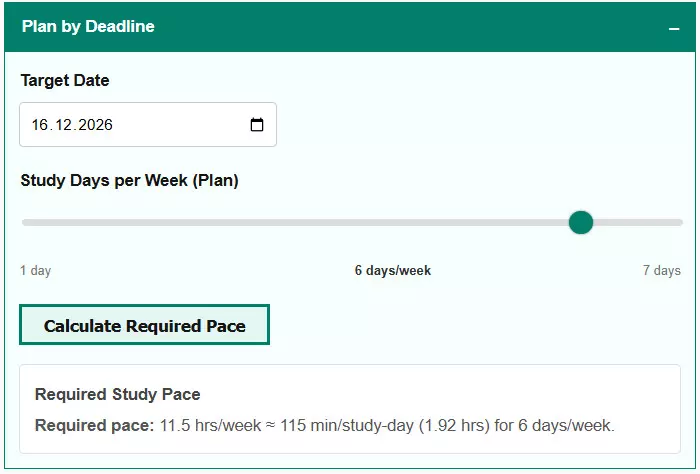
The Plan by Deadline mode is for situations where you have a fixed date — for example, a job start, an exam, or a move abroad. Instead of telling you “how long it will take”, it answers a different question:
“How much do I need to study each week to reach my target level by this date?”
How the required pace is calculated
First, the calculator estimates total hours needed the same way as in timeline mode. Then it checks how many days you have until your target date and converts that into weeks:
- Days available = Target date – Today
- Weeks available = Days available ÷ 7
- Required hours/week = Total hours needed ÷ Weeks available
Finally, it uses your chosen study days per week to show a daily pace:
- Required hours per study day = Required hours/week ÷ Study days/week
- Required minutes per study day = Required hours per study day × 60
The result is displayed in a clear format, for example:
- Required pace: 9.5 hrs/week ≈ 114 min/study-day for 5 days/week
How to interpret it: if the required pace looks too high for your schedule, your options are to move the deadline, lower the target level, or increase study efficiency (speaking practice, feedback, structured materials).
Learning milestone roadmap
The roadmap table shows intermediate milestones between your current level and target level. This is important because long goals can feel overwhelming, while milestones make progress measurable.
What the roadmap table shows
For each CEFR level above your current level (up to your target), the calculator displays:
- Target Level — A1, A2, B1, B2, C1, C2
- Est. Weeks — how many weeks it may take to reach that level at your current weekly intensity
- Total Hours — estimated total hours required from your current level to that milestone
This is a practical way to set short-term goals, for example:
- Reach B1 first, then plan the jump to B2.
- Track whether your weekly routine is sustainable for the next milestone.
- Adjust hours/week after each milestone instead of doing one massive plan.
Study tips: how often to learn

The calculator gives you a timeline, but your real progress depends on consistency and study quality. Most learners get better results by studying in smaller регулярные sessions rather than doing rare “marathon” days.
1. Frequency beats intensity spikes
If you can choose between these two options, many learners do better with the second one:
- Option A: 7 hours once per week
- Option B: 1 hour/day for 7 days
Daily or near-daily exposure improves memory, listening adaptation, and speaking confidence. That is why this calculator shows minutes per study day — it encourages a routine, not only a weekly number.
2. A realistic weekly schedule
For most adults with work or school, these ranges are more sustainable long-term:
| Weekly study time | Typical daily plan | Who it fits best | What to focus on |
|---|---|---|---|
| 3–5 hrs/week | 30–60 min/day (5 days/week) | Busy schedule, slow steady progress | Vocabulary + listening + short speaking drills |
| 6–10 hrs/week | 60–90 min/day (5–6 days/week) | Most motivated learners (recommended) | Balanced routine: speaking + grammar + reading |
| 12–20 hrs/week | 2–3 hrs/day (5–6 days/week) | Exam prep, job relocation, fast track | Speaking feedback + intensive listening + writing |
| 25–40 hrs/week | 4–6 hrs/day (5–6 days/week) | Full-time study, immersion-like pace | High-volume input + daily speaking + structured review |
3. Split your time into skill blocks
Hours alone are not enough — how you spend them matters. A simple, effective weekly split:
- Listening (30–40%) — podcasts, graded videos, shadowing.
- Speaking (20–30%) — tutoring, speaking clubs, voice notes.
- Vocabulary (15–25%) — spaced repetition, collocations, phrases.
- Grammar + writing (10–20%) — targeted practice, short emails, corrections.
4. Use the deadline planner intelligently
If the required pace is extremely high, treat it as a signal. Better strategy:
- Move the deadline or lower the target level (e.g., B2 instead of C1).
- Increase study quality first (speaking feedback, structured plan).
- Then add more hours, but only if you can sustain them for months.
Best practice: adjust your plan every 4–6 weeks. If you consistently hit your minutes/day target, increase the goal slowly. If you struggle, reduce the pace and protect consistency.
FAQ
1. Is this calculator accurate for everyone?
No. It provides a structured estimate based on typical CEFR hour ranges and your input settings. Your actual speed depends on study quality, feedback, motivation, and how much speaking practice you get.
2. What should I choose as my target level?
For many learners:
- B1 is enough for travel and basic everyday communication.
- B2 is a strong “work-ready” target for professional communication.
- C1 is for advanced academic and high-level work situations.
3. Why does native language affect the estimate?
Some language backgrounds typically require more study time to reach the same English level. The calculator uses a difficulty multiplier to reflect that difference in a simple way.
4. What if I study irregularly?
The estimate assumes a consistent weekly routine. If you skip weeks or study in bursts, your completion date will shift. In that case, focus on building a stable schedule and use the calculator again after 2–3 weeks of real tracking.
5. Is it better to study 7 days/week?
Not always. Many learners do best with 5–6 days/week plus one rest day. The important part is sustainable consistency over months.
6. How can I make progress faster without adding more hours?
Increase study efficiency:
- Get speaking feedback (tutor or conversation partner).
- Use spaced repetition for vocabulary and phrases.
- Do regular listening with active practice (shadowing, dictation).
- Write short texts and correct them.
7. Does the calculator store my data?
No. The calculation runs in your browser. Your inputs and text are not saved or sent anywhere.