How to Form Questions in the Past Perfect Tense

 Here we how to form past perfect questions, including the use of had, yes/no and WH-questions, and differences from past simple. It also discusses typical contexts, common mistakes, and provides practice exercises for self-check.
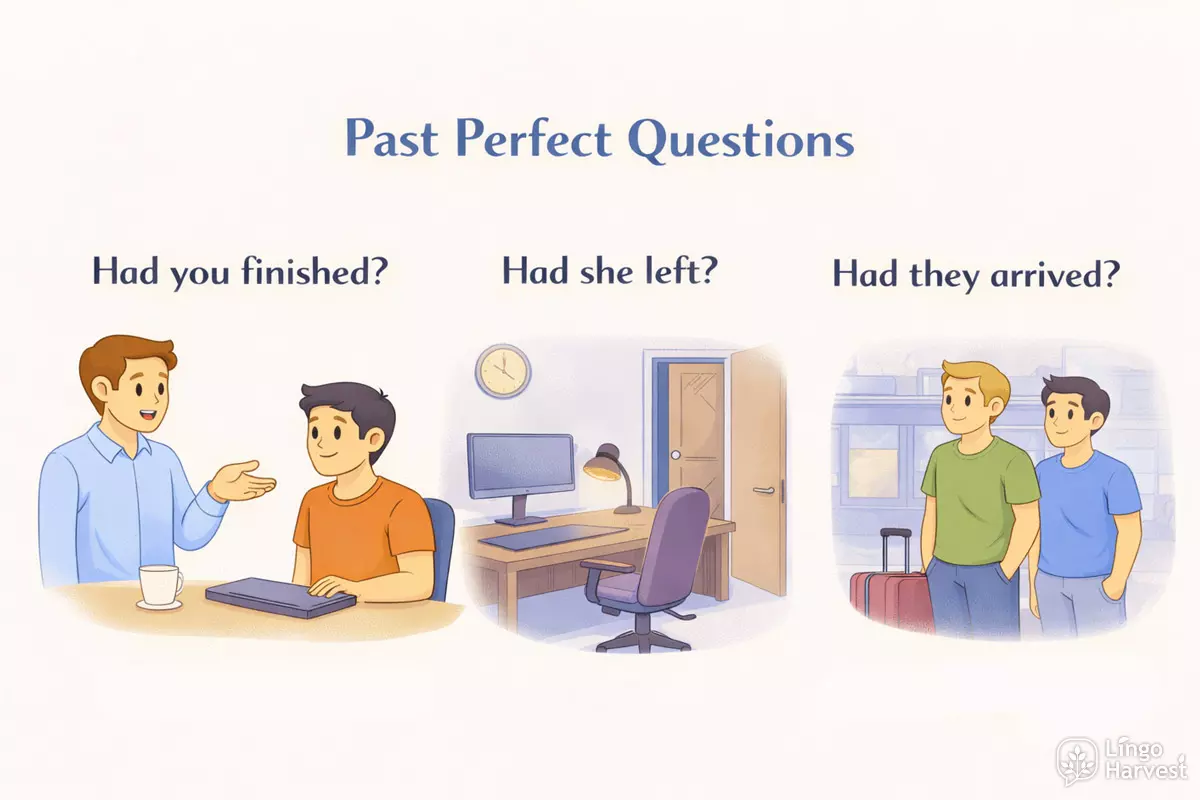
If you want to ask about actions that happened before another event in the past, learning to use the past perfect tense is essential. This tense helps you clarify the sequence of past events and makes your conversations clearer and more accurate. For example, you might ask, "Had you finished your homework before you went out?" Practicing questions like this will not only improve your grammar but also enhance your ability to communicate more fluently and confidently in English.
Past Perfect Question Structure
When forming questions in the past perfect tense, the word order and auxiliary verbs play an essential role. The basic pattern begins with the auxiliary verb “had,” followed by the subject, and then the past participle of the main verb. This structure allows speakers to ask about actions that were completed before another event in the past.
Basic Formula
To create a question, use this structure:
- Had + subject + past participle + (rest of sentence)?
For example, “Had she finished her homework before dinner?” Here, “had” starts the question, “she” is the subject, and “finished” is the past participle.
Wh- Questions
When you want more information, begin with a question word (e.g., “what,” “where,” “why,” “who,” “how”). Place the wh-word before “had”:
- What had they decided before the meeting? → They had decided to postpone it.
- Where had you gone before I called? → I had gone to the grocery store.
- Why had he left so early? → He had left early because he felt unwell.
- How had she known about the surprise? → She had found out through a friend.
Yes/No Questions
For questions that expect a “yes” or “no” answer, simply invert the subject and “had”:
- Had you ever visited Paris before 2010? → Yes, I had visited it once.
- Had they already eaten when you arrived? → No, they hadn’t eaten yet.
- Had we met before that day? → Yes, we had met briefly.
Examples of Past Perfect Questions

Here are more sample questions using this tense:
- Had the train left when you got to the station? → Yes, it had already left.
- Had she seen the movie before? → No, she hadn’t seen it before.
- Had they completed the project on time? → Yes, they had completed it on time.
- Had you heard the news before I told you? → No, I hadn’t heard it before.
- Had it rained all night? → Yes, it had rained all night.
- What had you done before breakfast? → I had gone for a short walk.
- Why had the lights gone out? → They had gone out because of a power cut.
- Who had called earlier? → My manager had called earlier.
- How had the team prepared for the match? → They had trained intensively.
- Where had he put the keys? → He had left them on the table.
- Had we forgotten anything important? → No, we hadn’t forgotten anything.
- Had the students finished their test? → Yes, they had finished it.
- Had your friends arrived before the party started? → No, they hadn’t arrived yet.
- Had she learned French before moving to Paris? → Yes, she had learned it earlier.
- Had you read the book before watching the film? → No, I hadn’t read it.
Question Structure Table
| Type | Example Question |
|---|---|
| Yes/No Question | Had you finished your work? |
| What Question | What had she said before leaving? |
| Where Question | Where had they gone? |
| Why Question | Why had he called? |
| How Question | How had you known the answer? |
Remember, the use of “had” as the auxiliary verb is what sets this tense apart. In spoken English, contractions are not typically used in questions (e.g., “Hadn’t you finished?” is less common), but negative forms do occur. Mastering this question format helps clarify the sequence of past events and is a valuable tool for both conversation and writing.
Using Had in Questions
Forming questions in the past perfect tense centers around the auxiliary verb "had." To construct a question, place "had" at the beginning of the sentence, followed by the subject and then the past participle of the main verb. This structure is consistent regardless of whether the subject is singular or plural. For example:
- Had she finished her homework before dinner?
- Had they already left when you arrived?
Notice that "had" does not change form for different subjects—in contrast to some present tense auxiliaries. This makes the pattern straightforward and easy to memorize.
Question Structure
The general word order for past perfect questions is:
- Had + subject + past participle + (rest of sentence)?
This formula applies to both yes/no questions and questions with question words (who, what, where, etc.).
Examples of Yes/No Questions
- Had you seen that movie before? → Yes, I had seen it before.
- Had we met somewhere before the conference? → No, we hadn’t met before.
- Had the train departed when you arrived at the station? → Yes, it had already departed.
- Had it rained overnight? → No, it hadn’t rained overnight.
- Had the students completed the test by noon? → Yes, they had completed it by noon.
- Had he ever visited Paris before 2010? → Yes, he had visited Paris before then.
- Had your friends called before you left home? → No, they hadn’t called yet.
- Had the company launched the product before the competition? → Yes, it had launched the product earlier.
- Had anyone told you the news? → No, no one had told me the news.
- Had she forgotten her keys again? → Yes, she had forgotten them again.
Wh- Questions in the Past Perfect
To ask for specific information, simply add a question word before "had." For example:
- What had you decided before the meeting? → I had decided to postpone it.
- Where had she put the keys? → She had put them in her bag.
- Why had they canceled the event? → They had canceled it due to low attendance.
- When had you realized the mistake? → I had realized it too late.
- Who had already finished the assignment? → Two students had finished it.
- How had he solved the problem? → He had solved it using a new method.
Comparison: Statements vs. Questions
The difference between statements and questions in the past perfect tense lies mainly in word order. The table below illustrates this contrast:
| Statement | Question |
|---|---|
| She had left the office. | Had she left the office? |
| They had finished dinner. | Had they finished dinner? |
| We had met before. | Had we met before? |
| The team had won the match. | Had the team won the match? |
Tips for Forming Past Perfect Questions
- Always start with "had" for all subjects.
- Follow "had" with the subject, then the past participle.
- Use question words (who, what, when, etc.) for information questions.
- Remember: "had" does not change for he/she/it or plural subjects.
- Do not use "did" in past perfect questions.
Mastering this question pattern helps you talk about events that happened before another point in the past, adding clarity and detail to your English conversations.
Yes/No Questions in Past Perfect
To ask yes/no questions about actions that were completed before another moment in the past, English uses the past perfect tense. These questions help you confirm whether something had already happened at a specific time. The structure is straightforward: begin with had, add the subject, then the past participle of the main verb.
Basic Structure
The formula for forming these questions is:
- Had + subject + past participle + (rest of sentence)?
This structure works for all subjects (I, you, he, she, it, we, they). The auxiliary verb had always comes first, followed by the person or thing, and then the main verb in its past participle form.
Common Examples
Here are some sample yes/no questions in the past perfect:
- Had you finished your homework before dinner? → Yes, I had finished it before dinner.
- Had they left when you arrived? → Yes, they had already left.
- Had she ever visited London before 2010? → No, she hadn’t visited London before then.
- Had it stopped raining by noon? → Yes, it had stopped by noon.
- Had we met before that party? → No, we hadn’t met before.
- Had he already eaten when you called? → Yes, he had already eaten.
- Had the train departed before you got to the station? → Yes, it had departed earlier.
- Had the team practiced enough for the match? → Yes, they had practiced enough.
- Had anyone seen my keys? → No, no one had seen them.
- Had the movie started when you arrived? → No, it hadn’t started yet.
- Had you heard the news before today? → Yes, I had heard it earlier.
- Had I misunderstood the instructions? → No, you hadn’t misunderstood them.
- Had the guests left by midnight? → Yes, they had left by midnight.
- Had your parents traveled abroad before? → Yes, they had traveled abroad.
- Had she finished reading the book? → Yes, she had finished reading it.
- Had the store closed when you got there? → Yes, it had already closed.
- Had the students completed the assignment? → Yes, they had completed it.
- Had you ever tried sushi before last night? → No, I hadn’t tried it before.
Short Answers
Responses to these questions are usually short. You can answer with Yes, subject + had or No, subject + hadn’t (had not).
| Question | Short Answer |
|---|---|
| Had you finished the report? | ✅ Yes, I had. ❌ No, I hadn’t. |
| Had they seen the movie? | ✅ Yes, they had. ❌ No, they hadn’t. |
| Had she called before noon? | ✅ Yes, she had. ❌ No, she hadn’t. |
| Had it snowed that night? | ✅ Yes, it had. ❌ No, it hadn’t. |
Key Points to Remember
- Always start with had when forming these questions.
- The main verb is always in past participle form (gone, seen, finished, etc.).
- Short answers repeat had or hadn’t with the subject.
- This question form does not change for different subjects.
Using this pattern helps you check if something was completed or true before a particular time in the past—making your English clearer and more precise.
WH-Questions in Past Perfect
To ask about specific information in the past using the past perfect tense, start your question with a “wh-” word such as what, where, when, why, who, whom, which, or how. These questions focus on an action completed before another point in the past. The structure places the “wh-” word first, followed by “had,” the subject, and then the past participle of the main verb.
Forming WH-Questions: The Basic Pattern
The typical pattern is:
- Wh-word + had + subject + past participle + (rest of sentence)?
This approach lets you ask about details or reasons for events that were already finished before something else happened.
Common WH-Words Used in Past Perfect Questions
- What
- Where
- When
- Why
- Who
- Whom
- Which
- How
Each of these question words serves a different purpose. For example, why looks for reasons, while where asks about places.
Examples of WH-Questions in the Past Perfect
Here are some typical question forms:
- What had you done before they arrived? → I had finished preparing the report.
- Where had she gone before the storm started? → She had gone to a nearby shelter.
- Why had they left so early? → They had left early because of the weather.
- Who had finished the project before the deadline? → The design team had finished it.
- When had you last seen him? → I had last seen him the previous week.
- Which route had they taken before the road was closed? → They had taken the coastal route.
- How had he solved the issue? → He had solved it with a temporary fix.
- Whom had she called before the meeting? → She had called her supervisor.
- What had the teacher explained before the test? → The teacher had explained the key concepts.
- Where had you lived before moving here? → I had lived in Boston.
- Why had the train stopped? → It had stopped due to a technical problem.
- Who had known the answer? → One student had known the answer.
- When had the guests left? → They had left late in the evening.
- Which song had they played before dinner? → They had played a jazz song.
- How had she learned to speak French? → She had learned it at school.
Comparison: Statement vs. WH-Question
| Statement (Past Perfect) | WH-Question Form |
|---|---|
| She had left before I arrived. | When had she left? |
| They had finished dinner by 8 pm. | What had they finished by 8 pm? |
| He had visited Paris twice before 2020. | How many times had he visited Paris before 2020? |
| We had met her at the conference. | Where had you met her? |
Notice how the “wh-” word targets the part of the sentence you want information about. The auxiliary “had” always comes before the subject, and the past participle follows the subject. This structure distinguishes these questions from other tenses and makes it clear you are referring to a completed action before another past event.
Past Perfect vs Past Simple in Questions
Understanding when to use the past perfect or the past simple in questions can help you express the correct sequence of past events. The past perfect tense is used to ask about an action that took place before another action in the past. In contrast, the past simple is used for questions about a single event or a series of events in the past, without focusing on the order in which they happened.
How to Recognize the Difference
Questions in the past perfect often include clues that one event happened before another. Words like "already," "before," or "by the time" are common. The past simple, on the other hand, is used when the timing or sequence is not the focus.
| Past Perfect Question | Past Simple Question |
|---|---|
| Had you finished your homework before dinner? | Did you finish your homework last night? |
| Had she ever been to Paris before that trip? | Did she go to Paris last summer? |
| Had they left when you arrived? | Did they leave after the movie? |
| Had he called you before you saw him? | Did he call you yesterday? |
| Had we met before the conference? | Did we meet at the conference? |
When to Choose Each Tense in Questions
- Use the past perfect to ask about something that happened before another past event.
- Choose the past simple when the question is about a completed action in the past, with no need to show that one event came before another.
- If you want to ask about the first of two past actions, the past perfect is more precise.
- For questions about experiences or routines in the past, the past simple is usually enough.
Typical Triggers and Examples

- Why had you left so early? → I had left early because I wasn’t feeling well.
- When had they realized the mistake? → They had realized it later that evening.
- What had happened before the lights went out? → A storm had damaged the power lines.
- Did you see the announcement? → Yes, I saw it this morning.
- Where did you find your keys? → I found them in my bag.
- Had she finished the report when the boss arrived? → Yes, she had already finished it.
- Did you eat breakfast this morning? → No, I didn’t have time.
- Had they ever visited Italy before 2010? → No, they hadn’t visited Italy before then.
- Did you hear the news? → Yes, I heard it earlier today.
- Had you read the book before watching the film? → Yes, I had read it first.
- Did you go to the meeting yesterday? → Yes, I went to the meeting.
- Had we met before that day? → No, we hadn’t met before.
- Did they call you last night? → Yes, they called me around 9 pm.
- Had he already left when you arrived? → Yes, he had already left.
- Did you finish your project on time? → Yes, I finished it on time.
By paying attention to the sequence of events and the function of each tense, you can form clearer, more accurate questions about the past. The context and your intent will guide your choice between these two tenses.
Typical Contexts and Time Order
Understanding when and why to use past perfect questions is key for clear communication. This tense is most often used when talking about two actions in the past—one that happened before the other. Forming questions in the past perfect helps to clarify which event took place first, especially in stories, interviews, or when checking details about a sequence of events.
When Are Past Perfect Questions Used?
Past perfect questions appear in various situations, such as:
- Asking if something was finished before another past event ("Had you eaten before the movie started?")
- Clarifying the timeline in stories ("Had she already left when you arrived?")
- Checking background information before a main event ("Had they met before the party?")
- Investigating cause and effect ("Had he studied before he passed the test?")
- Confirming earlier experiences ("Had you ever visited Paris before last year?")
- Exploring hypothetical situations ("Had you known about the delay, would you have come?")
- Reporting indirect questions ("He asked if I had finished the project.")
- Comparing two past events ("Had it rained before the match started?")
- Describing routines or habits before a certain past time ("Had you always lived there before you moved?")
- Seeking clarification about changes ("Had the rules changed before the exam?")
Time Order and Sequence
The main function of this tense in questions is to highlight the order of past events. The event in the past perfect tense always happens before the event in the simple past. Using questions in this way helps listeners or readers understand which action occurred first and prevents confusion.
| Earlier Event (Past Perfect) | Later Event (Simple Past) |
|---|---|
| Had you finished dinner | when they arrived? |
| Had the train left | before you reached the station? |
| Had she made a reservation | before she got to the restaurant? |
| Had it stopped raining | when you went outside? |
| Had they seen the film | before it was discussed in class? |
In summary, forming questions in the past perfect tense is most useful when you need to explore or clarify what happened first in a series of past events. This structure makes your meaning precise and helps avoid misunderstandings about the timeline.
Common Learner Mistakes
When practicing question formation in the past perfect tense, learners often run into several pitfalls. These issues can make communication unclear or grammatically incorrect, especially for those transitioning from present or simple past structures.
Typical Errors with Word Order
Mixing up the placement of "had" and the subject is a frequent problem. In English, questions in the past perfect require inversion (placing "had" before the subject), which differs from statement word order. For example, some may incorrectly write "She had finished?" instead of "Had she finished?"
Confusing "Had" with "Have"
Another stumbling block is using "have" or "has" instead of "had" when referring to completed actions before a specific point in the past. This confusion often results from similarities with the present perfect tense.
Leaving Out the Past Participle
Learners sometimes forget to use the past participle form of the verb, opting for the simple past instead. For example, "Had you saw the movie?" instead of the correct "Had you seen the movie?"
Adding Unnecessary Auxiliary Verbs
Some students mistakenly include extra helping verbs such as "did" or "was," creating incorrect questions like "Did you had finished?"
Common Mistakes Breakdown
Below is a comparison of frequent errors and their correct forms:
| Incorrect Example | Correct Form |
|---|---|
| Did you had eaten? | Had you eaten? |
| Had she went home? | Had she gone home? |
| Have they finished? | Had they finished? |
| She had finished? | Had she finished? |
| Had you was working? | Had you been working? |
| Had John did his homework? | Had John done his homework? |
Other Frequent Issues
- Forgetting to invert the subject and auxiliary ("Had" + subject).
- Using the simple past instead of the past participle.
- Mixing up question forms with present perfect or simple past.
- Omitting "had" entirely and making a simple past question.
- Confusing the time reference, leading to ambiguity.
- Overusing contractions in formal questions ("Hadn't you seen...?").
- Forming double questions, like "What had did you do?"
- Using incorrect question words with past perfect structure.
Paying attention to these details will help you avoid pitfalls and form accurate, clear questions in the past perfect tense.
Practice Exercises and Self-Check
Testing your understanding of forming questions in the past perfect tense is a practical way to reinforce the rules and recognize common patterns. Below you’ll find a mix of exercises: some ask you to transform statements into questions, others challenge you to spot errors or supply missing words. Take your time with each task before checking your responses.
Turn Statements into Past Perfect Questions
Rewrite each sentence as a question in the past perfect tense.
- She had finished her homework before dinner.
- They had left the building when the alarm rang.
- John had already seen that movie.
- The train had departed before we arrived at the station.
- You had read the instructions carefully.
- She had cleaned the house before the guests arrived.
- They had completed the task by the deadline.
- He had saved the file before the computer crashed.
- We had discussed the issue earlier.
- I had locked the door before leaving.
Show answers
- Had she finished her homework before dinner?
- Had they left the building when the alarm rang?
- Had John already seen that movie?
- Had the train departed before we arrived at the station?
- Had you read the instructions carefully?
- Had she cleaned the house before the guests arrived?
- Had they completed the task by the deadline?
- Had he saved the file before the computer crashed?
- Had we discussed the issue earlier?
- Had I locked the door before leaving?
Identify the Correct Question Form
Choose the correctly formed past perfect question from each pair.
- A) Had you ate breakfast before you left?
B) Had you eaten breakfast before you left? - A) Had they gone to Paris before 2020?
B) Had they went to Paris before 2020? - A) Had she completed the project on time?
B) Did she had completed the project on time? - A) Had he written the email before the meeting?
B) Had he wrote the email before the meeting? - A) Had we finished the work by Friday?
B) Did we had finished the work by Friday? - A) Had they seen the results before the announcement?
B) Had they saw the results before the announcement? - A) Had she taken the test earlier?
B) Did she had taken the test earlier? - A) Had you checked the details before signing?
B) Had you check the details before signing? - A) Had he already left when you arrived?
B) Did he had already left when you arrived? - A) Had they prepared everything in advance?
B) Had they prepare everything in advance?
Show answers
- B) Had you eaten breakfast before you left?
- A) Had they gone to Paris before 2020?
- A) Had she completed the project on time?
- A) Had he written the email before the meeting?
- A) Had we finished the work by Friday?
- A) Had they seen the results before the announcement?
- A) Had she taken the test earlier?
- A) Had you checked the details before signing?
- A) Had he already left when you arrived?
- A) Had they prepared everything in advance?
Practice with Wh- Questions
Make a question using the prompt and the past perfect tense.
- Why / he / leave early?
- Where / you / put the keys?
- What / they / do before the meeting?
- How many books / she / read by June?
- When / you / finish the report?
- Why / they / cancel the trip?
- Which movie / he / see before?
- How / she / learn about the news?
- Where / they / stay before moving?
- Who / you / talk to earlier?
Show answers
- Why had he left early?
- Where had you put the keys?
- What had they done before the meeting?
- How many books had she read by June?
- When had you finished the report?
- Why had they canceled the trip?
- Which movie had he seen before?
- How had she learned about the news?
- Where had they stayed before moving?
- Who had you talked to earlier?
Common Past Perfect Question Patterns
Here is a summary table of common structures for questions in the past perfect tense, using different subjects and question words:
| Pattern | Example |
|---|---|
| Had + subject + past participle? | Had they finished? |
| Wh- word + had + subject + past participle? | Where had she gone? |
| Had + subject + ever/never + past participle? | Had you ever tried sushi? |
| How many/much + noun + had + subject + past participle? | How many letters had he written? |
Self-Check: Spot the Error
Each question below contains a mistake. Rewrite them correctly.
- Had she saw the announcement before the meeting?
- What had you do after you arrived?
- Had they finish their work before the deadline?
- Did you had heard the news?
- Had he went home before it got dark?
- What had she wrote in the report?
- Had we ate dinner before the guests arrived?
- Did they had completed the task earlier?
- Where had you putted the documents?
- Had the train leave before we reached the platform?
Show answers
- Had she seen the announcement before the meeting?
- What had you done after you arrived?
- Had they finished their work before the deadline?
- Had you heard the news?
- Had he gone home before it got dark?
- What had she written in the report?
- Had we eaten dinner before the guests arrived?
- Had they completed the task earlier?
- Where had you put the documents?
- Had the train left before we reached the platform?
Regular practice with these exercises will help you recognize and form accurate questions in the past perfect. Try creating your own examples and check them using the patterns above.