Syllable Counter for English Text and Words

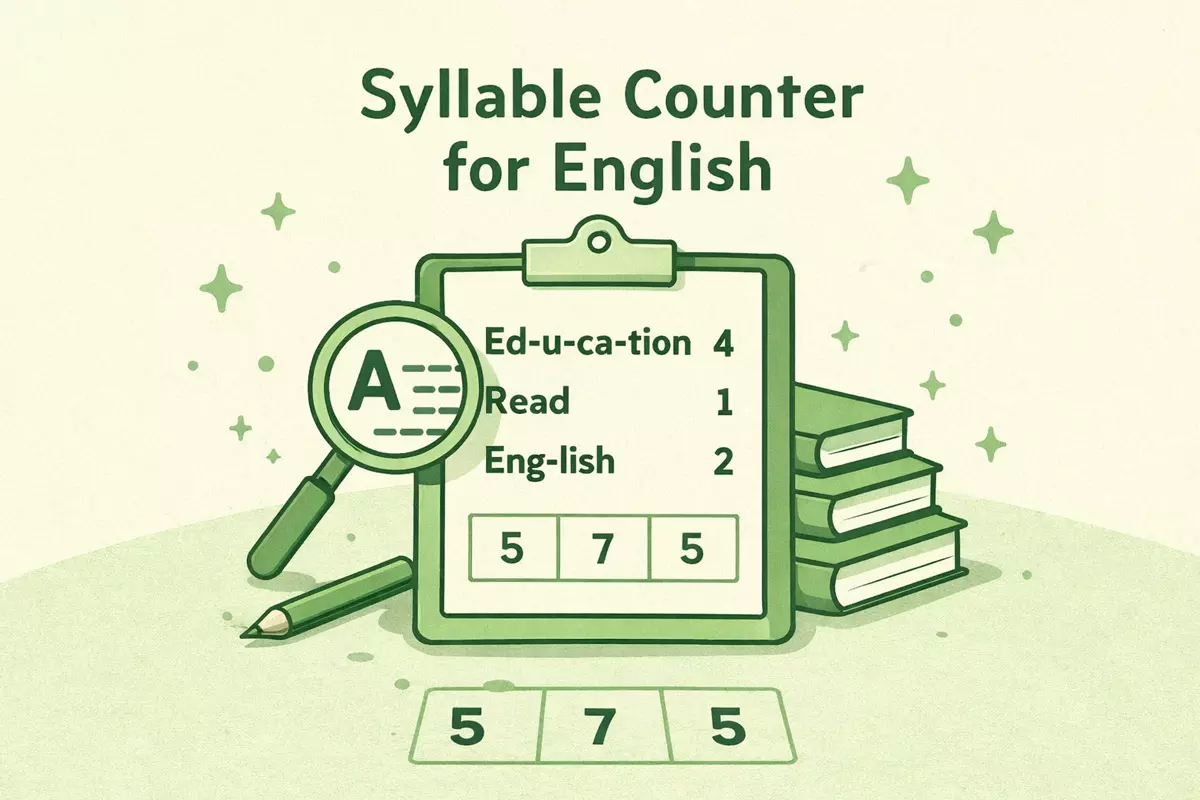 This Syllable Counter analyses English words, sentences, and full text to show syllable counts instantly. It supports hyphenated forms, apostrophes, and includes a 5–7–5 poetry mode. Useful for students, educators, songwriters, poets, and anyone improving pronunciation.
What this syllable counter does
Syllable Counter is an online tool that estimates how many syllables your English text has. You can paste single words, full sentences, or entire paragraphs and instantly see:
- Total syllables in the whole text.
- Per-word syllable counts in a breakdown table.
- Optional 5–7–5 poetry check for three-line poems.
The tool is useful for:
- Poets and songwriters checking rhythm and line length.
- Teachers and learners working on stress patterns and pronunciation.
- Writers and editors adjusting sentence flow or reading rhythm.
- Language nerds who want to explore how English words “sound” in syllables.
Simply paste your text, adjust options (punctuation, hyphens, apostrophes, poetry mode), and click Count syllables. The calculator will show a summary and a detailed table with each word and its syllable estimate.
How syllable counting works
The calculator combines a simple heuristic syllable algorithm with a server dictionary that stores hyphenation patterns for many common English words. This gives a good balance between speed and accuracy.
Step 1 — Clean the text
Before counting, the tool cleans your text using the selected options:
- Strip punctuation — removes extra symbols so they do not become “fake” words.
- Split hyphenated words — treats “English-speaking” either as one word or as two parts, depending on your setting.
- Keep apostrophes — keeps or removes apostrophes in words like “don’t”, “teacher’s”, “it’s”.
Numbers and some abbreviations (for example, e.g., i.e.) are removed so they do not distort the result.
Step 2 — Heuristic syllable estimate
For each remaining word, the calculator runs a simple English-focused heuristic:
- Normalises the word to lowercase.
- Removes some typical endings (-es, -ed, -e) that often do not add a new syllable.
- Counts vowel groups (a, e, i, o, u, y) as the core of syllables.
This gives a fast, “good enough” estimate even for rare words that are not in the dictionary.
Step 3 — Dictionary hyphenation override
After the heuristic step, the tool sends a list of unique words to a server-side dictionary and receives hyphenated forms for known words. For those words it:
- Uses the hyphenation pattern (for example, wa-ter-mel-on).
- Counts the parts between hyphens as syllables.
- Overrides the earlier heuristic result with this more precise count.
| Source | How syllables are counted | Strengths | Limitations |
|---|---|---|---|
| Heuristic algorithm | Counts vowel groups after simple clean-up rules | Works for almost any word, even rare or new ones | May be off by 1 syllable for tricky spellings or silent letters |
| Dictionary hyphenation | Uses stored patterns like be-au-ti-ful | More accurate for common words and typical pronunciations | Does not cover every possible word; accents and dialects may differ |
| Combined result | Dictionary where available, heuristic for everything else | Balanced: fast, practical, and fairly precise for most texts | Still an estimate, not a phonetic dictionary or full IPA transcription |
Thanks to this combination, the Syllable Counter is fast enough for long texts but still helpful for poetry, lyrics, and pronunciation work. For very precise phonetic work, native speaker feedback or phonetic dictionaries are still recommended.
5–7–5 poetry mode explained
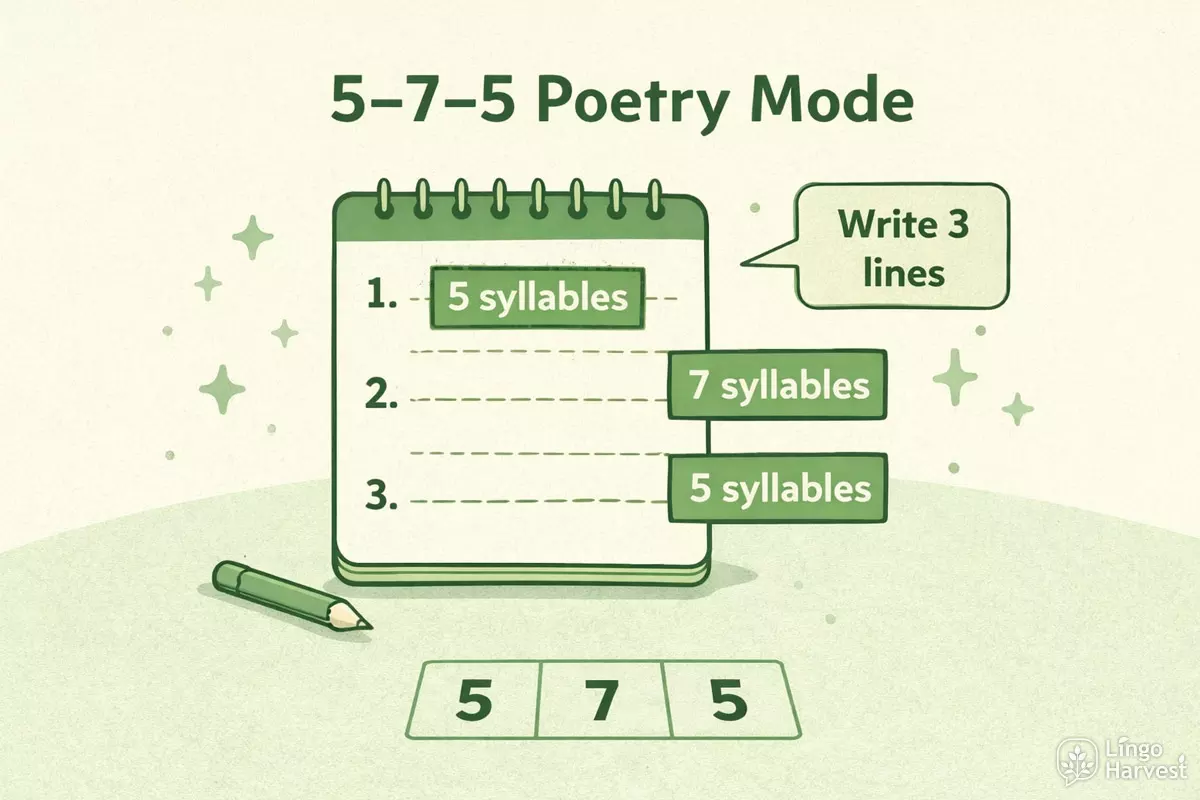
The Syllable Counter has a special Poetry mode (5 – 7 – 5) designed for short three-line poems, often inspired by the English version of Japanese haiku. In this mode the calculator checks whether your three lines follow the 5–7–5 syllable pattern.
What 5–7–5 means
A classic English “haiku-style” structure is:
- Line 1: 5 syllables
- Line 2: 7 syllables
- Line 3: 5 syllables
In the input field, you simply put each line on a new line. The tool then counts syllables per line and shows whether each one matches the expected pattern.
How to use 5–7–5 mode
- Tick the option “Poetry mode (5 – 7 – 5)”.
- Write exactly three lines (each line on its own line).
- Click Count syllables.
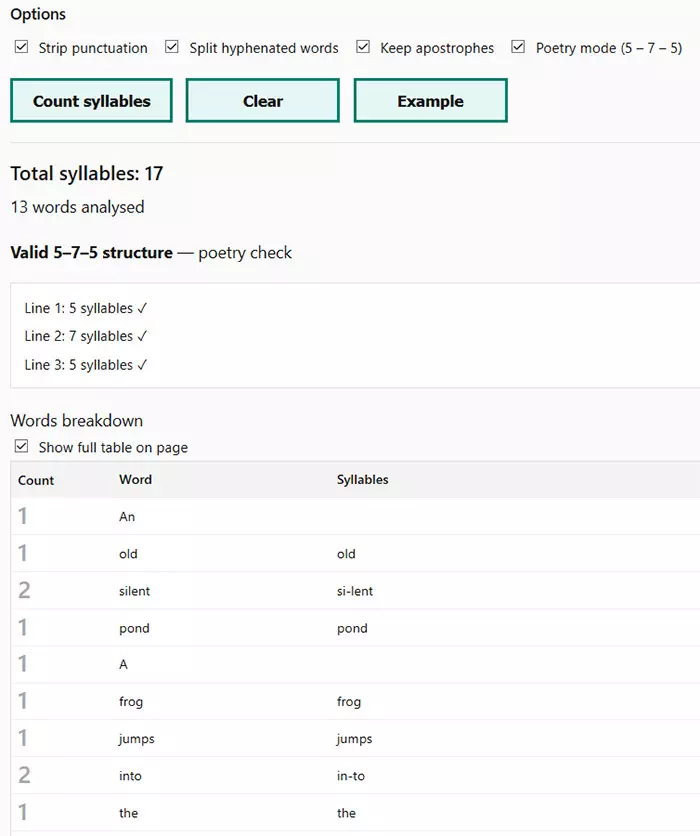
- Check the separate Poetry check block with line-by-line results.
If the structure is correct, you will see a message such as “Valid 5–7–5 structure — poetry check”. If not, the calculator shows “Does NOT match 5–7–5 — poetry check” and explains what went wrong (wrong syllable count or wrong number of lines).
Examples of 5–7–5 in English
Here is a typical haiku-style pattern in English:
- An old silent pond (5)
- A frog jumps into the pond (7)
- Splash, silence again (5)
Even though English haiku do not always strictly follow 5–7–5 in modern poetry, this pattern is still popular in teaching, contests, creative writing exercises, and classroom tasks.
| Line pattern | Example | What the tool shows |
|---|---|---|
| Correct 5–7–5 | Line 1: 5 syllables Line 2: 7 syllables Line 3: 5 syllables |
“Valid 5–7–5 structure — poetry check” with ✓ on all three lines |
| Wrong syllable count | Line 1: 6 syllables Line 2: 7 syllables Line 3: 5 syllables |
“Does NOT match 5–7–5” and line 1 shows the expected number in brackets |
| Too few lines | Only 2 lines entered | Extra note: “Please provide exactly 3 lines (one per line).” |
| Too many lines | 4+ lines entered | Extra note: “Too many lines: N. Provide exactly 3 lines.” |
This mode is ideal for:
- Haiku and micropoetry exercises.
- Songwriters and rappers experimenting with short lines and rhythm.
- Teachers creating quick, visual tasks for syllable awareness.
- Students who want instant feedback on homework tasks using 5–7–5.
Options: punctuation, hyphens, apostrophes
The options above the button let you control how “clean” the text should be and how words are split before syllables are counted. Turning them on or off can noticeably change the result for some lines.
Strip punctuation
When this option is enabled, most punctuation marks are removed so they do not turn into separate “words” or break words in strange places. This helps keep the word list clean, especially for poetry and song lyrics.
Split hyphenated words
Hyphenated words such as English-speaking or part-time can be treated in two ways:
- Split — count each part separately (for example, “English” + “speaking”).
- Keep as one word — treat the whole hyphenated form as a single word.
For many poems and lyrics, splitting hyphenated words can better match the intended rhythm.
Keep apostrophes
This option controls how words with apostrophes are handled: don’t, it’s, teacher’s, etc. Keeping apostrophes usually gives more natural syllable splits, especially in contractions. Removing them can be useful for very strict text processing.
| Option | What it does | Best for |
|---|---|---|
| Strip punctuation | Removes most punctuation so only “clean” words are counted | General text, classroom tasks, long paragraphs |
| Split hyphenated words | Treats “long-term plan” as separate words for counting | Poetry, lyrics, where rhythm by word parts is important |
| Keep apostrophes | Keeps forms like “don’t” or “it’s” closer to real pronunciation | Spoken-style text, songs, dialogues, contractions |
| Poetry mode (5–7–5) | Counts syllables per line and checks 5–7–5 structure | Haiku, micropoetry, short creative writing tasks |
Tip: if you are working with haiku, rap, or song lyrics, experiment with hyphen and apostrophe options until the counted rhythm matches how you actually read the lines aloud.
Words breakdown table and results
After you click Count syllables, the calculator shows a full breakdown table that lists every detected word and its syllable count. This table helps you analyse rhythm, spot unusual spellings, and check which words increased the total syllable number the most.
The table contains:
- Syllable number for each word.
- Original word form exactly as it appears in the text.
- Dictionary-based hyphenation when available (for example, be-au-ti-ful).
You can scroll the table or enable the Show full table on page option to display all results without a scrollbar. This is especially useful when working with long poems, lyrics, or academic texts.
The breakdown helps answer questions like:
- Which words create the rhythm peaks in my poem?
- Why is this line longer than I expected?
- How many total words are contributing to my syllable count?
For large texts, this level of detail can be extremely valuable for editing and structuring paragraphs, especially in persuasive writing and speeches.
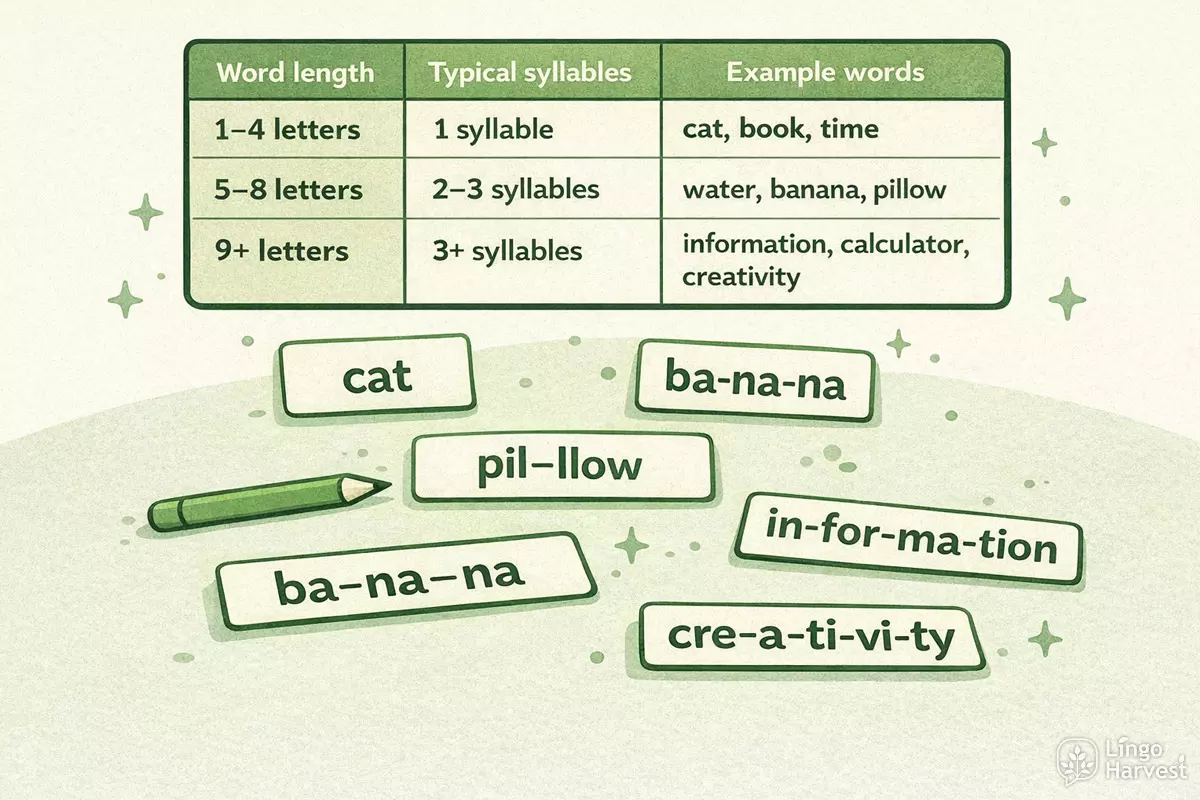
| Word length | Typical syllables | Example words | Example syllable patterns |
|---|---|---|---|
| 1–4 letters | 1 syllable | cat, book, time, word | cat, book, time, word |
| 5–8 letters | 2–3 syllables | water, banana, pillow | wa–ter, ba–na–na, pil–low |
| 9+ letters | 3+ syllables | information, calculator, creativity | in–for–ma–tion, cal–cu–la–tor, cre–a–ti–vi–ty |
This table is only a rough guide, but it gives new learners a simple idea of how English spelling and syllables interact. Longer words often contribute more to rhythm than short ones, especially in poetry.
Study and writing tips with syllables
Understanding syllable structure is useful far beyond poetry. Syllables influence pronunciation, reading speed, and natural sentence flow. Here are practical ways to use this calculator to improve your English writing and speaking style:
1. Improve pronunciation accuracy
- Check syllables for difficult words before speaking them.
- Compare similar words (for example, im-port-ant vs im-por-tance).
- Use hyphenation output to visualise word stress patterns.
2. Rewrite sentences for better rhythm
If your sentence sounds too long and heavy, you can shorten it by:
- Replacing long word clusters.
- Removing unnecessary fillers.
- Changing structure for balance.
3. Poetry and lyrics composition
Syllable counts guide rhythm. If you write songs or poems, use the line breakdown to:
- Balance verses.
- Create repeating patterns.
- Control stress and flow across stanzas.
4. Academic and speech writing
Speakers and students can analyse syllable density to improve clarity and timing:
- Short syllable density = faster reading.
- High syllable density = slower reading.
- Balance helps presentations sound smooth.
| Goal | How to use syllable data | Who benefits |
|---|---|---|
| Improve pronunciation | Check word-by-word hyphen splits | English learners, teachers |
| Write poetry/lyrics | Track syllable rhythm by line length | Poets, musicians, writers |
| Structure paragraphs | Remove overly long word clusters | Students, editors, bloggers |
| Speech scripting | Balance syllables to control timing | Speakers, presenters |
With regular use, you start to “feel” syllables naturally, which improves your writing rhythm, listening comprehension, and spoken fluency.
FAQ about the Syllable Counter
1. How accurate is this syllable counter?
The tool gives a practical estimate based on a mix of heuristic rules and dictionary hyphenation. For most common English words it is close to how people actually pronounce them, because the system uses a dictionary database of over 164,000 syllabified words, covering the most frequently used vocabulary in modern English. However, it is still an approximation, not a full phonetic dictionary — rare terms, names, slang, or highly irregular forms may differ from real spoken pronunciation.
2. Why do some counts look “wrong” to me?
English pronunciation changes with accent, speed, and style. Some speakers might merge or drop syllables, others may pronounce them fully. The calculator follows a neutral, dictionary-like pattern, so in fast or very informal speech your own count may differ by 1 syllable.
3. Can I rely on it for serious poetry or song lyrics?
Yes, as a helper — but not as the only judge. Use the Syllable Counter to get a quick base count, then read the line aloud and adjust if your natural rhythm feels slightly different. For final versions, human ear is always the last authority.
4. Does the 5–7–5 mode work for any kind of poem?
No, it is designed specifically for short three-line poems that follow a 5–7–5 pattern. Free verse, longer stanzas, or other syllable patterns will not be “graded” by this mode and should be checked manually using the main breakdown table.
5. Why do I need options for punctuation, hyphens, and apostrophes?
Real texts are messy: songs, chats, and poems use contractions, dashes, and broken lines. These options let you clean or split the text so the syllable counter stays useful for different styles instead of forcing one rigid rule set on all texts.
6. Can I use this tool for teaching English?
Yes. Teachers can use it to show how syllables work, check classroom haiku, compare long and short words, and help students notice rhythm. Learners can independently check their homework and experiment with rewriting lines to match a target pattern.
7. Does the calculator store my text?
No. The analysis is done for your current session only. The tool is designed as a quick helper: you paste the text, get your counts, make changes if needed, and move on.