How Modal Verbs Express Speculation About the Past

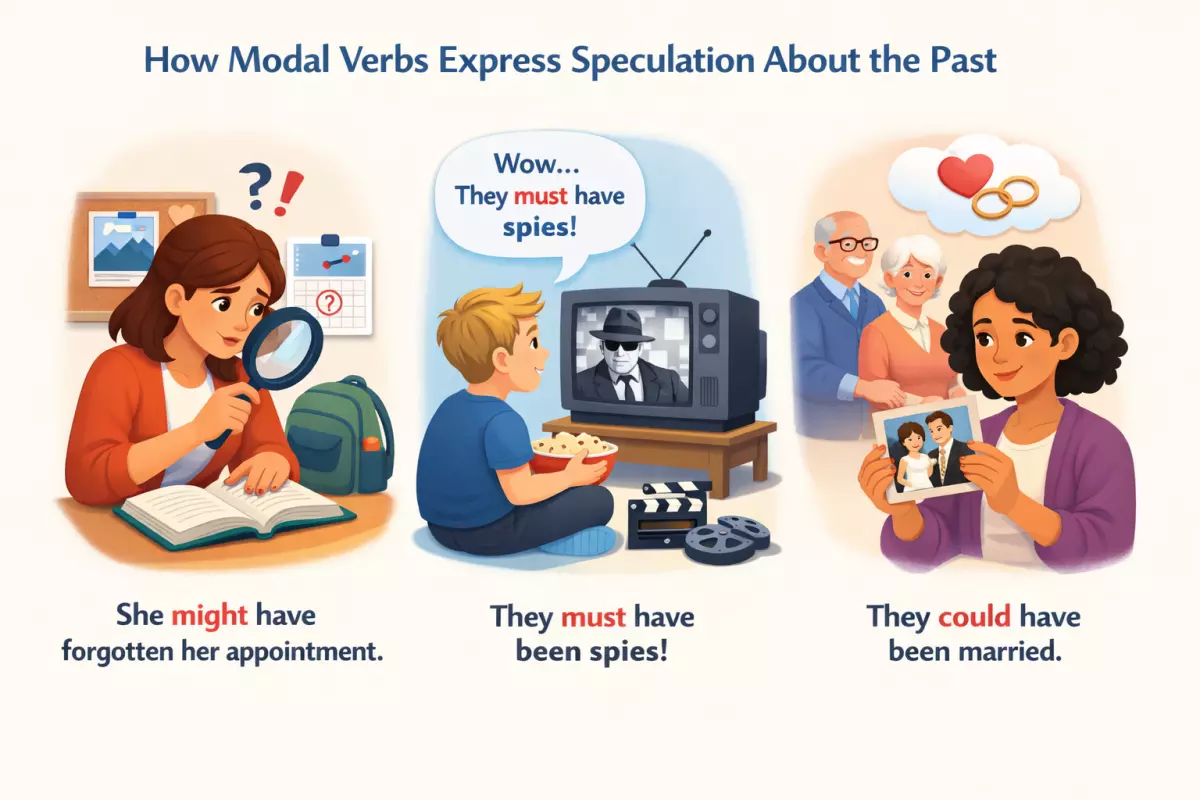 Learn how English speakers guess about past events using modal perfect forms like may have, might have, could have, and must have. See examples of inferring what probably happened, how certainty levels differ, how context shapes meaning, and practice with exercises.
- How English speakers guess about events that already happened
- Structures such as may have, might have, and could have
- How must have expresses strong confidence about a past situation
- Examples where speakers infer what probably happened
- How modal perfect forms show different levels of certainty
- How context helps listeners interpret past speculation
- Exercises and practice activities using modal verbs for past speculation
English has small helper verbs that let you infer what likely happened in the past. In everyday situations we often gather clues afterward, and phrases like might have, must have, and could have help you sound cautious, confident, or somewhere in between. This guide will help you pick the best option so your meaning stays clear, polite, and realistic.
How English speakers guess about events that already happened
When speakers infer what happened earlier, they often combine a modal verb with a perfect form (have + past participle). This structure signals “I’m not stating a fact; I’m drawing a conclusion now about a past event.” The choice of modal shows how confident the speaker is and what kind of evidence they’re using.
Core pattern: modal + have + past participle
The most common frame is:
- modal + have + past participle (e.g., “She must have left.”)
- Negative forms: modal + not have + past participle (e.g., “He can’t have forgotten.”)
- Questions are possible but less common for strong conclusions (e.g., “Could they have missed the bus?”)
Choosing the modal: strength of the guess
- must have + past participle → strong logical conclusion based on evidence: “The lights are off; they must have gone to bed.”
- can’t have + past participle → strong negative conclusion (speaker thinks it’s impossible): “She can’t have said that; she wasn’t there.”
- could have + past participle → realistic possibility (often one option among several): “They could have taken a different route.”
- may have + past participle → uncertain possibility, polite or cautious: “He may have misunderstood the email.”
- might have + past participle → even more tentative, or used to keep distance from the claim: “I might have left my keys at work.”
Common usage patterns and what they imply
- Evidence-based inference: “The package is open; someone must have checked it.”
- Explaining a result now: “You’re soaked—you must have been caught in the rain.”
- Ruling out a past event: “They can’t have finished already; it’s only been an hour.”
- Multiple possible explanations: “She could have missed the train, or it might have been canceled.”
- Softening blame: “You may have clicked the wrong button.”
- Self-correction and memory gaps: “I might have told you, but I’m not sure.”
- Speculating about someone’s motives: “He may have wanted to avoid conflict.”
- Speculating about timing: “They might have arrived earlier than us.”
- Adding a reason clause: “She must have left early because the car is gone.”
- Using “already/yet” with conclusions: “They can’t have left yet.” / “He may have already sent it.”
Frequent learner pitfalls (and fixes)
- ✅ “She must have gone home.” → ❌ “She must went home.”
- ✅ “He might have forgotten.” → ❌ “He might forgot.”
- ✅ “They can’t have seen us.” → ❌ “They mustn’t have seen us.” (Different meaning: “mustn’t” is usually prohibition, not deduction.)
- ✅ “She could have been sick.” → ❌ “She could was sick.”
- ✅ “I may have left it there.” → ❌ “I may left it there.”
Example bank (quick models you can reuse)
- “You must have misread the schedule.”
- “They must have forgotten to reply.”
- “She can’t have known about the change.”
- “He can’t have finished that fast.”
- “We could have parked on the next street.”
- “It could have slipped out of your bag.”
- “The file may have been deleted by accident.”
- “They may have taken the wrong exit.”
- “I might have left the window open.”
- “She might have been waiting for your call.”
- “The meeting must have been canceled.”
- “He could have been working late.”
- “They may not have received the message.”
- “You might not have noticed the attachment.”
Structures such as may have, might have, and could have
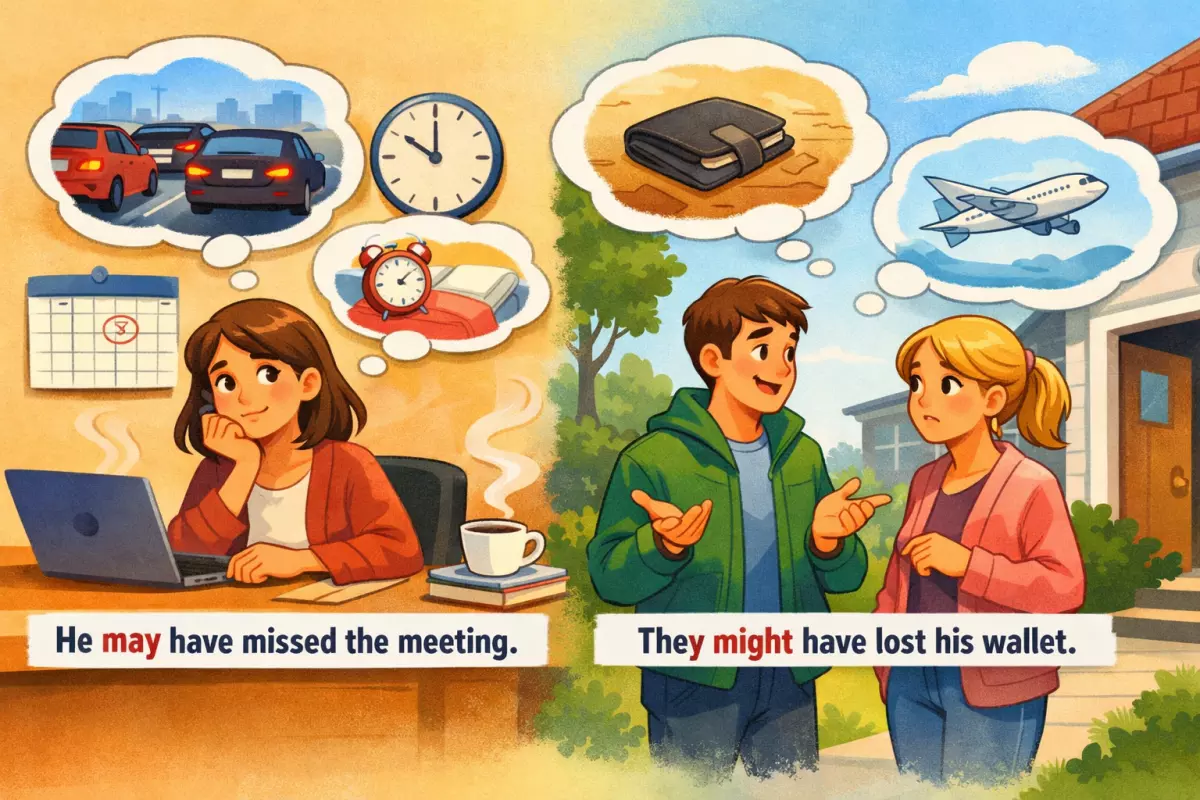
These forms combine a modal verb with have + past participle to show uncertainty about a past event. They are used when you are not stating a confirmed fact, but making a reasoned guess based on limited evidence.
Core pattern and meaning
- Form: may/might/could + have + past participle (V3)
- Time reference: the speculation is about the past (yesterday, earlier, before you arrived, etc.).
- Speaker stance: the speaker does not know for sure; the statement is a possibility, not a conclusion.
- Typical context: missing information, indirect clues, incomplete memory, or delayed discovery of results.
How the three modals differ in practice
- May have often sounds slightly more neutral or matter-of-fact when suggesting a possible explanation: “They may have missed the email.”
- Might have is very common in everyday speech and often feels a bit more tentative: “They might have missed the email.”
- Could have highlights that something was possible in the situation (one possible outcome among others): “They could have missed the email (or it could have gone to spam).”
- In many real conversations, may have and might have are interchangeable; the difference is usually small and depends on tone and region.
Common usage patterns
- With evidence phrases: “Based on the timestamp, she might have left early.”
- To explain a present result: “The screen is cracked; it could have fallen.”
- To speculate about someone’s actions: “He may have taken the wrong train.”
- To speculate about reasons: “They might have misunderstood the instructions.”
- To speculate about what happened in a process: “The file could have been deleted during the update.”
- With adverbs of uncertainty: “She may have accidentally sent the draft.”
- With time markers: “They might have arrived around noon.”
- In questions (less common, but possible): “Could he have forgotten?”
Examples (affirmative, negative, and question forms)
- She may have left her phone at the office.
- They might have misunderstood what you meant.
- He could have taken a different route and avoided traffic.
- The package may have arrived while you were out.
- I might have typed the wrong number.
- The server could have crashed overnight.
- She may not have seen your message yet.
- They might not have received the invitation.
- He could not have known about the change (it was announced later).
- Could she have misread the date?
- Might they have already paid the invoice?
- May he have forgotten to attach the file?
- The keys may have been left in the car.
- The meeting might have been moved to Friday.
- The results could have been affected by the temperature.
Frequent learner issues to avoid
- ✅ “She might have gone home.” → ❌ “She might have went home.” (use a past participle, not the past simple)
- ✅ “They may have been busy.” → ❌ “They may have busy.” (use been with adjectives)
- ✅ “He could have forgotten.” → ❌ “He could forgot.” (missing have)
- ✅ “She might not have heard.” → ❌ “She might have not heard.” (not impossible, but less natural; place not after the modal)
- ✅ “It may have happened earlier.” → ❌ “It may happened earlier.” (missing have)
How must have expresses strong confidence about a past situation
Use must have to make a firm logical deduction about something that already happened. It signals that the speaker feels the conclusion is very likely based on evidence, not that they directly witnessed the event.
Core form and meaning
- Structure: must + have + past participle (must have seen, must have left, must have forgotten).
- Time reference: the deduction is about the past, even though must itself has no past form here.
- Strength: stronger than may/might/could have; it presents the conclusion as close to certain.
- Basis: typically used when there is a clear clue (results, signs, context) that supports the inference.
Common usage patterns
- Cause → result reasoning: “The lights are off and the door is locked. They must have gone out.”
- Explaining a present situation with a past cause: “You’re soaked—you must have gotten caught in the rain.”
- Inference about someone’s actions: “He isn’t answering. He must have fallen asleep.”
- Inference about feelings or reactions: “She looked upset. She must have heard the news.”
- With adverbs to show how confident you are: “They must have definitely missed the train.” (often “definitely” is optional because must is already strong)
- With negatives in the main clause (not inside must): “I can’t find my keys. I must have left them at work.”
Examples you can model
- “The cake is half gone—you must have started without me.”
- “Her phone went straight to voicemail; she must have turned it off.”
- “The file is saved in the wrong folder. I must have clicked the wrong option.”
- “They arrived early; they must have taken a different route.”
- “The dog is muddy. It must have been digging in the garden.”
- “He knows my name, so we must have met before.”
- “No one heard the alarm. It must have malfunctioned.”
- “The room smells like paint. They must have painted recently.”
- “Your eyes are red—you must have been crying.”
- “There are footprints by the window. Someone must have come in that way.”
- “She got full marks. She must have studied a lot.”
- “The bus stop is empty. The bus must have already left.”
- “He’s limping. He must have hurt his ankle.”
- “The message shows ‘seen.’ You must have opened it.”
- “The meeting ended early. They must have reached a decision quickly.”
Common mistakes and how to fix them
- ❌ “He must went home.” → ✅ “He must have gone home.”
- ❌ “They must have went already.” → ✅ “They must have gone already.”
- ❌ “She mustn’t have taken it.” (often unnatural for deduction) → ✅ “She can’t have taken it.”
- ❌ “I must have to call you.” (wrong meaning) → ✅ “I had to call you.” / “I must call you.”
Negative deductions: prefer “can’t have”
For strong confidence that something did not happen, English usually uses can’t have + past participle rather than must not have. Mustn’t is more often used for prohibition (rules), not logical conclusions.
- ✅ “He can’t have forgotten; I reminded him twice.”
- ✅ “They can’t have seen the email; it was sent an hour ago.”
- ✅ “She can’t have said that—she’s usually very careful.”
Examples where speakers infer what probably happened

When speakers reconstruct past events from clues, they often choose modal + perfect forms (modal + have + past participle). These patterns signal a conclusion rather than a witnessed fact, and they let you grade how strong the conclusion is.
Common patterns and what they imply
- must have + past participle: strong logical conclusion based on evidence (high certainty).
- may have / might have + past participle: possible explanation (medium to low certainty).
- could have + past participle: one plausible scenario among others; sometimes suggests “it was possible” rather than “it happened.”
- can’t have / couldn’t have + past participle: strong negative conclusion (you believe it was impossible).
- should have + past participle: expectation about what is likely true, or a “probability” reading in some contexts (distinct from the regret/criticism meaning).
Inference examples (with typical evidence)
- She must have left early—her coat is gone and the lights are off.
- They must have missed the train—the platform is empty and they’re not answering.
- He must have forgotten the meeting—he never misses it unless something slipped his mind.
- The package must have arrived—I got a delivery notification an hour ago.
- She may have taken a different route—traffic was backed up on the main road.
- They might have changed the schedule—the time on the board doesn’t match yesterday’s email.
- He might have misunderstood your message—his reply answers a different question.
- The keys could have fallen out of your bag—the lining is torn.
- Someone could have moved the file—it’s not where we always keep it.
- It can’t have been John—he was with me the whole evening.
- They couldn’t have finished already—they only started twenty minutes ago.
- She can’t have seen the email—it’s still unread in the shared inbox.
- He should have arrived by now—it’s a ten-minute walk and he left ages ago.
- The results should have been posted yesterday—that’s the usual release date.
- There must have been a power cut—all the clocks are blinking.
- They may have been delayed—the flight status shows “awaiting departure.”
Usage notes that help you choose the right modal
- Use must have when your evidence points strongly to one explanation; it sounds like “the only reasonable conclusion.”
- Use might have when you want to keep multiple explanations open and avoid sounding too sure.
- Use could have to present a plausible alternative, especially in problem-solving (“One possibility is…”).
- Use can’t have to rule something out with confidence; it often appears in disagreements about what happened.
- Avoid mixing inference with definite past statements in the same claim: ✅ She must have left early (inference) vs. ❌ She left early, she must have (awkward unless used as an afterthought in speech).
How modal perfect forms show different levels of certainty
Modal + have + past participle lets you comment on a past situation while signaling how confident you are about it. The modal you choose (and whether you make it negative) creates a scale from “almost sure” to “just a guess.”
| Certainty level (typical) | Form | Common meaning about the past | Example |
|---|---|---|---|
| Very high (logical conclusion) | must have + past participle | Strong inference based on evidence | She must have missed the bus; she’s never this late. |
| High (near-certain negative) | can’t have / couldn’t have + past participle | Strong belief something did not happen | He can’t have finished already; he started ten minutes ago. |
| Medium (reasonable possibility) | may have / might have + past participle | Possible explanation; speaker is unsure | They might have taken a different route. |
| Low (weak possibility, often “maybe”) | could have + past participle | One possible past scenario among others | I could have left my keys at the office. |
| Expectation vs. reality (often criticism or surprise) | should have / ought to have + past participle | Past obligation or expectation not met | You should have told me earlier. |
| Unnecessary action (often mild criticism) | needn’t have + past participle | Something was done but wasn’t necessary | You needn’t have bought water; we have plenty. |
Patterns that raise or lower confidence
- Evidence-based conclusion: use must have when you have clear clues (timestamps, messages, visible results).
- Evidence-based rejection: use can’t have / couldn’t have when the facts make an event nearly impossible.
- Open possibilities: use may have / might have when you are offering an explanation without committing to it.
- One option among many: use could have when several past explanations are plausible and you’re naming one.
- Expectation (met or not): should have usually implies the expected action did not happen; in questions it can ask for a likely explanation (e.g., “Where should I have put it?” is different and not about speculation).
- Negatives change the message: might not have means “possibly didn’t,” while can’t have means “almost certainly didn’t.”
Quick usage notes (common learner traps)
- ✅ must have is about deduction, not permission: “He must have left early.” ❌ “He must have left early?” (as permission) is not the intended meaning.
- ✅ Use can’t have for strong negative conclusions: “She can’t have said that.” ❌ “She mustn’t have said that” usually sounds like prohibition, not deduction.
- ✅ Keep the perfect form: modal + have + past participle. ❌ “He might went” → ✅ “He might have gone.”
- might have and may have are often interchangeable; might commonly sounds a little less certain in everyday use.
- could have can also express missed opportunity (“I could have helped”), which is different from speculation; context usually makes the meaning clear.
Example set: same situation, different certainty
- must have: “The lights are off; they must have gone to bed.”
- can’t have: “They can’t have gone to bed; I just heard music.”
- might have: “They might have gone to bed, but I’m not sure.”
- could have: “They could have gone to bed, or they could be out back.”
- should have: “They should have gone to bed earlier if they were tired.”
- needn’t have: “They needn’t have gone to bed so early; the meeting was canceled.”
How context helps listeners interpret past speculation
Listeners usually decide what a past-modal sentence means by combining the modal form with surrounding clues: time markers, shared knowledge, the type of evidence mentioned, and the speaker’s goal (guessing, explaining, criticizing, or correcting). The same grammar can sound like a neutral inference in one situation and a reproach in another.
Context clues that guide interpretation
- Time anchoring: Words like “yesterday,” “by 8 p.m.,” “when I arrived,” or “before the meeting” help listeners place the speculation on a timeline, especially with must have, might have, or could have.
- Evidence type: Concrete evidence (receipts, footprints, a timestamp) pushes interpretations toward stronger conclusions (often must have), while vague impressions (“I had a feeling…”) fit weaker modals (often might have).
- Degree of certainty: Adverbs and framing phrases (“probably,” “almost certainly,” “I’m not sure”) tune the strength of the modal and can soften or sharpen it.
- Shared background: If everyone knows a person’s habits, “He must have left early” sounds like a logical inference; without that shared knowledge, it may sound overconfident.
- Speaker intent: In explanations, past modals often summarize reasoning; in arguments, the same forms can imply blame or defensiveness.
- Politeness and face-saving: Speakers choose weaker forms to avoid sounding accusatory: “You might have missed my email” is gentler than “You must have ignored it.”
- Counterevidence: If the next sentence contradicts the guess (“But then I saw him inside”), listeners reinterpret the modal as a tentative hypothesis rather than a conclusion.
- Question vs. statement: “Could he have taken it?” invites collaborative reasoning; “He could have taken it” can sound like suspicion, depending on tone and prior talk.
- Negation scope: Context helps resolve what is being denied: “He can’t have said that” usually denies the event; “He may not have said that” leaves it open.
- Alternative explanations: Mentioning other possibilities (“or maybe…”) signals that the modal is one option among several, not a final verdict.
- Sequence of events: Past perfect time relations (“by the time…,” “already”) make could have sound like missed opportunity or unrealized possibility.
- Genre and setting: In news, reports, and formal summaries, modals tend to be cautious; in casual conversation, they often compress reasoning and rely more on shared assumptions.
Common context-driven readings (with patterns)
- Inference from results: “The lights were off; they must have gone to bed.” (observable result → strong conclusion)
- Low-commitment guess: “She might have taken the earlier train.” (no clear evidence → tentative)
- Multiple possible causes: “It could have been a software bug.” (one plausible explanation among others)
- Impossibility based on facts: “He can’t have been at the office; his badge wasn’t used.” (known constraint → rejection)
- Polite correction: “You may have misunderstood the instructions.” (softens the claim)
- Regret / criticism (missed obligation): “You should have called.” (context often adds judgment)
- Unrealized option: “We could have left earlier, but we waited.” (explicit contrast → missed chance)
- Rumor-like distance: “They might have broken up.” (speaker keeps distance from certainty)
- Defensive explanation: “I must have misread the date.” (self-directed inference to account for an error)
- Reconstruction of events: “Someone must have opened the window; it was locked earlier.” (before/after context → reconstruction)
- Soft accusation vs. neutral hypothesis: “He could have taken it” sounds neutral in a brainstorming setting, but accusatory after a conflict.
- Uncertain negation: “She may not have seen your message.” (keeps both possibilities alive)
Quick checks for choosing the right modal in context
- Ask what the listener already knows; if little is shared, prefer weaker commitment (might have / may have).
- Match the modal to your evidence: strong, specific evidence supports must have; limited evidence supports might have.
- Watch for blame: if the aim is cooperation, use softer phrasing (“might have,” “may have”) rather than forms that sound like conclusions about someone’s behavior.
- Use explicit time markers when the timeline matters; it reduces confusion between “past guess” and “general possibility.”
- Be careful with negation: can’t have usually means “impossible,” while may not have usually means “possibly not.”
Exercises and practice activities using modal verbs for past speculation
Use these tasks to practice choosing the right modal + perfect form (modal + have + past participle) and matching it to the speaker’s certainty. Focus on the pattern first, then on meaning: must have (strong conclusion), might/may/could have (possibility), and can’t/couldn’t have (strong impossibility).
1) Form drill: build the correct structure
Complete each sentence with a modal verb and the correct perfect form. Use: must / might / may / could / can’t / couldn’t + have + past participle.
- They ________ (leave) already; the lights are off and the office is locked.
- She ________ (forget) to charge her phone; it went straight to voicemail.
- He ________ (say) that. He was with me the whole time.
- We ________ (take) the wrong exit; the GPS keeps recalculating.
- The package ________ (arrive) yesterday, but I didn’t check the mail.
- Anna ________ (know) about the meeting; nobody told her.
- The kids ________ (break) the window; they were playing football outside.
- I ________ (misread) the email; the date seems different now.
- That ________ (be) the right address; the street number doesn’t exist.
- He ________ (miss) the train; he texted that he was running late.
Show answers
- must have left
- might/may/could have forgotten
- can’t/couldn’t have said
- might/may/could have taken
- might/may/could have arrived
- can’t/couldn’t have known
- might/may/could have broken
- must have misread
- can’t/couldn’t have been
- must have missed
2) Meaning drill: choose the level of certainty
Select the best option for each context. Pay attention to evidence words like “definitely,” “probably,” “maybe,” and “no way.”
- The door is wide open and the alarm is off. Someone ________ (must have / might have) come in earlier.
- He answered every question correctly. He ________ (can’t have / might have) studied a lot.
- It’s possible I misunderstood. I ________ (must have / could have) taken your comment the wrong way.
- No one has her new number. She ________ (can’t have / may have) called you from her phone.
- The roads were icy, so they ________ (must have / might have) arrived late.
- She was on a flight during the meeting. She ________ (couldn’t have / might not have) attended.
- He looks exhausted and his laptop is still open. He ________ (must have / may have) worked all night.
- There’s a small chance the file is in the downloads folder. You ________ (must have / might have) saved it there.
- The receipt shows the payment was declined. You ________ (can’t have / might have) paid successfully.
- They knew the password, but it was written on a sticky note. They ________ (must have / could have) guessed it.
Show answers
- must have
- must have
- could have
- can’t have
- might have
- couldn’t have
- must have
- might have
- can’t have
- could have
3) Fix the error: past speculation vs. past simple
Each sentence has a problem with form or meaning. Rewrite it so it expresses past speculation correctly.
- He must went home early.
- She can’t have went to the party.
- They might have to left before noon.
- I could misread the instructions yesterday.
- That must be a mistake; you sent it last week.
- We may have forgot your birthday.
- He couldn’t have to do it alone.
- The keys must have fell behind the sofa.
- She might called you earlier.
- This can’t have been happen.
Show answers
- He must have gone home early.
- She can’t have gone to the party.
- They might have left before noon.
- I could have misread the instructions yesterday.
- That must have been a mistake; you sent it last week.
- We may have forgotten your birthday.
- He couldn’t have done it alone.
- The keys must have fallen behind the sofa.
- She might have called you earlier.
- This can’t have happened.
4) Guided speaking/writing prompts (no single “correct” answer)
- Look at a messy room and write 5 sentences: 2 with must have, 2 with might have, and 1 with can’t have.
- Think of a late arrival scenario. Write 6 different explanations using: must have / might have / could have / might not have / can’t have / could have.
- Take a short story you know (a film scene or a news event) and add 8 lines of inference about what happened off-screen using modal perfect forms.
- Choose one past misunderstanding and write a mini-dialogue (8–10 lines) where each speaker uses at least three speculating forms (for example, “You might have meant…”, “I must have sounded…”, “You couldn’t have known…”).
- Practice “evidence chaining”: for one situation, write three sentences that increase certainty (could have → might have → must have) and explain what new evidence caused the stronger conclusion.
5) Quick pattern checklist
- Use modal + have + past participle for guesses about a finished past situation: “She might have missed the bus.”
- Use must have when the evidence strongly supports one conclusion: “He must have forgotten.”
- Use can’t/couldn’t have to reject a past possibility: “They can’t have seen it from here.”
- Use might/may/could have when several explanations are possible: “It could have been a server error.”
- Avoid mixing with “to”: ❌ “might have to left” → ✅ “might have left.”