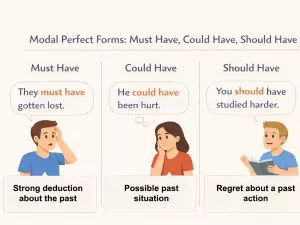
How to Express Past Possibility with Modal Verbs

 Learn how English speakers speculate about past events using may have, might have, and could have. See how each modal shows stronger or weaker certainty, with examples of what probably happened, how context and evidence shape your choice, and practice exercises for real conversations.
- How English speakers speculate about events that already happened
- Modal structures such as may have, might have, and could have
- How different modal verbs signal stronger or weaker certainty
- Examples of guessing what probably happened in the past
- How context and evidence influence the modal choice
- How speakers discuss uncertain past events in conversation
- Exercises and practice activities using modal verbs for past possibility
Talking about what might have happened in the past is a skill you’ll use often, from explaining a missed call to guessing why someone was late. In this lesson, you’ll practice modal verbs that show different levels of certainty after the fact, so your meaning stays clear and natural. You’ll learn how could have, might have, and must have help you express guesses, regrets, and logical conclusions without sounding dramatic or vague.
How English speakers speculate about events that already happened
To guess about a past event, English usually combines a modal verb with a perfect infinitive: modal + have + past participle. This pattern lets you talk about what was possible, likely, or certain in the past, even when you don’t know the full facts.
Core pattern: modal + have + past participle
- Form: modal + have + V3 (past participle) → might have missed, could have left, must have forgotten
- Meaning: the speaker is making a judgment now about a completed past situation, not describing a known fact.
- Time reference: the action is earlier than “now” (or earlier than another past reference point in context).
Choosing the modal: degrees of certainty
- might have / may have → a reasonable possibility (not sure): “She might have taken the earlier train.”
- could have → one possible explanation among others, or past ability/opportunity (context decides): “They could have misunderstood the instructions.”
- must have → strong logical conclusion based on evidence: “He must have left already; the lights are off.”
- can’t have / couldn’t have → strong belief something was impossible or untrue: “You can’t have seen her yesterday; she was abroad.”
- should have / ought to have → expectation, advice, or criticism about the past (often implies it didn’t happen): “You should have called me.”
- would have → imagined result in a past condition or a “future in the past”: “I would have helped, but I didn’t know.”
Common usage patterns (with examples)
- Evidence-based guess: “The ground is wet. It must have rained.”
- Uncertain explanation: “She’s not answering. She might have fallen asleep.”
- Ruling something out: “They can’t have finished in one day; it’s too much work.”
- Multiple possibilities: “He could have taken a taxi or might have walked.”
- Past mistake / regret: “I shouldn’t have said that.”
- Expectation not met: “The package should have arrived by now.”
- Polite criticism: “You could have told me you’d be late.”
- Counterfactual past result: “If you’d warned me, I would have prepared.”
- Past possibility that didn’t happen (often implied): “We could have won (but we didn’t).”
- Strong negative conclusion: “She couldn’t have written this; she doesn’t speak French.”
- Guessing about reasons: “They may have canceled because of the weather.”
- Guessing about actions: “He might have deleted the email by accident.”
- Guessing about feelings: “They must have been worried.”
- Guessing about duration (with perfect continuous): “She may have been waiting for hours.”
Perfect vs. perfect continuous
- modal + have + V3 focuses on a completed action or a resulting state: “He must have missed the bus.”
- modal + have been + V-ing focuses on an ongoing activity in the past (duration or temporary situation): “He must have been rushing.”
Frequent learner errors to avoid
- ✅ “She might have gone home.” ❌ “She might went home.”
- ✅ “They must have forgotten.” ❌ “They must forgot.”
- ✅ “You can’t have seen him.” ❌ “You can’t saw him.”
- ✅ “I should have studied.” ❌ “I should studied.”
- ✅ “She may have been working.” ❌ “She may was working.”
Modal structures such as may have, might have, and could have

Use a modal + have + past participle to talk about a possibility in the past when you are not certain what happened. This structure is common for guessing, interpreting evidence, or considering alternative explanations after the fact.
Core form and meaning
- Form: may/might/could + have + past participle (V3)
- Time reference: the action is earlier than “now” (a past situation)
- Certainty level: less than “must have” (strong deduction), more open-ended than a simple past statement
- Typical use: “I’m not sure, but it’s possible that…”
How the three modals differ in practice
- may have often sounds slightly more neutral or cautious in formal contexts: “It may have happened during the night.”
- might have is very common in everyday speech for uncertain past possibility: “She might have missed the bus.”
- could have highlights that something was possible (sometimes one of several possibilities): “They could have taken a different route.”
- In many situations, may have and might have are interchangeable; the difference is usually about tone, not grammar.
Common patterns you can reuse
- Guessing from evidence: “He might have left early; his desk is empty.”
- Explaining a result: “The file could have been corrupted during the transfer.”
- Offering a possible reason: “She may have been stuck in traffic.”
- Uncertain memory: “I might have met him before, but I’m not sure.”
- Multiple possibilities: “They could have misunderstood the instructions.”
- With adverbs of uncertainty: “He might have simply forgotten.”
- With time markers: “It may have started around midnight.”
- With ‘by’ + time: “They might have arrived by now, but I haven’t heard from them.”
Expanded example bank (past possibility)
- She may have sent the email to the wrong address.
- He might have misunderstood your question.
- They could have taken the earlier train.
- The meeting may have been moved to Friday.
- I might have left my keys in the office.
- The package could have been delivered to a neighbor.
- She may have forgotten to attach the document.
- He might have been asleep when you called.
- The system could have crashed due to heavy traffic.
- We may have met at a conference years ago.
- They might have changed their minds at the last minute.
- The note could have been written by someone else.
- She may have taken a different entrance.
- I might have misheard the address.
- The results could have been affected by the temperature.
- He may have already paid the invoice.
Frequent learner errors to avoid
- ✅ “She might have gone home.” → ❌ “She might have went home.”
- ✅ “They could have been late.” → ❌ “They could have are late.”
- ✅ “He may have forgotten.” → ❌ “He may forgot.”
- Don’t use this structure when you are certain. If you know the fact, use the past simple or present perfect instead (depending on context).
Negative and question forms
- Negative: may not / might not / couldn’t + have + V3
- “She might not have seen your message.”
- “He couldn’t have done it alone.” (often implies strong disbelief)
- Questions: May/Might/Could + subject + have + V3?
- “Could they have missed the exit?”
- “Might she have taken my notebook by mistake?”
How different modal verbs signal stronger or weaker certainty
When you talk about a past possibility, the modal you choose shows how confident you are about what happened. In English, this “certainty scale” is mostly expressed through a small set of patterns: modal + have + past participle (e.g., must have left, might have forgotten). The same event can sound almost proven, merely plausible, or close to impossible depending on the modal.
| Certainty level (past) | Common modal patterns | Typical meaning | Example |
|---|---|---|---|
| Very strong (near conclusion) | must have + past participle | Speaker is drawing a logical conclusion from evidence. | She must have missed the train; her phone is off and she’s not here. |
| Strong (expected/likely) | should have / ought to have + past participle | Expectation or probability based on norms/plans (not proof); can also imply criticism depending on context. | They should have arrived by now if the flight was on time. |
| Medium (possible) | may have / might have / could have + past participle | A realistic possibility; the speaker is not sure. | He might have taken the earlier bus. |
| Weak (unlikely / almost impossible) | can’t have / couldn’t have + past participle | Speaker believes it was not possible, based on evidence. | They can’t have finished already; they only started an hour ago. |
| Counterfactual (did not happen) | would have + past participle | An unreal past result (often with an if-clause or an implied condition). | I would have called, but I didn’t have your number. |
Usage notes that affect how “certain” the sentence sounds
- Must have is about inference, not a memory. It sounds confident because it points to evidence: “The lights are off; they must have gone out.”
- Should have / ought to have often sits between “likely” and “expected.” It can mean probability (“They should have landed by now”) or a past mistake (“You should have told me”). Context decides which.
- Might have usually feels weaker than may have in many varieties of English, but the difference is small; both commonly signal uncertainty.
- Could have highlights one possible explanation among others. It often suggests “one plausible option,” not “the most likely option.”
- Can’t have / couldn’t have is the standard way to express a strong negative conclusion about the past. Avoid using mustn’t have for this meaning; it usually sounds like prohibition, not deduction.
- Would have does not mean “maybe.” It frames an unreal past outcome tied to a condition: “I would have helped (if I’d known).”
Quick pattern reminders (past possibility forms)
- ✅ must have + past participle: “She must have left.”
- ✅ should have / ought to have + past participle: “They should have received it.”
- ✅ may have / might have / could have + past participle: “He might have misunderstood.”
- ✅ can’t have / couldn’t have + past participle: “It can’t have been easy.”
- ✅ would have + past participle (counterfactual): “I would have stayed.”
- ❌ mustn’t have (for deduction): use can’t have instead for “it’s impossible that…”
Examples of guessing what probably happened in the past
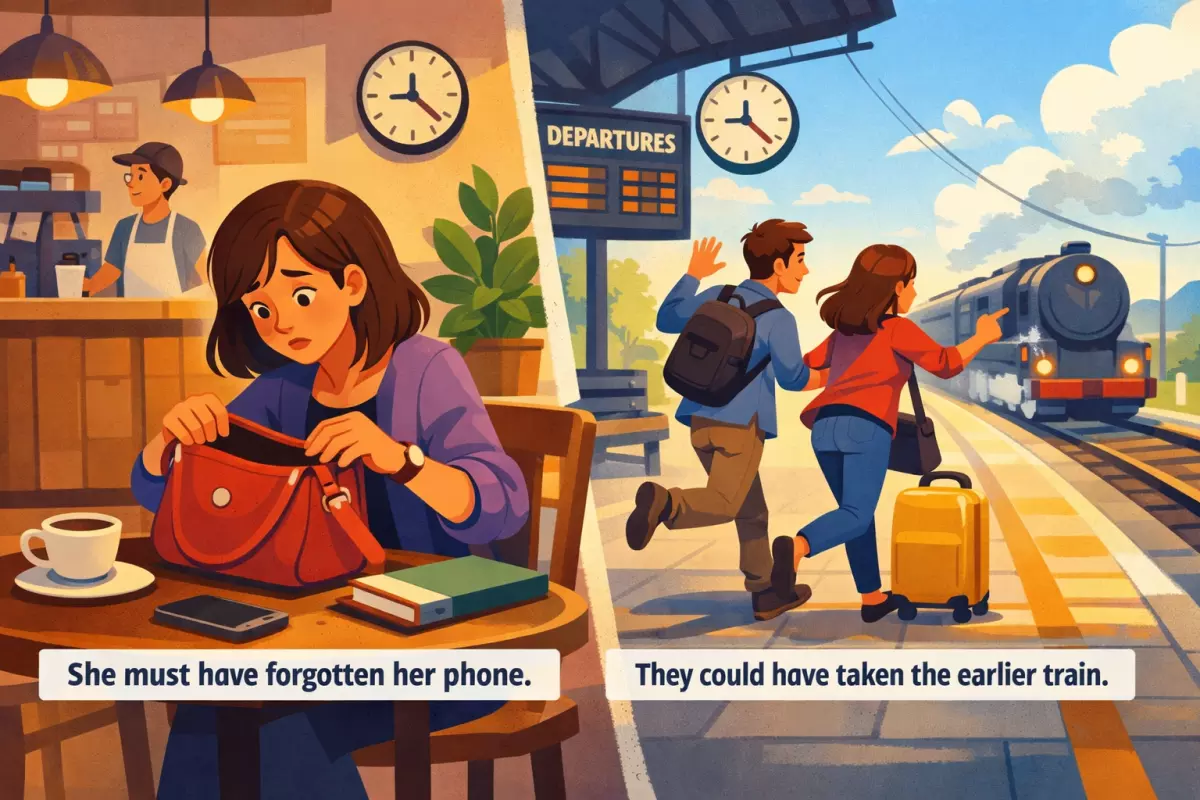
To make a reasoned guess about a finished past situation, English often uses modal + have + past participle. The modal shows how sure you are (strong, medium, weak), and the perfect form (have + V3) signals that the time is before now.
Common patterns to copy
- must have + past participle (very strong conclusion): “She must have forgotten her phone.”
- could have + past participle (one possible explanation): “They could have taken the earlier train.”
- may have / might have + past participle (uncertain possibility): “He might have misunderstood the instructions.”
- can’t have / couldn’t have + past participle (strong negative conclusion): “You can’t have seen her yesterday; she was out of town.”
Example sentences (with typical contexts)
- “The lights are off; they must have gone to bed early.”
- “He isn’t answering. He might have fallen asleep.”
- “The file is missing. Someone could have deleted it by mistake.”
- “She looks relaxed today; she may have finished the project.”
- “The kitchen is spotless. You must have cleaned it this morning.”
- “The meeting started at 9. They could have arrived late because of traffic.”
- “This email is dated tomorrow—there can’t have been a system error, right?”
- “His name isn’t on the list. They might have forgotten to add him.”
- “The dog is wet. It must have been outside in the rain.”
- “The door was locked. She couldn’t have left without a key.”
- “The package isn’t here. It may have been delivered to the wrong address.”
- “The screen is cracked. He must have dropped his phone.”
- “They knew the answer immediately. They might have studied that topic already.”
- “The cookies are gone. The kids must have eaten them after school.”
- “Her accent is very natural. She could have lived abroad for years.”
- “He’s smiling—he must have heard the good news.”
Useful contrasts (correct form vs. common mistake)
- ✅ “She must have left already.” → finished past guess
❌ “She must left already.” - ✅ “They might have missed the bus.”
❌ “They might missed the bus.” - ✅ “He can’t have known about it.”
❌ “He can’t have knew about it.”
When you want to sound less certain, choose might have or could have. When you want to show a strong conclusion from evidence, must have is the usual choice. For a strong negative conclusion, use can’t have or couldn’t have.
How context and evidence influence the modal choice
Your choice of modal for past possibility depends on what you know, how you know it, and how strongly you want to commit to the conclusion. In practice, speakers weigh the type of evidence (direct, indirect, none), the strength of the inference, and whether they are explaining a result or imagining an alternative past.
Evidence strength: from strong inference to weak guess
- Strong evidence → “must have + past participle”: Use when the facts almost force the conclusion.
- “The lights are off and the door is locked. She must have left.”
- “He knew every detail. He must have read the report.”
- Some evidence → “may/might/could have + past participle”: Use when the conclusion is plausible but not certain.
- “She didn’t answer. She might have been in a meeting.”
- “They arrived late. They could have missed the earlier train.”
- “The file isn’t here. It may have been moved.”
- Little or no evidence → “might have” (often) or “could have”: Use when you are openly speculating.
- “I don’t know why he reacted like that. He might have had a bad day.”
- “It could have been a misunderstanding.”
Type of evidence: what you base the guess on
- Visible results now (you infer a past cause from a present clue):
- “The ground is wet. It must have rained.”
- “Her eyes are red. She might have been crying.”
- Reported information (someone said something, but you are not fully committing):
- “They said he was there. He may have attended the meeting.”
- “Apparently the system failed. There could have been a power cut.”
- Background knowledge (habits, typical behavior, known constraints):
- “She’s very punctual. She must have been stuck in traffic.”
- “He hates flying. He might have taken the train.”
Meaning focus: explanation vs. alternative past
- Explaining what probably happened: use “must have / might have / could have” to reconstruct events.
- “They’re not replying. They might have forgotten.”
- “The window is broken. Someone must have hit it.”
- Talking about a different possible outcome (often with a conditional idea): “could have” is common for unrealized possibilities.
- “We could have won, but we made mistakes.”
- “I could have called you, but I didn’t have your number.”
- Regret/criticism about the past: “should have” (expectation) and “could have” (missed opportunity) are frequent, and context decides which fits.
- ✅ “You should have checked the date.” (it was the right thing to do)
- ✅ “You could have checked the date.” (it was possible, but not necessarily expected)
Common contextual patterns that guide the modal
- “There’s no other explanation” → must have: “He isn’t here; he must have gone home.”
- “One of several explanations” → might/could have: “He isn’t here; he might have gone home.”
- “It was possible, but it didn’t happen” → could have: “I could have helped, but I wasn’t asked.”
- “I’m being cautious/polite” → might have: “There might have been a misunderstanding.”
- “Formal, report-like tone” → may have: “The error may have occurred during processing.”
- “Surprising result” → must have / can’t have: “They can’t have finished already; it’s too soon.”
- “Negative deduction” → can’t/couldn’t have: “She can’t have seen me; she walked past.”
- “Ongoing past situation” → modal + have been + -ing: “He might have been working late.”
- “Completed past action” → modal + have + past participle: “He might have left early.”
- “Speaker wants to avoid blaming” → might have: “The email might have been sent to the wrong address.”
- “Speaker is confident and explanatory” → must have: “They knew the answers; they must have prepared.”
- “Multiple plausible causes listed” → might/could have (often in a series): “It could have been the battery, the cable, or the settings.”
A useful check is to ask: “Am I deducing from strong clues, offering a reasonable possibility, or describing an unrealized option?” The answer usually points to must have, might/may/could have, or could have (missed opportunity) as the most natural fit.
How speakers discuss uncertain past events in conversation
In everyday talk, speakers often need to guess, infer, or politely challenge what happened earlier. English commonly does this with modal verbs plus a perfect form (modal + have + past participle) to signal that the event is in the past and not fully certain. These choices help manage tone: sounding careful, confident, doubtful, or critical without stating a fact.
Core patterns people use
- might / may / could + have + past participle for possibility: “She might have missed the train.”
- must + have + past participle for a strong conclusion from evidence: “They must have left already.”
- can’t / couldn’t + have + past participle for strong disbelief: “He can’t have said that.”
- should / shouldn’t + have + past participle for expectations, advice, or mild criticism: “You should have called.”
- would + have + past participle for a likely past habit/response or a “that sounds like…” inference: “She would have noticed.”
- needn’t + have + past participle for “it wasn’t necessary (but it happened)”: “You needn’t have brought food.”
Common conversational moves (with ready-to-use examples)
- Speculating without overcommitting: “I might have left it at the office.”
- Offering an alternative explanation: “He could have been stuck in traffic.”
- Drawing a conclusion from clues: “The lights are off; they must have gone to bed.”
- Rejecting a claim firmly: “That can’t have been her—she’s abroad.”
- Softening disagreement: “He may have meant it as a joke.”
- Expressing regret: “I should have apologized sooner.”
- Pointing out a mistake (more direct): “You shouldn’t have told them.”
- Reassuring someone about effort: “You couldn’t have known.”
- Suggesting a missed opportunity: “We could have taken a taxi.”
- Explaining a surprising outcome: “She must have forgotten the time.”
- Showing doubt about a memory: “I might have misunderstood you.”
- Guessing who did something: “It could have been Alex who called.”
- Reacting to news with skepticism: “They can’t have finished already.”
- Making a cautious correction: “You may have mixed up the dates.”
- Commenting on what was expected: “The package should have arrived by now.”
How negatives and questions change the meaning
- Negative possibility often means “possibly not”: “She might not have seen the message.”
- Negative deduction is stronger with can’t have: “She can’t have seen the message (she was offline).”
- Questions invite speculation or confirmation: “Could he have taken my keys by mistake?”
- Tag questions keep it tentative: “He might have called, mightn’t he?” (less common, but possible)
Quick accuracy checks speakers rely on
- ✅ “He might have gone home early.” ❌ “He might went home early.”
- ✅ “They must have forgotten.” ❌ “They must forgot.”
- ✅ “You shouldn’t have said that.” ❌ “You shouldn’t have say that.”
- Use been for states/continuous forms: “She might have been sleeping.”
- Use done (past participle) after have: “could have done,” “would have known.”
Exercises and practice activities using modal verbs for past possibility
Use these tasks to build accuracy with the main patterns for talking about what was possible in the past, what you strongly believe happened, and what you think did not happen. Focus on the form modal + have + past participle and choose modals based on how certain the speaker is.
1) Pattern drill: complete the sentence
Complete each sentence with the best option: might have, may have, could have, must have, or can’t have + the verb in parentheses.
- She __________ (forget) to charge her phone; it’s completely dead.
- They __________ (take) the wrong train, because they arrived in the wrong city.
- He __________ (hear) the announcement; the speakers were broken.
- We __________ (leave) earlier, but we didn’t know the road would close.
- Someone __________ (use) my card online; I never shop on that site.
- It __________ (rain) overnight; the streets are still wet.
- She __________ (misunderstand) the email, so she didn’t show up.
- They __________ (be) at home; all the lights were off and no one answered.
- He __________ (lose) the key, or he would have opened the door by now.
- The package __________ (arrive) yesterday, but the tracking didn’t update.
Show answers
- might have forgotten / may have forgotten
- must have taken
- can’t have heard
- could have left
- must have used
- must have rained
- might have misunderstood / may have misunderstood
- might not have been / may not have been / can’t have been (depending on certainty)
- must have lost
- might have arrived / may have arrived
2) Choose the meaning: match certainty to the situation
Pick the best sentence (A or B) for each situation. Choose the option that matches the level of certainty.
- You see clear proof on camera that Tom entered the building.
- A) Tom might have entered the building.
- B) Tom must have entered the building.
- You have no evidence, but you think Sara possibly missed the bus.
- A) Sara may have missed the bus.
- B) Sara can’t have missed the bus.
- The museum was closed all day, so it was impossible for them to visit.
- A) They could have visited the museum.
- B) They can’t have visited the museum.
- The exam was very easy for him, so it’s reasonable he finished quickly.
- A) He might have finished quickly.
- B) He must have finished quickly.
- You’re guessing: the meeting possibly started late because of traffic.
- A) The meeting could have started late.
- B) The meeting can’t have started late.
Show answers
- B
- A
- B
- B
- A
3) Error correction: fix the form
Each sentence has a common mistake with past modals (missing have, wrong participle, or wrong modal choice). Rewrite each one correctly.
- He must went home early.
- They might have went to the wrong address.
- She can’t have to seen the message.
- We could have to finish before noon.
- It may have broke during delivery.
- You mustn’t have left your bag there. (Meaning: I’m sure you didn’t.)
- He can have forgotten his password.
- They might not have arrive yet.
Show answers
- He must have gone home early.
- They might have gone to the wrong address.
- She can’t have seen the message.
- We could have finished before noon.
- It may have broken during delivery.
- He can’t have left his bag there. / You can’t have left your bag there. (for strong negative deduction)
- He might have forgotten his password. / He may have forgotten his password.
- They might not have arrived yet.
4) Production practice: write your own deductions
Write one sentence for each prompt using modal + have + past participle. Aim for natural reasons (evidence) in a second clause.
- Strong conclusion about a past event (use must have).
- Weak possibility (use might have or may have).
- Alternative possibility (use could have).
- Strong negative conclusion (use can’t have).
- Two competing explanations for one result (use two different modals).
5) Quick reference: when each modal fits best
- must have + past participle: strong logical conclusion based on evidence (not just a guess).
- might have / may have + past participle: uncertain possibility; you are not committing strongly.
- could have + past participle: one possible explanation among others; often suggests “it was possible that…”
- can’t have + past participle: strong belief something was impossible or did not happen.
- ✅ Correct form reminder: modal + have + past participle → “She might have left.” ❌ “She might left.”