Past Modal Verbs: Could Have, Should Have, Might Have

 This article explains how modal perfect forms talk about alternative past outcomes. It breaks down could have for missed chances, should have for criticism or regret, and might have for uncertain past events, with everyday comparisons and practice exercises.
- How modal perfect forms describe alternative past outcomes
- The meaning of could have when talking about missed possibilities
- How should have expresses criticism or regret about past actions
- How might have suggests uncertain past events
- Examples comparing these modal forms in everyday communication
- How different modal verbs change the interpretation of the past
- Exercises and practice activities using past modal verb structures
Ever wished you could rewind and say you could have done something, should have acted differently, or might have chosen another option? Past modal forms help you talk about missed chances, regrets, and uncertain possibilities in everyday life. Learn how to use them to explain what didn’t happen, what the better choice was, and what may have been true.
How modal perfect forms describe alternative past outcomes
Modal + have + past participle is the standard pattern for talking about a past situation that did not happen as described, or for making a judgement about a past event from the evidence you have now. These forms often carry ideas like missed opportunities, criticism, regret, uncertainty, or logical deduction.
Core structure and what it signals
- Form: modal + have + past participle (V3) → could have gone, should have called, might have missed
- Time reference: the meaning points back to an earlier time, even if the sentence is said now.
- “Alternative outcome” meaning: the speaker contrasts reality with another possible past result (real outcome vs. imagined one).
- Common verbs: been, done, gone, seen, known, taken, left, made, said, forgotten, missed
Usage patterns (what each modal usually adds)
- Could have + V3: past ability/opportunity that existed, but wasn’t used.
Example: We could have taken the earlier train, but we waited. - Could have + V3: a possible explanation (one option among several).
Example: He could have misunderstood the instructions. - Should have + V3: expectation, advice, or criticism about a past choice (often implies “but you didn’t”).
Example: You should have backed up the files. - Shouldn’t have + V3: criticism/regret about a past action (implies “but you did”).
Example: I shouldn’t have said that. - Might have + V3: weak possibility; the speaker is not sure.
Example: They might have left already. - May have + V3: possibility, often slightly more neutral/formal than “might.”
Example: The email may have gone to spam. - Must have + V3: strong logical conclusion about the past (based on evidence).
Example: She must have forgotten the meeting. - Can’t have + V3: strong disbelief/impossibility (the speaker rejects the idea).
Example: They can’t have finished in ten minutes. - Would have + V3: the result in a past hypothetical (often with an if-clause).
Example: I would have helped if you had asked.
Common sentence frames to express “what didn’t happen”
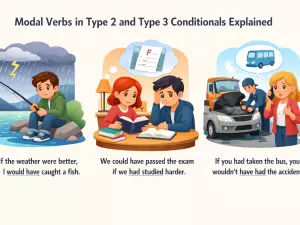
- If + past perfect, ... would have + V3: If I had known, I would have called.
- If + past perfect, ... could have + V3: If we had left earlier, we could have avoided traffic.
- ... might have + V3 if ...: It might have worked if the battery had been charged.
- ... should have + V3 (but ...): I should have checked, but I assumed it was fine.
- ... could have + V3 (instead of ...): You could have emailed instead of waiting.
Frequent learner pitfalls (form and meaning)
- Using the wrong verb form after have: ✅ should have gone ❌ should have went
- Confusing “could have” (possibility) with “must have” (deduction): could have leaves other explanations open; must have presents the speaker’s conclusion as very likely.
- Overusing “should have” for simple past facts: should have adds judgement; for neutral reporting, use past simple. ✅ I missed the bus. (fact) vs. I should have caught the bus. (judgement/regret)
- Mixing time references: keep the “have + V3” part tied to the earlier event, even when the reason is explained in the present.
Example: He might have missed the message, because his phone is off. - Negatives attach to the modal: ✅ might not have seen it, shouldn’t have said it, can’t have done it
In practice, these modal perfect forms let you talk about past decisions and past evidence without rewriting history: you describe what was possible, advisable, or likely, and you show how that imagined version differs from what actually happened.
The meaning of could have when talking about missed possibilities

Could have + past participle is used to look back at the past and say that something was possible, but it did not happen. It often highlights an unrealized option, a different outcome, or a chance that wasn’t taken.
Core form and basic pattern
The structure is:
- Subject + could have + past participle (V3)
- Negative: couldn’t have + past participle
- Question: Could + subject + have + past participle?
Common past participles in this pattern include: gone, done, taken, seen, called, helped, finished, told, bought, left.
What it communicates
- Past possibility that didn’t happen: It was possible to do it, but the person didn’t do it. Example: “I could have called you, but I forgot.”
- A different past outcome was available: Another result was within reach. Example: “We could have won if we had defended better.”
- Missed opportunity (often with mild regret): The speaker notices a lost chance. Example: “You could have applied earlier.”
- Polite criticism or reproach: Softer than “You should have…”, but still points to a better choice. Example: “You could have told me you were running late.”
- Speculation about an unrealized option: The speaker imagines what was possible. Example: “They could have taken a different route.”
Typical contexts and common add-ons
- With “but …” to show the reason it didn’t happen: “I could have helped, but I was out of town.”
- With “if …” to show a condition: “She could have passed if she had studied.”
- With time expressions to emphasize the lost window: “We could have left earlier.”
- With “easily / probably / maybe” to adjust certainty: “He could have easily missed the train.”
Example sentences (missed chances and alternative outcomes)
- “I could have met you after work, but my meeting ran late.”
- “You could have saved a lot of time by taking the highway.”
- “We could have ordered food, but we decided to cook.”
- “She could have asked for help, but she didn’t want to.”
- “They could have arrived on time if they had left at six.”
- “He could have apologized, but he stayed silent.”
- “I could have backed up the files before the update.”
- “You could have checked the address before you left.”
- “We could have booked the tickets earlier; now they’re sold out.”
- “She could have taken the job, but she chose to travel.”
- “I could have warned you, but I thought you already knew.”
- “They could have reduced costs by renegotiating the contract.”
- “He could have finished on Friday, but he kept revising.”
- “You could have sent a message instead of calling.”
- “We could have avoided the argument by talking sooner.”
Common learner errors to avoid
- ✅ “I could have gone.” → ❌ “I could have went.” (Use the past participle, not the past simple.)
- ✅ “She couldn’t have known.” → ❌ “She couldn’t have knew.”
- ✅ “Could you have told me?” → ❌ “Could you had told me?”
- Don’t use it for a real past action that happened; use past simple instead. Example: ❌ “I could have went to the store yesterday.” (If it really happened: “I went to the store yesterday.”)
How should have expresses criticism or regret about past actions
Should have + past participle is used to judge a past decision or action as the wrong choice, or to say that a better action was possible. It often implies “the correct thing didn’t happen” and can sound like mild advice, strong criticism, or personal regret depending on context and tone.
Core pattern and meaning
Form: should have + past participle (V3).
- Meaning: “It was a mistake not to do this” or “This was the better option, but it didn’t happen.”
- Time reference: the past (the opportunity is over).
- Typical use: evaluating choices, pointing out errors, expressing remorse, or giving hindsight advice.
Common usage patterns
- Criticism of someone else’s past action: You should have checked the details before you sent it.
- Regret about your own past action: I should have apologized sooner.
- Hindsight advice (neutral tone): We should have left earlier to avoid traffic.
- With “not” to criticize an action that happened: You shouldn’t have said that in the meeting.
- With “only” to show a missed chance: I should have only booked one night, not three.
- With “never” for strong disapproval: They should never have ignored the warning signs.
- With “just” to soften the judgment: You should have just told me the truth.
- In questions to challenge a past choice: Why did you do that? / Why should you have done that?
Examples (missed obligation vs. wrong action)
- ✅ She should have saved a copy of the file. (She didn’t, and that was a mistake.)
- ✅ We should have brought cash. (We didn’t, and it caused a problem.)
- ✅ I should have listened to your advice. (I didn’t, and I regret it.)
- ✅ You should have called when you arrived. (You didn’t; speaker is unhappy.)
- ✅ They should have followed the instructions. (They didn’t; criticism.)
- ✅ He should have worn a helmet. (He didn’t; negative outcome implied.)
- ✅ I shouldn’t have interrupted her. (I did; I regret it.)
- ✅ You shouldn’t have shared that photo. (You did; criticism.)
- ✅ We shouldn’t have trusted that source. (We did; it was a bad choice.)
- ✅ She shouldn’t have skipped breakfast. (She did; it led to a problem.)
- ✅ They should never have left the door unlocked. (Strong blame.)
- ✅ I should have double-checked the address. (Regret about a preventable error.)
- ✅ You should have asked for clarification. (Missed step that would help.)
- ✅ He shouldn’t have promised something he couldn’t deliver. (Criticism of judgment.)
- ✅ We should have backed up the data before updating. (Hindsight advice.)
Frequent learner errors to avoid
- ❌ You should have went there. → ✅ You should have gone there.
- ❌ I should have to call you. → ✅ I should have called you.
- ❌ She should has done it. → ✅ She should have done it.
- ❌ We should have arrived yesterday (when you mean a general rule). → Use it only when judging a specific past situation.
Because this structure carries judgment, speakers often soften it with context (for example, explaining the difficulty) or strengthen it with words like “really” or “never,” depending on how critical they want to sound.
How might have suggests uncertain past events

Use might have + past participle to talk about a past possibility when you are not sure what really happened. It often appears when you are guessing from limited evidence, considering alternative explanations, or acknowledging that more than one past outcome was possible.
Core pattern and meaning
- Form: might have + past participle (V3) → “might have missed,” “might have forgotten,” “might have left.”
- Main idea: a past event was possible, but the speaker cannot confirm it.
- Typical context: you infer, speculate, or leave room for doubt rather than state a fact.
Common uses
- Guessing about a cause: “The lights are off; they might have gone out.”
- Explaining a mistake: “I might have entered the wrong date.”
- Considering an alternative past: “We might have taken a different route.”
- Softening an accusation: “You might have misunderstood the instructions.”
- Uncertain memory: “I might have met her before, but I’m not sure.”
- Possibility with evidence: “His phone is dead; he might have forgotten to charge it.”
Example sentences (varied situations)
- She might have left early to avoid traffic.
- They might have misread the email.
- I might have put the keys in my jacket pocket.
- He might have fallen asleep during the movie.
- We might have parked on the next street.
- The package might have been delivered to the wrong building.
- The meeting might have started without us.
- She might have taken the last train.
- They might have changed the schedule at the last minute.
- I might have deleted the message by accident.
- He might have been joking when he said that.
- The file might have been saved in a different folder.
- She might have forgotten your name.
- We might have overlooked a detail in the report.
- The restaurant might have closed earlier than usual.
Negatives and questions
- Negative possibility: might not have + V3 → “He might not have seen your call.”
- Question form (less common, often for checking): “Might you have left it on the desk?”
- More natural spoken alternative: “Do you think you might have left it on the desk?”
Frequent learner errors to avoid
- ✅ She might have gone home. ❌ She might have went home.
- ✅ They might have forgotten. ❌ They might have forgot (informal speech exists, but avoid in careful writing).
- ✅ He might not have heard you. ❌ He might haven’t heard you.
- ✅ I might have been late. ❌ I might have was late.
How it differs from “could have” and “should have” (quick guide)
- Might have focuses on uncertainty about what happened (a guess).
- Could have often highlights ability/opportunity in the past (possible because it was feasible).
- Should have expresses expectation, advice, or regret about a past action (a judgment).
Examples comparing these modal forms in everyday communication
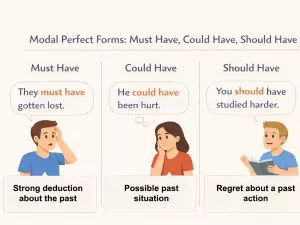
These past modal patterns help you talk about earlier situations with different meanings: missed ability (could have), criticism or advice about the past (should have), and uncertain possibility (might have). The form is consistent: modal + have + past participle (could have done, should have said, might have left).
| Everyday situation | Could have + past participle (ability/option) | Should have + past participle (regret/advice/criticism) | Might have + past participle (possibility/uncertainty) |
|---|---|---|---|
| Missing a bus | I could have taken an earlier bus. | I should have left the house sooner. | The bus might have come early. |
| Forgetting to reply | I could have replied during lunch. | I should have answered your message yesterday. | I might have missed your notification. |
| Losing keys | I could have put them in my jacket pocket. | I should have hung them on the hook. | I might have left them at the office. |
| Late to a meeting | We could have joined by video instead. | We should have checked the time zone. | There might have been an accident on the road. |
| Cooking mistake | I could have used less salt. | I should have tasted it before serving. | I might have added salt twice. |
| Buying a ticket | We could have bought the tickets online. | We should have booked earlier. | The show might have sold out. |
| Small conflict | I could have explained my point more clearly. | I should have stayed calm. | They might have misunderstood my tone. |
| Health and rest | I could have taken a short break. | I should have gone to bed earlier. | I might have caught a cold from someone. |
| Work deadline | I could have asked for help sooner. | I should have started the report last week. | The file might have been corrupted. |
| Travel planning | We could have packed lighter. | We should have checked the weather forecast. | It might have rained overnight. |
| Helping a friend | I could have driven you home. | I should have checked in earlier. | You might have needed support more than you said. |
| Money decision | We could have compared prices first. | We should have saved the receipt. | The store might have charged us twice. |
Quick usage patterns to notice
- Could have often highlights an alternative that was possible but not chosen: “I could have called.” (I had the option.)
- Should have evaluates the past and often implies a mistake: “You should have told me.” (It would have been better.)
- Might have stays uncertain and avoids strong claims: “She might have forgotten.” (It’s one possible explanation.)
- Negative forms follow the same pattern: “couldn’t have finished,” “shouldn’t have said,” “might not have noticed.”
- Questions are common in conversation, especially for guesses or gentle criticism: “Where could I have put it?” / “Should we have called first?” / “Might he have taken the wrong train?”
Common accuracy checks
- ✅ “I should have brought my charger.” → advice/regret about a past choice
- ✅ “I could have brought my charger.” → a past option (not necessarily wrong)
- ✅ “I might have brought my charger.” → uncertainty about whether it happened
- ❌ “I should brought my charger.” → missing “have”
- ❌ “I might have went.” → use the past participle: “might have gone”
How different modal verbs change the interpretation of the past
Past modal patterns use modal + have + past participle to look back and add a “lens” (ability, obligation, possibility, deduction, or regret). The main event stays in the past; the modal tells you how the speaker evaluates it now.
| Past modal form | Core meaning in hindsight | Typical use | Example |
|---|---|---|---|
| could have + past participle | Past ability or opportunity that was possible (often not taken) | Missed chances; “it was possible for me/us to do it” | I could have called, but I didn’t want to interrupt. |
| should have + past participle | Past obligation or best choice (often not done); criticism or regret | Advice after the fact; judging a decision | You should have checked the address before leaving. |
| might have + past participle | Past possibility; uncertainty about what happened or what could have happened | Speculating; explaining a risk or an alternative outcome | We might have missed the train if we’d left later. |
| must have + past participle | Strong logical conclusion about the past | Confident deduction from evidence | She must have forgotten the meeting; she never arrived. |
| may have + past participle | Possible explanation (more neutral/less tentative than “might” in some contexts) | Careful, non-committal guesses | He may have taken the earlier flight. |
| would have + past participle | Hypothetical past result; “this is what would happen” under a condition | Third conditional; imagined outcomes | I would have helped if you’d asked. |
| couldn’t have + past participle | Past impossibility (often a strong denial) | Rejecting an accusation; saying something was not possible | He couldn’t have done it; he was with me all evening. |
| shouldn’t have + past participle | Past action was a mistake; negative judgment | Regret; criticism | I shouldn’t have said that in the meeting. |
Choosing the right modal: what you are “adding” to the past
- Ability/opportunity: use could have when the action was possible at the time. It often implies the action did not happen, but context decides.
- Advice/judgment: use should have to evaluate a past choice as the right one. It commonly signals regret or criticism.
- Uncertain possibility: use might have when you are not sure what happened, or when you are describing a possible past outcome.
- Strong inference: use must have when evidence makes one past explanation very likely.
- Hypothetical result: use would have to describe what was expected to happen in an unreal past situation (usually with an if-clause).
Common patterns and frequent learner issues
- Form check: ✅ should have gone → ❌ should have went
- Pronunciation note: in fast speech, should have / could have often sound like “should’ve” / “could’ve,” which is why “should of” appears in writing (but it is incorrect).
- Could have vs should have: “could” focuses on possibility; “should” adds evaluation. Compare: “I could have emailed” (it was possible) vs “I should have emailed” (it was the better choice).
- Might have vs must have: “might” keeps multiple explanations open; “must” narrows to one main conclusion.
- Negatives shift meaning: shouldn’t have = “it was a mistake,” while couldn’t have = “it was impossible.”
- Questions are common for deductions: “Where is Dan? He might have left early.” / “He must have left early, then.”
- Time references still matter: add time markers to make the past frame clear: “She might have called yesterday,” “They must have arrived by now.”
- Passive is possible when the focus is on the action, not the actor: “The email could have been sent earlier,” “The mistake should have been caught.”
Exercises and practice activities using past modal verb structures
Use these activities to build accuracy with modal + have + past participle and to choose the right meaning: missed obligation (should have), unrealized ability/opportunity (could have), and uncertain possibility (might have). Focus on two steps: (1) pick the modal for the meaning, then (2) pick the correct past participle.
1) Form check: build the structure
- Complete each sentence with the correct form of the verb in parentheses.
- Write the full structure: modal + have + past participle.
- I should have (call) you earlier.
- They might have (forget) about the meeting.
- We could have (take) a taxi, but we walked.
- She should have (tell) the truth.
- He might have (leave) already.
- You could have (ask) for help.
- The package might have (arrive) yesterday.
- I should have (bring) my ID.
- We could have (save) more money.
- She might have (misunderstand) the instructions.
Show answers
- I should have called you earlier.
- They might have forgotten about the meeting.
- We could have taken a taxi, but we walked.
- She should have told the truth.
- He might have left already.
- You could have asked for help.
- The package might have arrived yesterday.
- I should have brought my ID.
- We could have saved more money.
- She might have misunderstood the instructions.
2) Meaning choice: should have vs could have vs might have
Choose the best option based on the intended meaning. Use should have for criticism/regret about a past action, could have for a past possibility/option (often not taken), and might have for an uncertain guess about what happened.
- It’s a pity we didn’t go. We (could have / should have / might have) seen the concert.
- You (should have / could have / might have) apologized; now she’s still upset.
- He isn’t answering. He (should have / could have / might have) fallen asleep.
- I didn’t know your number. I (might have / could have / should have) called you if I had it.
- They (might have / should have / could have) checked the address before leaving; they got lost.
- The lights are off. They (might have / should have / could have) gone out.
- We (could have / might have / should have) taken the earlier train, but we decided to wait.
- You (might have / should have / could have) backed up the files before updating.
- She looks familiar. I (could have / might have / should have) met her at the conference.
- He had the money; he (might have / could have / should have) paid, but he refused.
Show answers
- could have
- should have
- might have
- could have
- should have
- might have
- could have
- should have
- might have
- could have
3) Error correction: fix the pattern
Rewrite each sentence correctly. Watch for common problems: using the base verb instead of the past participle, adding “to,” or mixing meanings.
- ❌ I should have went home earlier.
- ❌ She could have to finish the report yesterday.
- ❌ They might have went to the wrong office.
- ❌ You should have to tell me.
- ❌ We could have bought it, but we didn’t had enough time.
- ❌ He might has forgotten.
- ❌ I should have seen him yesterday, but I was sick. (meaning: obligation, not plan)
- ❌ She could have been late because she missed the bus. (meaning: uncertain guess)
Show answers
- ✅ I should have gone home earlier.
- ✅ She could have finished the report yesterday.
- ✅ They might have gone to the wrong office.
- ✅ You should have told me.
- ✅ We could have bought it, but we didn’t have enough time.
- ✅ He might have forgotten.
- ✅ I should have seen him yesterday, but I was sick. (or: I should have met him yesterday.)
- ✅ She might have been late because she missed the bus.
4) Guided production: prompts for your own sentences
Create your own examples using the cues. Aim for one sentence per cue, and keep the meaning clear (regret, missed option, or uncertainty).
- Regret about a mistake at work/school → use should have + past participle.
- A better travel choice you didn’t take → use could have + past participle.
- A guess about why someone was late → use might have + past participle.
- A missed chance to speak to someone → use could have + past participle.
- A criticism about not preparing → use should have + past participle.
- An uncertain explanation for a strange noise → use might have + past participle.
- A situation where you had the ability but didn’t act → use could have + past participle.
- A past decision you want to change → use should have + past participle.
- An uncertain guess about where an item went → use might have + past participle.
- A polite reflection on what was possible → use could have + past participle.
5) Mini-dialogue completion (context controls meaning)
- Complete each blank with could have, should have, or might have (plus a suitable past participle).
- A: Why is the door unlocked?
B: Someone __________ (forget) to lock it. - A: I missed the deadline.
B: You __________ (start) earlier. - A: The trip was expensive.
B: We __________ (book) in advance. - A: Where’s my phone?
B: You __________ (leave) it in the car. - A: We walked in the rain for 40 minutes.
B: You __________ (bring) an umbrella. - A: I didn’t know you needed help.
B: You __________ (tell) me. - A: The meeting room is empty.
B: They __________ (cancel) it. - A: I didn’t apply for the scholarship.
B: You __________ (apply); you were eligible.
Show answers
- might have forgotten
- should have started
- could have booked
- might have left
- should have brought
- should have told
- might have canceled
- could have applied