Ellipsis in Coordinate Clauses: When Words Can Be Omitted

 This article explains ellipsis in grammar, focusing on how it works in coordinated structures with and, or, or but. It covers safe omission of words, common patterns, clarity benefits, typical mistakes, and practice exercises.
In sentences connected by words like and or but, we often omit repeated words to keep our language clear and concise. This process, known as ellipsis, streamlines both speech and writing, making communication more efficient and natural. By avoiding unnecessary repetition, ellipsis not only prevents redundancy but also helps sentences flow better, allowing readers and listeners to focus on the main ideas without distraction. This simple linguistic technique is a common and useful feature in everyday English.
What Ellipsis Means in Grammar
In grammatical terms, ellipsis refers to the omission of one or more words that are understood in context and therefore do not need to be stated. This technique helps make sentences less repetitive and more concise, especially in situations where the omitted elements can be easily inferred by the reader or listener. Typically, ellipsis occurs in coordinated structures—such as sentences joined by "and" or "but"—where repeating the same words would feel redundant.
How Ellipsis Functions in Sentences
Elliptical constructions allow speakers and writers to avoid unnecessary repetition. For example, instead of saying, "She likes coffee and she likes tea," you can simply say, "She likes coffee and tea." The subject and verb are dropped in the second clause because their meaning is clear from the first.
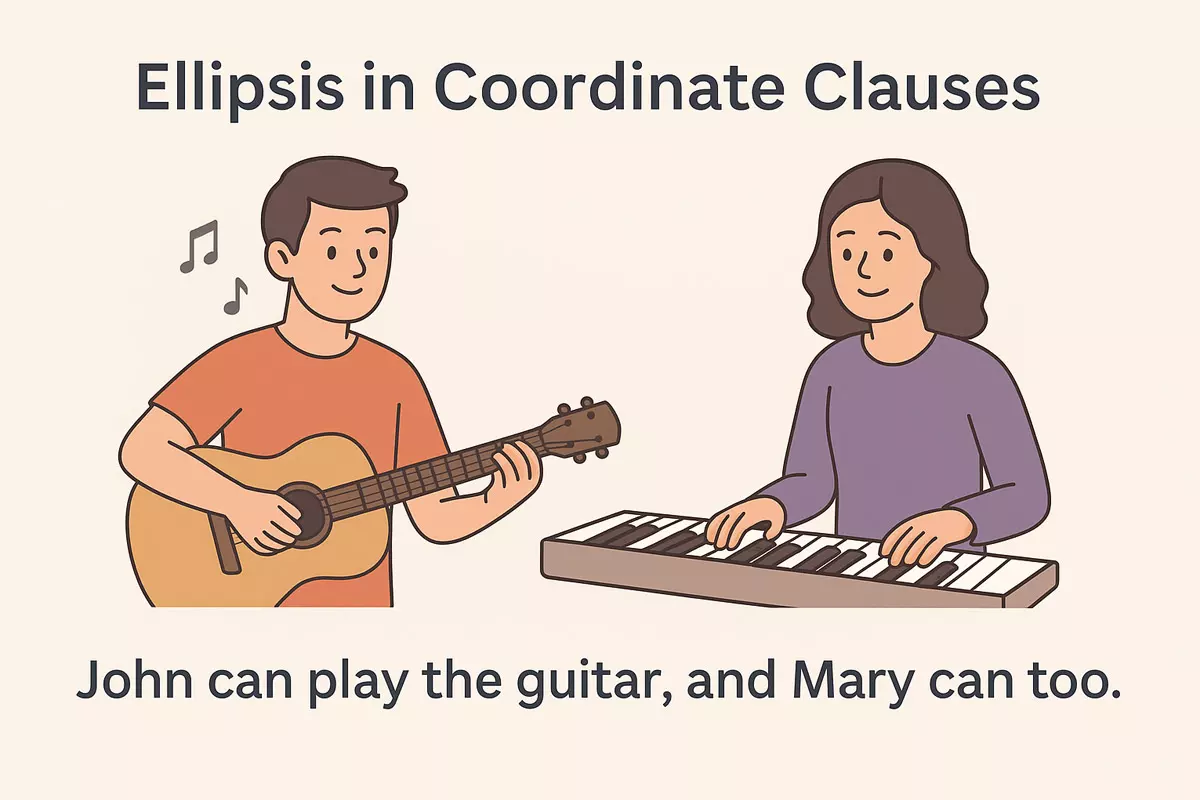
- John can play the guitar, and Mary can play the guitar too → John can play the guitar, and Mary can too.
- Sam ordered pizza, and Anna ordered pasta → Sam ordered pizza, and Anna pasta.
- He loves hiking, but she does not love hiking → He loves hiking, but she does not.
- I haven’t finished my work, but you haven’t finished your work → I haven’t finished my work, but you haven’t.
- They will arrive on Monday, and we will arrive on Tuesday → They will arrive on Monday, and we on Tuesday.
- Lisa can swim, and Tom can swim as well → Lisa can swim, and Tom as well.
- I want tea, and you want tea → I want tea, and you too.
- She went to Paris, and I went to Paris too → She went to Paris, and I too.
- He could have called, but he did not call → He could have called, but he did not.
- We visited the museum, and they visited the museum as well → We visited the museum, and they as well.
Types of Ellipsis in Coordination
Several forms of ellipsis are common in coordinated clauses. These include:
- Verb phrase ellipsis: Omitting the verb phrase when it is identical in both clauses.
- Noun phrase ellipsis: Dropping a repeated noun phrase in the second clause.
- Subject ellipsis: Leaving out the subject when it matches the previous clause.
- Auxiliary ellipsis: Omitting auxiliary verbs that are already implied.
Benefits of Using Ellipsis
Using ellipsis in coordinate clauses streamlines expression and avoids unnecessary repetition. This not only improves sentence flow but also makes communication more efficient and natural. Readers and listeners rely on context to fill in the gaps, which is why this structure works well in both spoken and written language.
Ellipsis in Coordinated Structures
When sentences are joined by conjunctions like "and" or "but," it's common to omit repeated words or phrases to avoid redundancy. This process, known as ellipsis, helps keep communication concise and natural. The omitted material is typically recoverable from the surrounding context, allowing speakers and listeners to understand the intended meaning without restating every element.
Common Patterns of Omission
Writers and speakers often leave out verbs, subjects, or even entire clauses after a conjunction. Here are some frequent ways ellipsis appears in coordinated clauses:
- Omitting the verb: "She likes tea, and he coffee." (The verb "likes" is missing in the second clause.)
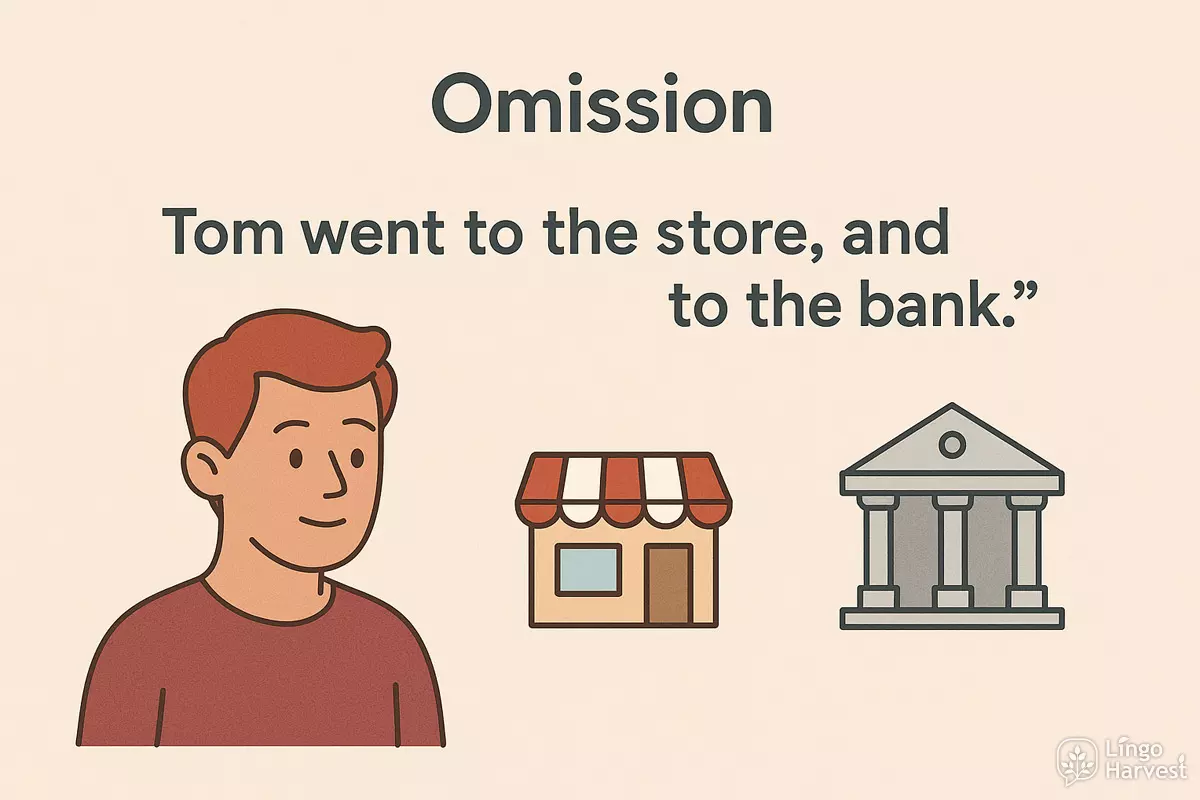
- Skipping the subject: "Tom went to the store, and to the bank." (The subject "Tom" is omitted in the second part.)
- Leaving out auxiliary verbs: "Will you go, or stay?" (The auxiliary "will" is omitted in the second clause.)
- Dropping both subject and verb: "Some ate pizza, others salad." (Both subject and verb are omitted in the second clause.)
- Coordinating prepositional phrases: "In the morning and (in the) evening, he jogs."
- Using ellipsis with negatives: "I don't like apples, nor (do I like) oranges."
- Omitting repeated objects: "She read the book and (she read) the article."
- Leaving out full clauses: "He wanted to win, but (he) didn't."
- Skipping repeated adjectives: "The room was large and (was) bright."
- Ellipsis in questions: "Who called and (who) left this note?"
Types of Ellipsis in Coordination
Different forms of omission can occur depending on which elements are shared between clauses. Some of the most discussed types include:
- Gapping: Typically, the verb is missing in the second clause ("Anna plays guitar and Ben drums.")
- Stripping: Only one constituent remains after omission, often with an adverb or negative ("He laughed, and so did she.")
- Verb Phrase Ellipsis: The verb phrase is omitted ("She has eaten, and he has, too.")
- Null Complement Anaphora: The complement of a verb is omitted and understood from context ("She can sing, and he can, too.")
Comparison of Ellipsis Types in Coordination
| Type | Example | Omitted Element | Typical Context |
|---|---|---|---|
| Gapping | Mary eats apples and John oranges. | Main verb | Subject and object differ |
| Stripping | He went home, and so did I. | All but one constituent | Short responses or emphasis |
| Verb Phrase Ellipsis | She will sing, and he will too. | Verb phrase | Auxiliary verbs present |
| Null Complement Anaphora | She asked, but nobody answered. | Verb complement | Shared context, often questions |
When Ellipsis is Acceptable
Omitting elements is generally acceptable when the meaning remains clear and there is no ambiguity. However, in some cases, leaving out too much can confuse the reader or listener. The context, the structure of the sentence, and shared knowledge between speakers all play a role in determining whether ellipsis works smoothly. In summary, ellipsis in coordinated clauses streamlines language, making it more efficient and less repetitive. Mastery of these patterns can help both writers and speakers produce clearer, more natural sentences.
When Words Can Be Safely Omitted
Ellipsis in coordinate clauses is common when the omitted elements are easily understood from context. Native speakers often leave out repeated subjects, verbs, or objects, especially if these elements would otherwise appear identically in both parts of the sentence. This helps avoid redundancy and keeps communication natural and efficient.
Typical Situations for Ellipsis
Elliptical constructions are most natural when there's no risk of ambiguity. The missing words are "recoverable"—that is, listeners or readers can effortlessly supply the omitted information from what has already been said. Here are some typical cases:
- Repeated subjects: Anna likes tea, and (she) loves coffee.
- Shared verbs: He plays the guitar, and (he plays) the piano.
- Common objects: She bought apples and (she bought) bananas.
- Identical auxiliaries: Tom can swim, and (Tom can) dive.
- Parallel predicates: The weather was cold, but (the weather was) sunny.
- Repeated prepositions: We walked in the park and (in) the forest.
- Coordinated adjectives: The dress is blue and (the dress is) beautiful.
- Shared infinitives: She wants to sing and (to) dance.
- Omitted modals: You should call, or (you should) write.
- Identical complements: He considers her smart and (he considers her) capable.
- Repeated adverbs: She left quickly and (she left) quietly.
- Coordinated noun phrases: They visited Paris and (they visited) Rome.
- Shared direct and indirect objects: Give him the book and (give him) the pen.
- Identical clauses: She said she would come, and (she said) she might stay.
- Parallel participles: He came running and (he came) shouting.
When Not to Omit Words
Ellipsis is less effective if it leads to confusion or if the omitted elements differ between clauses. In such cases, clarity is more important than brevity. For example, omitting words is risky when two different verbs or subjects are involved, or when the structure of the clauses is not parallel.
Comparing Acceptable and Unacceptable Ellipsis
| Acceptable Ellipsis ✅ | Unacceptable Ellipsis ❌ |
|---|---|
| Lisa cooked and (Lisa) cleaned. | Lisa cooked and (John) cleaned. |
| He can sing and (he can) dance. | He can sing and (he will) dance. |
| They visited London and (they visited) Paris. | They visited London and (she visited) Paris. |
| We will win or (we will) lose. | We will win or (they might) lose. |
Common Patterns with And/Or/But
Ellipsis often appears in sentences joined by coordinating conjunctions such as "and," "or," and "but." In these structures, repeated elements—subjects, verbs, or objects—are frequently omitted to avoid redundancy. Recognizing these omissions helps readers and writers maintain clarity while keeping sentences concise.
Typical Omitted Elements
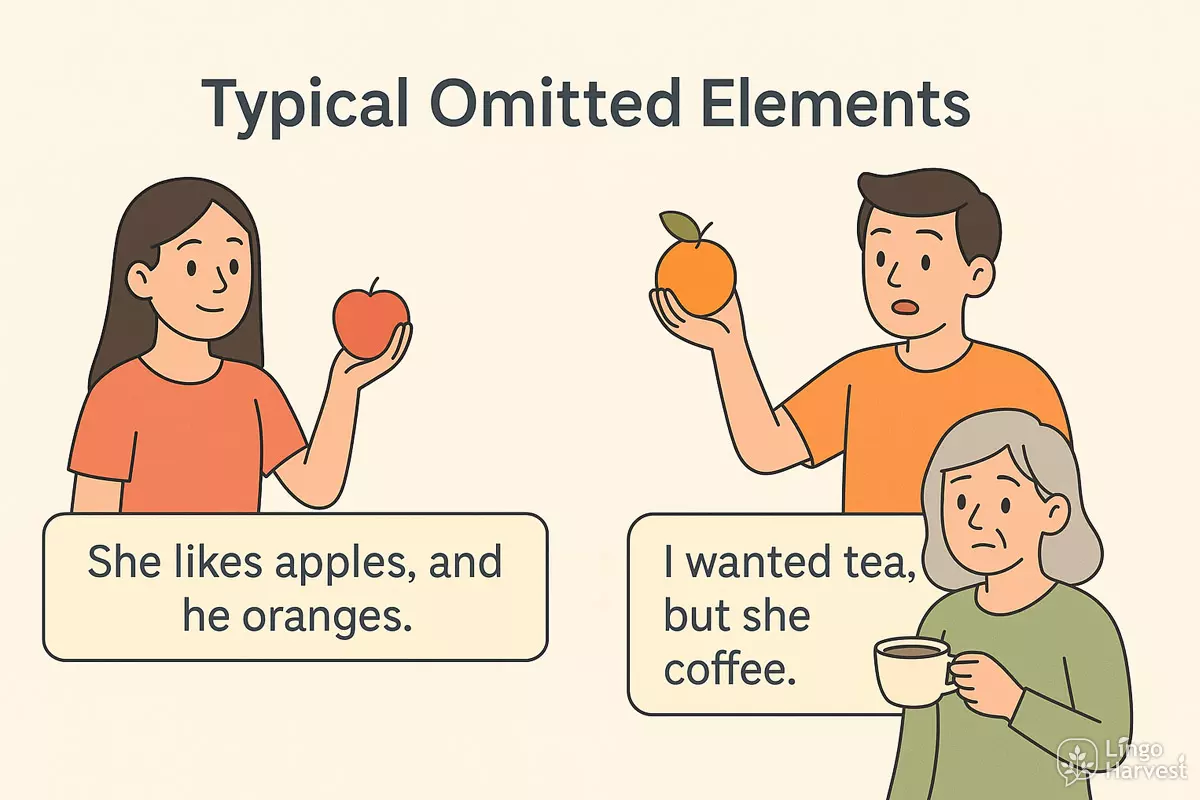
Writers commonly leave out repeated verbs or subjects when the meaning stays clear. For instance, after a conjunction, the verb or noun from the first clause is usually dropped in the second if it's understood from context.
- She likes apples, and he likes oranges. → She likes apples, and he oranges.
- They can come, or we can stay here. → They can come, or we stay here.
- I wanted tea, but she wanted coffee. → I wanted tea, but she coffee.
- He will call, and I will text.
- You may leave early, or you may wait for the meeting.
- We should eat now, but we should not rush.
- She brought gifts, and she brought snacks too.
- He reads novels, or he reads magazines.
- They washed the car, and they washed the bike.
- I could stay here, or I could go home.
- We saw the movie, but we did not see the ending.
- She finished first, and she finished fastest.
- He can sing, or he can dance.
- You want pizza, but you want salad too.
- I will help, or I will watch.
- She went home, and she went to bed.
- He must hurry, or he must wait.
- They played chess, but they did not play well.
Patterns by Conjunction
The choice of conjunction can influence which parts are omitted:
- And: Often omits repeated verbs or subjects when combining similar actions or items.
- Or: Used for choices, so ellipsis typically drops the repeated auxiliary or main verb.
- But: Contrasts ideas, and omits shared elements to highlight differences.
| Full Form | With Ellipsis |
|---|---|
| She likes tea, and he likes coffee. | She likes tea, and he coffee. |
| We can stay here, or we can leave. | We can stay here, or leave. |
| I wanted to go out, but I had to work. | I wanted to go out, but had to work. |
| He will bring snacks, and she will bring drinks. | He will bring snacks, and she drinks. |
Practical Guidelines
When using ellipsis in coordination:
- Ensure the omitted words are easily understood from context.
- Do not drop elements if it causes confusion or ambiguity.
- Ellipsis is more common in informal or conversational writing, but can appear in formal contexts too.
By observing these conventions, sentences remain both efficient and clear, making communication smoother for both writers and readers.
How Ellipsis Improves Clarity and Flow
Omitting repeated words or phrases in coordinate clauses streamlines sentences, making them easier to read and understand. Instead of restating information, ellipsis allows writers and speakers to focus attention on what’s new or different in each clause. This technique not only reduces redundancy but also helps maintain a natural, conversational rhythm in both spoken and written language.
Benefits of Using Ellipsis in Coordinate Structures
- Reduces unnecessary repetition: By omitting repeated elements, sentences become more concise.
- Highlights key differences: Ellipsis makes contrasts and comparisons clearer by foregrounding only the changing parts.
- Improves readability: Shorter, cleaner sentences are quicker to process.
- Enhances stylistic flow: The sentence moves smoothly from one idea to the next without awkward pauses or clutter.
- Reflects natural speech patterns: Native speakers often drop repeated words, making ellipsis feel more authentic and spontaneous.
Examples of Ellipsis in Coordinate Clauses
Consider these pairs of sentences, with and without ellipsis:
- She likes tea, and she likes coffee. → She likes tea and coffee.
- John can play the guitar, and John can sing. → John can play the guitar and sing.
- We should buy apples, or we should buy oranges. → We should buy apples or oranges.
- They finished the report, but they didn't finish the presentation. → They finished the report but not the presentation.
- Maria will call you, and Maria will email you. → Maria will call and email you.
- He has visited Paris, and he has visited London. → He has visited Paris and London.
- The train was late, and the bus was late. → The train and the bus were late.
- She can cook, and she can bake. → She can cook and bake.
- We could stay home, or we could go out. → We could stay home or go out.
- He didn't read the book, and he didn't watch the movie. → He didn't read the book or watch the movie.
Comparing Sentences With and Without Ellipsis
| Full Sentence (No Ellipsis) | With Ellipsis |
|---|---|
| Sarah finished her homework, and Sarah started dinner. | Sarah finished her homework and started dinner. |
| We can visit the museum, or we can visit the park. | We can visit the museum or the park. |
| Tom didn’t call, but Tom sent a message. | Tom didn’t call but sent a message. |
| The cat chased the mouse, and the cat caught it. | The cat chased and caught the mouse. |
| I have cleaned the kitchen, and I have cleaned the bathroom. | I have cleaned the kitchen and the bathroom. |
When Ellipsis Might Not Be Appropriate
While ellipsis brings clarity and efficiency, it’s important to use it where the omitted words are truly understood from context. In sentences where omission causes ambiguity or confusion, it’s better to repeat the necessary information. Always consider the audience and the potential for misunderstanding before dropping repeated elements. Ellipsis in coordinate clauses, when used thoughtfully, can make communication smoother, more direct, and easier to follow.
Typical Mistakes to Avoid
When using ellipsis in coordinate clauses, it’s easy to create confusion or ambiguity if you’re not careful. Many writers omit too much or too little, leading to sentences that are hard to understand or grammatically incorrect. Here are some common missteps and how to sidestep them.
Omitting Essential Elements
Leaving out words that are necessary for clarity or grammatical correctness can make your sentence ambiguous. For example, if the main verb is missing in the second clause and there’s no clear parallel, your reader may be left guessing.
- Incorrect: She likes apples, and oranges. (Is "likes" implied for "oranges"?)
- Correct: She likes apples and (she likes) oranges.
Overusing Ellipsis
Too much omission can result in sentences that sound clipped or unnatural. Coordinate clauses often benefit from some repetition to maintain rhythm and clarity.
- Incorrect: He can play the guitar, she the piano, they drums.
- Better: He can play the guitar, she can play the piano, and they can play the drums.
Ambiguous References
If the omitted words could refer to more than one part of the sentence, the meaning may become unclear. Always check that the reader can easily reconstruct the missing elements.
Incorrect Parallelism
Coordinate clauses should match in structure. If the ellipsis causes the clauses to become unbalanced, revise the sentence for symmetry.
| Problematic Example | Improved Version |
|---|---|
| Tom likes pizza, and Jerry pasta. | Tom likes pizza, and Jerry likes pasta. |
| She went to Paris, he to Rome. | She went to Paris, and he went to Rome. |
| The manager approved the budget, the director the plan. | The manager approved the budget, and the director approved the plan. |
| We wanted to visit the museum, they the park. | We wanted to visit the museum, and they wanted to visit the park. |
List of Frequent Pitfalls
- Omitting the subject when it’s not clear from context
- Leaving out auxiliary verbs needed for tense or aspect
- Forgetting to repeat negative constructions if necessary
- Not matching the structure of coordinate elements
- Making the sentence too terse, causing unnatural flow
- Assuming shared knowledge that the reader may not have
- Using ellipsis with unfamiliar or complex sentence patterns
- Omitting prepositions that are not recoverable from context
- Applying ellipsis across clauses of different grammatical types
- Overloading the sentence with too many omitted elements
- Creating unintended double meanings through omission
- Ignoring punctuation that clarifies the structure
- Failing to check the sentence aloud for clarity
- Using ellipsis in formal writing where it may seem too informal
- Overlooking the need to repeat pronouns for clarity
- Removing connectors that are necessary for logical flow
- Not revising after applying ellipsis to ensure coherence
- Assuming that ellipsis is always shorter and better—sometimes repetition is clearer
By keeping these common errors in mind, you can use omission gracefully in coordinate clauses, ensuring your meaning remains clear and your writing polished.
Practice: Complete or Reduce Coordinated Sentences
Understanding when to omit repeated elements in coordinate clauses is essential for clear and natural English. In this section, you'll explore how to recognize when words can be left out (ellipsis) and when full forms are required. Consider how coordination works in real sentences and practice both expanding reduced sentences and reducing complete ones.
Identifying Ellipsis in Coordination
Ellipsis often occurs in sentences joined by "and," "or," or "but," where repeated subjects, verbs, or objects can be omitted for brevity. For example:
- She likes tea and he likes coffee. → She likes tea and he, coffee.
- Maria read the book, and Tom did too. → Maria read the book, and Tom too.
- We can stay or (we can) leave.
Notice how readers must supply the missing words mentally.
Practice: Expand or Reduce the Sentences
Try to either add the omitted words to make the sentences complete, or remove repeated elements to make them more concise. Decide which form is most natural for each case.
- John plays the guitar and Mary the piano.
- I have finished my homework, but he hasn't.
- You can call me or (you can) email me.
- Sarah wants to visit Paris and Tom London.
- He will go to the store, and I will (go to the store) too.
- We watched the movie and (we) enjoyed it.
- She speaks French, and her brother (speaks) German.
- They bought apples and (they bought) oranges.
- The girls danced and the boys sang.
- Anna cooked dinner, and Ben (cooked) dessert.
Show answers
- John plays the guitar and Mary plays the piano. / John plays the guitar and Mary the piano.
- I have finished my homework, but he has not finished his homework. / ...but he hasn't.
- You can call me or you can email me. / You can call me or email me.
- Sarah wants to visit Paris and Tom wants to visit London. / ...and Tom London.
- He will go to the store, and I will go to the store too. / ...and I will too.
- We watched the movie and we enjoyed it. / ...and enjoyed it.
- She speaks French, and her brother speaks German. / ...and her brother German.
- They bought apples and they bought oranges. / ...and oranges.
- The girls danced and the boys sang. (Already complete; not reduced.)
- Anna cooked dinner, and Ben cooked dessert. / ...and Ben dessert.
Patterns of Omission in Coordinate Clauses
Certain patterns frequently allow or require ellipsis. Here are some common forms:
- Subject ellipsis: "Mary likes apples and (Mary likes) oranges."
- Verb ellipsis: "She can play the violin; he (can play) the piano."
- Object ellipsis: "She bought a book and (she bought) a pen."
- Auxiliary verb ellipsis: "He has finished, and she (has finished) too."
- Predicate ellipsis: "Tom ate the cake, and Anna (ate the cake) too."
- Infinitival ellipsis: "I want to go, but not (to go) alone."
- Modal ellipsis: "You may stay or (may) leave."
- Negation ellipsis: "Some students passed and some (did) not."
- Adverbial ellipsis: "She left early, and he (left) late."
- Comparative ellipsis: "She is taller than he (is tall)."
Structured Comparison: Full vs. Reduced Coordination
Below is a table comparing complete and reduced forms in coordinate clauses. Notice how ellipsis streamlines the sentence without losing meaning.
| Complete Form | Reduced (with Ellipsis) |
|---|---|
| Lisa ate dinner and Lisa washed the dishes. | Lisa ate dinner and washed the dishes. |
| He can sing and he can dance. | He can sing and dance. |
| We have visited Rome and we have visited Paris. | We have visited Rome and Paris. |
| Michael saw the film, and Anna saw the film too. | Michael saw the film, and Anna too. |
| I will call or I will write. | I will call or write. |
Try It Yourself
Challenge yourself: take a few sentences from your own writing or speech. Can you spot opportunities for ellipsis, or do you need to restore missing information for clarity? Practicing both expansion and reduction will help you recognize natural patterns in English coordination.