Using Modal Verbs in Business Communication

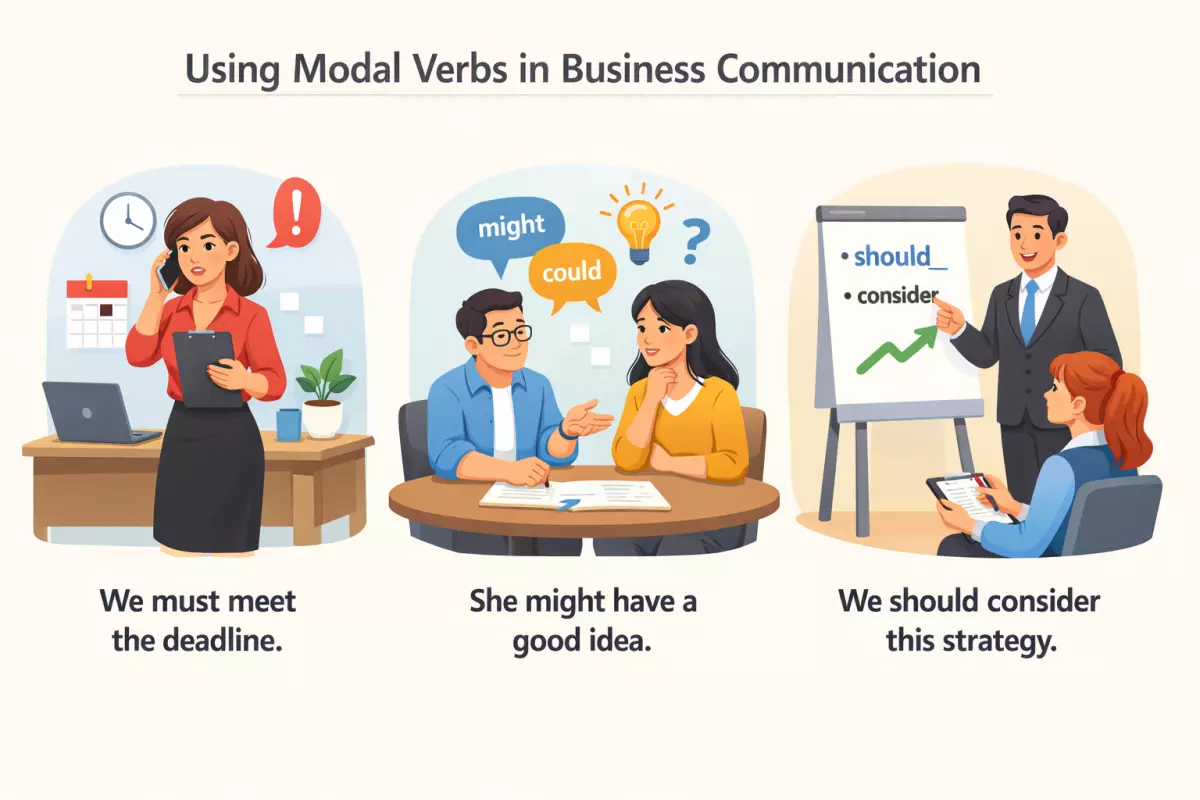 Learn how modal verbs keep your workplace tone professional. It covers common modals for proposing ideas, sample meeting phrases, making polite cooperative requests, softening instructions or feedback, choosing modals by context, and practice exercises to build fluency.
- How modal verbs help maintain a professional tone at work
- Common modal verbs used when proposing ideas or solutions
- Examples of modal expressions used in meetings and discussions
- How modal verbs make requests sound cooperative and polite
- Situations where modal verbs soften instructions or feedback
- How professionals adjust modal choice depending on context
- Exercises and practice activities with modal verbs in workplace communication
Modal verbs shape the tone of workplace communication, so choosing the right one helps your message land well. Switching from can to could can make a request sound more polite, while moving from must to should can keep guidance firm without sounding harsh. This article explains how to use these forms in real situations, including emails, meetings, and negotiations.
How modal verbs help maintain a professional tone at work
Modal verbs help you sound clear, respectful, and appropriately confident in workplace messages. They let you adjust how direct a request feels, how certain a statement sounds, and how firmly you set expectations—without changing the core meaning.
Use modals to choose the right level of directness
In business writing, the goal is usually “firm but polite.” Modals give you a sliding scale from soft suggestions to clear obligations. Compare how the modal changes the tone while the task stays the same:
- Soft request: “Could you share the updated figures?”
- Neutral request: “Can you share the updated figures?”
- Polite directive: “Please, could you share the updated figures by 3 PM?”
- Expectation: “You should share the updated figures by 3 PM.”
- Requirement: “You must share the updated figures by 3 PM.”
Common patterns that sound professional
These structures are widely used in emails, chats, and meeting notes because they are efficient and courteous. Use them as templates and swap in your own verb and details.
- Could you + base verb: “Could you confirm the attendee list?”
- Would you + base verb: “Would you review the draft before we send it?”
- Can we + base verb (collaborative): “Can we align on the timeline today?”
- May I + base verb (formal permission): “May I propose an alternative approach?”
- Would it be possible to + base verb: “Would it be possible to move the call to Thursday?”
- Could we + base verb (soft suggestion): “Could we simplify the approval steps?”
- We should + base verb (recommendation): “We should document the decision in the ticket.”
- We may need to + base verb (cautious planning): “We may need to extend the testing window.”
- We might + base verb (low certainty): “We might see delays if the vendor responds late.”
- We can + base verb (capability/option): “We can deliver a summary by end of day.”
- We could + base verb (alternative): “We could run a pilot with two teams first.”
- Should we + base verb? (invite input): “Should we escalate this to Legal?”
- Would you mind + -ing (very polite): “Would you mind forwarding the invoice?”
- Could you please + base verb (polite emphasis): “Could you please add your comments in the document?”
Match the modal to the message type
Professional tone depends on whether you are requesting, recommending, or setting a rule. The modal you pick signals that intent.
- Requests: prefer could / would for a respectful ask; use can for quick, informal coordination.
- Recommendations: use should to advise without sounding authoritarian: “We should validate the numbers before publishing.”
- Rules and non-negotiables: use must sparingly and only when it is truly mandatory: “All expenses must be submitted by month-end.”
- Permission and formality: use may when you want a more formal register: “You may proceed once Finance approves.”
- Uncertainty and risk: use might / may to avoid overpromising: “This may impact the release date.”
- Offers and support: use can / could: “I can jump on a quick call,” “I could draft the first version.”
Avoid common tone problems
Small modal choices can make a message sound abrupt, unclear, or overly forceful. These adjustments keep the wording firm while staying professional.
- ❌ “Send me the file.” → ✅ “Could you send me the file?”
- ❌ “You must review this today.” → ✅ “Could you review this today?” (or “Please review this today” if it is truly required)
- ❌ “This will be done tomorrow.” → ✅ “This should be done tomorrow” (target) / “This will be done tomorrow” (only if confirmed)
- ❌ “We can’t do that.” → ✅ “We may not be able to do that due to X” (adds reason and reduces bluntness)
- ❌ “You should do this.” (to a senior stakeholder) → ✅ “We could consider doing this” / “Would you be open to doing this?”
When you choose modals deliberately, your writing signals respect, precision, and good judgment. That combination is what keeps workplace communication smooth, especially when deadlines, priorities, and authority levels differ.
Common modal verbs used when proposing ideas or solutions

When you put forward a plan at work, modal verbs help you control how strong, cautious, or collaborative your suggestion sounds. They also make it easier to signal feasibility, permission, obligation, and predicted outcomes without sounding absolute.
Core patterns to use
- Modal + base verb: “We could reduce costs by renegotiating the contract.”
- Modal + be + -ing (for ongoing actions): “We could be missing a step in onboarding.”
- Modal + have + past participle (for past possibilities/feedback): “We could have communicated the timeline earlier.”
- Modal question forms (to invite input): “Could we pilot this with one team first?”
- Negative modals (to flag constraints): “We can’t commit to Friday without final approval.”
Modal verbs and how they shape proposals
- Could (options, low-pressure suggestions): “We could start with a two-week trial.” / “Could we align on success metrics first?”
- Can (practical ability, immediate feasibility): “We can reuse the existing template to save time.”
- May (formal possibility, cautious prediction): “This change may improve response times.”
- Might (more tentative possibility, risk-aware tone): “It might be worth testing this with a small group.”
- Should (recommendation, professional guidance): “We should document the handover process to avoid gaps.”
- Would (polite proposals, expected outcomes, hypotheticals): “Would it help if we shared a weekly status summary?” / “This would reduce back-and-forth.”
- Will (firm commitment or confident prediction): “I will draft the first version by Thursday.” / “This will simplify approvals.”
- Must (non-negotiable requirement; use carefully): “We must meet the compliance deadline.”
- Shall (formal offers/scheduling, less common in modern business): “Shall we review the proposal on Monday?”
- Need to (necessity; often softer than “must”): “We need to confirm the budget before we proceed.”
- Ought to (gentle recommendation; slightly formal): “We ought to clarify ownership for each task.”
Choosing the right level of strength
- To sound collaborative, prefer “could” and “would”: “Could we map the risks first?” “Would you be open to a short pilot?”
- To give clear direction, use “should” for recommendations and “need to” for necessities: “We should standardize the intake form.” “We need to agree on scope.”
- To avoid overpromising, use “may/might” for uncertain outcomes: ✅ “This may reduce churn.” ❌ “This will reduce churn.” (if not proven)
- To commit to actions, use “will” with owners and dates: “I will send the revised deck by 3 pm.”
- To signal constraints, use negatives with a reason and a next step: “We can’t finalize today; we can review after legal signs off.”
Examples of modal expressions used in meetings and discussions
In meetings, modal verbs help you manage tone: they let you propose ideas, ask for input, set expectations, and handle disagreement without sounding abrupt. The patterns below show common ways to combine modals with reporting verbs, question forms, and softeners such as “perhaps” or “a bit.”
Common patterns and ready-to-use lines
- Polite requests (could / would): “Could you walk us through the numbers?” / “Would you share the latest timeline?”
- Asking for permission (may / could): “May I add one point before we move on?” / “Could I jump in with a quick question?”
- Making suggestions (could / might): “We could run a pilot in one region first.” / “We might consider a phased rollout.”
- Offering options (can / could): “We can proceed today, or we can wait for the final sign-off.”
- Softening disagreement (might / could): “That might be risky given the deadline.” / “We could look at an alternative approach.”
- Checking understanding (can / could): “Can I confirm what success looks like here?” / “Could you clarify the priority order?”
- Inviting participation (could / would): “Could we hear from Sales on this?” / “Would anyone like to add context?”
- Setting expectations (should): “We should align on scope before we estimate effort.”
- Giving recommendations (should / ought to): “We should document the decision and owners.” / “We ought to involve Legal early.”
- Stating ability or capacity (can / can’t): “We can deliver by Friday if requirements stay stable.” / “We can’t commit until we confirm resources.”
- Expressing necessity (must / have to): “We must meet the compliance deadline.” / “We have to update the client by end of day.”
- Reducing force with hedges (might / could + adverbs): “We might need a bit more time.” / “We could possibly simplify the workflow.”
- Discussing likelihood (may / might / will): “This may impact support volume.” / “It might take longer than planned.” / “It will require coordination across teams.”
- Conditional planning (would): “If we delay the launch, we would need a revised comms plan.”
- Making commitments carefully (will / can): “I’ll send the notes right after the call.” / “I can take the action item and report back tomorrow.”
- Signaling limits (can only / can’t): “We can only approve the budget after Finance reviews it.”
- Diplomatic refusals (can’t / won’t + reason): “We can’t change the scope today because the contract is fixed.” / “We won’t be able to support that without additional headcount.”
- Keeping the meeting moving (shall / could): “Shall we park this and return to it at the end?” / “Could we take this offline and sync after?”
Quick usage notes to avoid common misfires
- Use “could” to sound less directive than “can”: ✅ “Could you send the draft?” → softer than “Can you send the draft?”
- Reserve “must” for true non-negotiables: Overuse can sound inflexible; “have to” often feels more neutral in discussion.
- Prefer “should” for guidance, not orders: “We should review risks” invites alignment; it’s less forceful than “We must review risks.”
- Use “might” when you are not fully certain: It signals openness to new information and reduces over-commitment.
How modal verbs make requests sound cooperative and polite

In business writing and meetings, modal verbs help you ask for action without sounding like you are issuing an order. They soften the force of an imperative, give the other person room to respond, and signal respect for time, priorities, and constraints. The result is a request that feels collaborative rather than demanding.
Core patterns that reduce pressure
- Modal + base verb: “Could you review this?” “Would you confirm receipt?”
- Modal + you + possibly (adds extra softening): “Could you possibly send the latest figures?”
- Modal + we (shares responsibility): “Could we align on the timeline?” “Should we schedule a quick check-in?”
- Modal + be able to (focuses on feasibility): “Would you be able to join at 3 pm?”
- Modal + mind + -ing (polite permission-style request): “Would you mind forwarding this to Legal?”
- Question form instead of imperative: “Can you…” / “Could you…” instead of “Do this.”
- Reason + modal request (adds context, not pressure): “To finalize the report, could you approve the draft?”
- Time window + modal (sets expectations gently): “Could you send it by Thursday?”
Choosing the right modal for the relationship and situation
- Can: neutral and direct for routine requests with close colleagues. “Can you share the deck?”
- Could: more tentative; good for cross-team requests or when you are asking for extra effort. “Could you take a look today?”
- Would: courteous and professional; common in email. “Would you please confirm the attendee list?”
- Will: more assertive; use when roles are clear and the action is expected. “Will you send the signed copy?”
- May: formal permission language; useful when requesting approval or access. “May I proceed with the vendor onboarding?”
- Might: very soft; helpful when proposing rather than requesting. “Might we revisit the scope?”
- Should: suggestion with a light obligation; use carefully to avoid sounding corrective. “Should we loop in Finance?”
Polite request formulas you can reuse
- “Could you + verb + [object], please?”
- “Would you + verb + [object] when you have a moment?”
- “Would you be able to + verb + [object] by [time]?”
- “Could we + verb + [next step] to keep this moving?”
- “Can you + verb + [object] and let me know if anything blocks you?”
- “May I + verb + [action] once you approve?”
- “Would you mind + -ing + [action]?”
- “Could you please + verb + [object]? If not, what timing works?”
- “Would it be possible to + verb + [action] this week?”
- “Could you help by + -ing + [task]?”
- “Could you confirm whether + clause?”
- “Would you clarify + noun phrase?”
Common tone issues and cleaner alternatives
- ❌ “Send this today.” → ✅ “Could you send this today?”
- ❌ “You need to respond ASAP.” → ✅ “Could you respond by EOD if possible?”
- ❌ “I want this done now.” → ✅ “Would you be able to prioritize this today?”
- ❌ “Fix the numbers.” → ✅ “Could you double-check the numbers and update the sheet?”
- ❌ “Explain this.” → ✅ “Could you clarify the assumption behind this figure?”
- ❌ “Don’t forget to…” → ✅ “Could you please remember to…”
Small additions that keep the request cooperative
- Add an option: “Could you send it today, or would tomorrow morning work better?”
- Invite constraints: “Would you be able to do this, or is something blocking it?”
- Offer support: “Could you share the draft? I can format it after.”
- Keep “please” natural: one “please” is usually enough; avoid stacking multiple softeners in one sentence.
- Match urgency to language: use “could”/“would” with clear deadlines rather than relying on “ASAP.”
Situations where modal verbs soften instructions or feedback
Modal verbs help you sound clear without sounding forceful. In business messages, they are useful when you need cooperation, want to protect the relationship, or are giving guidance that could be taken as criticism. The most common softeners are could, would, might, and may, often paired with polite framing such as “please,” “when you have a moment,” or “it would help if…”.
Common workplace contexts and reliable patterns
- Assigning tasks without sounding like an order
Patterns: “Could you + verb…?”, “Would you + verb…?”, “You might want to + verb…”
Examples: “Could you update the slide deck by 3 pm?” / “Would you send the final file to Finance?” - Requesting revisions to someone’s work
Patterns: “Could you revise + noun…?”, “Would you be able to + verb…?”, “You may want to consider + -ing…”
Examples: “Could you revise the summary to highlight the key risk?” / “You may want to consider adding one data point for context.” - Giving corrective feedback while keeping it professional
Patterns: “It might be better to + verb…”, “We could + verb… instead”, “You might want to + verb…”
Examples: “It might be better to move this detail to the appendix.” / “We could clarify the scope in the first paragraph.” - Chasing overdue items (reminders and follow-ups)
Patterns: “Could you share an update…?”, “Would you mind + -ing…?”, “When you can, could you…?”
Examples: “When you can, could you share an update on the timeline?” / “Would you mind confirming receipt?” - Asking for approvals without pressuring
Patterns: “Could you approve + noun…?”, “Would you be comfortable with + noun…?”, “Might we get sign-off on + noun…?”
Examples: “Could you approve the budget note today?” / “Would you be comfortable with this wording for the client email?” - Disagreeing or pushing back diplomatically
Patterns: “We might need to + verb…”, “Could we + verb…?”, “I would suggest + -ing…”
Examples: “We might need to revisit the deadline given the dependencies.” / “Could we align on the success criteria first?” - Raising risks and constraints without alarm
Patterns: “This could + verb…”, “That might + verb…”, “We may need to + verb…”
Examples: “This could affect the rollout if the vendor slips.” / “We may need to add a contingency step.” - Offering help in a non-intrusive way
Patterns: “I could + verb…”, “I’d be happy to + verb…”, “Would it help if I + past verb…?”
Examples: “I could draft the first version for review.” / “Would it help if I joined the call?” - Negotiating timelines and workload
Patterns: “Could we + verb…?”, “Would it be possible to + verb…?”, “We might be able to + verb…”
Examples: “Would it be possible to move the meeting to Thursday?” / “We might be able to deliver Friday if scope stays fixed.” - Setting expectations and boundaries politely
Patterns: “We would need to + verb…”, “You’ll need to + verb…” (firmer), “We may not be able to + verb…”
Examples: “We would need to confirm requirements before committing.” / “We may not be able to support that change this sprint.” - Suggesting process improvements without blaming
Patterns: “We could + verb…”, “It might help to + verb…”, “Could we consider + -ing…?”
Examples: “It might help to document decisions in one place.” / “Could we consider adding a short QA checklist?” - Handling sensitive topics (performance, errors, compliance)
Patterns: “You may want to + verb…”, “We might need to + verb…”, “Could you clarify + noun…?”
Examples: “You may want to double-check the figures before submission.” / “Could you clarify which version was sent externally?” - Chairing meetings and directing discussion gently
Patterns: “Could we + verb…?”, “Let’s + verb…” (direct but inclusive), “We might start by + -ing…”
Examples: “Could we park that topic and return after the update?” / “We might start by reviewing the key decisions.” - Writing comments in documents (track changes, review notes)
Patterns: “Could you + verb…?”, “Might be worth + -ing…”, “Would you consider + -ing…?”
Examples: “Might be worth defining this term on first use.” / “Would you consider shortening this section?”
Quick form choices that change the tone
- “Could you…?” focuses on feasibility and sounds collaborative; good for requests and edits.
- “Would you…?” focuses on willingness and can feel more courteous; good for favors and coordination.
- “Might / may” reduces certainty and softens suggestions; good for feedback and risk notes.
- “Need to / must” increases authority and urgency; use when requirements are non-negotiable (policy, safety, compliance).
- For clearer accountability, combine a soft modal with a concrete detail: “Could you send it by 2 pm?” rather than “Could you send it soon?”
Common upgrades from blunt to professional
- ❌ “Send me the report.” → ✅ “Could you send me the report when you have a moment?”
- ❌ “This is wrong.” → ✅ “This might need a quick check—could we verify the numbers?”
- ❌ “Change this.” → ✅ “Could you adjust this section to match the new scope?”
- ❌ “You didn’t include the attachment.” → ✅ “It looks like the attachment may be missing—could you resend?”
- ❌ “We can’t do that.” → ✅ “We may not be able to support that this quarter; could we look at alternatives?”
How professionals adjust modal choice depending on context
Effective business writing and speaking often depends on choosing modals that match the situation: how urgent the request is, how much authority you have, how certain the information is, and how much you want to soften the message. The same task can sound cooperative, neutral, or forceful depending on the modal you select.
Key context factors that drive modal selection
- Power and role: Use stronger modals when you have clear authority; use softer ones when you are requesting across teams or upward.
- Urgency and risk: Higher stakes and deadlines justify firmer language; low-risk items can use lighter phrasing.
- Certainty: Choose modals that reflect evidence level (guess vs. likely vs. confirmed).
- Politeness and relationship: When preserving rapport matters, add distance or options (especially in email).
- Formality: Some modals and structures are more formal (for proposals, reports, client-facing notes).
- Channel: Chat tolerates shorter, more direct modals; formal documents often prefer carefully framed obligations and conditions.
- Scope of impact: Team-wide actions usually require clearer obligation than individual suggestions.
Common professional patterns (with examples)
- Direct obligation (policy, compliance): Use must for non-negotiable rules. Example: “All vendors must complete the security questionnaire before onboarding.”
- Operational requirement (process, deadlines): Use need to for practical necessity. Example: “We need to submit the revised forecast by Friday.”
- Assigned responsibility (managerial direction): Use have to when the requirement comes from circumstances or a plan. Example: “We have to pause deployments during the audit window.”
- Recommendation (professional judgment): Use should for advice with room for discussion. Example: “We should validate the numbers with Finance before sharing.”
- Gentle suggestion (low pressure): Use could to offer an option. Example: “We could move the meeting to 3 p.m. if that helps.”
- Polite request (email, cross-team): Use could you / would you to reduce friction. Example: “Could you review the draft by end of day?”
- Softening a directive: Combine a modal with a reason. Example: “We need to freeze scope this week so the team can hit the release date.”
- Conditional commitment: Use can / could with conditions. Example: “We can approve this once Legal signs off.”
- Permission and boundaries: Use may for formal permission; use can for practical allowance. Example: “You may proceed after the client confirms the timeline.”
- Capability vs. availability: Use can for ability; use can + time phrase for availability. Example: “I can run the analysis today.”
- Probability (inference): Use might / may for uncertainty. Example: “This change might affect reporting for Q2.”
- Strong likelihood: Use should / ought to for expected outcomes (carefully). Example: “The patch should resolve the login issue.”
- Risk signaling: Use could to flag potential impact without overstating. Example: “A delay could push the launch into next month.”
- Diplomatic disagreement: Use might + hedge to stay constructive. Example: “That approach might be hard to maintain at scale.”
- Negotiation language: Use would for proposals and trade-offs. Example: “We would extend support if the scope stays within the current plan.”
- Customer-facing caution: Prefer measured certainty. Example: “We can confirm the root cause after we review the logs.”
- Avoiding accidental harshness: Replace bare imperatives with a modal. ❌ “Send the file.” ✅ “Could you send the file when you have a moment?”
Quick checks before you hit send
- Ask whether the message is a rule, a need, or a suggestion, then choose must, need to, or could/should accordingly.
- Match certainty to evidence: use might when you are not sure; avoid sounding definitive without data.
- When requesting action, add a timeframe and keep the modal consistent: “Could you share this by 2 p.m.?”
- If the goal is collaboration, favor options (could) and proposals (would) over commands.
Exercises and practice activities with modal verbs in workplace communication
Build accuracy by practicing modals in realistic workplace contexts: requests, permissions, obligations, recommendations, and risk statements. Focus on common patterns (modal + base verb, modal + be + past participle, modal + have + past participle) and on choosing the right level of directness for emails, meetings, and chat messages.
1) Quick pattern warm-up (choose the best modal)
- You ___ submit the expense report by Friday (company rule).
- ___ you send me the updated timeline by 3 p.m.? (polite request)
- We ___ want to postpone the launch if QA finds critical bugs (possibility/contingency).
- Employees ___ not share client data outside the project team (prohibition).
- We ___ review the contract before signing (advice/best practice).
- ___ I join the call a few minutes late? (asking permission)
- The server ___ be down; I’m seeing timeouts (uncertainty based on evidence).
- You ___ need to escalate this to Legal (strong recommendation/necessity).
- We ___ finish today if we cut the nonessential steps (ability/feasibility).
- They ___ have missed the email; it was sent to the wrong list (past possibility).
Show answers
- must / have to
- Could / Can
- might / may
- must not / can’t
- should / ought to
- May / Can
- might / could
- may / might / should
- can / could
- might / may / could
2) Rewrite for tone: direct → collaborative
Rewrite each sentence using a modal to keep the meaning but reduce bluntness. Keep the message clear and action-focused.
- Send me the file now.
- Explain why the numbers changed.
- Move the meeting to Thursday.
- Fix this by end of day.
- Don’t contact the vendor again.
- I need an answer today.
Show answers
- Could you send me the file now?
- Could you explain why the numbers changed?
- Could we move the meeting to Thursday?
- We’ll need to have this fixed by end of day.
- Please don’t contact the vendor again; we must keep communication centralized.
- Could you get back to me today?
3) Fix the form: modal patterns that often go wrong
Correct each sentence. Watch for the base verb after modals and for the perfect form (modal + have + past participle) when talking about the past.
- We must to finalize the proposal today.
- She can attends the client meeting.
- You should to check the figures again.
- The report might finished already.
- They may have went to the wrong office.
- Can you to share the deck?
- We could discussed this earlier.
- It must be deliver by Friday.
Show answers
- We must finalize the proposal today.
- She can attend the client meeting.
- You should check the figures again.
- The report might be finished already.
- They may have gone to the wrong office.
- Can you share the deck?
- We could have discussed this earlier.
- It must be delivered by Friday.
4) Choose the right strength: obligation vs. recommendation
Pick the best option for each situation. Aim for language that matches policy, risk, and relationship.
- Internal security policy: passwords are mandatory. (must / should)
- Friendly suggestion to a peer: review the slides once more. (must / should)
- Legal requirement: do not delete audit logs. (must not / should not)
- Low-stakes idea: try a shorter agenda. (could / must)
- Manager instruction framed politely: send the update by noon. (need to / could)
- Uncertain cause: the delay is possibly due to approvals. (might / must)
- Strong inference from evidence: the invoice is definitely incorrect. (must be / might be)
- Offer help: assist with onboarding. (can / must)
Show answers
- must
- should
- must not
- could
- need to
- might
- must be
- can
5) Mini role-play prompts (use at least 3 modals each)
- Status update meeting: One person reports a risk; another proposes options and next steps using might/could/should.
- Deadline negotiation: Ask for an extension without sounding evasive; use could for requests and need to for constraints.
- Policy reminder: Explain a rule using must/must not, then soften with a support offer using can.
- Client email: Request missing information using could and set expectations using will and should.
- Incident response: State uncertainty with might, make a cautious recommendation with should, and assign actions with need to.
6) Useful modal sentence frames (practice by swapping details)
- Could you please + base verb + (by time/date)?
- Can we + base verb + (today/this week)?
- We may need to + base verb + (if condition).
- You’ll need to + base verb + (before next step).
- We should + base verb + (to reduce risk).
- We could + base verb + (as an alternative).
- It might be + adjective/noun phrase + (based on evidence).
- It must be + past participle + (by deadline). ✅ / It must be deliver... ❌
- We might have + past participle + (past possibility).
- We should have + past participle + (missed best practice in the past).
- Could you have + past participle + (by now)? (checking progress politely)
- We can + base verb + (to support/enable).