Could vs Would: Differences in Polite Requests

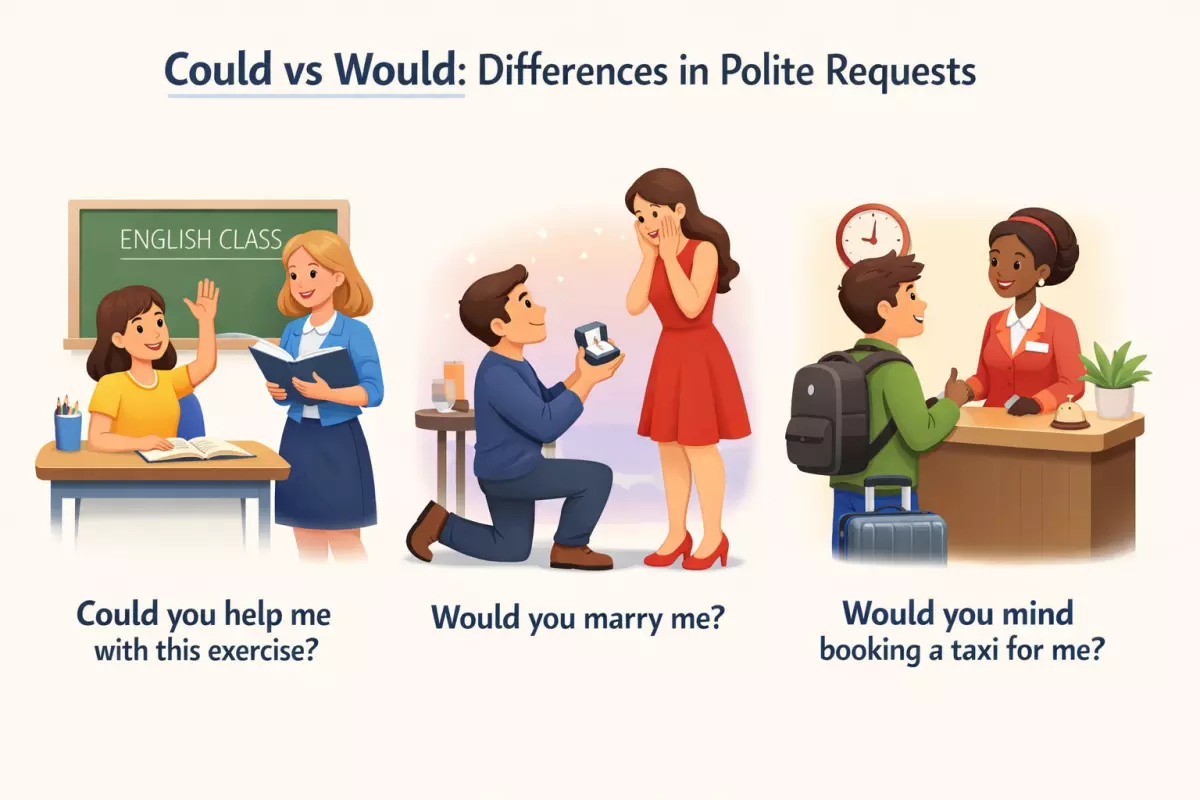 This article explains how could and would work in polite requests, focusing on ability vs willingness, common patterns like could you and would you, and how context and tone affect what sounds natural. It also covers real examples, learner mistakes, and practice exercises.
- How could and would are both used in polite requests
- The difference between asking about ability and willingness
- Common sentence patterns such as could you and would you
- How context influences which modal sounds more natural
- Examples of polite request forms in real conversations
- How tone changes when using different modal verbs
- Typical learner mistakes when forming requests
- Exercises and practice activities with could and would
When you want to be polite, choosing between could and would can change how your request sounds. In daily conversation, could often suggests ability or possibility, while would usually expresses willingness or a gentle preference. Learners confuse them because both feel soft and indirect, but the situation and tone determine which one fits best. With a little practice, the choice becomes natural.
How could and would are both used in polite requests
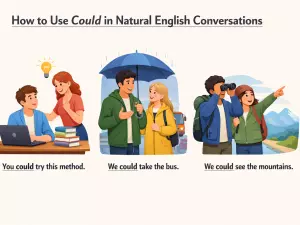
In everyday English, both could and would help you ask for something in a softer, more respectful way. They often appear in similar request patterns, but they “soften” the message differently: could leans toward ability/possibility, while would leans toward willingness and preference.
Common request patterns you can use with either modal
- Could/Would you + base verb: “Could you open the window?” / “Would you open the window?”
- Could/Would you please + base verb: “Could you please email me the file?”
- Could/Would you mind + -ing: “Could you mind waiting a moment?” ❌ → “Would you mind waiting a moment?” ✅
- Could/Would it be possible to + base verb: “Could it be possible to reschedule?” / “Would it be possible to reschedule?”
- Could/Would there be any chance you could + base verb: “Would there be any chance you could call later?”
- Could/Would I + base verb (asking permission): “Could I leave early today?” / “Would I be able to leave early today?”
- Could/Would we + base verb (group action): “Could we meet at 3?” / “Would we be able to meet at 3?”
- Could/Would you happen to + base verb: “Could you happen to have a charger?”
- Could/Would you be able to + base verb: “Could you be able to join?” ❌ → “Would you be able to join?” ✅ / “Could you join?” ✅
- Could/Would you like to + base verb (offering/ inviting): “Would you like to sit here?” / “Could you join us?”
Where they overlap in meaning
- Both can be polite and indirect: “Could you send that today?” and “Would you send that today?” are both respectful in most situations.
- Both work well with “please”: adding “please” usually increases politeness, especially in service or workplace contexts.
- Both can soften commands into requests: “Close the door” → “Could you close the door?” / “Would you close the door?”
- Both can be made more tentative with phrases like “a moment,” “when you have time,” “if possible,” or “when you get a chance.”
Quick usage notes to avoid common mistakes
- Use “Would you mind + -ing…?” (not “could you mind”): “Would you mind lowering your voice?”
- Answer “Would you mind…?” carefully: “No” usually means “I don’t mind” (so the request is accepted). “Yes” can sound like refusal unless you add clarification.
- Keep the main verb in base form after could/would: “Could you help me?” (not “Could you helped me?”).
- Avoid stacking modals: “Would you could…” ❌ Use either “Could you…” or “Would you…”.
- Match tone to context: in very formal situations, longer frames (“Would it be possible…”) can sound more appropriate than short forms.
Example bank (mix-and-match templates)
- Could you take a quick look at this?
- Would you take a quick look at this?
- Could you please forward that message?
- Would you please forward that message?
- Could I ask you a quick question?
- Would it be possible to move the meeting to Friday?
- Could we switch seats?
- Would you mind waiting here for a minute?
- Could you let me know when you’re free?
- Would you be able to confirm the address?
- Could you call me back when you have a moment?
- Would you send me the updated version when you get a chance?
The difference between asking about ability and willingness
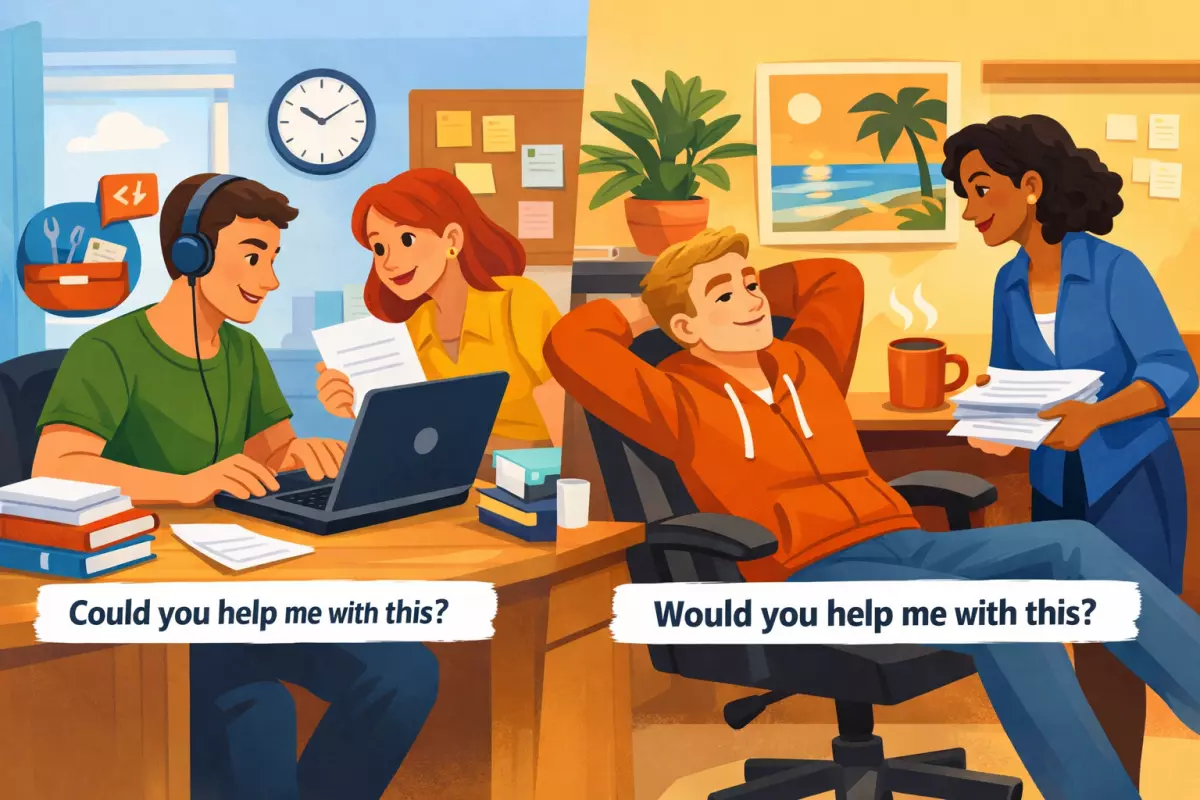
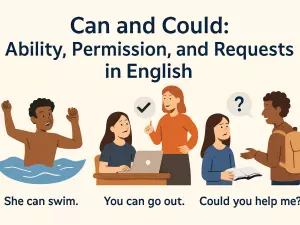
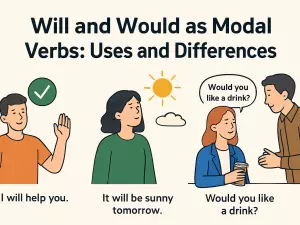
In polite requests, could often checks whether something is possible (ability, capacity, permission), while would often checks whether someone is prepared to do it (willingness, preference, intention). Both can be polite, but they point to different reasons a request might fail: “I can’t” versus “I’d rather not.”
Typical meanings in requests
- Could focuses on feasibility: time, skill, access, rules, or practical possibility.
- Would focuses on choice: readiness, cooperation, and what the person is willing to do.
- In many everyday situations, either works, but the nuance changes what you are really asking.
- If you suspect a practical limitation, could sounds more natural.
- If you are asking for a favor or cooperation, would often sounds more direct and courteous.
Common request patterns (and what they imply)
- Could you + base verb…? → “Is it possible for you to do this?”
- Would you + base verb…? → “Are you willing to do this?”
- Could you possibly…? → extra softening; highlights difficulty or inconvenience.
- Would you mind + -ing…? → asks for willingness; expects a “no” meaning “I don’t mind.”
- Could I + base verb…? → asks permission/possibility for the speaker.
- Would it be possible to…? → formal feasibility check.
- Would it be okay if…? → seeks approval; closer to willingness/acceptance than ability.
- Could you help me with…? → checks availability/capacity to help.
- Would you help me with…? → asks for agreement to help (a favor).
- Could you tell me…? → polite information request; “are you able to provide this info?”
- Would you tell me…? → can sound more insistent in some contexts; “will you do it?”
- Could you send… by 3? → checks whether the deadline is feasible.
- Would you send… by 3? → asks for commitment to meet the deadline.
- Could you come in tomorrow? → asks about availability.
- Would you come in tomorrow? → asks if the person will agree to come in.
How answers tend to differ
- Could you…? often gets ability-based replies: “I can,” “I can’t,” “I’m not able to,” “I don’t have access.”
- Would you…? often gets willingness-based replies: “Sure,” “I’d rather not,” “I’d be happy to,” “I can, but I’d prefer not to.”
- A useful check: if “I’m not allowed to” or “I don’t have time” is likely, could fits well; if “I don’t want to” is the real issue, would targets the decision.
Choosing the best form in context
- Use could when you are unsure the person has the ability, resources, or permission.
- Use would when you mainly need cooperation or consent.
- For sensitive favors, would you mind… can be gentler than would you…, but it requires careful answering (a “no” means agreement).
- If you want to sound less like you are testing someone’s capability, prefer would for simple favors (e.g., passing something, closing a door).
- If you want to avoid pressure and keep the request open-ended, could often feels less demanding.
Common sentence patterns such as could you and would you
Polite request forms often follow a few reliable templates. The main differences come from (1) how direct the request sounds, (2) whether you are asking about ability or willingness, and (3) how much you soften the request with extra phrasing.
Core request templates
- Could you + base verb: asks about ability in a polite way; commonly used for everyday requests.
Example: “Could you open the window?” - Would you + base verb: asks about willingness; often sounds slightly more formal or carefully polite.
Example: “Would you open the window?” - Could you please + base verb: adds extra politeness; useful with strangers or service situations.
Example: “Could you please check this receipt?” - Would you please + base verb: very polite; can sound firm if your tone is strict.
Example: “Would you please lower your voice?” - Could you + verb + for me: makes the favor explicit and personal.
Example: “Could you print this for me?” - Would you + verb + for me: similar meaning, slightly more “requesting” than “asking ability.”
Example: “Would you hold this for me?”
Common add-ons that soften the request
- …if you can: reduces pressure and acknowledges limitations.
Example: “Could you send it today, if you can?” - …when you have a moment: polite for non-urgent tasks.
Example: “Would you reply when you have a moment?” - …whenever you get a chance: very low-pressure timing.
Example: “Could you look at this whenever you get a chance?” - …as soon as possible: increases urgency; still polite, but more demanding.
Example: “Would you call me back as soon as possible?” - …real quick / quickly: casual; can sound pushy in formal contexts.
Example: “Could you quickly sign here?” - …just: common in speech, but can minimize the request or sound impatient depending on tone.
Example: “Could you just email me the file?”
Question forms for specific situations
- Could you help me with + noun/gerund?: standard help request.
Example: “Could you help me with this form?” - Would you mind + gerund…?: very polite; the grammar changes (use -ing).
Example: “Would you mind waiting here?” - Would you mind if I + past tense…?: asks permission for your action.
Example: “Would you mind if I opened the window?” - Could I + base verb…?: you request permission for yourself (common in service settings).
Example: “Could I speak to the manager?” - Would it be possible to + base verb…?: formal and indirect; good for emails.
Example: “Would it be possible to reschedule the meeting?”
Polite requests in emails and workplace messages
- Could you + base verb + by (time/date)?: clear deadline without sounding harsh.
Example: “Could you send the draft by Friday?” - Would you be able to + base verb…?: polite and professional; focuses on feasibility.
Example: “Would you be able to join the call at 3?” - Could you let me know + wh-clause…?: indirect request for information.
Example: “Could you let me know when you’re available?” - Would you let me know + wh-clause…?: similar, slightly more formal in tone.
Example: “Would you let me know what you decide?” - Could you confirm + noun/clause…?: common for logistics and plans.
Example: “Could you confirm the address?”
Accuracy notes (common learner issues)
- ✅ “Could you send it?” → use the base verb after could/would.
❌ “Could you to send it?” - ✅ “Would you mind closing the door?” → use -ing after “Would you mind.”
❌ “Would you mind close the door?” - ✅ “Would you mind if I sat here?” → past tense after “if I” is typical for politeness.
❌ “Would you mind if I sit here?” (possible, but less standard in careful English)
In practice, choose could when you want a friendly, everyday request that doesn’t feel too forceful, and choose would when you want to emphasize willingness or keep the tone more formal. Adding timing phrases (like “when you have a moment”) often changes the politeness more than the modal verb itself.
How context influences which modal sounds more natural
Choose between could and would based on what you are doing socially: asking about ability/possibility, or asking about willingness/behavior. The “right” choice often depends less on grammar rules and more on the situation, relationship, and how direct you want to sound.
Common context patterns that guide the choice
- Ability or possibility in the moment → Use could when the request is mainly about whether something is possible.
- “Could you open the window?” (Is it possible for you to do it?)
- “Could you send that file today?” (Is it feasible?)
- Willingness or cooperation → Use would when you’re asking someone to choose to do something (often a favor).
- “Would you help me for a minute?” (Are you willing?)
- “Would you mind checking this?” (Polite willingness check)
- Service and hospitality settings → would often sounds smoother because it matches customer-service language and offers.
- “Would you like a receipt?”
- “Would you like to take a seat?”
- “Would you like me to email that to you?”
- Quick, practical requests with strangers → could is common for brief, low-emotion interactions.
- “Could you tell me where the station is?”
- “Could you hold the door?”
- When you want to sound slightly more formal or careful → Both modals can be polite, but would often feels more “socially cushioned,” especially with favors.
- “Would you be able to review this by Friday?”
- “Would you be willing to cover my shift?”
- When the request might inconvenience the listener → would fits well because it frames the action as a choice.
- “Would you stay a little later today?”
- “Would you mind lowering your voice?”
- When you’re checking feasibility before asking for action → Start with could to test constraints (time, access, ability).
- “Could you meet tomorrow, or is your schedule full?”
- “Could you access the shared folder?”
- When you’re asking for a consistent behavior → would often sounds natural for repeated or ongoing actions.
- “Would you send me the report every Monday?”
- “Would you keep me posted?”
- When you’re proposing a hypothetical or conditional request → would pairs naturally with conditions and softens the request.
- “Would you be able to call me if anything changes?”
- “Would you let me know when you arrive?”
- When you want to avoid sounding like you doubt their ability → Prefer would if “could” might be heard as “Are you capable?”
- More tactful: “Would you take a look at this?”
- Potentially awkward in some contexts: “Could you take a look at this?” (can sound like ability is in question)
- When you are asking for permission vs. requesting an action → For permission, could is common; for the other person’s action, would can feel more natural.
- Permission: “Could I leave a bit early today?”
- Action: “Would you approve this request?”
- When “would” is part of a set polite frame → Some patterns strongly prefer would.
- “Would you mind + -ing…?” ✅ “Would you mind closing the door?”
- ❌ “Could you mind closing the door?” (unnatural)
- “Would it be possible to…?” (very formal)
- When “could” is part of a set feasibility frame → Some patterns naturally prefer could.
- “Could you possibly…?” (polite, emphasizes difficulty)
- “Could you by any chance…?” (softens and signals low expectation)
A practical decision shortcut
- If the key question is “Is this doable?” → choose could.
- If the key question is “Would you do this for me?” → choose would.
- If you’re making an offer or inviting a choice → would is usually the default.
- If you’re asking a quick, simple favor and want neutral politeness → either can work; pick the one that matches your intent (feasibility vs. willingness).
Examples of polite request forms in real conversations
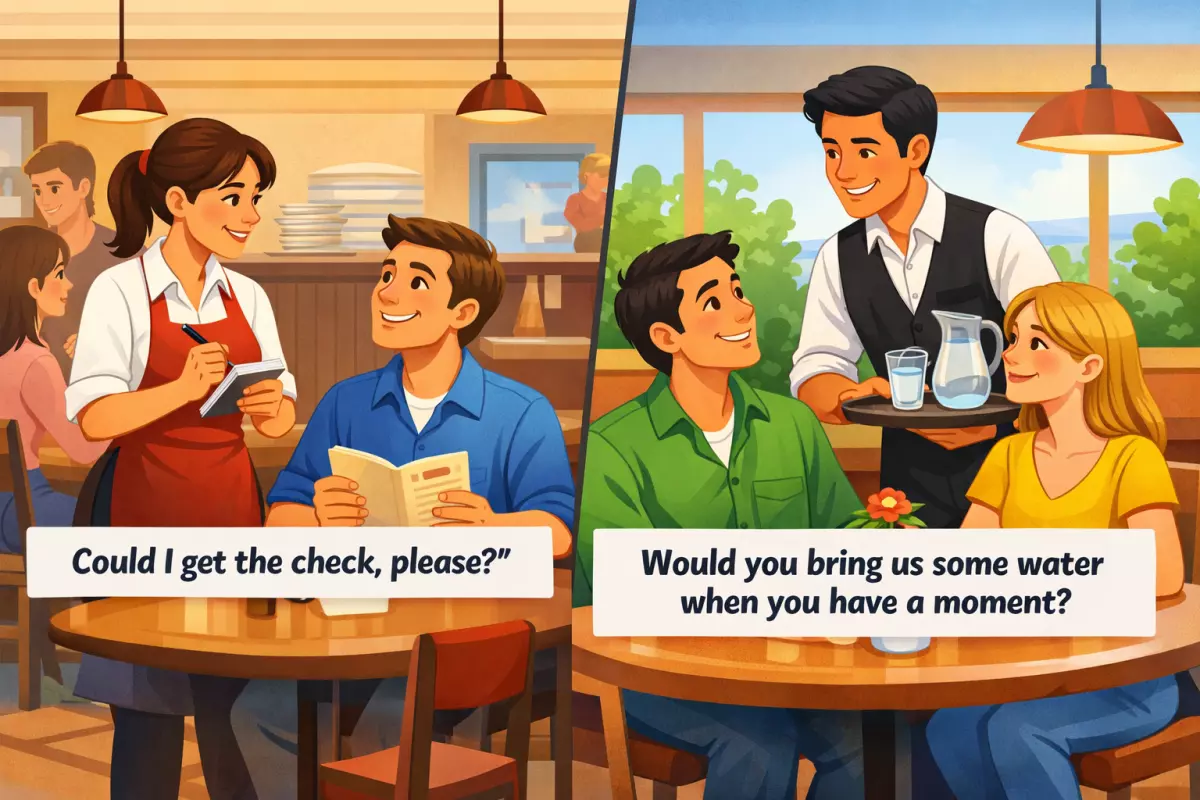
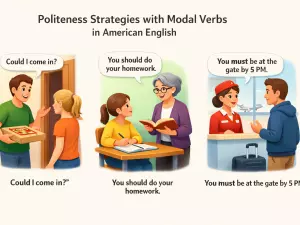
Real-life requests usually combine a modal verb (could/would) with softening language such as “please,” “just,” “a bit,” or a short reason. The choice often depends on what you’re asking for: could commonly checks ability/possibility, while would often sounds like a courteous invitation to help or a preference-based request.
Service and customer situations
- “Could I get the check, please?” (a standard, polite request in restaurants)
- “Would you bring us some water when you have a moment?” (polite, gives the server flexibility)
- “Could you tell me where the restrooms are?” (asking for information/directions)
- “Would you mind splitting the bill?” (a common softener: “would you mind…?”)
- “Could I try this on in a different size?” (permission + possibility)
- “Would it be possible to exchange this?” (formal, indirect request)
- “Could you hold this for me until tomorrow?” (checks feasibility)
- “Would you be able to print the receipt as well?” (very polite; adds distance)
Workplace requests (email, meetings, chat)
- “Could you send me the updated file by 3 p.m.?” (clear task + deadline)
- “Would you review this draft when you have time?” (less pressure; emphasizes willingness)
- “Could we move our meeting to Thursday?” (suggesting a change)
- “Would you be willing to take the first slide?” (asks for willingness, not ability)
- “Could you clarify what you mean by ‘priority’ here?” (polite request for explanation)
- “Would it help if I summarized the action items?” (offers support in a courteous way)
- “Could I ask a quick question about the timeline?” (softens the interruption)
- “Would you mind adding me to that calendar invite?” (indirect, polite)
Friends, family, and everyday favors
- “Could you pass the salt?” (classic small request)
- “Would you pick me up at 7?” (sounds like a favor; focuses on the person’s willingness)
- “Could I borrow your charger for a minute?” (permission + temporary favor)
- “Would you help me carry this?” (asks for help directly but politely)
- “Could we keep the music a little lower?” (softened request; “a little” reduces bluntness)
- “Would you mind texting me when you get home?” (common caring request)
Useful patterns that make requests sound more natural
- Could you…? + action: “Could you open the window?”
- Would you…? + action: “Would you close the door?”
- Could I…? + permission: “Could I leave a bit early today?”
- Would you mind + -ing: “Would you mind waiting here?”
- Would it be possible + to…: “Would it be possible to reschedule?”
- When you have a moment/when you get a chance: “Could you call me when you get a chance?”
- Just/a quick: “Could I ask a quick favor?” (softens, but avoid overusing)
- Reason (brief): “Could we start on time? I have another meeting right after.”
Common form mistakes to avoid
- ❌ “Could you to send it?” → ✅ “Could you send it?” (no “to” after “could you”)
- ❌ “Would you can help me?” → ✅ “Could you help me?” or “Would you help me?” (don’t stack modals)
- ❌ “Would you like to…?” when you mean a request → ✅ “Would you…?” (the “like” version often sounds like an invitation, not a favor)
- ❌ “Could you please to…?” → ✅ “Could you please…?” (no “to”)
How tone changes when using different modal verbs
Modal verbs shift a request’s level of directness, formality, and how much choice the listener feels they have. Small changes (like switching from could to would, or adding “possibly”) can make the same basic request sound more tentative, more deferential, or more confident.
Common tone effects and when to use them
- Can: straightforward and practical; often sounds neutral with friends, but can feel blunt in formal settings. Example: “Can you send the file today?”
- Could: softer and more tentative; suggests the listener has options and you’re not assuming compliance. Example: “Could you send the file today?”
- Would: polite and slightly more formal; frames the request as the listener’s willingness/choice. Example: “Would you send the file today?”
- Will: direct and future-focused; can sound like an instruction unless the context is already cooperative. Example: “Will you send the file today?”
- May: formal and permission-oriented; often used with “I” for asking permission rather than requesting action from someone else. Example: “May I leave a bit early?”
- Might: very tentative; useful when you want to avoid pressure or when the favor is significant. Example: “Might you have time to review this?”
- Would you mind + -ing: careful and indirect; can sound very polite, but it’s easy to answer incorrectly if the listener isn’t attentive. Example: “Would you mind checking this?”
- Could you possibly: extra-softening; good for bigger asks, but can feel overcareful if used for small, routine tasks. Example: “Could you possibly cover the first 10 minutes?”
- Would you be able to: emphasizes feasibility rather than willingness; helpful when time/ability is the issue. Example: “Would you be able to join at 3?”
- Could I: polite permission request; common in everyday speech. Example: “Could I borrow your charger?”
- Would it be possible to: highly formal and process-oriented; common in emails and service contexts. Example: “Would it be possible to reschedule?”
- I was wondering if you could/would: very diplomatic; creates distance and reduces pressure, especially in writing. Example: “I was wondering if you could take a look.”
- Do you think you could: collaborative and non-demanding; invites a quick feasibility check. Example: “Do you think you could finish this by Friday?”
- Can you just: minimizes the task; can sound pushy because it implies the request is small or obvious. Example: “Can you just sign this?”
- Could you please vs Please could you: both polite; placing “please” earlier can sound more formal or more emphatic depending on tone. Example: “Could you please confirm?”
Patterns that reliably change the level of politeness
- Past-form modals soften: “can” → “could”; “will” → “would.” The meaning is still present-time, but the tone becomes less forceful.
- Ability vs. willingness: “Could you…?” often checks ability/feasibility; “Would you…?” often checks willingness. In many everyday requests, both work, but the emphasis differs.
- Add a reason to reduce pressure: “Could you send this today, so I can finalize the report?” sounds more cooperative than a bare request.
- Use softeners sparingly: words like “possibly,” “a bit,” “when you have a moment,” and “if you don’t mind” reduce directness, but too many can sound hesitant or overly formal.
- Avoid accidental bluntness: “Will you…?” and “Can you…?” are fine in friendly contexts, but in emails to clients or managers, “Could you…?” or “Would you…?” usually lands better.
- Match the size of the favor: small routine asks often fit “can/could”; larger or more inconvenient requests often benefit from “would,” “could you possibly,” or “would you be able to.”
Quick correctness notes (common pitfalls)
- ✅ “Would you mind opening the window?” → natural request form.
- ❌ “Would you mind to open the window?” → incorrect in standard usage (use -ing).
- ✅ “Could you help me for a minute?” → polite and common.
- ✅ “Would you help me for a minute?” → polite, slightly more formal.
Typical learner mistakes when forming requests
Many problems with polite asking come from mixing grammar patterns, choosing the wrong level of directness, or using a form that sounds like a demand. The points below focus on common pattern errors with could and would, plus quick fixes you can apply immediately.
Common pattern and meaning errors
- ❌ Using could to ask about willingness (instead of ability) in a way that sounds unclear:
❌ “Could you help me now?” (can be read as “Are you able?”) → ✅ “Would you help me now?” / “Could you help me, please?” - ❌ Using would when you mean ability or permission:
❌ “Would you open this file?” (you mean “Are you able to?”) → ✅ “Could you open this file?” - ❌ Treating could as past time only:
❌ Avoiding “Could you…?” because it “sounds past” → ✅ Use “Could you…?” freely for polite present requests. - ❌ Confusing request vs. offer patterns:
❌ “Could I help you?” (possible, but often sounds like asking permission) → ✅ “Can I help you?” / “Would you like some help?” - ❌ Using “Would you like to…?” when you are actually requesting an action from the listener:
❌ “Would you like to send me the report?” → ✅ “Would you send me the report?” - ❌ Overusing “Can you…?” in formal or sensitive situations:
❌ “Can you explain this again?” (can sound abrupt) → ✅ “Could you explain that again?” - ❌ Using “Could you please…” with an impatient tone marker like “now” or “immediately” (polite word + urgent adverb can clash):
❌ “Could you please reply immediately?” → ✅ “Could you reply when you have a moment?” / “Could you reply today, if possible?” - ❌ Making the request too indirect and vague:
❌ “I was wondering if maybe you could possibly…” → ✅ “Could you…?” + one clear detail (what/when).
Grammar slips that make requests sound incorrect or unnatural
- ❌ Wrong word order in questions:
❌ “Could you can help me?” → ✅ “Could you help me?” - ❌ Doubling modals:
❌ “Would you could send it?” → ✅ “Could you send it?” / “Would you send it?” - ❌ Using “to” after a modal:
❌ “Could you to check this?” → ✅ “Could you check this?” - ❌ Adding “do” incorrectly:
❌ “Would you do help me?” → ✅ “Would you help me?” - ❌ Using the wrong verb form after the listener:
❌ “Could you helps me?” → ✅ “Could you help me?” - ❌ Using a noun instead of a verb after the modal:
❌ “Could you a favor?” → ✅ “Could you do me a favor?” - ❌ Omitting the main verb:
❌ “Could you please?” → ✅ “Could you please repeat that?”
Pragmatic issues: sounding too strong, too soft, or mismatched
- ❌ Using “Would you…” for a command-like instruction without softeners:
❌ “Would you close the door.” → ✅ “Would you close the door, please?” / “Would you mind closing the door?” - ❌ Using “Could you…” to ask for something the listener clearly cannot do (creates awkwardness):
❌ “Could you change the company policy?” → ✅ “Would you be able to raise this with the team?” - ❌ Missing context when the request is big:
❌ “Could you review this?” → ✅ “Could you review this by 3 pm? It’s for the client meeting.” - ❌ Overusing “please” in every sentence (can sound tense or insistent):
❌ “Please could you please send it please?” → ✅ Use “please” once, or replace with “when you can / if possible.” - ❌ Using “Would you…” when you are actually asking for permission:
❌ “Would I leave early today?” → ✅ “Could I leave early today?” - ❌ Ending with a tag that pressures the listener:
❌ “Could you send it today, okay?” → ✅ “Could you send it today, if that works?” - ❌ Skipping a polite opener in email when the request is the first line:
❌ “Could you send the file.” → ✅ “Hi [Name], could you send the file when you have a moment?”
A reliable check is to match the modal to the meaning: use could for ability/permission and a softer request frame, and use would to ask for willingness or cooperation. Then keep the structure simple: modal + subject + base verb, with one clear detail (what you need and by when).
Exercises and practice activities with could and would
Focus on choosing the modal that matches the purpose: could often checks possibility/ability or makes a gentle request, while would often asks about willingness, preferences, or polite routines. Use the activities below to practice the most common patterns and avoid typical mix-ups.
1) Pattern drills (build automatic, natural phrasing)
- Could you + base verb: Could you open the window?
- Would you + base verb: Would you open the window?
- Could I + base verb (ask permission): Could I leave early today?
- Could we + base verb (suggest/request as a group): Could we meet at 3?
- Would you mind + -ing: Would you mind closing the door?
- Would you like + noun / to + verb: Would you like some water? / Would you like to sit down?
- I would like + noun / to + verb (polite request/ordering): I would like a coffee. / I would like to speak to the manager.
- Could you possibly + base verb (extra softening): Could you possibly send it today?
- Would it be possible to + base verb (formal): Would it be possible to reschedule?
- Could you + base verb + for me: Could you check this for me?
- Would you + base verb + when you have a moment: Would you call me when you have a moment?
- Could you + base verb + (time limit): Could you finish this by Friday?
2) Choose the best option (requests, permission, willingness)
- (Could / Would) you help me carry this box?
- (Could / Would) I borrow your pen for a minute?
- (Could / Would) you mind waiting outside?
- (Could / Would) you like tea or coffee?
- (Could / Would) you be willing to work late tonight?
- (Could / Would) we move to a quieter table?
- (Could / Would) you possibly speak a bit more slowly?
- (Could / Would) it be possible to get a refund?
- (Could / Would) you send me the file when you have time?
- (Could / Would) I ask a quick question?
Show answers
- Could / Would (both work; would leans to willingness)
- Could
- Would
- Would
- Would
- Could
- Could
- Would
- Could / Would (both work; could is slightly more “is it possible?”)
- Could
3) Fix the sentence (common form errors)
- ❌ Could you to send me the link?
- ❌ Would you mind to close the window?
- ❌ Would you like that you sit here?
- ❌ Could I to use your phone?
- ❌ Would it possible to meet tomorrow?
- ❌ Could you sending the invoice today?
- ❌ Would you like some help to carry this?
- ❌ Could you mind waiting a second?
Show answers
- ✅ Could you send me the link?
- ✅ Would you mind closing the window?
- ✅ Would you like to sit here?
- ✅ Could I use your phone?
- ✅ Would it be possible to meet tomorrow?
- ✅ Could you send the invoice today?
- ✅ Would you like some help carrying this? / Would you like help to carry this?
- ✅ Would you mind waiting a second?
4) Rewrite for tone (neutral → more polite)
Rewrite each sentence using could or would. Keep the meaning the same, but make it sound more courteous.
- Open the door.
- Give me a minute.
- Tell me your name.
- Wait here.
- Let me see the schedule.
- Move your bag.
- Speak more quietly.
- Send this to everyone.
Show answers
- Could you open the door? / Would you open the door?
- Could you give me a minute? / Would you give me a minute?
- Could you tell me your name? / Would you tell me your name?
- Could you wait here? / Would you wait here?
- Could I see the schedule? / Would it be possible for me to see the schedule?
- Could you move your bag? / Would you move your bag?
- Could you speak more quietly? / Would you speak more quietly?
- Could you send this to everyone? / Would you send this to everyone?
5) Mini role-play prompts (short, realistic production practice)
- In a café: order a drink and ask for the Wi‑Fi password using would like and a polite request form.
- At work: ask a colleague to review your email; then ask if they are willing to join a quick call.
- On public transport: ask someone to move their bag; then ask permission to sit down.
- Customer service: ask if it is possible to exchange an item; then ask them to explain the steps.
- In class: ask the teacher to repeat something; then ask if you can leave early.
- With a neighbor: ask them to lower the music; then offer a preference question with would you like.
When checking your work, confirm the structure first (base verb after could/would, -ing after would you mind, and to + verb after would like). Then decide whether the situation is about possibility/permission (often could) or willingness/preference (often would).