Modal Verbs in Formal and Professional English

 This article explains how modal verbs show up in workplace talk and writing, which ones fit formal situations, and gives examples from business discussions and emails. It also shows how modals shape politeness and tone, when careful choice matters, and includes practice exercises.
- How modal verbs appear in professional communication and workplace language
- Which modal verbs are preferred in formal situations
- Examples of modal verbs used in business discussions and emails
- How modal verbs help express politeness and professionalism
- Situations where formal language requires careful modal choice
- How professional tone changes depending on the modal verb used
- Exercises and practice activities with modal verbs in formal contexts
In workplace and academic writing, small helper verbs shape how your message is received, making it sound confident, polite, or appropriately cautious. This guide explains how to choose them when requesting action, offering advice, setting expectations, or expressing uncertainty. You will learn to match tone to context so emails, reports, and meetings stay clear, professional, and respectful.
How modal verbs appear in professional communication and workplace language
In workplace writing and meetings, modal verbs help speakers manage tone: they soften requests, set expectations, negotiate risk, and state rules without sounding abrupt. The same task can sound cooperative or forceful depending on the modal chosen, so professionals use them to balance clarity with politeness.
Common functions and the modal patterns that signal them
- Polite requests and service language: use could / would to sound collaborative.
- Could you send the revised deck by 3 p.m.?
- Would you mind adding a note on the budget impact?
- Direct instructions (higher authority or urgent context): use must or need to for non-negotiable actions.
- All visitors must sign in at reception.
- We need to complete the security training this week.
- Policies and prohibitions: use must not / may not for rules; avoid vague wording.
- Confidential files must not be shared outside the team.
- Employees may not install unapproved software.
- Permission and approval: use may (formal) or can (neutral) to grant or ask for permission.
- You may proceed with the purchase once Finance approves.
- Can I move our meeting to Thursday?
- Suggestions and low-pressure advice: use might, could, or may want to to keep options open.
- We might consider a phased rollout.
- You may want to flag this risk in the summary.
- Recommendations with professional firmness: use should / ought to when there is a clear best practice.
- We should document the decision in the project log.
- The report ought to include a methodology section.
- Commitments and promises: use will for definite action; use should for expected timing.
- I will share the minutes by end of day.
- The shipment should arrive on Friday.
- Probability and forecasting: use will (high confidence), should (likely), may/might (uncertain).
- This change will reduce processing time.
- The update may cause a short outage.
- Ability and capacity: use can / be able to to describe capability, resources, or constraints.
- We can support two additional regions this quarter.
- We won’t be able to deliver without final specs.
- Conditional planning: use could / would to discuss scenarios and dependencies.
- We could start Monday if the contract is signed today.
- We would need extra headcount to meet that deadline.
High-frequency workplace templates (usable patterns)
- Could you + base verb → “Could you confirm the attendee list?”
- Would you + base verb → “Would you review the draft?”
- Would it be possible to + base verb → “Would it be possible to extend the deadline?”
- Can we + base verb → “Can we align on priorities today?”
- May I + base verb → “May I suggest an alternative approach?”
- We should + base verb → “We should clarify the scope before estimating.”
- You may want to + base verb → “You may want to add a reference number.”
- We need to + base verb → “We need to validate the data source.”
- It must be + adjective/noun → “It must be approved by Legal.”
- It might + base verb → “It might take longer due to testing.”
- We won’t be able to + base verb → “We won’t be able to ship without sign-off.”
- Should we + base verb? → “Should we escalate this to the vendor?”
Common tone pitfalls and cleaner alternatives
- ❌ “You must send this today.” → ✅ “Could you send this today?” (request) or “We need this today to meet the deadline.” (constraint)
- ❌ “We might deliver by Friday.” (too uncertain for stakeholders) → ✅ “We should deliver by Friday, assuming testing passes.”
- ❌ “Can you approve this?” (permission vs ability ambiguity) → ✅ “Could you approve this by 2 p.m.?” or “May I proceed once you approve?”
- ❌ “You should not share this.” (sounds like advice) → ✅ “You must not share this.” (policy) or “Please do not share this.” (instruction)
Which modal verbs are preferred in formal situations

In professional writing and formal speech, modal choices tend to be more precise, less emotional, and more indirect. The most common pattern is to soften requests and recommendations, while making obligations and policies sound objective rather than personal.
Preferred modals and what they typically signal
- Would for polite requests and offers: “Would you please confirm receipt?” / “We would be happy to provide further details.”
- Could for tactful requests and possibility: “Could you clarify the timeline?” / “This could result in delays.”
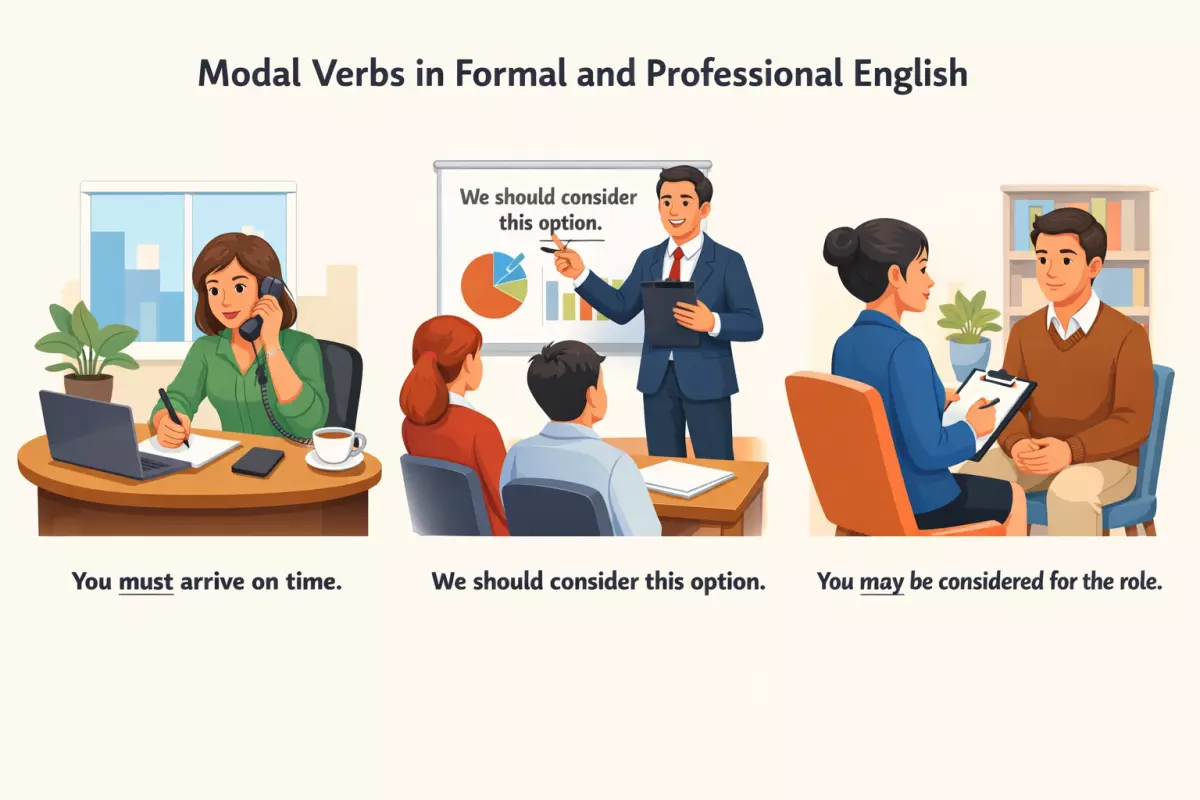
- May for permission and formal possibility (often written): “You may submit the form by Friday.” / “This may affect performance.”
- Might for cautious, low-certainty predictions: “This might require additional approval.”
- Should for recommendations and expected standards: “All staff should complete the training.”
- Must for firm requirements, rules, and non-negotiable obligations: “Applicants must provide valid identification.”
- Will for commitments, official decisions, and future actions: “We will review your request within five business days.”
- Shall for legal/contract language and formal undertakings (limited but still common in policies): “The supplier shall deliver the goods by 1 June.”
- Need to as a practical alternative to “must” when a slightly less forceful tone is desired: “We need to obtain written consent.”
- Ought to for formal-sounding advice (less common in modern business English): “The report ought to include supporting data.”
Common formal patterns (ready-to-use templates)
- Request: “Could you + base verb…?” / “Would you be able to + base verb…?”
- Soft instruction: “You may wish to + base verb…” / “You might want to + base verb…”
- Recommendation: “We should + base verb…” / “It would be advisable to + base verb…”
- Requirement: “You must + base verb…” / “All users are required to + base verb…”
- Commitment: “We will + base verb…” / “We will be able to + base verb…”
- Conditional politeness: “We would appreciate it if you could + base verb…”
- Risk/uncertainty: “This may/might/could + base verb…” (choose based on certainty level)
Modals that often sound too direct (and how to adjust)
- ❌ “Can you send this today?” → ✅ “Could you send this today?” (more courteous)
- ❌ “You have to sign here.” → ✅ “You must sign here.” (clear policy) or “You need to sign here.” (less severe)
- ❌ “You should do this now.” → ✅ “You may wish to do this now.” (softer suggestion)
- ❌ “I want you to review this.” → ✅ “Could you review this?” / “Please review this.” (professional request)
As a general rule, formal English favors modals that create distance and professionalism (would, could, may, might) while reserving stronger forms (must, shall) for policies, compliance, and contractual obligations. Choosing the right modal helps align tone with authority, urgency, and the level of certainty you intend.
Examples of modal verbs used in business discussions and emails
In workplace communication, modal verbs help you control tone: they can soften requests, express obligation, signal probability, or set boundaries. The same message can sound collaborative or overly direct depending on the modal you choose, so it helps to learn common patterns that appear in meetings, project updates, and email threads.
Common patterns and ready-to-use examples
- Polite requests (could / would): “Could you share the latest figures by 3 p.m.?”
- Polite requests with options: “Could you send the file today, or would tomorrow morning work?”
- Softening instructions (could): “We could move this item to next week’s agenda to save time.”
- Offers of help (can / could): “I can draft the first version if you’d like.” / “I could take the minutes for this meeting.”
- Permission and approval (may / can): “May I proceed with the vendor onboarding?” / “Can we confirm the budget with Finance?”
- Formal permission (may): “You may use the updated template for all client-facing documents.”
- Obligation and requirements (must / have to): “We must comply with the reporting deadline.” / “We have to obtain sign-off before release.”
- Policy-based obligation (must): “All expenses must be submitted within 30 days.”
- External necessity (have to): “We have to revise the timeline due to the supplier delay.”
- Strong recommendation (should): “We should clarify the scope before we estimate costs.”
- Gentle recommendation (might want to): “You might want to flag this risk in the weekly update.”
- Possibility (may / might / could): “The client may request additional testing.” / “We might need extra support next month.” / “This could impact delivery dates.”
- Probability (should): “The revised forecast should be ready by Friday.”
- Uncertainty with caution (might): “There might be a delay if approvals take longer than expected.”
- Ability and capacity (can / be able to): “We can accommodate a short extension.” / “We’ll be able to confirm after the review.”
- Limitations (can’t / won’t): “We can’t share that data without an NDA.” / “We won’t be able to join the call at that time.”
- Negotiation and compromise (could): “We could reduce scope to meet the deadline.”
- Setting expectations (will): “I will circulate the notes and action items by end of day.”
- Conditional commitment (would): “We would be happy to proceed once the contract is signed.”
Accuracy and tone: quick corrections
- ✅ “Could you review this today?” → more tactful than ❌ “Review this today.”
- ✅ “We have to wait for Legal’s approval.” → external constraint; compare with ✅ “We must follow the policy.” (internal rule/requirement)
- ✅ “May I ask for clarification on point 3?” → more formal than ✅ “Can I ask…?”
- ✅ “We might miss the deadline if testing runs late.” → cautious; compare with ✅ “We will miss the deadline…” (certain)
When writing emails, modals often appear with a clear action, a timeframe, and a reason: “Could you + verb… by + time… so that…”. In meetings, they are useful for proposing next steps without sounding final: “We could…”, “We might…”, and “We should…” keep the discussion open while still moving it forward.
How modal verbs help express politeness and professionalism
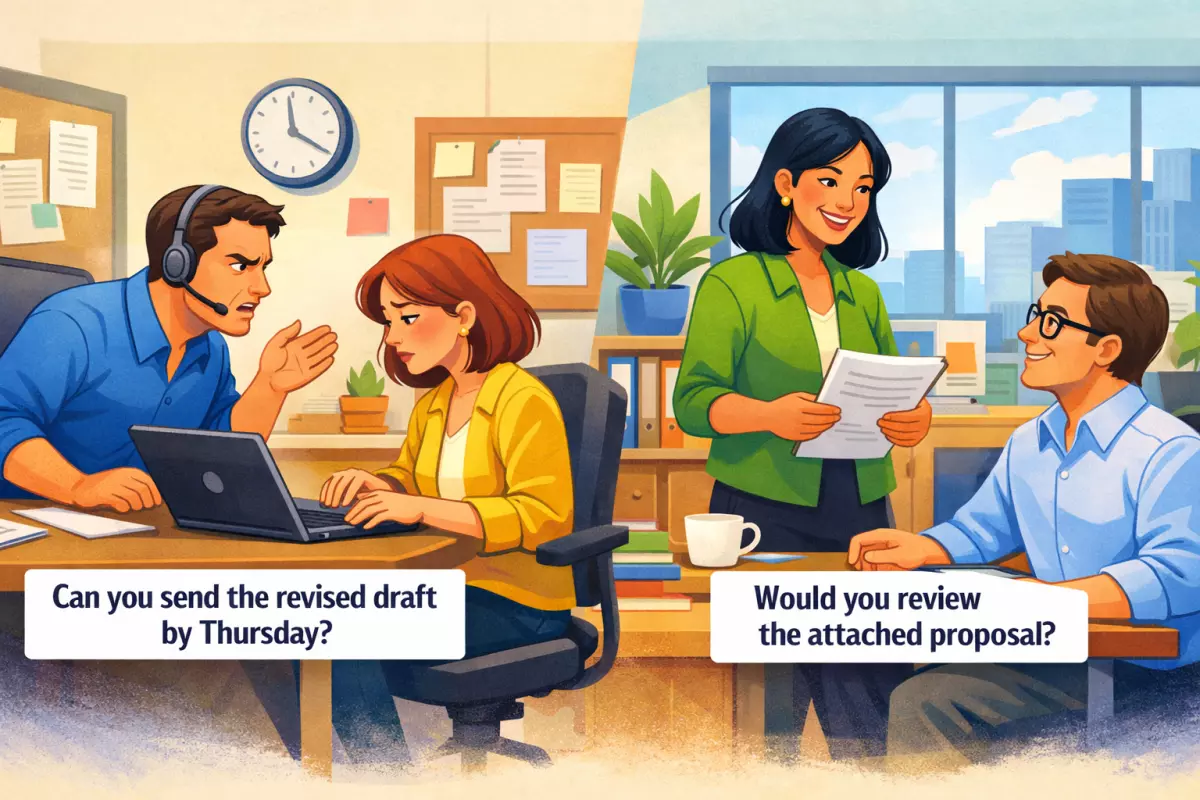
In formal communication, modal verbs soften requests, manage expectations, and reduce the risk of sounding demanding. They let you be clear about what you need while still showing respect for the other person’s time, authority, and workload.
Core politeness patterns (and what they signal)
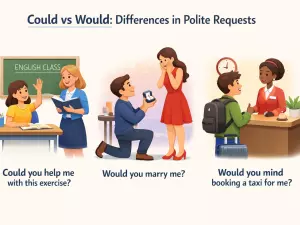
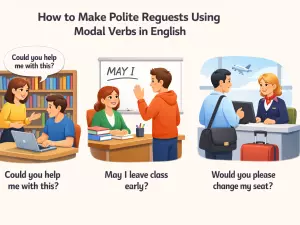
- Could you…? Polite request; less direct than “Can you…?”
- Could you send the revised draft by Thursday?
- Would you…? Polite request that frames cooperation as a choice.
- Would you review the attached proposal and share your feedback?
- Would you mind + -ing…? Very polite, especially for small favors.
- Would you mind confirming the meeting room booking?
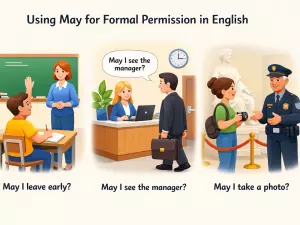
- May I…? Formal permission; common in emails and meetings.
- May I ask a quick clarifying question about the timeline?
- Could I…? Slightly less formal than “May I,” still professional.
- Could I reschedule our call to Friday morning?
- Would it be possible to…? Indirect request; useful when the ask is significant.
- Would it be possible to extend the deadline by two business days?
- I was wondering if you could… Softens the request further; common in client-facing writing.
- I was wondering if you could share the latest figures.
- We would appreciate it if you could… Polite and collaborative; good for external partners.
- We would appreciate it if you could confirm receipt of the documents.
- Should we…? Suggestion framed as joint decision-making.
- Should we align on priorities before the next milestone?
- Might we…? Very tentative suggestion; useful when you want to avoid sounding pushy.
- Might we revisit the scope to reduce delivery risk?
- Could we…? Collaborative request; often used for scheduling or process changes.
- Could we move this discussion to email to keep the meeting on track?
- Would it help if…? Offers support without implying the other person is struggling.
- Would it help if I drafted the first version for your review?
Using modals to reduce pressure and keep boundaries clear
- Could / would to avoid commands:
- ✅ Could you update the tracker today?
- ❌ Update the tracker today.
- Can for neutral, efficient requests (often internal teams), but less softened than “could”:
- Can you join for 10 minutes to confirm the numbers?
- May to sound especially formal when asking permission:
- May we proceed with the change request as outlined?
- Might to communicate uncertainty without sounding unprepared:
- The release might be delayed if testing uncovers critical issues.
- Should to give guidance without sounding absolute:
- You should be able to access the folder once IT approves the request.
- Would to describe preferences diplomatically:
- It would be better to finalize the scope before we estimate costs.
Common pitfalls to avoid in formal writing
- Overusing strong obligation forms when you mean a request:
- ❌ You must send this by EOD. → ✅ Could you send this by end of day?
- Using “can” in sensitive contexts where “could” sounds more tactful:
- ✅ Could you clarify which version is approved?
- Mixing permission and ability in a way that sounds abrupt:
- ✅ May I leave the meeting early today?
- ✅ Could I leave a few minutes early?
- Making suggestions with “must” or “have to” when you intend flexibility:
- ✅ We might consider a phased rollout.
- ✅ We could start with a pilot group.
Situations where formal language requires careful modal choice
In professional writing and speech, modals do more than show time or possibility; they set the level of authority, politeness, and legal or procedural force. Small changes (for example, must vs should) can shift a sentence from guidance to obligation, so it helps to choose patterns that match the situation and the relationship between writer and reader.
Common contexts and the modal patterns that fit
-
Policies, rules, and compliance statements: Use must for non-negotiable requirements and must not for prohibitions. Use should only for recommended practice.
✅ Employees must wear ID badges on site. → ❌ Employees should wear ID badges (sounds optional).
-
Contracts and formal specifications: Prefer precise obligation language (must, is required to) and avoid vague permission like can when you mean authorization.
✅ The supplier must deliver the goods by 30 June.
-
Permission and authorization: Use may for permission in formal registers; reserve can for ability or practical possibility.
✅ Staff may access the archive upon approval. → ❌ Staff can access the archive (could imply ability rather than permission).
-
Requests to colleagues or external partners: Use could or would for polite distance; use can for neutral, efficient requests; avoid must unless you have clear authority.
✅ Could you confirm receipt by Friday? / Would you be able to share the latest figures?
-
Instructions in procedures and manuals: Use must for safety-critical steps; use should for best practice; use may for optional steps.
✅ The device must be unplugged before cleaning. / The filter should be replaced every 3 months.
-
Recommendations and professional advice: Use should for strong guidance; use might want to or may wish to for softer suggestions (often useful with senior stakeholders).
✅ You should document all changes to the scope. / You may wish to review the risk register.
-
Risk statements and uncertainty: Use may, might, or could to show possibility; avoid will when outcomes are not guaranteed.
✅ Delays may occur if approvals are not received. → ❌ Delays will occur (too definite unless certain).
-
Forecasts and planned actions: Use will for firm commitments; use should for expected outcomes based on current information; use may for tentative plans.
✅ We will publish the report on 15 April. / The update should resolve the issue.
-
Negotiation and proposals: Use would to present terms as conditional and collaborative; use could to offer options without pressure.
✅ We would be prepared to extend the deadline if the scope is reduced. / We could schedule a review meeting next week.
-
Diplomatic disagreement and limitations: Use may and might to soften claims; use cannot for firm constraints; avoid blunt must when managing relationships.
✅ This approach may not address the underlying issue. / We cannot approve the request without documentation.
-
Formal apologies and explanations: Use may in set phrases to sound appropriately formal; use might to acknowledge possible impact without over-committing.
✅ We may have caused inconvenience, and we apologise for the disruption.
-
Academic and analytical writing: Use may, might, and could to hedge interpretations; use must only for logical necessity (not personal certainty).
✅ The results may indicate a shift in consumer preferences. / This must be due to sampling bias (only if logically unavoidable).
-
Reporting obligations vs. describing capability: Separate duty (must, have to) from ability (can, be able to) to avoid ambiguity.
✅ The team must submit timesheets weekly. / The team can submit timesheets via the portal.
-
Escalation and urgency: Use need to for practical urgency; use must for formal requirement; use should when urgency is strong but not mandatory.
✅ We need to resolve this before month-end to avoid penalties.
-
Customer-facing communication: Use can and will to sound helpful and action-oriented; use may to set limits politely; avoid overpromising with will if delivery is uncertain.
✅ We can offer a replacement within 5 business days. / Delivery may take longer during peak periods.
Quick accuracy checks before sending
-
If the sentence creates a rule, prefer must (or must not) rather than should.
-
If the sentence grants permission, prefer may rather than can in formal documents.
-
If the sentence is a request, prefer could or would to reduce pressure.
-
If the sentence is a prediction, choose will only when you can stand behind the certainty; otherwise use should, may, or might.
-
If the sentence expresses analysis, use hedging modals (may, might, could) unless you are stating a strict logical conclusion.
How professional tone changes depending on the modal verb used
The modal you choose signals how strong, polite, or negotiable your message is. In professional English, modals help you manage authority (giving instructions), diplomacy (making requests), and risk (avoiding absolute promises). The same basic idea can sound firm, neutral, or tactful depending on the modal verb and the structure around it.
Common modals and the tone they create
- Must sets a non-negotiable requirement. Use for rules, compliance, and safety: “All visitors must sign in.”
- Have to is also strong, but often sounds like an external obligation rather than the speaker’s authority: “We have to submit the report by Friday.”
- Need to is firm but slightly softer than must; it frames the action as necessary for a goal: “We need to confirm the numbers before publishing.”
- Should expresses recommendation or expectation. It leaves room for discussion: “You should review the draft before sending it.”
- Ought to is similar to should but can sound more formal or old-fashioned in business writing; use sparingly: “We ought to document the decision.”
- Can often signals ability or permission; in requests it can sound direct and practical: “Can you share the updated file?”
- Could is a more polite, less pressuring request than can; it also suggests options: “Could you send this by 3 p.m.?”
- May is formal for permission and is common in policies and official emails: “You may access the portal using your ID.”
- Might reduces certainty and is useful for cautious suggestions or forecasts: “This might delay the timeline by a week.”
- Will shows commitment or a clear future action; it can sound decisive: “I will follow up tomorrow.”
- Would softens statements and requests, and is standard for polite business phrasing: “Would you be available for a quick call?”
- Shall is rare in modern professional American English, but appears in legal or very formal contexts to express obligation: “The tenant shall maintain the property.”
Patterns that soften or strengthen professional messages
- Modal + please increases politeness, especially with direct requests: “Could you please confirm receipt?”
- Would you mind + -ing is very tactful and indirect: “Would you mind reviewing this section?”
- Could/May I sounds more formal than Can I for asking permission: “May I reschedule our meeting?”
- We need to can feel collaborative compared with You must: “We need to align on the scope.”
- Should we…? invites input and reduces pressure: “Should we involve Legal at this stage?”
- Might want to offers a gentle suggestion (useful when giving feedback): “You might want to add a brief summary.”
- Must not is a strict prohibition and can sound severe; reserve for safety/compliance: “Passwords must not be shared.”
- May not is formal prohibition used in policies; it can sound less personal than must not: “Users may not export client data.”
- Will vs can for commitments: “I will send it today” (promise) vs “I can send it today” (ability/availability).
- Would for conditional commitment avoids overpromising: “I would be happy to review it this afternoon.”
- Could you + time frame keeps requests clear without sounding demanding: “Could you reply by end of day?”
- Need to + reason makes firmness feel justified: “We need to finalize this now to meet the deadline.”
Quick contrasts: choosing the right level of force
- High authority: “You must complete the training.” → Best for mandatory requirements.
- Firm but practical: “You need to complete the training.” → Strong expectation with less command.
- Advisory: “You should complete the training.” → Recommendation; easier to push back on.
- Polite request: “Could you complete the training by Friday?” → Keeps the relationship tone smoother.
- Formal permission: “You may access the system after approval.” → Typical for written policies.
- Cautious forecast: “This might affect delivery dates.” → Signals uncertainty and reduces alarm.
Exercises and practice activities with modal verbs in formal contexts
Build accuracy by practising common professional patterns: polite requests, obligations and policies, recommendations, risk statements, and carefully worded refusals. Focus on formality markers (hedging, indirectness, and passive structures) and on choosing the right strength (must vs. should vs. may).
1) Choose the best modal for the context
Complete each sentence with one modal (or semi-modal) that fits a formal workplace context. Use: must / have to / should / may / might / can / could / would. Each item uses one best answer.
- All visitors ______ sign in at reception and wear a badge.
- You ______ wish to review the attached draft before the meeting.
- We ______ be able to confirm delivery by Friday, subject to supplier approval.
- Employees ______ submit expense claims within 30 days of purchase.
- ______ you please provide the revised figures by 3 p.m.?
- We ______ appreciate it if you could keep this information confidential.
- To reduce risk, the device ______ be disconnected before maintenance begins.
- We ______ not disclose client data without written consent.
- There ______ be a delay due to scheduled maintenance.
- New starters ______ complete the compliance training in their first week.
Show answers
- must
- may
- might
- should
- could
- would
- must
- cannot
- may
- have to
2) Rewrite to increase formality and soften tone
Rewrite each sentence so it sounds professional and appropriately indirect. Keep the meaning, but adjust the modal choice and structure.
- Send me the report today.
- You’re wrong about the numbers.
- We will not accept late applications.
- Fix this issue now.
- I need the signed contract.
- We can’t meet your deadline.
- Tell IT to reset my password.
- Don’t share this outside the team.
Show answers
- Could you please send the report today?
- You may wish to revisit the figures; there appears to be a discrepancy.
- We cannot accept applications submitted after the deadline.
- Could this issue be addressed as a priority?
- Could you please provide the signed contract at your earliest convenience?
- We may not be able to meet the proposed deadline; could we discuss alternatives?
- Could IT please reset my password?
- This information should not be shared outside the team.
3) Correct the modal pattern (form and meaning)
Each sentence contains a typical error in formal English (wrong infinitive, missing “be,” incorrect negation, or an overly strong modal). Rewrite each sentence correctly.
- We must to receive the payment before shipment.
- The report should submitted by end of day.
- You may to contact our support team for assistance.
- We don’t can approve this request at present.
- The files must not to be shared externally.
- Could you to confirm your availability?
- The meeting might will be postponed.
- Staff mustn’t forget to complete the form. (policy email to external partners)
Show answers
- We must receive the payment before shipment.
- The report should be submitted by end of day.
- You may contact our support team for assistance.
- We cannot approve this request at present.
- The files must not be shared externally.
- Could you confirm your availability?
- The meeting might be postponed.
- Please ensure the form is completed. (or: The form must be completed.)
4) Mini-scenarios: choose a suitable professional response
Select the most appropriate option (A, B, or C). Aim for clarity, appropriate authority, and a respectful tone.
- A client asks for confidential pricing details by phone.
- A) I won’t tell you that.
- B) We can’t share that.
- C) We cannot disclose pricing details by phone; could you please email your request so we can verify authorisation?
- You need a colleague to review a document.
- A) Review this now.
- B) Can you review this?
- C) Could you please review the attached document when you have a moment?
- You want to warn about a possible delay.
- A) There will be a delay.
- B) There might be a delay due to the system upgrade.
- C) There is a delay because IT failed.
- You are stating a non-negotiable requirement.
- A) You should provide ID at reception.
- B) You may provide ID at reception.
- C) Visitors must present ID at reception.
Show answers
- C
- C
- B
- C
5) Pattern bank for deliberate practice
Use these templates to produce your own sentences (for emails, policies, meeting notes). Replace the bracketed parts with your content and keep the modal pattern intact.
- Polite request: Could you please + base verb + [document/task] by [time]?
- Soft suggestion: You may wish to + base verb + [action] to + [purpose].
- Hedged possibility: There may/might be + [issue/delay] due to + [cause].
- Firm obligation (policy): [Role/party] must + base verb + [requirement].
- External-facing prohibition: [Item/data] must not be + past participle + [shared/distributed].
- Ability with limitations: We may not be able to + base verb + [commitment] at this stage.
- Conditional commitment: We can + base verb + [deliverable] provided that + [condition].
- Escalation: This matter should be + past participle + [reviewed/escalated] by + [team/person].
- Professional refusal: We are unable to + base verb + [request] at present; however, we could + base verb + [alternative].
- Meeting coordination: Would [time/date] be convenient, or could we schedule + [alternative]?
- Risk reduction: To minimise risk, [process/equipment] must be + past participle + [checked/secured] before + [step].
- Documentation: The following information should be + past participle + [recorded/retained] for + [reason].
- Permission (controlled): You may + base verb + [action] once + [approval/condition] has been obtained.
- Deadline clarity: [Item] must be submitted no later than + [date/time].
- Expectation-setting: We should be able to + base verb + [outcome] by + [time], subject to + [constraint].