Modal Verbs in Questions for Offers and Invitations

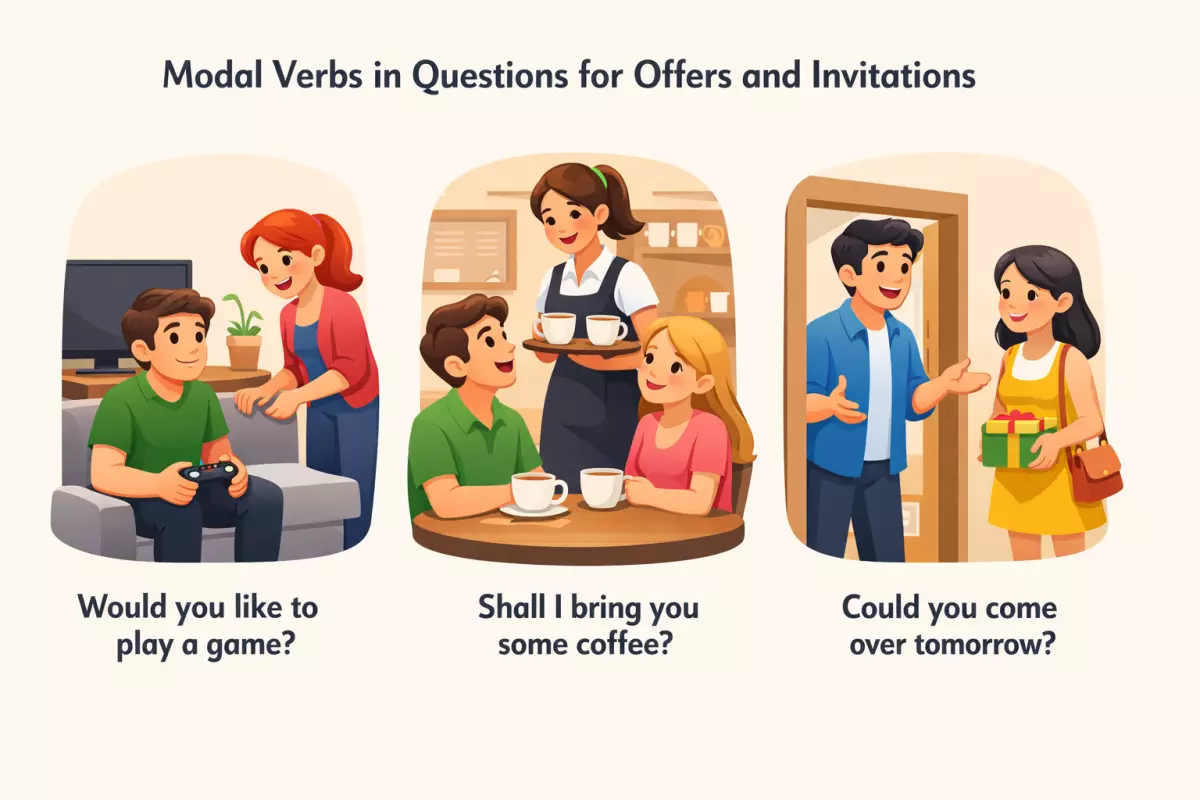 This article explains why English speakers phrase offers and invitations as questions, which modal verbs they use, and how question structure affects tone. It gives everyday examples, shows how context shifts formality, and includes exercises to practice making these modal questions.
- Why English speakers often use questions when offering help or inviting someone
- Common modal verbs used in offer and invitation questions
- How question structure changes the tone of an offer
- Examples of invitations formed with modal verbs in everyday situations
- How context determines whether a question sounds friendly or formal
- How speakers adjust modal verbs when inviting or offering help
- Exercises and practice activities creating modal questions for offers and invitations
A small change in wording can turn a question into a friendly offer or warm invitation. In everyday English, modal verbs help soften requests and show respect for the other person’s choice. This article explains how could, would, and can help you sound natural when offering help, proposing plans, or inviting someone to join you, while keeping your tone polite and clear.
Why English speakers often use questions when offering help or inviting someone
In English, offers and invitations are often phrased as questions because the question form makes the action feel optional, polite, and easy to accept or decline. It also helps the speaker check availability, preference, or permission without sounding pushy.
What the question form achieves
- It gives the listener control. A question frames the offer as a choice, not a decision already made for them.
- It reduces pressure. “Would you like…?” feels lighter than “You want…” or “Take this.”
- It checks practical constraints. Questions can confirm time, ability, or plans before the speaker commits.
- It signals politeness through distance. Modals like would, could, and might create a softer tone than direct imperatives.
- It invites a short, clear response. Yes/no answers (“Yes, please.” / “No, thanks.”) are simple and socially comfortable.
- It avoids assumptions. Asking prevents guessing what someone wants or needs.
- It supports indirectness in formal settings. In workplaces and service contexts, indirect questions often sound more professional.
Common modal-question patterns and what they imply
- Would you like + noun / to + verb? Polite, standard for invitations and offers. (“Would you like some tea?” / “Would you like to join us?”)
- Do you want + noun / to + verb? More direct; fine with friends, can sound abrupt in formal situations. (“Do you want a ride?”)
- Can I + verb? Offering by volunteering your action; common in service and help. (“Can I help you with that?”)
- Could I + verb? More tentative than can I; often used to be extra polite. (“Could I get you a glass of water?”)
- Can you + verb? Often a request, but can function as an offer in context. (“Can you come over?” is an invitation; “Can you carry this?” is a request.)
- Could you + verb? Softer request; sometimes used when offering options. (“Could you come by at 3, or would 4 be better?”)
- Shall I + verb? Offering to do something (more common in British English). (“Shall I open the window?”)
- Shall we + verb? Suggesting a shared plan; invitation to decide together. (“Shall we grab lunch?”)
- Would you like me to + verb? Clear help-offer; emphasizes your action. (“Would you like me to email the file?”)
- Would it help if I + past tense? Very tactful; frames help as a possibility. (“Would it help if I called them?”)
- Could I interest you in + noun? Formal or sales-like; used for polite proposing. (“Could I interest you in dessert?”)
- Why don’t we + base verb? Friendly suggestion; less formal. (“Why don’t we meet after work?”)
Small wording choices that change the tone
- Would usually sounds more courteous than will: ✅ “Would you like to sit?” → softer than “Will you sit?”
- Could often sounds more tentative than can: ✅ “Could I help?” → gentler than “Can I help?”
- Adding any can reduce pressure: “Would you like any help?”
- Using or offers choices and makes refusal easier: “Would you like tea or coffee?”
- Tag questions can sound friendly but assume agreement: “We could start now, couldn’t we?” (use carefully in formal contexts)
Offers vs. requests: how context keeps them clear
- “Can I carry that?” is an offer because the speaker volunteers the action.
- “Can you carry that?” is usually a request because the listener must do the action.
- “Would you like me to…?” strongly signals an offer, even in formal writing.
- When in doubt, make the subject “I” to show you are offering help, not assigning a task.
Common modal verbs used in offer and invitation questions
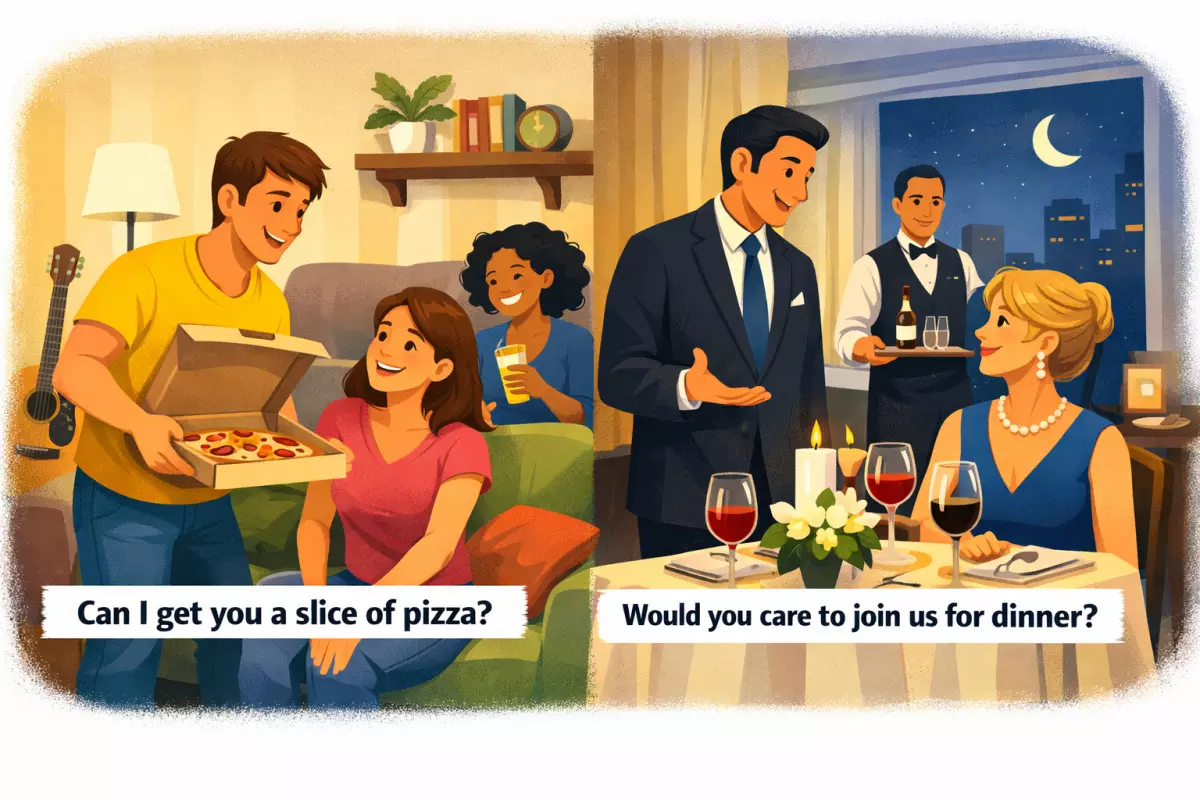
Offer and invitation questions often rely on a small set of modal verbs because they let you sound polite, flexible, and non-demanding. The modal you choose signals how direct the question is, how formal it feels, and whether you are asking about ability, willingness, permission, or a suggestion.
Key modals and the patterns they follow
- Can (informal to neutral): asks about ability or a practical possibility; often used for quick offers and casual invites.
Common patterns:- Can I + base verb…? (offer help) → “Can I carry that for you?”
- Can you + base verb…? (request as an offer of action) → “Can you send me the address?”
- Can we + base verb…? (suggest an invitation) → “Can we meet after work?”
- Could (more polite/softer than can): adds distance and reduces pressure; useful with strangers or in professional settings.
Common patterns:- Could I + base verb…? → “Could I help you with those bags?”
- Could you + base verb…? → “Could you join us for dinner?”
- Could we + base verb…? → “Could we talk for a few minutes?”
- Would (polite, often preference-focused): frames the question around what someone wants, making invitations feel considerate.
Common patterns:- Would you like + noun/to-infinitive…? → “Would you like some tea?” / “Would you like to come along?”
- Would you + base verb…? (gentle request) → “Would you join us on Saturday?”
- Would it be okay if + clause…? → “Would it be okay if I invited a friend?”
- Will (direct, future-oriented): common for immediate offers or decisions; can sound firm, so tone and context matter.
Common patterns:- Will you + base verb…? → “Will you come to the meeting?”
- Will I + base verb…? (checking an arrangement) → “Will I need to bring anything?”
- Will we + base verb…? → “Will we have time for lunch?”
- Shall (suggestion/offer, especially BrE; formal or service-style): often used for proposing a plan or offering to do something.
Common patterns:- Shall I + base verb…? (offer) → “Shall I open the window?”
- Shall we + base verb…? (invitation/suggestion) → “Shall we go for a walk?”
- May (formal permission): less common in everyday invitations, but useful for polite, rule-based settings.
Common patterns:- May I + base verb…? → “May I join you?”
- May we + base verb…? → “May we come in?”
- Might (very tentative): signals low pressure and openness; often used when you are unsure or want to sound especially gentle.
Common patterns:- Might I + base verb…? (very formal/rare) → “Might I suggest a different time?”
- Might we + base verb…? → “Might we reschedule for next week?”
Useful question frames to reuse
- Would you like + noun…? → “Would you like a seat?”
- Would you like to + base verb…? → “Would you like to join us?”
- Can I + base verb…? → “Can I get you something to drink?”
- Could I + base verb…? → “Could I give you a hand?”
- Shall I + base verb…? → “Shall I call a taxi?”
- Shall we + base verb…? → “Shall we grab lunch?”
- Could you + base verb…? → “Could you come a bit earlier?”
- Would you + base verb…? → “Would you come over this evening?”
- May I + base verb…? → “May I sit here?”
- Can we + base verb…? → “Can we meet tomorrow?”
- Could we + base verb…? → “Could we talk after class?”
- Will you + base verb…? → “Will you be there at 7?”
Common usage notes (to avoid awkwardness)
- Use the base verb after a modal: ✅ “Could you come?” ❌ “Could you to come?”
- Would you like…? is usually the safest invitation form because it focuses on the listener’s preference rather than their obligation.
- Can and will can sound too direct in sensitive contexts; switch to could or would to soften the request.
- Shall we…? often implies “let’s do this together,” so it works best when both people are included in the plan.
How question structure changes the tone of an offer
The way a question is built can make the same offer sound warm, formal, tentative, or direct. Small choices—word order, modal verb, tense, and whether you add a tag question—signal how much freedom the listener has and how strongly you expect a “yes.”
Key structural choices and what they communicate
- Modal choice sets the baseline: can often sounds practical and casual; could adds distance and politeness; would is more formal and considerate; shall (in offers) can sound old-fashioned or very formal in many varieties of English.
- Inversion vs. statement questions: Standard inversion (“Can I…?”) is neutral; a statement with rising intonation (“I can get you a taxi?”) can sound tentative or checking for approval, and is more common in casual speech.
- “I” vs. “you” as the subject: “Can I…?” highlights the speaker’s action (a direct offer). “Can you…?” shifts the burden to the listener (often a request, not an offer), even if the intention is helpful.
- Adding “like” softens the invitation: “Would you like…?” frames it as a choice and reduces pressure compared with “Do you want…?” which can sound blunt in some contexts.
- Using “mind” increases politeness and distance: “Would you mind if I…?” is careful and respectful, but can feel overly formal for close friends.
- Negative questions can imply expectation: “Wouldn’t you like some tea?” often suggests the speaker expects agreement; it can feel persuasive rather than open-ended.
- Tag questions invite agreement gently: “I can carry that, can’t I?” can sound playful or reassuring, but may also sound pushy if the listener is trying to refuse.
- Time and conditional framing reduces pressure: “Could I help you with that later?” or “Would you like me to…?” gives the listener more space to decide.
- “Any” and “at all” widen the offer: “Can I do anything to help?” sounds broad and supportive; “Can I help?” is simpler and more neutral.
- Short forms can sound brisk: “Need a hand?” is friendly and efficient, but less formal than “Would you like some help?”
Common offer and invitation patterns (with tone notes)
- “Can I help you?” → neutral, service-oriented
- “Could I help you with that?” → more polite, slightly more formal
- “May I help you?” → formal, often customer-service style
- “Shall I open the window?” → traditional/formal; also used for quick suggestions
- “Would you like a seat?” → considerate, polite invitation
- “Do you want a seat?” → direct; can sound abrupt depending on context
- “Would you like me to call you a taxi?” → helpful, low-pressure
- “Can I get you something to drink?” → friendly, casual hospitality
- “Could I get you something to drink?” → a touch more polite
- “Would you like some water, or tea?” → structured choice; reduces decision effort
- “How about some coffee?” → informal suggestion/invitation
- “Why don’t we grab lunch?” → friendly invitation; can feel assumptive with some listeners
- “Would you mind if I carried that for you?” → very polite; careful about permission
- “Do you need any help?” → checks necessity; can sound less warm than offering directly
- “Can I give you a hand?” → casual, supportive
- “Could I possibly help?” → extra tentative; can sound overly cautious if overused
Avoiding accidental pressure or confusion
- ✅ “Can I carry that for you?” (offer) → ❌ “Can you carry that for you?” (ungrammatical/unclear)
- ✅ “Would you like me to email the details?” (offer) → ❌ “Would you email the details?” (often heard as a request)
- ✅ “Would you like some help?” (invitation to accept) → ❌ “You want help?” (can sound abrupt)
- ✅ “Wouldn’t you like some tea?” (expecting yes) → use with care if you want a truly open choice
When choosing a structure, match the level of formality and how much choice you want to signal. More distance (could/would, “like,” “mind,” conditionals) usually sounds more polite; more direct forms (“can,” short questions, negative questions) often feel quicker but can reduce the listener’s room to decline.
Examples of invitations formed with modal verbs in everyday situations

Invitations in English often use modal verbs to sound polite, flexible, or friendly. The most common patterns are modal + subject + base verb (questions) and short follow-ups that give the other person an easy way to accept or decline.
Common patterns to notice
- Would you like + noun / to + verb for a clear, polite invitation.
- Would you like to + verb when inviting someone to do an activity.
- Could you + verb can function as an invitation when the action benefits both people (often softer than “Can you”).
- Can you + verb is informal and direct; it can sound like a request, so context matters.
- Shall we + verb suggests doing something together and often includes planning.
- Would you be able to + verb adds extra politeness and acknowledges the person’s schedule.
Everyday invitation examples (with typical contexts)
- Would you like to join us for dinner tonight?
- Would you like some coffee?
- Would you like to come over after work?
- Could you come to my place this weekend?
- Can you come to the game on Saturday?
- Would you like to take a walk during lunch?
- Shall we grab a bite after class?
- Shall we meet up at 6 and go together?
- Would you be able to join our meeting tomorrow morning?
- Could you stay for a quick chat after the presentation?
- Would you like to watch a movie tonight?
- Can you drop by for a minute?
- Would you like to sit with us?
- Could you come along to the museum with me?
- Would you like to try this new restaurant?
- Shall we plan something for next weekend?
Small grammar points that prevent common mistakes
- Use the base verb after most modals: ✅ Could you come? ❌ Could you to come?
- Use to + verb after “would like”: ✅ Would you like to join us? ❌ Would you like join us?
- For offers of food/drink, “Would you like + noun” is natural: ✅ Would you like tea?
- “Can you…?” may sound like a favor-request; add a friendly frame when needed: “Can you come by later, if you’re free?”
How context determines whether a question sounds friendly or formal
Whether an offer or invitation feels warm, neutral, or formal depends less on the modal verb alone and more on the situation around it. The same structure can sound casual among friends but polite and distant in customer service. Pay attention to relationship, setting, and how much freedom the listener has to say no.
Key context factors that change the tone
- Relationship and distance: Close relationships tolerate shorter, more direct questions; unfamiliar or professional relationships usually require more softening.
- Power and roles: When the speaker has authority (teacher, manager), questions can feel like instructions unless softened with extra politeness.
- Imposition level: Bigger favors (time, money, inconvenience) typically need more indirect phrasing and more polite modals.
- Setting: Social settings (parties, chats) favor friendly forms; workplaces and service interactions often favor formal, standard politeness.
- Urgency: Urgent situations push speakers toward directness; adding “please” or a brief reason can keep the tone respectful.
- Choice and exit: Invitations sound friendlier when they clearly allow refusal (e.g., “if you’re free,” “no worries if not”).
- How specific the plan is: Vague invitations (“Do you want to…?”) can feel casual; scheduled proposals (“Would you be available at 3?”) tend to feel more formal.
- Channel: Text messages often read more direct than intended; email and formal writing often require fuller, more conventional wording.
Modal choices and the patterns they signal
- Can / Do you want to: Often friendly and informal; common with peers and in relaxed invitations.
- Could / Would: More polite and more distant; common in professional offers and requests.
- Would you like…?: Standard polite invitation/offer; can sound service-oriented, especially in shops or hospitality.
- Shall I…?: Offers help in a respectful, slightly formal way; common when the speaker proposes an action for the listener.
- May I…?: Formal permission-seeking; can sound stiff in casual conversation.
- Why don’t we…?: Friendly suggestion for shared action; usually informal and cooperative.
- How about…? / What about…?: Casual, friendly alternatives; tone depends heavily on intonation and relationship.
- Would you mind…?: Very polite but can feel heavy for small favors; best for higher-imposition situations.
Examples: same goal, different tone depending on context
- Offering a drink:
- Friendly: “Can I get you a coffee?”
- More formal: “Would you like some coffee?”
- Inviting someone to join:
- Friendly: “Do you want to come with us?”
- More formal: “Would you like to join us?”
- Offering help:
- Friendly: “Need a hand?”
- More formal: “Could I help you with that?”
- Proposing a plan:
- Friendly: “How about dinner tonight?”
- More formal: “Would you be available for dinner this evening?”
Softening and strengthening: small additions that shift formality
- Add a choice phrase to keep it friendly: “If you’re free,” “If you’d like,” “Only if it works for you.”
- Add a brief reason to reduce pressure: “Could you help me for a minute? I’m not sure which file is correct.”
- Use polite markers carefully: “please” can sound warm or firm depending on context and punctuation.
- Avoid accidental bluntness in writing: “Can you…?” in email may read like a command; “Could you…?” is often safer.
- Match the listener’s style: if they use formal phrasing, mirror it; if they are casual, overly formal modals may sound distant.
How speakers adjust modal verbs when inviting or offering help
When making an offer or invitation, speakers choose modal verbs based on two main variables: how much freedom the other person has, and how direct the speaker wants to sound. Small changes (like switching can to could, or adding possibly) often shift the tone from casual to more careful and polite.
Common adjustments and what they signal
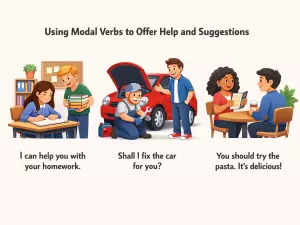
- Use can for simple, friendly offers: “Can I help you with that?” / “Can I get you a drink?”
- Use could to soften the offer: “Could I help you carry those?” / “Could I get you anything?”
- Use may for formal or service-style permission: “May I take your coat?” / “May I help you find something?”
- Use shall (especially UK) for suggestions and planning: “Shall I open the window?” / “Shall we start without them?”
- Use would you like…? for invitations that feel low-pressure: “Would you like to join us?” / “Would you like some tea?”
- Use will for confident, practical offers: “Will that be enough?” / “Will you have another slice?”
- Add “like” to make offers sound warmer: “Would you like me to email it?” vs. “Would I email it?” (less natural)
- Add “to” + verb for activity invitations: “Would you like to come over?” / “Would you like to meet tomorrow?”
- Use “some/any” to match expectations: “Would you like some coffee?” (expecting yes) vs. “Would you like any coffee?” (more neutral)
- Use “a” + noun for specific, countable offers: “Could I get you a taxi?” / “Shall I bring a chair?”
- Use “help + -ing” or “help + (to) verb” depending on style: “Can I help carry this?” / “Can I help you (to) carry this?”
- Choose “we” questions to include the listener: “Shall we grab lunch?” / “Could we talk for a minute?”
- Choose “I” questions to take responsibility: “Shall I call them?” / “Could I take a look?”
- Use “Do you want…?” for very direct, informal invitations: “Do you want to come with us?” (friendly, but can sound pushy in formal settings)
- Use “Would you mind…?” for careful requests framed as consideration: “Would you mind if I opened the window?” / “Would you mind helping me for a second?”
Politeness and distance: small grammar choices that matter
- Past forms add distance: could and would often sound more polite than can and will, even when talking about the present.
- Question structure reduces pressure: “Could you…?” and “Would you like…?” feel less forceful than imperatives like “Help me with this.”
- Extra softeners make refusals easier: adding “possibly,” “perhaps,” or “at all” can make the offer sound more optional: “Could I possibly help at all?”
- Tag questions check comfort: “I can carry that for you, can’t I?” is less common; more natural is “I can carry that for you, if you like.”
Frequent pitfalls to avoid in offers and invitations
- ❌ “Would you like that I help you?” → ✅ “Would you like me to help you?”
- ❌ “Could you like some coffee?” → ✅ “Would you like some coffee?”
- ❌ “May you come to dinner?” → ✅ “Would you like to come to dinner?”
- ❌ “Shall you sit down?” → ✅ “Shall we sit down?” or “Would you like to sit down?”
- ❌ “Can I to help?” → ✅ “Can I help?”
Exercises and practice activities creating modal questions for offers and invitations
Build strong offer and invitation questions by focusing on three things: the modal you choose (politeness and certainty), the action you’re offering or suggesting, and the time/place details. The practice below moves from controlled form work to realistic speaking and writing tasks.
1) Pattern drills: choose the best modal question
Complete each item by choosing the most natural question (A or B) for an offer or invitation.
- You see a colleague carrying boxes.
A) Shall I help you with those?
B) Must I help you with those? - You want to invite a friend to dinner this weekend.
A) Would you like to come over for dinner on Saturday?
B) Could you like to come over for dinner on Saturday? - You’re planning a meeting and want to suggest a time.
A) Should we meet at 3 pm?
B) Must we meet at 3 pm? - You’re offering a visitor a drink.
A) Would you like some water?
B) Do you like some water? - You want to offer to call someone for a client.
A) Shall I give her a call for you?
B) Should I give her a call for you? - You’re inviting a classmate to study together.
A) Could we study together after class?
B) Can we study together after class? - You want to politely ask a guest to sit.
A) Would you like to take a seat?
B) Will you like to take a seat? - You’re offering to open a window because the room is warm.
A) Shall I open the window?
B) May you open the window? - You’re proposing an idea in a team discussion.
A) Why don’t we try a shorter agenda?
B) Why we don’t try a shorter agenda? - You’re inviting a neighbor to join you for a walk.
A) Would you like to go for a walk later?
B) Would you like go for a walk later?
Show answers
- A
- A
- A
- A
- A (both can work, but “Shall I…?” is a classic offer)
- A or B (both possible; “Could we…?” is often softer)
- A
- A
- A
- A
2) Fix the form: word order and modal choice
Rewrite each sentence as a natural question used for an offer or invitation. Keep the meaning.
- You like to have some tea?
- Can you like to join us for lunch?
- Why don’t meet we at the café?
- I shall carry that for you?
- Would you to like come to my place after work?
- May I to help you with your bags?
- Should I to send you the file now?
- Could you to give me a hand for a minute?
- Would you mind to close the door?
- Shall we going to the museum on Sunday?
- Do you want that I pick you up?
- Could we meet tomorrow, is it?
Show answers
- Would you like some tea?
- Would you like to join us for lunch?
- Why don’t we meet at the café?
- Shall I carry that for you?
- Would you like to come to my place after work?
- May I help you with your bags?
- Should I send you the file now?
- Could you give me a hand for a minute?
- Would you mind closing the door?
- Shall we go to the museum on Sunday?
- Do you want me to pick you up?
- Could we meet tomorrow?
3) Expand the question: add detail without losing politeness
Rewrite each prompt as a complete modal question. Include the extra detail in parentheses.
- Offer to help (carry groceries / to the car).
- Invite someone (movie / Friday evening).
- Suggest a plan (start early / avoid traffic).
- Offer a choice (tea or coffee).
- Invite a coworker (join / quick lunch / nearby).
- Offer to do a task (email the summary / after the meeting).
- Suggest a time (meet / 10:30 / online).
- Offer reassurance and help (look at the form / together).
- Invite someone politely (come in / sit down).
- Suggest an alternative (take a taxi / it’s raining).
Show answers
- Shall I carry your groceries to the car?
- Would you like to go to a movie on Friday evening?
- Should we start early to avoid traffic?
- Would you like tea or coffee?
- Would you like to join me for a quick lunch nearby?
- Shall I email the summary after the meeting?
- Could we meet online at 10:30?
- Would you like me to look at the form with you?
- Would you like to come in and sit down?
- Should we take a taxi since it’s raining?
4) Choose the right pattern for the situation
Use the prompts to produce one question each. Aim for a natural match between situation and modal (for example, “Would you like…?” for offering/hosting, “Shall I…?” for volunteering, “Should we…?” for suggestions, “Could we…?” for softer planning).
- You notice someone looks lost in your building.
- A guest arrives and you want to offer food.
- Your friend seems tired; you want to suggest a break.
- You’re hosting a meeting and want to propose starting.
- You want to invite a new neighbor to a casual event.
- A teammate is struggling with a spreadsheet; you want to offer help.
- You’re on the phone and can take a message for someone.
- You want to suggest changing seats because it’s noisy.
- You’re offering to share notes after class.
- You want to invite someone to join your table at a café.
- You want to offer to reschedule because of a conflict.
- You want to suggest a different route home.
5) Mini role-plays: produce two versions (neutral and extra polite)
For each scenario, write (or say) two questions: one neutral and one more formal. Keep them short and realistic.
- You’re offering to pay for a coworker’s coffee because they forgot their wallet.
- You’re inviting a client to wait in a meeting room.
- You’re suggesting a team lunch to welcome a new colleague.
- You’re offering to proofread someone’s email before they send it.
- You’re inviting a friend to join a weekend trip, but you want to sound low-pressure.
- You’re offering to carry a suitcase up the stairs for an older neighbor.
Show answers
- Neutral: Do you want me to get this? / Polite: Would you like me to pay for your coffee?
- Neutral: Can you wait in the meeting room? / Polite: Would you like to wait in the meeting room?
- Neutral: Should we go out for lunch to welcome Sam? / Polite: Would you like to join us for lunch to welcome Sam?
- Neutral: Do you want me to proofread it? / Polite: Would you like me to proofread your email before you send it?
- Neutral: Do you want to come on a weekend trip? / Polite: Would you like to join us for a weekend trip, if you’re free?
- Neutral: Can I carry that? / Polite: Shall I carry your suitcase up the stairs?
6) Quick checklist for self-correction
- Use modal + base verb: ✅ “Could we meet…” ❌ “Could we meeting…”
- Use “Would you like…?” (not “Could you like…?”) for invitations and hosted offers.
- Use “Shall I…?” to volunteer an action; use “Shall we…?” to propose a shared plan.
- Prefer “Would you mind + -ing” for polite requests, not for invitations.
- Add softeners when needed: “this afternoon,” “if you’d like,” “when you have a moment.”