Prepositions in Contracts and Legal English: subject to, under

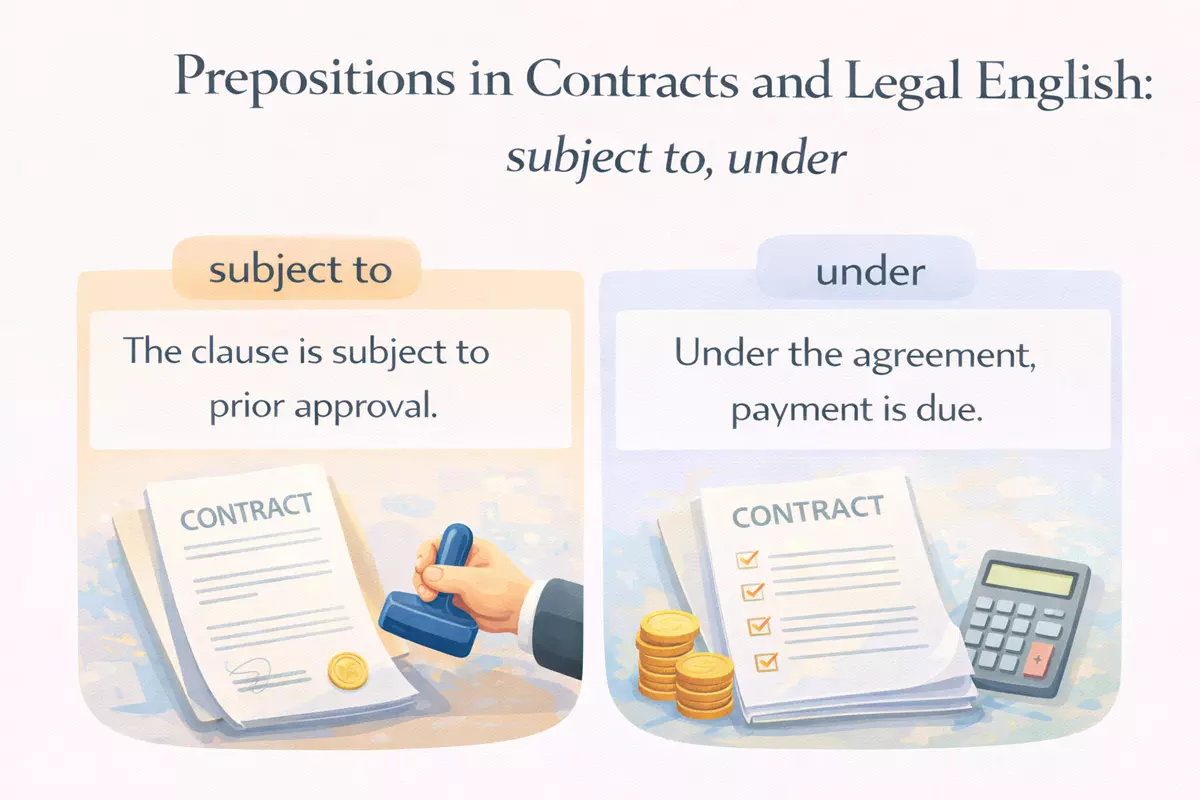 Here we the use of prepositions in legal drafting, including how 'subject to' shapes conditional obligations, the authority behind 'under' versus 'pursuant to', spatial and timeline terms, subtle distinctions like 'notwithstanding', and best drafting…
- Semantic weight of 'subject to' in defining conditional obligations
- Using 'under' vs 'pursuant to' for authority and contractual basis
- Spatial and hierarchical logic: 'herein', 'therein', and 'whereof' patterns
- Precision in timelines: 'within', 'no later than', and 'including but not limited to'
- Non-interchangeability: Subtle differences between 'notwithstanding' and 'subject to'
- Prepositional doublets in legal drafting: 'by and between', 'for and on behalf of'
- Structural placement: Managing long-distance dependencies in complex clauses
- Ambiguity audit: Fixing vague prepositional phrases in rights and duties
- Practice: Drafting and editing clauses for strict legal compliance
Understanding the language used in legal documents can be challenging, especially since seemingly simple words like "subject to" and "under" often have important and specific meanings. These prepositions can significantly affect how a contract is interpreted, so it is essential to pay close attention to their use. By carefully considering these terms, individuals and businesses can better understand their obligations and rights, helping to prevent misunderstandings or disputes that might arise from misinterpretation.
Semantic weight of 'subject to' in defining conditional obligations
In legal English, the phrase subject to is a powerful tool for expressing when one obligation, right, or provision is dependent on another. Rather than simply linking clauses, this preposition signals that the operation or enforcement of one term is conditional upon the fulfillment, existence, or application of another. This creates a clear legal hierarchy, ensuring that certain terms take precedence or that specific events must occur before others become effective.
How 'subject to' frames conditionality
The use of subject to clarifies relationships between contractual provisions. For example, it can subordinate an entire section, limit the scope of an obligation, or indicate that an exception applies. This phrase is not mere legal filler; it shapes the reader’s understanding of what must happen for a particular clause to operate.
- Establishes that a clause only applies if a condition is satisfied
- Prioritizes one provision over another in case of conflict
- Signals exceptions or carve-outs to otherwise general rules
- Limits liability or obligations based on external events
- Connects timelines (“subject to earlier termination”)
- Restricts rights (“subject to applicable law”)
- Highlights dependencies on third-party actions
- Controls sequence (“subject to completion of due diligence”)
- Indicates regulatory or statutory compliance
- Specifies financial conditions (“subject to payment of fees”)
Usage patterns in contracts
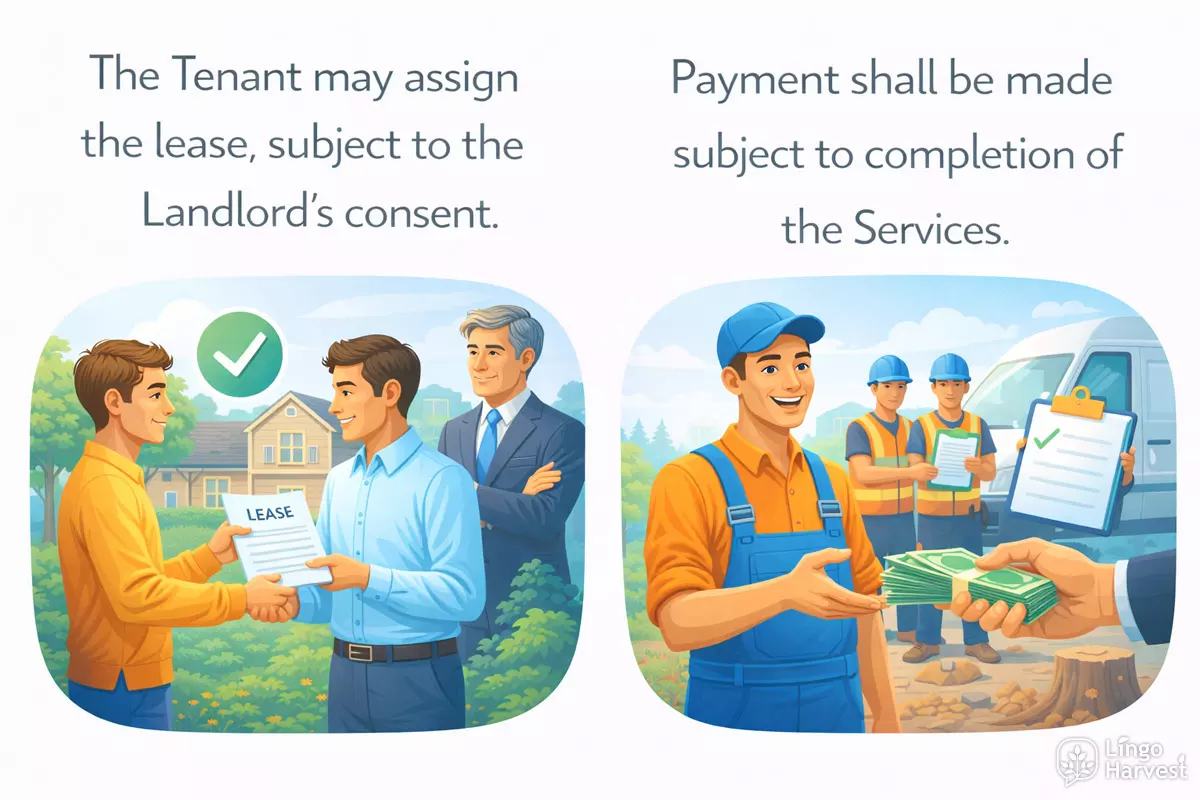
Writers often use subject to at the beginning of a clause, but it can also appear mid-sentence. Its semantic force comes from what follows: the referenced condition or limitation. Consider these common formulations:
- “The Tenant may assign the lease, subject to the Landlord’s consent.”
- “Payment shall be made subject to completion of the Services.”
- “The obligations herein are subject to applicable law.”
- “Subject to Section 7, the Company will…”
- “Any extension is subject to prior written agreement.”
- “The warranty is subject to the following conditions:”
- “Use of the software is subject to license terms.”
- “All sales are subject to availability.”
- “Delivery dates are subject to change without notice.”
- “The offer is subject to regulatory approval.”
- “Subject to earlier termination, the Agreement remains in effect for two years.”
- “Benefits are subject to employee eligibility.”
Nuances and pitfalls
Misusing or omitting subject to can lead to ambiguity, disputes, or unintended obligations. It’s crucial to specify exactly which provision or external factor the clause depends on. Vague references reduce enforceability.
Comparison with other prepositions
While under is often used to indicate a source of authority or compliance (“under this Agreement”), subject to always introduces a condition or limitation. Their functions are distinct and not interchangeable.
| Phrase | Effect on Obligation |
|---|---|
| Subject to completion of X | Obligation is conditional; only arises after X is complete |
| Under this Agreement | Obligation exists by virtue of the contract itself |
| Subject to applicable law | Obligation is limited or qualified by legal requirements |
| Under statute | Obligation arises directly from legislation |
In summary, subject to is essential for expressing dependencies and establishing conditionality in legal documents. Its careful use ensures clarity and manages risk by structuring how and when obligations arise.
Using 'under' vs 'pursuant to' for authority and contractual basis
When drafting or interpreting contracts, choosing between "under" and "pursuant to" can have practical implications for clarity and precision. Both prepositions relate to the source of authority or the legal basis for an obligation, but they are not always interchangeable. Understanding how each is typically used helps avoid ambiguity and ensures the intended meaning is clear to all parties.
General Usage and Nuances
"Under" is frequently used to indicate that something is governed by, or subject to, the terms or authority of a contract, statute, or clause. It often signals a direct relationship between the provision and the obligation or right. In contrast, "pursuant to" emphasizes that an action is being taken in accordance with, as a result of, or as authorized by a specific provision or agreement. It often highlights compliance or procedural adherence.
Contextual Examples
Consider the following typical uses in contractual language:
- Obligations under this Agreement shall survive termination.
- Payment will be made pursuant to Section 5.2.
- Any dispute arising under the Employment Contract shall be resolved by arbitration.
- Notices sent pursuant to this Article must follow the specified process.
- The parties' rights under applicable law remain unaffected.
- Delivery dates may be extended pursuant to mutual written agreement.
- Claims under the warranty must be submitted within 12 months.
- Refunds will be provided pursuant to the company’s returns policy.
- Interest is payable under Clause 7.
- Termination may occur pursuant to a material breach.
- Employee benefits under the plan are subject to change.
- Adjustments are permitted pursuant to regulatory approval.
Comparing 'Under' and 'Pursuant to' in Contract Drafting
The difference between these prepositions can affect interpretation, especially in formal legal documents. "Under" is often preferred where the provision directly creates a right or duty, while "pursuant to" is favored when referencing the process or mechanism by which something is done.
| Preposition | Typical Context or Meaning | Sample Usage |
|---|---|---|
| Under | Direct rights, duties, or status conferred by a contract, law, or clause | The parties agree to perform their obligations under this Agreement. |
| Pursuant to | Action taken in accordance with a specific provision, process, or authority | Invoices will be submitted pursuant to the procedure outlined in Section 4.3. |
| Under | Liabilities or entitlements arising from a legal instrument | Liability under the contract is limited to the purchase price. |
| Pursuant to | Compliance with instructions, orders, or steps set by the agreement | Termination occurs pursuant to written notice by either party. |
Practical Tips for Contract Drafters
- Use under when referring to rights, obligations, or status that exist because of a contract or law.
- Choose pursuant to for steps or actions that must follow a process or a specific provision.
- Avoid using both terms in the same sentence unless each serves a distinct legal purpose.
- When in doubt, ask whether the reference is to a direct right or duty (use under) or to an action taken in accordance with a provision (use pursuant to).
- Selecting the correct preposition helps keep contractual language precise and reduces the risk of misinterpretation.
Spatial and hierarchical logic: 'herein', 'therein', and 'whereof' patterns
Legal English frequently uses adverbs like "herein," "therein," and "whereof" to clarify relationships within contractual documents. These words serve as linguistic shortcuts, letting drafters refer back to specific sections, provisions, or the contract as a whole without repeating long phrases. Their function is not just spatial—pointing to a location in the document—but also hierarchical, indicating scope and context.
The role of 'herein', 'therein', and related terms
Such adverbs are rooted in the need for precision and internal referencing. "Herein" typically means "in this document," while "therein" refers to "in that (other) document" or section. "Whereof" ties back to "of which" or "of the thing just mentioned." These patterns allow legal writers to avoid ambiguity and make cross-references clear.
- Herein – in this agreement
- Therein – in that agreement/section
- Hereunder – under this document/provision
- Thereunder – under that provision/section
- Hereto – to this document
- Thereto – to that document/section
- Hereof – of this agreement
- Thereof – of that agreement/section
- Whereof – of which (often in recitals or concluding clauses)
- Wherein – in which (the place or context just mentioned)
- Whereby – by which (means or process just described)
- Whereafter – after which (sequence or timing)
- Whereinsoever – in whatever place or respect
- Hereby – by this act/document
- Hereinafter – later in this document
- Thereinafter – later in that document/section
- Herewith – with this (enclosed with this document)
- Therewith – with that (enclosed with that document)
Hierarchical referencing in legal drafting
Writers use these terms to create a logical map within contracts, helping readers track obligations and rights as they move through different articles or appendices. For instance, "subject to the provisions herein" ties a statement to the current contract, while "pursuant to Section 5 therein" points to a section in another referenced document.
Example patterns in context
Understanding the context is crucial. For example:
- "The rights granted herein are subject to the limitations set forth in Article 4."
- "Any breach thereof shall constitute grounds for termination."
- "Payments due hereunder must be made within 30 days."
- "The parties agree to the terms set out hereinbefore."
- "The schedule attached hereto forms part of this agreement."
These referencing patterns reduce wordiness and clarify which part of the contract governs a particular issue, reinforcing both spatial (where in the document) and hierarchical (which level or section) logic. Mastery of these forms is essential for navigating and drafting precise legal documents.
Precision in timelines: 'within', 'no later than', and 'including but not limited to'
Legal English relies on clear expressions to set deadlines and scope, especially in contracts. Terms like within, no later than, and including but not limited to help to avoid ambiguity about timing and breadth of obligations. Understanding how these phrases function is essential for drafting enforceable agreements and managing expectations between parties.
Specifying Deadlines: 'within' vs. 'no later than'
The phrases within and no later than often appear in contractual clauses to define timeframes for action. However, their nuances are distinct:
- Within sets a window that begins at a specific starting point and ends before a specified period expires. For example, "within 30 days of receipt" means the action must occur any time after receipt, but before the 30th day ends.
- No later than sets a hard deadline, requiring completion on or before a particular date or event. "No later than June 30" allows performance up to and including June 30, but not after.
Misunderstanding these terms can lead to disputes about whether an obligation was timely.
Examples of Timeline Language
Here are some commonly used patterns for expressing timeframes and deadlines in legal documents:
- within 5 business days of notice
- no later than 10 calendar days after execution
- at least 48 hours prior to delivery
- on or before the Effective Date
- not earlier than 1 week before closing
- immediately upon request
- promptly after receipt
- by the end of each month
- following completion of services
- as soon as practicable
- upon acceptance
- from time to time during the Term
- continuously throughout the period
- as of the Commencement Date
- no sooner than 30 days prior to expiration
- after the occurrence of an Event of Default
- not later than the due date
- until terminated
Expanding Scope: 'including but not limited to'
This phrase is used to introduce examples without limiting the range of what is covered. It makes clear that the items listed are not exhaustive, helping prevent loopholes or restrictive interpretations. For example, "including but not limited to damages, losses, and expenses" means the party is responsible for those items and potentially others not specifically named.
Comparing Timeline Phrases
When deciding which phrase to use, consider the degree of flexibility or strictness required. The table below summarizes the core distinctions:
| Phrase | Implication |
|---|---|
| within [time period] | Action must occur any time after the trigger and before the period ends |
| no later than [date/event] | Action must be completed on or before a specific point |
| including but not limited to | List is illustrative, not exhaustive; wider interpretation |
By choosing the right expressions for timing and scope, drafters can enhance clarity and minimize the risk of misinterpretation in contracts.
Non-interchangeability: Subtle differences between 'notwithstanding' and 'subject to'
In legal drafting, the distinction between "notwithstanding" and "subject to" is more than a matter of style; each preposition signals a different relationship between contract provisions. Understanding the nuances is vital for avoiding ambiguity and ensuring that contractual priorities are enforced as intended.
How 'notwithstanding' operates
"Notwithstanding" is used to override or carve out exceptions to other provisions. When a clause begins with this word, it means that the clause will apply even if another section says otherwise. For example, "Notwithstanding anything to the contrary in Section 5..." makes it clear that the new clause prevails over Section 5 in case of conflict.
How 'subject to' functions
By contrast, "subject to" subordinates the current clause to another. It means the provision is conditional on, or limited by, another referenced section. For instance, "Subject to Section 7, the Buyer shall..." tells the reader that Section 7 may limit or override this clause.
Key differences summarized
- Hierarchy: "Notwithstanding" elevates its clause above others; "subject to" lowers its clause beneath the referenced provision.
- Direction of effect: The first makes exceptions; the second imposes conditions or limitations.
- Drafting impact: Swapping these terms can invert the intended legal effect.
- Clarity: Misuse may cause confusion or litigation over which clause prevails.
Examples of usage in context
- Notwithstanding Section 8, the Seller remains liable for damages.
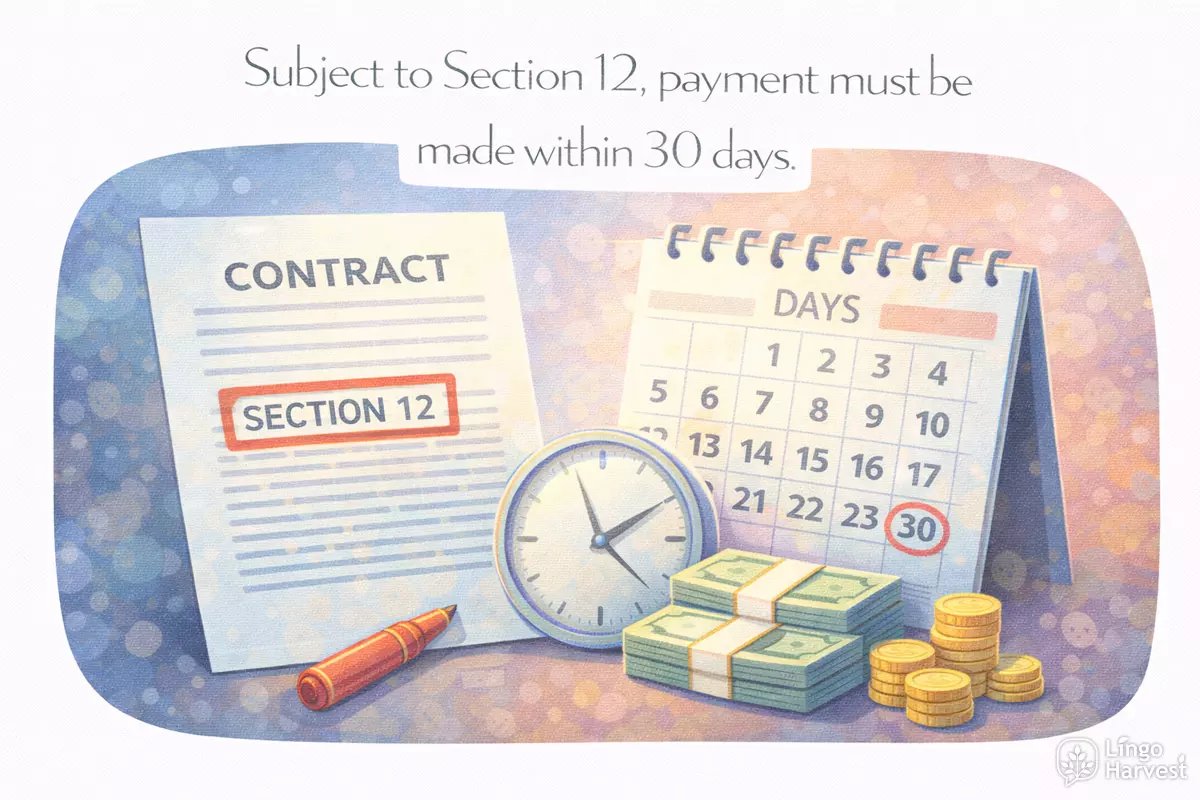
- Subject to Section 12, payment must be made within 30 days.
- Notwithstanding any other provision of this Agreement, termination requires 90 days’ notice.
- Subject to applicable law, the parties may agree to modify terms.
- Notwithstanding the foregoing, the warranty does not cover misuse.
- Subject to prior written consent, the Licensee may sublicense rights.
- Notwithstanding Article 3, the Company may withhold payment for non-performance.
- Subject to the approval of the Board, dividends will be declared annually.
- Notwithstanding any conflict, this confidentiality clause survives termination.
- Subject to the terms herein, the Agreement is binding on successors.
Comparison at a glance
| 'Notwithstanding' | 'Subject to' |
|---|---|
| Overrides or creates an exception to another clause | Makes the clause conditional or subordinate to another |
| Clause prevails in case of conflict | Other clause prevails in case of conflict |
| Signals supremacy for the provision it introduces | Signals deference to the referenced provision |
| Example: "Notwithstanding Section 2, payment is due in 10 days." | Example: "Subject to Section 2, payment is due in 10 days." |
Careful choice between these prepositions ensures the contract reflects the parties’ real intentions. Even a small drafting error can change which obligations or rights take precedence, so precision is essential.
Prepositional doublets in legal drafting: 'by and between', 'for and on behalf of'
Legal English frequently employs pairs of prepositions—sometimes called "doublets"—to capture complex relationships in contracts. These paired expressions are not only traditional but also serve to clarify the roles and responsibilities of parties, which is crucial for legal certainty. Rather than relying on a single preposition, drafters often use combinations such as "by and between" or "for and on behalf of" to remove ambiguity.
Usage and Function of Common Doublets
"By and between" is a classic example found in the opening paragraphs of agreements. The phrase designates the parties to the contract, specifying both who is involved and the reciprocal nature of obligations. Meanwhile, "for and on behalf of" distinguishes situations where one party is acting as a representative or agent, making it clear that actions are not for personal benefit but instead for another entity or individual.
Examples of Prepositional Doublets in Contracts
Some of the most frequently encountered doublets and their uses include:
- By and between – defines the parties entering into the agreement.
- For and on behalf of – clarifies agency relationships.
- To and from – describes the directionality of obligations or payments.
- In and to – often seen in IP assignments, granting rights both "in" and "to" a subject matter.
- Of and concerning – broadens the scope of what is covered.
- From and after – sets out when a provision becomes effective.
- Under and pursuant to – links obligations to the authority of the contract.
- With and subject to – combines conditions and limitations.
- In respect of – covers issues relating to a subject.
- On or before – sets deadlines with flexibility.
- As and when – describes timing for performance.
- Without prejudice to – preserves rights or positions.
- At or about – gives approximate timing or location.
- In connection with – broadens the link between concepts.
- For the benefit of – clarifies for whom a provision is intended.
- Notwithstanding anything to the contrary – establishes precedence of a clause.
- In lieu of – indicates substitution.
- In accordance with – ties actions to requirements or standards.
Precision and Redundancy: Why Use Doublets?
The use of paired prepositions is partly a product of legal tradition and partly a way to cover potential interpretative gaps. While sometimes criticized for redundancy, these combinations are valued for their ability to lock down the intended meaning, especially in cross-border or multi-jurisdictional contracts where a single preposition might have different interpretations.
Comparing 'By and Between' vs. 'For and on Behalf of'
| Expression | Typical Usage in Contracts |
|---|---|
| By and between | Used in the recitals to name the contracting parties, e.g., "This Agreement is made by and between Company A and Company B." |
| For and on behalf of | Indicates agency, where one party signs or acts as a representative, e.g., "The Attorney signs for and on behalf of the Client." |
| Under and pursuant to | Links rights or obligations to the authority of the contract or law, e.g., "Under and pursuant to Section 5, the Licensee shall..." |
| In and to | Common in intellectual property transfers, e.g., "Assign all rights in and to the patent." |
Drafting Tips
When using these prepositional combinations, consider both clarity and necessity. While doublets can enhance precision, excessive use may make contracts verbose. Aim for a balance: include paired prepositions where ambiguity might arise, but avoid unnecessary repetition. Always tailor your drafting to the specific legal context and the parties’ needs.
Structural placement: Managing long-distance dependencies in complex clauses
Understanding how prepositions like subject to and under are positioned in legal sentences is essential for clarity, especially in lengthy or multi-part contractual clauses. Legal English often demands precision, and misplaced prepositional phrases can obscure the relationship between obligations, exceptions, and conditions.
In complex contracts, prepositional phrases may be separated from the nouns or verbs they modify by several intervening words, phrases, or even entire clauses. This can create what linguists call "long-distance dependencies," where the logical connection between elements is stretched across the sentence. Managing these dependencies is crucial for avoiding ambiguity and ensuring that contractual provisions are interpreted as intended.
Common patterns with subject to and under
- Subject to: Often introduces an exception, restriction, or condition, and may appear at the start, middle, or end of a clause.
- Under: Typically specifies the applicable law, regulation, or contractual section, and is frequently embedded within conditional or referential phrases.
Examples of long-distance placement
- The Seller shall, subject to Clause 10, deliver the Goods within 30 days.
- Any payment made under this Agreement shall be non-refundable.
- The Buyer may, subject to prior written notice, terminate the contract for convenience.
- Obligations under applicable law shall prevail over conflicting contract terms.
- This guarantee is, subject to the limitations set out herein, valid for five years.
- Each party must, under Section 5(b), provide monthly reports.
- Performance is, subject to regulatory approval, scheduled to begin next quarter.
- Liability under Clause 12 is capped at the amount paid.
- The licensee may, subject to the Licensor’s consent, sublicense the rights granted.
- Any amendment, subject to mutual agreement, must be in writing.
- Payments under this provision are due within 10 days.
- The obligation, subject to force majeure, remains in effect.
Guidelines for effective placement
- Keep prepositional phrases as close as possible to the words they modify to reduce ambiguity.
- In lengthy clauses, use commas to set off subject to or under phrases for readability.
- When referencing other contract sections, be explicit (e.g., “under Section 8(a)” instead of “under the above”).
- Review sentences for unintended meanings caused by intervening phrases or clauses.
Comparison: Placement and Function
| Preposition | Typical Role & Placement |
|---|---|
| Subject to | Introduces exceptions or conditions; may appear at the beginning or within the clause, often separated by commas. |
| Under | Identifies the legal basis, regulation, or contract section; usually embedded in reference phrases, close to the noun or verb it modifies. |
| Subject to… (long-distance) | Can be separated from the main clause by intervening phrases, requiring careful punctuation for clarity. |
| Under… (long-distance) | Typically kept near the reference, but in complex sentences, may be distanced by modifying clauses. |
In summary, careful placement of prepositional phrases in legal drafting reduces the risk of misinterpretation, particularly in clauses with extended or embedded structures. Awareness of these dependencies in contract language helps ensure that obligations and exceptions are clearly linked to the right terms.
Ambiguity audit: Fixing vague prepositional phrases in rights and duties
Vague prepositional phrases like "subject to" or "under" can cause real confusion when defining rights and duties in contracts. Ambiguity often creeps in when these phrases are left open-ended or lack clear referents. For legal English, clarity means spelling out exactly what condition, document, or provision is being referenced—and what effect that reference has.
Common sources of vagueness
- Omitting the specific section, document, or law meant by the preposition
- Using "subject to" without clarifying what is subordinated and to what
- Employing "under" where the relationship is unclear (e.g., is it authority, compliance, or location?)
- Layering multiple prepositional phrases, making it hard to track which rule applies
Redrafting strategies for clarity
- Always specify the exact clause, schedule, or law after the preposition.
- Replace ambiguous prepositions with more precise language where possible.
- Break up long sentences containing several rights or duties linked by prepositions.
- Use defined terms and cross-references for complex arrangements.
- Test each phrase by asking: "What, exactly, is being made conditional or subordinate to what?"
Examples: Before and after clarification
- Before: "The Buyer shall deliver the Goods subject to payment."
After: "The Buyer shall deliver the Goods only after receiving full payment from the Seller." - Before: "The Tenant may terminate the Lease under this Agreement."
After: "The Tenant may terminate the Lease in accordance with Clause 14 of this Agreement." - Before: "Obligations under applicable law."
After: "Obligations as required by the Data Protection Act 2018."
Ambiguous prepositional patterns to watch for
- subject to approval → The final budget is subject to approval by the finance committee.
- under the agreement → Under the agreement, both parties must provide written notice before termination.
- subject to the provisions → This clause is subject to the provisions set out in Section 8.
- under law → Under law, personal data must be processed fairly and transparently.
- subject to conditions → The offer is subject to conditions listed in the attached schedule.
- under applicable regulations → Under applicable regulations, the product must meet safety standards.
- subject to change → All dates are subject to change without prior notice.
- under instructions → Under instructions from management, the team will suspend the rollout.
- subject to notification → Any extension is subject to notification in writing.
- under this section → Under this section, the client may request a refund within 14 days.
- subject to requirements → Access is subject to requirements set by the compliance department.
- under the authority → The inspection was carried out under the authority of the local regulator.
- subject to exceptions → The policy applies to all employees, subject to exceptions outlined below.
- under contract → Under contract, the supplier must deliver the goods within 30 days.
- subject to approval by… → The revised scope is subject to approval by the project sponsor.
- under direction of… → The audit was conducted under direction of the legal department.
- subject to any claim → Payment may be withheld if the invoice is subject to any claim.
- under the following terms → The service is provided under the following terms and conditions.
Quick comparison: "subject to" vs. "under" in legal drafting
| Phrase | Typical Ambiguity |
|---|---|
| subject to Clause 5 | Does Clause 5 override, limit, or merely relate to the preceding duty? |
| under the Lease | Is the right/duty created by the Lease, or merely compliant with it? |
| subject to approval | Who must approve? What standard applies? When must approval be obtained? |
| under applicable law | Which law? Local, national, international? Which version or date? |
Checklist for eliminating ambiguity
- Identify every prepositional phrase attached to a right or duty.
- Ask what specific document, law, or clause is meant.
- Rewrite to specify the reference in full.
- Clarify the legal effect—does it create a condition, limitation, or just reference?
- Review the text for multiple meanings and potential misinterpretation.
Clear, specific use of prepositions is essential for enforceable, predictable contract language. Regularly reviewing and refining these phrases ensures that parties’ rights and obligations are not left open to dispute.
Practice: Drafting and editing clauses for strict legal compliance
When drafting legal documents, precise use of prepositions such as “subject to” and “under” is essential to avoid ambiguity and ensure enforceability. Legal professionals must be able to recognize, edit, and refine clauses to meet formal requirements and reflect the parties’ true intentions.
Common Issues with “Subject to” and “Under”
Many contract clauses become problematic due to incorrect or ambiguous use of these prepositions. Consider the following practice items to sharpen your editing skills:
- “Subject to Clause 5, the Seller shall deliver the goods by June 1.”
- “The obligations of the Buyer are under Clause 7.”
- “Payment is subject to approval by the Lender.”
- “Under this Agreement, the Contractor must maintain insurance.”
- “Interest will be charged subject to the Bank’s discretion.”
- “Any dispute arising under this Agreement shall be settled by arbitration.”
- “The employee’s rights are subject to the company policy.”
- “The warranty applies under the following conditions.”
- “Termination is subject to thirty days’ notice.”
- “All obligations under Clause 4 remain in force after expiry.”
Editing Tasks: Identify Ambiguities and Suggest Corrections
Review these sentences. For each, determine if “subject to” or “under” is used correctly. If not, suggest a clearer alternative.
- “The Supplier must, subject to prior written consent, assign its rights.”
- “Under Clause 12, the Lessee may terminate the lease.”
- “The insurance is subject to the Insurer’s terms and conditions.”
- “The obligations under this section shall survive termination.”
- “Any changes are subject to mutual agreement.”
- “Payment shall be made under the terms of this Agreement.”
- “The License is granted subject to compliance with applicable law.”
- “Under this provision, either party may request arbitration.”
- “Delivery dates are subject to availability of materials.”
- “The Contractor operates under the authority of the Client.”
Show answers
- Correct; “subject to prior written consent” correctly makes the assignment conditional.
- Correct; “under Clause 12” means “according to Clause 12”.
- Correct; “subject to” indicates that the insurance depends on the stated terms.
- Correct; “under this section” refers to obligations defined within that section.
- Correct; “subject to mutual agreement” means changes require consent from both parties.
- Correct; “under the terms” links the obligation directly to the agreement.
- Correct; “subject to compliance” makes the license conditional on legal compliance.
- Correct; “under this provision” refers to authority granted by a specific clause.
- Correct; “subject to availability” clearly expresses a limitation.
- Correct; “under the authority” indicates lawful power granted by another party.
Comparison Table: “Subject to” vs. “Under” in Legal Clauses
| Expression | Typical Legal Function | Example Clause | Potential Pitfall |
|---|---|---|---|
| Subject to | Condition or exception; something depends on another provision | “Subject to Clause 10, payment shall be made within 30 days.” | Can create uncertainty if not specifying what is conditional |
| Under | Governing provision or authority; “by virtue of” | “Under this Agreement, the Agent may act on behalf of the Principal.” | Misusing for conditions, leading to confusion |
| Subject to | Limitation or restriction | “The license is granted subject to compliance with regulations.” | Overuse may cloud which obligations are absolute |
| Under | Reference to specific sections or laws | “All disputes arising under Section 15 will be resolved by mediation.” | Vague use may obscure which provision applies |
Checklist: Ensuring Precise Use in Your Contracts
- Is “subject to” used to introduce a condition, exception, or limitation?
- Is “under” applied to indicate the source of authority or the relevant provision?
- Have you checked for ambiguity in compound sentences?
- Are cross-references clear and accurate?
- Do all parties understand the hierarchy of obligations?
- Does each clause reflect the intended legal effect?
- Is unnecessary repetition of prepositions avoided?
- Have you avoided using “subject to” where “provided that” or “if” would be clearer?
- Is “under” not used to express conditions?
- Have you reviewed for consistent terminology throughout?
Quick Exercise: Spot the Error
Which of the following sentences misuses “subject to” or “under”? Mark all that apply.
- a) “The Buyer shall pay under receipt of invoice.”
- b) “The contract is subject to applicable law.”
- c) “The Seller must deliver the goods under Clause 6.”
- d) “All obligations are subject to timely performance.”
- e) “The refund is under our return policy.”
- f) “The discount applies subject to you pay within 10 days.”
- g) “Under the regulations, the product must meet safety standards.”
- h) “The parties may amend the terms under mutual agreement.”
- i) “The warranty is subject to normal wear and tear.”
- j) “The Service Provider acts under behalf of the Client.”
Show answers
- a) Incorrect – “upon receipt of the invoice” is correct; “under” is not used for time/events.
- b) Acceptable – “subject to applicable law” is standard.
- c) Acceptable, but slightly formal/old-fashioned – “in accordance with Clause 6” can be clearer.
- d) Acceptable – “subject to timely performance” correctly adds a condition.
- e) Acceptable, but “under our return policy” is more natural than “under the return policy” in many contexts.
- f) Incorrect – use “subject to payment within 10 days” or “provided that you pay within 10 days”.
- g) Acceptable – “under the regulations” correctly means “according to”.
- h) Incorrect/awkward – use “subject to mutual agreement” or “by mutual agreement”.
- i) Acceptable – this is a common warranty limitation.
- j) Incorrect – “on behalf of the Client” is correct; “under behalf of” is not used.