How to Use Must for Obligation in English Grammar

 This article explains the core meaning of must for strong obligation, how it’s used for rules, duties, and responsibilities, and how it can give strong advice or warnings. It covers must not, differences from have to, real examples, common mistakes, and practice exercises.
- The core meaning of 'must' and how it expresses strong obligation
- Situations where 'must' is used for rules, duties, and responsibilities
- How 'must' can also express strong recommendations or warnings
- Negative structures with 'must' and the meaning of must not
- Key differences between 'must' and have to in everyday English
- Examples of 'must' used in real spoken and written communication
- Typical learner mistakes when choosing or forming 'must'
- Exercises and practice activities on using 'must' for obligation
Knowing when to use must to express strong obligation in everyday English can make your speech clearer and more confident. Use it when something feels necessary right now, such as rules, safety, or urgent plans, and it often reflects personal pressure. You will learn how to distinguish it from softer choices, how it works in negative forms, and how to use it naturally in real conversations.
The core meaning of 'must' and how it expresses strong obligation
Must signals a strong, non-optional requirement. It presents an action as necessary, often because of rules, safety, authority, or the speaker’s firm judgment. Compared with softer modals, it leaves little room for choice and suggests that not doing the action would be unacceptable or risky.
Basic pattern and what it implies
- Form: must + base verb (no to): “You must leave now.”
- Meaning: the speaker treats the action as required, not merely recommended.
- Time reference: usually present or future obligation; context supplies the timing (“You must submit it by Friday.”).
- Strength: stronger than “should” and typically closer to “have to,” but with more emphasis on the speaker’s stance or authority.
Where this strong obligation commonly comes from
- Rules and procedures: “Visitors must sign in at reception.”
- Law and official requirements: “Drivers must stop at a red light.”
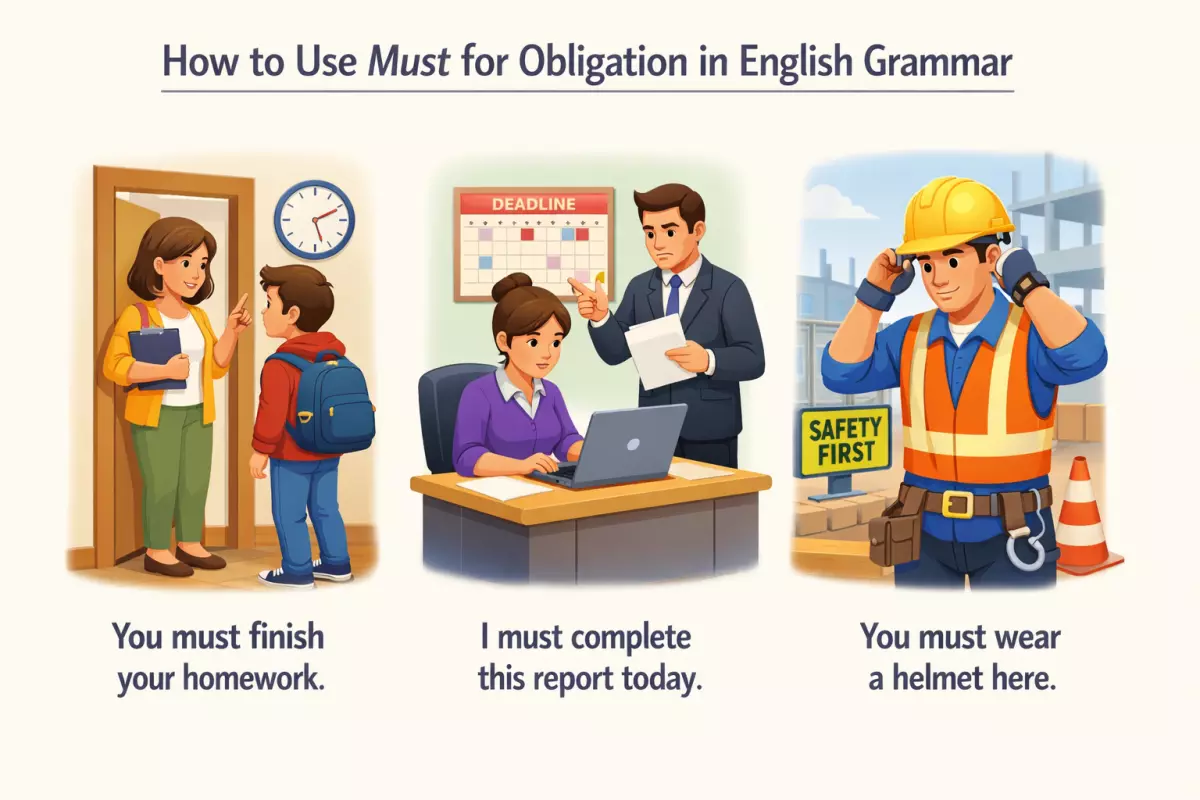
- Safety and prevention: “You must wear a helmet on site.”
- Urgency: “We must act quickly.”
- Speaker authority or firm instruction: “You must finish this today.”
- Strong personal necessity (internal pressure): “I must remember to call her.”
Usage patterns that show obligation clearly
- Must + base verb: “You must follow the instructions.”
- Must + be + adjective/noun phrase (required state): “All documents must be complete.”
- Must + not (prohibition): “You must not smoke here.”
- Must + always/never (strict rule): “You must always lock the door.”
- Must + by + time limit: “Applications must be received by 5 p.m.”
- Must + before + event: “You must register before entering.”
- Must + immediately/right away (urgent instruction): “You must leave immediately.”
Examples: strong obligation in everyday sentences
- Employees must wear ID badges at all times.
- You must back up your files before updating the system.
- Passengers must remain seated during takeoff.
- All guests must show a valid ticket at the entrance.
- You must tell me if anything changes.
- We must keep this information confidential.
- Students must submit the assignment in PDF format.
- You must not use your phone while driving.
- Applicants must provide two references.
- I must be at the airport by six.
- You must check the label before taking the medicine.
- We must follow the safety checklist every time.
Common learner pitfalls (and cleaner alternatives)
- ❌ “You must to go.” → ✅ “You must go.”
- ❌ “He musts do it.” → ✅ “He must do it.” (no -s in the third person)
- ❌ “Do you must leave?” → ✅ “Must you leave?” or “Do you have to leave?”
- ❌ “I musted call.” → ✅ “I had to call.” (use “had to” for past obligation)
Situations where 'must' is used for rules, duties, and responsibilities
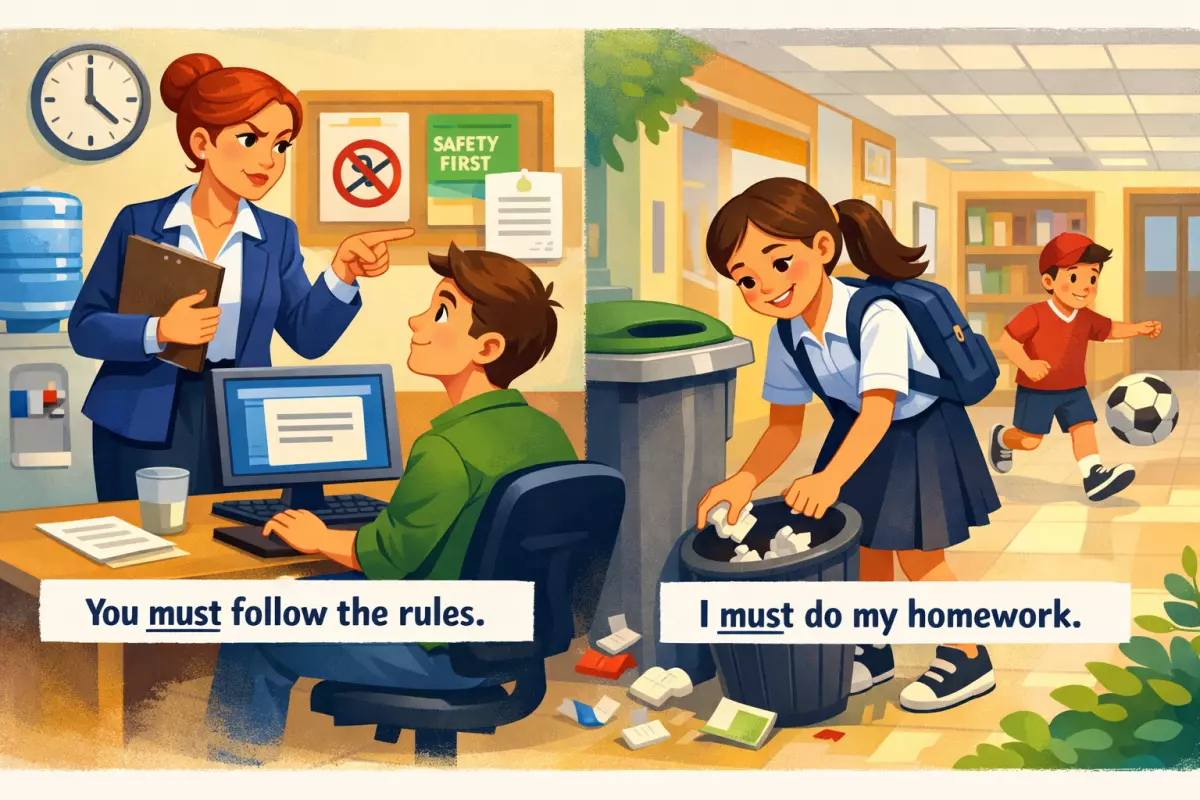
Use must when the speaker presents an obligation as necessary and non-optional. It often sounds firm because it frames the action as required, not merely recommended. In many contexts, it reflects the speaker’s authority, a policy they enforce, or a duty they accept as binding.
1) Rules and policies (especially in workplaces, schools, and public settings)
Must is common in written rules, announcements, and instructions where compliance is expected. It is frequently followed by a base verb (must + verb).
- Employees must wear ID badges at all times.
- Visitors must sign in at reception.
- Students must submit assignments by Friday.
- Passengers must remain seated during takeoff.
- All bags must be screened at the entrance.
- You must not bring food into the lab.
- Users must create a strong password.
- Applications must include two references.
- Guests must check out by 11 a.m.
- Vehicles must stop at the gate.
- Forms must be completed in black ink.
- Reports must be approved before publication.
2) Duties tied to a role (job responsibilities and assigned tasks)
When the obligation comes from someone’s position or assignment, must highlights that the task is part of the role. This is typical in job descriptions, handovers, and operational procedures.
- The manager must review the schedule each week.
- New staff must complete safety training in their first month.
- The technician must document every repair.
- Team leads must report incidents immediately.
- Cashiers must count the register at closing.
- Drivers must check tire pressure before departure.
- Supervisors must ensure breaks are taken.
- The committee must meet at least once per quarter.
- All contractors must follow site procedures.
- Support staff must respond to urgent tickets first.
3) Personal responsibility stated strongly (speaker-imposed obligation)
Must also expresses a duty the speaker places on themselves, often because they feel it is necessary, urgent, or morally important. This use is common with “I/we must …” and often implies determination.
- I must finish this today.
- We must keep our promise.
- I must apologize for what I said.
- We must protect customer data.
- I must remember to call them back.
- We must act quickly.
- I must be more careful next time.
- We must not ignore the warning signs.
4) Safety, legal, and compliance requirements
For safety rules and compliance language, must signals that the instruction is mandatory. It is often used in warnings, procedures, and formal notices.
- You must wear a helmet in this area.
- Children must be supervised at all times.
- Medication must be stored out of reach of children.
- All incidents must be reported within 24 hours.
- Hazardous waste must be disposed of properly.
- Equipment must be switched off before cleaning.
- Data must be encrypted during transfer.
- Employees must not share confidential information.
5) Common patterns that appear in rule-style English
- must + base verb: You must arrive on time.
- must not (mustn’t) + base verb for prohibition: You mustn’t park here.
- must be + past participle (passive) to focus on the rule, not the person: ID must be shown.
- must be + adjective/noun for requirements: The form must be complete.
- All/Each/Every + noun + must for broad rules: Every applicant must provide ID.
When you want a softer tone for obligations, speakers often choose have to or need to, but must remains the clearest choice when the requirement is presented as strict and non-negotiable.
How 'must' can also express strong recommendations or warnings
In English, must is not limited to strict obligation. Speakers also use it to give urgent advice, highlight a serious risk, or stress that an action is the sensible choice. In these cases, the meaning is closer to “it’s very important that you…” rather than “you are legally required to…”.
Common patterns
- must + base verb: “You must call a doctor.”
- must + base verb with a reason: “You must back up your files, because the drive is failing.”
- must not / mustn’t + base verb for strong warnings: “You mustn’t touch that wire.”
- must + base verb in short, direct instructions (often in emergencies): “You must stay calm.”
- must + base verb with time pressure: “You must leave now, or you’ll miss the last train.”
When it sounds like advice (not a rule)
When the speaker is recommending an action for the listener’s benefit, must can sound forceful but caring. It often appears with health, safety, and “best practice” topics, where ignoring the advice could have bad consequences.
- You must see this film if you like mysteries.
- You must try restarting the router before calling support.
- You must get some rest; you’ve been working all week.
- You must drink more water in this heat.
- You must keep a copy of your passport somewhere safe.
- You must check the ingredients if you have allergies.
- You must read the instructions before using this cleaner.
- You must talk to your manager before making that change.
- You must update your contact details so we can reach you.
- You must plan extra time for traffic on Fridays.
When it functions as a warning
For warnings, must emphasizes danger or unacceptable outcomes. Negative forms are especially strong: mustn’t typically means “do not” with a serious reason, not a mild suggestion.
- You mustn’t drive if you’ve taken this medication.
- You mustn’t open the door to strangers.
- You mustn’t share your password with anyone.
- You mustn’t ignore that warning light.
- You mustn’t leave candles unattended.
- You mustn’t stand too close to the edge.
- You mustn’t mix these two chemicals.
- You mustn’t sign the contract without reading the cancellation clause.
- You mustn’t store batteries loose in a drawer with coins.
- You mustn’t assume the email is genuine—check the sender carefully.
Choosing the right strength
- Use must when you want to sound firm and urgent, especially for safety, health, or high-stakes situations.
- Use should for softer recommendations when there is room for choice and the consequences are not severe.
- Avoid using must for small preferences, because it can sound overly controlling (e.g., “You must sit here”).
- In polite conversation, speakers often add context to reduce harshness: “You must get it checked—just to be safe.”
Negative structures with 'must' and the meaning of must not
In negative form, must usually expresses prohibition or a strong warning. This is different from saying something is not necessary. Understanding the pattern helps you avoid common meaning mistakes.
Core meanings in negative form
- must not / mustn’t + base verb = “do not do this” (prohibition, rules, safety, strong advice).
✅ You mustn’t park here. (It’s forbidden.) - must not can also mean “it is essential that this does not happen” (strong prevention).
✅ The medicine must not be taken with alcohol. - mustn’t is common in speech and informal writing; must not is often used for emphasis or in formal rules and instructions.
Form and word order patterns
- Statement: Subject + must not + base verb
✅ Visitors must not enter this area. - Question (less common): Must + subject + not + base verb?
✅ Must we not inform the client? - Negative short answers: No, you mustn’t. / No, you must not.
✅ “Must I tell him?” “No, you mustn’t.” - With adverbs: Subject + must not + adverb + base verb (or adverb after the verb, depending on the adverb).
✅ You mustn’t ever share your password. - With be: must not + be + complement
✅ The door mustn’t be left open. - With passive: must not + be + past participle
✅ This form must not be signed in pencil.
Mustn’t vs. don’t have to (different meanings)
A frequent error is using mustn’t when you mean “not necessary.” Use don’t have to (or needn’t) for lack of obligation. Use mustn’t for prohibition.
| Form | Meaning | Example |
|---|---|---|
| mustn’t / must not + base verb | prohibited; not allowed | ✅ You mustn’t use your phone during the exam. |
| don’t / doesn’t have to + base verb | not necessary; no obligation | ✅ You don’t have to bring anything. |
| needn’t + base verb | not necessary (often more formal) | ✅ You needn’t reply today. |
| can’t + base verb | not permitted (often external rules) or impossible (context decides) | ✅ You can’t park here. (Not allowed.) |
Common uses with practical example patterns
- Rules and signs: You must not smoke. / You mustn’t feed the animals.
- Safety instructions: You mustn’t touch the wires. / The machine must not be opened while running.
- Work and compliance: Employees must not share customer data. / Reports mustn’t be altered.
- Strong advice (speaker’s judgment): You mustn’t skip meals. / You must not drive when you’re this tired.
- Preventing outcomes: We mustn’t miss the deadline. / This information must not leak.
Typical learner errors to avoid
- ❌ You mustn’t come early. (sounds like “don’t come early” is forbidden)
✅ You don’t have to come early. (not necessary) - ❌ You must not to talk. (extra “to”)
✅ You must not talk. - ❌ Mustn’t you to wear a helmet? (wrong structure)
✅ Mustn’t you wear a helmet? - ❌ You mustn’t be late tomorrow? (question mark with statement form)
✅ Mustn’t you be on time tomorrow? / You mustn’t be late tomorrow. (statement)
Key differences between 'must' and have to in everyday English
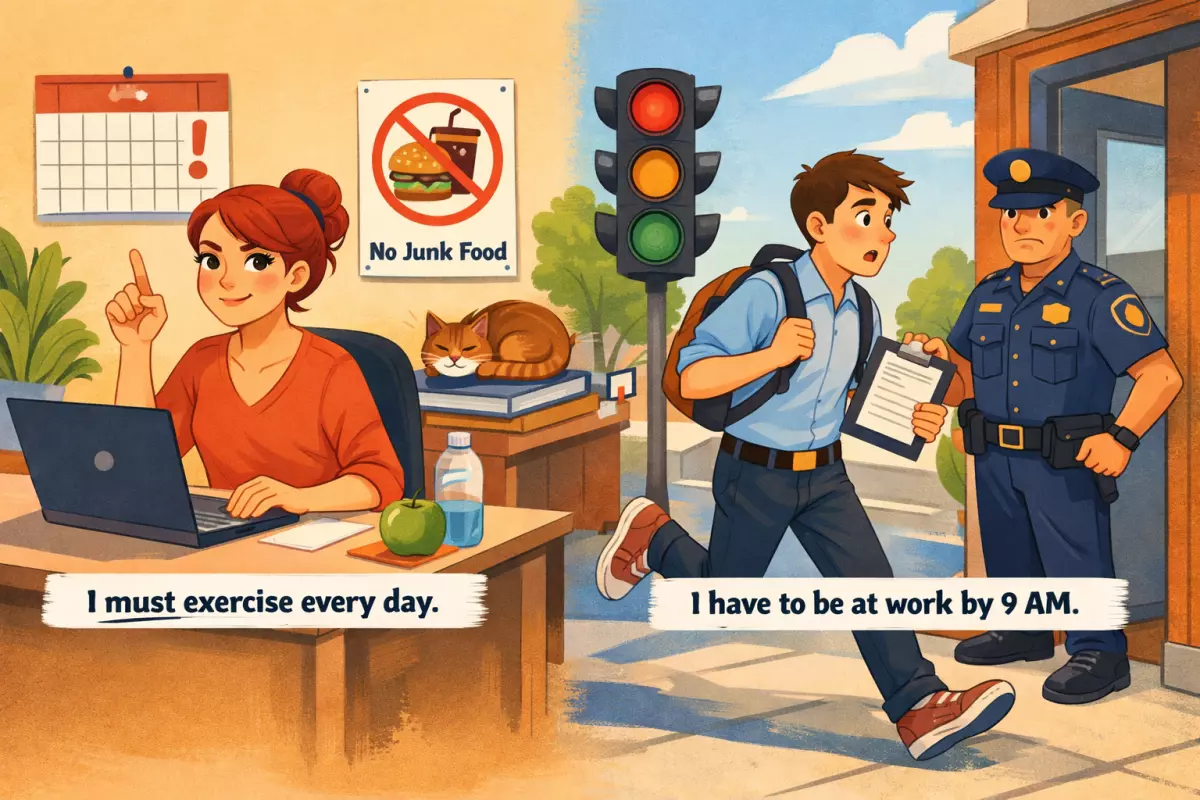
In daily use, must and have to often express obligation, but they don’t feel the same. The choice depends on where the obligation comes from, how strong or formal you want to sound, and which tense you need.
| Point of difference | Must | Have to |
|---|---|---|
| Source of obligation | Often speaker-based (personal rule, strong advice, insistence) | Often external (rules, laws, schedules, other people’s decisions) |
| Strength and tone | Stronger, more direct; can sound formal or authoritative | More neutral and common in conversation |
| Tense flexibility | Limited (mainly present/future meaning) | Flexible (past, present, future: had to / have to / will have to) |
| Negative meaning | Must not = prohibition (not allowed) | Don’t have to = no necessity (optional) |
| Typical everyday choice | Less frequent; used for emphasis, rules, and strong recommendations | Very frequent; default option for “obligation” in many situations |
Common usage patterns (with examples)
- Personal decision / strong advice: “I must call my parents tonight.”
- Strong instruction from the speaker: “You must wear a helmet on this site.”
- Company/school rules (neutral reporting): “We have to badge in at reception.”
- Law/regulations (external requirement): “Drivers have to stop at red lights.”
- Schedule/arrangement: “I have to leave by six.”
- Authority voice (formal notice style): “Guests must check out by 11 a.m.”
- Past obligation: ✅ “I had to work late yesterday.” ❌ “I musted work late yesterday.”
- Future obligation: “I’ll have to renew my passport soon.”
- Prohibition: “You must not park here.” (It’s not allowed.)
- No necessity: “You don’t have to come if you’re busy.” (It’s optional.)
- Polite-sounding alternative in conversation: “I have to go now.” (Often preferred to “I must go.”)
- Emphasis / urgency: “You must see this video.” (Stronger than “You have to see this.”)
- Explaining an outside reason: “I have to take this call—it’s my boss.”
- Self-imposed rule: “I must stop eating so late.”
- Reporting a requirement in writing: “Applicants must provide ID.”
A quick warning about negatives
- ✅ “You must not use your phone here.” → It is forbidden.
- ✅ “You don’t have to pay today.” → It is not necessary.
- ❌ “You must not pay today.” (This usually means you are not allowed to pay, which is a different idea.)
Examples of 'must' used in real spoken and written communication
In real-life English, must most often signals a strong obligation, a firm rule, or a requirement that the speaker treats as non-negotiable. The source of the obligation may be the speaker (personal authority), an institution (policy), or a situation (practical necessity). The examples below show common settings and the patterns that typically appear.
Spoken English: everyday rules, urgency, and instructions
- “You must wear a seatbelt.” (safety rule; common in reminders from a parent or instructor)
- “We must leave now or we’ll miss the train.” (time pressure; necessity created by the situation)
- “You must be quiet in here.” (rule tied to a place, often said in libraries, hospitals, or during meetings)
- “I must call her back.” (personal obligation; the speaker feels it is required)
- “You mustn’t touch that.” (prohibition; stronger than “don’t” because it implies a strict rule)
- “Students must hand in their phones before the exam.” (authority-based requirement; teacher/invigilator voice)
- “You must follow my instructions exactly.” (procedural compliance; often used in training or safety briefings)
- “We mustn’t be late again.” (group obligation; often used after a warning or consequence)
- “You must try this.” (strong recommendation; not a legal duty, but expressed with force)
- “I must admit, I was wrong.” (fixed expression used to introduce a frank statement; not obligation in the literal sense, but common in speech)
Written English: policies, notices, and formal requirements
- “All visitors must sign in at reception.” (workplace rule; typical in building notices)
- “Applicants must provide proof of identity.” (administrative requirement; formal tone)
- “Payments must be made by the 15th of each month.” (deadline requirement)
- “Employees must comply with the company’s data security policy.” (policy language; institutional authority)
- “You must be 18 or over to enter.” (eligibility condition; signage and terms)
- “All assignments must be submitted electronically.” (academic instruction; procedural rule)
- “Guests must not smoke in the rooms.” (formal prohibition; common in hotel rules)
- “The device must be switched off during takeoff and landing.” (safety instruction; passive form is common in notices)
- “To reset your password, you must answer the security question.” (step requirement in instructions)
- “Participants must agree to the terms before registering.” (condition for access)
Useful patterns to notice
- must + base verb: “You must submit the form.” (no “to” and no “-s”)
- mustn’t + base verb for prohibition: “You mustn’t park here.”
- must + be + adjective/noun: “You must be careful.” / “You must be a member to enter.”
- must + be + past participle (passive) in rules/notices: “ID must be shown.”
- must + have + past participle is usually deduction, not obligation: ❌ “You must have finished by 5.” (sounds like a guess) → ✅ “You must finish by 5.” (obligation)
Typical learner mistakes when choosing or forming 'must'
Errors with must usually come from mixing it up with other modals, using the wrong form for tense, or building negatives and questions incorrectly. The points below focus on the most common pattern problems and how to fix them.
-
Adding “to” after must
❌ I must to go now. → ✅ I must go now.
Use the base verb after this modal: must + verb (must leave, must study, must pay).
-
Using “must” for past obligation
❌ Yesterday I must finish the report. → ✅ Yesterday I had to finish the report.
For past obligation, English normally uses had to, not must.
-
Trying to make an infinitive or -ing form
❌ to must / musting
Modal verbs do not take infinitive or -ing forms. Rephrase with have to when you need those forms: “I don’t like having to wake up early.”
-
Overusing must when the meaning is “advice”
❌ You must see that movie (sounds like a strong obligation). → ✅ You should see that movie.
Choose should for recommendations; use must for strong necessity or rules.
-
Confusing “must not” with “don’t have to”
❌ You must not pay today (when you mean it’s optional). → ✅ You don’t have to pay today.
Must not means prohibition (it’s not allowed). Don’t have to means no obligation (it’s optional).
-
Forming negatives with “don’t”
❌ I don’t must work late. → ✅ I mustn’t work late / I don’t have to work late.
Use mustn’t for prohibition. Use don’t have to for lack of necessity.
-
Building questions with “do/does”
❌ Do I must sign this? → ✅ Must I sign this?
In questions, invert the modal and the subject: Must + subject + base verb?
-
Using “must” when the obligation comes from another person (tone issue)
❌ You must send me the file by 5 (can sound too forceful). → ✅ You have to send me the file by 5 / Please send it by 5.
In many contexts, have to sounds more neutral for external requirements, while must can sound like a personal command.
-
Mixing up obligation must and logical deduction must
❌ You must be tired (when you mean “it’s required”). → ✅ You have to be tired (rare/odd) / You must be tired (deduction).
“Must be” often expresses a conclusion (“I’m sure you’re tired”), not a rule. For obligation, use must + action verb (must finish, must attend).
-
Using must in places where English prefers “need to”
❌ I must buy some milk (can sound very strong for a small task). → ✅ I need to buy some milk.
For everyday necessities, need to is often more natural, while must adds extra force.
-
Double modals or stacking obligation forms
❌ I must have to go. → ✅ I must go / I have to go.
Use one structure. If you want to show uncertainty, change the wording (for example, “I think I have to go”).
-
Forgetting the base verb after must
❌ She must to the office early. → ✅ She must go to the office early.
Because must does not carry the main meaning alone, the following verb is required.
-
Wrong short answers
❌ Yes, I must. / No, I mustn’t (when the meaning is “not necessary”).
Better patterns:
- ✅ Must I pay now? → Yes, you must. (obligation)
- ✅ Must I pay now? → No, you don’t have to. (no obligation)
-
Using must for rules in the past instead of “had to” or “wasn’t allowed to”
❌ When I was a child, I mustn’t stay out late (possible, but often unclear). → ✅ When I was a child, I wasn’t allowed to stay out late.
For past prohibition, “wasn’t allowed to” is often clearer than mustn’t.
-
Choosing must where “be supposed to” fits better
❌ You must be here at 9 (sounds like a strict order). → ✅ You’re supposed to be here at 9 (expectation/schedule).
Use “be supposed to” for expectations, schedules, and informal rules rather than strong obligation.
Exercises and practice activities on using 'must' for obligation
These activities help you practice using must to express strong necessity, rules, and duties. Focus on the core pattern must + base verb (no to) and on choosing it when the speaker presents the obligation as firm or non-negotiable.
1) Form and meaning check (quick recognition)
- Choose the correct completion: “You ____ wear a helmet on this site.” (must / must to)
- Choose the correct completion: “She ____ submit the form today.” (must / musts)
- Choose the correct completion: “We ____ be quiet during the exam.” (must / musted)
- Decide if the sentence expresses obligation or deduction: “You must be tired after the trip.”
- Decide if the sentence expresses obligation or deduction: “Employees must clock in by 9:00.”
- Correct the error: “I must to call my manager.”
- Correct the error: “He musts follow the rules.”
- Correct the error: “They musted leave early.”
Show answers
- must
- must
- must
- Deduction (not obligation)
- Obligation
- I must call my manager.
- He must follow the rules.
- They had to leave early. (or: They must leave early. if present/future obligation)
2) Complete the sentences (obligation in real contexts)
Fill each blank with must and the correct base verb. Use a verb that makes sense.
- Visitors must ________ their ID at reception.
- You must ________ your seatbelt before we move.
- Students must ________ their phones during the test.
- All staff must ________ the safety training this week.
- You must ________ the instructions carefully.
- We must ________ a decision by Friday.
- Drivers must ________ at the red light.
- Applicants must ________ a valid passport.
- You must ________ your hands before entering the lab.
- Guests must ________ the noise down after 10 p.m.
- Team members must ________ on time for the briefing.
- Employees must ________ protective gloves in this area.
Show answers
- show / present
- fasten / wear
- turn off / silence
- complete / attend
- read / follow
- make
- stop
- have
- wash
- keep
- arrive / be
- wear / use
3) Rewrite to strengthen the obligation
Rewrite each sentence using must. Keep the meaning as close as possible, but make the requirement sound firm.
- It’s necessary for you to submit the report today.
- You are required to wear closed-toe shoes in the workshop.
- It is essential that we follow the procedure exactly.
- It’s important for him to call the client before noon.
- It is forbidden to park here. (Rewrite as a “must not” rule.)
- It’s necessary for passengers to remain seated during takeoff.
- It is required that all payments be made in advance.
- It’s essential for me to renew my license this month.
Show answers
- You must submit the report today.
- You must wear closed-toe shoes in the workshop.
- We must follow the procedure exactly.
- He must call the client before noon.
- You must not park here.
- Passengers must remain seated during takeoff.
- All payments must be made in advance.
- I must renew my license this month.
4) Choose between “must” and “have to” (pattern awareness)
Select the best option. Use must when the speaker states a strong rule/requirement; use have to when the focus is on an external requirement or routine necessity (both can be correct in some contexts, but choose the more natural one).
- I ____ wear a uniform at work; it’s company policy. (must / have to)
- You ____ try this dessert; it’s amazing. (must / have to)
- We ____ leave early tomorrow because the train is at 6 a.m. (must / have to)
- Employees ____ sign in at reception; it’s a strict rule. (must / have to)
- I ____ remember to email her; it’s really important. (must / have to)
- She ____ work late every Monday due to meetings. (must / have to)
- You ____ not share your password with anyone. (must / have to)
- Do we ____ bring our own laptops? (must / have to)
Show answers
- have to
- must
- have to
- must
- must
- has to
- must
- have to
5) Error correction (common problems)
Each sentence has one issue with form or meaning. Rewrite it correctly.
- You must to finish this by 5.
- He musts pay the fee today.
- We musted attend the meeting yesterday.
- Must you to show your ticket?
- I don’t must work tomorrow.
- You mustn’t to enter this room.
- She must can drive to the airport.
- They must not late for the interview.
Show answers
- You must finish this by 5.
- He must pay the fee today.
- We had to attend the meeting yesterday.
- Must you show your ticket?
- I don’t have to work tomorrow. (or: I mustn’t work tomorrow. if it’s prohibited)
- You mustn’t enter this room.
- She must be able to drive to the airport. (or: She can drive... / She must drive... depending on meaning)
- They must not be late for the interview.
6) Production practice (write your own rules)
- Write 8 rules for a place you know (a classroom, gym, office, library). Use must in 5 rules and must not in 3 rules.
- Underline the main verb after must each time to check you used the base form.
- Swap your rules with a partner (or reread them yourself) and label each as: safety, behavior, time, or paperwork.
- Rewrite two rules using have to and note whether the meaning changes (speaker-imposed rule vs. external requirement).