Modal Verbs in Safety Instructions and Warnings

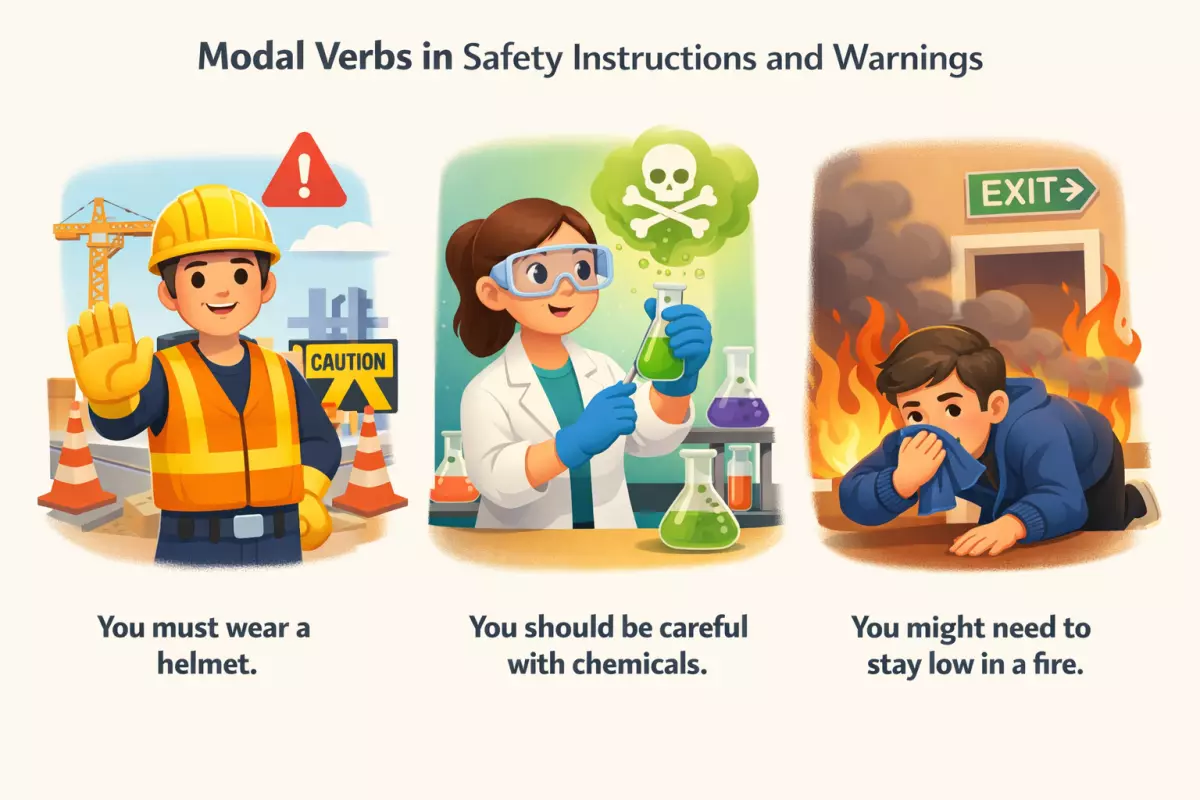 The article explains why safety rules often use modal verbs, which modals show obligation, prohibition, or advice, and how must, should, and may signal different urgency. It gives examples from manuals, signs, and workplace policies, shows how modals clarify required vs forbidden actions, and includes practice to avoid risky misunderstandings.
- Why safety guidelines frequently rely on modal verbs
- Modal verbs commonly used to express obligation, prohibition, or advice
- How must, should, and may signal different levels of urgency
- Examples from safety manuals, warning signs, and workplace policies
- How modal verbs clarify what actions are required or forbidden
- Situations where misunderstanding modal verbs may cause safety risks
- Exercises and practice activities interpreting modal verbs in safety instructions
On safety signs and warning labels, small helper verbs like must, should, and may shape how seriously we take a message. They show what is required, what is recommended, and what is permitted or possible, helping people act quickly without guessing. This article explains how to spot these cues in real situations, from workplace notices to medication directions, and how to choose them accurately when writing instructions.
Why safety guidelines frequently rely on modal verbs
Safety documents need language that is fast to scan and hard to misread. Modal verbs help writers express obligation, prohibition, permission, and likelihood without long explanations, so instructions stay short while still signaling how serious a risk is.
How modals match the needs of warnings
- They encode “strength” of instruction. A single modal can show whether something is mandatory (must), recommended (should), or optional (may).
- They reduce ambiguity in responsibility. Modals make it clear whether the reader is required to act (“You must…”) or merely advised (“You should…”).
- They support quick, standardized phrasing. Many industries reuse established patterns like “must be” + past participle, which improves consistency across labels, manuals, and training materials.
- They communicate risk and probability. Warnings often need to state possible outcomes without claiming certainty (“may cause injury,” “can result in damage”).
- They fit space limits. Signs, labels, and on-device instructions have little room; modals compress meaning into a few words.
- They help separate rules from explanations. A modal-based instruction can stand alone, while the reason can follow in a second sentence.
Common patterns you see in safety writing
- Must + base verb: “You must wear eye protection.”
- Must not / mustn’t + base verb: “You must not bypass the guard.”
- Should + base verb: “You should inspect the cable before use.”
- Should not + base verb: “You should not operate the unit when tired.”
- May + base verb (permission): “The cover may be removed for cleaning.”
- May + base verb (possibility): “Exposure may cause irritation.”
- Can + base verb (general risk/result): “Loose clothing can get caught.”
- Cannot / can’t + base verb (impossibility/ban): “The device cannot be used in wet areas.”
- Will + base verb (strong prediction): “Failure to follow these steps will result in damage.”
- Could + base verb (weaker possibility): “Improper storage could lead to leaks.”
- Must be + past participle: “All bolts must be tightened to specification.”
- Should be + past participle: “Filters should be replaced every 3 months.”
- May be + past participle: “Parts may be recycled where facilities exist.”
- Must be kept + adjective/past participle: “Containers must be kept closed.”
- Must be used with + noun: “This solvent must be used with adequate ventilation.”
Usage choices that affect clarity
- Use “must” for non-negotiable rules. It signals a requirement, not a preference.
- Use “should” for best practice. It reads as guidance, so it’s useful when alternatives may be acceptable.
- Choose “may” vs. “can” carefully. In instructions, “may” often marks permission, while “can” often describes capability or a possible consequence.
- Avoid mixing strength levels in one rule. For example, don’t pair a strong hazard statement with a weak instruction unless that contrast is intentional and explained.
- Keep the subject explicit when needed. “Operators must…” is clearer than an implied subject if multiple people are involved.
- Prefer direct negatives for prohibitions. ✅ “You must not remove the shield.” ❌ “You should not remove the shield.” (too soft if it’s truly forbidden)
Modal verbs commonly used to express obligation, prohibition, or advice
Safety messages rely on a small set of modal verbs to signal how strict a requirement is. The modal you choose affects legal force, urgency, and how readers interpret risk. In instructions and warnings, keep the structure consistent: modal + base verb (no “to”), and place negatives directly after the modal (for example, “must not”).
Obligation (required actions)
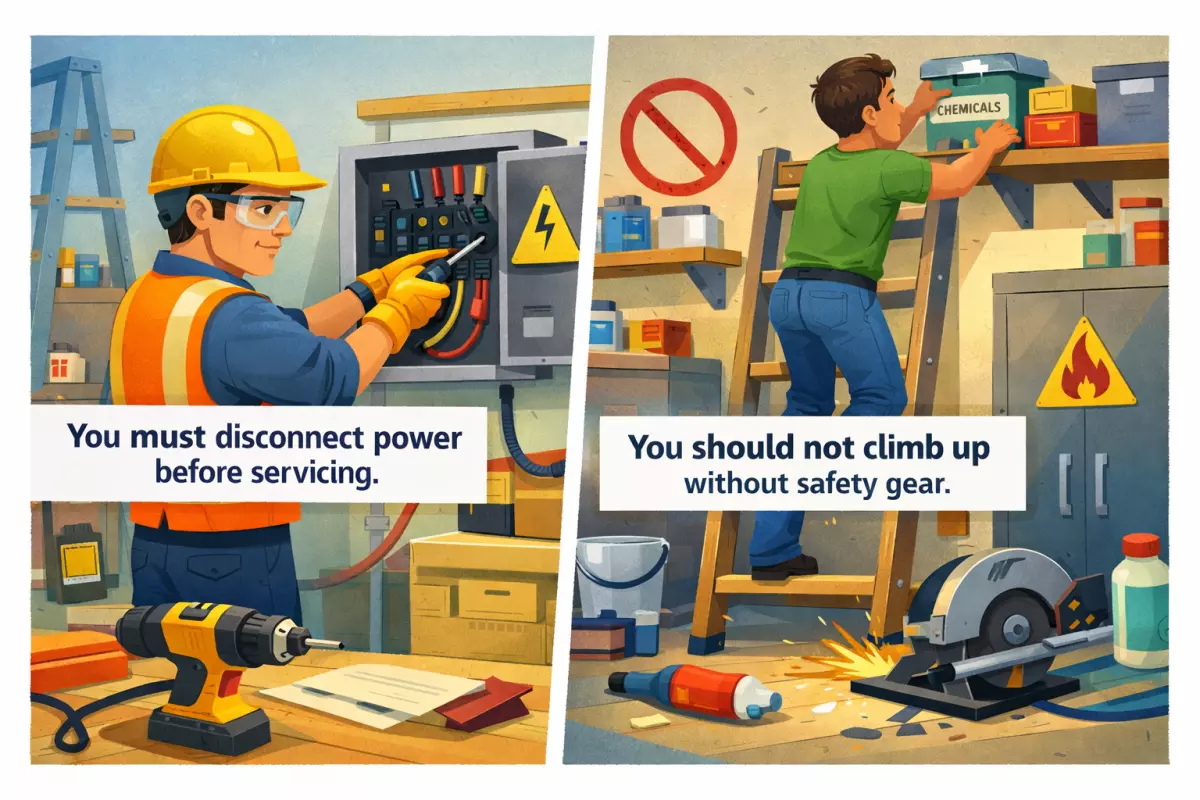
- must + base verb: strongest requirement; used for critical hazards and mandatory steps. Example: “You must disconnect power before servicing.”
- have to + base verb: practical necessity, often tied to procedure or conditions. Example: “Operators have to wear eye protection in this area.”
- need to + base verb: requirement with a slightly softer tone; common in user-facing instructions. Example: “You need to tighten the clamp before use.”
- be required to + base verb: formal, policy-driven phrasing. Example: “Visitors are required to sign in at reception.”
- shall + base verb: formal/contractual style; common in standards and technical documentation. Example: “The device shall be grounded.”
- Pattern note: use the passive when the actor is general or unspecified. Example: “The guard must be installed before operation.”
Prohibition (forbidden actions)
- must not / mustn’t + base verb: strongest prohibition; use for actions that create immediate danger. Example: “You must not bypass the interlock.”
- cannot / can’t + base verb: indicates impossibility or disallowed operation; useful when a system limitation is involved. Example: “The unit cannot be used in explosive atmospheres.”
- may not + base verb: formal prohibition (permission denied). Example: “Personnel may not enter without authorization.”
- should not + base verb: discourages an action; use when the risk is lower or conditional. Example: “You should not use solvents on the lens.”
- Common error to avoid: ❌ “must to” → ✅ “must + base verb” (for example, “must wear,” not “must to wear”).
Advice and best practice (recommended actions)
- should + base verb: standard recommendation; good for preventive steps. Example: “You should inspect the cable before each use.”
- ought to + base verb: similar to “should,” slightly more formal; use sparingly for consistency. Example: “Users ought to store chemicals in labeled containers.”
- can + base verb: describes safe options or allowed methods (not a requirement). Example: “You can use a damp cloth to clean the housing.”
- may + base verb: permission or possibility; useful for conditional outcomes. Example: “The surface may become hot during operation.”
- could + base verb: cautious possibility; often used to explain hazards. Example: “Loose clothing could get caught in moving parts.”
- Pattern note: pair advice with a reason when it improves compliance. Example: “You should ventilate the area to reduce fume buildup.”
Common patterns that improve clarity in warnings
- Condition + modal: “If the alarm sounds, you must evacuate immediately.”
- Modal + be + past participle (passive): “The cover must be closed during operation.”
- Modal + not + base verb (clean negation): “Do not” is also common, but when using modals keep the negative directly after the modal: “must not,” “should not.”
- One modal per requirement: avoid stacking (“must should”) and avoid mixing strength levels in the same sentence.
- Consistency across a document: reserve “must/must not” for mandatory rules, and “should/should not” for recommendations to prevent readers from misjudging severity.
How must, should, and may signal different levels of urgency
In safety instructions, modal verbs help readers judge what is mandatory, what is strongly recommended, and what is simply allowed. Choosing the right modal reduces ambiguity, supports compliance, and keeps warnings consistent across labels, manuals, and on-screen prompts.
| Modal | Force of instruction | Typical purpose in safety text | Example pattern |
|---|---|---|---|
| must | Mandatory requirement | Non-negotiable rule tied to safety, law, or critical procedure | You must + base verb |
| should | Strong recommendation | Best practice that reduces risk but may allow exceptions | You should + base verb |
| may | Permission / possibility | What is allowed, optional, or conditionally acceptable | You may + base verb |
| must not / should not / may not | Prohibition (varies by modal) | What is forbidden, discouraged, or not permitted | Modal + not + base verb |
Using must for non-negotiable requirements
Use must when the instruction is essential for preventing harm, avoiding equipment damage, or meeting a regulatory requirement. It signals that the reader has no discretion.
- Place must close to the action: “You must disconnect power before servicing.”
- Prefer direct subject + modal patterns: “Operators must wear eye protection.”
- Use must not for clear prohibitions: “You must not bypass the interlock.”
- Avoid mixing must with softeners that weaken it (for example, “try to,” “if possible”).
- When conditions apply, state the condition first, then the requirement: “If the alarm sounds, you must evacuate immediately.”
Using should for best practices and risk reduction
Should works well for guidance that improves safety outcomes but may not be strictly required in every scenario. It implies “recommended unless there is a good reason not to.”
- Use it for preventive steps: “You should inspect the cord for damage before use.”
- Pair it with frequency cues when helpful: “Users should clean the filter weekly.”
- Use should not for discouraged actions: “You should not operate the unit in standing water.”
- Don’t use should when noncompliance creates immediate danger; upgrade to must in those cases.
- If exceptions exist, name them explicitly: “You should store the product upright, unless the packaging states otherwise.”
Using may for permission, options, and conditional allowance
May is useful when the text is granting permission, describing an optional step, or indicating that a choice is acceptable under stated conditions. In warnings, it can also express possibility (“may cause”), which should be handled carefully to avoid confusion with permission.
- Permission/option: “You may use a grounded extension cord rated for outdoor use.”
- Optional step: “You may remove the guard for cleaning after shutdown.”
- Conditional allowance: “You may restart the system once the indicator turns green.”
- Prohibition of permission: “You may not modify the plug.” (often used in policies; in safety labels, must not can be clearer)
- Possibility (hazard statement): “Exposure may cause irritation.” Keep this separate from instructions so readers don’t misread it as permission.
Common patterns that keep urgency clear
- ✅ “You must wear hearing protection.” → ❌ “You should wear hearing protection” (if it’s truly mandatory).
- ✅ “You should allow the motor to cool before refueling.” → ❌ “You must allow…” (if it’s guidance rather than a strict rule).
- ✅ “You may use either detergent A or B.” → ❌ “You should use either…” (sounds like a recommendation, not a choice).
- Keep one modal per instruction when possible; stacking modals makes the message harder to interpret.
- Use consistent modals across a document: if “must” marks mandatory steps in one section, don’t switch to “should” for the same level of requirement elsewhere.
- When translating policy into instructions, decide whether the intent is obligation (must), recommendation (should), or permission (may) before drafting the sentence.
Examples from safety manuals, warning signs, and workplace policies
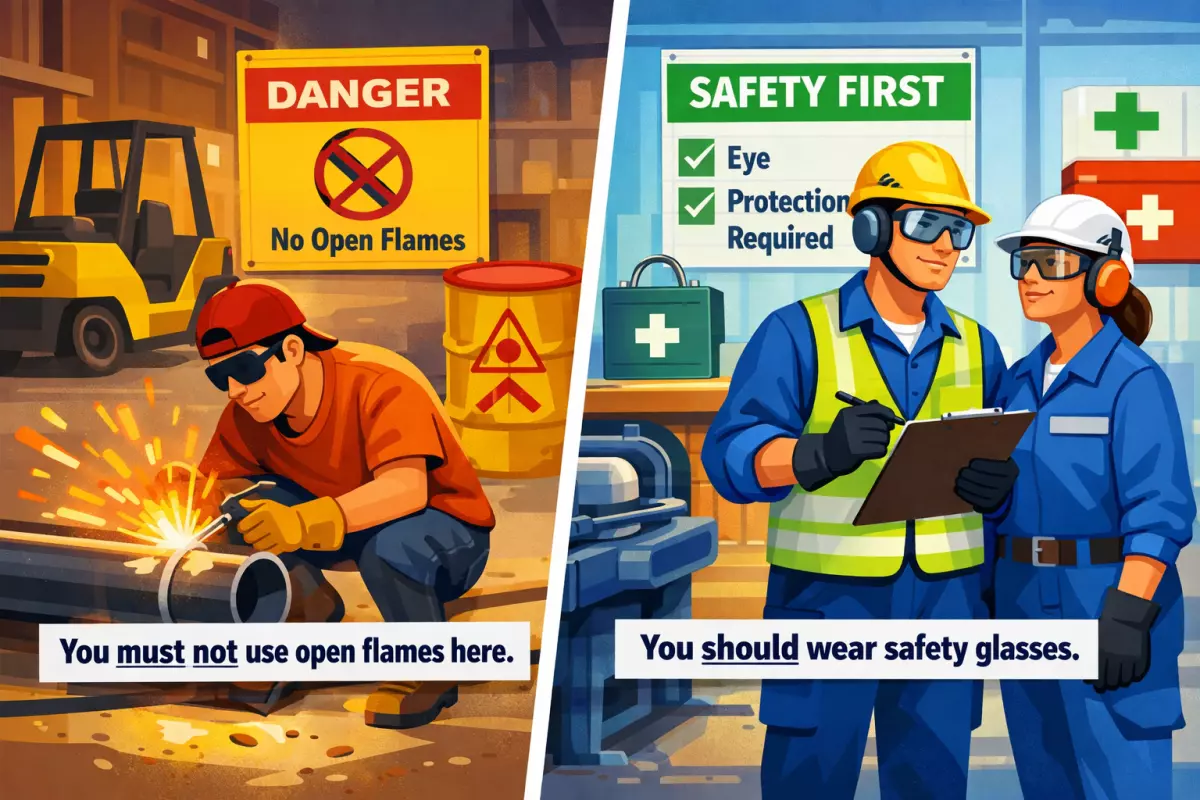
Real-world safety language relies on modal verbs to signal obligation, prohibition, permission, and advice. The same task can be framed as a strict requirement (must), a rule-based prohibition (must not), a recommendation (should), or a conditional expectation (may, can). The patterns below show how these modals typically appear in manuals, signage, and policy documents.
Common modal patterns and what they signal
- Must + base verb for non-negotiable rules: “Operators must wear eye protection.”
- Must not / mustn’t + base verb for strict bans: “You must not bypass machine guards.”
- Should + base verb for strong recommendations or best practice: “You should inspect the ladder before use.”
- May + base verb for permission or possibility (often risk-related): “This surface may be slippery when wet.”
- Can + base verb for capability or general possibility: “Loose clothing can get caught in rotating parts.”
- Shall + base verb for formal policy requirements (common in older or legal-style documents): “Employees shall report all incidents.”
- Do not + base verb for direct prohibitions on signs: “Do not enter.”
- Never + base verb for absolute prohibitions (often training materials): “Never reach into moving equipment.”
Examples you might see in safety manuals
- “Before servicing, you must isolate the power supply and apply lockout/tagout.”
- “Guards must be in place before the machine is started.”
- “You must not operate this equipment if you are fatigued or under the influence of medication that impairs alertness.”
- “The emergency stop button should be tested at the start of each shift.”
- “Hearing protection should be worn in designated high-noise areas.”
- “Only trained personnel may perform maintenance on the hydraulic system.”
- “This product may cause skin irritation; gloves are recommended.”
- “Improper lifting can cause back injury; use mechanical assistance when available.”
- “If a spill occurs, you should contain it immediately and notify your supervisor.”
- “Tools shall be returned to storage after use to prevent trip hazards.”
Examples typical of warning signs and labels
- “Hard hats must be worn beyond this point.”
- “Eye protection must be worn.”
- “Do not touch: hot surface.”
- “Do not use mobile phones in this area.”
- “You must not smoke on site.”
- “Authorized personnel only: you may enter only with a permit.”
- “Forklifts may be operating in this area.”
- “Falling objects may occur; keep clear.”
- “Loose items can fall from height.”
- “Do not block fire exit.”
Examples common in workplace policies and procedures
- “Employees must report hazards as soon as they are identified.”
- “All incidents and near-misses must be recorded within 24 hours.”
- “Staff must not share access badges or passwords.”
- “You should take scheduled breaks to reduce fatigue-related risk.”
- “Personal protective equipment should be replaced if damaged or expired.”
- “Visitors may access production areas only when accompanied.”
- “Supervisors may stop work if conditions are unsafe.”
- “Employees can request additional training when assigned unfamiliar tasks.”
- “Contractors shall comply with site traffic management rules.”
- ✅ “You must not remove guards.” → ❌ “You don’t must remove guards.” (modal verbs do not take “do” support in statements)
Across these sources, the most consistent pattern is that stronger modals align with higher consequences: must and must not communicate enforceable requirements, while should signals recommended practice that still carries safety importance. May and can often appear in hazard statements to describe risk conditions and likely outcomes.
How modal verbs clarify what actions are required or forbidden
Safety instructions work best when they state the level of obligation clearly. Modal verbs do this by signaling whether an action is mandatory, recommended, allowed, or prohibited, and by showing how strongly the writer is directing the reader.
Core obligation levels and the modals that express them
- Non-negotiable requirement: use must for rules that apply in all normal conditions.
Example: “You must wear eye protection during cutting operations.” - Prohibition: use must not (or mustn’t) to ban an action.
Example: “You must not bypass the safety interlock.” - External rule or policy requirement: use have to when the obligation comes from regulations, procedures, or circumstances.
Example: “Operators have to complete the lockout checklist before maintenance.” - Weaker obligation / expected behavior: use should for strong advice, best practice, or risk-reducing guidance that may allow exceptions.
Example: “You should inspect the cord for damage before use.” - Negative recommendation: use should not to discourage an action that increases risk but is not framed as an absolute ban.
Example: “You should not use the device in heavy rain.” - Permission: use may or can to indicate what is allowed or possible under stated conditions.
Example: “The guard may be removed only for cleaning.” - Denied permission: use may not to state that something is not permitted (often more formal).
Example: “Unauthorized personnel may not enter the restricted area.” - Ability/possibility (not obligation): use can to describe what is possible, which often supports a warning rather than a rule.
Example: “Hot surfaces can cause burns.”
Patterns that make requirements and bans unambiguous
- Modal + base verb: “must wear,” “must keep,” “should check,” “may remove.” Avoid adding “to” after a modal (❌ “must to wear”).
- Modal + not + base verb for prohibitions: “must not operate,” “should not touch,” “may not enter.” Place not directly after the modal.
- Condition + permission/requirement to limit scope: “Before servicing, you must disconnect power.” / “Only trained staff may adjust the regulator.”
- Only + permission to control exceptions: “You may open the cover only after the unit has cooled.” This prevents readers from treating permission as general.
- Requirement + purpose clause to show safety intent: “You must secure the load to prevent shifting.” The obligation stays clear, and the reason supports compliance.
- Prohibition + safer alternative to guide action: “Do not use solvents; you should clean with mild detergent.” Pairing modals helps readers choose the correct behavior.
- Avoid mixing strength levels in one rule: don’t combine “must” and “should” for the same action unless you are separating a required step from an optional best practice.
Common safety-instruction examples (with typical intent)
- “You must disconnect the power supply before opening the panel.” (mandatory step)
- “You must not operate the machine without the guard installed.” (strict ban)
- “You have to report any leaks immediately.” (procedural requirement)
- “You should keep hands clear of moving parts.” (strong guidance)
- “You should not store chemicals near heat sources.” (risk-reducing advice)
- “Authorized technicians may replace the fuse.” (permission limited by role)
- “Visitors may not enter the maintenance bay.” (permission denied)
- “The battery can overheat if charged near a heater.” (warning about possibility)
- “You must wear hearing protection in this area.” (site rule)
- “You may use the emergency stop only in an emergency.” (permission with restriction)
- “You must not lift the unit by the cable.” (prohibited method)
- “You should check that ventilation openings are not blocked.” (recommended check)
Situations where misunderstanding modal verbs may cause safety risks
Small differences in modal verbs can change a message from optional advice to a strict rule. In safety instructions, that shift affects decisions: whether someone isolates power, wears protection, evacuates, or continues operating equipment. The cases below show where modal-verb confusion commonly leads to unsafe actions.
High-risk contexts where modal meaning is often misread
- Lockout/tagout and isolation steps: Misreading must as a recommendation (like should) can lead to working on energized equipment. Pattern to watch: must be isolated before + task.
- Chemical handling and mixing: Confusing must not with need not can cause dangerous combinations. Pattern: must not be mixed with + substance.
- Confined spaces: Treating may (possibility) as permission can lead to entry without controls. Pattern: may contain + hazard (gas, low oxygen) signals risk, not approval.
- Hot work (welding, cutting): Interpreting can (ability) as may (permission) can bypass permit systems. Pattern: may only be performed by + authorized roles.
- Machine guarding: Reading do not as softer language (like should not) can result in removing guards during operation. Pattern: do not remove + guard/covers while running.
- Electrical panels and arc-flash boundaries: Misunderstanding shall (mandatory in many standards) as formal but optional language can lead to missing PPE or approach limits. Pattern: shall wear + PPE category.
- Medication and medical devices: Confusing must with should can cause under-dosing, over-dosing, or incorrect setup. Pattern: must be calibrated / must be verified before use.
- Fire safety and evacuation: Reading may as “maybe later” rather than “is allowed” can delay evacuation when the instruction is actually mandatory elsewhere. Pattern: must evacuate when + alarm/condition; may use + exit route indicates permission, not timing.
- Respiratory protection: Misreading should as optional comfort advice when it is used as a near-mandate in workplace guidance can lead to exposure. Pattern: should be worn when + exposure condition (especially in internal policies).
- Food safety and allergens: Confusing may contain (possibility) with contains (certainty) can cause severe allergic reactions. Pattern: may contain traces of + allergen is a risk warning.
- Transport and lifting operations: Misreading must not exceed as “try not to exceed” can cause overload and failure. Pattern: must not exceed + rated load/pressure.
- Radiation and laser areas: Treating can cause injury as a general statement rather than a real hazard can reduce compliance. Pattern: can cause + harm describes capability; pair it with the required action (must wear, must not enter).
- Gas cylinders and pressure systems: Confusing must be secured with should be secured can lead to tipping and valve failure. Pattern: must be stored + position/constraints.
- Child safety and small parts: Misreading must be kept out of reach as a suggestion can lead to choking incidents. Pattern: must be kept + location control.
Modal-verb mix-ups that commonly trigger wrong actions
- ❌ may (possibility) read as permission → People treat hazard statements like “may explode” as “it’s allowed.”
- ❌ can (ability) read as permission → “You can remove the cover” is interpreted as allowed, even if it only describes physical possibility.
- ❌ should read as optional → In safety policies, should often signals expected practice; treating it as “only if convenient” increases risk.
- ❌ must not confused with don’t have to → Prohibitions are mistaken for lack of requirement.
- ❌ shall treated as old-fashioned and ignored → Many technical standards use shall for non-negotiable requirements.
- ❌ Negatives misplaced → “You must not only…” vs “You must not…” can reverse meaning; keep not directly after the modal for clear prohibition.
- ❌ Conditionals softened → “If X happens, you must…” rewritten as “If X happens, you might…” removes the required response.
When drafting or interpreting warnings, match the modal to the intended force: obligation (must/shall), recommendation (should), permission (may), ability (can), and prohibition (must not/may not). Keeping these categories distinct helps prevent unsafe “optional” readings of rules that are meant to be followed every time.
Exercises and practice activities interpreting modal verbs in safety instructions
Focus on what each modal verb signals in a warning: obligation, prohibition, permission, advice, or possibility. In safety writing, small changes (must vs. should, may vs. can) change the level of risk and the reader’s required action. Use the activities below to practice identifying strength, scope, and the “if/when” conditions that often surround modals.
1) Identify the strength of the instruction
- Label each modal as: Required, Not allowed, Recommended, Allowed, or Possible risk.
- Operators must wear eye protection in this area.
- You must not bypass the interlock.
- Visitors should remain behind the barrier.
- Employees may use the side entrance during evacuation drills.
- Loose clothing can get caught in moving parts.
- The surface may be hot after shutdown.
- Do not touch the terminals; they could be live.
- Hearing protection should be worn when the alarm sounds.
- Only trained staff may reset the system.
- All guards must be in place before operation.
Show answers
-
- Required
- Not allowed
- Recommended
- Allowed
- Possible risk
- Possible risk
- Possible risk
- Recommended
- Allowed (permission restricted to a group)
- Required
2) Choose the best modal for the risk level
- Pick the most appropriate option for a safety notice. Use the modal that matches the seriousness and whether the action is mandatory or advisory.
- Before servicing, you (must / should) disconnect the power supply.
- Users (must not / may not) remove the warning labels.
- In windy conditions, the load (may / must) swing unexpectedly.
- Children (must / should) be supervised near the pool.
- To reduce dust exposure, you (must / should) wear a respirator.
- Unauthorized persons (may not / cannot) enter the control room.
- During charging, batteries (can / should) emit gas.
- If the cable is damaged, you (must / may) stop using the device.
- After cleaning, the floor (may / must) be slippery.
- To prevent trips, you (should / may) keep walkways clear.
Show answers
-
- must
- must not
- may
- should
- should
- may not
- can
- must
- may
- should
3) Spot ambiguity and rewrite for clarity
- Check who the modal applies to: “Staff may enter” is clearer than “May enter.” Add the subject when signs are shortened.
- Check the condition: “You must wear gloves when handling solvents” is clearer than “You must wear gloves,” if gloves are only required in one task.
- Separate permission from ability: Use “may” for permission and “can” for capability or general possibility. Example: “Only technicians may open this panel” vs. “This panel can be opened with a key.”
- Avoid mixed strength in one sentence: “You must wear a harness and should inspect it first” is acceptable, but it is clearer as two bullets if the steps are critical.
- Use “must not” for prohibition: “You must not smoke” is more direct than “You may not smoke” in many safety contexts.
- Prefer direct commands for immediate hazards: “Do not touch” is often stronger and faster to process than “You must not touch.”
- Limit “could” to uncertainty: “Could cause injury” suggests a possible outcome; if the risk is well established, “can cause injury” is usually stronger.
- Keep one modal per clause when possible: “You must be able to…” can be confusing; rewrite as “You must…” plus a separate requirement.
- Rewrite each line to remove ambiguity while keeping the same meaning.
- May cause irritation. Wear gloves.
- You can’t enter without authorization.
- Operators may wear eye protection.
- The guard should not be removed.
- Must be isolated before maintenance.
- Only trained staff can reset the alarm.
- You may not touch the belt while running.
- Should be stored upright.
Show answers
-
- This product may cause irritation. You should wear gloves.
- Unauthorized persons may not enter.
- Operators must wear eye protection.
- You must not remove the guard.
- The equipment must be isolated before maintenance.
- Only trained staff may reset the alarm.
- Do not touch the belt while it is running.
- Store the container upright.
4) Pattern practice: common safety structures
- Must + base verb: “You must lock out the machine.” (mandatory action)
- Must not + base verb: “You must not operate without guards.” (prohibition)
- Should + base verb: “You should report defects immediately.” (best practice)
- May + base verb: “The device may overheat.” (possible hazard) / “Staff may enter.” (permission)
- Can + base verb: “Fumes can accumulate.” (general possibility) / “This key can open the panel.” (ability)
- Could + base verb: “A fall could result in injury.” (less certain, hypothetical, or conditional)
- Modal + be + past participle: “PPE must be worn.” (passive voice common on signs)
- If/When + clause, modal + action: “If the alarm sounds, you must evacuate.” (condition triggers obligation)
- Do not + base verb: “Do not use damaged cords.” (direct prohibition without a modal)
- Complete each sentence with one option: must / must not / should / may / can / could.
- If you smell gas, you ______ leave the area immediately.
- This chemical ______ cause burns on contact.
- Visitors ______ remain with a guide at all times.
- You ______ use this ladder if the feet are damaged.
- In rare cases, the device ______ restart after a power interruption.
- To reduce strain, you ______ lift with your legs, not your back.
- Only authorized staff ______ access the server room.
- Metal tools ______ create sparks near flammable vapors.
- During testing, the circuit ______ be live.
- Hearing protection ______ be worn when noise levels exceed the limit.
Show answers
-
- must
- can
- must
- must not
- could
- should
- may
- can
- may
- must