Can vs May: Permission Rules in English Grammar

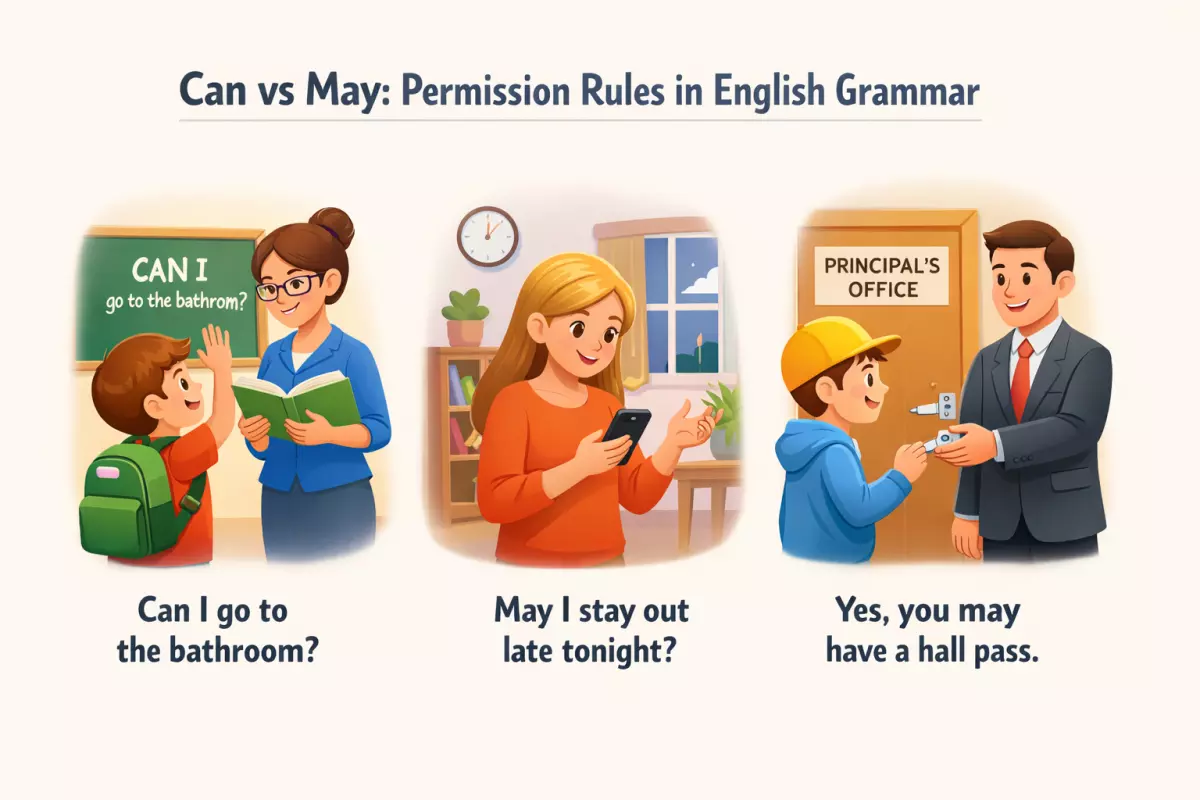 This article explains how can and may both ask permission, why may is traditionally more formal, and why everyday English often uses can. It gives formal and informal examples, notes where may still appears officially, covers negatives/refusals, common learner mistakes, and practice exercises.
- How can and may are both used to ask for permission
- The traditional rule that treats may as more formal
- How modern English often prefers can in everyday requests
- Examples of permission questions in formal and informal contexts
- Situations where may still appears in official communication
- How refusals and negative forms work with permission modals
- Common learner mistakes when asking permission
- Exercises and practice activities with can and may
Many people wonder whether to use can or may when asking for permission. In everyday English, these two small words can change the tone of a request, from casual to more polite or formal, so learners often mix them up. This guide explains when each one fits best, helping you sound natural at school, at work, and in public situations.
How can and may are both used to ask for permission
English offers more than one polite way to request permission. Can and may both work in many situations, but they signal different levels of formality and different assumptions about the speaker’s right to do something. Learning the common patterns helps you choose the tone that fits the setting.
Core idea: ability vs. permission (and why both still work)
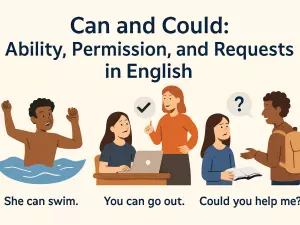
Traditionally, can relates to ability (what someone is able to do), while may relates to permission (what someone is allowed to do). In real usage, can is widely used for permission in everyday speech, and most listeners understand it as a request to be allowed, not a question about physical capability.
- Use “Can I…?” for neutral, everyday permission requests (friends, classmates, coworkers in casual contexts).
- Use “May I…?” for more formal permission requests (customer service, official situations, speaking to someone in authority).
- Expect “can” to sound more direct; it can be friendly, but it may feel too casual in strict or ceremonial contexts.
- Expect “may” to sound more deferential; it fits well when you want to show respect or follow formal etiquette.
Common request patterns (with examples)
Permission questions often follow a small set of reliable structures. These patterns work with both modals, with small changes in formality.
- Can I + base verb…? (neutral) → Can I leave a little early today?
- May I + base verb…? (formal) → May I speak with you for a moment?
- Can I + have + noun…? → Can I have a copy of the schedule?
- May I + have + noun…? → May I have your attention, please?
- Can I + borrow + noun…? → Can I borrow your charger?
- May I + borrow + noun…? → May I borrow this book overnight?
- Can I + use + noun…? → Can I use your phone?
- May I + use + noun…? → May I use the restroom?
- Can I + ask + a question…? → Can I ask a quick question?
- May I + ask + a question…? → May I ask for clarification?
- Can I + come in / join / sit…? → Can I sit here?
- May I + come in / join / sit…? → May I come in?
- Can I + (please) + base verb…? → Can I please reschedule?
- May I + (please) + base verb…? → May I please be excused?
Answering permission requests
Responses often mirror the modal used in the question. In careful or formal English, may is also common in the reply.
- ✅ Yes, you can. / Sure, you can. (everyday approval)
- ✅ Yes, you may. (formal approval)
- ✅ No, you can’t. (direct refusal)
- ✅ No, you may not. (formal, firm refusal; can sound strict)
- ✅ I’m afraid you can’t. (polite refusal)
- ✅ I’m afraid you may not. (formal refusal; often used for rules)
Typical corrections teachers make (and what matters in real life)
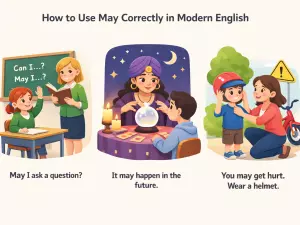
In classrooms, you may hear the correction “You mean May I…?” when a student says “Can I…?” This reflects the traditional rule (permission vs. ability). Outside the classroom, “Can I…?” is usually acceptable, but choosing “May I…?” can be safer when you need a more formal tone.
- ✅ May I leave the room? (more formal) → ✅ Can I leave the room? (common, informal/neutral)
- ✅ May I have your signature? (polite, official) → ✅ Can I have your signature? (may sound too casual in some settings)
- ❌ May I to go now? → ✅ May I go now?
- ❌ Can I to use your laptop? → ✅ Can I use your laptop?
The traditional rule that treats may as more formal
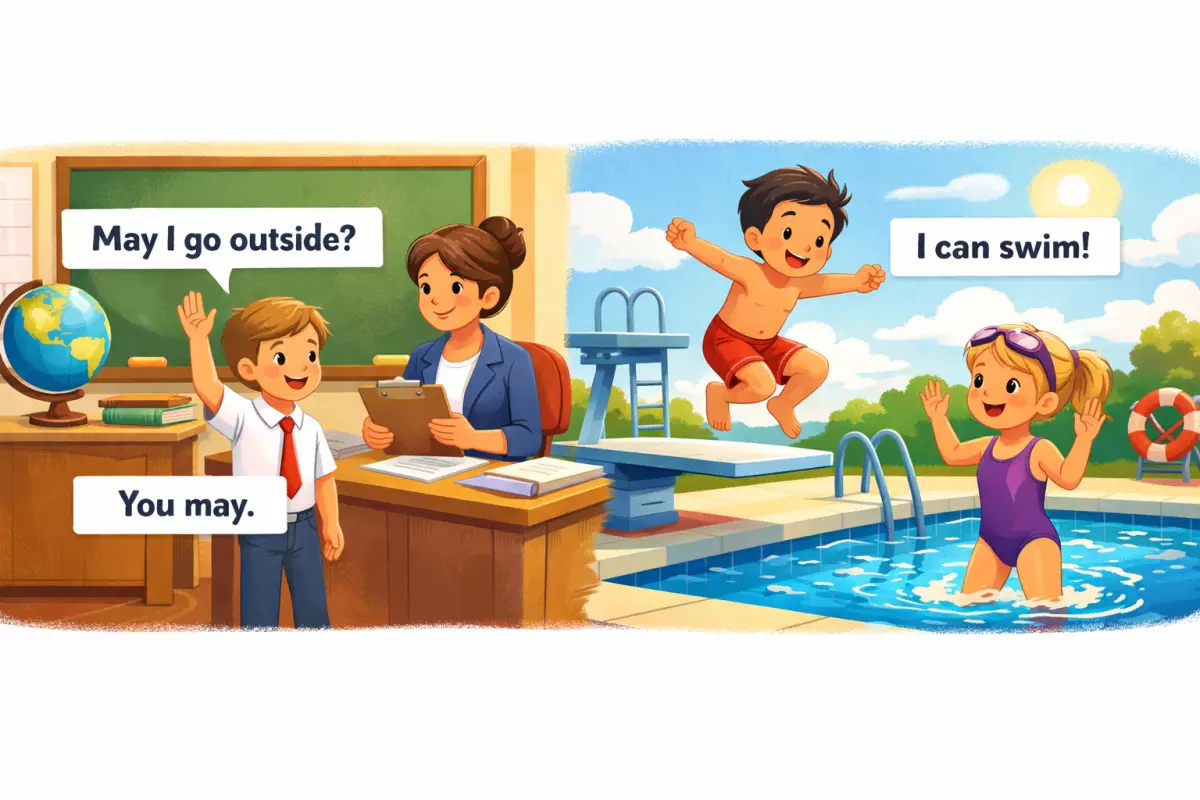
In older grammar guidance and many classroom settings, may is presented as the “polite permission” modal, while can is framed as ability. In real modern English, both are widely used for permission, but the traditional distinction still shapes expectations in formal writing, careful speech, and institutional contexts.
What the rule says (and why it exists)
- May is taught as the standard way to ask for or grant permission: “May I…?” / “You may…”.
- Can is taught as ability or possibility: “I can swim.” / “It can get cold here.”
- The logic is that permission is about what is allowed, not what is physically possible.
- Because “May I…?” became associated with careful etiquette and formal settings, it often sounds more deferential than “Can I…?”
Where “may” still sounds like the expected choice
Even speakers who normally use can for permission often switch to may when the situation feels official, distant, or rule-governed.
- Requests to authority figures: “May I leave early today?”
- Formal meetings and ceremonies: “May I have your attention?”
- Customer-facing politeness scripts: “May I help you?”
- Written notices and policies: “Visitors may park in Lot B.”
- Academic or exam instructions: “You may begin now.”
- Legal or administrative permissions: “The tenant may terminate the lease…”
- Medical or professional gatekeeping: “You may resume normal activity.”
- Granting permission with a controlled tone: “You may proceed.”
Common patterns and sentence frames
The traditional usage shows up in a few repeatable structures. These are useful templates when you want a more formal register.
- May I + base verb…? → “May I speak with the manager?”
- May we + base verb…? → “May we begin the presentation?”
- You may + base verb… → “You may submit the form online.”
- May + subject + base verb… (announcements) → “May I remind everyone to silence phones?”
- May I ask + wh-/if… → “May I ask why the deadline changed?”
- May I have + noun…? → “May I have your name, please?”
- May I see + noun…? → “May I see your ID?”
- May I + verb + you…? → “May I call you tomorrow?”
- May I be excused? (set phrase) → “May I be excused from the table?”
- May I suggest + noun/clause… → “May I suggest a different approach?”
- May I confirm + noun/clause… → “May I confirm the appointment time?”
- You may not + base verb… (prohibition) → “You may not enter without a badge.”
How it contrasts with everyday “can”
- Everyday spoken English often prefers can for permission: “Can I borrow your pen?”
- In many workplaces, “Can I…?” is neutral and polite enough; “May I…?” can sound more formal or slightly stiff.
- When correcting someone by the old rule, the contrast is typically framed like this: ✅ “May I leave?” → ❌ “Can I leave?” (in very formal contexts).
- In practice, listeners rarely misunderstand “Can I…?” as ability-only; the situation usually makes the meaning clear.
Practical takeaway for writers and learners
- Choose may when you want a formal, permission-focused tone (policies, instructions, official requests).
- Choose can when you want a natural, conversational request in everyday settings.
- If the context is strict or rule-based, “You may…” is often the clearest way to express what is allowed.
How modern English often prefers can in everyday requests
In present-day conversation, can is the default choice for asking permission in many everyday situations. It sounds natural, efficient, and friendly, especially when the context already makes it clear that permission (not ability) is the point.
Why speakers choose can so often
- Context does the work: In a request, listeners typically interpret can as “Is it allowed?” rather than “Is it possible?”
- Neutral tone: It fits casual and semi-formal settings without sounding stiff.
- Short and direct: Many common request patterns are built around Can I…? and Can you…?
- Common in service interactions: Shops, cafés, offices, and classrooms often use can as the everyday standard.
- Works well with softeners: Adding “please,” “just,” or “a moment” keeps the request polite while staying natural.
Common permission patterns with can (with natural variations)
- Can I use your phone?
- Can I sit here?
- Can I open the window?
- Can I borrow this for a minute?
- Can I take a look?
- Can I ask a quick question?
- Can I leave a little early today?
- Can I come in?
- Can I get a refill?
- Can I have the bill, please?
- Can I try this on?
- Can I change my order?
- Can I switch seats with you?
- Can I turn the volume down?
- Can I park here?
- Can I take a photo?
Politeness: how can stays friendly without becoming too informal
- Add “please” or “please?” at the end: ✅ Can I sit here, please?
- Use “just” for small requests: ✅ Can I just check one thing?
- Use “a moment/second” to soften: ✅ Can you wait a second?
- Prefer “Could you…?” when you want extra tact, especially with strangers or in customer service.
When may still sounds more appropriate
- Formal permission (rules, policies, official settings): “May I enter?” “May we begin?”
- Careful politeness in highly respectful situations: “May I ask your name?”
- Written notices and instructions where permission is explicit: “Students may use calculators.”
In practice, everyday English treats can as a normal permission request, while may often signals formality, institutional rules, or a more ceremonial tone. The best choice depends less on “correctness” and more on the situation and the relationship between speakers.
Examples of permission questions in formal and informal contexts
Permission requests shift depending on setting, relationship, and how cautious you want to sound. In casual speech, can is common for everyday asks. In more formal situations, may and other polite structures often signal respect, deference, or institutional rules.
| Context | More informal (common in speech) | More formal / polite (common in writing or official settings) |
|---|---|---|
| Classroom | Can I go to the bathroom? | May I leave the room for a moment? |
| Workplace (colleagues) | Can I take a quick break? | May I step away for a few minutes? |
| Meeting / presentation | Can I ask a question? | May I ask a question about the last point? |
| Customer service | Can I speak to a manager? | May I speak with a manager, please? |
| Email / written request | Can you approve this today? | May I request your approval by end of day? |
| Rules / policy setting | Can we bring food inside? | May visitors bring food into the facility? |
Useful patterns that soften the request
When you want to sound more careful, the structure matters as much as the modal. These patterns work with both can and may, but they are especially common with more formal wording.
- May I + verb…? (May I join the call?)
- Can I + verb…? (Can I borrow your charger?)
- Could I + verb…? (Could I leave a bit early today?)
- Would it be okay if I + past verb…? (Would it be okay if I rescheduled?)
- Do you mind if I + present verb…? (Do you mind if I open the window?)
- Would you mind if I + past verb…? (Would you mind if I sat here?)
- Is it okay if I + present verb…? (Is it okay if I record this?)
- Am I allowed to + verb…? (Am I allowed to park here?)
- Is it permitted to + verb…? (Is it permitted to take photos?)
- May we + verb…? (May we begin?)
Common usage notes (to avoid awkwardness)
- ✅ Use may for a more formal tone: “May I have your signature?” → sounds respectful and official.
- ✅ Use can for everyday permission: “Can I use your pen?” → natural with friends and coworkers.
- ❌ Avoid over-formality in casual settings: “May I have a fry?” can sound stiff among close friends.
- ✅ In policies and signs, may often means “is allowed”: “Guests may enter after 9 a.m.”
- ✅ If you are asking about rules rather than requesting a favor, “Am I allowed to…?” and “Is it permitted to…?” are clear and neutral.
Situations where may still appears in official communication

In formal writing, may often signals a careful, institutional tone. It can sound more neutral than can, especially when the writer is granting permission, setting conditions, or leaving room for discretion.
Common contexts where “may” is preferred
- Policies and regulations: to grant permission within a defined rule set (e.g., “Employees may request flexible hours with manager approval.”).
- Contracts and legal clauses: to indicate an allowed action rather than an obligation (e.g., “The Client may terminate the agreement with 30 days’ notice.”).
- Terms and conditions: to describe what users are permitted to do (e.g., “You may download one copy for personal use.”).
- Official forms and applications: to offer optional choices (e.g., “You may attach additional pages if needed.”).
- Government and public-service notices: to keep language formal and non-personal (e.g., “Applicants may submit documents in person or by mail.”).
- Academic and administrative rules: to state permitted actions under criteria (e.g., “Students may retake the exam only once.”).
- Permission with conditions: when permission depends on meeting requirements (e.g., “Visitors may enter after security screening.”).
- Discretionary decisions: to show an action is allowed but not guaranteed (e.g., “The committee may grant an extension.”).
- Formal requests: to sound polite and deferential (e.g., “May I speak with the director?”).
- Customer service and complaints: to offer options without promising outcomes (e.g., “You may be eligible for a refund.”).
- Compliance and safety instructions: to distinguish permission from requirement (e.g., “Protective eyewear may be removed only in designated areas.”).
- Internal memos and HR guidance: to describe allowed actions while maintaining a formal register (e.g., “Staff may work remotely up to two days per week.”).
- Professional email announcements: to grant access or participation (e.g., “You may join the meeting via the conference link.”).
- Procedural documents: to indicate optional steps (e.g., “You may include screenshots to support your report.”).
Typical patterns and how to interpret them
- “may + base verb” for permission: “You may enter.” (allowed)
- “may not + base verb” for prohibition: “You may not park here.” (not allowed)
- “may only + base verb” for strict limits: “You may only access this file on-site.”
- “may … with/subject to …” for conditional permission: “You may proceed subject to approval.”
- “may be required to …” to flag possible future obligation depending on circumstances: “You may be required to provide ID.”
- “may wish to …” as a formal suggestion (not permission): “You may wish to review the guidelines.”
In these settings, can is often avoided because it can sound like ability (“is able to”) rather than authorization. Using may helps the reader understand that the text is granting (or withholding) permission within an official framework.
How refusals and negative forms work with permission modals
Negative permission is expressed in two main ways: by denying permission (you are not allowed) or by refusing to give permission (the speaker won’t allow it). English uses different modal patterns for each, and the choice affects meaning, politeness, and clarity.
1) Denying permission (rule: “not allowed”)
Use these forms when a rule, policy, or authority says something is prohibited. This is about permission status, not ability.
- may not = not allowed (often formal): ✅ You may not park here.
- cannot / can’t = not allowed (common in speech): ✅ You can’t bring food into the lab.
- must not / mustn’t = prohibited (strong, rule-like): ✅ You mustn’t touch that switch.
- not allowed to (clear and neutral): ✅ Visitors are not allowed to enter this area.
- mayn’t exists but is rare in modern English; prefer may not.
- In writing, may not can sometimes be read as “might not” (possibility). If ambiguity matters, use cannot or not allowed to.
2) Refusing permission (speaker decision: “I won’t let you”)
Use these when the speaker is actively saying no. The grammar often includes an explicit decision-maker (I/we) and a permission verb.
- You may not + base verb can mean a direct refusal in formal contexts: ✅ You may not leave early today.
- You can’t often sounds like a firm refusal in conversation: ✅ No, you can’t go out tonight.
- I can’t let you / I won’t let you makes the refusal explicit: ✅ I can’t let you use my account.
- I’m afraid you can’t softens the refusal: ✅ I’m afraid you can’t take photos in here.
- We can’t allow / We don’t allow is typical for policies: ✅ We don’t allow pets.
3) Where negatives go: common patterns
With modals, the negative usually attaches to the modal, not the main verb. This is one reason permission modals are easy to spot in refusals.
- ✅ You may not enter. ❌ You may enter not.
- ✅ You can’t sit here. ❌ You can sit not here.
- ✅ You mustn’t speak during the test. ❌ You must speak not during the test.
- With be allowed to, the negative attaches to be: ✅ You aren’t allowed to record.
4) Short answers and refusals in dialogue
Short replies often carry the social meaning of a refusal. The modal you choose affects how strict or polite the “no” sounds.
- ✅ “May I leave early?” “No, you may not.” (formal, rule-based)
- ✅ “Can I leave early?” “No, you can’t.” (neutral, common)
- ✅ “Could I leave early?” “I’m afraid you can’t.” (polite refusal)
- ✅ “Can I use your phone?” “Sorry, I can’t.” (refusal without stating a rule)
- ✅ “May I take a photo?” “No, you’re not allowed to.” (very clear: prohibited)
5) Avoiding common confusion
- may not can mean either “not allowed” or “possibly not.” If you mean prohibition, consider: → can’t / mustn’t / not allowed to.
- can’t can mean “not allowed” or “not possible.” Context usually clarifies, but for rules and signs, must not or not allowed is often clearer.
- mustn’t is stronger than can’t for permission: it signals strict prohibition, not just a denied request.
- To refuse politely, pair the negative with a reason: ✅ You can’t park here because it blocks the entrance.
Common learner mistakes when asking permission
Many problems with permission questions come from mixing formality levels, choosing the wrong modal for the situation, or using a grammatically correct structure that sounds socially awkward. The patterns below show what typically goes wrong and what native speakers usually choose instead.
1) Using may in very casual situations (sounds stiff)
May is correct, but it often feels formal in everyday conversation. In casual speech, can (or could) is more natural.
- ❌ May I borrow your pen? (to a close friend) → ✅ Can I borrow your pen?
- ❌ May I sit here? (at a crowded café with peers) → ✅ Can I sit here?
- ✅ May I speak to the manager? (more formal request)
2) Using can when the context expects formality
Can is widely accepted for permission, but in official or polite settings it can sound too direct. May or could often fits better.
- ❌ Can I leave early, Professor? → ✅ May I leave early, Professor?
- ❌ Can I ask a question, Your Honor? → ✅ May I ask a question?
- ❌ Can I use the restroom? (formal interview) → ✅ Could I use the restroom?
3) Confusing permission with ability (the “I can” problem)
Learners sometimes answer a permission request with an ability statement, or they ask permission using a structure that focuses on ability instead of approval. The listener usually understands, but it can sound off.
- ❌ A: Can I open the window? B: Yes, you can. (can sound like “you are able to”) → ✅ Yes, you can / Sure / Go ahead (more natural permission-giving)
- ❌ I can go out? → ✅ Can I go out?
- ❌ I am able to leave now? → ✅ May I leave now?
4) Choosing the wrong level of politeness: can vs could
Could is often used to soften a request. Using can in sensitive situations may sound too blunt, even though it is grammatically fine.
- ❌ Can I interrupt you? → ✅ Could I interrupt you for a second?
- ❌ Can I take tomorrow off? → ✅ Could I take tomorrow off?
- ❌ Can I ask you something personal? → ✅ Could I ask you something personal?
5) Asking for permission but using the wrong verb pattern
Permission questions often need a clear action verb. Missing the main verb, choosing the wrong complement, or using an unnatural phrase can make the request unclear.
- ❌ May I to go? → ✅ May I go?
- ❌ Can I to use your phone? → ✅ Can I use your phone?
- ❌ May I permission to leave? → ✅ May I have permission to leave?
- ❌ Can I a question? → ✅ Can I ask a question?
6) Mixing up “asking” vs “giving” permission
Some learners use question forms when they need to grant approval, or they respond with a structure that does not clearly allow the action.
- ❌ You may? (as a response) → ✅ Yes, you may. / Sure, go ahead.
- ❌ Can you. (incomplete) → ✅ Yes, you can. / Of course.
- ❌ You can? (when granting) → ✅ You can. / You may. / That’s fine.
7) Overusing “Please” or placing it awkwardly
Please helps, but too much can sound unnatural. Placement matters: it usually goes at the beginning or end of the request.
- ❌ Can I please borrow please your notes please? → ✅ Can I borrow your notes, please?
- ❌ May I please to leave? → ✅ May I leave, please?
- ✅ Please may I leave? (possible, but more common: May I leave, please?)
8) Using indirect questions incorrectly
Indirect forms are polite, but they require statement word order after the introductory phrase.
- ❌ Could you tell me can I leave early? → ✅ Could you tell me if I can leave early?
- ❌ I wonder can I open the window. → ✅ I wonder if I can open the window.
- ❌ Do you know may I park here? → ✅ Do you know if I may park here?
9) Forgetting that rules and signs often use may not (not “can’t”)
In notices and formal rules, may not is common to mean “not allowed,” while can’t is more conversational.
- ✅ Visitors may not enter this area.
- ✅ You may not use phones during the exam.
- ✅ You can’t park here. (everyday spoken warning)
10) Not matching the request to the situation (time, authority, and impact)
Permission language changes depending on who has authority and how big the request is. A small favor can use can; a bigger or more sensitive request often benefits from could or a longer polite frame.
- Small, low-stakes: ✅ Can I open the window?
- Polite, slightly formal: ✅ Could I step out for a moment?
- Formal/official: ✅ May I request an extension?
- Very sensitive: ✅ Would it be okay if I took a day off next week?
Exercises and practice activities with can and may
Practice choosing can or may by focusing on two questions: (1) Is it a request for permission or a statement about permission? (2) How formal does the situation sound? Use may for more formal permission and polite requests; use can for everyday permission and informal requests. In questions, both are common, but the tone changes.
1) Choose the best option (can/may)
- ________ I leave early today? I have a doctor’s appointment.
- You ________ start the exam when you are ready.
- ________ we park here after 6 p.m.?
- Students ________ not use phones during the test.
- ________ I borrow your charger for a minute?
- Visitors ________ enter through the main door only.
- ________ I ask a quick question about the homework?
- Employees ________ request time off through the HR system.
- ________ we bring snacks into the meeting room?
- You ________ take one brochure per person.
Show answers
- May
- may
- Can
- may
- Can
- must/may (If limited to can/may: may)
- May
- may
- Can
- may
2) Rewrite to change the level of formality
Rewrite each sentence twice: (A) more formal, (B) more casual. Keep the meaning the same.
- Can I come in?
- May I use the restroom?
- You may leave your bags at reception.
- Can we reschedule the meeting?
- Guests may not smoke on the balcony.
- Can I have a copy of the report?
Show answers
- A: May I come in? B: Can I come in?
- A: May I use the restroom? B: Can I use the restroom?
- A: You may leave your bags at reception. B: You can leave your bags at reception.
- A: May we reschedule the meeting? B: Can we reschedule the meeting?
- A: Guests may not smoke on the balcony. B: Guests can’t smoke on the balcony.
- A: May I have a copy of the report? B: Can I have a copy of the report?
3) Spot the issue and correct it (permission focus)
Some sentences are fine; others need a change because the permission meaning or tone is off. Rewrite only the ones that need fixing.
- ❌ May you help me carry this box?
- ✅ May I speak with the manager?
- ❌ Can I possibly open the window, sir?
- ❌ You can not enter without a badge. (formal sign)
- ✅ Can we sit here?
- ❌ May I to leave now?
- ✅ You may take one cookie.
- ❌ Can I have permission to submit it tomorrow? (very formal context)
Show answers
- Can you help me carry this box?
- No change.
- May I open the window, sir?
- You may not enter without a badge.
- No change.
- May I leave now?
- No change.
- May I have permission to submit it tomorrow?
4) Pattern practice: common permission frames
Use these frames to build your own permission requests and responses. Say each one aloud with two different nouns or activities to make the pattern automatic.
- May I + base verb? → May I step out for a moment?
- Can I + base verb? → Can I use your pen?
- May we + base verb? → May we begin?
- Can we + base verb? → Can we meet at 3?
- You may + base verb. → You may start now.
- You can + base verb. → You can sit here.
- May I have + noun? → May I have a receipt?
- Can I get + noun? → Can I get a glass of water?
- May I + base verb + please? → May I leave early, please?
- Can I + base verb + real quick? → Can I ask a quick question?
- You may not + base verb. → You may not record the session.
- You can’t + base verb. → You can’t bring food inside.
- May I be allowed to + base verb? → May I be allowed to retake the quiz?
- Can I be allowed to + base verb? → Can I be allowed to join later?
- Is it okay if I + present? → Is it okay if I leave at 4?
- Would it be okay if I + past? → Would it be okay if I left early?