Reduction of Adverbial Clauses (while - when doing)

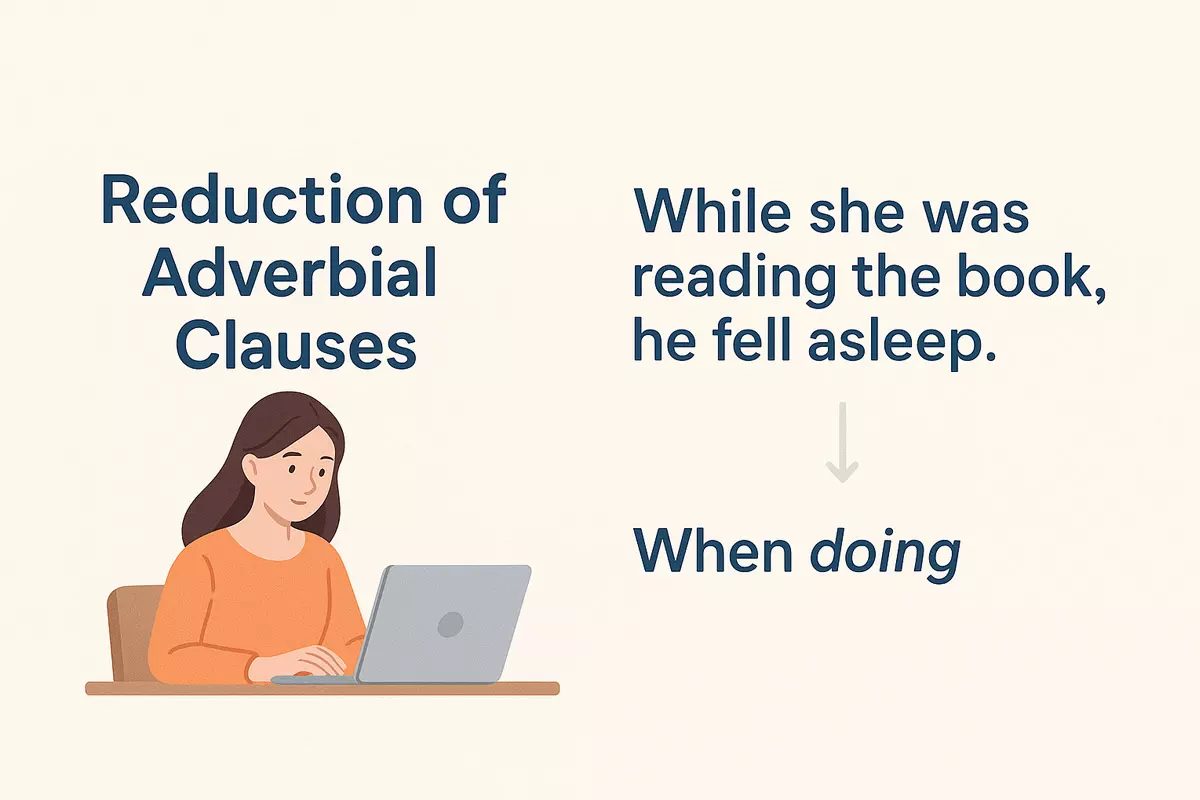 Here we when and how to reduce adverbial clauses, highlighting which clause types suit reduction, patterns with -ing and past participles, clarity concerns, formal versus informal contexts, and provides practice with participial reductions.
If you want to make your sentences more concise and fluid, try transforming time-related subordinate clauses—like those starting with “while” or “when”—into shorter phrases. This straightforward technique can sharpen your writing by reducing unnecessary words and making your ideas clearer. For example, instead of writing “When you edit your work, you catch mistakes,” you can say “Editing your work helps you catch mistakes.” Small changes like this can significantly improve the clarity and impact of your writing.
When reduction is possible
Adverbial clauses can often be shortened, but only under certain grammatical conditions. Typically, reduction is allowed when the subject of the adverbial clause is the same as the subject of the main clause. This process is common with time-related conjunctions like when and while. The verb in the adverbial part is changed to its -ing form (present participle), creating a more concise and natural sentence.
Requirements for clause reduction
- The adverbial clause must have the same subject as the main clause.
- The verb in the adverbial clause should not be negative or passive (with some exceptions).
- Usually, the conjunctions when, while, after, before, since, and as allow this transformation.
- Reduction is not possible if the meaning would become ambiguous or if a different subject is needed for clarity.
- The reduced clause typically uses the present participle (-ing) or, for past actions, the perfect participle (having + past participle).
Examples of reducible adverbial clauses
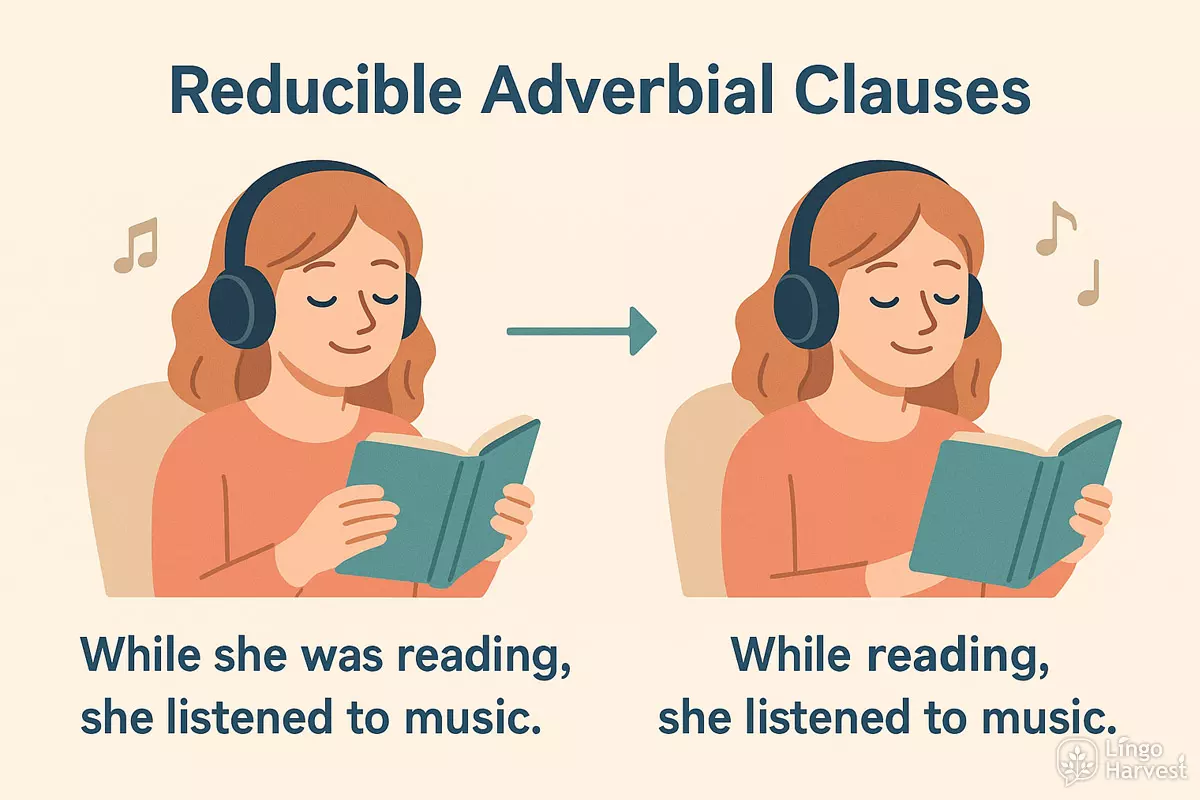
- While she was reading, she listened to music. → While reading, she listened to music.
- When he entered the room, everyone stood up. → Entering the room, he saw everyone stand up.
- After I finished my work, I went home. → After finishing my work, I went home.
- Before she left, she called her friend. → Before leaving, she called her friend.
- Since he moved to the city, he has met many people. → Since moving to the city, he has met many people.
- As she walked to school, she listened to a podcast. → Walking to school, she listened to a podcast.
- When he does homework, he often listens to music. → When doing homework, he often listens to music.
- While she was waiting for the bus, she read a book. → While waiting for the bus, she read a book.
- After we ate dinner, we watched a movie. → After eating dinner, we watched a movie.
- Before he goes to bed, he brushes his teeth. → Before going to bed, he brushes his teeth.
- When people travel abroad, it’s important to have insurance. → When traveling abroad, it’s important to have insurance.
- While she was shopping, she found a great deal. → While shopping, she found a great deal.
- After they arrived, they started the meeting. → After arriving, they started the meeting.
- Before you start the test, read the instructions. → Before starting the test, read the instructions.
- When she asked for help, she approached the teacher. → Asking for help, she approached the teacher.
- After they had finished the project, they took a break. → Having finished the project, they took a break.
- Because he was working late, he missed the last train. → Working late, he missed the last train.
- As he was running down the street, he tripped and fell. → Running down the street, he tripped and fell.
- Because she had seen the film before, she knew the ending. → Having seen the film before, she knew the ending.
Common situations where reduction does not work
- If the subjects of the main and adverbial clauses are different.
- If the adverbial clause is negative and clarity would suffer.
- When the clause is passive and the participle form would be awkward or unclear.
- When using conjunctions that don’t allow reduction (such as because, although, or if in most cases).
Types of clauses that reduce well
When looking at adverbial clauses that can be shortened, certain patterns and time words are much more likely to allow for reduction. In English, clauses introduced by words like while, when, after, before, and since often work smoothly with this kind of transformation. These typically describe time relationships or conditions, and can easily shift to a participial phrase, such as While walking or After finishing.
Common subordinators and their reducibility
Some subordinators naturally lend themselves to reduction, especially those that refer to simultaneous or sequential actions. Here are some of the most common ones:
- while (While reading → Reading)
- when (When leaving → Leaving)
- after (After finishing → Finishing)
- before (Before starting → Before starting)
- since (Since moving → Since moving)
- once (Once completed → Completed)
- as (As walking → Walking)
- until (Until told → Until told)
- because (Because feeling tired → Feeling tired)
- if (If used correctly → Used correctly)
- though/although (Although injured → Injured)
- provided (that) (Provided followed → If followed)
Typical patterns for clause reduction
Adverbial clauses are most easily reduced when:
- The subject of both clauses is the same.
- The verb is active (but passive forms are possible too).
- The meaning remains clear without the subordinator.
Examples of reduction in practice
Here is a concise overview showing how original clauses transform into their reduced forms for different subordinators:
| Full Clause | Reduced Form |
|---|---|
| While he was driving, he listened to music. | While driving, he listened to music. |
| After she finished her work, she went home. | After finishing her work, she went home. |
| When you enter the room, please turn off your phone. | When entering the room, please turn off your phone. |
| Because he was tired, he left early. | Being tired, he left early. |
| If you are used correctly, these tools help a lot. | Used correctly, these tools help a lot. |
Subordinators that do not reduce well
Not all adverbial clauses can be reduced. Causal clauses with so that or contrastive clauses with whereas generally do not work. Also, if the subject changes between the clauses, reduction is impossible.
Summary
In summary, time and condition clauses with the same subject are the best candidates for reduction, especially with words like while, when, after, and because. Recognizing these patterns makes it easier to write concise, fluent sentences.
Patterns with -ing and past participles
Understanding how to reduce adverbial clauses often involves switching to -ing forms (present participles) or past participles. This reduction streamlines sentences, making them more concise and sometimes more formal. Typically, the subject of the main clause and the adverbial clause must be the same for this transformation to work properly.
Common -ing Clause Reductions
When reducing clauses that use words like "while," "when," or "after," the verb usually shifts to the -ing form. This is especially common when talking about events happening at the same time or in sequence.
- While she was reading → Reading
- When he arrived → Arriving
- After they finished → After finishing
- Before you leave → Before leaving
- If you see him → Seeing him
- Since she moved → Since moving
- Because he was tired → Being tired
- Though he tried → Though trying
- When you travel → Traveling
- While he worked → Working
Using Past Participles in Reductions
Past participles are used when the reduced clause has a passive meaning, or when the action is completed before the main action.
- When finished (meaning: when it is finished/completed)
- Given enough time (meaning: if enough time is given)
- Seen from a distance (meaning: when it is seen from far away)
- Built in 1920 (meaning: which was built in 1920)
- Left alone (meaning: if left alone)
- Surprised by the news (meaning: because he was surprised)
- Encouraged by his friends (meaning: because his friends encouraged him)
- Given the circumstances (meaning: considering the circumstances)
- Known for her work (meaning: because she is known)
- Completed ahead of schedule (meaning: after it was completed)
Comparison: -ing vs. Past Participle Reductions
| Original Clause | Reduced Form |
|---|---|
| While she was studying, she listened to music. | Studying, she listened to music. |
| After the work was finished, we left the office. | After the work was finished, we left the office. or After finishing the work, we left the office. |
| If given the opportunity, he will succeed. | Given the opportunity, he will succeed. |
| When he was asked, he explained everything. | Asked, he explained everything. |
| Because he was tired, he went to bed early. | Being tired, he went to bed early. |
| Before she left, she called her friend. | Before leaving, she called her friend. |
Key Points to Remember
- Use -ing forms for active, ongoing, or simultaneous actions.
- Use past participles for passive or completed actions.
- Reduction works best when both clauses share the same subject.
- Sometimes the reduced clause keeps the conjunction (e.g., "after," "before"), but not always.
- Be careful with meaning—some reductions can sound awkward or change the intended sense.
By practicing these patterns, you can make your writing more natural and efficient, especially in formal or academic contexts.
Clarity vs ambiguity when reducing
Reducing adverbial clauses, such as transforming "while she was working" into "while working," can make sentences more concise, but sometimes this process introduces uncertainty about meaning. When you shorten adverbial clauses, you often remove the subject, relying on the reader to infer who is performing the action. This is usually clear when the subject of the main and reduced clauses is the same, but confusion can arise when it’s not obvious.
When reduction works well
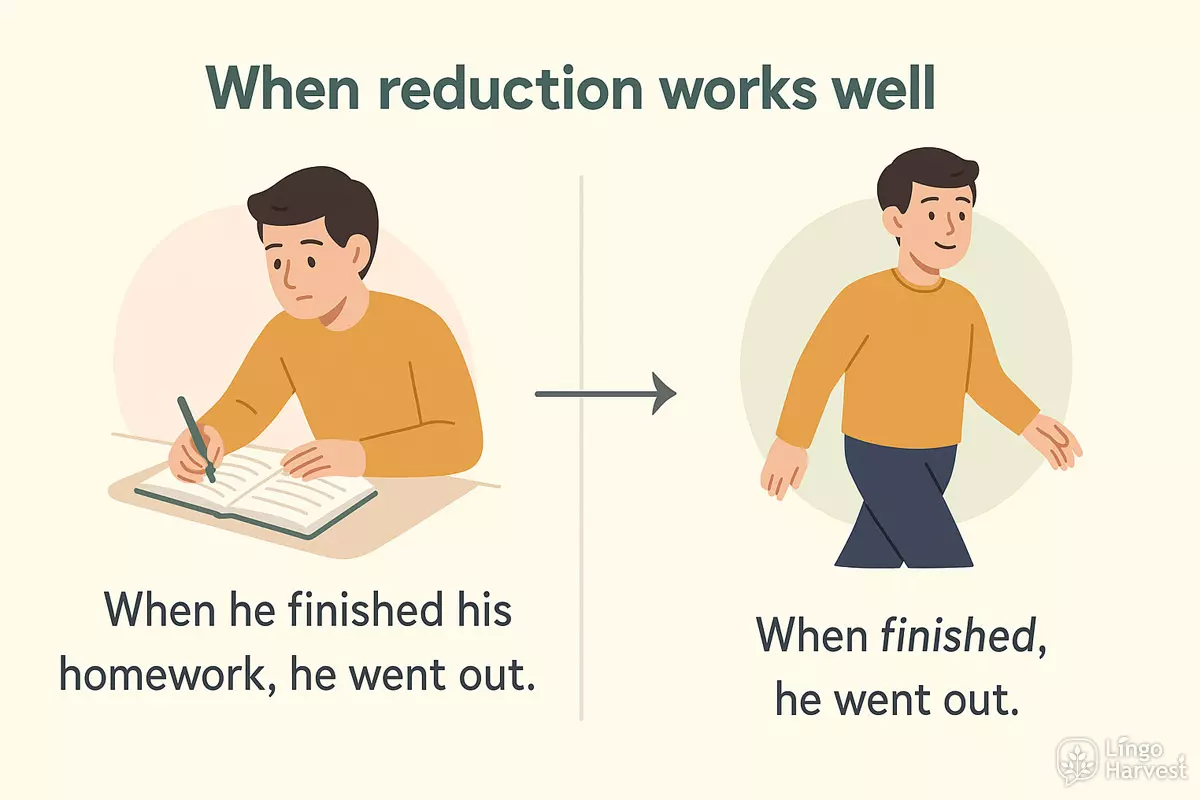
Clarity is maintained if both clauses share the same subject and context makes it clear. For example:
- While she was reading, she took notes. → While reading, she took notes.
- After he finished his homework, he went out. → After finishing his homework, he went out.
- Before she left the office, she sent the email. → Before leaving the office, she sent the email.
- Since he moved to the city, he has met many people. → Since moving to the city, he has met many people.
- When they arrived, they started the meeting. → Upon arriving, they started the meeting.
- While he was cooking dinner, he listened to music. → While cooking dinner, he listened to music.
- After she reviewed the report, she approved it. → After reviewing the report, she approved it.
- Because he was feeling tired, he went to bed early. → Feeling tired, he went to bed early.
In these cases, the reduced forms are easily understood because the subject is clear from the main clause.
Common sources of ambiguity
Omitting the subject can lead to confusion, especially if the implied subject could refer to more than one noun in the sentence. For instance:
- While walking the dog, the rain started. ❌ (Who was walking?)
- When eating, distractions can cause mistakes. ❌ (Who is eating?)
- After finishing the report, the computer crashed. ❌ (Who finished?)
- Before leaving the station, the train schedule was updated. ❌ (Who was leaving?)
- While reviewing the documents, several errors were found. ❌ (Who reviewed?)
- Driving through the city, the skyscrapers looked enormous. ❌ (Who was driving?)
- To succeed in this role, strong communication skills are needed. ❌ (Who needs them?)
- Having missed the bus, the office seemed even farther away. ❌ (Who missed the bus?)
Here, the reduced clause could be misinterpreted, as the subject isn't explicitly stated.
Comparison: Full vs. reduced adverbial clauses
| Full Clause | Reduced Clause |
|---|---|
| While she was reading, she heard a noise. | While reading, she heard a noise. |
| When I am driving, I listen to podcasts. | When driving, I listen to podcasts. |
| While he was jogging, he saw a friend. | While jogging, he saw a friend. |
| When the bell rang, students left the room. | When the bell rang, students left the room. (Not reducible, as "the bell" can't perform the action) |
Tips for maintaining clear meaning
- Only reduce when the subject of both clauses is the same.
- If there’s any chance of confusion, keep the full clause.
- Avoid reductions when the subject is not the main clause’s subject.
- Read the sentence aloud to check for possible ambiguity.
- Be cautious with passive structures or impersonal subjects.
In summary, shortening adverbial clauses can streamline your writing, but always double-check to ensure the meaning remains unmistakable. If clarity suffers, it’s better to use the full clause.
Formal vs informal suitability
When reducing adverbial clauses—especially with “while” and “when”—the context and style of your writing matter. In formal texts, such as academic essays or reports, full adverbial clauses are often preferred for clarity and precision. By contrast, in emails, notes, or spoken English, the reduced form (using the -ing participle) is common and can make language more concise and natural.
Key differences in usage
Writers often choose between full and reduced forms based on how formal or relaxed their communication needs to be. Reduced clauses (e.g., “While driving, she listened to music”) are efficient but sometimes ambiguous in very formal contexts. On the other hand, using the full clause (“While she was driving, she listened to music”) can sound unnecessarily wordy in casual speech.
Typical environments for each form
- Academic writing: Full clauses for clarity
- Business correspondence: Mix of both, depending on tone
- Everyday conversation: Reduced forms are favored
- Instructions/manuals: Reduced clauses for brevity
- Literary texts: Choice depends on narrative style
- Emails/chats: Shortened forms for efficiency
- News articles: Balanced use for readability
- Official documents: Full clauses for formality
- Social media: Reduced, informal phrasing
- Presentations: Reduced or full, depending on audience
Examples: Full vs. reduced adverbial clauses
| Full Clause (More Formal) | Reduced Clause (Less Formal) |
|---|---|
| While he was reading, the phone rang. | While reading, he heard the phone ring. |
| When she arrived, we started the meeting. | Upon arriving, she joined the meeting. |
| While they were working, it began to rain. | While working, they got caught in the rain. |
| When I was leaving, I saw my neighbor. | Leaving the house, I saw my neighbor. |
Choosing the right form
Selecting between full and reduced adverbial expressions depends on your audience and purpose. For academic or legal writing, opt for the full structure to avoid misinterpretation. In day-to-day conversation, reduced forms keep language fluid and less repetitive. If in doubt, prioritize clarity—especially if your sentence could be misunderstood. In summary, understanding when to use reduced adverbial clauses versus full ones helps your writing match the expected tone and formality of any situation.
Practice: reduce full clauses to participial forms
Understanding how to transform adverbial clauses into participial phrases is an essential skill for achieving more concise and sophisticated English. Typically, when the subject of the main and subordinate clause is the same, we can reduce clauses with words like "while" or "when" to participial forms. This practice helps to avoid repetition and makes sentences flow more naturally.
Instructions
Below are several sentences containing full adverbial clauses. Try rewriting each one by reducing the adverbial clause to a participial phrase. Focus on sentences using "while" or "when" plus a verb.
- While she was cooking dinner, she listened to the radio.
- When he arrived at the station, he called his friend.
- While they were waiting for the bus, they chatted about their weekend plans.
- When you enter the room, please turn off your phone.
- While I was reading the article, I took some notes.
- When the teacher finished the lesson, she gave us homework.
- While the children were playing outside, it started to rain.
- When the sun rises, the birds start singing.
- While walking to work, he thought about his presentation.
- When you travel abroad, you should carry your passport at all times.
- While Mary was studying, her phone rang.
- When the bell rang, the students left the classroom.
- While he was jogging in the park, he met an old friend.
- When the movie ended, everyone clapped.
- While the cat was sleeping, the dog barked loudly.
Common Patterns for Reduction
- While/When + subject + be + verb-ing → While/When + verb-ing (if the subject is the same as in the main clause)
- When/While + subject + simple verb → Upon/After/Before + verb-ing (sometimes "on" or "upon" can be used for more formal writing)
Quick Reference: Clause Reduction Examples
| Full Clause | Participial Phrase |
|---|---|
| While she was cooking dinner, she listened to the radio. | While cooking dinner, she listened to the radio. |
| When he arrived at the station, he called his friend. | Arriving at the station, he called his friend. |
| While they were waiting for the bus, they chatted. | While waiting for the bus, they chatted. |
| When you enter the room, please turn off your phone. | Entering the room, please turn off your phone. |
| While I was reading the article, I took some notes. | While reading the article, I took some notes. |
| When the teacher finished the lesson, she gave us homework. | After finishing the lesson, the teacher gave us homework. |
| While the children were playing outside, it started to rain. | While the children were playing outside, it started to rain. (No reduction; different subjects) |
| When the sun rises, the birds start singing. | When rising, the birds start singing. (Unnatural; better to keep the full clause) |
Note: Only reduce when the subject of the adverbial clause and the main clause is the same. If the subjects differ, reduction is not possible or can lead to confusion.
Try It Yourself
Rewrite the following sentences by reducing the adverbial clause, when possible:
- While I was waiting for the elevator, I checked my messages.
- When John opened the window, fresh air came in.
- While she was talking on the phone, she made coffee.
- When you finish the test, hand it to your teacher.
Show answers
- While waiting for the elevator, I checked my messages.
- Opening the window, John let fresh air in. / When John opened the window, fresh air came in. (subjects differ, so reduction may not be possible)
- While talking on the phone, she made coffee.
- Finishing the test, hand it to your teacher. / When you finish the test, hand it to your teacher. (both possible; reduction is more common in instructions)
With regular practice, transforming full adverbial clauses into participial phrases will become more intuitive, allowing you to write more natural and concise sentences.