Spoken English Verb Reductions Explained

 This article explains what verb reductions are, including auxiliary reductions, contractions, and weak forms, and how rhythm and linking create natural speech. It also covers listening for reduced forms, common learner problems, and ways to improve pronunciation.
In everyday conversation, English verbs and phrases are often shortened so speech flows faster and sounds more natural. If you have ever heard gonna, wanna, gotta, or I’ve and wondered what they mean, this guide will help you recognize these forms, understand the full expressions behind them, and use them comfortably in real conversations without sounding overly formal.
What verb reductions are
In everyday speech, English speakers often shorten common verb phrases so they flow faster and sound more natural. These shortened pronunciations are predictable: sounds get weakened, merged, or dropped, especially in unstressed parts of a sentence. The meaning usually stays the same, but the sound changes.
How reductions typically happen
- Weak forms: function words (auxiliaries, modals, “to”) lose stress and use a simpler vowel sound.
- Sound linking: a final consonant connects to the next word’s vowel (e.g., “turn it” sounds like it runs together).
- Assimilation: one sound changes to match a nearby sound (common with /t/, /d/, /n/ + /y/).
- Elision: a sound is dropped, often /t/ or /d/ in consonant clusters (“next day” may lose the /t/).
- Contraction: written apostrophe forms reflect frequent speech patterns (“I’m,” “we’ve,” “she’d”).
Where you hear them most
- Auxiliary verbs (be, have, do): “I am,” “we have,” “do you” often compress in fast speech.
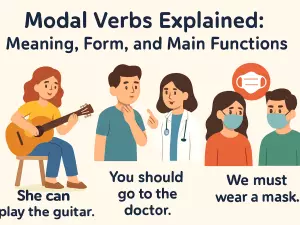
- Modals (can, could, should, would, must): the vowel weakens and consonants may blend with the next word.
- Verb + not: negative forms frequently contract and may further reduce in connected speech.
- Verb + to: “to” commonly becomes a weak /tə/ sound, and may blend into the verb before it.
- Pronoun + verb: subject pronouns attach closely to auxiliaries (“I’ll,” “you’re,” “they’ve”).
Common patterns you can recognize (and practice)
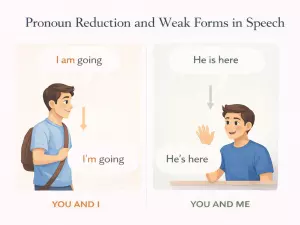
- “I am” → “I’m” (often with a very light /m/)
- “you are” → “you’re” (the vowel shortens in fast speech)
- “we have” → “we’ve” (the /v/ may be subtle)
- “I have” → “I’ve” (can sound close to “I-uhv” when unstressed)
- “they will” → “they’ll” (the /l/ can be hard to hear)
- “I would” → “I’d” (often identical in sound to “I had” in isolation)
- “she has” → “she’s” (context tells you if it means “is” or “has”)
- “do you” → “d’you” (the words fuse; the vowel weakens)
- “did you” → “didja” (assimilation: /d/ + /y/ blends)
- “would you” → “wouldja” (very common in requests)
- “could you” → “couldja” (same blending pattern)
- “should you” → “shouldja” (often in advice or questions)
- “want to” → “wanna” (informal; frequent in speech)
- “going to” → “gonna” (informal; future meaning stays)
- “have to” → “hafta” (the /v/ often weakens or disappears)
- “has to” → “hasta” (the /z/ may reduce in fast speech)
- “got to” → “gotta” (informal; obligation meaning)
- “let me” → “lemme” (common in quick offers or requests)
A useful way to think about these forms is that stress drives pronunciation. When the main verb or key information word carries the stress, the supporting verb (auxiliary or modal) often reduces. In careful speech you may hear the full form; in relaxed conversation, the reduced form is usually the default.
Auxiliary reductions in speech
In everyday conversation, helping verbs often shrink so the rhythm stays smooth and unstressed words don’t take up extra time. These reductions are most common when an auxiliary sits between a subject and the main verb, or when it’s part of a short response. They are less common in careful, formal speech, and they usually disappear when the auxiliary is emphasized.
Common reduction patterns (and when they happen)
- Unstressed auxiliaries reduce when they carry little meaning by themselves: “I have finished” → “I’ve finished.”
- Reductions prefer mid-sentence positions: “She is going” → “She’s going” is more natural than reducing at the end: “Yes, she is” (often stays full).
- Contractions attach to the subject (or to a preceding word): “they are” → “they’re,” “who is” → “who’s.”
- Negative forms have their own reductions: “do not” → “don’t,” “cannot” → “can’t,” “will not” → “won’t.”
- Stress blocks reduction: “I am ready” (emphasis) usually stays full, rather than “I’m ready.”
- Tag questions often reduce: “You’re coming, aren’t you?” (often said quickly as one unit).
- Short answers vary by emphasis: “Have you eaten?” “Yes, I have.” (careful) vs. “Yeah, I have.” (often reduced vowel on have).
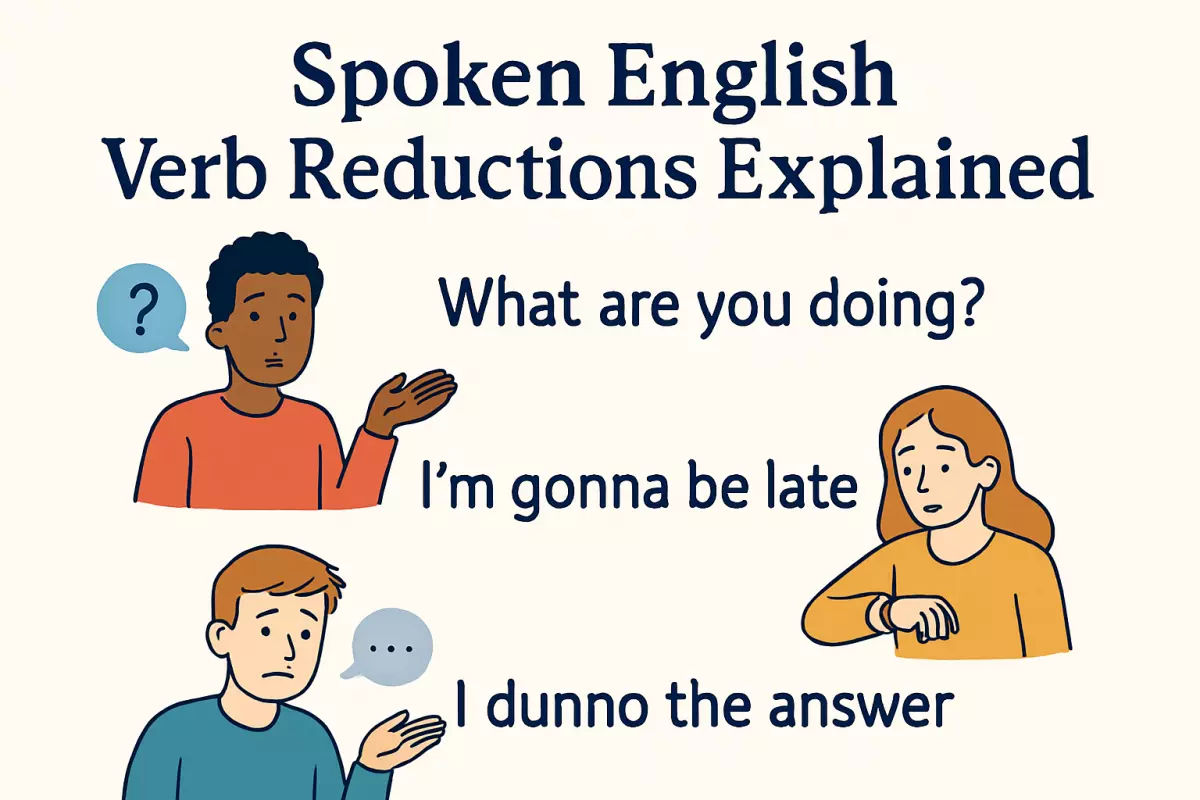
- Some reductions are pronunciation-only (not written as contractions): “What are you doing?” → “Whaddaya doing?” in fast speech.
Useful forms to recognize and produce
- be: I’m, you’re, he’s, she’s, it’s, we’re, they’re
- be (past): I was (rarely contracts), you were (often reduces in sound: “you were” → “you wer”)
- have: I’ve, you’ve, we’ve, they’ve; he’s/she’s/it’s can mean has (context decides)
- have (perfect) often becomes a weak sound: “I’ve been,” “we’ve done,” “they’ve seen”
- will: I’ll, you’ll, he’ll, she’ll, we’ll, they’ll (often a quick “l” sound)
- would: I’d, you’d, he’d, we’d, they’d (also used for had; meaning depends on the next word)
- had: I’d/you’d/he’d (before past participles: “I’d eaten”)
- do (negative): don’t, doesn’t, didn’t (very common in questions and statements)
- can (negative): can’t; can itself often reduces in affirmative sentences (“I can go” with a weak vowel)
- should/ could/ might (negative): shouldn’t, couldn’t, mightn’t (the last is less common in many varieties)
- must (negative): mustn’t (common in some dialects; elsewhere “don’t have to” may replace it)
- going to (semi-auxiliary): “going to” → “gonna” (informal, fast speech)
- want to (not an auxiliary, but similar reduction pattern): “want to” → “wanna” (informal)
- have to (semi-auxiliary): “have to” → “hafta” (informal, fast speech)
- used to: “used to” → “usta” (informal, fast speech)
Meaning and spelling traps to watch for
- He’s can mean he is or he has: “He’s late” (is) vs. “He’s left” (has).
- I’d / you’d / he’d can mean would or had: “I’d go” (would) vs. “I’d gone” (had).
- There’s is often used even with plurals in speech: “There’s two options” (common spoken usage), though careful writing may prefer “There are.”
- Contractions are limited by grammar: ❌ “I’mn’t” is not standard; use “I’m not.”
- End-position auxiliaries often stay full when they carry the answer: “Yes, I do.” “No, she isn’t.”
As a practical rule, reduce the auxiliary when it’s predictable and unstressed, and keep it full when you need contrast, clarity, or emphasis. Listening for these patterns helps you parse fast speech, and using them selectively makes your own spoken English sound more natural without becoming unclear.
Contractions and weak forms
In everyday speech, English often reduces function words (auxiliaries, pronouns, prepositions) so the rhythm stays smooth and the stressed words stand out. These reductions follow predictable patterns: some are written with apostrophes (contracted forms), and others are mainly spoken (weak forms) and may not appear in writing.
When contractions are natural (and when they are not)
- Most common in neutral conversation: “I’m,” “you’re,” “we’ve,” “they’d,” “she’ll.”
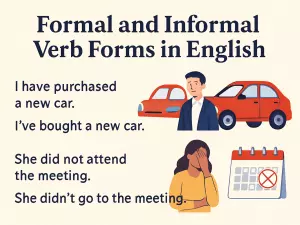
- Less common in very formal writing: essays, legal text, careful reports often avoid them.
- Common in speech even in serious contexts: meetings, presentations, interviews (unless the speaker is aiming for extra formality).
- Not used at the end of a clause in some cases: “Yes, I am” (not “Yes, I’m”). “No, I have not” (not “No, I’ve not” in many varieties, though “I’ve not” exists in some dialects).
- Watch ambiguity: “he’d” can mean “he had” or “he would,” so context must clarify.
Core contraction patterns to recognize
- Be + pronoun/noun: I am → I’m; you are → you’re; she is → she’s; that is → that’s.
- Have as auxiliary: I have finished → I’ve finished; they have gone → they’ve gone.
- Will: I will call → I’ll call; we will see → we’ll see.
- Would / had: I would go → I’d go; I had seen → I’d seen.
- Negative with not: is not → isn’t; do not → don’t; cannot → can’t; will not → won’t.
- Question-word + is/are: what is → what’s; where is → where’s; who are → who’re (less common, but possible).
- There is/are: there is → there’s; there are → there’re (rare in careful speech; many speakers avoid it).
Weak forms: reductions that usually stay unwritten
Weak forms happen when a word is not the focus of the message. The vowel often becomes a neutral sound (schwa /ə/) or a shorter vowel, and consonants may soften. This is why spoken English can sound “faster” even when the speaker is not rushing.
- to: “to go” → /tə ɡoʊ/; “to eat” → /tə iːt/ (often clearer before a vowel).
- for: “for you” → /fər juː/; “for a minute” → /fər ə ˈmɪnɪt/.
- and: “bread and butter” → /brɛd ən ˈbʌtər/ (sometimes /n/ after a consonant).
- of: “a cup of tea” → /ə ˈkʌp ə tiː/.
- at: “at home” → /ət hoʊm/.
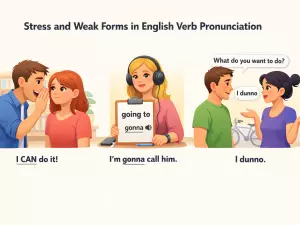
- can (positive): “I can do it” → weak /kən/ when not emphasized.
- can’t (negative): usually stays strong because it carries meaning; compare “I can do it” vs “I can’t do it.”
- have (auxiliary): “I have seen” → /əv/ or /v/ in fast speech; “should have” → “should’ve.”
- him/her/them: “tell him” → /tɛl ɪm/; “ask her” → /æsk ər/; “give them” → /ɡɪv ðəm/.
- your: “your phone” → /jər foʊn/ when unstressed.
- are in questions: “What are you doing?” → /wʌtər jə ˈduːɪŋ/ (often blends with the previous word).
- or: “tea or coffee” → /tiː ər ˈkɔːfi/ (sometimes reduced to /r/ linking).
Common spoken combinations (blending and assimilation)
- gonna (going to): “I’m going to leave” → “I’m gonna leave” (informal; avoid in formal writing).
- wanna (want to): “Do you want to try?” → “Do you wanna try?”
- gotta (got to / have to): “I’ve got to go” → “I gotta go.”
- hafta (have to): “You have to pay” → “You hafta pay.”
- kinda / sorta: “kind of tired” → “kinda tired”; “sort of works” → “sorta works.”
- did you → “didja”; don’t you → “doncha” (very casual, mainly heard rather than written).
- let me → “lemme”; give me → “gimme” (informal, can sound abrupt if overused).
- next day → /nɛks deɪ/ (the /t/ may disappear); must be → /mʌs biː/.
Meaning and emphasis: how to avoid misunderstandings
- Use strong forms for contrast: “I can do it” (stressed) vs “I can do it” (unstressed).
- Negatives usually resist heavy reduction: “can’t,” “won’t,” “don’t” tend to stay clear because they flip meaning.
- Don’t reduce the key word: keep content words (main verbs, nouns, adjectives) clearer than grammar words.
- Clarity over speed: if a listener looks confused, switch to fuller forms: “I am” instead of “I’m,” “going to” instead of “gonna.”
- Be careful with “’d”: “He’d left” (had) vs “He’d leave” (would) → the following verb form signals the meaning.
Natural rhythm and linking
Reduced verb forms sound natural because English speech is organized into stress groups: content words (nouns, main verbs, adjectives) usually carry the beat, while function words and auxiliary verbs often weaken and attach to nearby sounds. This creates smooth connections across word boundaries, especially when a verb reduction ends in a consonant or begins with a vowel sound.
Core patterns that create smooth speech
- Stress stays on the main message: auxiliaries like have, has, had, will, would, can often reduce so the main verb or key noun remains prominent.
- Consonant-to-vowel linking: a final consonant sound moves forward to the next word’s vowel sound (e.g., she’s_on, I’ve_asked).
- Vowel-to-vowel smoothing: when a reduced form ends in a vowel-like sound and the next word begins with a vowel, speakers often add a light glide (like a subtle y or w) to avoid a gap.
- Stop consonants may “soften”: t/d at the end of reduced forms can become a quick tap or a held stop before the next word (common in fast American speech).
- Clusters simplify: when reductions create difficult consonant clusters, one sound may be shortened or dropped, but the meaning stays clear from context.
- Function words attach: reduced auxiliaries and pronouns frequently “lean” on a neighboring stressed word, forming one rhythm unit.
Common linking outcomes with verb reductions
- ’s + vowel start: He’s_asking, She’s_away (the z/s sound links forward).
- ’ve + vowel start: I’ve_ever, We’ve_already (often a quick v connection).
- ’d (would/had) + vowel start: I’d_asked, She’d_opened (the d links; in some accents it may sound very light).
- ’ll + consonant start: I’ll_call, We’ll_meet (the l blends into the next consonant).
- ’re + vowel start: We’re_in, They’re_out (often a smooth r-like connection in rhotic accents).
- gonna + vowel start: I’m gonna_ask, We’re gonna_end (the final vowel links; the phrase stays one unit).
- wanna + vowel start: You wanna_eat?, I wanna_ask (the two words behave like one chunk).
- gotta + vowel start: We gotta_idea, I gotta_admit (often with a quick flap-like t in American speech).
- hafta + consonant start: I hafta_go, You hafta_try (the v in have to commonly disappears in fast speech).
- used to in connected speech: I used to_go often becomes a single flow unit; the d may be hard to hear.
- can / can’t in rhythm: I can_do it (often reduced), but I can’t_do it keeps clearer contrast; avoid reducing in a way that hides the negative.
- and after auxiliaries: I’ve (and) I’ve sequences may compress; the conjunction can become a quick n sound (’n).
Practice: build rhythm groups, not isolated words
- Say the stressed word louder/longer, then let the reduced verb form be quick: I’ve finished, She’s ready.
- Mark where linking happens: We’ve_asked, He’d_ever, I’ll_see.
- Keep reductions inside a single idea unit: I’m gonna call you (one smooth phrase), not four equally stressed words.
- Use clear negatives: ✅ I can’t go (keep can’t distinct) ❌ reducing so much it sounds like can.
- Slow down without “separating” words: aim for clean connections, then increase speed while keeping the same stress pattern.
Understanding reduced forms in listening
Listening to natural speech gets easier when you expect verbs and function words to shrink in predictable ways. In fast conversation, speakers prioritize rhythm and stress, so unstressed syllables often weaken to a schwa sound (ə), consonants may disappear, and words can link together as if they were one unit.
What to listen for: the stress pattern first
Reduced verb forms are usually unstressed. If you train yourself to catch the stressed content words (nouns, main verbs, adjectives), the reduced parts become easier to “fill in” from grammar and context. This is especially true for auxiliaries (be, have, do) and modals (can, could, should, would), which often carry little stress unless they are emphasized or contrasted.
- Anchor on stressed words and treat the quieter syllables as grammatical glue.
- Expect weak vowels: /ə/ commonly replaces full vowels in unstressed auxiliaries (e.g., “was” → /wəz/).
- Listen for timing: English tends toward stress-timed rhythm, so reductions help keep the beat.
- Use grammar to predict: after a subject, an auxiliary is likely even if you barely hear it.
Common reduction processes that hide verbs
Most “missing” verb sounds are not random; they follow a few recurring processes. Recognizing these patterns helps you map what you hear to the full written form.
- Contraction: two words combine (I am → I’m; she has → she’s).
- Weak forms: function words lose their full vowel (can → /kən/ in many accents when unstressed).
- Linking: final consonants connect to the next word’s vowel (I’ll ask → sounds like “I-lask”).
- Assimilation: a sound changes to match a neighbor (did you → “didja” in many varieties).
- Elision: a sound drops entirely (next day → “nex day”; can also affect /t/ or /d/ around consonants).
- Flapping (common in North American speech): /t/ or /d/ between vowels becomes a quick tap (wanted it → “waned it”).
- Glottal stop (common in several accents): /t/ may become a catch in the throat (got it → “go’ it”).
High-frequency verb reductions to recognize quickly
Some reduced forms appear constantly in everyday listening. The goal is not to memorize every possible pronunciation, but to recognize the “small” versions when they occur in a sentence.
- be in progressives: “I’m working,” “you’re going,” “they’re coming” (often very short, attached to the subject).
- have in perfect forms: “I’ve seen,” “she’s finished,” “we’ve been” (the /h/ is frequently weak or absent in fast speech).
- will for future/volition: “I’ll call,” “we’ll see,” “that’ll help” (often merges with the subject or the preceding word).
- would in polite/conditional speech: “I’d like,” “we’d go,” “that’d be great” (the /d/ may be barely audible before consonants).
- can vs can’t: “I can do it” often has a weak vowel; “I can’t” may rely on a clearer final /t/ or a longer vowel depending on accent and emphasis.
- do in questions: “Do you…?” often reduces and links (sounds like “d’ya” in many accents).
- did in past questions: “Did you…?” commonly compresses (often heard as “didja”).
- going to: frequently reduces toward “gonna” in casual speech.
- want to: often reduces toward “wanna” when it functions as a single unit.
- have to: commonly reduces toward “hafta” in fast, informal speech.
- got to: often reduces toward “gotta” in casual conversation.
- used to: often compresses (commonly heard like “useta” depending on accent).
How to avoid common listening mistakes
Reduced speech can cause predictable misunderstandings. These checks help you confirm what you heard without guessing wildly.
- Don’t “overhear” full words: if the sentence rhythm is fast, the auxiliary may be present only as a consonant or a weak vowel.
- Check the grammar slot: if you hear “She ___ working,” the missing piece is likely a form of be even if it is tiny.
- Watch for emphasis: auxiliaries become clearer when stressed for contrast (✅ “I did send it” ❌ assuming “I sent it”).
- Use the next word: reductions often reveal themselves through linking (a final consonant “belongs” to the next word’s vowel).
- Expect variation by accent: the same reduction may sound different across regions, but the underlying pattern (unstressed → shorter/weaker) remains consistent.
Common learner difficulties
Reduced verb forms can feel unpredictable because the spelling stays “full,” but the sound changes with speed, stress, and the next word. Learners often understand the grammar yet miss the reduced audio cue, or they produce reductions in places that make speech harder to follow.
1) Hearing reductions as “missing words”
A frequent listening problem is assuming a speaker skipped a verb when it was simply compressed. This happens most with auxiliaries (be, have, do) and modals (can, could, should, would), especially in fast connected speech.
- “What are you doing?” sounding like “Whatcha doing?” (the verb are is reduced and linked)
- “I’m going to…” sounding like “I’m gonna…” (the verb phrase reduces as a chunk)
- “He has to…” sounding like “He hasta…” (the has vowel weakens and links)
- “Did you…?” sounding like “Didja…?” (the verb did links to you)
2) Reducing in the wrong place (stress errors)
Reductions are tied to stress. Function words and auxiliary verbs are commonly weak; main verbs and new information are usually strong. If a learner reduces the wrong word, the sentence can sound unclear or oddly emphatic.
- Reducing a main verb that carries meaning (e.g., weakening “bought” or “need”) instead of weakening the helper verb
- Keeping every auxiliary fully stressed, making speech sound choppy and overly careful
- Stressing contractions that are normally light (e.g., over-stressing ’m, ’ve, ’ll)
- Missing contrastive stress: “I did call” (here did is intentionally strong, so reduction is less likely)
3) Confusing similar reduced sounds
Several reductions converge on similar consonant patterns, so learners may confuse forms that look different in writing. Context and grammar usually disambiguate, but the ear needs practice with these sound families.
- can (often weak) vs. can’t (often clearer final consonant): learners may miss the difference in noisy speech
- did you vs. do you: both can blur when linked quickly
- have to vs. has to: both often surface as a similar “hafta/hasta” rhythm
- would you vs. will you: both can compress, especially before you
4) Not linking to the next word
Many reductions depend on linking (the end of one word attaches to the start of the next). Without linking, learners may pronounce each word separately, which blocks the natural reduced form.
- “want to” → “wanna” is triggered by saying it as one unit, not two separate words
- “going to” → “gonna” is more likely when the phrase is unstressed and followed by a verb
- “got to” → “gotta” often requires a smooth /t/ connection
- “would you” → “wouldja” relies on the /d/ linking into the /y/ sound
5) Overusing informal reductions in formal contexts
Some reduced verb phrases are neutral in everyday conversation, while others can sound very casual. Learners sometimes apply the most informal patterns in presentations, interviews, or academic speech, where a slightly fuller form is safer.
- Using “gonna / wanna / gotta” in situations where “going to / want to / have to” sounds more appropriate
- Reducing too aggressively when clarity matters (phone calls, instructions, public speaking)
- Not adjusting register: casual chat allows more compression than careful explanation
6) Producing reductions that change the grammar
Some reductions are only acceptable with specific structures. If the underlying grammar is different, copying the sound pattern can create an error.
- ❌ “I’m gonna to call you.” → ✅ “I’m gonna call you.” (no extra to)
- ❌ “I wanna that.” → ✅ “I want that.” (the reduced form needs to + verb, not a noun phrase)
- ❌ “He hasta goes.” → ✅ “He has to go.” (don’t add a third-person -s to the following verb)
- ❌ “Didja went?” → ✅ “Did you go?” (after did, the main verb stays in base form)
7) Skipping weak forms of “be” and “have” in connected speech
“Be” and “have” often reduce to very small sounds, especially in contractions. Learners may either drop them entirely (hurting grammar) or pronounce them too fully (hurting rhythm).
- Missing ’s in “She’s working” and hearing only “She working”
- Missing ’ve in “They’ve been there” and hearing “They been there”
- Pronouncing “I have” as a strong “I HAVE” in neutral statements where “I’ve” is typical
- Confusing “he’s” (he is / he has) and relying on context to choose the meaning
Improving pronunciation naturally
Better reduced-verb pronunciation comes from noticing patterns and practicing them in short, realistic phrases. The goal is not to “swallow” sounds randomly, but to match the rhythm of connected speech: content words stay clearer, while common helper verbs and endings often become shorter and softer.
1) Use stress to decide what gets reduced
In everyday speech, stressed words (usually key nouns, main verbs, adjectives) carry the message. Unstressed words (auxiliaries, pronouns, function words) often compress. If you keep the stress pattern, reductions start to sound natural instead of forced.
- Keep the main information word clear; let surrounding helper verbs shorten.
- Reduce more in fast, casual talk; reduce less in careful, formal speech.
- If a word is emphasized for contrast, avoid reducing it (e.g., “I did call”).
- When in doubt, prioritize clarity over speed; reductions should never hide meaning.
2) Practice reductions as “chunks,” not isolated words
Verb reductions depend on the sounds before and after them. Train your mouth to move through the whole phrase smoothly rather than trying to pronounce each word separately.
- “What are you” → “what’re you” / “whatcha” (casual, fast)
- “I am going to” → “I’m gonna” (informal)
- “I want to” → “I wanna” (informal)
- “You have to” → “you hafta” (common in quick speech)
- “We have been” → “we’ve been” (contraction + clear main verb)
- “He should have” → “he should’ve” / “he shoulda” (very casual for “should have”)
- “They would have” → “they would’ve” / “they woulda” (very casual)
- “I could have” → “I could’ve” / “I coulda” (very casual)
- “She is” → “she’s” (contraction in normal conversation)
- “There are” → “there’re” (often reduced in fast speech)
- “I will” → “I’ll” (often reduced unless emphasized)
- “He has” → “he’s” (only when “has” is auxiliary: “he’s eaten”)
3) Train the most common sound changes
Many reductions are predictable because English favors smooth transitions between consonants and vowels. Focus on a few high-frequency mechanics and you will hear improvements quickly.
- Contractions: “I am” → “I’m,” “we are” → “we’re,” “they have” → “they’ve.”
- /t/ and /d/ softening between vowels: “wanted” → “wan-id,” “needed” → “nee-did” (flap sound in many accents).
- /t/ deletion in consonant clusters: “next day” → “nex day,” “must be” → “mus be” (common in fast speech).
- Linking (final consonant connects to next vowel): “take it” → “tay-kit,” “leave it” → “lee-vit.”
- Yod coalescence (sounds blend): “did you” → “didja,” “would you” → “wouldja.”
- Schwa in unstressed syllables: “to” → “tuh,” “can” (unstressed) → “cn.”
4) Keep grammar distinctions clear while reducing
Some reduced forms can sound similar, so use context and timing to keep meanings separate. A small pause or clearer vowel can prevent confusion.
- “He’s” can mean “he is” or “he has.” Keep the next word clear: “he’s late” vs. “he’s eaten.”
- “I’d” can mean “I would” or “I had.” Make the following verb type obvious: “I’d go” vs. “I’d gone.”
- Unstressed “can” vs. “can’t”: “can” often reduces heavily, but “can’t” usually keeps a clearer stop or length. If needed, slow slightly to protect meaning.
- Negative contractions often stay more audible than positives in fast speech: “don’t,” “won’t,” “can’t” tend to keep stronger cues.
5) A simple practice routine that builds automaticity
Short, repeated cycles work better than long drills. Aim for consistent rhythm, then speed up only after the phrase stays clear.
- Choose 5–8 high-use phrases from your daily conversations.
- Say each phrase slowly with correct stress, then repeat 5 times at normal speed.
- Record one take; listen for stress placement and smooth linking, not “perfect” individual sounds.
- Shadow a short sentence: listen once, then speak along, copying timing and reductions.
- Do a contrast check: ✅ “I can do it” (unstressed “can” reduces) vs. ✅ “I can’t do it” (negative stays clearer).
- Rotate phrases weekly so reductions become flexible across different sentences.
Homework: listening and reduction practice
Build automatic recognition first, then production. The goal is to hear reduced verb forms as normal (not “missing words”), and to use them in your own speech without speeding up or mumbling. Work in short sessions and repeat the same lines until the reduced forms feel predictable.
Step 1: “Spot the reduction” listening (10 minutes)
Listen to any short clip with natural dialogue (a show scene, a podcast snippet, a voice note). Choose 20–40 seconds and loop it. Your job is to identify where the verbs compress and what sound replaces the full form.
- First pass: write what you think you hear (don’t pause yet).
- Second pass (pause allowed): underline places where a verb sounds shorter than the spelling.
- Third pass: label the type of reduction (examples: gonna, wanna, gotta, shoulda, ’ve as /v/ or /əv/).
- Final pass: replay and check whether the reduced form is tied to the next word (linking) or ends the phrase (often less reduced).
Step 2: Minimal-pair style discrimination (hear the difference)
Read each pair aloud, then record yourself saying both versions. While listening back, check that the reduced version is shorter and more connected, but still clear. Keep the meaning the same; only change the pronunciation.
- “I have to go.” → “I hafta go.”
- “You have to see it.” → “You hafta see it.”
- “We got to leave.” → “We gotta leave.”
- “I want to ask you.” → “I wanna ask you.”
- “Do you want to go?” → “D’you wanna go?”
- “I’m going to call.” → “I’m gonna call.”
- “She’s going to be late.” → “She’s gonna be late.”
- “I should have told you.” → “I shoulda told you.”
- “They would have known.” → “They woulda known.”
- “I could have helped.” → “I coulda helped.”
- “You must have seen it.” → “You musta seen it.”
- “I might have missed it.” → “I mighta missed it.”
Step 3: Pattern drills (predict the reduction before you hear it)
Use these prompts to practice the most common environments where reductions happen. Say each line three times: (1) careful, (2) natural, (3) natural but slightly slower. That third version trains control.
- Modal + have before a past participle: “should have,” “would have,” “could have,” “might have,” “must have.”
- Want to before a verb: “want to go,” “want to see,” “want to know.”
- Going to for plans/near future: “going to call,” “going to try,” “going to be.”
- Have to for obligation: “have to work,” “have to leave,” “have to pay.”
- Got to for necessity/strong need: “got to go,” “got to stop,” “got to get.”
- Pronoun + auxiliary contractions: “I’ve,” “you’ve,” “we’ve,” “they’ve,” “he’s,” “she’s,” “it’s.”
- Linking into the next word: reductions are stronger when the next word starts with a consonant (for many speakers).
- Phrase-final position: reductions often weaken when the verb is the last important word in the chunk.
Step 4: Dictation challenge (train your ear for “hidden” verbs)
Read the sentences below once at a natural pace, record them, then play your recording back and write what you hear. After that, compare your dictation to the original text and mark the reduced verb forms you missed.
- I’m gonna call you when I’m done.
- You shoulda told me earlier.
- We’ve gotta leave before traffic gets worse.
- I wanna make sure you’re okay.
- They woulda helped if they’d known.
- You musta been really tired.
- I coulda sworn I saw it.
- She’s gonna be there in a minute.
- I hafta finish this tonight.
- We mighta missed the last train.
Show answers
- I’m gonna call you when I’m done.
- You shoulda told me earlier.
- We’ve gotta leave before traffic gets worse.
- I wanna make sure you’re okay.
- They woulda helped if they’d known.
- You musta been really tired.
- I coulda sworn I saw it.
- She’s gonna be there in a minute.
- I hafta finish this tonight.
- We mighta missed the last train.
Step 5: Controlled speaking (use reductions without losing clarity)
Choose five sentences from your own daily life and rewrite them in two versions: a careful version and a natural version. When you practice, keep these checks in mind.
- Keep the main verb and content words clear; reductions usually belong to function words and auxiliaries.
- Reduce more inside a phrase and less at the end of a thought.
- If you’re unsure, aim for a light reduction (shorter + linked) rather than an extreme one.
- Record and confirm that the reduced form is still recognizable when you listen back.