Pseudo-cleft Sentences: What makes it difficult is...

 Here we the difference between cleft and pseudo-cleft sentences, explains the basic structure and sentence patterns of pseudo-clefts, highlights their stylistic uses, discusses typical learner mistakes, and includes practice in rewriting sentences.
Exploring why certain sentence structures can be challenging highlights the complexity of English. When we attempt to emphasize a particular point by rearranging or splitting a sentence in an unconventional way, the result can sometimes confuse even native speakers. The logic or natural word order may become disrupted, making the sentence harder to follow. This demonstrates how mastering sentence structure is not just about knowing grammar rules, but also about understanding how to communicate ideas clearly and effectively.
Difference Between Cleft and Pseudo-Cleft
Understanding how cleft and pseudo-cleft sentences function helps clarify why learners sometimes struggle with them. Both sentence types are used to highlight information, but they differ in structure and emphasis.
Structural Contrasts
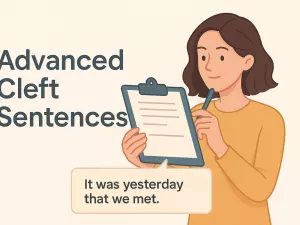
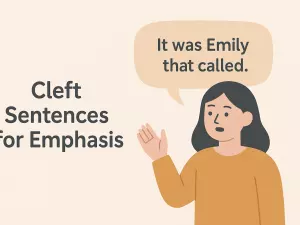
Cleft constructions typically begin with “It is/was…” followed by the focused element and a relative clause. Pseudo-clefts, on the other hand, start with a wh-clause (like “what,” “where,” or “how”) that serves as the subject or object, then link to the focus using a form of “be.” This difference in form often leads to confusion, especially when both are used to foreground information.
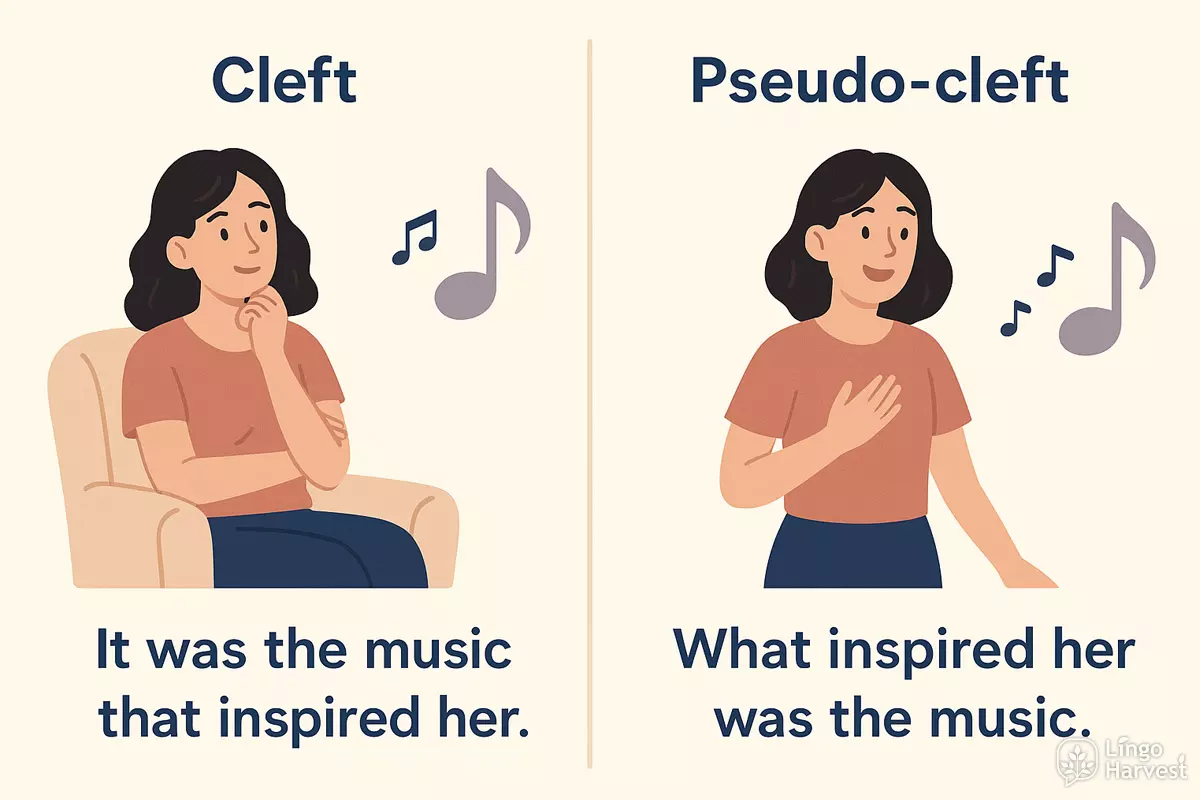
- Cleft: “It was the music that inspired her.”
- Pseudo-cleft: “What inspired her was the music.”
Focus and Emphasis
A major distinction lies in what is being emphasized. Cleft sentences often highlight a specific element by placing it right after the verb “be.” Pseudo-clefts, however, shift the focus to the information introduced by the wh-clause, which can sometimes be less direct.
Summary Table: Cleft vs. Pseudo-Cleft
| Aspect | Cleft Sentence | Pseudo-Cleft Sentence |
|---|---|---|
| Typical Structure | It + be + focus + relative clause It was John who called. |
Wh-clause + be + focus What surprised me was John. |
| Common Wh-words | who, that (in the relative clause) | what, where, how, when, why |
| Focus Placement | Immediately after “be” | After “be,” following a wh-clause |
| Example | It was the cake that she baked. | What she baked was the cake. |
Common Uses and Challenges
Both forms are used to clarify, emphasize, or contrast information. However, learners often mix them up due to their similar functions. Pseudo-clefts are particularly tricky because they can be longer and more complex, sometimes leading to awkward or ambiguous sentences if not structured carefully.
Key Points to Remember
- Cleft sentences foreground a specific element using “it is/was.”
- Pseudo-clefts use wh-clauses to introduce the highlighted information.
- Word order and clause structure are essential for clarity.
- Both types serve to emphasize, but in slightly different ways.
- Practice with varied examples helps in distinguishing the two.
Basic Structure of Pseudo-Clefts
Understanding how pseudo-cleft constructions are formed is crucial for grasping their function in English. These sentences are characterized by a split structure, typically dividing information between a relative clause and a focus element. This split allows speakers to highlight a particular part of the message, often for emphasis or clarity.
Core Components
Most pseudo-cleft sentences have two main parts:
- A wh-clause (such as "what you need", "where she went", "how it happened"), which introduces the information being focused on.
- A main clause that provides the key detail or identifies the focus, typically introduced by a copula ("is," "was," etc.).
For example: What I like is chocolate. Here, "what I like" is the wh-clause, and "chocolate" is the focus.
Common Patterns
Several patterns appear frequently in these sentences. The structure can vary based on the type of information being highlighted:
- What + clause + be + focus (What surprised me was the answer.)
- Where + clause + be + focus (Where you’ll find her is the library.)
- How + clause + be + focus (How he fixed it is impressive.)
- Why + clause + be + focus (Why I called is important.)
This flexibility makes pseudo-clefts useful for drawing attention to different types of information.
Variations and Examples
Wider usage includes both subject and object focus, as well as tense variation. Here are several illustrative forms:
- What matters most is honesty.
- Where we met was in Paris.
- How you solved it is remarkable.
- Who called you is unknown.
- Why she left isn’t clear.
- What I need is a break.
- When it happened was yesterday.
- What you said surprised me.
- How it works is simple.
- What they want is support.
- What makes it difficult is the ambiguity.
- Where it hurts is my arm.
- What I remember is the laughter.
- Why this matters is obvious.
- Who finished first was Sam.
- What she wrote became famous.
Comparing Pseudo-Clefts to Related Forms
To clarify the distinction, here’s a comparison with similar sentence types:
| Type | Example |
|---|---|
| Pseudo-cleft | What I want is peace. |
| It-cleft | It is peace that I want. |
| Regular declarative | I want peace. |
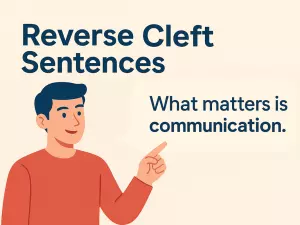
| Reverse pseudo-cleft | Peace is what I want. |
This structure allows for nuanced emphasis, making it a valuable tool for both spoken and written English. The variety of wh-clauses and the ability to focus on different sentence elements contribute to the complexity and expressive power of pseudo-cleft constructions.
Emphasizing Actions vs Reasons
When constructing pseudo-cleft sentences, speakers often choose whether to highlight actions or motivations. This subtle grammatical choice can shift the listener’s focus, making the sentence either more about what happened or why it happened. Understanding how to manipulate this balance is key to using pseudo-clefts effectively.
Highlighting Actions
To draw attention to what was done, pseudo-clefts typically place the action in the clause following “what.” For example:
- What surprised me was how quickly she finished.
- What they did next was leave without saying goodbye.
- What matters most is showing up on time.
- What you need to do is fill out this form.
- What I enjoyed was watching the sunrise.
- What went wrong was forgetting the password.
- What made the difference was practicing every day.
- What I’ll never forget is climbing that mountain.
- What keeps me awake is thinking about tomorrow.
- What helps most is asking questions.
In each case, the structure foregrounds the action or event, making it central to the meaning.
Focusing on Reasons or Causes
Alternatively, pseudo-clefts can spotlight explanations or justifications. This approach is especially common when the speaker wants to explain behavior or clarify motivation. Examples include:
- What makes it difficult is the lack of clear instructions.
- What I don’t understand is why they left so early.
- What annoyed me was that nobody called ahead.
- What led to the problem was a simple misunderstanding.
- What caused the delay is traffic on the highway.
- What bothers people most is not being heard.
- What explains his reaction is his past experiences.
- What made her hesitate was uncertainty about the outcome.
- What convinced me was her detailed explanation.
- What I need to know is whether it’s safe.
Comparing Focus: Actions vs. Reasons
The following table illustrates how changing the focus in pseudo-cleft sentences can alter the nuance and emphasis:
| Action-Focused Example | Reason-Focused Example |
|---|---|
| What she did was apologize immediately. | What made her apologize was feeling guilty. |
| What you need to do is submit the form. | What makes it necessary is company policy. |
| What I noticed was the lights flickering. | What caused the flickering was a faulty wire. |
| What impressed me was his dedication. | What explains his dedication is his passion for the project. |
| What happened next was they left the room. | What made them leave was the loud noise. |
Choosing between highlighting an event or its motivation can subtly influence interpretation. In conversation and writing, this flexibility allows speakers to manage emphasis, clarify meaning, and guide listeners’ attention toward either the deed or its underlying cause.
Common Sentence Patterns
Understanding how pseudo-cleft constructions are formed is crucial for mastering their use in English. These patterns typically involve splitting a sentence to place emphasis on a particular element, often using structures like "what," "all," or "the thing that." By reorganizing standard sentences, speakers can highlight new or important information.
Typical Pseudo-cleft Patterns
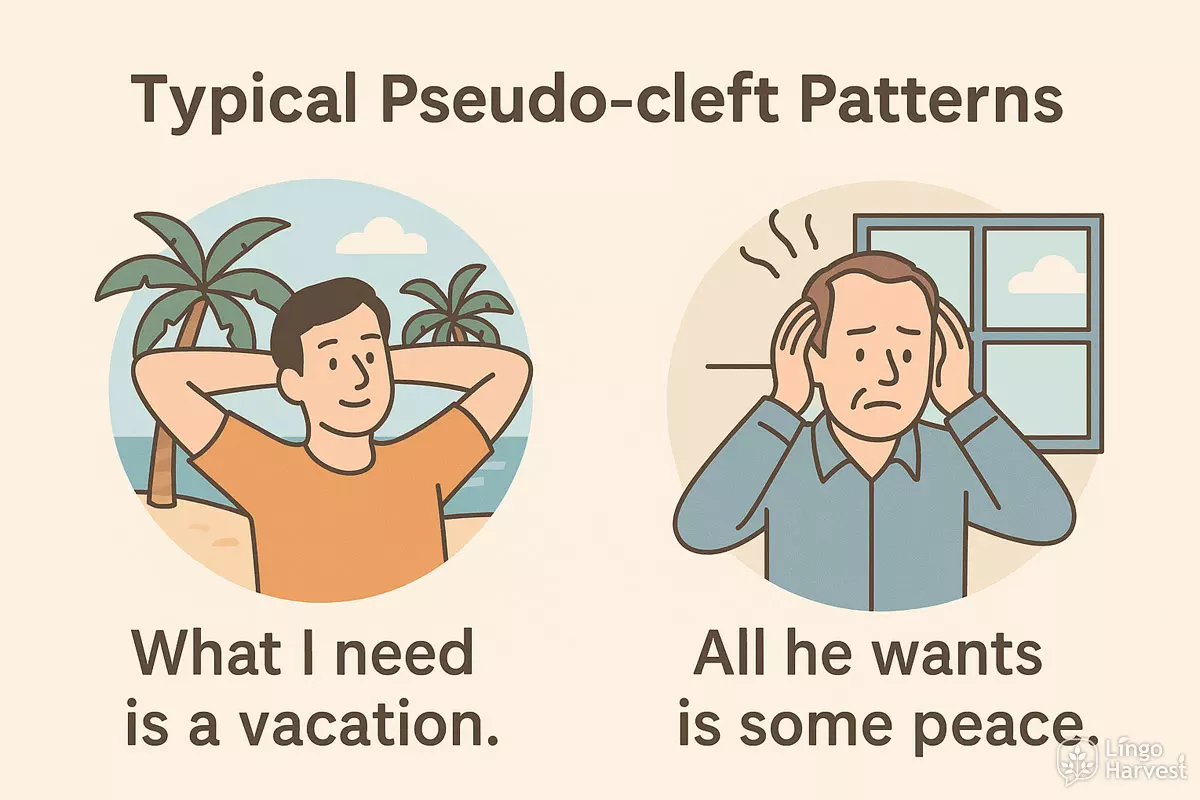
Most pseudo-cleft sentences begin with a wh-clause followed by a form of the verb "be" and the focused element. Alternatively, the focused element can come first, followed by a clause that explains or specifies it. Here are some core forms:
- What-clause + be + focus: "What I need is a vacation."
- All-clause + be + focus: "All he wants is some peace."
- The thing that-clause + be + focus: "The thing that bothers me is the noise."
- Focus + is + what-clause: "A vacation is what I need."
- It + be + focus + (that/who) + clause: "It is John who called you."
- Where-clause + be + focus: "Where I feel safe is at home."
- When-clause + be + focus: "When I relax is after work."
- Why-clause + be + focus: "Why I left is because I was tired."
- How-clause + be + focus: "How she solved it is impressive."
- Who-clause + be + focus: "Who you need is a specialist."
- Focus + is + where/when/why-clause: "At home is where I feel safe."
Comparing Standard and Pseudo-cleft Constructions
Pseudo-cleft structures often rephrase ordinary sentences to draw attention to specific information. Compare these forms:
| Standard Sentence | Pseudo-cleft Version |
|---|---|
| I need a vacation. | What I need is a vacation. |
| John called you. | It is John who called you. |
| She solved the problem impressively. | How she solved it is impressive. |
| I feel safe at home. | Where I feel safe is at home. |
| He wants some peace. | All he wants is some peace. |
Structural Notes
The most common challenge with these constructions is identifying which part of the sentence to emphasize and how to restructure the clause. Pseudo-clefts are especially common in formal writing and spoken emphasis, where highlighting specific information is important. Watch for subtle shifts in meaning or tone when using different patterns, as the focus can dramatically affect the listener’s attention.
Typical Learner Errors
When learners encounter pseudo-cleft sentences, they often struggle with both structure and meaning. One frequent issue is confusing the word order, especially with clauses introduced by "what" or "all." For example, students might incorrectly place the main clause element before the relative clause, producing sentences like "Is difficult what makes it" instead of "What makes it difficult is...".
Common Mistakes with Structure
- Misplacing the subject and complement (e.g., "Is important what you do" instead of "What you do is important")
- Omitting the "what" or "all" at the beginning of the clause
- Using a finite verb where a non-finite form is required
- Adding unnecessary words, such as "that," resulting in "What that I want is..."
- Confusing pseudo-clefts with it-clefts (e.g., "It is what I need is help")
- Mixing up tense agreement between the pseudo-cleft clause and the main verb
- Incorrect subject-verb agreement ("What you need are help")
- Doubling up on subjects ("What I want is it a new phone")
- Placing adverbs in the wrong position ("What really I need is...")
- Forgetting to invert for questions ("What you want is?")
Confusion with Meaning
Learners sometimes misinterpret which part of the sentence is being emphasized. For instance, "What she likes is chocolate" puts focus on "chocolate," but students may mistakenly stress the wrong part, or misunderstand the information structure. This can lead to awkward or unclear statements.
Frequent Error Patterns
| Error Example | Correct Form |
|---|---|
| Is what I want a break | What I want is a break |
| What do you need is help | What you need is help |
| What I like it is music | What I like is music |
| All that I want is is peace | All I want is peace |
Summary of Challenges
Difficulties with pseudo-cleft constructions often stem from unfamiliarity with their unique syntax and information focus. Learners may also transfer patterns from their native language, leading to unnatural phrasing. Regular exposure to correct forms and focused practice can help clarify both structure and meaning.
Using Pseudo-Clefts for Style
Writers and speakers often turn to pseudo-cleft constructions to add emphasis, variety, or clarity to their sentences. These structures—like “What matters is honesty” or “What surprised me was the ending”—shift focus onto particular information, helping to foreground new or important details. By reordering standard sentence structure, they introduce a stylistic twist that can make prose feel more deliberate, thoughtful, or dramatic.
When to Choose a Pseudo-Cleft Construction
Pseudo-clefts are especially useful in certain contexts:
- Highlighting key information or contrast
- Delaying the main point for rhetorical effect
- Creating suspense or guiding the reader’s attention
- Breaking up repetitive sentence patterns
- Softening claims (“What I think is…”) or opinions
- Introducing explanations (“What this means is…”)
- Clarifying or specifying details
- Framing answers to implicit questions
- Signaling a summary or conclusion
- Transitioning between topics
Common Patterns and Examples
Pseudo-cleft sentences come in several forms. Here are some typical patterns:
- What + clause + be + focus
What she needs is a break. - All + clause + be + focus
All I want is some peace and quiet. - The thing (that/which) + clause + be + focus
The thing that bothers me is the noise. - Where + clause + be + focus
Where you see problems is in the details. - How + clause + be + focus
How he managed it is a mystery. - Why + clause + be + focus
Why she left is unclear. - One thing + clause + be + focus
One thing I’ve learned is patience. - The reason (that) + clause + be + focus
The reason I called is to apologize. - The place (where) + clause + be + focus
The place we met was the library. - The way (that) + clause + be + focus
The way he solved it was impressive.
Effect on Tone and Rhythm
Choosing a pseudo-cleft structure can subtly change the tone, making statements sound more reflective or deliberate. They also affect rhythm—these sentences are generally longer and can add a pause before the main point, which is useful for dramatic or persuasive effect.
Comparing Standard and Pseudo-Cleft Forms
To see the stylistic shift, compare standard sentences with their pseudo-cleft versions:
| Standard Form | Pseudo-Cleft Form |
|---|---|
| I like chocolate the most. | What I like the most is chocolate. |
| She needs a break. | What she needs is a break. |
| Patience matters. | What matters is patience. |
| He solved it impressively. | The way he solved it was impressive. |
| We met at the library. | The place we met was the library. |
| His kindness surprised me. | What surprised me was his kindness. |
Tips for Effective Use
- Reserve pseudo-clefts for moments when you want extra emphasis.
- Mix with other sentence types to avoid monotony.
- Use them to answer implied questions or clarify complex points.
- Be mindful of sentence length; overusing pseudo-clefts can make writing feel heavy.
In summary, pseudo-cleft sentences are a valuable stylistic tool, offering nuanced ways to foreground information, shape rhythm, and guide your reader’s focus.
Practice: Rewrite Using Pseudo-Clefts
Transforming regular sentences into pseudo-cleft constructions helps highlight specific information and can clarify what is most important in a statement. This exercise focuses on rewording standard sentences to use pseudo-cleft forms, such as "What X is Y" or "The thing that X is Y." These structures often emphasize the subject, object, or reason in a sentence, which can be especially helpful for both learners and advanced users of English.
Task: Convert the Sentences
Below is a list of statements. Revise each one into a pseudo-cleft sentence, focusing on what is being emphasized. Try to use different pseudo-cleft patterns where possible.
- Emma enjoys classical music the most.
- We need more time to finish the project.
- The manager approved the proposal yesterday.
- He forgot his keys at home.
- They chose honesty over anything else.
- Julia wants to travel to Japan next year.
- The problem is a lack of communication.
- She learned Spanish by practicing every day.
- We are looking for someone who can lead the team.
- The team won the championship because of their dedication.
- John fixed the computer this morning.
- Patience is what you need in this situation.
Show answers
- What Emma enjoys the most is classical music.
- What we need to finish the project is more time.
- What the manager approved yesterday was the proposal.
- What he forgot at home were his keys.
- What they chose over anything else was honesty.
- Where Julia wants to travel next year is Japan.
- What the problem is is a lack of communication.
- How she learned Spanish was by practicing every day.
- What we are looking for is someone who can lead the team.
- What made the team win the championship was their dedication.
- Who fixed the computer this morning was John.
- What you need in this situation is patience.
Common Pseudo-Cleft Patterns
Here are several typical forms you can use when creating pseudo-cleft sentences:
- What + clause + is/was + focus: What I need is a break.
- Where + clause + is/was + focus: Where they met was at the park.
- Who + clause + is/was + focus: Who called you was my sister.
- How + clause + is/was + focus: How he solved the problem was by asking for help.
- When + clause + is/was + focus: When I realized the truth was yesterday.
- The thing (that) + clause + is/was + focus: The thing that worries me is the deadline.
- All + clause + is/was + focus: All I want is some peace and quiet.
- The reason (why) + clause + is/was + focus: The reason why she left is unknown.
- The place (where) + clause + is/was + focus: The place where we met was the library.
- The person (who) + clause + is/was + focus: The person who helped me was Tom.
Tips for Creating Pseudo-Cleft Sentences
- Identify what you want to emphasize: subject, object, place, time, manner, or reason.
- Start the sentence with the appropriate wh-word (what, where, who, how, when, why).
- Follow with a verb (“is,” “was,” etc.) and the information you want to highlight.
- Use pseudo-clefts to clarify or draw attention to new or important information.
- Avoid overusing this structure—reserve it for emphasis or clarity.