Reverse Cleft Sentences: What Matters Is… Structures Explained

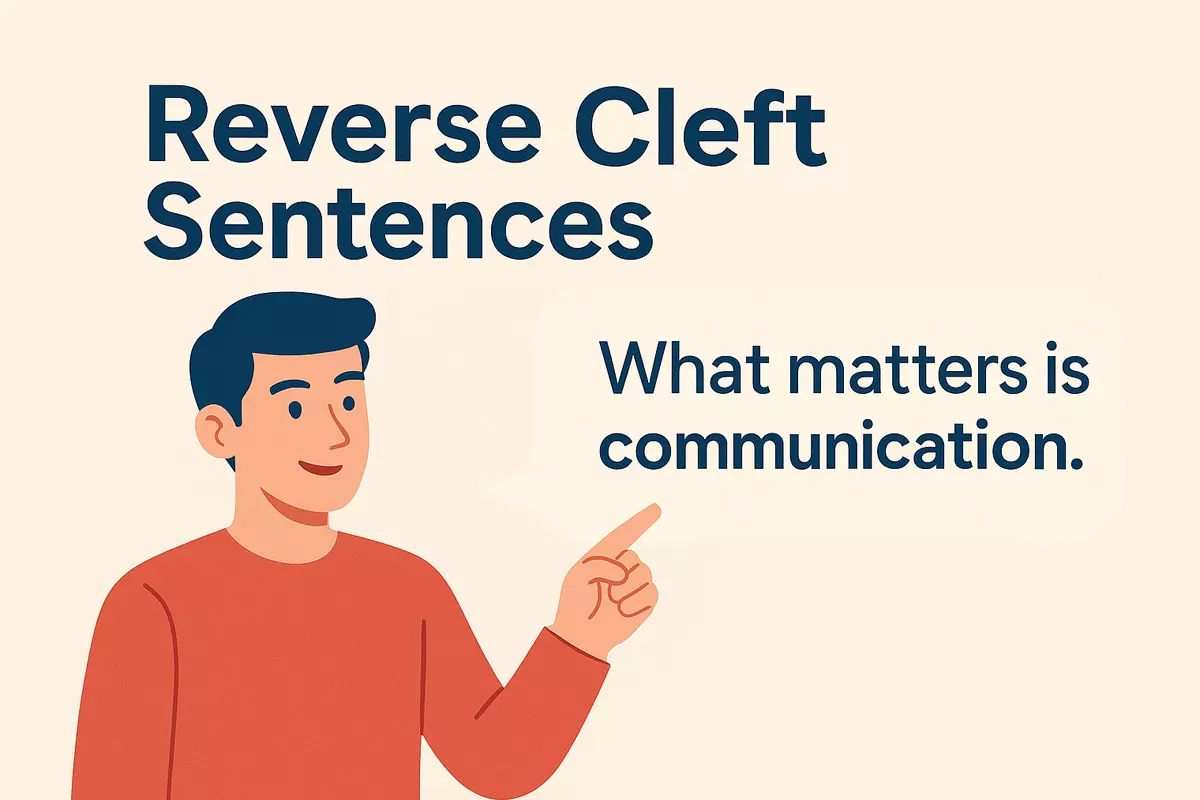 Here we the structure of what-cleft and reverse cleft sentences, contrasts them with it-clefts, and explains how they highlight actions, reasons, and results.
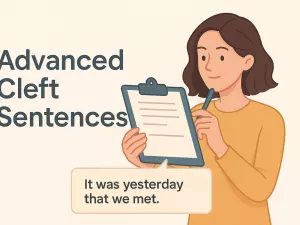
Have you ever noticed how we sometimes rearrange a sentence to highlight what matters most? These special constructions, designed to bring the most significant information to the forefront, can add both emphasis and clarity to our communication. By learning how and why we use such sentence structures, you can improve the way you express your ideas, making your messages more impactful and easier to understand in both writing and speaking situations.
Structure of what-cleft and reverse cleft
Understanding the internal makeup of what-clefts and their reversed counterparts is essential for recognizing focus and emphasis in English sentences. These constructions alter the usual flow of information by foregrounding particular elements, helping speakers highlight what truly matters.
What-cleft construction
A what-cleft sentence typically starts with "what," followed by a verb (often "is" or "was"), then the element in focus. This arrangement is common when you want to emphasize a specific part of the message.
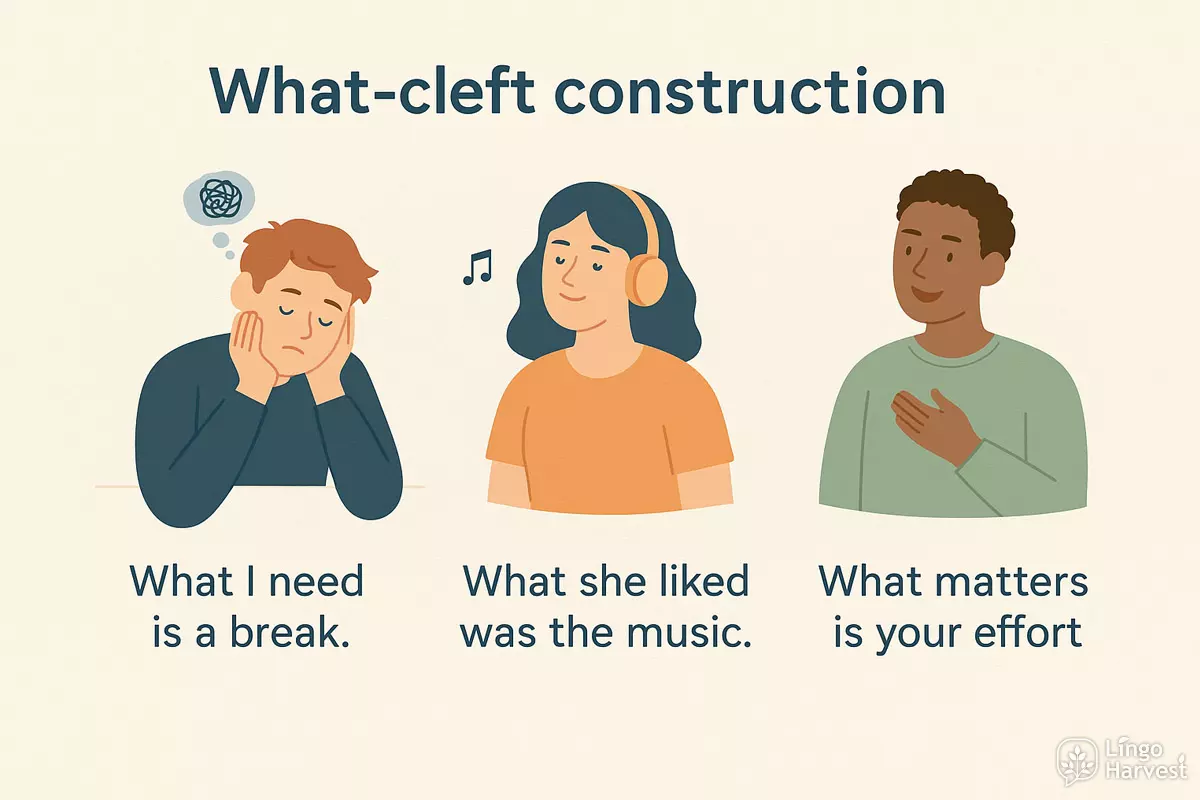
- What I need is a break.
- What she liked was the music.
- What matters is your effort.
- What surprised them was the ending.
- What you said hurt me.
- What we want is change.
- What annoyed him was the noise.
- What they built was impressive.
- What you see is not always true.
- What counts is honesty.
The structure can be summarized as: What + clause + (be) + focused element
Reverse cleft (pseudo-cleft inversion)
Reverse clefts flip the usual order. The focused element comes first, followed by a form of "be," and then the "what" clause. This inversion is especially prominent in formal writing and spoken emphasis.
- A break is what I need.
- The music was what she liked.
- Your effort is what matters.
- The ending was what surprised them.
- Change is what we want.
- The noise was what annoyed him.
- Impressive was what they built.
- Honesty is what counts.
- Not always true is what you see.
- Hurt me was what you said.
The typical pattern is: Focused element + (be) + what-clause
Comparing forms: what-cleft vs reverse cleft
The following table highlights the contrasting word order and focus placement in these two sentence types.
| What-cleft Example | Reverse Cleft Example |
|---|---|
| What she wanted was rest. | Rest was what she wanted. |
| What they need is support. | Support is what they need. |
| What matters is truth. | Truth is what matters. |
| What inspires me is music. | Music is what inspires me. |
| What frustrates him is traffic. | Traffic is what frustrates him. |
Key points to remember
- Both structures serve to foreground information, but their word order changes the rhythm and emphasis.
- Reverse clefts often sound more formal or emphatic than standard what-clefts.
- Understanding these patterns helps with both comprehension and expressive writing.
Differences between it-clefts and what-clefts
Understanding the distinctions between it-cleft and what-cleft structures is essential for anyone analyzing English sentence focus or exploring reverse cleft constructions. Both forms serve to highlight specific information, but they operate differently in terms of structure, emphasis, and flexibility.
Structural contrasts
It-clefts use the pattern "It is/was [focused element] that/who [rest of clause]," allowing almost any sentence element to be foregrounded. In contrast, what-clefts rely on "What [verb phrase] is [focused element]," typically emphasizing actions or results rather than single constituents.
- It-cleft example: It was John who fixed the car.
- What-cleft example: What John did was fix the car.
Flexibility and focus
Only it-clefts can highlight subjects, objects, adverbials, or even prepositional phrases with ease. What-clefts are more restricted—they usually focus on actions or events, not isolated nouns or adverbs. This means you can use it-clefts for a wider range of emphasis.
Comparative overview
| Feature | It-cleft | What-cleft |
|---|---|---|
| Basic Pattern | It is/was [X] that/who [Y] | What [Y] is [X] |
| Element Focused | Subject, object, adverbial, prep phrase | Action, event, result |
| Example | It was the piano that she played. | What she played was the piano. |
| Common Register | All styles (formal/informal) | Mainly spoken, informal |
| Reverse Cleft Variant | Less common ("The piano is what she played") | Standard ("What she played is the piano") |
Summary of key usage points
- It-clefts are more versatile for emphasizing nearly any sentence part.
- What-clefts often introduce explanations or clarifications in conversation.
- Reverse it-clefts are rare; reverse what-clefts are common ("What matters is...").
- Both types help shift focus, but with different stylistic effects.
- It-clefts require a form of "be" and a relative clause; what-clefts use "what" as a fused relative.
Choosing between these forms depends on what you want to emphasize and the tone you wish to set—formal, explanatory, or conversational.
Highlighting actions, reasons, and results
Reverse cleft sentences provide a flexible way to foreground different elements of a statement, especially when you want to emphasize what happened, why it happened, or what the outcome was. By flipping the usual structure, these sentences help speakers draw attention to the most important part—whether that's the action, the reason, or the result.
Emphasizing the Action
When the focus is on what actually took place, reverse clefts allow you to spotlight the verb phrase or event. This is particularly useful in narratives or explanations where the action itself is the main point.
- What she did was apologize immediately.
- What surprised everyone was his sudden resignation.
- What happened next was the lights went out.
- What they discovered was a major flaw in the system.
- What we noticed was the temperature dropping rapidly.
- What he forgot was to lock the door.
- What she avoided was giving a direct answer.
- What impressed us was her calm reaction.
Focusing on Reasons
Reverse clefts are often used to bring reasons or causes to the front of the sentence, making it clear why something occurred. This is common in explanations, arguments, and clarifications.
- What made the difference was her persistence.
- What caused the delay was unexpected traffic.
- What convinced them was the evidence presented.
- What motivated him was a desire for improvement.
- What worried them was the lack of communication.
- What started the argument was a simple misunderstanding.
- What forced the change was new regulations.
- What encouraged her was the team’s support.
Highlighting Results
Sometimes, the result or consequence is most important. Reverse cleft structures can highlight outcomes, signaling to the listener or reader that the following information is the key takeaway.
- What resulted was a complete change of plans.
- What followed was a heated debate.
- What she achieved was remarkable progress.
- What emerged was a new approach to the problem.
- What happened was a total system reset.
- What they gained was valuable experience.
- What we observed was a steady improvement.
- What resulted in the end was a successful outcome.
Patterns and Variations
These constructions typically start with a wh-clause ("what," "why," "how") and a linking verb (“was” or “is”), followed by the emphasized element. Here's a selection of common patterns:
- What I need is some rest.
- What they want is clear instructions.
- What matters most is your safety.
- What we learned was to stay flexible.
- What shocked me was the outcome.
- What I like best is the atmosphere.
- What went wrong was a miscommunication.
- What I heard was unexpected news.
- What you should remember is the main principle.
- What finally happened was they agreed.
Comparison of Emphasis Types
Below is a table contrasting how reverse cleft sentences can shift focus to actions, reasons, or results, using similar content for clarity:
| Emphasis Type | Example Sentence |
|---|---|
| Action | What she did was apologize in public. |
| Reason | What led to her decision was the feedback she received. |
| Result | What happened next was the audience applauded. |
| Consequence | What this meant was a new policy was introduced. |
Discourse functions in argument and narrative
Reverse cleft sentences such as “What matters is…” or “What you need is…” are especially useful for structuring information in both argumentative and narrative contexts. These constructions help speakers and writers foreground specific elements, making their stance or the flow of events clearer to the listener or reader.
Highlighting Importance and Contrast
In argumentative writing, reverse clefts draw attention to key points, distinguishing them from supporting details. For example, “What we mustn’t ignore is the evidence,” places exclusive emphasis on the evidence itself, guiding the audience toward the crux of the argument. This is especially effective in debates or persuasive essays, where prioritizing information is crucial.ъ
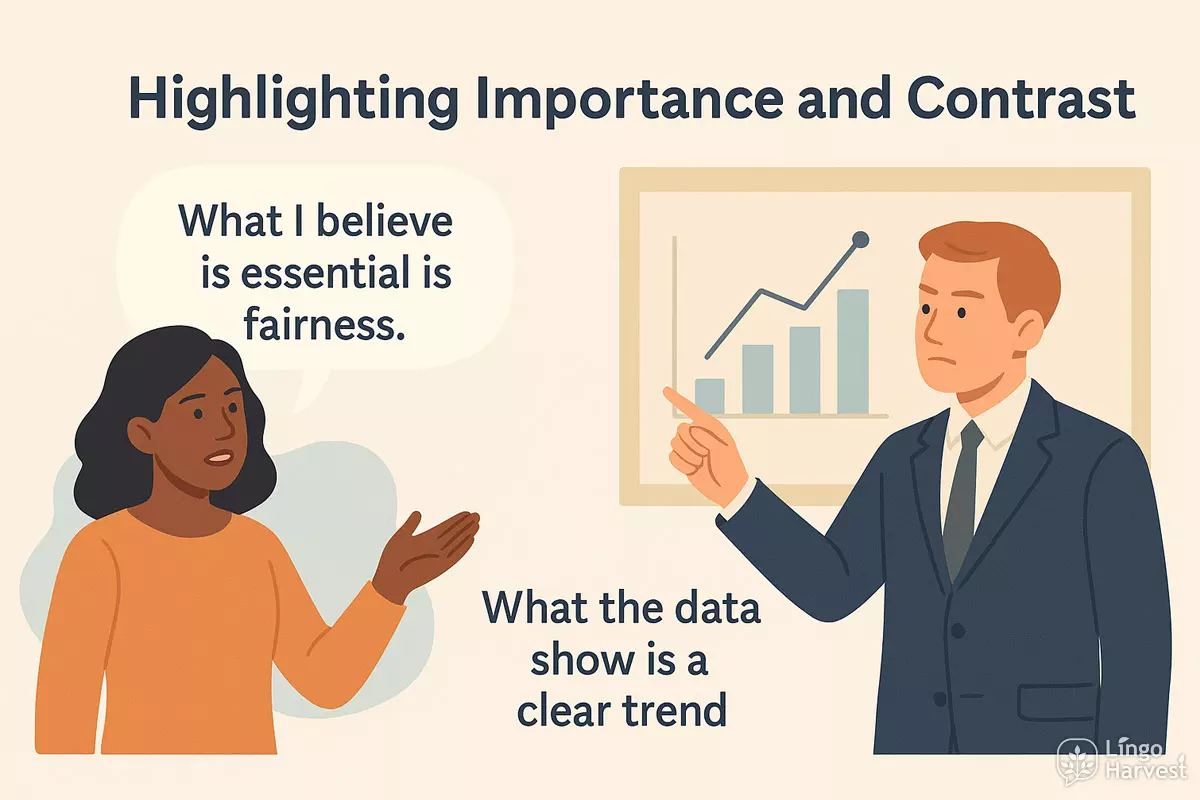
- “What I believe is essential is fairness.”
- “What the data show is a clear trend.”
- “What critics fail to mention is the context.”
- “What truly matters is the outcome.”
- “What you’re missing is the bigger picture.”
- “What we’re arguing for is justice.”
- “What’s at stake is our reputation.”
- “What no one anticipated is the backlash.”
- “What makes the difference is consistency.”
- “What we learned is invaluable.”
Organizing Narratives and Guiding Reader Focus
In storytelling, reverse cleft structures can shape the narrative arc or highlight turning points and motivations. For instance, “What changed everything was the letter,” signals a pivotal event. This helps maintain coherence and keeps the audience engaged by signaling shifts or revelations.
- “What happened next was unexpected.”
- “What drove her decision was loyalty.”
- “What they discovered altered their plans.”
- “What everyone feared became reality.”
- “What united them was a common goal.”
- “What set the story in motion was a simple mistake.”
- “What finally convinced him was her honesty.”
- “What the journey revealed was their resilience.”
- “What the audience didn’t see was the preparation.”
- “What remained unsaid lingered between them.”
Comparing Reverse Clefts in Argument vs. Narrative
| Argumentative Use | Narrative Use |
|---|---|
| Directs the audience to the main claim or evidence ✅ “What we need to consider is the cost.” |
Marks a key event or turning point ✅ “What changed the course was her decision.” |
| Emphasizes contrast or correction ✅ “What you’re missing is the counterargument.” |
Signals a reveal or hidden motivation ✅ “What he truly wanted was acceptance.” |
| Frames the conclusion or summary ✅ “What this shows is the need for reform.” |
Highlights emotional or dramatic peaks ✅ “What broke the silence was a sudden cry.” |
| Clarifies priorities in complex discussions ✅ “What matters most is transparency.” |
Links cause and effect in plot development ✅ “What followed was a chain reaction.” |
By using reverse cleft sentences, speakers and writers can manipulate focus and structure information to serve the needs of persuasion or storytelling. This flexible tool not only foregrounds key ideas, but also enhances clarity and engagement across a variety of discourse settings.
Typical errors with word order and agreement
Reverse cleft sentences, like “What matters is…”, can trip up learners due to their unusual structure. The most common pitfalls involve getting the subject-verb agreement wrong or muddling the expected word order, especially when the sentence gets longer or more complex.
Frequent word order mistakes
Writers and speakers sometimes misplace the main clause or insert unnecessary words. In English, the pattern should be:
- What + verb (+ object/complement) + is/are + focus.
But mistakes often include:
| ❌ Incorrect | ✅ Correct / Preferred |
|---|---|
| Is what matters your happiness. | What matters is your happiness. |
| What matters your happiness. | What matters is your happiness. |
| What it is that matters is your happiness. (overly wordy) | What matters is your happiness. |
| What matters really is your happiness. | What really matters is your happiness. |
Subject-verb agreement errors
Matching the verb to the true subject (the “what” clause) can be tricky. The verb (“is” or “are”) must agree with the focus, not the “what” clause itself.
| ❌ Incorrect Form | ✅ Correct Form |
|---|---|
| What matters are your attitude. | What matters is your attitude. |
| What they need is new shoes. | What they need are new shoes. |
| What counts are patience. | What counts is patience. |
| What annoys me are loud noises. | What annoys me is loud noises. |
Other common issues
- Forgetting to use “what” as the introductory word (e.g., “Matters is your attitude” ❌)
- Using “it is” instead of “what is”: “It is matters your attitude.”
- Mixing up tenses: “What mattered is your attitude.” (Should be consistent: “What mattered was your attitude.”)
- Overusing reverse clefts for emphasis, making writing sound unnatural
- Inserting unnecessary pronouns: “What it matters is…”
- Misplacing negatives: “What doesn’t matters is…” (should be “What doesn’t matter is…”)
- Using plural focus with singular verb, or vice versa
- Incorrectly splitting the sentence: “What matters. Is your attitude.”
Careful attention to structure and agreement helps ensure these sentences sound natural and clear. Reviewing typical patterns and double-checking verb forms will prevent most mix-ups.
Practice: rewrite sentences using reverse clefts
Reverse cleft sentences focus attention on what matters most in a statement by fronting the key information. This exercise helps you recognize and produce these structures for clearer, more emphatic communication. Below, you'll find a variety of tasks to help you transform ordinary sentences into reverse clefts. Pay attention to how the meaning or emphasis shifts.
Understanding the transformation
Before you start, remember: reverse clefts often begin with phrases like What matters is…, The thing that… is…, or Where the difference lies is…. They're especially useful for highlighting causes, results, or contrasts.
Rewrite these sentences
For each sentence, rewrite it using a reverse cleft structure. Focus on drawing attention to the most important idea.
- She passed the exam because she studied hard.
- We need to improve our communication.
- My main concern is the deadline.
- They chose this restaurant for its atmosphere.
- He apologized for his mistake.
- Technology is changing the way we work.
- The best part of the trip was meeting new people.
- You should focus on quality, not quantity.
- We missed the train due to traffic.
- John solved the problem with creativity.
- The highlight of the event was the keynote speech.
- She values honesty above all else.
- Climate change affects everyone.
- The reason we’re late is the weather.
- He succeeded because of his determination.
- What motivates me is a challenge.
- They won because of teamwork.
- This job requires attention to detail.
- Support from friends helped her recover.
- Her advice made a difference.
Show answers
- What made her pass the exam was studying hard.
- What we need to improve is our communication.
- What concerns me most is the deadline.
- The reason they chose this restaurant is its atmosphere.
- What he did was apologize for his mistake.
- What is changing the way we work is technology.
- The best part of the trip was meeting new people. (Already a reverse cleft.)
- What you should focus on is quality, not quantity.
- The reason we missed the train was traffic.
- What solved the problem was John’s creativity.
- What made the event special was the keynote speech.
- What she values above all else is honesty.
- What affects everyone is climate change.
- The reason we’re late is the weather. (Already a reverse cleft.)
- What made him succeed was his determination.
- What motivates me is a challenge. (Already a reverse cleft.)
- What made them win was teamwork.
- What this job requires is attention to detail.
- What helped her recover was support from friends.
- What made a difference was her advice.
Reverse cleft patterns: quick reference
- What + verb phrase + is/was + focus
- The reason (why) + clause + is/was + focus
- The thing (that) + clause + is/was + focus
- Where/When/How + clause + is/was + focus
By practicing these transformations, you'll become more adept at shifting emphasis and clarifying the main point in spoken and written English.