Cleft Sentences for Emphasis: It was X that... / What I need is...

 The article explains why cleft sentences are used, how it-clefts and what-clefts are structured, ways to choose emphasis, common clarity problems, differences between spoken and written usage, and provides practice transforming sentences into clefts.
Have you ever wanted to highlight a particular detail in a sentence for dramatic effect? English provides special sentence structures that allow you to direct attention precisely where you want it, transforming ordinary statements into ones with greater emphasis. By using these unique patterns, such as cleft sentences or fronting, you can make your message clearer, more memorable, and more impactful, ensuring your audience notices the points that matter most.
Purpose of Cleft Sentences
Cleft sentences allow speakers and writers to highlight specific information in a sentence, drawing attention to what is most important or relevant in a particular context. By restructuring a basic sentence, cleft constructions help clarify what the speaker wants to emphasize, making communication more effective and nuanced.
Focusing Attention in Communication
One core function of cleft sentences is to focus the listener’s or reader’s attention on a particular element. For example, instead of simply saying “John broke the vase,” using a cleft form like “It was John who broke the vase” shifts the focus squarely onto John, not the vase or the action itself. This technique is especially useful when correcting misunderstandings or clarifying details.
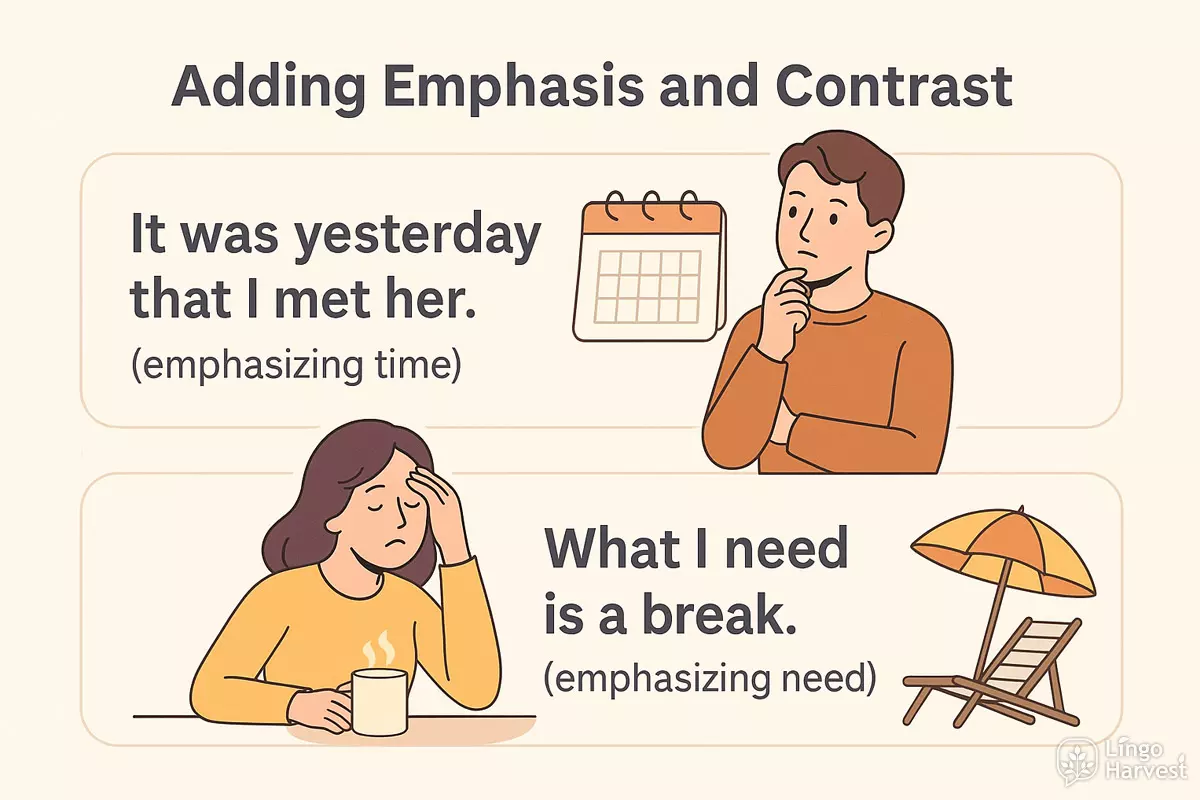
Adding Emphasis and Contrast
These constructions are often used to add emphasis or contrast within a conversation. They can make the highlighted information stand out, especially when correcting someone or introducing new, surprising, or important facts. Consider these examples:
- It was yesterday that I met her. (emphasizing time)
- What I need is a break. (emphasizing need)
- It’s on Saturdays that the market opens. (emphasizing day)
- What really matters is your health. (emphasizing priority)
- It was the noise that woke me up. (emphasizing cause)
- What I dislike is dishonesty. (emphasizing dislike)
- It’s the blue one that I prefer. (emphasizing choice)
- What surprised us was her decision. (emphasizing surprise)
- It was after midnight when he called. (emphasizing time)
- What you need is patience. (emphasizing advice)
Clarifying Information Structure
Cleft sentences also help organize information by clearly separating what is already known from what is new or important. This can make complex ideas easier to follow, especially in spoken English where intonation and stress play a key role. By using structures like “It was X that…” or “What X needs is…”, speakers guide listeners to the heart of the message.
Comparing Regular and Cleft Forms
To see how cleft constructions change the focus and meaning, compare these pairs:
| Regular Sentence | Cleft Sentence |
|---|---|
| Mary baked the cake. | It was Mary who baked the cake. |
| I need some help. | What I need is some help. |
| They met at the station. | It was at the station that they met. |
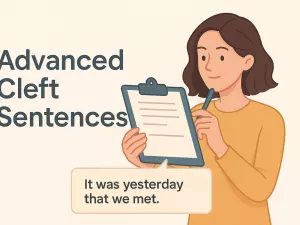
| We discussed the problem yesterday. | It was yesterday that we discussed the problem. |
| Patricia called me. | It was Patricia who called me. |
In summary, cleft sentences are powerful tools for shaping meaning, highlighting what matters most, and making conversations clearer and more engaging. Whether you want to correct, specify, or add dramatic effect, these structures are invaluable for precise and effective communication.
Structure of It-Clefts
It-cleft sentences are a special construction in English that allow speakers to focus attention on a particular part of a sentence. They typically follow a set pattern, which makes them easy to recognize and use for emphasis. The basic form involves splitting a simple sentence into two clauses, highlighting the element you want to stress.
Basic Pattern
The most common structure looks like this:
- It is/was + focused element + that/who + the rest of the sentence
For example:
- It was John who broke the vase.
- It is on Mondays that we have meetings.
This pattern allows the speaker to place emphasis on the subject, object, time, place, or other sentence elements.
Components of an It-Cleft Sentence
- Dummy subject ("It"): The sentence always starts with "It."
- Form of "be": Use the appropriate tense (is/was/will be) to match the context.
- Focus element: This can be a noun, noun phrase, adverbial, or prepositional phrase.
- Relative clause ("that"/"who"/"where"): Connects the focus element to the rest of the information.
- Clause with background information: The remaining part of the sentence, often what would follow in a standard sentence.
What Can Be Focused?
Almost any part of a sentence can be highlighted using this construction. Here are some typical examples:
- Subject: It was the manager who made the decision.
- Object: It is the keys that I lost.
- Adverbial (time/place): It was yesterday that she called. / It was in Paris that we met.
- Prepositional phrase: It was for her birthday that he bought the cake.
Examples of It-Cleft Patterns
Below is a table showing how different sentence elements can be emphasized using this structure:
| Element Emphasized | It-Cleft Example |
|---|---|
| Subject | It was Sarah who solved the puzzle. |
| Object | It is the report that needs revision. |
| Time adverbial | It was last night that they arrived. |
| Place adverbial | It is in the library that you will find him. |
| Prepositional phrase | It was for charity that they organized the event. |
| Infinitive phrase | It was to help that she volunteered. |
Notes on Usage
- The verb "be" changes tense to fit the situation: "It is", "It was", "It will be", etc.
- Use "who" for people, "that" or "which" for things, and "where" for places.
- It-clefts are often used in both formal writing and everyday speech for clarity or emphasis.
- They are especially useful for correcting misunderstandings or clarifying information.
This sentence structure is a powerful tool for drawing attention to the most important information in your message, making your communication clearer and more effective.
Structure of What-Clefts
What-cleft constructions are a handy way to highlight specific information in a sentence by foregrounding it. They typically begin with “what,” followed by a verb (often “is” or “was”), and then the element to be focused on. This structure allows speakers and writers to emphasize the most relevant part of the message, often for clarity or dramatic effect.
Basic Pattern
The essential pattern for a what-cleft sentence is:
- What + clause + be + emphasized element
For example: What I need is a vacation. Here, “a vacation” is highlighted as the key information.
Key Components
- What-clause: A dependent clause starting with “what” that introduces the topic.
- Linking verb: Most often “is” or “was,” depending on tense.
- Focus element: The information to be emphasized, which can be a noun, noun phrase, or sometimes a clause.
Examples of What-Cleft Patterns
- What I want is some quiet time.
- What surprised her was the sudden storm.
- What we need now is patience.
- What he forgot was his umbrella.
- What matters most is honesty.
- What they discovered was amazing.
- What you should do is call your doctor.
- What upset me was the noise.
- What she did next was unexpected.
- What they bought was very expensive.
- What he enjoys is playing chess.
- What we’re discussing is important.
- What you see isn’t always what you get.
- What I dislike is dishonesty.
- What finally convinced him was the evidence.
- What I heard was unbelievable.
- What makes the difference is effort.
- What you need is a break.
Negative, Interrogative, and Complex Forms
What-clefts can be adapted for different purposes:
- Negative: What I don’t like is waiting in line.
- Question: What is it that you want?
- Complex: What I need right now is someone who understands.
Comparing What-Clefts and Regular Sentences
| Regular Sentence | What-Cleft Version |
|---|---|
| I need a break. | What I need is a break. |
| She enjoys reading. | What she enjoys is reading. |
| They discovered something amazing. | What they discovered was amazing. |
| The evidence finally convinced him. | What finally convinced him was the evidence. |
| Honesty matters most. | What matters most is honesty. |
Summary of Usage
What-cleft sentences shift focus and allow for targeted emphasis in both speech and writing. They are especially useful for clarifying what is most important or for expressing contrast. By manipulating the structure, users can foreground nearly any element, making these constructions flexible tools for communication.
Choosing What to Emphasize
When forming cleft sentences, the speaker decides which part of the message deserves special attention. This choice shapes how listeners interpret the sentence and what stands out as most important. Cleft constructions allow you to highlight people, objects, time, reasons, or actions—depending on what you want to foreground in your statement.
Types of Information to Highlight
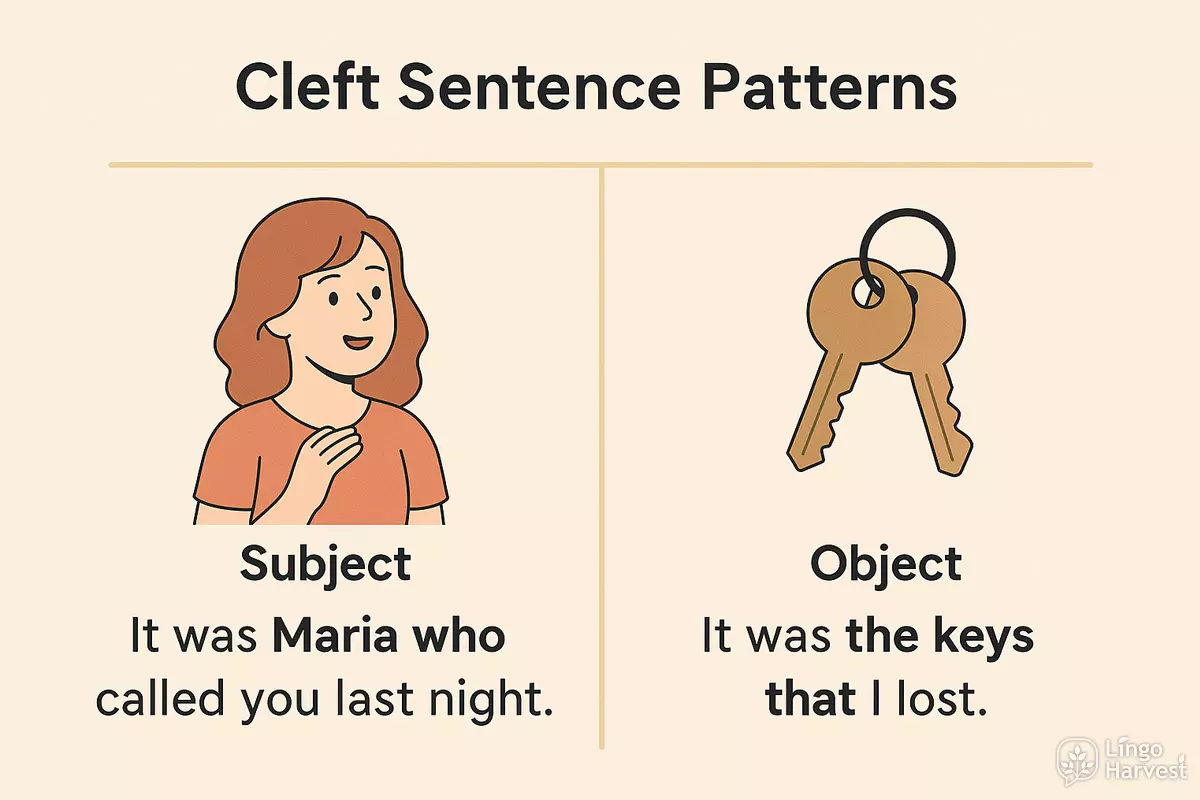
You can use cleft sentences to emphasize different elements, such as:
- Subject: It was Maria who called you last night.
- Object: It was the keys that I lost.
- Place: It was in the garden that we found the puppy.
- Time: It was yesterday that he arrived.
- Reason: It was because of the rain that the picnic was canceled.
- Action: What I need is a break.
- Manner: It was with great care that she painted the mural.
- Person performing the action: It was my brother who fixed the bike.
- Thing acted upon: It was the report that she finished early.
- Condition: What matters is that you tried.
Factors Influencing Your Choice
Several factors can influence what you choose to put in focus:
- Context: What information is already known or expected by the listener?
- Contrast: Are you correcting someone or clarifying a misunderstanding?
- Intent: Do you want to direct attention to a surprising or new detail?
- Flow: Which part of the message links best to the previous sentence or question?
Cleft Sentence Patterns
The form you select depends on what you want to bring forward. Here are some common patterns:
- It was X that... (emphasizes X)
- What X did was... (highlights the action of X)
- What I need is... (focuses on the requirement)
- All I want is... (puts the wish or need in the spotlight)
Comparison of Emphasis Types
| Element in Focus | Example Cleft Sentence |
|---|---|
| Subject | It was John who broke the vase. |
| Object | It was the vase that John broke. |
| Place | It was in the kitchen that John broke the vase. |
| Time | It was yesterday that John broke the vase. |
| Reason | It was because he was careless that John broke the vase. |
| Action | What John did was break the vase. |
By carefully selecting which part of your message to stress, you can control the listener’s attention and clarify your intended meaning. Cleft structures are especially helpful for correcting, clarifying, or simply making sure the most important detail is not missed.
Common Clarity Problems
Writers and speakers often run into issues when using cleft constructions, especially when aiming for emphasis. Although these sentences can help highlight important information, they sometimes make ideas harder to follow or unintentionally obscure the intended meaning. Awareness of these pitfalls makes it easier to use clefts effectively.
Overcomplicating Simple Ideas
Cleft sentences can make straightforward thoughts feel unnecessarily complex. For example, saying "It was at midnight that the alarm rang" instead of "The alarm rang at midnight" may sound awkward when there’s no real need for emphasis. Overuse or misuse can lead to wordiness and confusion.
- Unneeded focus: Emphasizing trivial details distracts from the main message.
- Redundancy: Repeating information already clear from the context.
- Ambiguity: The actual point of emphasis may be unclear to readers or listeners.
Ambiguous or Misplaced Emphasis
Cleft forms sometimes highlight the wrong part of the sentence, especially if the structure is not aligned with the intended focus. This can mislead the audience about what is truly important.
- Incorrect focus: "It was John who broke the vase" (when the time or place might be more relevant).
- Unclear referents: Using "what" or "it" without a clear antecedent.
- Shifting emphasis: Multiple clefts in a paragraph can scatter attention.
Awkward or Unnatural Sentences
Sometimes, cleft constructions sound stilted, especially in casual writing or speech. This can make dialogue or explanations less engaging and even confusing.
- Forcing emphasis: Using clefts for every detail instead of natural alternatives.
- Lengthy phrasing: "What I found surprising was the result of the experiment," instead of a direct statement.
- Stilted rhythm: Breaking up natural sentence flow with unnecessary structure.
Common Cleft Sentence Pitfalls
Below is a comparison of effective versus problematic cleft usage:
| Effective Cleft | Problematic Example |
|---|---|
| It was Sarah who called last night. ✅ | It was last night that Sarah called to tell us that she would arrive late because of the meeting that ran over. ❌ |
| What I need is a quick answer. ✅ | What I need is for you to provide me with a detailed and comprehensive answer regarding the question I asked yesterday. ❌ |
| It was the blue folder that went missing. ✅ | It was the blue folder, which was on the desk, that seems to have gone missing from the office at some point this morning. ❌ |
| What surprised everyone was her decision. ✅ | What was surprising to everyone, including the guests and organizers, was the unexpected decision that she made during the closing remarks. ❌ |
Quick Tips for Clearer Emphasis
- Reserve cleft forms for information that truly needs highlighting.
- Keep cleft sentences short and focused.
- Double-check that the most important idea is actually being emphasized.
- Mix direct and cleft structures for natural flow.
- Read sentences aloud to check for awkwardness.
By being mindful of these challenges, writers and speakers can use cleft sentences to enhance—not hinder—clarity and impact.
Clefts in Spoken vs Written English
Cleft constructions like "It was John who called" or "What I need is a break" appear in both conversation and formal writing, but their use and frequency can differ significantly depending on the context. In everyday speech, these sentences often help speakers highlight new or important information, clarify misunderstandings, or add dramatic effect. In contrast, written English—especially in academic or journalistic styles—may use clefts to foreground particular details, but usually with more careful structuring and less repetition.
How Clefts Function in Conversation
Spoken language relies on intonation and rhythm, so cleft sentences allow speakers to naturally stress certain elements. For example, saying "It was yesterday that I saw him" draws attention to 'yesterday' rather than 'I' or 'him'. People also use cleft forms to correct, confirm, or contradict, as in:
- Correction: "It wasn't Anna who broke the vase, it was Tom."
- Clarification: "What I meant was that we should leave now."
- Adding emphasis: "What bothers me is the noise."
Listeners easily pick up on these cues in spoken interaction, even when the grammar is less precise.
Use in Writing: More Formal, More Precise
In written texts, cleft sentences are less common but strategically valuable. Writers often use them to introduce key points, create focus, or guide the reader's attention. For example, in an essay: "It is the rapid pace of technological change that concerns many educators." Such structures are typically more polished, avoiding the false starts or incomplete forms found in speech.
Comparing Spoken and Written Clefts
| Spoken English | Written English |
|---|---|
| Often uses contractions: "It's you I need." | Rarely uses contractions: "It is you whom I need." |
| May drop elements: "What I want—coffee." | Complete sentences: "What I want is a cup of coffee." |
| Supports correction or negotiation in real time | Used for emphasis or thematic focus |
| Intonation signals emphasis | Relies on punctuation and structure |
| Frequent in storytelling and anecdotes | Appears in introductions, conclusions, or arguments |
Common Cleft Patterns and Examples
Speakers and writers use a variety of cleft structures. Here are some typical forms:
- It is/was X who/that...
- What subject needs/wants/is... is X
- The thing (that)... is X
- All (that)... is X
- Where/When/How... is X
- The person (who)... is X
- What matters is X
- It's not X but Y that...
- It was only X that...
- What surprises me is X
- What I love about this is X
- It was X who first noticed...
- Where you went wrong is X
Practice: Transform to Cleft Sentences
Understanding how to emphasize parts of a sentence using cleft structures is key to making your English more expressive. Below you'll find exercises to help you rewrite simple statements as cleft sentences for greater focus. Try changing the emphasis in each example by using patterns like “It was X that…” or “What I need is…”.
Exercise: Rewrite Using Cleft Forms
Rewrite the following sentences to highlight the underlined part. Use either an "It-cleft" or a "What-cleft" construction, as appropriate.
- John fixed the car yesterday.
- I need a cup of coffee right now.
- Last week we met your brother.
- She bought a new laptop for work.
- Because he was late, we missed the train.
- They chose the blue one instead of the red.
- We will leave after the meeting.
- My phone keeps ringing during class.
- I enjoy reading in the evening.
- Hard work brings success.
Show answers
- It was John who fixed the car yesterday.
- What I need right now is a cup of coffee.
- It was last week that we met your brother.
- It was a new laptop that she bought for work.
- It was because he was late that we missed the train.
- It was the blue one that they chose instead of the red.
- It is after the meeting that we will leave.
- It is my phone that keeps ringing during class.
- What I enjoy is reading in the evening.
- It is hard work that brings success.
Common Patterns for Cleft Sentences
These are the main structures used to create clefts in English:
- It was / is + [emphasized part] + that / who + [rest of sentence]
- What + [subject/verb] + is + [emphasized part]
- All + [subject/verb] + is + [emphasized part]
- The thing (that) + [subject/verb] + is + [emphasized part]
Transforming Different Sentence Parts
Notice how cleft sentences allow you to stress different elements, such as the subject, object, time, or reason. Here’s a handy reference for possible transformations:
| Original Sentence | Cleft Sentence |
|---|---|
| Mary called the doctor. | It was Mary who called the doctor. |
| We met at the café. | It was at the café that we met. |
| He forgot his keys. | What he forgot was his keys. |
| They left early because of the storm. | It was because of the storm that they left early. |
| I need some rest. | What I need is some rest. |
| She will arrive tomorrow. | It is tomorrow that she will arrive. |
| The dog barked loudly. | It was the dog that barked loudly. |
| We discussed the problem. | What we discussed was the problem. |
| Only Anna passed the exam. | It was only Anna who passed the exam. |
| He works late on Fridays. | It is on Fridays that he works late. |
Tips for Mastery
- Think about what you want to highlight: subject, object, time, place, or reason.
- Use “It was/is…” for specific emphasis, and “What…is…” for general needs or actions.
- Practice by changing the focus in your own sentences; this flexibility will improve your fluency and style.