Hedging for Academic Writing: Softening Claims Strategically

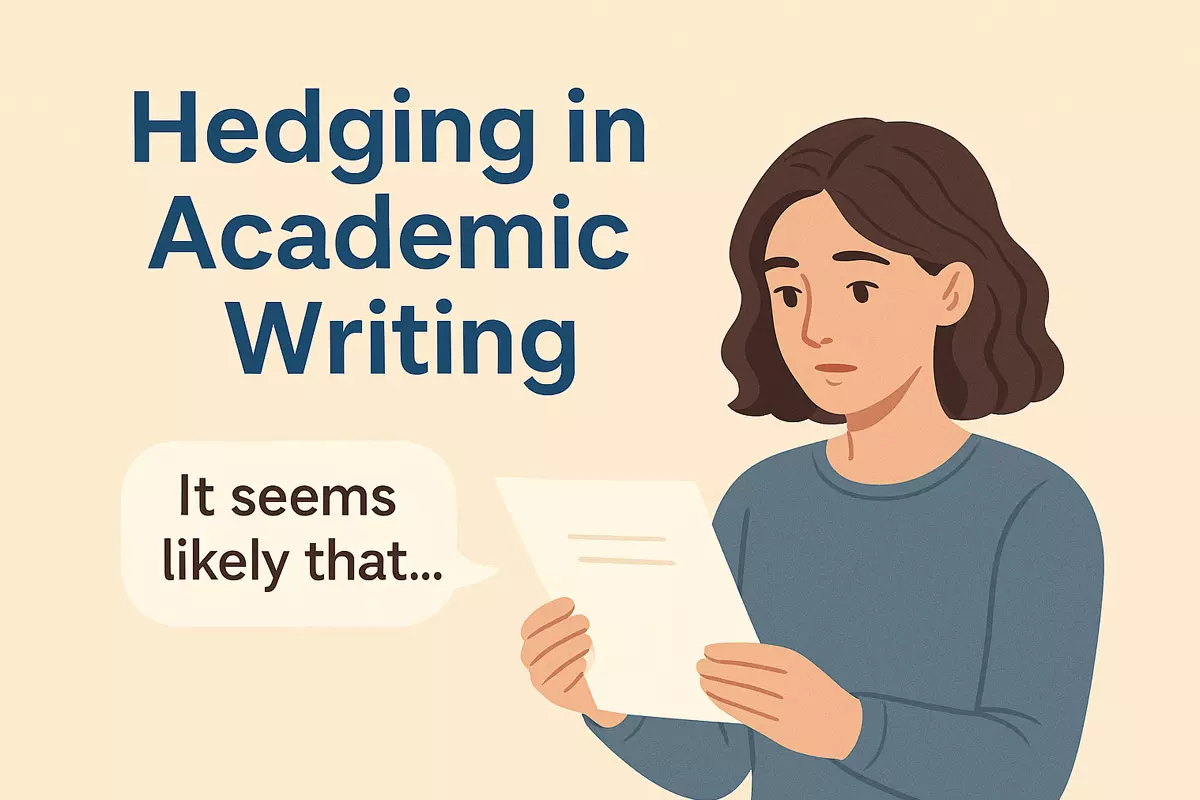 Here we the concept of hedging in research writing, including its importance, typical language structures, and how to strike the right balance between certainty and caution. It also addresses common pitfalls and offers practical tips for literature reviews.
In academic writing, tempering claims can make arguments both more convincing and nuanced, as it shows the writer’s willingness to consider different perspectives. By thoughtfully moderating their statements, scholars foster a more open and reflective discussion, which encourages readers and peers to engage critically with This. This approach not only strengthens the credibility of the argument but also promotes a collaborative atmosphere in academic discourse, where ideas are examined carefully rather than accepted without question.
What hedging is and why it matters
In academic writing, it's rarely appropriate to make absolute statements. Instead, writers often use language that shows caution or uncertainty—this is known as hedging. By softening claims, authors can acknowledge limitations, avoid overgeneralization, and invite academic discussion rather than confrontation.
Hedging involves using specific words and structures that express degrees of possibility or suggest that a statement is open to interpretation. This practice is not just about politeness; it reflects the tentative nature of research and respects the complexity of scholarly inquiry. Using cautious language helps writers avoid sounding dogmatic and allows space for alternative perspectives or future developments.
Common reasons for using hedging in academic writing
- Reflecting uncertainty: Research findings are often provisional or based on limited data.
- Demonstrating critical thinking: Softened claims show awareness of complexity and nuance.
- Avoiding overstatement: Absolute statements can be easily challenged or disproven.
- Encouraging dialogue: Cautious language invites further research and discussion.
- Maintaining objectivity: Hedging distances the writer from personal bias or emotion.
Typical forms and signals of hedging
Writers use a variety of approaches to hedge their statements. These include modal verbs, adverbs, reporting verbs, and cautious phrases. Here are some of the most frequently encountered:
- may
- might
- could
- appear(s) to
- suggest(s) that
- possibly
- likely
- seem(s) to
- it is possible that
- tend(s) to
- in general
- often
- typically
- according to
- reportedly
- somewhat
- relatively
- assumed
- presumably
- under certain conditions
Hedging benefits and potential drawbacks

| Advantages ✅ | Possible Pitfalls ❌ |
|---|---|
| Shows awareness of limits and uncertainty | Can make writing seem vague or indecisive |
| Encourages academic debate | Overuse may weaken the impact of arguments |
| Protects against criticism of overclaiming | Readers may interpret excessive caution as lack of confidence |
| Facilitates nuanced, balanced discussion | Misapplied hedging can obscure main points |
Mastering the art of hedging is essential for academic writers who want to communicate their ideas with precision and credibility. Using these strategies carefully can make arguments more persuasive and scholarly writing more effective.
Common hedging verbs, adverbs, and structures
Selecting the right words and phrases helps writers signal uncertainty, politeness, or caution in their arguments. In academic contexts, this often means using language that softens the force of claims, making them more tentative or open to discussion. Relying on a range of modal verbs, adverbs, and specific sentence structures allows for nuanced expression that respects complexity and avoids overgeneralization.
Typical Verbs for Hedging
Hedging verbs are frequently used to minimize commitment to a statement. These verbs suggest possibility rather than certainty. Some of the most useful include:
- suggest
- indicate
- appear
- seem
- imply
- estimate
- assume
- propose
- speculate
- consider
- predict
- suspect
Useful Adverbs and Adverbial Phrases
Adverbs and adverbial phrases help signal tentativeness or partial certainty. They can be placed before verbs or entire clauses to soften statements. Common choices include:
- possibly
- probably
- likely
- generally
- apparently
- potentially
- presumably
- typically
- in most cases
- to some extent
- in general
- in many cases
Common Hedging Structures
Writers also use particular sentence patterns to express uncertainty or limitation. Some frequently encountered structures are:
- It is possible that…
- There is some evidence to suggest that…
- To the best of our knowledge…
- The data may indicate…
- This could be due to…
- It seems that…
- One might argue that…
- It is generally accepted that…
- This result might reflect…
Comparison of Modal Verbs for Hedging
Modal verbs are essential for expressing different degrees of certainty. The table below summarizes some common modals and their typical hedging strength:
| Modal Verb | Degree of Certainty / Example |
|---|---|
| Might | Very tentative (e.g., "This might explain the results.") |
| Could | Possible, but not definite (e.g., "The findings could suggest a link.") |
| May | Moderately tentative (e.g., "This may be due to sampling error.") |
| Can | General possibility (e.g., "Stress can affect performance.") |
Thoughtful use of these verbs, adverbs, and structures enables academic writers to present their ideas with appropriate caution and respect for alternative perspectives. This approach not only strengthens arguments but also aligns with the conventions of scholarly communication.
Balancing certainty and caution in arguments
Academic writers constantly navigate the tension between presenting their claims with confidence and acknowledging the limits of knowledge. Striking the right balance is crucial: too much certainty can appear dogmatic or dismissive of other perspectives, while excessive caution may weaken the perceived value of your argument. Skillful use of hedging language helps maintain this equilibrium, making your points persuasive yet measured.
Why tempering claims matters
Readers expect scholarly work to reflect both expertise and intellectual humility. When writers soften assertions, they show awareness of complexities, respect for alternative interpretations, and a commitment to evidence-based reasoning. This approach enhances credibility and invites critical engagement, rather than closing off debate.
Common strategies for softening claims
Writers use a variety of linguistic tools to adjust the strength of their statements. Here are some widely used methods:
- Employing modal verbs: may, might, could, can
- Using adverbs of frequency or degree: often, sometimes, generally, largely
- Adding introductory phrases: It appears that…, The evidence suggests…, There is a possibility that…
- Qualifying nouns and adjectives: certain factors, possible explanations, limited impact
- Referencing sources: According to Smith (2020), As noted in previous research…
- Attributing claims: It has been argued that…, Some scholars believe that…
- Presenting exceptions or limitations: However, in some cases…, With the exception of…
- Expressing probability: likely, unlikely, probable, possible
- Comparing strength: stronger evidence, weaker correlation
- Using passive voice to depersonalize: It is assumed that…, It is thought that…
- Stating conditions: If…, Provided that…, Unless…
- Highlighting scope: In most studies…, Within this context…, Among these variables…
- Softening conclusions: This may indicate…, These findings could suggest…
- Distinguishing between fact and interpretation: The data show…, This could be interpreted as…
- Clarifying uncertainty: The reasons remain unclear…, The causality is not fully established…
Comparing confident and cautious approaches
Writers must decide when to assert claims with certainty and when to adopt a more tentative tone. The table below contrasts typical language choices for each approach, illustrating how subtle shifts in wording can affect the perceived strength of an argument.
| Confident Expression | Cautious (Hedged) Expression |
|---|---|
| Smith demonstrates that X causes Y. | Smith suggests that X may cause Y. |
| This result proves the hypothesis. | This result supports the hypothesis. |
| All participants agreed. | Most participants appeared to agree. |
| There is no doubt that... | It seems likely that... |
| This always leads to... | This can sometimes lead to... |
| The data confirm... | The data may indicate... |
Guidelines for effective hedging
To use hedges effectively, consider your evidence, audience, and purpose. Be specific about what is uncertain and why. Avoid overusing hedging to the point of vagueness, but do not ignore ambiguity where it genuinely exists. The goal is to communicate both your findings and their limitations with clarity and integrity.
Over-hedging vs under-hedging problems
Striking the right balance when softening claims is crucial in academic writing. Excessive use of cautious language—sometimes called “over-hedging”—can make arguments appear weak or uncertain. On the other hand, failing to include enough hedging—“under-hedging”—may make statements seem overly confident, dismissive of doubt, or even inaccurate. Both tendencies can undermine the credibility and clarity of your work.
What is over-hedging?
Over-hedging happens when writers use too many qualifiers or tentative expressions. This can dilute the impact of their arguments, making them sound unsure or lacking in authority. For example, repeatedly using phrases like "it might be possible that" or "one could perhaps suggest that" can distract from the main point and suggest a lack of confidence in the research findings.
What is under-hedging?
Under-hedging occurs when claims are presented as absolute truths, without acknowledging complexity or potential exceptions. This approach can come across as dogmatic or dismissive of alternative perspectives. Academic readers expect authors to recognize uncertainty and nuance, so omitting hedging can reduce the perceived sophistication of the analysis.
Common signs and risks
- Overuse of words like “possibly,” “perhaps,” and “may” in every sentence
- Statements that sound like opinions instead of evidence-based conclusions
- Lack of modal verbs or hedging phrases in contexts where uncertainty exists
- Absolute language such as “always,” “never,” or “proves” without qualification
- Minimal acknowledgment of limitations or alternative explanations
Comparing effects
| Potential Issue | Typical Consequences |
|---|---|
| Over-hedging |
|
| Under-hedging |
|
Examples of hedging extremes
- “It might perhaps be suggested that…” (over-hedging)
- “This proves that…” (under-hedging)
- “Possibly, in some cases, it could be argued that…” (over-hedging)
- “It is clear that…” (under-hedging, unless fully justified)
Finding the middle ground—using hedging to express appropriate caution without undermining your authority—helps you communicate effectively and credibly in academic contexts. Aim for language that acknowledges uncertainty where necessary, but also confidently presents your main findings.
Hedging in literature review and discussion sections
Writers often use hedging when engaging with previous studies or interpreting results. In literature reviews, hedging allows authors to present prior findings without overstating their certainty or universal applicability. Similarly, in the discussion section, it helps researchers suggest interpretations, implications, or limitations with appropriate caution. This strategic softening maintains academic objectivity and signals respect for the complexity of knowledge in the field.
Common Hedging Strategies in Literature Reviews
- Introducing uncertainty: "It appears that...", "There seems to be..."
- Acknowledging limitations: "To some extent...", "In certain cases..."
- Attributing claims: "According to Smith (2020)...", "Several studies suggest..."
- Using cautious verbs: "may indicate", "suggests", "could reflect"
- Employing modal verbs: "might", "could", "would"
- Specifying scope: "In the context of...", "Among adolescents..."
- Qualifying frequency: "often", "sometimes", "rarely"
- Highlighting diversity: "Varied results have been reported..."
- Softening generalizations: "Not all studies agree...", "Evidence is mixed..."
- Referencing ongoing debates: "Remains a matter of debate..."
Hedging Patterns in Discussion Sections
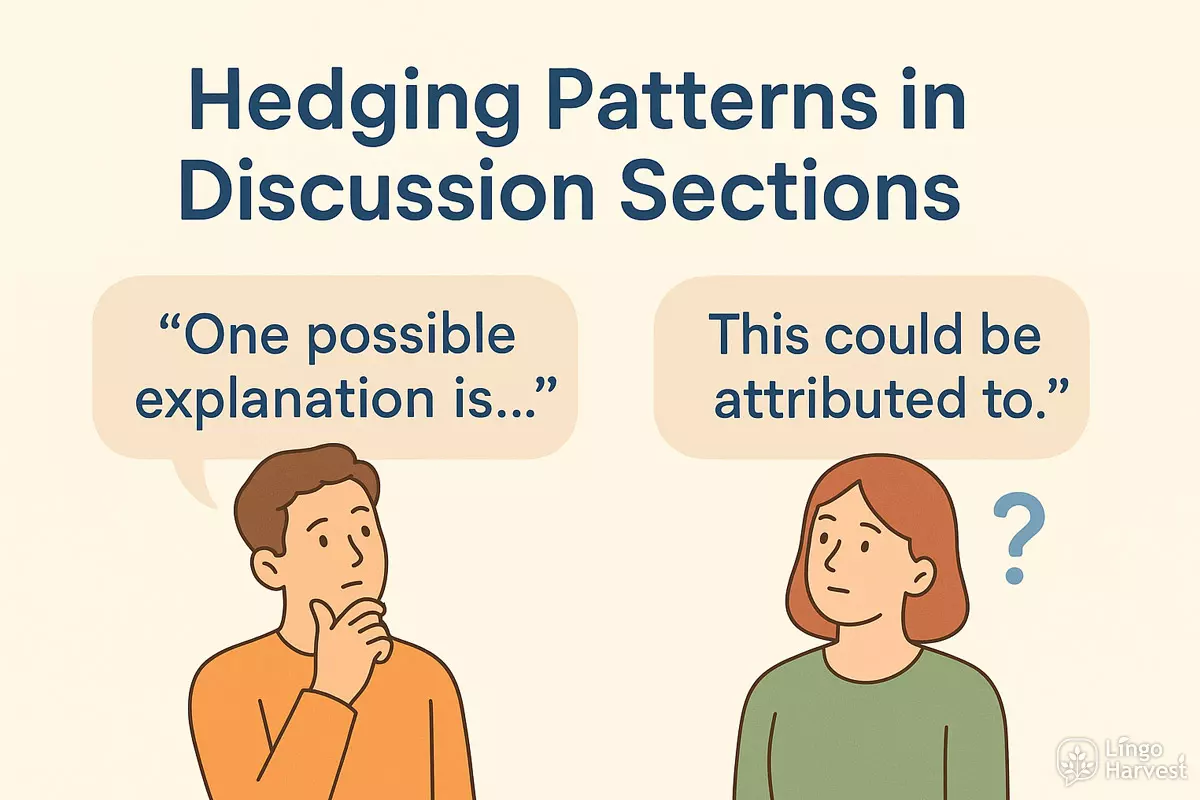
When interpreting results, academic writers employ hedges to avoid overclaiming. This is especially important when discussing unexpected findings, theoretical implications, or possible limitations. Typical expressions include:
- "These results may suggest..."
- "One possible explanation is..."
- "This could be attributed to..."
- "It is possible that..."
- "Further research is needed to confirm..."
- "The findings should be interpreted with caution."
- "A potential limitation is..."
- "Alternatively, this might result from..."
- "Our data tentatively support..."
- "While the evidence points to..., it does not conclusively establish..."
Comparison of Hedging Forms: Literature Review vs. Discussion
| Purpose | Typical Hedging Examples |
|---|---|
| Reviewing previous studies | "Several authors have reported...", "Findings appear to be inconsistent", "It has been proposed that..." |
| Interpreting results | "This may indicate...", "These results could be explained by...", "It is plausible that..." |
| Discussing limitations | "A possible limitation is...", "This should be considered a preliminary finding", "Further studies are warranted" |
| Suggesting implications | "The results might have implications for...", "This potentially supports...", "Such findings may inform..." |
Practice: Identifying Hedging in Context
Read each sentence and decide whether it uses hedging. Mark ✅ for hedged, ❌ for not hedged.
- It is likely that environmental factors contributed to these results.
- This study proves that the intervention is effective.
- Several studies suggest a correlation between sleep and memory.
- All participants responded positively to the treatment.
Show answers
- ✅ (uses "likely")
- ❌ (no hedge; overstates certainty)
- ✅ ("suggest" is a hedge)
- ❌ (absolute statement)
Practice: adjust strong claims to appropriate hedging levels
Effective academic writing often requires transforming absolute statements into balanced, nuanced claims. This helps avoid overgeneralization and acknowledges limitations or alternative perspectives. Let’s explore how to practice this skill by revising strong assertions and identifying suitable hedging language.
Exercise: Revising Overly Strong Statements
Below are several assertive sentences. Your task is to rewrite each one using appropriate hedging expressions to introduce caution, probability, or respect for other viewpoints.
- Technology improves education for all students.
- This theory completely explains the phenomenon.
- Online learning always leads to better outcomes than traditional classrooms.
- There is no evidence supporting this claim.
- These results prove the hypothesis.
- Experts agree that remote work increases productivity in every industry.
- Social media causes mental health problems in all teenagers.
- The new drug eliminates the disease entirely.
- Climate change is caused only by human activity.
- Artificial intelligence will replace all human jobs.
Show answers
- Technology may improve education for many students.
- This theory appears to explain the phenomenon to a large extent.
- Online learning often leads to better outcomes than traditional classrooms, according to some studies.
- There is little evidence supporting this claim.
- These results support the hypothesis.
- Experts suggest that remote work may increase productivity in several industries.
- Social media can contribute to mental health challenges in some teenagers.
- The new drug may help reduce the disease’s impact.
- Climate change is largely influenced by human activity, though other factors also play a role.
- Artificial intelligence is likely to automate certain tasks, but may not replace all jobs.
Common Hedging Words and Phrases
Writers use a variety of expressions to soften claims. Here is a selection of useful hedging terms and structures you can incorporate:
- may / might / could
- appear(s) to / seem(s) to
- suggest(s) / indicate(s)
- it is possible that / it is likely that
- to some extent / in many cases
- generally / often / typically
- according to the data / based on current evidence
- not always / not necessarily
- it remains unclear whether
- further research is needed
- relatively / somewhat / partially
- in most cases / in certain contexts
- can be interpreted as
- appears to be
- suggests the possibility that
- is assumed to
- is consistent with
- is associated with
- the evidence points to
- there is some evidence that
Comparison: Strong Claims vs. Hedged Statements
Understanding the difference between absolute and softened assertions is crucial. The table below contrasts direct claims with their appropriately hedged counterparts.
| Strong Claim | Hedged Version |
|---|---|
| Climate change is caused by human activity. | Climate change is largely attributed to human activity. |
| This treatment cures the disease. | This treatment may help to manage the disease. |
| All students benefit from group work. | Many students benefit from group work. |
| This method always produces accurate results. | This method tends to produce accurate results. |
| The data proves the theory. | The data supports the theory. |
| No one disagrees with these findings. | Few have disagreed with these findings. |
Task: Choose Appropriate Hedges
Select the best hedging phrase to complete each academic sentence:
- These findings [choose one: prove / suggest / guarantee] that further study is necessary.
- The evidence [choose one: always / sometimes / never] supports the hypothesis.
- It is [choose one: certain / possible / impossible] that the results were influenced by external factors.
- The data [choose one: clearly / somewhat / barely] indicate a shift in public opinion.
- The results can [choose one: undoubtedly / potentially / never] be applied to other contexts.
- It seems [choose one: obvious / likely / unlikely] that the sample was too small.
- This method [choose one: proves / appears to / fails to] improve accuracy.
- The increase may be [choose one: entirely / partly / not at all] due to seasonal changes.
- The study [choose one: confirms / suggests / contradicts] earlier research.
- It is [choose one: clear / probable / uncertain] that additional testing is required.
Show answers
- suggest
- sometimes
- possible
- somewhat
- potentially
- likely
- appears to
- partly
- suggests
- uncertain
Practicing these transformations will help you develop a more credible and nuanced academic voice. Remember, strategic hedging is not about weakening your argument, but about presenting it with appropriate caution and scholarly integrity.