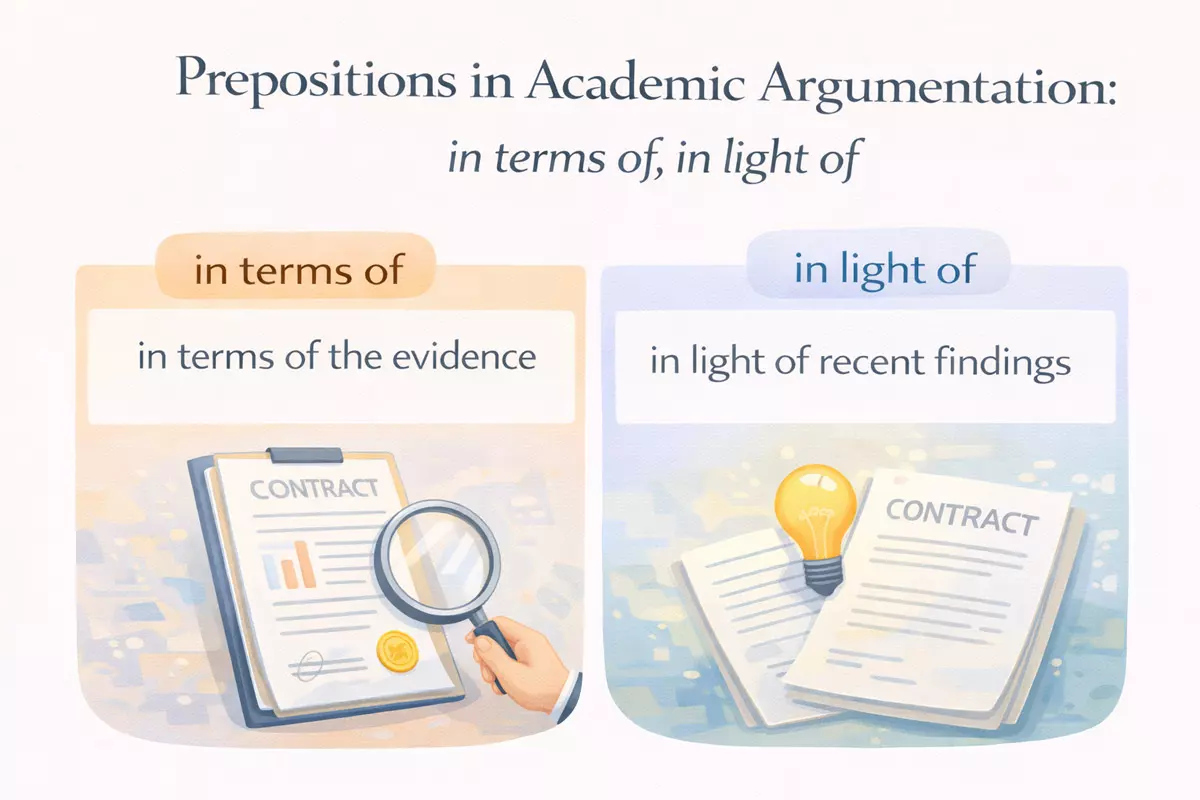
Prepositions in Academic Argumentation: in terms of, in light of

 Here we how prepositional phrases such as in terms of, in light of, and contrary to structure academic arguments. It covers defining scope, evaluating evidence, logical transitions, register differences, and improving argument clarity.
- The Framing Function: Using 'in terms of' to define scope and limitations
- Evidence Evaluation: 'In light of' and 'given' for contextualizing new findings
- Persuasive logic: Mastering 'contrary to', 'notwithstanding', and 'with respect to'
- Degree and Extent: Nuanced argumentation with 'to a large extent' and 'in part'
- Logical transitions: Prepositional phrases as signposts for 'furthermore' and 'however'
- Avoiding 'Empty Filler': Stripping redundant prepositions to sharpen thesis statements
- Register contrast: Differentiating between 'about' (general) and 'regarding' (academic)
- Syntactic complexity: Embedding argument markers within multi-clause sentences
- Practice: Evaluating and rewriting weak academic arguments for better logical flow
Crafting strong academic arguments depends on using precise language to clearly express relationships between ideas. Effectively framing evidence or context is essential, as it helps readers understand how different points connect and supports the overall logic of an argument. Certain phrases and transitions, such as in addition, for example, or as a result, play a key role in making these connections explicit. By choosing words carefully and structuring sentences thoughtfully, writers can present their arguments in a coherent and persuasive manner that enhances clarity and impact.
The Framing Function: Using 'in terms of' to define scope and limitations
Academic writing often requires authors to clarify the boundaries of their arguments. The phrase in terms of is a practical tool for delineating what aspects will be considered and, just as importantly, what will be set aside. By specifying the angle or parameter under discussion, writers make their claims more precise and help readers understand the context and focus of their analysis.
Clarifying Focus and Boundaries
Using this prepositional phrase allows scholars to zoom in on particular variables or criteria. For instance, rather than making a sweeping statement about a phenomenon, an author might say, "The results are significant in terms of statistical correlation," immediately narrowing the reader’s attention to the relevant metric.
Common Patterns and Examples
Writers use this construction to introduce a specific lens or set of criteria. Here are some common ways it appears in academic contexts:
- “In terms of methodology, the study employs qualitative interviews.”
- “Economic growth, in terms of GDP, increased steadily.”
- “The theory is robust in terms of explanatory power.”
- “There are notable differences in terms of gender representation.”
- “The policy was successful in terms of reducing emissions.”
- “In terms of sample size, the research is limited.”
- “The intervention failed in terms of long-term effectiveness.”
- “User satisfaction, in terms of survey responses, was high.”
- “The argument is weak in terms of empirical support.”
- “Results are comparable in terms of statistical significance.”
- “In terms of scope, the article covers only primary sources.”
- “The project was evaluated in terms of cost efficiency.”
- “No major changes were observed in terms of demographic trends.”
- “The material is superior in terms of durability.”
- “Success was measured in terms of graduation rates.”
- “Improvements were noted in terms of user engagement.”
- “Performance was analyzed in terms of speed and accuracy.”
- “In terms of historical context, the event is unique.”
- “The findings are limited in terms of generalizability.”
- “Progress is evident in terms of technological development.”
Benefits for Argument Structure
Framing claims with this phrase helps prevent overgeneralization. It signals to readers that the author is aware of the complexity of the subject and is intentionally focusing on a particular element. This approach enhances the transparency and rigor of the discussion, especially in multidisciplinary fields where terms and measures can vary widely.
Comparing 'in terms of' with Other Framing Devices

Writers sometimes confuse in terms of with similar expressions. The table below highlights differences in usage:
| Expression | Primary Function | Example |
|---|---|---|
| in terms of | Specifies the aspect or dimension being discussed | The model is accurate in terms of prediction. |
| with respect to | Indicates relationship or relevance to a particular element | There are differences with respect to age groups. |
| regarding | Introduces the topic or subject of discussion | Regarding the results, further research is needed. |
| concerning | Draws attention to a particular issue | Questions concerning methodology remain. |
By intentionally choosing in terms of, writers maintain control over the scope of their argument and ensure clarity for their audience. This framing device is especially helpful when addressing multifaceted topics where multiple interpretations or measurements might exist.
Evidence Evaluation: 'In light of' and 'given' for contextualizing new findings
When presenting new research or interpreting data, academic writers frequently rely on prepositional phrases like in light of and given to frame evidence within a broader context. These expressions signal to readers that the findings are being considered against a backdrop of prior knowledge, assumptions, or changing circumstances. Using such phrases helps clarify how new results relate to established understanding or specific conditions.
Purpose and Function in Academic Writing
Both in light of and given serve to introduce a rationale or justification for interpreting evidence in a particular way. They work by connecting new information to what is already known, allowing writers to highlight significance, limitations, or implications. For example, one might say, "In light of recent studies, the results suggest a revised hypothesis," or "Given the sample size, these findings should be interpreted cautiously."
Common Patterns and Usage Examples
Writers use these prepositional phrases in a variety of argumentative contexts. Consider the following common patterns:
- In light of conflicting evidence, further research is warranted.
- Given the methodological constraints, the conclusions remain tentative.
- In light of previous failures, the current success is notable.
- Given the theoretical framework, these results align with expectations.
- In light of recent policy changes, the data require re-examination.
- Given the limited scope of the study, caution is advised.
- In light of participant feedback, adjustments were made to the protocol.
- Given the statistical significance, the effect appears robust.
- In light of ethical considerations, certain methods were excluded.
- Given the available resources, the approach was pragmatic.
- In light of emerging trends, the findings gain additional relevance.
- Given historical precedents, such outcomes are unsurprising.
Subtle Differences in Emphasis
While in light of and given are sometimes used interchangeably, they can imply slightly different relationships between evidence and context. In light of often emphasizes a change or new perspective resulting from recent developments. Given tends to present background facts or conditions as a starting point for interpretation.
| Phrase | Typical Function / Example |
|---|---|
| In light of | Signals a shift or reconsideration based on new information. Example: In light of recent findings, previous theories may need revision. |
| Given | Establishes a condition or background context for the argument. Example: Given the small sample, generalizations should be made cautiously. |
| In light of | Highlights the influence of external developments on interpretation. Example: In light of policy changes, the data take on new significance. |
| Given | Presents an accepted premise as the basis for reasoning. Example: Given the theoretical assumptions, the outcome is expected. |
Strategic Use for Academic Argumentation
Effectively deploying these prepositional phrases enhances clarity and transparency in scholarly writing. By explicitly stating the context in which evidence is evaluated, authors help readers understand the reasoning behind claims, acknowledge limitations, and recognize the scope of conclusions. This practice not only strengthens argumentation but also fosters critical engagement with the research.
Persuasive logic: Mastering 'contrary to', 'notwithstanding', and 'with respect to'
In academic argumentation, nuanced prepositions like contrary to, notwithstanding, and with respect to are invaluable for constructing clear, persuasive logic. Using these expressions effectively allows writers to frame counter-arguments, acknowledge exceptions, and clarify scope. Understanding their distinct roles can significantly enhance the sophistication and precision of your writing.
When and How to Use Each Expression
- Contrary to — Signals direct opposition to a stated idea, expectation, or evidence. Use it to introduce findings or arguments that differ markedly from previously held views.
- Notwithstanding — Means “in spite of” or “despite.” It is often used to introduce exceptions or to highlight something that remains true even when another factor is present.
- With respect to — Narrows the focus to a particular aspect or dimension of the topic, helping readers understand exactly what is being addressed.
Common Patterns and Examples
- Contrary to popular belief, the results indicate a different trend.
- Contrary to Smith’s hypothesis, the data support an alternative explanation.
- Notwithstanding recent criticism, the theory remains influential.
- Notwithstanding these limitations, the study offers valuable insights.
- With respect to methodology, the research maintains rigorous standards.
- With respect to environmental factors, the findings are consistent across regions.
- Contrary to expectations, the intervention produced no significant effect.
- Notwithstanding the challenges, the project achieved its objectives.
- With respect to participants’ age, the results were uniform.
- Contrary to earlier reports, the current evidence suggests improvement.
- Notwithstanding these concerns, the policy was implemented nationwide.
- With respect to funding, the initiative was well-supported.
Comparing Functions
| Expression | Typical Function | Example |
|---|---|---|
| Contrary to | Introduce direct opposition or contradiction | Contrary to the initial hypothesis, results showed no correlation. |
| Notwithstanding | Present exceptions or factors that do not alter the main point | Notwithstanding its limitations, the study is cited frequently. |
| With respect to | Specify the aspect or context being discussed | With respect to ethics, the procedure was approved. |
Practical Tips for Academic Writing
- Reserve contrary to for strong contrasts or clear disagreement.
- Use notwithstanding to introduce caveats without undermining your main argument.
- Apply with respect to to clarify which part of a complex issue you are referencing.
- Combine these expressions with evidence to reinforce credibility.
- Avoid overusing any single structure; variety strengthens your prose.
Careful use of these prepositions supports precise, nuanced argumentation, making your academic writing more compelling and logically robust.
Degree and Extent: Nuanced argumentation with 'to a large extent' and 'in part'
Academic writing often requires a precise approach to expressing how strongly a point is supported or to what degree evidence applies. Rather than making absolute claims, scholars frequently qualify their statements using phrases such as “to a large extent” or “in part.” This nuanced language allows arguments to reflect complexity, acknowledge limitations, and engage critically with multiple viewpoints.
Expressing Degrees of Certainty and Scope
Writers use specific prepositional phrases to indicate the scope or strength of a claim. “To a large extent” signals that a statement is mostly, but not entirely, true. Conversely, “in part” suggests that a factor or explanation is only partially responsible or relevant. These expressions promote balanced argumentation and demonstrate an awareness of the multifaceted nature of academic topics.
- To a significant degree → The outcome depends to a significant degree on external factors.
- Partially → The hypothesis was partially supported by the data.
- For the most part → For the most part, the findings align with previous research.
- In some respects → In some respects, the proposed model improves accuracy.
- To some extent → To some extent, the results reflect sample bias.
- On the whole → On the whole, the study provides reliable conclusions.
- To a lesser degree → Environmental factors influenced the outcome to a lesser degree.
- In certain respects → In certain respects, the method remains limited.
- Largely → The theory was largely confirmed by empirical evidence.
- To a limited extent → The intervention was effective to a limited extent.
- In many cases → In many cases, participants responded positively.
- To a considerable extent → The variation can be explained to a considerable extent by age.
- In part → The discrepancy is due in part to measurement error.
- To a great extent → Success depends to a great extent on early planning.
- In specific contexts → In specific contexts, the strategy proves effective.
- Primarily → The decline was primarily caused by external pressures.
- Not entirely → The explanation is not entirely convincing.
- To an extent → The criticism is valid to an extent.
- In some measure → The results confirm the hypothesis in some measure.
- Mostly → The responses were mostly consistent across groups.
Comparing 'To a Large Extent' and 'In Part'
These two phrases serve distinct rhetorical purposes. “To a large extent” emphasizes that the majority of evidence or reasoning supports a point, while “in part” highlights that only a portion of the argument or explanation is valid. Mastery of these expressions helps writers avoid overgeneralization and supports critical analysis.
| Expression | Typical Use |
|---|---|
| To a large extent | Used to indicate that a claim is mostly but not entirely accurate or applicable. |
| In part | Highlights that a factor explains or contributes to something only partially. |
| To some extent | Suggests a moderate degree of truth or relevance. |
| On the whole | Expresses a generalization while allowing for exceptions. |
Practical Application in Argumentation
Using these structures, writers can present claims that are both persuasive and appropriately cautious. For example, “In light of recent data, the hypothesis is supported to a large extent,” or, “The results can be explained, in part, by socioeconomic factors.” Such phrasing is especially useful in research articles, literature reviews, and critical essays, where acknowledging complexity is essential for credibility.
Logical transitions: Prepositional phrases as signposts for 'furthermore' and 'however'
In academic writing, creating clear connections between ideas is essential. Prepositional phrases such as in addition to and in contrast to help guide readers by signaling whether information is being extended or a contrast is being introduced. These linguistic tools act as signposts, much like the words furthermore and however, but with added nuance and sophistication.
Extending an argument: Prepositional phrases for addition

Writers often use prepositional phrases to smoothly introduce supporting points or develop existing claims. Instead of overusing simple connectors, consider these alternatives that function as cues for further information:
- In addition to the previous findings, recent studies suggest a broader applicability of the model.
- Along with methodological concerns, ethical issues arise regarding data collection.
- Beyond the scope of this paper, future research may explore long-term implications.
- In terms of statistical significance, the results are robust across multiple samples.
- With respect to participant diversity, the sample was limited to a specific demographic.
- As well as theoretical implications, practical applications are notable in real-world settings.
- From the perspective of policy makers, these results are crucial for informed decision-making.
- By means of longitudinal analysis, trends become apparent over extended periods.
- On the basis of recent evidence, the hypothesis is supported with moderate confidence.
- Regarding sample size, the study was comprehensive enough to ensure reliability.
Signaling contrast: Prepositional phrases for opposition
To introduce opposing viewpoints or highlight exceptions, prepositional phrases can serve as subtle alternatives to "however." They frame contrasts in a way that is both formal and precise:
- In contrast to earlier research, this study found no significant correlation.
- Unlike previous approaches, our method emphasizes qualitative analysis.
- In light of new evidence, prior assumptions are questioned and reassessed.
- Despite methodological improvements, challenges remain in data interpretation.
- Contrary to expectations, the results were inconclusive.
- In opposition to established theories, recent data suggest an alternative explanation.
- In spite of limited resources, outcomes were significant and measurable.
- As opposed to traditional models, this framework allows greater flexibility.
- Against the backdrop of economic uncertainty, the findings are particularly notable.
- In defiance of conventional wisdom, the experiment succeeded under strict conditions.
Comparing signpost phrases for addition and contrast
| Phrases for Addition (similar to 'furthermore') |
Phrases for Contrast (similar to 'however') |
|---|---|
| In addition to | In contrast to |
| Along with | Unlike |
| Beyond | In light of |
| With respect to | Despite |
| As well as | Contrary to |
| From the perspective of | In opposition to |
| By means of | In spite of |
| On the basis of | As opposed to |
| Regarding | Against |
| — | In defiance of |
Academic argumentation benefits from such variety, as these prepositional signposts clarify whether the writer is building on a previous statement or introducing a counterpoint. This helps readers navigate the logic of the text and understand the structure of the argument.
Avoiding 'Empty Filler': Stripping redundant prepositions to sharpen thesis statements
Unnecessary prepositions often sneak into academic writing, especially in thesis statements, where clarity is crucial. Phrases like "in terms of" or "in light of" can dilute arguments if overused or applied without real need. Tightening language by cutting redundant prepositions not only makes statements more concise but also strengthens the overall argument.
Common Redundant Prepositions in Academic Writing
Writers often rely on familiar constructions for comfort, but these can weigh down a thesis with superfluous words. Consider these commonly overused or unnecessary prepositional phrases:
- in terms of → The proposal was evaluated in terms of cost and efficiency.
- in light of → In light of recent findings, the theory requires revision.
- with regard to → With regard to your inquiry, additional data is needed.
- on the basis of → On the basis of the evidence, the claim is supported.
- in connection with → The inquiry was launched in connection with safety concerns.
- with respect to → With respect to methodology, the approach is sound.
- in relation to → The findings must be considered in relation to prior research.
- for the purpose of → The survey was conducted for the purpose of data collection.
- in order to → The procedure was revised in order to improve accuracy.
- by means of → The samples were analyzed by means of statistical modeling.
- as a result of → The delay occurred as a result of technical difficulties.
- in the context of → In the context of climate change, the results are significant.
- on account of → The experiment was halted on account of safety risks.
- in the case of → In the case of incomplete data, results were excluded.
- due to the fact that → The outcome differed due to the fact that conditions varied.
- at the level of → The analysis was conducted at the level of individual responses.
- with the exception of → All variables were controlled with the exception of age.
- in accordance with → The study was carried out in accordance with ethical guidelines.
- in opposition to → In opposition to earlier models, this approach emphasizes flexibility.
- in support of → The data was presented in support of the main argument.
Sharpening Thesis Statements: Practical Revisions
Cutting out empty prepositions can transform a vague thesis into a direct claim. For example, rather than writing, "In terms of economic policy, this paper will discuss the effects of taxation," one could state, "This paper discusses the effects of taxation on economic policy." The second version is more assertive and immediately clear.
Identifying and Replacing Redundant Phrases
Writers can often replace wordy prepositional phrases with a single word or a more direct expression. Here are some alternatives:
- instead of "in light of" → "considering"
- instead of "in terms of" → "about" or "regarding"
- instead of "on the basis of" → "by" or "because of"
- instead of "with regard to" → "about"
- instead of "due to the fact that" → "because"
- instead of "for the purpose of" → "to"
- instead of "in order to" → "to"
- instead of "as a result of" → "because of"
- instead of "in support of" → "supporting"
- instead of "in opposition to" → "opposing"
Quick Reference: Streamlining Prepositional Phrases
| Wordy Version | Concise Alternative |
|---|---|
| In terms of policy effectiveness | Policy effectiveness |
| In light of recent findings | Considering recent findings |
| Due to the fact that | Because |
| With regard to environmental impact | Regarding environmental impact |
| For the purpose of analysis | To analyze |
| On account of limited data | Because of limited data |
| As a result of budget cuts | Because of budget cuts |
| In connection with the survey | Regarding the survey |
Checklist for Streamlining Your Thesis
When revising, ask yourself:
- Does this prepositional phrase add clarity, or can it be removed?
- Can I replace a multi-word phrase with a single, more direct word?
- Is my thesis statement as concise as possible while remaining specific?
Stripping away extra prepositions is a simple but effective way to make academic arguments more persuasive and reader-friendly.
Register contrast: Differentiating between 'about' (general) and 'regarding' (academic)
In academic writing, the choice between prepositions such as "about" and "regarding" often signals the formality and precision of the argument. While "about" is widely used in everyday conversation and informal contexts, "regarding" tends to appear in more formal or scholarly texts. This distinction is not only a matter of vocabulary, but also of register—the level of formality suitable for the audience and purpose.
When to Use "About"
"About" is flexible and familiar, making it a go-to option for general discussions, casual explanations, or introductory statements. It conveys the idea of topic or subject matter without the weight of formality. For example:
- We talked about climate change.
- This book is about marine biology.
- I have some questions about your research.
- Can you tell me about your experience?
These examples show how "about" fits naturally in contexts where the tone is conversational or the relationship is informal.
When to Choose "Regarding"
In contrast, "regarding" is favored in academic, professional, or bureaucratic settings. It suggests a formal approach to a subject, often introducing topics in research papers, reports, or official communication. Some typical uses include:
- Regarding the results of the experiment, further analysis is needed.
- The committee made a decision regarding the proposal.
- Questions regarding methodology should be addressed to the lead author.
- There are concerns regarding data accuracy.
Using "regarding" helps establish a scholarly tone and can signal attention to detail or specificity.
Comparing Usage in Academic Argumentation
Writers often choose between these words depending on the level of formality and the expectations of their audience. The table below summarizes key differences for quick reference:
| Expression | Typical Contexts & Register |
|---|---|
| about | Informal tone, spoken English, general writing, personal essays, emails, blog posts |
| regarding | Formal tone, academic articles, research papers, business correspondence, official documentation |
| concerning | Formal/neutral; often used in legal, academic, or official contexts as an alternative to "regarding" |
| with respect to | Very formal; used in academic argumentation, technical writing, and structured analysis |
| in relation to | Formal/neutral; useful in both academic papers and professional reports to show connections between ideas |
Nuances and Synonyms
Expanding your range of prepositions can help vary tone and precision. Besides "about" and "regarding," consider these alternatives, especially in academic contexts:
- concerning → Concerning your request, additional documentation is required.
- in relation to → In relation to previous findings, the results are consistent.
- with respect to → With respect to data accuracy, further verification is needed.
- in connection with → The investigation was initiated in connection with safety concerns.
- as for → As for the proposed timeline, minor adjustments may be necessary.
- in reference to → In reference to your earlier email, we have updated the schedule.
- on the subject of → On the subject of funding, several options were discussed.
- pertaining to → All records pertaining to the case were reviewed.
- as regards → As regards participant selection, strict criteria were applied.
- in the matter of → In the matter of contract renewal, a decision is pending.
- relating to → Documents relating to the transaction were submitted.
- as far as X is concerned → As far as data privacy is concerned, compliance is mandatory.
- with regard to → With regard to your inquiry, a detailed response will follow.
- touching on → The lecture touched on several ethical considerations.
- in the context of → In the context of international law, the ruling is significant.
Choosing the right preposition can clarify your intent, align with disciplinary conventions, and shape how your argument is received. In summary, consider audience, purpose, and register when selecting between "about," "regarding," and their synonyms in academic argumentation.
Syntactic complexity: Embedding argument markers within multi-clause sentences
Academic writers often use prepositional phrases like in terms of and in light of to signal reasoning, stance, or the basis of an argument. These phrases frequently appear embedded within sentences that contain multiple clauses, contributing to intricate syntactic structures. Recognizing how such markers function within layered sentences is crucial for both comprehension and effective writing.
Placement and Integration within Sentences
Writers typically introduce these prepositional argument markers to clarify relationships between ideas or to qualify claims. When embedded within complex sentences, they may appear at the beginning, middle, or end of a clause, often requiring careful punctuation and coordination. For example:
- In light of recent findings, the hypothesis was revised, although further research is needed.
- The results, in terms of statistical significance, were compelling, yet limitations remain.
- While the policy seems effective in light of current data, its long-term impact is unclear.
Common Patterns of Embedded Usage
Writers tend to nest these markers within subordinate or relative clauses, or alongside conjunctions, to create nuanced arguments. Here are some recurring patterns:
- Initial positioning: In terms of X, [main clause]
- Mid-clause insertion: The outcome, in light of Y, [rest of sentence]
- Layered subordination: Although [clause], in light of [evidence], [main clause]
- Relative clause embedding: The issue, which is significant in terms of Z, [rest of sentence]
- Paired with concessive clauses: Even though [clause], the findings, in light of [data], suggest…
- Conditional construction: If [clause], then, in terms of [criteria], [result]
- Comparative structures: More effective in terms of cost than previous models
- Multiple embedding: In light of the evidence presented, which, in terms of scope, is comprehensive, the conclusion is robust.
- Appositive phrases: The proposal, in terms of feasibility, is promising.
- Preceding lists: Several factors, in light of the analysis, must be reconsidered: A, B, and C.
Managing Syntactic Depth
The inclusion of argument markers within multi-clause sentences can increase sentence length and complexity. Writers must balance clarity and sophistication, ensuring that prepositional phrases do not obscure the main point. Strategies to manage this include:
- Breaking long sentences into shorter units when possible
- Using commas to set off embedded phrases for readability
- Ensuring that the referent of the prepositional phrase is clear
- Limiting multiple layers of embedding in a single sentence
Comparing "in terms of" and "in light of" in Embedded Contexts
The following table summarizes distinctive features and usage considerations for these two prepositional markers when embedded:
| Marker | Embedded Function/Typical Use |
|---|---|
| in terms of | Specifies the aspect or dimension being discussed within a clause (e.g., "The project, in terms of cost, is feasible.") |
| in light of | Introduces a rationale or justification, often referencing evidence or developments (e.g., "The approach was modified, in light of recent discoveries.") |
| in terms of + subordination | Used with subordinate clauses to highlight specific evaluative criteria (e.g., "Although progress was slow, in terms of quality, results were excellent.") |
| in light of + concession | Paired with concessive structures to weigh evidence against claims (e.g., "Even though the sample was small, in light of clear trends, conclusions were drawn.") |
Conclusion
Embedding prepositional argument markers within complex sentences allows for nuanced academic argumentation, but demands careful syntactic management. Awareness of common patterns and functions enhances both clarity and persuasiveness in scholarly writing.
Practice: Evaluating and rewriting weak academic arguments for better logical flow
Understanding how prepositions like in terms of and in light of influence academic argumentation is essential for clear communication. This section focuses on identifying common weaknesses in argument structure and provides practical steps for improvement. You will analyze sample sentences, spot issues, and practice rewriting for coherence and precision.
Common Weaknesses in Academic Arguments Using Prepositions
- Overuse of vague prepositions, leading to unclear relationships between ideas
- Misapplication of in light of when in terms of is needed (or vice versa)
- Redundancy or repetition that muddles the logical connection
- Failure to specify criteria or evidence when introducing a perspective
Typical Revision Patterns
- Replace general prepositions with more precise alternatives
- Clarify the basis for comparison or evaluation
- Eliminate unnecessary qualifiers or repetition
- Explicitly state the logical connection or cause-and-effect
Practice Task: Spot the Problem & Suggest a Revision
Read each example and identify the weakness. Then, rewrite the sentence for stronger logical flow and clarity.
- The policy was changed in terms of recent events.
- The results are important in light of the research, in terms of methodology.
- In terms of the data, the findings are surprising, in light of previous studies.
- The theory is interesting in light of, in terms of social context.
- The argument is weak in terms of evidence, in light of the conclusions drawn.
- The proposal is effective in terms of, in light of current regulations.
- The model performs well in light of, in terms of efficiency.
- The conclusion is justified in terms of the evidence, in light of recent findings.
- The method is reliable in light of, in terms of experimental design.
- The recommendation is reasonable in terms of, in light of practical constraints.
Show answers
- Weakness: “in terms of” is vague.
Revision: The policy was changed in light of recent events. - Weakness: Redundant use of both prepositions; unclear focus.
Revision: The results are important in light of the methodology used in the research. - Weakness: Overloading the sentence with both phrases; unclear relationship.
Revision: The findings are surprising in light of previous studies, given the current data. - Weakness: Confusing and incomplete combination of prepositions.
Revision: The theory is interesting in terms of its relevance to social context. - Weakness: Ambiguous use of both phrases; redundancy.
Revision: The argument is weak in terms of evidence, especially considering the conclusions drawn. - Weakness: Incorrect pairing of prepositions; unclear structure.
Revision: The proposal is effective in light of current regulations. - Weakness: Misuse of both phrases without clear distinction.
Revision: The model performs well in terms of efficiency. - Weakness: Redundant reference to evidence and findings.
Revision: The conclusion is justified in light of recent findings. - Weakness: Confusing overlap between evaluation and explanation.
Revision: The method is reliable in terms of experimental design. - Weakness: Both phrases compete for the same function.
Revision: The recommendation is reasonable in light of practical constraints.
Quick Check: Choose the Correct Preposition
Select the appropriate preposition (in terms of or in light of) for each sentence:
- ______ recent technological advances, the results are promising.
- The study is limited ______ sample size.
- ______ previous literature, our findings are novel.
- There are differences ______ methodology.
- ______ the new evidence, the initial conclusion should be reconsidered.
- The report is strong ______ clarity and organization.
- ______ recent policy changes, the recommendations require updating.
- The two approaches vary ______ cost effectiveness.
- ______ the revised dataset, the trend appears less consistent.
- The model performs well ______ speed but poorly ______ accuracy.
- ______ the historical context, the decision was understandable.
- The analysis is incomplete ______ participant diversity.
Show answers
- In light of
- In terms of
- In light of
- In terms of
- In light of
- In terms of
- In light of
- In terms of
- In light of
- In terms of / In terms of
- In light of
- In terms of