Embedded Relative Clauses Inside Noun Phrases: Dense Academic Style

 Here we how embedded relative clauses and stacked modifiers contribute to dense noun phrases, explores ways to balance clarity with information density, and provides strategies and practice for simplifying and analyzing complex noun phrases.
Academic writing typically conveys complex ideas within concise sentences by embedding multiple descriptive clauses into noun groups. While this intricate structure can pose challenges for readers, it also enhances scholarly prose by allowing dense information to be communicated efficiently. The resulting text is both precise and informative, enabling authors to express nuanced arguments and detailed analysis without unnecessary elaboration. This balance between complexity and clarity is a hallmark of effective academic communication.
What embedded relative clauses look like
Academic writing often features noun phrases that contain relative clauses tucked inside. These embedded structures add detail, clarify referents, and create denser, more information-rich sentences. Recognizing their typical forms is key to understanding and producing advanced prose.
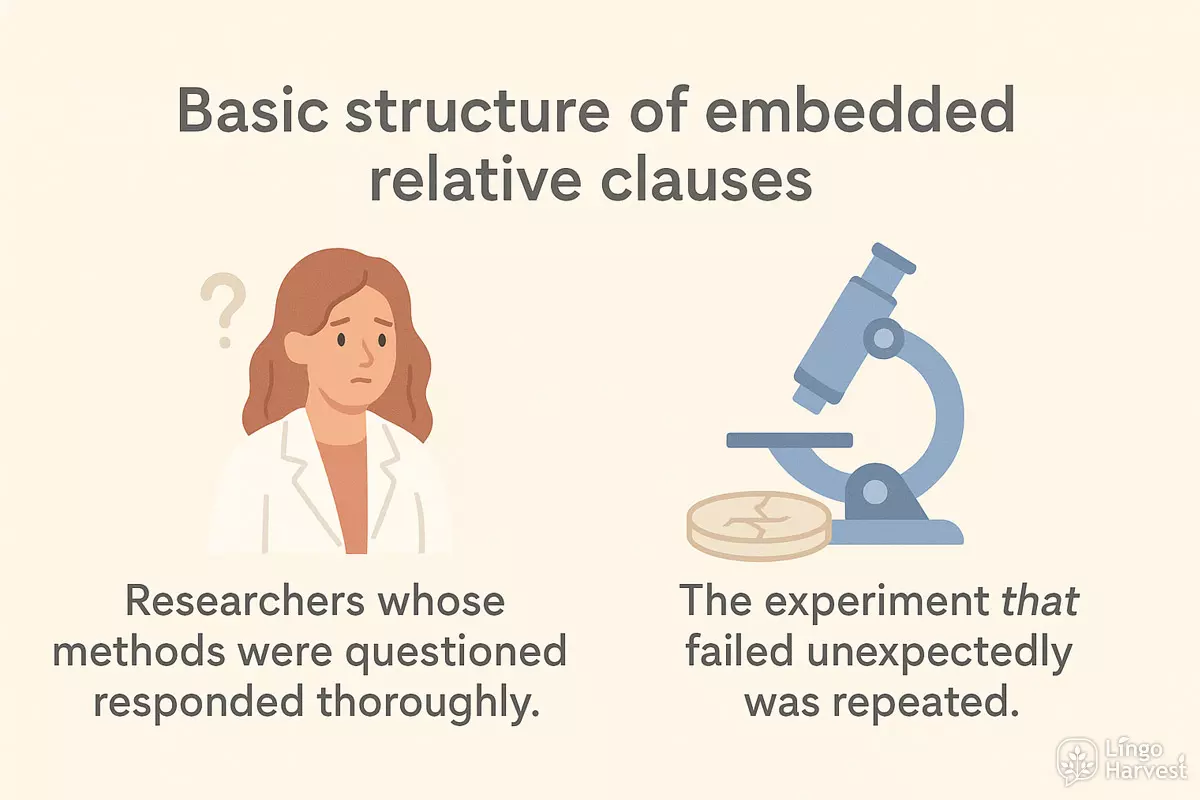
Basic structure of embedded relative clauses
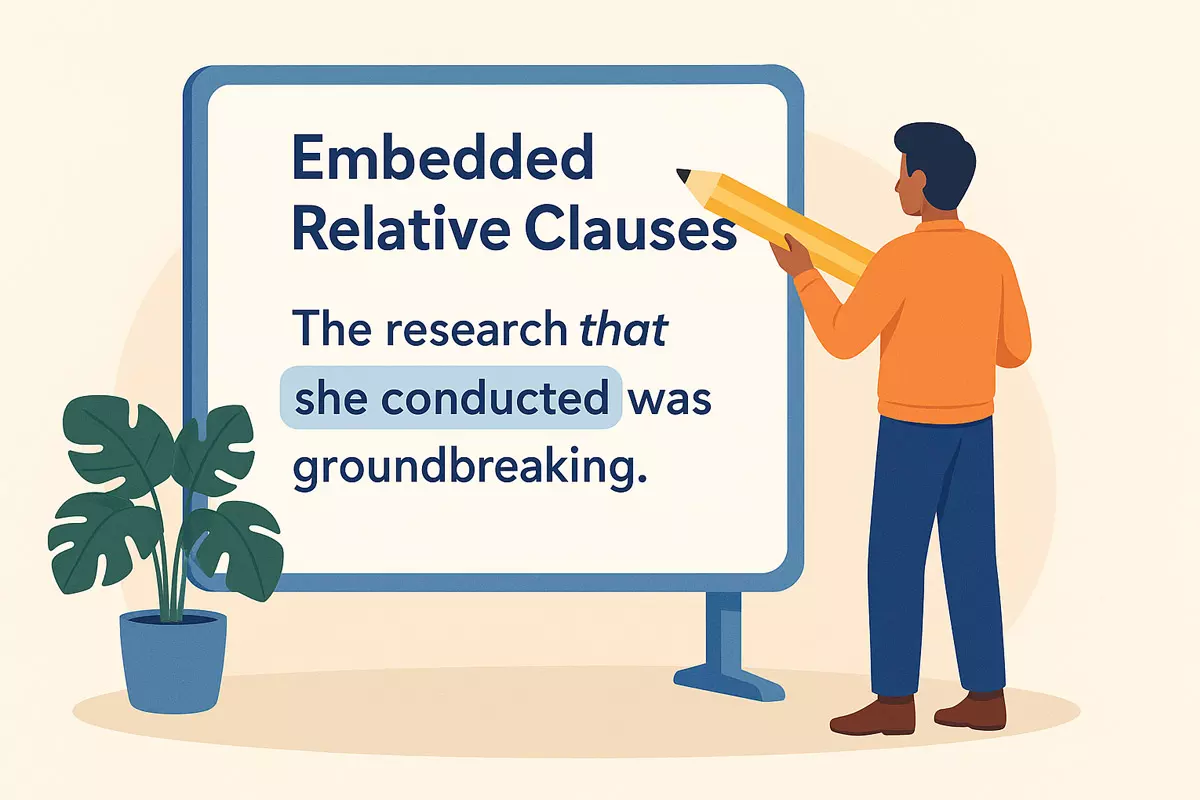
An embedded relative clause usually follows the noun it describes, beginning with words like who, which, that, or whose. The entire noun phrase—including the relative clause—acts as a single unit within the sentence. For example, in “the theory that she proposed,” the clause that she proposed gives essential information about the theory.
- The article that was published last year received several awards.
- Students who submit their work early benefit from feedback.
- The results which surprised the committee led to further research.
- Researchers whose methods were questioned responded thoroughly.
- The experiment that failed unexpectedly was repeated.
- Books which address this issue are in high demand.
- Participants who met the criteria were included in the study.
- The hypothesis that underlies this model is widely debated.
- Data which supports the conclusion is presented below.
- Cases where the outcome was unclear required review.
- Methods that rely on automation are increasingly common.
- The observation which prompted the revision is significant.
- Authors who collaborate internationally often publish more widely.
- Policies that restrict access have been controversial.
- The model which predicts growth was validated last year.
- Programs that target at-risk groups have shown success.
- Questions which remain unanswered invite further study.
- Factors that influence learning are complex.
- The sample which was randomly selected increased reliability.
- Findings that contradict expectations are discussed in the conclusion.
When do embedded relative clauses occur?
These clauses are common in academic writing when authors need to specify, limit, or add information about a noun. They help condense multiple ideas into a single, cohesive phrase, reducing repetition and making arguments more precise.
Summary of key patterns
Embedded relative clauses can appear in various forms. Here’s a quick comparison of their markers and uses:
| Relative Word | Typical Use |
|---|---|
| who | Refers to people (e.g., researchers who discovered...) |
| which | Refers to things or ideas (e.g., method which relies on...) |
| that | Can refer to people or things, often in essential clauses (e.g., data that supports...) |
| whose | Indicates possession (e.g., authors whose work...) |
| where/when | Refers to places or times (e.g., cases where...) |
By observing these structures in context, writers can adopt a more concise and sophisticated academic style, making complex information accessible and logically organized within sentences.
Stacking modifiers inside noun phrases
Academic writing often features dense noun phrases, where several modifiers cluster before and after the head noun. This strategy enables writers to condense complex information, but it can also increase cognitive load for readers. Understanding how to layer descriptive elements—such as adjectives, quantifiers, and embedded relative clauses—within a noun phrase is key to mastering academic style.
Types of Modifiers Commonly Embedded
Writers use a variety of descriptive elements to enrich noun phrases. These include:
- Pre-modifiers (e.g., adjectives, determiners, numerals: several complex syntactic patterns)
- Post-modifiers (e.g., prepositional phrases: the data in the table)
- Relative clauses (e.g., the method that researchers used)
- Appositive phrases (e.g., the hypothesis, a widely debated issue)
- Participial phrases (e.g., the documents collected during the study)
- Infinitive phrases (e.g., the steps to be followed)
Typical Stacking Patterns in Academic Prose
Writers often combine multiple modifiers for precision. For example:
- The recently published articles that address the phenomenon
- Several innovative approaches developed by the team
- The complex theoretical frameworks underlying the analysis
- The only participant who completed all tasks
- All relevant factors identified in previous research
- Multiple conflicting results reported in the literature
- The primary sources cited in the introduction
- Any alternative explanations offered by critics
- The methodological issues discussed in section 3
- The key variables that influence outcomes
- Several significant differences observed across groups
- Those findings that challenge conventional assumptions
- The main argument advanced by the author
- Each theoretical position presented in the review
- Various practical applications suggested by the results
Modifier Order and Readability
The arrangement of modifiers affects clarity. Native-like order typically places determiners and adjectives before the noun, with prepositional and relative clauses following. Overly complex stacking can obscure meaning, so balancing precision and readability is crucial.
| Example Structure | Explanation |
|---|---|
| [Det] [Adj] [N] [RelCl] the crucial study that changed the field |
Determiner and adjective precede the noun; relative clause follows, adding detail. |
| [Quant] [Adj] [N] [PP] many recent articles on this topic |
Quantifier and adjective stack before the noun; prepositional phrase adds specificity. |
| [Det] [N] [PartP] [PP] the data collected during interviews |
Participial phrase modifies the noun; prepositional phrase provides context. |
| [Adj] [N] [RelCl] [PP] key variables that influence results in experiments |
Relative clause and prepositional phrase follow the noun, clarifying and expanding meaning. |
Suggestions for Effective Modifier Stacking
- Prioritize clarity: avoid unnecessary piling of modifiers.
- Use embedded relative clauses to specify key distinctions.
- Vary modifier types to prevent monotony and ambiguity.
- Revise long noun groups for conciseness and flow.
- When possible, split highly dense noun phrases into shorter units.
In summary, layering different modifiers within noun groups is a hallmark of formal academic English, but judicious use is essential to maintain both detail and readability.
Clarity vs density in information packaging
Academic writing often involves packing large amounts of information into a single noun phrase, especially through the use of embedded relative clauses. This stylistic choice can create highly compact sentences, but it also risks making the meaning less transparent for readers unfamiliar with such constructions. Striking a balance between how much is included in a noun phrase and how easily it can be understood is a key stylistic challenge.
When is density effective?
Dense information packaging is common in scholarly articles, particularly when authors want to tightly link background, description, and qualification. For example, a phrase such as “the data collected by researchers working in remote areas” embeds a relative clause to provide crucial detail without additional sentences. This approach helps to avoid repetition and maintains a formal, concise tone. However, excessive density may overwhelm readers or obscure the main point.
Clarity: The trade-off
Clarity often requires unpacking dense noun phrases into simpler, more linear structures. While this may lengthen the sentence or passage, it can significantly increase accessibility. Consider rephrasing: instead of “the proposals that were submitted by the committee members who specialize in linguistics,” breaking it into “The committee members specialize in linguistics. They submitted the proposals.” can help readers process each idea separately.
Common patterns for embedded relative clauses
Writers use a variety of patterns to condense information within noun phrases. Here are some frequent formats:
- the study that examined urban migration
- the students who participated in the survey
- the methods which were recommended by experts
- the theories that have influenced current research
- the article which discusses embedded clauses
- the conference where findings were presented
- the data collected in 2020
- the model proposed by Smith et al.
- the samples that failed testing
- the hypothesis which remains untested
- the framework adopted in this study
- the participants who withdrew early
- the assumptions underlying the analysis
- the variables that were controlled
- the results that surprised the team
Comparing approaches: compactness vs readability
Below is a comparison of how information can be presented in either a dense, embedded form or a more explicit, unpacked style:
| Dense, Embedded Example | Unpacked, Clear Example |
|---|---|
| The report that was submitted by the external reviewers | The external reviewers submitted a report. |
| The students who had completed the prerequisite courses | The students had completed the prerequisite courses. |
| The variables which were excluded from the analysis | The analysis excluded certain variables. |
| The theory that challenges the prevailing paradigm | This theory challenges the prevailing paradigm. |
| The samples that failed the initial testing phase | Some samples failed the initial testing phase. |
Tips for balancing information density
- Use embedded relative clauses to condense detail, but monitor sentence length.
- Break up complex noun phrases if you notice multiple embedded clauses.
- Read passages aloud to check for clarity and flow.
- Alternate dense and clear structures to keep readers engaged and informed.
- Revise dense passages when your audience may not be familiar with technical language.
Ultimately, the choice between density and clarity depends on your audience and communicative goals. Academic style often prizes compactness, but clarity should not be sacrificed when comprehension is at stake.
Managing long pre- and postmodification chains
Dense academic writing often features noun phrases laden with multiple modifiers, both before and after the head noun. Navigating these extended chains, especially when embedded relative clauses are involved, can challenge both readers and writers. The key is to maintain clarity without sacrificing the precision and detail that academic style requires.
Identifying complex modification structures
Long modification chains typically arise from the accumulation of adjectives, participles, compound nouns, and relative clauses. For example, a phrase like "the recently published peer-reviewed articles that address methodological inconsistencies" contains several layers packed into a single noun phrase. Recognizing where premodifiers (elements before the noun) and postmodifiers (elements after, such as relative clauses) cluster is the first step to managing them.
Strategies for clarity and flow
Writers can employ specific techniques to keep dense noun phrases comprehensible:
- Break up long phrases: Split overly complex noun phrases into smaller, more digestible segments.
- Prioritize modifiers: Place the most crucial information closest to the noun; consider moving less essential details elsewhere.
- Use punctuation: Commas and dashes can help signal boundaries between modifiers, especially with non-restrictive clauses.
- Vary sentence structure: Alternate between dense noun phrases and simpler constructions to avoid reader fatigue.
- Choose precise vocabulary: Replace stacked adjectives with more specific terms when possible.
- Limit layering: Avoid embedding multiple relative clauses within a single noun phrase unless absolutely necessary.
- Utilize apposition: Sometimes, an appositive phrase can clarify or elaborate on a densely modified noun.
- Read aloud: Hearing the sentence can reveal awkwardness or ambiguity in modification chains.
- Edit for redundancy: Remove modifiers that do not add essential meaning.
- Diagram sentences: Visual mapping can help untangle complex structures and ensure modifiers attach to the intended nouns.
Common pitfalls in modification chains
Writers should be aware of frequent issues, such as ambiguous attachment (where it’s unclear which noun a modifier refers to), “garden path” effects (misleading readers into parsing the phrase incorrectly), and unintentional repetition. Keeping an eye out for these can prevent confusion.
Examples of modification patterns
Below is a selection of common pre- and postmodification elements found in academic noun phrases. Combining several of these can quickly generate complex structures:
- Adjective + Noun (e.g., "experimental procedure")
- Noun + Noun (e.g., "data analysis")
- Participle + Noun (e.g., "emerging technology")
- Prepositional phrase postmodification (e.g., "the effects of exposure")
- Relative clause postmodification (e.g., "the results that were obtained")
- Appositive phrase (e.g., "the author, a leading expert in the field, ...")
- Infinitive postmodification (e.g., "the method to be used")
- Non-finite clause (e.g., "the data collected during the experiment")
- Adjective phrase (e.g., "the highly significant finding")
- Compound adjective (e.g., "state-of-the-art equipment")
- Numeral + Noun (e.g., "three independent variables")
- Determiner + Noun (e.g., "each participant")
- Postmodifying adjective (rare, e.g., "something useful")
- Comparative structure (e.g., "the larger sample")
- Embedded relative clause (e.g., "the study that the committee approved")
- Coordinated modifiers (e.g., "the ethical and methodological considerations")
- Adverb + Adjective + Noun (e.g., "recently discovered phenomenon")
- Parenthetical insertion (e.g., "the hypothesis, although untested, ...")
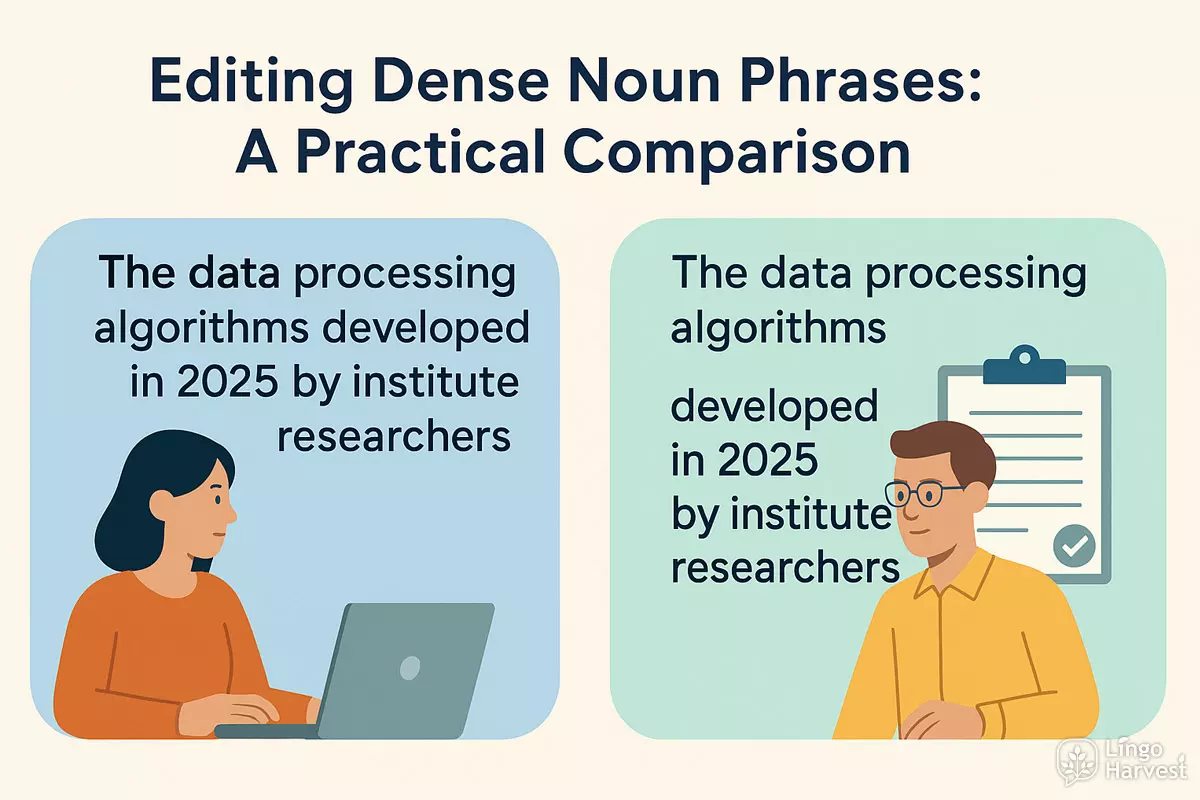
Editing dense noun phrases: a practical comparison
Sometimes, it helps to see how a complex noun phrase can be simplified or clarified. The table below compares original, densely modified phrases with possible revisions for clarity.
| Dense Version | Improved Version |
|---|---|
| The recently developed data processing algorithms that researchers at the institute implemented in 2022 | The data processing algorithms developed in 2022 by institute researchers |
| Findings from the longitudinal studies that examined cognitive decline in elderly patients with chronic conditions | Findings from longitudinal studies on cognitive decline in elderly patients with chronic conditions |
| The policy recommendations proposed by the international committee that convened last year | The international committee’s policy recommendations from last year |
| The complex ethical dilemmas that arise when researchers conduct experiments involving vulnerable populations | Ethical dilemmas in experiments involving vulnerable populations |
By consciously restructuring and prioritizing information, writers can produce academic prose that remains rich in detail but is much easier to process.
Strategies to simplify overly dense phrases
Academic writing often packs multiple ideas into a single noun phrase using embedded relative clauses. While this can increase information density, it may also burden readers and obscure your main point. There are several practical ways to make these constructions more approachable without losing essential detail.
Break long noun phrases into shorter sentences
Splitting complex noun phrases can make your writing clearer. For example, instead of writing, “The theory that the researcher who the committee supported proposed was controversial,” consider dividing it: “The committee supported a researcher. That researcher proposed a controversial theory.” This approach guides your reader step by step.
Replace relative clauses with simpler structures
Relative clauses often add extra information about a noun. Where possible, substitute them with adjectives, participle phrases, or prepositional phrases. For example:
- “The proposal which was submitted yesterday” → “The proposal submitted yesterday”
- “The data that were collected in 2020” → “The 2020 data”
- “The students who excelled in the exam” → “The top-performing students”
Use appositives and parenthetical explanations
Appositives (nouns or noun phrases that rename another noun) and parentheses can clarify meaning and reduce syntactic load. For instance: “The scientist, a Nobel laureate, presented her findings” instead of embedding this detail in a relative clause.
Choose active voice over passive where possible
Active constructions tend to be shorter and more direct. Instead of “The experiments that were conducted by the team yielded results,” write “The team conducted experiments that yielded results.”
Limit the number of embedded clauses per sentence
Overusing nested clauses can make even a well-structured sentence difficult to follow. Aim for one embedded clause per sentence, or restructure the information into a list or separate sentences.
Comparing Common Dense Structures with Simpler Alternatives
| Dense Academic Phrase | Simplified Version |
|---|---|
| The results that the model which the authors developed predicted were unexpected. | The authors developed a model. Its predicted results were unexpected. |
| The participants who the researchers recruited from the university took part in the survey that the team designed. | The researchers recruited university participants. These participants took part in the team’s survey. |
| The conclusion which the analysis that the committee conducted supports is significant. | The committee conducted an analysis. Its conclusion is significant. |
| The policy that the agency that oversees education implemented was controversial. | The education agency implemented a controversial policy. |
Additional techniques to enhance clarity
- Favor concrete nouns and verbs over abstract ones
- Use bullet points or lists for multiple embedded details
- Eliminate redundant modifiers and qualifiers
- Read sentences aloud to spot awkward constructions
- Ask a peer to paraphrase your sentence for clarity testing
- Keep subject and verb close together
- Prioritize the main point early in the sentence
- Reserve heavy modification for technical documents where precision outweighs readability
- Revise after drafting; dense phrases are often easier to simplify in revision
By applying these approaches, you can communicate complex ideas more effectively and make your academic writing accessible to a wider audience.
Practice: analyze and adjust complex noun phrases
Academic writing often features dense noun phrases with embedded relative clauses, which can obscure meaning or slow comprehension. Breaking down and reworking such structures helps clarify ideas and improve readability. Below, you'll find activities and examples to help you identify, analyze, and revise these complex constructions.
Identifying Embedded Relative Clauses
To begin, practice spotting relative clauses inside noun phrases. These clauses often start with words like who, which, or that, and modify a noun within a larger phrase.
- The article that was published last year offers new insights.
- Students who completed the survey received extra credit.
- The proposal which the committee rejected was revised.
- The data that the researchers collected supports their hypothesis.
- The book, which contains detailed case studies, is widely cited.
- Results that were unexpected prompted further investigation.
- The experiment which failed to produce results was discontinued.
- The researcher who led the project presented the findings.
- The theory that he proposed changed the field.
- The conference, which attracted global experts, was a success.
Common Patterns in Dense Academic Noun Phrases
Writers often stack modifiers and clauses, creating challenging structures. Here are some frequent patterns:
- [Noun] + [relative clause] + [prepositional phrase]
- [Noun] + [adjective] + [relative clause]
- [Noun] + [appositive] + [relative clause]
- [Noun] + [relative clause] + [participial phrase]
- [Noun] + [series of relative clauses]
Adjusting for Clarity: Before and After
Rewriting dense noun phrases can greatly enhance clarity. Compare the original and revised versions in the table below.
| Original Phrase | Revised Version |
|---|---|
| The data that the team collected during the experiment which lasted six months | The team collected data during the six-month experiment. |
| The hypothesis that was proposed by the researcher who won the award | The award-winning researcher proposed the hypothesis. |
| The results that were unexpected and that challenged previous assumptions | The unexpected results challenged previous assumptions. |
| The method which the committee recommended after reviewing the evidence that was presented | After reviewing the presented evidence, the committee recommended the method. |
| The students who participated in the study which was conducted over two years | The study, conducted over two years, included participating students. |
Practice: Spot and Revise
Try rewriting the following noun phrases to make them clearer and more direct.
- The conclusions that were drawn by the experts who attended the conference which lasted three days
- The proposal which was rejected by the reviewers who specialize in linguistics
- The techniques that the researchers developed in the laboratory that was recently renovated
- The survey that was completed by the participants who volunteered for the study
- The report that was prepared by the analysts who reviewed the financial data
- The recommendations that were issued by the committee that met last month
- The experiment that was designed by the students who participated in the workshop
- The book that was edited by the professor who teaches modern literature
- The model that was created by the engineers who worked on the new prototype
- The presentation that was delivered by the researcher who specializes in neuroscience
Show answers
- The experts who attended the three-day conference drew the conclusions.
- The linguistics specialists rejected the proposal.
- The researchers developed the techniques in the recently renovated laboratory.
- The study included participants who volunteered to complete the survey.
- The analysts who reviewed the financial data prepared the report.
- The committee that met last month issued the recommendations.
- The students who participated in the workshop designed the experiment.
- The professor who teaches modern literature edited the book.
- The engineers who worked on the new prototype created the model.
- The researcher who specializes in neuroscience delivered the presentation.
Tips for Simplifying Complex Noun Phrases
- Move relative clauses into separate sentences when possible.
- Replace passive constructions with active voice.
- Reduce stacked modifiers by clarifying relationships.
- Use appositives or parenthetical phrases for extra information.
- Check if all details are necessary—omit redundant elements.
Regularly practicing these strategies will help you read and write academic texts with greater precision and clarity, especially when handling intricate noun phrases with embedded clauses.