Nouns in Scientific Writing and Research Communication

 Here we how nouns function in scientific writing, focusing on their roles in explanation and reporting, the use of different noun types, nominalization, objectivity, information density, typical learner errors, and sentence revision for clarity.
- Role of nouns in scientific explanation and reporting
- Process, result, and measurement nouns in research texts
- Nominalization in scientific writing
- Agent vs non-agent noun choice for objectivity
- Information density in noun-based sentence structure
- Typical learner mistakes in scientific noun usage
- Practice: revise research-style sentences for clarity
Selecting precise terminology to identify objects, concepts, and processes is essential in scientific writing, as it directly impacts clarity and accuracy. The use of appropriate naming conventions helps ensure that research findings are communicated effectively and understood by the intended audience. By carefully considering how terms are chosen and applied, scientists can reduce ambiguity, promote consistent understanding, and facilitate collaboration across disciplines. Effective naming ultimately strengthens the quality and impact of scientific communication.
Role of nouns in scientific explanation and reporting
Nouns are central to scientific communication because they provide the terminology that defines concepts, objects, and phenomena under study. When researchers describe their methods, results, or theories, they rely heavily on precise naming to avoid ambiguity and ensure clarity. This reliance on specific language helps readers understand exactly what is being discussed, whether it is a chemical compound, a biological process, or a statistical method.
Precision and Consistency Through Noun Usage
Clear scientific writing depends on the accurate use of nouns to distinguish between different entities and processes. For instance, using "solution," "solvent," and "solute" correctly in a chemistry report prevents confusion. Similarly, in biology, terms like "organism," "population," and "ecosystem" each have distinct meanings. Consistent noun usage throughout a paper ensures that the discussion remains unambiguous.
- Accuracy: Specific nouns prevent misinterpretation of findings.
- Brevity: Well-chosen terms reduce the need for lengthy explanations.
- Reproducibility: Standardized nouns allow other scientists to replicate procedures.
- Comparability: Shared terminology enables comparison across studies.
- Objectivity: Nouns focus attention on phenomena, not personal opinions.
Types of Nouns in Scientific Texts
Scientific writing employs a range of noun types, each serving a distinct role:
- Concrete nouns (e.g., "microscope," "protein") for tangible objects
- Abstract nouns (e.g., "efficiency," "resistance") for concepts or qualities
- Collective nouns (e.g., "sample," "group") for sets or categories
- Proper nouns (e.g., "Homo sapiens," "Newton’s Law") for unique identifiers
- Mass nouns (e.g., "water," "data") for substances or uncountable items
- Countable nouns (e.g., "specimen," "variable") for individual elements
- Process nouns (e.g., "oxidation," "migration") for actions or events treated as entities
- Disciplinary terms (e.g., "algorithm," "paradigm") for field-specific concepts
- Nominalizations (e.g., "measurement," "calculation") for actions described as things
- Instrument nouns (e.g., "spectrometer," "incubator") for tools and equipment
Examples of Noun Usage in Scientific Sentences
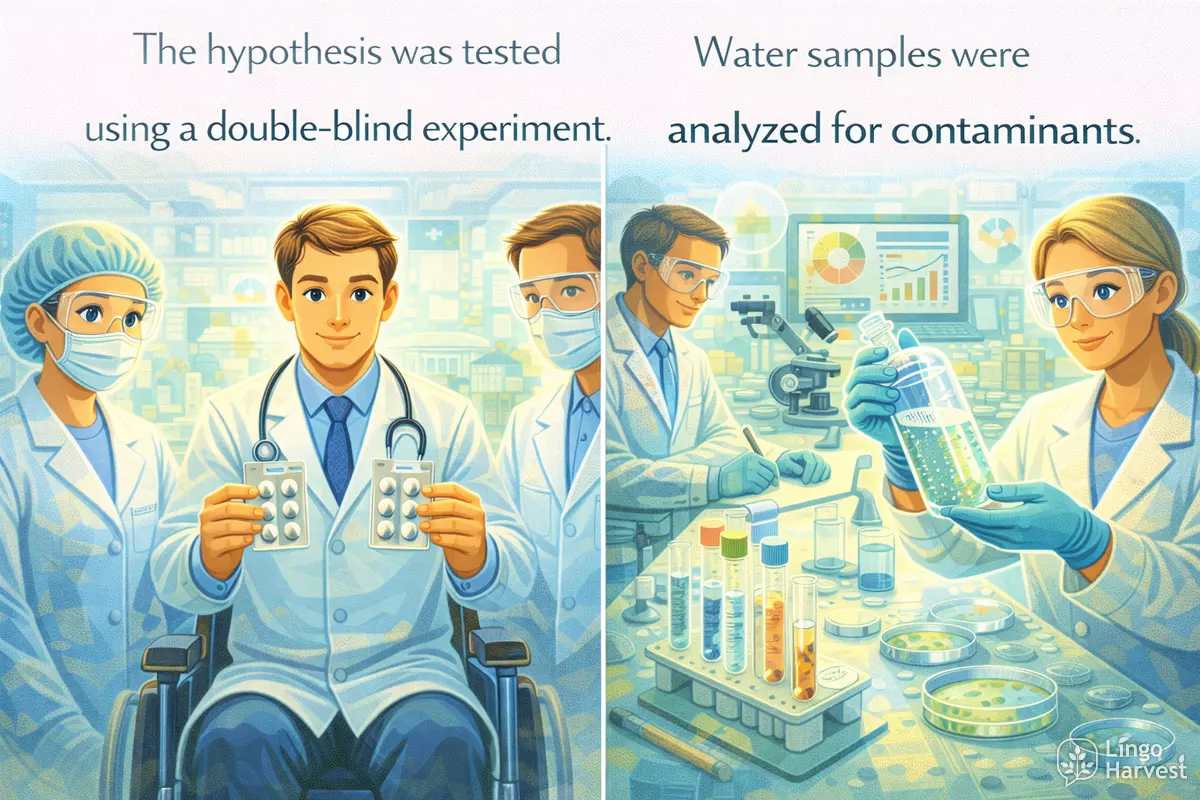
Choosing the right noun influences how results and explanations are interpreted. Here are illustrative examples of concise noun use in various scientific contexts:
- The hypothesis was tested using a double-blind experiment.
- Water samples were analyzed for contaminants.
- The theory predicts a linear relationship between variables.
- Each observation was recorded in the database.
- A new protocol improved the yield of the reaction.
- Statistical significance was determined by p-value calculation.
- The population consisted of 200 participants.
- Gene expression was measured using qPCR.
- The model incorporates both parameters and constraints.
- All results were verified through independent replication.
Noun-Driven Structure in Scientific Reporting
Nouns help organize scientific texts by providing the backbone for headings, captions, and references. Sections like "Materials," "Methods," and "Results" are built around key terms that guide the reader. In tables, figures, and appendices, nouns label data points and variables, ensuring that information is accessible and well-organized.
| Function | Noun Example | Effect in Scientific Writing |
|---|---|---|
| Concept Definition | Theory, Model, Hypothesis | Clarifies core ideas and frameworks for study |
| Object/Material Identification | Sample, Reagent, Instrument | Specifies what is used or observed in research |
| Process Naming | Oxidation, Synthesis, Measurement | Describes actions as analyzable entities |
| Result Reporting | Outcome, Finding, Value | Structures presentation and discussion of data |
In summary, the effective use of nouns shapes the clarity, precision, and structure of scientific explanation and reporting. This linguistic foundation allows research to be communicated, replicated, and built upon reliably across disciplines.
Process, result, and measurement nouns in research texts
In scientific writing, nouns that represent actions, outcomes, or quantitative values are essential for clarity and precision. These terms help researchers describe methodologies, report findings, and express data without ambiguity. Understanding the distinction between nouns that signify processes, those that indicate results, and those that denote measurements can improve both the accuracy and the readability of research communication.
Process nouns: Naming actions and procedures
Process nouns refer to activities, methods, or ongoing phenomena. They often derive from verbs and are used to describe what was done in a study or experiment. Common in methods sections, these nouns help condense procedural information into succinct, formal language.
- Analysis → The analysis revealed a clear link between diet and energy levels.
- Measurement → Accurate measurement is essential for reliable data collection.
- Observation → Her observation helped identify a pattern in participant responses.
- Calculation → The calculation confirmed the initial hypothesis.
- Evaluation → A careful evaluation showed weaknesses in the method.
- Assessment → The assessment indicated strong progress after training.
- Investigation → Their investigation focused on long-term climate trends.
- Comparison → A comparison of models produced similar outcomes.
- Simulation → The simulation predicted future market behavior.
- Extraction → Data extraction took several hours to complete.
- Detection → Early detection can prevent system failures.
- Estimation → The estimation suggested that the project would take six months.
Result nouns: Expressing outcomes and findings
Nouns that express results are key for summarizing discoveries and conclusions. They encapsulate what was obtained or demonstrated, making results sections concise and direct. These terms are especially valuable when highlighting the significance of the research.
- Outcome → The outcome supported the research hypothesis.
- Finding → One major finding was the rise in productivity.
- Result → The result confirmed the team’s expectations.
- Conclusion → The conclusion highlighted key limitations.
- Discovery → Their discovery changed the direction of the study.
- Product → The final product exceeded design standards.
- Increase → There was a noticeable increase in sales.
- Reduction → A reduction in errors improved performance.
- Improvement → Significant improvement occurred after training.
- Effect → The effect of temperature change was dramatic.
- Change → A sudden change in behavior surprised researchers.
- Correlation → A strong correlation appeared between stress and sleep.
Measurement nouns: Quantifying data and variables
Measurement nouns are indispensable for reporting data, variables, or specific quantities. These words are frequently accompanied by units or values and are critical in both the methods and results sections. Their use ensures that readers can easily interpret the scale and scope of the research.
- Concentration → The concentration of salt in the sample was high.
- Length → The length of the bridge is 1,200 meters.
- Volume → The volume of water increased after rainfall.
- Rate → The unemployment rate fell last year.
- Temperature → Temperature rose steadily during the experiment.
- Speed → The speed of the reaction doubled with heat.
- Density → The density of the material is extremely low.
- Frequency → The frequency of visits increased over time.
- Proportion → A large proportion of students passed the exam.
- Amount → The amount of rainfall broke records.
- Level → Stress level decreased after training.
- Magnitude → The magnitude of the earthquake was severe.
- Duration → The duration of the study was two years.
Comparing noun types in research writing
The table below summarizes typical characteristics and examples of process, result, and measurement nouns as they appear in scientific texts.
| Type | Function in Text | Common Examples |
|---|---|---|
| Process | Describes actions, procedures, or methods | Analysis, measurement, observation, simulation |
| Result | Summarizes outcomes or findings | Finding, outcome, effect, improvement |
| Measurement | Quantifies data or variables | Concentration, rate, volume, magnitude |
Selecting the appropriate type of noun helps researchers convey their message with precision. By distinguishing between terms that indicate an action, an outcome, or a quantitative value, writers can streamline their communication and support clearer understanding among readers.
Nominalization in scientific writing
Turning verbs and adjectives into nouns is a common feature of academic and research texts. This grammatical process, called nominalization, allows writers to express complex ideas more succinctly and to focus on concepts rather than actions. By converting active verbs into abstract nouns, scientific communication often achieves a more formal and impersonal tone, which is valued in research contexts.
Functions and effects of nominalization
Nominal forms help condense information and create cohesion in technical writing. They can make sentences more compact but sometimes lead to ambiguity or reduced clarity if overused. Understanding when and how to deploy nominalizations effectively is crucial for clear scientific expression.
- Emphasizes results or processes over agents
- Allows for dense information packaging
- Supports objectivity and formality
- Can obscure agency or responsibility
- May reduce sentence clarity if excessive
Common patterns and examples
Writers frequently transform verbs or adjectives into nouns to describe processes, phenomena, or concepts. Here are some typical examples found in scientific manuscripts:
- analyze → analysis → The analysis revealed significant differences between groups.
- measure → measurement → Precise measurement is crucial for reliable results.
- develop → development → The development of new software improved workflow efficiency.
- observe → observation → Careful observation helped identify unexpected patterns.
- assess → assessment → The assessment showed a clear improvement in student skills.
- react → reaction → The reaction was faster at higher temperatures.
- decide → decision → The final decision was based on several data points.
- conclude → conclusion → The conclusion highlighted several key limitations.
- resist → resistance → The material displayed strong resistance to heat.
- strong → strength → The strength of the signal increased over time.
- efficient → efficiency → Greater efficiency reduced overall production costs.
- accurate → accuracy → The accuracy of measurements improved with calibration.
- present → presentation → The presentation explained the results clearly.
- predict → prediction → The prediction closely matched the final outcome.
- investigate → investigation → The investigation uncovered several new findings.
- perform → performance → The performance of the device exceeded expectations.
- compare → comparison → A comparison of data sets showed consistent patterns.
- fail → failure → The failure of the system led to a complete redesign.
Comparing verb-based and nominalized structures
Choosing between a verb-based construction and its nominalized counterpart can affect both style and clarity. The table below compares typical active and nominalized forms often encountered in research writing:
| Verb-based sentence | Nominalized sentence |
|---|---|
| We analyzed the data. | The analysis of the data was performed. |
| The team measured the temperature. | Measurement of the temperature was conducted. |
| They assessed the results. | Assessment of the results was carried out. |
| Researchers observed changes in behavior. | Observation of behavioral changes occurred. |
| We compared the samples. | A comparison of the samples was made. |
Guidelines for effective use
While abstract nouns are indispensable in scientific prose, balance is key. Over-nominalizing can lead to dense, hard-to-read sentences. To improve clarity:
- Use nominal forms when focusing on concepts or results
- Prefer verbs for direct actions or to highlight agency
- Revise overly complex nominal phrases for readability
Ultimately, thoughtful application of nominalization can enhance precision and cohesion in research communication.
Agent vs non-agent noun choice for objectivity
Choosing between agent and non-agent nouns plays a significant role in shaping the tone and perceived impartiality of research writing. Agent nouns identify the performer of an action (such as “scientist,” “observer,” or “analyst”), while non-agent nouns refer to concepts, processes, or things being studied, rather than who is doing the work (like “measurement,” “analysis,” “observation”).
Influence on Objectivity in Research Communication
Scientific writing often strives for neutrality and detachment. Using non-agent nouns shifts focus away from the researcher and toward the phenomena or data. This helps minimize bias and emphasizes the reproducibility of results. For instance, “Analysis revealed a trend” appears more objective than “The researcher found a trend,” since the latter draws attention to the individual rather than the findings themselves.
Common Agent and Non-Agent Nouns in Scientific Texts
Writers can increase the perceived objectivity of their work by selecting nouns that foreground the research, not the researcher. Here are some frequently encountered terms:
- Agent nouns: scientist, investigator, author, experimenter, technician, participant, observer, analyst, reviewer, respondent, subject
- Non-agent nouns: observation, measurement, calculation, analysis, result, finding, dataset, outcome, experiment, procedure, trend, evidence, hypothesis, variable, process, phenomenon, sample, method, parameter, correlation
Comparing Usage: Clarity and Objectivity

The choice between these types of nouns can subtly alter both clarity and formality. See the table below for illustrative comparisons:
| Agent Noun Usage | Non-Agent Noun Usage |
|---|---|
| The scientist concluded that the treatment significantly improved recovery time. | The conclusion was that the treatment significantly improved recovery time. |
| Researchers observed a pattern in the participants’ responses during the survey. | A pattern was observed in the participants’ responses during the survey. |
| The analyst calculated the mean to compare test performance across schools. | The mean was calculated to compare test performance across schools. |
| We found a correlation between stress levels and reduced productivity. | A correlation was found between stress levels and reduced productivity. |
| The author proposed a hypothesis about language learning speed in adults. | A hypothesis was proposed about language learning speed in adults. |
Best Practices for Noun Selection
Choosing non-agent nouns is generally recommended when the goal is to highlight data, results, and procedures over individual contributions. However, agent nouns are sometimes necessary, such as when clarifying responsibility or distinguishing between multiple actors. Balancing these choices can help maintain a clear, neutral, and professional tone in scientific manuscripts.
Information density in noun-based sentence structure
Precision and compactness are essential in scientific writing, especially when conveying complex ideas. One common strategy is to use noun-based constructions—phrases where nouns carry the main informational load, often by packing multiple concepts into a single unit. This approach allows researchers to communicate more content with fewer words, making their arguments clearer and more efficient.
How noun structures concentrate meaning
Noun phrases often combine several layers of detail: modifiers, attributes, and embedded information. For example, the phrase "gene expression regulation mechanisms" encapsulates at least three distinct ideas—genes, their expression, and the mechanisms controlling that expression—within just three words. This style avoids lengthy explanations and keeps texts concise.
Common patterns in scientific noun phrases
Writers frequently rely on specific templates to build information-rich noun groups. Here are some typical constructions:
- adjective + noun (e.g., "statistical analysis")
- noun + noun (e.g., "data collection")
- noun + prepositional phrase (e.g., "effects of temperature")
- compound nouns (e.g., "cell membrane potential")
- noun + participle modifier (e.g., "protein-binding site")
- multiple modifiers (e.g., "long-term population dynamics")
- possessive constructions (e.g., "patients’ responses")
- noun + numeral (e.g., "phase 2 trial")
- nested noun phrases (e.g., "water quality assessment methods")
- noun + acronym (e.g., "DNA sequence analysis")
- noun + abbreviation (e.g., "MRI scan results")
- noun + relative clause (e.g., "samples that were collected")
- noun + appositive (e.g., "the enzyme catalase")
- noun + conjunction (e.g., "structure and function")
- noun + quantifier (e.g., "a series of experiments")
- noun + adjective (postpositive, e.g., "attorney general")
- noun + gerund (e.g., "data mining")
- noun + infinitive (e.g., "opportunity to observe")
- noun + adjective clause (e.g., "the method that was used")
Benefits and drawbacks
Dense noun constructions can make prose more concise, but also risk overloading sentences. Overuse or excessive stacking of nouns may reduce readability, especially for readers less familiar with the field. Writers must balance efficiency with clarity.
| Dense Noun Phrase | Expanded Form |
|---|---|
| Protein folding pathway analysis | Analysis of the pathway by which proteins fold |
| Climate change impact assessment | Assessment of the impact caused by climate change |
| Drug resistance gene mutation frequency | Frequency of mutations in genes that cause drug resistance |
| Water contamination risk evaluation | Evaluation of the risk of water contamination |
| Machine learning algorithm accuracy | Accuracy of algorithms used in machine learning |
Practical tips for writers
- Break up long noun strings when clarity suffers.
- Use prepositions to clarify relationships if needed.
- Favor familiar patterns in your field for smoother reading.
- Check for ambiguity, especially in multi-noun sequences.
- Revise dense phrases by expanding or rephrasing when possible.
In summary, noun-based structures allow researchers to convey detailed information succinctly, but require careful handling to maintain readability and precision.
Typical learner mistakes in scientific noun usage
Misusing nouns in scientific contexts can easily lead to confusion, inaccuracies, or even misinterpretation of research findings. Many learners face challenges with noun forms, countability, and precise word choice when writing about science. Below, we explore common pitfalls and provide examples to help clarify proper usage.
1. Incorrect Countability
Scientific English often distinguishes between countable and uncountable nouns, but this can be tricky for learners. For instance, "data" is traditionally plural ("the data are conclusive"), though "data is" is increasingly accepted in informal contexts. Words like "evidence," "research," and "information" are uncountable and should not be pluralized.
- ❌ "Many researches were conducted." → Correct: "Much research was conducted."
- ❌ "Several evidences support this claim." → Correct: "There is much evidence supporting this claim."
- ❌ "An information was missing." → Correct: "Some information was missing."
2. Misuse of Abstract Nouns
Abstract nouns like "significance," "accuracy," and "efficiency" are often confused with their adjective or verb forms, leading to awkward or incorrect phrasing.
- "The significance of the results is high." (Correct abstract noun usage)
- ❌ "The results are significance." → Should be: "The results are significant."
3. Pluralization Errors
Some scientific nouns have irregular plurals or are rarely used in the plural form. Learners may also overgeneralize regular pluralization rules.
- ❌ "Phenomenons" → Correct: "Phenomena"
- ❌ "Criterias" → Correct: "Criteria"
- ❌ "Datum" (singular) is rarely used; "data" (plural) is standard.
4. Confusing Related Nouns
Words with similar roots but different meanings can be a source of mistakes. For example, "effect" vs. "affect" or "method" vs. "methodology."
| Commonly Confused Nouns | Clarification & Example |
|---|---|
| Effect vs. Affect | Effect is usually a noun ("The effect was significant."); Affect is usually a verb ("The drug affects the results."). |
| Method vs. Methodology | Method = technique/procedure ("The method used..."); Methodology = study of methods ("The methodology is discussed..."). |
| Result vs. Outcome | Result is a specific finding; Outcome is broader, often used in clinical studies. |
| Hypothesis vs. Theory | Hypothesis = testable statement; Theory = well-supported explanation. |
5. Overusing Generic Nouns
Relying on vague terms like "thing," "stuff," or "aspect" weakens scientific writing. It's better to use precise nouns that convey exact meaning.
- ❌ "The thing that was measured..." → Better: "The variable that was measured..."
- ❌ "Different stuffs were tested." → Better: "Different compounds were tested."
6. Omission of Articles
Learners sometimes omit "the," "a," or "an" before scientific nouns, especially when referring to specific items or concepts.
- ❌ "Experiment showed increase." → Correct: "The experiment showed an increase."
7. Misusing Compound Nouns
Incorrect word order or missing hyphens in compound nouns can change the meaning. For example, "cell culture medium" (correct) vs. "cell medium culture" (incorrect).
Summary List: Frequent Noun-Related Errors
- Incorrect use of countable/uncountable forms
- Confusion between singular and plural
- Mixing up similar-sounding or related nouns
- Overusing non-specific vocabulary
- Omitting necessary articles
- Incorrect compound noun formation
- Using adjectives or verbs instead of nouns (and vice versa)
- Neglecting scientific conventions for terms like "data," "species," "series"
- Using colloquial instead of formal scientific terms
- Incorrect capitalization of scientific names or terms
Awareness of these patterns can help learners develop more precise, credible, and professional research writing.
Practice: revise research-style sentences for clarity
Clear noun usage is essential for effective scientific communication. Dense or abstract noun phrases often obscure meaning, making research harder to understand. Below, you’ll find practical exercises to help you transform complex research sentences into clearer, more direct statements. These activities focus on identifying and revising problematic noun constructions, particularly nominalizations (nouns formed from verbs or adjectives) and overly packed noun phrases.
Common Issues in Scientific Sentences
- Overuse of nominalizations (e.g., “the investigation of…” instead of “investigating…”)
- Strings of nouns without clear relationships (“protein receptor activation pathway” can be unclear)
- Ambiguous reference or lack of specificity
- Unnecessary passive constructions with noun-heavy subjects
- Wordiness due to abstract nouns
Revision Practice: Simplify the Nouns
Below are several sentences typical of academic writing. Revise each to improve clarity and directness by focusing on verbs and breaking up noun clusters.
- The measurement of temperature was performed by the researchers for the determination of the effect on reaction rates.
- A review of the data analysis methods was conducted prior to the commencement of the experiment.
- The implementation of the new protocol resulted in the reduction of error rates.
- Observation of the phenomenon was achieved through utilization of specialized equipment.
- The collection of samples occurred at predetermined intervals to facilitate monitoring of changes.
- The evaluation of participant responses was completed to identify patterns in behavior.
- The comparison of two datasets was performed to highlight statistical differences.
- The estimation of total costs was calculated based on current financial records.
- The development of the model was carried out to predict future trends.
- The investigation of the issue was initiated following multiple system failures.
Show answers
- The researchers measured the temperature to determine its effect on reaction rates.
- The team reviewed data analysis methods before starting the experiment.
- The new protocol reduced error rates.
- Researchers observed the phenomenon using specialized equipment.
- Samples were collected at set intervals to monitor changes.
- The team evaluated participant responses to find behavior patterns.
- They compared two datasets to show statistical differences.
- They estimated total costs using current financial records.
- The team developed a model to predict future trends.
- The group investigated the issue after repeated system failures.
Strategies for Revising Noun-Heavy Sentences
- Convert nominalizations back to verbs (“analysis of data” → “analyze data”)
- Break up long noun phrases (“gene expression regulation mechanisms” → “mechanisms that regulate gene expression”)
- Clarify who is performing the action (“the measurement was taken” → “the team measured”)
- Use active voice when possible
- Eliminate unnecessary words and redundancies
Before-and-After Comparison Table
| Original Sentence | Improved Version |
|---|---|
| The identification of significant results was accomplished through statistical analysis. | Statistical analysis identified significant results. |
| The application of the method allowed for the detection of minor changes. | The method detected minor changes. |
| The assessment of patient responses was performed by clinicians. | Clinicians assessed patient responses. |
| Completion of the survey led to the collection of valuable feedback. | Completing the survey provided valuable feedback. |
| The evaluation of results occurred after the experiment’s termination. | Researchers evaluated results after the experiment ended. |
Quick Practice: Spot the Noun Problem
Which of the following sentences could be made clearer by reducing noun-heavy constructions? Mark all that apply.
- The observation of cell growth was carried out by the team.
- The team observed cell growth.
- Data analysis was performed for result interpretation.
- The researchers interpreted the results after analyzing the data.
- The evaluation of system performance was conducted to identify weaknesses.
- The team evaluated system performance to identify weaknesses.
- The collection of air samples occurred to measure pollution levels.
- The researchers collected air samples to measure pollution levels.
- The investigation of climate data was completed to detect long-term trends.
- The team investigated climate data to detect long-term trends.
Show answers
- Items 1, 3, 5, 7, and 9 contain noun-heavy constructions that can be simplified.
By practicing these revisions, you can improve the clarity and impact of your research writing. Aim for concise, active sentences that make the role of each noun explicit and direct.