Abstract Nouns with Prepositions in Academic English Explained

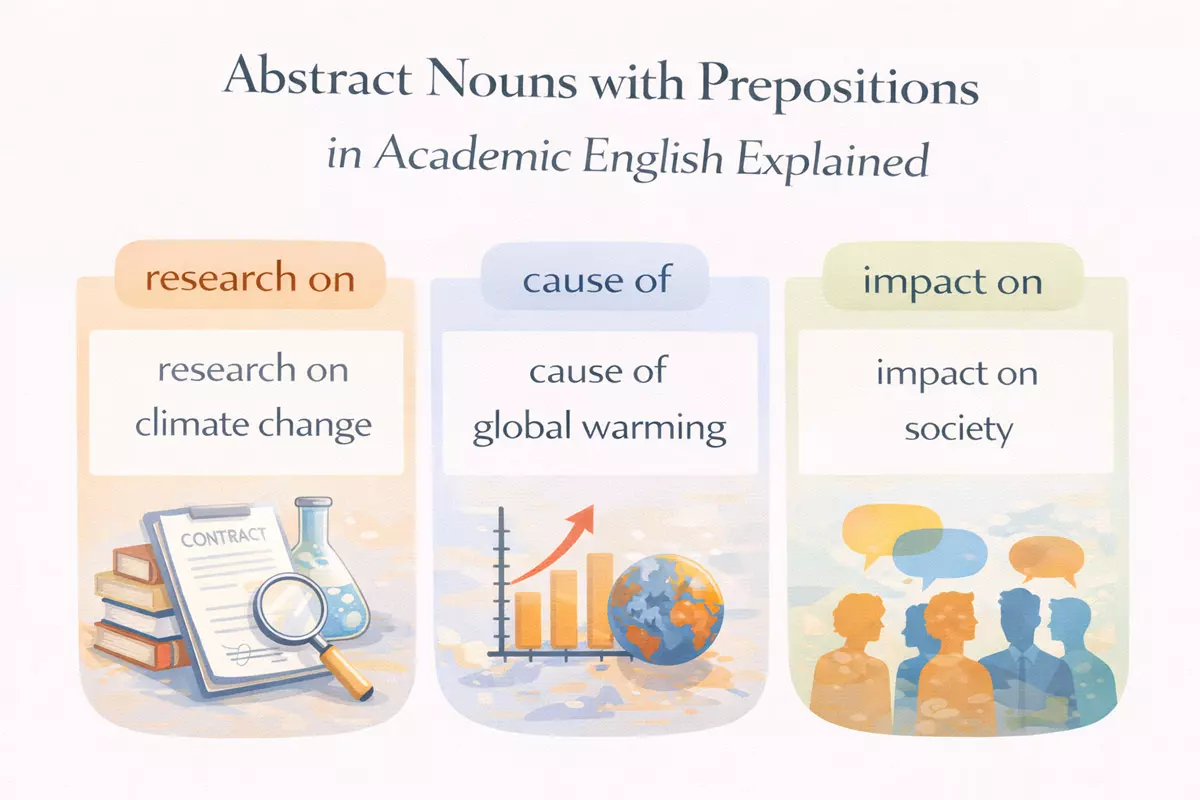 Here we how abstract concepts in academic English depend on noun-preposition pairings for clarity, covering core academic pairs, the 'of' phrase, stance signaling, nominalization, corpus evidence, managing density, and ambiguity detection.
- The Noun-Preposition Bond: How abstract concepts require structural 'anchors'
- Core Academic Pairs: In-depth analysis of 'basis for', 'impact on', and 'insight into'
- The 'of-phrase' Power: Using 'of' for classification, possession, and attribute definition
- Directional Logic: How prepositions like 'towards', 'against', and 'for' signal stance
- Nominalization Strategies: Converting clauses into concise noun + preposition units
- Corpora Evidence: Using data-driven frequency to choose the most natural prepositional partner
- Managing Lexical Density: Stringing multiple noun + preposition phrases without losing clarity
- Ambiguity Detection: Fixing phrases where prepositions create multiple interpretations
- Practice: Editing real-world academic abstracts for precision and professional flow
Understanding how intangible concepts combine with connecting words is crucial for clear scholarly writing. Here we the patterns and nuances involved in pairing abstract ideas with prepositions, aiming to enhance your ability to communicate effectively in academic contexts. By examining common structures and providing practical examples, we offer guidance on choosing the most appropriate prepositions when expressing complex relationships between concepts. Mastery of these connections not only clarifies your arguments but also strengthens the overall coherence and professionalism of your writing.
The Noun-Preposition Bond: How abstract concepts require structural 'anchors'
Academic English often relies on abstract nouns to express complex ideas, but these concepts rarely stand alone. To clarify relationships, writers commonly pair these nouns with prepositions, creating a kind of grammatical "anchor" that grounds meaning. For learners and writers alike, understanding how these pairs work is essential for both clarity and precision.
Why Abstract Nouns Need Prepositions
Abstract nouns—such as "impact," "basis," or "evidence"—refer to ideas rather than tangible objects. Without a preposition, their meaning can be vague or ambiguous. Prepositions specify connections: they tell us what something is based on, who has responsibility for something, or what evidence relates to.
Common Abstract Noun + Preposition Pairings
Some combinations are fixed or highly conventional in academic English. Here are frequent patterns that illustrate this structural anchoring:
- advantage of → One advantage of this method is its efficiency.
- basis for → The data provides a solid basis for further analysis.
- evidence of → There is clear evidence of improvement.
- impact on → The policy had a significant impact on public health.
- responsibility for → She has responsibility for quality control.
- solution to → This approach offers a practical solution to the problem.
- effect on → The change had little effect on overall performance.
- access to → Students have access to online resources.
- increase in → There was a noticeable increase in productivity.
- reliance on → The system shows heavy reliance on external data.
- concern about → There is growing concern about data privacy.
- approach to → The study adopts a new approach to risk assessment.
- awareness of → Public awareness of climate change is increasing.
- contribution to → The research makes a valuable contribution to the field.
- distinction between → A clear distinction between theory and practice is necessary.
- preference for → Consumers show a strong preference for sustainable products.
- reduction in → The initiative led to a reduction in emissions.
- role in → Education plays a key role in social development.
- threat to → Climate change poses a serious threat to ecosystems.
- transition from ... to → The company is managing the transition from manual to automated systems.
Comparing Prepositional Choices

Choosing the correct preposition is not always intuitive. Sometimes, subtle shifts in meaning occur with different prepositions. Consider these examples:
| Noun + Preposition | Example in Academic Context |
|---|---|
| Influence on | The study examines the influence on student performance. |
| Influence of | Researchers debated the influence of technology in education. |
| Increase in | There was an increase in productivity after the intervention. |
| Increase of | An increase of 10% was recorded over the year. |
Tips for Mastering Noun-Preposition Combinations
- Check collocations in reliable academic sources or corpora.
- If unsure, consult example sentences or usage notes in dictionaries.
- Notice that some nouns take only one preposition in academic style, while others can take several, each with a different nuance.
- Practice by writing your own sentences, swapping prepositions to see how meaning changes.
Grasping these noun-preposition pairings allows academic writing to convey abstract ideas with precision, making arguments clearer and more persuasive.
Core Academic Pairs: In-depth analysis of 'basis for', 'impact on', and 'insight into'
Academic English often features abstract nouns followed by prepositions to convey precise relationships between ideas. Expressions like “basis for,” “impact on,” and “insight into” are especially common in research articles, reports, and essays. Understanding how these combinations function can help writers express cause, effect, and understanding more accurately.
Exploring the Meaning and Usage
Each of these noun-preposition pairs serves a specific purpose:
- Basis for — introduces the underlying support or justification for an argument, method, or conclusion.
- Impact on — highlights the effect or consequence one factor has on another.
- Insight into — points to a deeper understanding or new perspective about a topic or phenomenon.
Common Academic Patterns and Examples
Writers typically use these pairs to clarify logical relationships. Here are some typical patterns:
- The basis for this theory is empirical evidence.
- Researchers examined the impact on student performance.
- The study provides valuable insight into language acquisition.
- There is a strong basis for further investigation.
- Policy changes had an immediate impact on local communities.
- Recent findings offer insight into the causes of climate change.
- The basis for their approach rests on previous models.
- Technological advances have a measurable impact on productivity.
- Interviews yielded insight into employee motivation.
- Data analysis formed the basis for the recommendations.
- There was little impact on test results after the intervention.
- Comparative studies offered new insight into cultural differences.
Comparing Function and Focus
While these combinations may appear similar, their communicative roles differ. The following table outlines the distinctions in their usage and focus:
| Pair | Function in Academic Writing | Typical Questions Answered |
|---|---|---|
| Basis for | States the foundation or justification for a claim, method, or decision | Why? On what grounds? |
| Impact on | Describes the effect or influence of one element upon another | What happens as a result? |
| Insight into | Indicates deeper understanding or revelation about a subject | What is understood? What is revealed? |
Tips for Accurate and Effective Use
Writers should choose these pairs based on the logical connections they wish to emphasize. For instance, use “basis for” when explaining underlying support, “impact on” to describe direct consequences, and “insight into” when presenting new understanding. Consistent and precise use of these structures enhances clarity and academic tone.
The 'of-phrase' Power: Using 'of' for classification, possession, and attribute definition
In academic English, the preposition "of" is central for expressing relationships between abstract nouns and other elements in a sentence. This small word helps writers define categories, indicate ownership, and clarify attributes in a precise manner. Mastering these patterns enhances both clarity and formality in scholarly writing.
Classification: Grouping and Types
"Of" is frequently used to show that one abstract noun belongs to a certain group or category. This construction is essential for describing types, kinds, or classes in research and analysis.
- the concept of justice → The concept of justice varies across legal systems.
- the field of linguistics → The field of linguistics examines how language is structured and used.
- the process of assimilation → The process of assimilation can affect cultural identity over time.
- the notion of equality → The notion of equality is central to many democratic societies.
- the phenomenon of migration → The phenomenon of migration has intensified in recent decades.
- the principle of autonomy → The principle of autonomy supports an individual’s right to make informed choices.
- the discipline of philosophy → The discipline of philosophy addresses fundamental questions about knowledge and ethics.
- the category of literature → The category of literature includes both fiction and non-fiction works.
- the system of governance → The system of governance determines how authority is distributed and exercised.
- the tradition of storytelling → The tradition of storytelling preserves collective memory and values.
Possession: Abstract Ownership and Sources
"Of" also signals possession or origin, especially with abstract nouns where a simple apostrophe-s ('s) would be awkward or incorrect. This structure is vital for attributing ideas, qualities, or results.
- the influence of culture → The influence of culture shapes communication styles and social norms.
- the impact of globalization → The impact of globalization is evident in international trade and media.
- the authority of the state → The authority of the state is limited by constitutional principles.
- the responsibility of leadership → The responsibility of leadership includes maintaining accountability and trust.
- the outcome of negotiation → The outcome of negotiation depends on compromise and shared interests.
- the legacy of colonialism → The legacy of colonialism continues to affect political and economic structures.
- the effect of pollution → The effect of pollution can be observed in declining air quality.
- the role of education → The role of education is crucial in promoting social mobility.
- the significance of evidence → The significance of evidence lies in its ability to support or refute claims.
- the result of experimentation → The result of experimentation must be interpreted within a clear methodology.
Attribute Definition: Describing Qualities or Features
Writers often rely on "of-phrases" to specify attributes or characteristics, making academic arguments more precise. This construction can define relationships between abstract qualities and their bearers.
- the importance of accuracy → The importance of accuracy increases when decisions rely on data.
- the complexity of identity → The complexity of identity reflects multiple social and personal factors.
- the relevance of context → The relevance of context becomes clear when meaning depends on situation.
- the necessity of transparency → The necessity of transparency is often emphasized in public institutions.
- the universality of human rights → The universality of human rights is a core principle of international law.
- the diversity of perspectives → The diversity of perspectives improves the quality of discussion.
- the clarity of explanation → The clarity of explanation affects how well readers understand an argument.
- the reliability of data → The reliability of data must be assessed before drawing conclusions.
- the validity of a claim → The validity of a claim depends on logic and supporting evidence.
- the ambiguity of meaning → The ambiguity of meaning can lead to multiple interpretations.
Comparing 'Of' with Other Prepositions
The preposition "of" is not always interchangeable with other prepositions. It is especially preferred when talking about relationships involving abstract nouns, where alternatives like "for," "to," or "in" would change the meaning or sound unnatural. The table below compares a few typical patterns:
| Phrase with "of" | Alternative Preposition (if any) |
|---|---|
| the importance of collaboration | the importance for collaboration ❌ |
| the result of research | the result from research ✅ |
| the impact of technology | the impact on technology ✅ (different meaning) |
| the effect of climate change | the effect on climate change ✅ (different meaning) |
| the necessity of reform | the necessity for reform ✅ |
In summary, understanding how to use "of" with abstract nouns allows for nuanced, accurate academic writing. This preposition not only links ideas but also clarifies their relationships, making arguments and analyses more effective.
Directional Logic: How prepositions like 'towards', 'against', and 'for' signal stance
When academic writers combine abstract nouns with prepositions such as "towards," "against," and "for," they are not just indicating direction or movement—they are revealing attitudes, intentions, or opposition related to ideas and arguments. These prepositions play a crucial role in expressing support, resistance, or orientation within academic discourse.
Signaling Alignment and Orientation
Prepositions like "for" and "towards" often signal positive alignment or a movement in favor of a concept. For example, pairing "support" with "for" (support for innovation) indicates advocacy, while "attitude towards" shows a general orientation or approach to a topic. In contrast, "against" marks clear opposition, as in "argument against privatization."
- Support for reform → There is growing support for reform among policy makers.
- Opposition to censorship → Opposition to censorship remains strong in academic circles.
- Attitude towards technology → Public attitude towards technology continues to evolve.
- Movement against exploitation → The movement against exploitation gained international attention.
- Preference for collaboration → The organization shows a clear preference for collaboration.
- Objection to policy → Several groups raised an objection to the proposed policy.
- Response to criticism → The response to criticism was measured and constructive.
- Commitment to equality → The institution reaffirmed its commitment to equality.
- Resistance against change → Resistance against change can slow innovation.
- Aspiration towards excellence → Aspiration towards excellence drives long-term improvement.
- Vote for expansion → The committee cast a vote for expansion of the program.
- Campaign against pollution → A nationwide campaign against pollution was launched.
- Advocacy for rights → Advocacy for rights plays a key role in civil society.
- Reaction against injustice → The reaction against injustice was swift and widespread.
- Contribution to progress → Education makes a significant contribution to progress.
- Transition towards sustainability → The transition towards sustainability requires coordinated effort.
- Belief in progress → A strong belief in progress motivates continued reform.
- Call for reform → There is an increasing call for reform in the sector.
Subtle Differences in Meaning
Choosing between "towards," "against," and "for" can subtly alter the stance or nuance an author conveys. "Towards" often implies an ongoing process or aspiration, while "for" denotes clear support. "Against" unmistakably communicates resistance or disapproval.
| Preposition | Typical Nuance | Example Phrase | Stance Signaled |
|---|---|---|---|
| for | Support, endorsement | Advocacy for reform | ✅ Positive/aligned |
| against | Opposition, resistance | Resistance against policy | ❌ Negative/disaligned |
| towards | Movement, aspiration | Progress towards consensus | → Directional/neutral-positive |
| to | Target, response | Response to feedback | Neutral/relational |
Why This Matters in Academic English
Understanding the directional logic of these prepositions helps readers interpret an author’s position more accurately. Whether describing advocacy, opposition, or a trajectory of change, the choice of preposition with abstract nouns is rarely accidental. It shapes the nuance of the argument and clarifies the writer’s stance for the audience.
Nominalization Strategies: Converting clauses into concise noun + preposition units
Transforming full clauses into compact noun phrases is a common practice in academic English. This approach helps writers achieve greater conciseness and formality, making arguments more direct and information-dense. Rather than using a verb to express an action or process, a writer can recast the idea as a noun, often followed by a prepositional phrase for clarity or detail. This technique is especially valuable when summarizing complex ideas or results.
Why Use Nominalization?
Academic texts favor this method for several reasons:
- It allows for summarizing entire actions or processes in a single, compact expression.
- It increases the objectivity and impersonality of the writing.
- It helps avoid repetitive or cumbersome sentences.
- It enables clearer connections between ideas by focusing on concepts rather than actions.
Common Patterns
Writers often use abstract nouns followed by prepositions to encapsulate complex processes. Here are some typical patterns:
- Analysis of + noun (e.g., analysis of data)
- Awareness of + noun (e.g., awareness of risks)
- Influence on + noun (e.g., influence on policy)
- Response to + noun (e.g., response to criticism)
- Advantage of + noun (e.g., advantage of automation)
- Contribution to + noun (e.g., contribution to science)
- Concern about/over + noun (e.g., concern about safety)
- Effect of + noun (e.g., effect of temperature)
- Role in + noun (e.g., role in development)
- Evidence for + noun (e.g., evidence for change)
- Impact on + noun (e.g., impact on environment)
- Preference for + noun (e.g., preference for simplicity)
- Access to + noun (e.g., access to information)
- Reduction in + noun (e.g., reduction in errors)
- Increase in + noun (e.g., increase in demand)
- Basis for + noun (e.g., basis for argument)
- Resistance to + noun (e.g., resistance to change)
- Similarity to + noun (e.g., similarity to previous studies)
- Distinction between + nouns (e.g., distinction between theory and practice)
- Approach to + noun (e.g., approach to learning)
Before and After: Clause vs. Noun + Preposition
The shift from a full clause to a noun phrase typically involves removing the verb and rephrasing the sentence. Notice how the information becomes more condensed and formal.
| Full Clause | Nominalized Noun + Preposition |
|---|---|
| Researchers analyzed the data. | Analysis of the data |
| The policy affects the environment. | Impact of the policy on the environment |
| The team responded to criticism. | Response to criticism |
| They prefer simplicity. | Preference for simplicity |
| We observed that errors were reduced. | Reduction in errors |
Tips for Effective Nominalization
- Identify the main verb or action and consider its noun form (e.g., analyze → analysis).
- Choose a preposition that logically connects your noun to the next idea (e.g., of, in, on, to).
- Ensure the phrase remains clear and does not obscure the original meaning.
- Use this structure to summarize findings, introduce topics, or highlight relationships in your writing.
Mastering these transformations can help you write more efficiently and meet the expectations of academic style. As you practice, you will recognize patterns that can be reused and adapted for different contexts.
Corpora Evidence: Using data-driven frequency to choose the most natural prepositional partner
Understanding which preposition to use with abstract nouns in academic English can be challenging, even for advanced learners. Linguists and language instructors often turn to large databases of real texts—corpora—to observe how native speakers actually combine nouns and prepositions in authentic contexts. This approach helps identify which combinations are truly natural and widely accepted, as opposed to those that may sound odd or overly formal.
Why Corpus Data Matters for Preposition Choice
Frequency data from corpora gives us a clear picture of which prepositions most commonly follow specific abstract nouns in academic writing. This method moves beyond intuition or prescriptive rules, offering a practical, evidence-based reference for learners and writers. For example, while both "influence on" and "influence over" are grammatically possible, corpus searches reveal that "influence on" is far more common in scholarly articles.
Common Abstract Noun + Preposition Patterns

Here are some frequent pairings found in academic texts, based on large-scale corpus analysis:
- benefit from → Students benefit from regular feedback.
- influence on → Media coverage has a strong influence on public opinion.
- answer to → There is no simple answer to this question.
- cause of → Poor ventilation is a common cause of discomfort.
- reaction to → Her reaction to the news was calm and measured.
- exposure to → Prolonged exposure to noise can affect concentration.
- consequence of → The delays were a consequence of limited resources.
- growth in → The company reported steady growth in revenue.
- commitment to → Their commitment to quality is well known.
- attitude towards → His attitude towards teamwork is very positive.
- interest in → There is growing interest in renewable energy.
- evidence for → The study presents strong evidence for the proposed theory.
- reason for → There is no clear reason for the sudden change.
- response to → In response to complaints, the policy was updated.
- relationship between → The relationship between sleep and memory is well documented.
- dependence on → The system’s dependence on external data creates risks.
Comparing Frequency: Typical vs. Unusual Pairings
Corpora not only show which combinations are common, but also help highlight less natural or rare pairings. Using the right preposition increases clarity and makes writing sound more native-like. For instance, "increase in" (e.g. "an increase in demand") is standard, while "increase of" is rare and often incorrect in academic contexts.
| Abstract Noun | Frequent Preposition | Unusual Pairing |
|---|---|---|
| effect | on | for, at |
| solution | to | for, about |
| concern | about | of, for |
| approach | to | for, of |
| evidence | for | of, to |
| role | in | on, for |
How to Use Corpus Insights in Your Writing
When unsure about a noun-preposition combination, consult reputable corpora or frequency dictionaries. Not only does this ensure your usage aligns with academic norms, but it also increases your confidence in producing clear, natural-sounding English. Over time, exposure to authentic examples will help these patterns become second nature.
Managing Lexical Density: Stringing multiple noun + preposition phrases without losing clarity
Academic English often relies on dense clusters of abstract nouns linked by prepositions (for example, "analysis of the impact of globalization on education"). While this compact style allows writers to pack more information into less space, it can quickly become difficult to follow. Clarity can suffer if too many noun + preposition combinations are stacked together without careful structuring.
Why Lexical Density Matters
High lexical density—when sentences contain a large number of content words, especially nouns—can overwhelm readers. In academic writing, this often results from chaining together several abstract nouns with prepositions. If not handled deliberately, meaning gets buried and readers may lose track of the main point.
Common Challenges with Noun + Preposition Chains
Writers often face these issues when combining multiple abstract noun phrases:
- Sentences become overly long and hard to parse
- Relationships between concepts are unclear
- Important ideas are lost in a tangle of prepositional phrases
- Readers must re-read to grasp basic meaning
Strategies for Maintaining Clarity
To keep your writing accessible—even with complex noun/preposition strings—try these approaches:
- Break up long noun chains by introducing verbs or relative clauses.
- Use parallel structure to clarify relationships between abstract concepts.
- Rephrase where possible to reduce the total number of consecutive prepositional phrases.
- Prioritize the main idea by placing it earlier in the sentence.
- Employ punctuation (commas, dashes) to signal logical groupings.
Examples: Abstract Noun + Preposition Chains
Here are some typical patterns found in academic texts. Notice how clarity can decline as more prepositional phrases are added:
- the effect of climate change on agriculture
- the discussion of the implications of policy reforms for social welfare
- the analysis of the relationship between income and health outcomes
- the examination of trends in the adoption of technology by small businesses
- the investigation into the causes of resistance to organizational change
- the assessment of the impact of funding cuts on research quality
- the evaluation of the role of education in economic development
- the study of attitudes towards environmental protection
- the identification of factors contributing to student success
- the review of literature on mental health interventions
- the measurement of the effectiveness of training programs for employees
- the interpretation of data from various sources
- the exploration of opportunities for collaboration between institutions
- the analysis of responses to public policy initiatives
- the summary of findings in previous studies
Before and After: Improving Readability
Sometimes, a sentence can be made more digestible by restructuring or splitting it. Consider the following transformations:
- Original: The assessment of the impact of online learning on the development of critical thinking skills among undergraduate students.
- Improved: This study assesses how online learning affects the development of critical thinking skills in undergraduate students.
- Original: The analysis of the influence of teacher motivation on student achievement in primary education.
- Improved: We analyze how teacher motivation influences student achievement in primary education.
Summary Tips
- Limit the number of consecutive prepositional phrases in one sentence.
- Favor active verbs and clear subject-verb-object structure.
- Use abstract nouns with prepositions purposefully, not excessively.
- Always ask: can the idea be made clearer with fewer nouns or a different construction?
By being mindful of how you connect abstract nouns with prepositions, you can make your academic writing both information-rich and easy to follow.
Ambiguity Detection: Fixing phrases where prepositions create multiple interpretations
Academic English often relies on abstract nouns paired with prepositions, but these combinations can introduce confusion when a preposition connects ambiguously to more than one element in a sentence. Unclear phrasing can obscure meaning, especially in scholarly writing where precision is crucial. Recognizing and editing these ambiguous structures helps prevent misinterpretation.
Common sources of prepositional ambiguity
Several patterns frequently cause confusion:
- Attachment ambiguity: It's unclear which noun or verb the preposition relates to.
- Multiple possible referents: The preposition could logically connect to more than one part of the sentence.
- Ellipsis or omission: Words left out make it difficult to determine the preposition’s target.
Examples of ambiguous phrases with abstract nouns
Below are typical cases where prepositional use with abstract nouns leads to multiple interpretations. For each, a clearer alternative is suggested.
- Analysis of data from experts (Is the data from experts, or is the analysis from experts?)
- Discussion about changes in policy (Are the changes in policy, or is the discussion in policy?)
- Concern for students with disabilities (Is the concern for students, or is it for disabilities?)
- Report on issues with funding (Are there issues with funding, or is the report with funding?)
- Review of literature on technology (Is it a review of literature on technology, or a review on literature about technology?)
- Influence of teachers on students (Does the influence belong to teachers or does it act on teachers?)
- Study of attitudes towards change (Are the attitudes towards change, or is the study towards change?)
- Evidence for support of the theory (Is the evidence for support, or is it support for evidence?)
- Impact of technology on learning (Does technology impact learning, or does learning impact technology?)
- Perception of risk among employees (Is it the perception among employees, or is it the risk among employees?)
- Explanation for failure in experiments (Is the explanation for failure, or for experiments?)
- Evaluation of methods by experts (Are experts evaluating, or are the methods by experts?)
- Proposal for improvement in practice (Is the improvement in practice, or the proposal in practice?)
- Interpretation of results for policymakers (Is the interpretation for policymakers, or the results for them?)
- Concern about safety of equipment (Is the concern about safety, or about equipment?)
- Control over variables in research (Is the control over variables, or in research?)
- Access to information on regulations (Is it access to information, or to regulations?)
- Awareness of issues among staff (Is staff aware of issues, or are the issues among staff?)
How to clarify meaning
Writers can eliminate ambiguity by:
- Rephrasing with relative clauses or active verbs.
- Splitting complex noun phrases.
- Specifying the agent or target of the preposition.
Clear vs. ambiguous: comparison table
| Ambiguous Phrase | Clarified Version |
|---|---|
| Analysis of data from experts | Analysis of data provided by experts or Analysis by experts of data |
| Review of literature on technology | Review of literature that discusses technology |
| Influence of teachers on students | Influence that teachers have on students |
| Evaluation of methods by experts | Evaluation performed by experts on methods |
| Perception of risk among employees | Employees’ perception of risk |
| Interpretation of results for policymakers | Interpretation intended for policymakers |
By reviewing sentences for these patterns and rewording as shown, academic writers can greatly reduce ambiguity and clarify their intended meaning when using abstract nouns with prepositions.
Practice: Editing real-world academic abstracts for precision and professional flow
Academic writing often relies on abstract nouns combined with prepositions to convey complex relationships and ideas. However, these constructions can introduce ambiguity or wordiness if not chosen carefully. In this section, you will work with authentic abstract sentences, sharpening both precision and flow by refining how abstract nouns and their prepositions are used.
Common issues with abstract nouns and prepositions
Writers frequently face challenges such as:
- Choosing the wrong preposition (e.g., "impact on" vs. "impact of")
- Overusing abstract nouns, making sentences dense or unclear
- Misplacing prepositional phrases, leading to awkward or ambiguous meaning
- Unnecessary repetition or redundancy in phrasing
Editing exercise: Improve these abstract sentences
Read each example taken from academic abstracts. Edit each one to improve clarity and flow, focusing on the use of abstract nouns with prepositions.
- The analysis of the influence of climate change on agriculture was conducted by means of data collection from various sources.
- This paper addresses the issue of the lack of awareness about cyber security in educational institutions.
- There is a growing concern of the increase in antibiotic resistance among hospital patients.
- The study provides an examination on the effectiveness of online learning for adult students.
- Our results show a correlation between the rise in urbanization and the decrease of green spaces.
- The discussion of the impact of social media on mental health was supported by means of interviews with participants.
- This report offers an analysis on the reasons for the decline of voter participation in local elections.
- There is increasing evidence of the effect of air pollution on respiratory conditions in children.
- The research provides an evaluation of the benefit of exercise for cognitive performance in older adults.
- Our findings indicate a relationship between the improvement in public transport and the reduction of traffic congestion.
Show answers
- The influence of climate change on agriculture was analyzed using data from various sources.
- This paper addresses the lack of awareness about cyber security in educational institutions.
- There is growing concern about the increase in antibiotic resistance among hospital patients.
- The study examines the effectiveness of online learning for adult students.
- Our results show a correlation between urbanization and the reduction of green spaces.
- The impact of social media on mental health was supported by interviews with participants.
- This report analyzes the reasons for the decline in voter participation in local elections.
- There is increasing evidence that air pollution affects respiratory conditions in children.
- The research evaluates the benefits of exercise for cognitive performance in older adults.
- Our findings indicate a relationship between improved public transport and reduced traffic congestion.
Useful abstract noun + preposition patterns
Mastering typical combinations will help you avoid awkward phrasing. Here are some frequent pairings:
- effect on
- influence of
- relationship between
- evidence for
- impact on
- reason for
- basis for
- concern about
- response to
- contribution to
- approach to
- increase in
- decrease in
- awareness of
- examination of
- solution to
- advantage of
- risk of
- role of
- need for
Comparison: Original vs. Improved Abstract Sentences
| Original Sentence | Improved Version |
|---|---|
| There is a need of improvement in the methods of data analysis. | There is a need to improve data analysis methods. |
| The impact of the use of social media on mental health is under investigation. | The impact of social media use on mental health is being investigated. |
| A discussion about the benefits of renewable energy is presented. | The benefits of renewable energy are discussed. |
| This research focuses on the exploration of factors influencing job satisfaction. | This research explores factors influencing job satisfaction. |
| The examination on changes in policy was carried out by the committee. | The committee examined policy changes. |
Quick practice: Identify and improve
For each sentence, identify the abstract noun + preposition pairing and suggest a more concise or precise revision.
- The report provides information about the causes of pollution in urban areas.
- There is evidence for the effectiveness of this treatment in reducing symptoms.
- The transition from traditional to digital media has implications on literacy rates.
- Researchers observed an increase of anxiety among adolescents.
- The study presents an analysis of the impact of climate change on agriculture.
- There has been a growth of interest in renewable energy sources.
- The article discusses the role of technology in modern education.
- Scientists reported a decrease of biodiversity in coastal regions.
- The findings suggest a relationship between diet and mental health.
- The survey collected data about student attitudes towards online learning.
Show answers
- information about the causes of pollution → The report explains the causes of urban pollution.
- evidence for the effectiveness of this treatment → Evidence shows this treatment effectively reduces symptoms.
- implications on literacy rates → The transition from traditional to digital media affects literacy rates.
- increase of anxiety among adolescents → Researchers observed increased anxiety among adolescents.
- analysis of the impact of climate change → The study analyzes the impact of climate change on agriculture.
- growth of interest in renewable energy → There has been growing interest in renewable energy sources.
- the role of technology in education → The article examines the role of technology in modern education.
- decrease of biodiversity → Scientists reported decreased biodiversity in coastal regions.
- relationship between diet and mental health → The findings indicate a relationship between diet and mental health.
- data about student attitudes → The survey collected data on student attitudes towards online learning.
By practicing these revisions, you will develop a more precise and professional academic style, using abstract noun and preposition combinations with confidence and clarity.