Compression Strategies: Cutting Word Count Without Losing Meaning

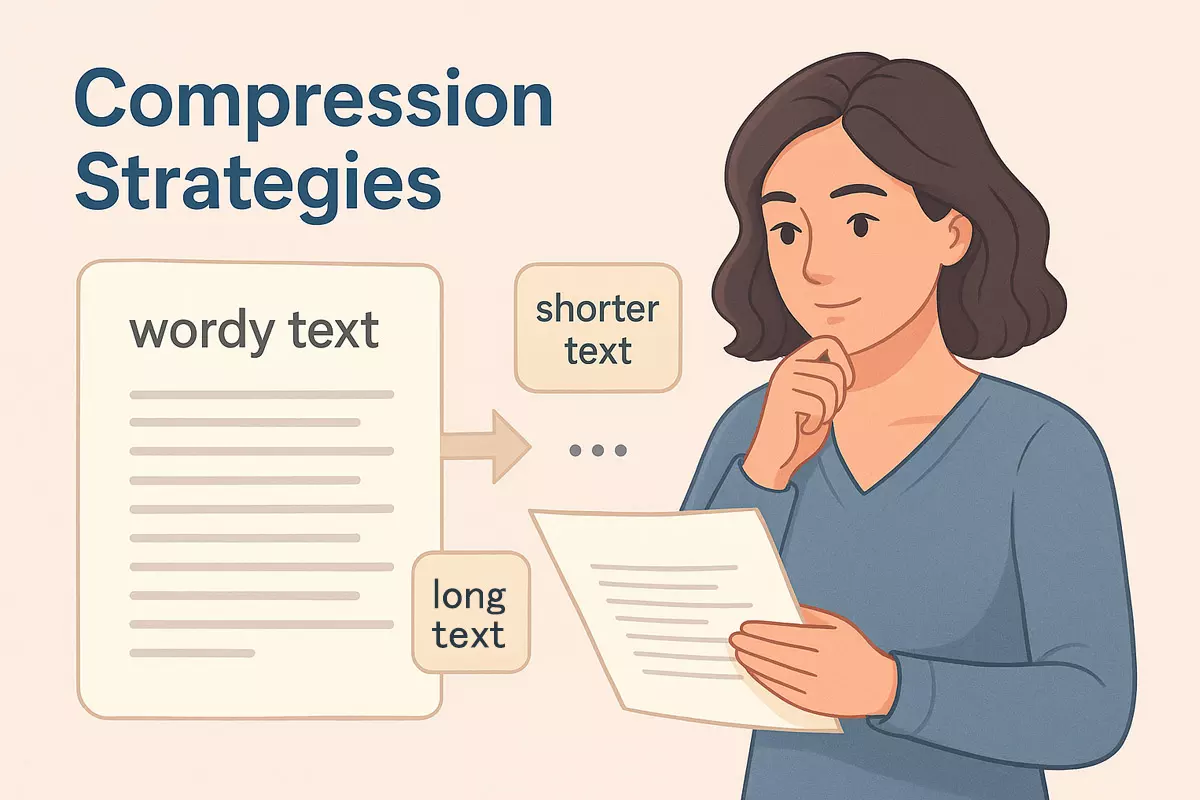 Here we why compression is important in advanced writing, how to replace clauses with shorter forms, use non-finite verbs and nominalizations, remove redundancy, and maintain clarity. It also provides step-by-step practice on compressing paragraphs.
Trimming text while preserving its essence is a valuable skill for any writer, particularly when clarity and brevity are essential. By learning to refine your writing, you ensure that every word serves a purpose, making your message more impactful and accessible. Focus on eliminating unnecessary words, choosing precise language, and organizing ideas logically. This approach not only streamlines your work but also helps readers grasp your main points quickly, maintaining both the integrity and effectiveness of your communication.
Why compression matters in advanced writing
Precision and efficiency are vital in sophisticated text, whether for academic, technical, or creative purposes. Writers often face strict word or page limits, but concise language also creates clarity, keeps readers engaged, and demonstrates mastery of the subject. When you eliminate redundancy, each sentence carries more weight, making arguments stronger and narratives tighter.
Benefits of concise expression
- Improves reader comprehension by removing distractions
- Highlights main ideas without burying them in excess detail
- Shows respect for the reader’s time and attention
- Makes texts more adaptable for publication, translation, or presentation
- Facilitates easier editing and revision
Compression vs. oversimplification
It’s important to distinguish between cutting unnecessary words and losing important nuance. Effective compression means trimming the fat, not the substance. Advanced writers know how to preserve tone, intent, and detail while reducing length.
Common areas where concise writing excels
- Abstracts and executive summaries
- Research papers with strict word counts
- Grant proposals and application essays
- Professional emails and memos
- Instructional guides and manuals
- Speechwriting and presentations
- Social media posts with character limits
- Resumes and cover letters
- Legal briefs and case summaries
- Technical documentation
Before-and-after examples
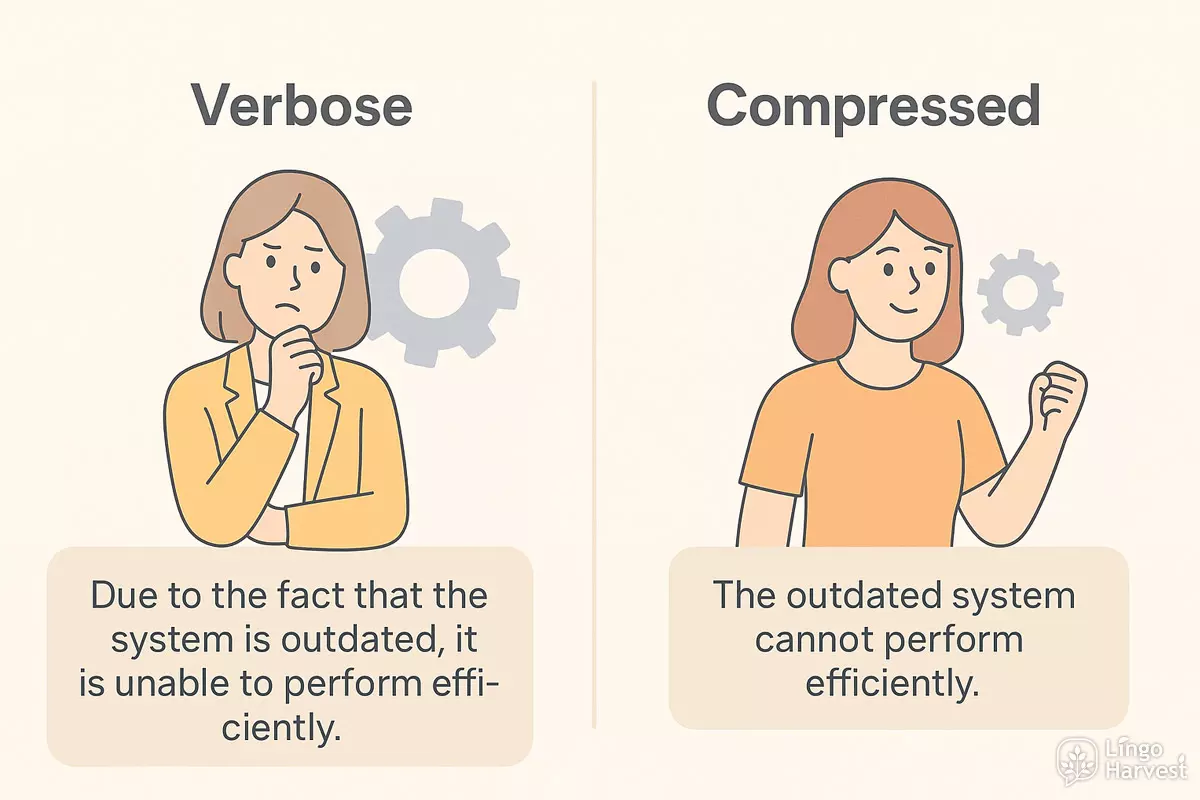
| Verbose Version | Compressed Version |
|---|---|
| Due to the fact that the system is outdated, it is unable to perform efficiently. | The outdated system cannot perform efficiently. |
| In the event that you require further assistance, please do not hesitate to contact me. | If you need help, contact me. |
| There are a number of reasons why this solution is preferable to the alternatives. | This solution is preferable for several reasons. |
| At this point in time, we are currently reviewing the proposal. | We are reviewing the proposal. |
| It is important to note that this process can be time-consuming. | This process can be time-consuming. |
Learning to compress text without sacrificing meaning is a skill that distinguishes advanced writers. It requires critical thinking, a strong grasp of language, and the confidence to trust concise statements to carry the same impact as longer explanations.
Replacing clauses with phrases or words
Often, sentences become unnecessarily long because they rely on full clauses when a phrase or even a single word can do the job. Recognizing these opportunities is an effective way to condense writing without sacrificing clarity or nuance. By identifying subordinate or relative clauses that merely add descriptive information, you can often substitute them with more succinct alternatives.
Identifying Clauses for Compression
Writers can look for phrases like "who is," "which was," or "that are"—these frequently signal clauses that can be shortened. Instead of "The report, which was lengthy, confused readers," try "The lengthy report confused readers." This approach helps maintain the original idea while reducing word count.
Common Patterns for Streamlining
Here are some typical clause structures and their more concise equivalents:
- who is/was/are → adjective or appositive (e.g., "the man who is tall" → "the tall man")
- which/that + verb → participial phrase (e.g., "the car that was parked" → "the parked car")
- because + clause → "due to" or "because of" + noun (e.g., "because he was late" → "due to his lateness")
- in order to → "to" or infinitive verb (e.g., "in order to help" → "to help")
- if it is possible → "if possible"
- for the purpose of → "to" + verb
- despite the fact that → "although" or "despite"
- at the time when → "when"
- on the grounds that → "because"
- in the event that → "if"
- who/that/which can be → adjective or noun modifier
- it is necessary that → "must" or "should"
- there is a need for → "need"
Transforming Clauses: Practical Examples
Below is a comparison of common verbose constructions and their streamlined counterparts:
| Verbose Clause | Condensed Phrase/Word |
|---|---|
| The results that were unexpected surprised us. | The unexpected results surprised us. |
| Students who are diligent achieve more. | Diligent students achieve more. |
| He made a statement that was clear. | He made a clear statement. |
| Meetings which are unnecessary waste time. | Unnecessary meetings waste time. |
| She arrived at a time when everyone had left. | She arrived after everyone had left. |
| In the event that you are late, call me. | If you are late, call me. |
| Despite the fact that it rained, we played. | Despite the rain, we played. |
| He left because he was tired. | He left, tired. |
| There is a need for caution. | Caution is needed. |
| For the purpose of saving time, work faster. | To save time, work faster. |
Key Takeaways
Condensing clauses into phrases or words often improves readability and makes your text more direct. The process involves recognizing patterns that can be shortened, then confidently applying replacements. Over time, this technique becomes second nature, leading to concise, impactful writing.
Using non-finite forms and nominalizations
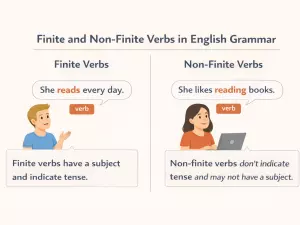
Shifting from full clauses to non-finite verb forms or transforming verbs and adjectives into nouns are powerful ways to reduce sentence length while maintaining clarity. These grammatical strategies allow writers to pack more information into fewer words, which is particularly useful when condensing complex ideas.
Non-finite verb forms: streamlining sentences
Non-finite verb forms—such as infinitives, gerunds, and participles—can replace longer clauses and help eliminate unnecessary words. Instead of using a full relative clause, a participial phrase can often convey the same meaning more succinctly. For example, "The man who was walking down the street" can be shortened to "The man walking down the street."
- To improve efficiency → Improving efficiency
- People who study linguistics → People studying linguistics
- She left because she was upset → Upset, she left
- The data that was collected yesterday → The data collected yesterday
- After he finished the project, he rested → Having finished the project, he rested
Nominalizations: turning actions into nouns
Turning verbs or adjectives into nouns (nominalization) can also compress information, allowing more complex ideas to be expressed compactly. However, overuse can make writing abstract, so balance is important.
| Original Phrase | Nominalized Version |
|---|---|
| When people decide | Upon decision |
| If you analyze the results | Upon analysis of the results |
| We concluded that | The conclusion |
| When the committee reviews | During the committee’s review |
| They improved the process | The improvement of the process |
| How the policy changes | The change in policy |
| They cooperate | Cooperation |
| The project succeeded | The project’s success |
| He failed to respond | His failure to respond |
| We recommend that you apply | Our recommendation for application |
When to use these techniques
Both non-finite constructions and nominalizations are most effective when the goal is to convey dense information without sacrificing meaning. They are especially useful in academic, technical, and business writing, where word economy and precision matter. Still, moderation is key—overusing these tools can make text harder to read or less engaging. By carefully choosing between full clauses, non-finite forms, and nominalizations, writers can compress content and keep their messages direct and clear. This approach is central to effective word count reduction without losing essential meaning.
Removing redundancy and filler expressions
Trimming unnecessary words is a direct way to make any piece of writing clearer and more concise. Redundant phrases and filler expressions often sneak in during drafting, padding out sentences without adding real meaning. Recognizing and eliminating these is key to effective compression: your text becomes tighter, and your message stands out more sharply.
Spotting Redundant Phrases
Redundancy happens when a word or phrase repeats an idea already expressed elsewhere in the sentence. Catching these repetitions helps reduce word count while retaining all essential information. Here are some common examples to watch for:
- “Advance planning” ❌ → “Planning” ✅
- “Basic essentials” ❌ → “Essentials” ✅
- “End result” ❌ → “Result” ✅
- “Free gift” ❌ → “Gift” ✅
- “Past history” ❌ → “History” ✅
- “Unexpected surprise” ❌ → “Surprise” ✅
- “Final outcome” ❌ → “Outcome” ✅
- “True facts” ❌ → “Facts” ✅
- “Completely finished” ❌ → “Finished” ✅
- “Each and every” ❌ → “Each” or “Every” ✅
- “Absolutely necessary” ❌ → “Necessary” ✅
- “New innovation” ❌ → “Innovation” ✅
Eliminating Filler Words and Phrases
Filler expressions dilute your writing and can be safely removed without loss of meaning. Words like “very,” “really,” “just,” and phrases such as “in order to,” “it is important to note that,” or “there is/are” often serve no real purpose. Consider these alternatives:
- “In order to” → “To”
- “Due to the fact that” → “Because”
- “At this point in time” → “Now”
- “It is important to note that” → Simply state the fact
- “There is/are” → Use active verbs: “A problem exists” → “A problem remains”
- “Very/really/quite” → Remove or choose a stronger word: “very big” → “huge”
- “Just” (when unnecessary) → Remove: “I just think” → “I think”
- “Actually/basically/literally” (as fillers) → Omit unless essential
When to Keep or Cut: Quick Reference
| Expression | Recommended Action |
|---|---|
| Advance warning | Cut “advance” – “warning” suffices |
| Exactly the same | Use “the same” |
| Absolutely essential | Keep “essential” only |
| In my personal opinion | “In my opinion” or “I think” is enough |
| At this moment in time | Replace with “now” or “currently” |
| End result | “Result” is sufficient |
| Completely unanimous | “Unanimous” already means complete agreement |
| Added bonus | Just “bonus” works |
| Future plans | Use “plans” |
| Just in case | Only keep if context requires emphasis |
By systematically removing these common redundancies and empty phrases, you streamline your writing and ensure every word serves a purpose. This process not only reduces overall word count, but also clarifies your message for readers.
Maintaining clarity while shortening text
Reducing word count doesn't have to mean sacrificing understanding. The challenge lies in making sure your message stays intact, even as you trim away extra words. To do this effectively, focus on identifying and keeping your core points, while removing redundancies and unnecessary detail. Consider your audience: what do they truly need to know, and what can be left unsaid without causing confusion?
Principles for Effective Compression
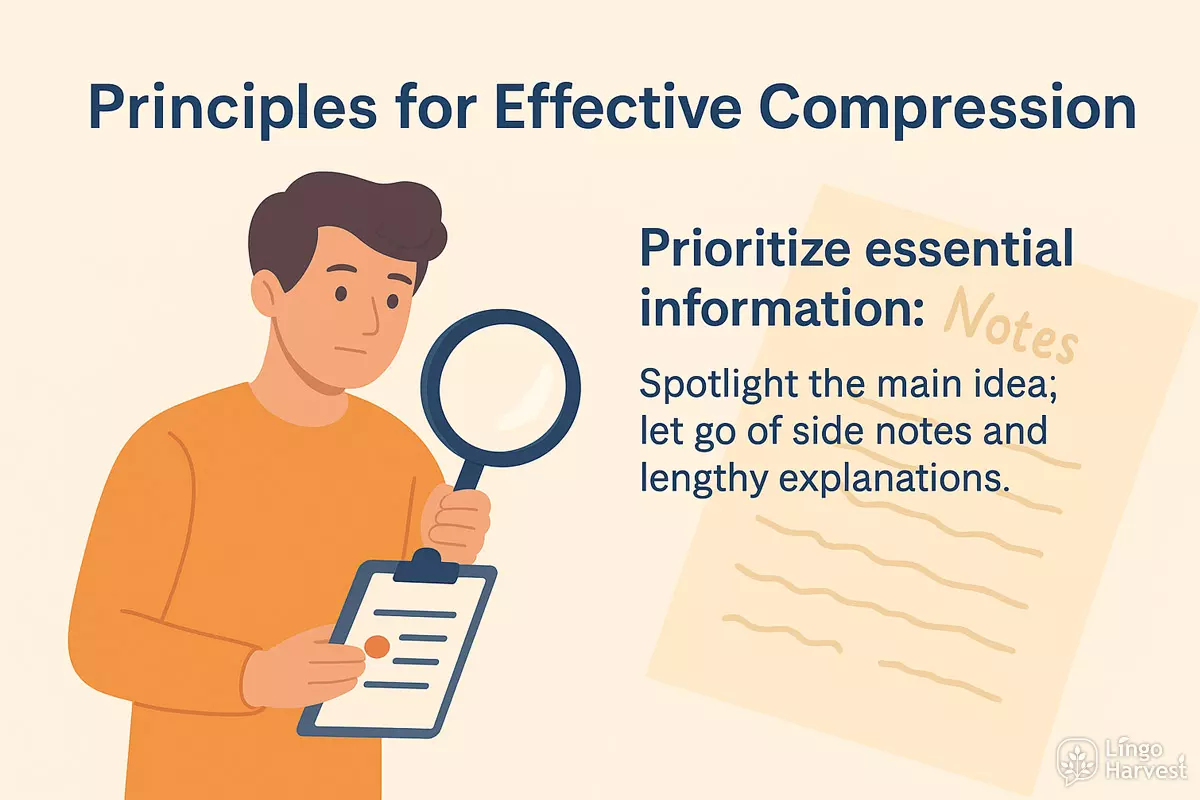
- Prioritize essential information: Spotlight the main idea; let go of side notes and lengthy explanations.
- Replace phrases with single words: Use "because" instead of "due to the fact that," for example.
- Eliminate filler words: Words like "really," "very," and "actually" often add little value.
- Use active voice: "The committee approved the plan" is shorter and clearer than "The plan was approved by the committee."
- Combine related sentences: Merge information to avoid repetition.
- Avoid vague qualifiers: Phrases like "somewhat," "kind of," or "in a way" can usually be omitted.
- Opt for familiar terms: Simple vocabulary increases readability and brevity.
- Remove obvious statements: If something is implied, don't restate it.
- Cut unnecessary examples: One clear example often suffices.
- Edit for structure: Reorganize sentences to make them more concise.
Common Wordy Phrases and Concise Alternatives
| Wordy Expression | Concise Alternative |
|---|---|
| In order to | To |
| At this point in time | Now |
| Due to the fact that | Because |
| It is important to note that | (Omit entirely or use "Note:") |
| In the event that | If |
| Despite the fact that | Although |
| For the purpose of | For |
| At that point in time | Then |
| With regard to | About |
| Has the ability to | Can |
Quick Checks for Clear, Brief Writing
- Read each sentence aloud; if it sounds awkward or long, try to condense it.
- Ask someone unfamiliar with your topic to summarize your text—if they can, your message is likely still clear.
- Review for repeated ideas or words and cut duplicates.
- Use bullet points or numbered lists to break up dense information.
Ultimately, the goal is to deliver information efficiently while ensuring your reader never has to guess your meaning. Trimming text with care, and always double-checking for clarity, keeps your communication both brief and effective.
Practice: compress paragraphs step by step
Effective word count reduction is a skill that improves with practice. The following exercises guide you through the process of shortening paragraphs without losing the core message or essential details. You'll learn to identify redundancy, swap phrases for single words, and restructure sentences for clarity and brevity.
Step 1: Spot unnecessary words
Start by reading a paragraph and highlighting words or phrases that could be removed or replaced. Common culprits include filler phrases, redundant adjectives, and vague qualifiers.
- “In order to” → “To”
- “Due to the fact that” → “Because”
- “At this point in time” → “Now”
- “Very unique” → “Unique”
- “Absolutely essential” → “Essential”
- “For the purpose of” → “For”
- “It is important to note that” → (often delete entirely)
- “In the event that” → “If”
- “In spite of the fact that” → “Although”
- “The reason why is because” → “Because”
- “With regard to” → “About”
- “Until such time as” → “Until”
- “Has the ability to” → “Can”
- “In the process of” → “While”
- “For the simple reason that” → “Because”
- “A large number of” → “Many”
- “Despite the fact that” → “Although”
- “In order that” → “So”
- “At a later date” → “Later”
- “At the present time” → “Now”
Step 2: Practice with an example
Here’s a paragraph to condense:
The purpose of this report is to provide an overview of the recent developments that have occurred in the field of renewable energy, particularly focusing on solar and wind power technologies. At the present time, there are a large number of new projects being developed in various countries around the world.
- Identify and cross out phrases that add little value or can be replaced.
- Rewrite sentences using more direct language.
Show answers
- Compressed version: This report overviews recent developments in renewable energy, especially solar and wind power. Many new projects are underway worldwide.
- Changes made: Removed “the purpose of,” “at the present time,” and “a large number of”; rephrased for directness.
Step 3: Compare before and after
Reviewing transformations side-by-side helps you see the impact of each change. Below is a comparison of original and compressed paragraph versions:
| Original Paragraph | Compressed Version |
|---|---|
| In order to achieve a significant reduction in energy consumption, it is important to implement a number of strategies that are effective and sustainable over time. | To reduce energy consumption significantly, implement effective, sustainable strategies. |
| There are a number of reasons why this approach is considered to be beneficial for both individuals and organizations. | This approach benefits individuals and organizations. |
| At the present time, many experts agree that immediate action is necessary in order to address climate change. | Many experts agree immediate action is needed to address climate change. |
| Due to the fact that renewable resources are becoming more affordable, more people are choosing to use them. | Because renewables are becoming affordable, more people use them. |
Step 4: Try it yourself
Practice by rewriting the following sentences to be more concise:
- At this point in time, we are in the process of reviewing the application.
- In order to make a decision, it is necessary to consider all available information.
- For the purpose of improving efficiency, the company has made several changes.
- Despite the fact that the project was challenging, the team completed it successfully.
- Due to the fact that the sample size was small, the results may be limited.
- In light of the fact that demand has increased, production will be expanded.
- For the reason that several issues were identified, the report was delayed.
- In the event that the system fails, a backup plan will be activated.
Show answers
- We are reviewing the application.
- To decide, consider all available information.
- To improve efficiency, the company made several changes.
- Although the project was challenging, the team completed it successfully.
- Because the sample size was small, the results may be limited.
- Since demand has increased, production will be expanded.
- Because several issues were identified, the report was delayed.
- If the system fails, a backup plan will be activated.
Practicing these steps regularly will sharpen your ability to condense text while keeping the core message intact. Focus on clarity, precision, and eliminating redundancy to master concise writing.