Verb Tense Consistency in Long Texts and Essays

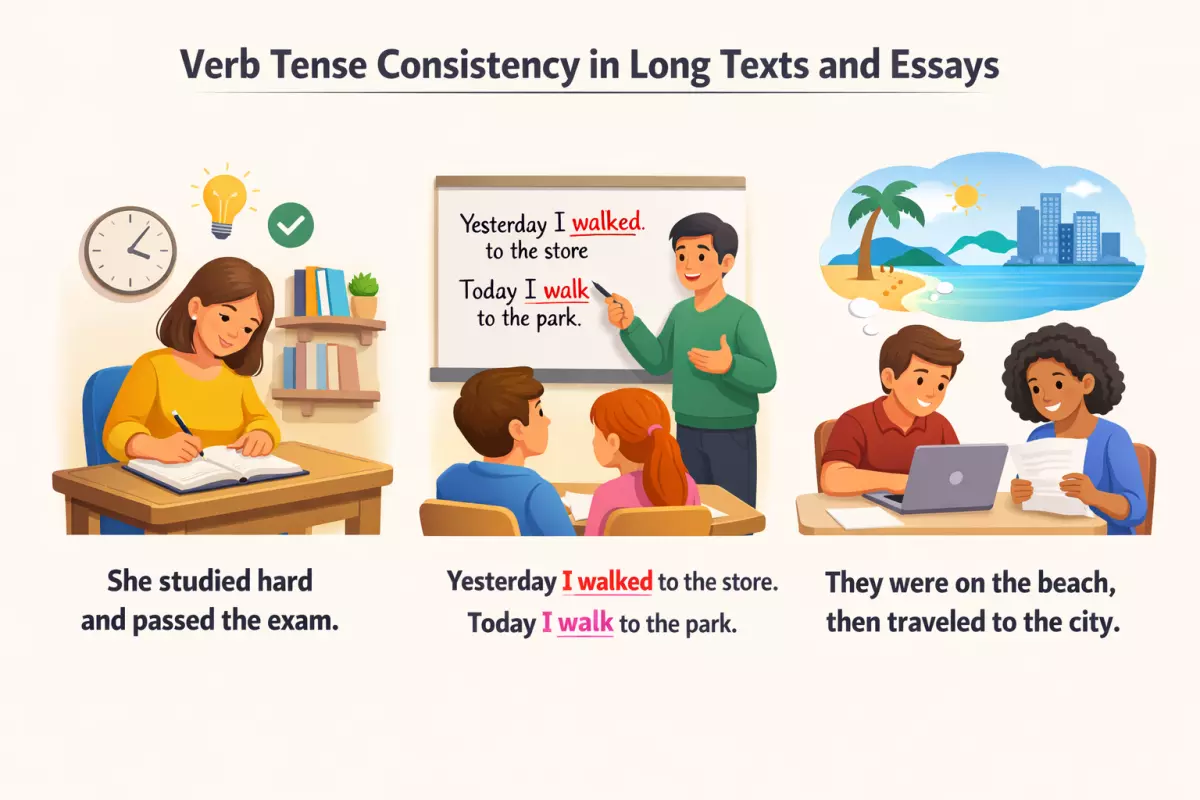 This article explains why tense consistency matters, how to choose a main timeline, and how to keep tense steady across paragraphs. It also shows when and why to shift tense, covers narrative vs academic norms, common fixes, a checklist, and practice tasks.
- Why tense consistency matters
- Choosing a main timeline for a text
- Keeping tense consistent across paragraphs
- Shifting tense correctly with clear reasons
- Narrative vs academic tense conventions
- Common mistakes and how to fix them
- Editing checklist for tense control
- Homework: tense consistency editing tasks
In a long essay, consistent verb tense helps readers track your ideas without confusion. Strong paragraphs can lose impact when a writer drifts from past to present or mixes timelines unintentionally. This article explains how to notice tense shifts, judge when a change is purposeful, and revise sentences so your meaning stays clear, smooth, and confident throughout.
Why tense consistency matters
Keeping verb forms aligned across sentences helps readers track time, cause-and-effect, and the order of events without having to reread. In long essays, even small, unplanned shifts (past to present, present to future) can make an argument feel jumpy or unclear, especially when you move between narration, analysis, and evidence.
What readers rely on when tenses stay steady
- Timeline clarity: A stable tense signals whether events happened before, are happening now, or will happen later, so the sequence stays easy to follow.
- Logical flow: When verbs match the time frame of the claim, examples and explanations connect cleanly instead of feeling like separate scenes.
- Credibility and control: Consistent grammar makes the writing sound intentional; frequent tense switching can sound like the writer lost track of the point.
- Reduced ambiguity: Readers can tell whether a sentence adds background, reports results, or states a general principle.
- Smoother transitions: Paragraph-to-paragraph movement is easier when the “time setting” stays predictable unless you clearly signal a shift.
Common places where tense drift happens in essays
- Topic sentences vs. supporting details: A present-tense claim (“This essay argues…”) followed by past-tense explanation that unintentionally changes the time frame.
- Summary of a source: Mixing “the author argues” with “the author argued” without a reason.
- Literary analysis: Starting in literary present (“The narrator reveals…”) and slipping into past (“He revealed…”) mid-paragraph.
- Methods and results sections: Describing procedures in past tense but switching to present for the same actions.
- Background vs. findings: Using past tense for established facts that are still true, which can make them sound outdated.
- Hypothetical examples: Beginning with “If” in present (“If a student submits…”) and then narrating consequences in past without meaning to.
- Referring to figures/tables: “Figure 2 shows…” followed by “it showed…” in the next sentence while still discussing the same figure.
- Editing sentence-by-sentence: Revising one line into a different tense while surrounding sentences remain unchanged.
Patterns that usually work (and when to shift)
- Use past tense for completed events and specific actions in the past: experiments you ran, steps you took, historical events you narrate.
- Use present tense for general truths, ongoing conditions, and many forms of analysis: what a text “does,” what data “suggest,” what a concept “means.”
- Use present perfect to connect past activity to the current discussion: research that has accumulated up to now.
- Shift tense only with a clear purpose (time change, different section function, or a move from narrative to interpretation).
- Signal a shift with time markers or framing phrases when needed (for example, “Earlier,” “In the following section,” “In recent studies”).
- Keep the main storyline in one tense within a paragraph; treat tense changes like transitions, not casual swaps.
Quick examples of confusing vs. controlled shifts
- ❌ “The study shows a decrease, and the researchers measured it with a survey.” → ✅ “The study shows a decrease, and the researchers measure it with a survey.” (same time frame)
- ❌ “In chapter two, the author argues that power is unstable, and she concluded that institutions fail.” → ✅ “In chapter two, the author argues that power is unstable, and she concludes that institutions fail.”
- ❌ “The experiment was conducted in May, and the results suggest a correlation.” → ✅ “The experiment was conducted in May, and the results suggested a correlation.” (reporting results as completed) or ✅ “The experiment was conducted in May, and the results suggest a correlation.” (if discussing what the results indicate now—choose one approach and stay with it)
- ❌ “The protagonist walked into the room and realizes he is trapped.” → ✅ “The protagonist walks into the room and realizes he is trapped.” (literary present)
Choosing a main timeline for a text

Long pieces read more smoothly when the verbs follow one dominant time frame. Before drafting (or during revision), decide what time frame will carry most of the narration or argument, then treat other tenses as purposeful shifts that serve a clear function.
Pick the default time frame by genre and purpose
- Literary analysis and most academic discussion: use the present to describe what a text does (e.g., “The narrator reveals…,” “The chapter shows…”).
- History and past events reporting: use the past to narrate completed events (e.g., “The policy changed…,” “The committee approved…”).
- Methods and procedures: often past for what you did (“We collected…”), present for what the method generally does (“This test measures…”).
- Personal narrative: usually past for a sequence of events, with occasional present for reflections or general truths.
- Science/technical explanation: present for established facts (“Water boils…”), past for specific study results (“The trial showed…”).
Build a simple “timeline map” before you revise
- Write one sentence stating the dominant time frame (example: “This essay mainly reports what happened during the experiment.”).
- Mark the sections that must stay in that frame (the main narrative, the core argument, the primary evidence summary).
- Circle places where the time frame changes and label the reason (background, flashback, commentary, prediction, definition, quotation framing).
- Check that each shift has a clear entry and exit, rather than drifting into a new tense for several sentences.
- Confirm that headings and topic sentences match the time frame used in the paragraphs they introduce.
Use tense shifts for specific jobs (and signal them)
- Earlier-than-main events: use past perfect to step back (e.g., “By 2019, the team had already tested…”), then return to the dominant frame.
- Later-than-main events: use “would,” “was going to,” or future forms when needed (e.g., “The next phase would address…”).
- General truths inside a past narrative: present can state a stable fact (e.g., “Copper conducts electricity.”), then move back to past for the story.
- Ongoing states around a past event: past progressive can set the scene (“The system was running when…”).
- Commentary or interpretation: present can frame what the writer believes now (“This suggests…”), especially in analytical writing.
- Definitions and concepts: present is typical (“A catalyst is…”), even if the surrounding section is past.
- Source integration: keep your reporting verbs consistent with your discipline’s norm (often present for what a source argues, past for what a study found).
Common drift patterns to watch for
- Switching to present mid-paragraph while still narrating completed events (❌ “We measured the samples and find a difference.” → ✅ “We measured the samples and found a difference.”).
- Using past for a claim that is meant to be currently true (❌ “This theory explained…” when you mean it still explains).
- Mixing “now/today” with a past narrative without a clear commentary frame.
- Letting a single vivid sentence in present pull the surrounding sentences out of the dominant frame.
- Keeping past perfect running too long after the flashback is established; once the earlier time is clear, simple past often resumes within the flashback.
- Inconsistent reporting verbs for sources in the same paragraph (e.g., “Smith argues… Johnson argued… Lee argues…” without a reason).
A practical revision routine
- Highlight all main verbs in one page and check whether most align with the dominant time frame.
- For each tense change, ask: “What job is this shift doing?” If the answer is unclear, revise back to the default frame.
- Add a time marker when needed (“earlier,” “by then,” “at that point,” “in the following year”) to make the timeline explicit.
- Read topic sentences in order; if they jump between time frames, the overall timeline will feel unstable even if individual sentences are grammatical.
Keeping tense consistent across paragraphs
Paragraph-to-paragraph tense control works best when each paragraph has a clear time job: one paragraph establishes the main timeline, and the next paragraph either continues that same timeline or signals a deliberate shift. Readers get lost when the tense changes without a reason (for example, a paragraph that narrates in past tense followed by a paragraph that suddenly summarizes in present tense).
Start by choosing a “default” tense for the whole section
In longer essays, most sections have a dominant tense that should carry across multiple paragraphs. Choose it based on what the section is doing:
- Past tense for narration of completed events (case studies, historical sequences, lab procedures).
- Present tense for general claims, ongoing states, and what a text “says” in literary analysis.
- Future tense mainly for proposals and plans (less common as a sustained default in academic essays).
Use paragraph roles to predict tense patterns
Many tense slips happen when writers change paragraph function (e.g., from describing evidence to interpreting it) but forget to keep the timeline consistent. These common paragraph roles tend to pair with predictable tense choices:
- Background/context paragraphs: often past for historical context, present for current conditions.
- Methods/process paragraphs: past for what was done; present for what the method does in general.
- Results/observations paragraphs: past for what was found; present for stable findings treated as facts.
- Analysis/interpretation paragraphs: present for claims you are making now; past when referring to specific earlier steps or results.
- Counterargument paragraphs: present for what critics argue; past for what they argued in a specific publication or moment.
- Conclusion paragraphs: present for what the essay shows; past for what you examined or demonstrated earlier in the paper.
Signal intentional shifts instead of letting them “just happen”
When you need a different tense in a new paragraph, make the shift explicit with a time cue or framing phrase. Without a signal, the change reads like an error even when the content is accurate.
- Use time markers to move the timeline: “In 2019…,” “By the end of the trial…,” “In the following decade…”.
- Use scope markers to move from event to generalization: “Overall,” “In general,” “Taken together,” “Typically,” “As a rule”.
- Use text-structure markers to move from summary to analysis: “This suggests…,” “This pattern indicates…,” “The key implication is…”.
- Use comparison markers to keep the same tense while changing focus: “Similarly,” “In contrast,” “By comparison,” “On the other hand”.
Keep past events past, and use present for stable claims
A reliable way to maintain coherence across paragraphs is to separate events from interpretations. Events (what happened, what you did, what the author wrote in a particular moment) usually stay in past tense. Interpretations and general truths often work better in present tense. Mixing them is fine, but the switch should track the meaning.
- ✅ “The survey found a drop in satisfaction. This result suggests that workload affects morale.”
- ❌ “The survey finds a drop in satisfaction. This result suggested that workload affects morale.”
- ✅ “Smith argued that access was limited. This argument highlights the role of policy design.”
- ❌ “Smith argues that access was limited. This argument highlighted the role of policy design.”
Watch for the most common cross-paragraph “drift” triggers
- Topic sentences in a new tense: the first sentence of a paragraph quietly resets the timeline; revise it to match the surrounding section unless you intend a shift.
- Quote integration: the reporting verb (“argues,” “argued”) can pull the whole paragraph into a different tense; choose reporting verbs consistently for that section.
- Definitions and generalizations: writers often switch to present for definitions; that can work, but return to the section’s default tense when you resume narration.
- Results vs. discussion blending: mixing “what happened” with “what it means” can cause sentence-to-sentence switching that becomes paragraph-to-paragraph inconsistency.
- Overuse of present perfect: “has shown/has demonstrated” can blur whether you mean a specific past study or an ongoing body of evidence.
- Headings and transitions: a new subtopic can tempt a new tense; keep tense aligned unless the time frame truly changes.
- Editing by patching: inserting a new paragraph from notes can import a different tense system; harmonize verbs during revision.
A quick revision routine for multi-paragraph consistency
- Underline or highlight the main verbs in each paragraph’s first two sentences; check whether they match the section’s default tense.
- Circle time cues (dates, “now,” “recently,” “previously”); confirm that each cue justifies any tense change it accompanies.
- Check reporting verbs in source-based paragraphs; keep “argues/claims/suggests” (present) or “argued/claimed/suggested” (past) consistent within the same discussion block.
- Scan for paragraphs that begin with broad statements; ensure the tense aligns with whether the statement is a general claim (present) or a past-stage summary (past).
- Read only the topic sentences in order; the timeline should feel steady, with shifts clearly announced.
Shifting tense correctly with clear reasons
Change verb tense only when the time frame, the rhetorical purpose, or the type of statement changes. In long essays, the reader relies on tense as a timeline signal, so each shift should be motivated and easy to track.
Situations where a tense shift is expected
- Moving along a timeline: You narrate events in one time period, then move to an earlier or later period. Use past perfect for “earlier than past,” and simple past for the main past sequence. Example: “The committee rejected the proposal after it had reviewed the data.”
- Background → main action: Use past progressive for ongoing background and simple past for the interrupting event. Example: “Researchers were collecting samples when the storm hit.”
- General truth inside a past discussion: Keep universal facts in present tense even if the surrounding paragraph is past. Example: “Darwin argued that natural selection operates through variation.”
- Textual analysis (literature/film) in the literary present: Present tense is common for what happens in the work, while past tense is used for publication history or the author’s life. Example: “In the novel, the narrator claims innocence, but the author published the book in 1925.”
- Reporting past research vs. stating your current claim: Past tense for what a study found; present tense for what your essay argues now. Example: “The survey showed a decline; this essay argues the decline is policy-driven.”
- Method vs. results vs. interpretation (academic writing): Past tense often suits completed procedures and results; present tense often suits interpretation or what the data indicate. Example: “We measured response times. The pattern suggests fatigue effects.”
- Conditional or hypothetical reasoning: Use present for real conditions, past for unreal/remote conditions, and “would” for the result. Example: “If the policy changes, costs fall” vs. “If the policy changed, costs would fall.”
- Future in past (reported plans): When narrating from a past viewpoint, future often becomes “would.” Example: “She said she would meet the team the next day.”
- Quoted material with its own time frame: Keep the tense inside a quotation as written, then match your surrounding verbs to your timeline. Example: “The report states, ‘The system fails under load,’ and later evidence confirmed the claim.”
- Switching from narration to instructions: A reflective narrative may be past, while a process explanation may be present. Example: “I tested three models. To reproduce the setup, you start by calibrating the sensors.”
- Shifting from specific events to habitual patterns: Simple past for one-time events; present simple for routines. Example: “Last year the lab expanded; it now runs trials weekly.”
- Clarifying sequence with time markers: Words like “before,” “after,” “by the time,” and “since” often justify a change. Example: “By the time the grant arrived, the project had ended.”
How to make a tense change feel clear (not accidental)
- Signal the new time frame early: Place a time phrase near the start of the sentence or paragraph (“In 2019…,” “Today…,” “In the following chapter…”).
- Keep one “anchor tense” per paragraph: Let most verbs match the paragraph’s main time frame; use other tenses only for brief, clearly marked exceptions.
- Use past perfect sparingly but strategically: Introduce the earlier event with past perfect, then return to simple past once the sequence is established.
- Maintain consistent tense within a single example: If you start a mini-narrative in past tense, don’t drift into present unless you intentionally switch to a general statement or analysis.
- Check pronouns and reporting verbs around citations: “Smith argues” (present) can work for ongoing scholarly positions; “Smith argued” (past) can work when emphasizing a historical moment. Pick one approach and apply it consistently within a section.
- Use the same tense for parallel points: In a series, match verb forms to avoid unintended shifts. Example: “The policy reduces costs, improves access, and limits delays.”
Common tense shifts that usually need revision
- ❌ Unmarked drift in a narrative: “The experiment started at noon and shows a clear trend.” → ✅ “The experiment started at noon and showed a clear trend.”
- ❌ Mixing timelines in one sentence without cues: “She walked into the room and is angry.” → ✅ “She walked into the room and was angry.”
- ❌ Using present perfect when the essay is anchored in a finished past period: “In 1998, the company has launched a new product.” → ✅ “In 1998, the company launched a new product.”
- ❌ Overusing past perfect for the main storyline: “He had gone to the store and had bought milk and had returned.” → ✅ Use simple past for the main sequence after the earlier-than-past point is established.
- ❌ Switching into the literary present mid-paragraph without a boundary: keep analysis of the work in present, and keep historical context in past, with a clear transition phrase if both appear.
When editing, highlight the main verbs in each paragraph and ask what time the paragraph lives in. If a verb doesn’t match that time, add a cue (time marker, reporting frame, or contrast) or revise the verb so the timeline stays readable.
Narrative vs academic tense conventions
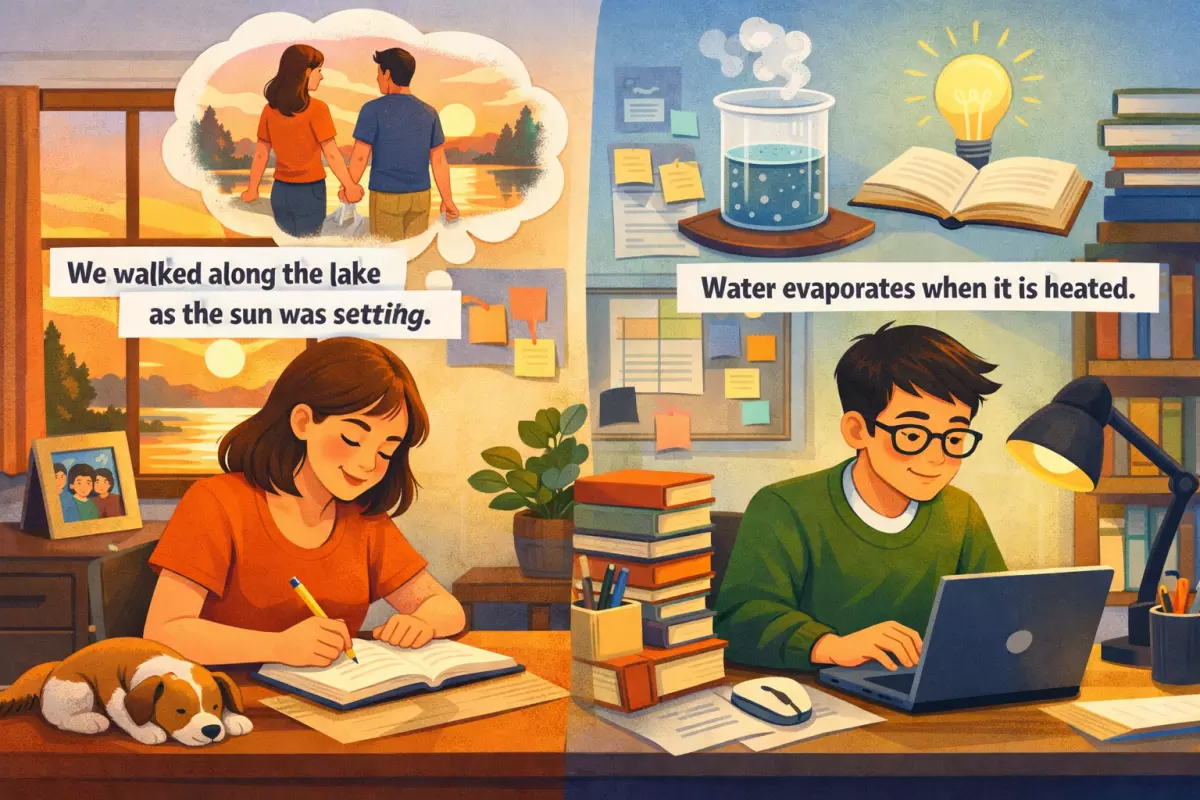
Different genres handle time differently, so the “right” tense pattern depends on whether you are telling a story or building an argument. Consistency comes from choosing a default tense for the main line of meaning, then switching only for clear, rule-based reasons (background, general truths, or earlier/later events).
Typical tense patterns by genre
| Writing situation | Common default tense | What tense shifts usually signal | Mini example |
|---|---|---|---|
| Personal narrative (storytelling) | Past simple | Earlier past (past perfect), ongoing background (past continuous), present for “now” reflections | I walked home. It was raining. I had forgotten my umbrella. |
| Fiction and creative nonfiction | Past simple or present (chosen voice) | Flashbacks/foreshadowing, scene-setting, internal commentary | She opens the door. Years earlier, she had promised never to return. |
| Academic argument (your claims and reasoning) | Present simple | Past for completed methods/results, present perfect for ongoing research conversation | This essay argues that X. The study found Y. Researchers have debated Z. |
| Literary analysis | Present simple (“literary present”) | Past for author’s life/history, past for publication context, present for what the text does | The narrator reveals fear. The novel was published in 1950. |
| Scientific/empirical report | Past simple for procedure/results; present for interpretation | Past = what you did/observed; present = what it means or what is generally true | We measured X. The results suggest Y. Water boils at 100°C. |
Practical rules for keeping tense consistent
- Pick one “spine tense” for the main line. In stories, that is often past simple; in essays, it is often present simple for claims.
- Use past simple for completed actions in a timeline. This is the default for events that happened and finished.
- Use past continuous to set background in a story. It marks a scene or an ongoing situation behind the main events (The crowd was cheering when the speaker arrived).
- Use past perfect to step further back than your main past timeline. It clarifies “earlier than earlier” (She left because she had heard the news).
- Use present simple for general truths and stable definitions. This is common in academic writing (Inflation increases when demand outpaces supply).
- Use present perfect to connect past research to the current discussion. It signals “up to now” relevance (Scholars have examined this issue for decades).
- Use past simple for methods and results in research writing. It keeps the report anchored in what was done (Participants completed a survey; the analysis showed a trend).
- Use present simple for what a text does in analysis. The “literary present” treats the work as continuously available (The poem contrasts light and shadow).
- Shift tense only at clear boundaries. Typical boundaries include a new paragraph, a new section (Methods → Discussion), or a signposted time jump (Years later, In the next chapter).
- Avoid accidental tense drift inside one paragraph. If the time reference has not changed, the tense usually should not change either.
- Keep reported findings consistent with your framing. If you describe a study as completed, keep its actions in past (The authors reported…); if you describe what the paper states, present can work (The paper argues…).
- Watch for “now” words that force a switch. Terms like today, currently, in recent years, at that time, and earlier often require a deliberate tense choice.
- Separate event time from commentary time. A narrative may stay in past for events but move to present for a brief reflection; make the switch purposeful and brief.
- Check verb tense around citations and summaries. Decide whether you are emphasizing the author’s action (past) or the source’s ongoing claim (present), then apply that choice consistently across the paragraph.
- Use time markers to prevent confusion. Words like before, after, by the time, since, and during help readers follow shifts without rereading.
When you revise a long draft, identify the dominant tense in each section and confirm it matches the genre goal: event sequence for storytelling, or stable claims plus clearly timed evidence for academic prose. Then treat any tense change as a signal that should be easy for a reader to interpret.
Common mistakes and how to fix them
In longer essays, tense problems usually come from a few repeatable patterns: drifting into a different time frame, mixing narrative and analysis, or letting quoted material “pull” surrounding sentences into the wrong tense. Use the fixes below to keep your timeline clear and your verbs working together.
1) Unplanned tense shifts inside one paragraph
- Pattern: You begin in past tense, then a later sentence slips into present for no reason.
- Why it happens: Writers summarize events (past) and then start “commenting” (present) without signaling a change.
- Fix: Choose the paragraph’s main time frame and revise every finite verb to match it unless a different time is required.
- Example: ❌ “The study showed a trend and suggests a new approach.” → ✅ “The study showed a trend and suggested a new approach.”
2) Switching between narration and analysis without a cue
- Pattern: A story-like section (past) suddenly becomes a general claim (present) mid-sentence or mid-paragraph.
- Fix: Separate the modes. Keep narration in past, then start a new sentence (or paragraph) for analysis in present, using a signal phrase (for example: “This suggests…”, “In general…”).
- Example: ❌ “She argued for reform, which shows the movement is divided.” → ✅ “She argued for reform. This shows the movement is divided.”
3) Literary analysis: mixing “literary present” with plot summary in past
- Pattern: One sentence treats a text as ongoing (“the author argues”), while the next treats it as finished history (“the author argued”).
- Fix: If your discipline uses the literary present, keep it for what happens in the text and for your interpretation. Use past tense only for the author’s life, publication history, or historical context.
- Example: ❌ “In the novel, the narrator described the city as hostile.” → ✅ “In the novel, the narrator describes the city as hostile.”
4) Research writing: inconsistent tense for methods, results, and implications
- Pattern: Methods are in present (“we collect”), results are in past (“we found”), then results flip back to present (“the data show”) without a reason.
- Fix: Follow a stable convention: methods and what you did are typically past; results can be past (what you found) or present (what the table/figure shows) but should be consistent within a section; implications and general truths are often present.
- Quick check: If the verb refers to a completed action, use past. If it refers to what a figure/paper states now, present can be appropriate.
5) Time markers that contradict the verb tense
- Pattern: A past-tense verb appears with “now/today/currently,” or a present-tense verb appears with “in 1998/last year.”
- Fix: Align the verb with the time expression or replace the time expression with one that matches your intended timeline.
- Examples:
- ❌ “In 2010, the policy changes the market.” → ✅ “In 2010, the policy changed the market.”
- ❌ “Currently, the committee recommended changes.” → ✅ “Currently, the committee recommends changes.”
6) Overusing present tense to sound “immediate”
- Pattern: Past events are narrated in present (“He walks into the room”) even though the rest of the essay is standard academic past.
- Fix: Use the historical present only if it is a deliberate stylistic choice and you can sustain it consistently. Otherwise, convert the whole narrative passage to past.
7) Perfect tenses used without a clear “before” relationship
- Pattern: Past perfect (“had + past participle”) appears even though no later past reference point is established.
- Fix: Use past perfect only to show an earlier past relative to another past moment. If you are simply narrating in order, simple past is usually enough.
- Example: ❌ “In 2019, the team had launched the product.” (No later past point.) → ✅ “In 2019, the team launched the product.”
8) Quotes and reporting verbs pulling the surrounding tense off track
- Pattern: You quote a present-tense line, then your own sentence shifts to present even though you are discussing past research or past events.
- Fix: Keep your reporting verb consistent with your section’s time frame, and treat the quote as self-contained. Adjust only what you control (your verbs), not the quoted text.
- Example: ❌ “Smith found that ‘stress increases risk,’ and this means the sample was biased.” → ✅ “Smith found that ‘stress increases risk,’ and this meant the sample was biased.”
9) Shifting tense when moving between sections
- Pattern: The introduction uses present (“This essay argues”), the body switches to past (“This essay argued”), and the conclusion drifts again.
- Fix: Set a default: many essays keep the writer’s argument in present (“This paper argues…”) and keep historical background in past. Then apply that choice consistently in headings, topic sentences, and transitions.
10) Sentence-level “agreement” errors in complex structures
- Pattern: The main clause is past, but a dependent clause is accidentally present (or vice versa), even though both refer to the same time.
- Fix: Identify the time of each clause. If both actions happen in the same time frame, match the tenses; if one happens earlier, use a perfect form or a clear time marker.
- Example: ❌ “The author explained why the policy fails in that period.” → ✅ “The author explained why the policy failed in that period.”
11) “Would” used as a vague past tense
- Pattern: “Would” appears where simple past is intended, making the timeline feel hypothetical.
- Fix: Use “would” for habitual past in a narrative (“Every summer, he would…”), for future-in-the-past (“She said she would…”), or for conditionals. Otherwise, switch to simple past.
- Example: ❌ “The committee would approve the plan in 2018.” → ✅ “The committee approved the plan in 2018.”
12) A practical revision routine for long drafts
- Underline the first main verb in each paragraph and label its time frame (past/present/future).
- Circle time markers (years, “now,” “since,” “by the time”) and confirm each one matches its verb.
- Check topic sentences and concluding sentences first; tense drift often starts there and spreads.
- Standardize reporting verbs for sources (for example, keep “argues/claims” or keep “argued/claimed” depending on your style guide) and apply the same choice across the essay.
- Read only the verbs in sequence (a “verb pass”): if the timeline jumps, revise the outliers or add a transition that signals the shift.
Editing checklist for tense control
Keep your timeline stable by deciding what “now” is in the piece, then checking every paragraph against that reference point. Most tense problems in long essays come from small, local shifts that feel natural in the moment but add up to a confusing chronology.
1) Set the default timeline before you edit
- Identify the dominant time frame of the whole text (present for analysis, past for narrative, future for proposals).
- Write a one-sentence “time anchor” in the margin (example: “This essay analyzes the novel in the present tense”).
- Mark any planned exceptions (flashbacks, historical background, methodology, predictions) so shifts are intentional rather than accidental.
- Decide how you will handle sources: summary in past (“Smith found…”) or present (“Smith argues…”), and apply it consistently.
2) Scan paragraph by paragraph for unintended shifts
- Underline the first finite verb in each paragraph; confirm it matches the paragraph’s purpose and the overall time anchor.
- Check topic sentences first: if the opening verb is off-timeline, the whole paragraph often drifts with it.
- Look for “silent switches” triggered by vivid description (writers often slip into present when narrating past events).
- Verify that a tense change signals a real change in time, not just a change in emphasis.
3) Use tense shifts only for clear functions
- Flashback/backstory: move from past to past perfect to show an earlier past, then return to simple past.
- Ongoing truths/generalizations: use present for statements that remain true across time, even inside a past narrative.
- Textual analysis: keep present for what the text “does” on the page, even if the author wrote it in the past.
- Forecasting: use future or modal verbs for predictions, recommendations, or expected outcomes.
- Procedure/method: keep a stable pattern (often past for completed research steps; present for what the paper shows).
4) Run a “time markers” audit
- Circle time adverbs and phrases (today, now, then, in 2019, later, currently, by the end) and check they match the verbs nearby.
- Watch for mixed signals: “In 2010… is” often needs “was,” unless you are stating a present fact about 2010.
- Ensure sequencing words (before, after, since, until) are paired with appropriate verb forms.
- Confirm that “since” is not forcing an unintended present perfect if your paragraph is otherwise anchored in past.
5) Check the “perfect” tenses for necessity
- Use past perfect (had + past participle) only when you must show one past event happened before another past event.
- Avoid staying in past perfect for too long; once the earlier-time frame is established, return to simple past.
- Use present perfect (has/have + past participle) for actions that connect to the present moment of the essay, not as a default past tense.
- Make sure perfect tenses are doing timeline work, not just adding heaviness.
6) Standardize common “trouble spots”
- Quoted material: keep the tense inside the quote as written, but align your reporting verb pattern around it.
- Captions, figure descriptions, and headings: choose a consistent tense (often present) and keep it uniform.
- Parenthetical asides: check that side comments don’t accidentally switch the whole sentence’s time frame.
- Rhetorical questions: ensure the verb tense matches the surrounding analysis rather than the reader’s real-time “now.”
- Definitions and claims: present tense usually works best, but don’t let it pull nearby narrative verbs out of past.
7) Do a sentence-level consistency pass
- In compound sentences, confirm both clauses belong to the same timeline unless a shift is clearly signposted.
- In long sentences with multiple verbs, verify that each verb’s tense matches its time reference (especially in relative clauses).
- Check reported speech and indirect questions for backshifting if your style requires it.
- Watch modals (would, could, should): they often imply a conditional or past perspective; make sure that’s what you mean.
8) Quick correctness checks with mini-patterns
- ❌ “In the experiment, participants report…” → ✅ “In the experiment, participants reported…” (if describing completed methods/results)
- ❌ “She walks into the room and said…” → ✅ keep both in past or both in present (unless using deliberate historical present)
- ❌ “He had left and goes home…” → ✅ return to simple past after the earlier-than-past event is clear
- ❌ “The author argued that the theme is…” → ✅ choose a consistent source-reporting style (past/present) and apply it throughout
9) Final pass: read for timeline clarity, not grammar
- Read each page asking, “What time is this happening?” If you can’t answer instantly, revise the verbs or add a time cue.
- Check the opening and closing paragraphs for drift; introductions and conclusions often shift into a different tense unintentionally.
- Search your draft for high-impact verbs (is/was, argues/argued, shows/showed, leads/led) and confirm each choice matches your established pattern.
- When in doubt, simplify: stable simple present or simple past is usually clearer than frequent switching.
Homework: tense consistency editing tasks
Use these editing drills to practice keeping time frames steady across paragraphs, quotations, and embedded narratives. The goal is to spot where a draft accidentally shifts from one time frame to another, then revise so the sequence of events stays clear.
How to complete the edits
- Read each passage once for meaning, then reread while tracking the time frame (past, present, future).
- Underline every verb and label it (past/present/future; simple/progressive/perfect if helpful).
- Decide the passage’s “default” time frame (often past for narratives, present for literary analysis, or a mix of present + past for research writing).
- Revise only what is necessary: keep intentional shifts (flashbacks, historical background, general truths) and fix accidental ones.
- After revising, reread aloud to confirm the timeline still makes sense.
Task set A: Find and fix unintended shifts
Edit each item so the verbs follow one consistent time frame unless a shift is clearly motivated. Keep the meaning the same.
- Last semester, our team meets every Friday and completed the prototype by mid-October.
- The author argued that social trust declines, and she shows several examples from the survey.
- When I arrive at the lab yesterday, the samples were already labeled and the machine runs quietly.
- In 2012 the city introduces the policy, and residents reported fewer complaints within a year.
- The experiment began with a control group, then we are adding a second condition to test the new variable.
- She was writing the report, but she forgets to attach the data table.
- During the interview, the participant says he felt anxious, and he described the symptoms in detail.
- The committee decides to postpone the vote after it reviewed the budget.
Show answers
- Last semester, our team met every Friday and completed the prototype by mid-October.
- The author argues that social trust declines, and she shows several examples from the survey.
- When I arrived at the lab yesterday, the samples were already labeled and the machine ran quietly.
- In 2012 the city introduced the policy, and residents reported fewer complaints within a year.
- The experiment began with a control group, then we added a second condition to test the new variable.
- She was writing the report, but she forgot to attach the data table.
- During the interview, the participant said he felt anxious, and he described the symptoms in detail.
- The committee decided to postpone the vote after it reviewed the budget.
Task set B: Keep the “research writing” pattern steady
Many academic drafts use a common division: present for what the text shows/argues and for general claims, past for what the researchers did and found. Edit each item to match that pattern.
- Smith (2020) finds a strong correlation, and the study concludes that sleep quality improved after the intervention.
- In this paper, I explained the method and argue that the results support the second hypothesis.
- The survey measures stress levels, and participants report lower stress after four weeks.
- Jones argued that the model is incomplete, and her critique highlighted missing variables.
- We collect responses in April, then we analyze the data using a mixed-effects model.
- The results section showed a clear trend, and Figure 2 illustrated the change over time.
Show answers
- Smith (2020) found a strong correlation, and the study concluded that sleep quality improved after the intervention.
- In this paper, I explain the method and argue that the results support the second hypothesis.
- The survey measured stress levels, and participants reported lower stress after four weeks.
- Jones argues that the model is incomplete, and her critique highlights missing variables.
- We collected responses in April, then we analyzed the data using a mixed-effects model.
- The results section shows a clear trend, and Figure 2 illustrates the change over time.
Task set C: Diagnose whether a tense shift is justified
For each item, decide whether the tense change is acceptable. If it is acceptable, leave it. If it is not, revise it for a consistent time frame.
- Marie Curie discovered radium in 1898, and her work influences modern medical imaging.
- I walked to the bus stop, and it is raining so hard that my notes got soaked.
- The novel opens with a storm, and the narrator remembered the night as unusually quiet.
- The teacher explained the rule: “A dependent clause cannot stand alone.”
- We tested three designs, and the data suggest that the third performs best.
- He promised he will submit the form the next day, but he never did.
Show answers
- Acceptable: past for the historical event, present for ongoing influence.
- Revise: I walked to the bus stop, and it was raining so hard that my notes got soaked.
- Revise: The novel opens with a storm, and the narrator remembers the night as unusually quiet.
- Acceptable: present in a quoted general rule often stays present even when introduced by a past reporting verb.
- Revise: We tested three designs, and the data suggested that the third performs best.
- Revise: He promised he would submit the form the next day, but he never did.
Editing checklist to apply to your own essay
- Identify the main time frame for each section (introduction, literature review, methods, narrative scene, conclusion).
- Check paragraph openings: a new paragraph is a common place for accidental time shifts.
- Watch reporting verbs (argues/argued; shows/showed) and keep them aligned with your discipline’s convention.
- Confirm that flashbacks use clear signals (earlier, previously, at the time) and consistent past-perfect when needed.
- Keep general truths stable (often present tense), even when surrounded by past-tense narration.
- Review “future in the past” after past reporting verbs (will → would) when the promise/prediction was made earlier.
- Do a final verb-only scan: read just the verbs in order to see whether the timeline jumps.