Article Shift for Emphasis and Contrast in Discourse

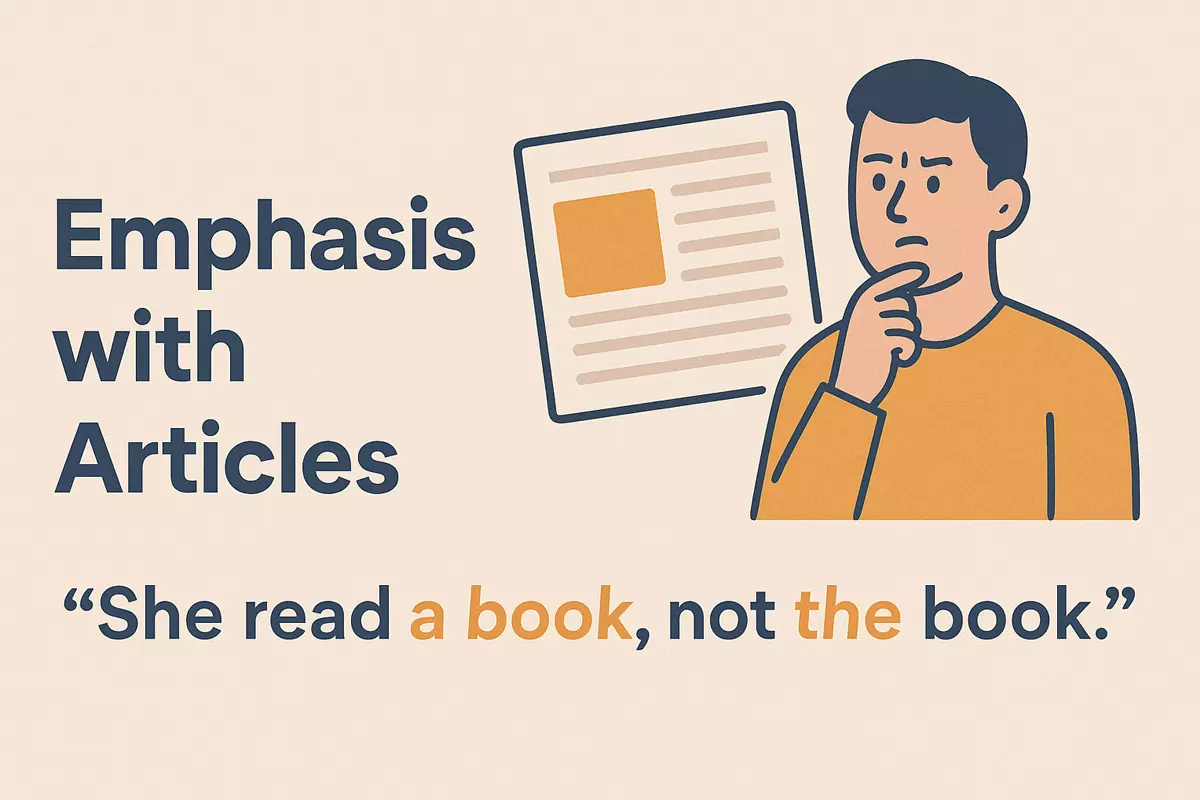 This article explains how changing articles like a and the can shift focus or emphasize contrast in writing. It covers tracking known information, discourse effects, examples from news and essays, and provides editing practice for emphasis.
Writers skillfully vary their use of definite and indefinite articles to emphasize key ideas or clarify distinctions within a text. By choosing between "the" and "a" or "an," they subtly guide readers’ focus and influence how information is interpreted. This careful selection not only highlights important concepts but also helps structure the meaning and coherence of the overall discourse, making the writing clearer and more engaging for the audience.
How changing the article can change focus
Shifting between definite and indefinite articles can guide the reader’s attention in subtle but powerful ways. When a writer chooses “the” instead of “a,” or vice versa, it signals whether the information is assumed to be known or is being introduced as new. This selection can foreground certain elements, create contrast, or highlight previously unmentioned concepts.
Signaling New vs. Known Information
Opting for an indefinite article like “a” or “an” often introduces something unfamiliar, inviting the reader to focus on its novelty or generality. By contrast, the definite article “the” presumes shared knowledge and directs attention to something specific or previously mentioned. For example:
- A cat sat on the mat. (Any cat; new topic)
- The cat sat on the mat. (A particular cat; known or previously mentioned)
Contrast and Emphasis Through Article Shifts
Switching articles can also create a deliberate contrast or shift in emphasis. Consider these examples:
- A solution was suggested, but the solution was controversial.
- She dreamed of a future different from the future others expected.
This kind of shift can draw attention to a change in perspective or focus within a narrative.
Common Patterns of Article Shifts
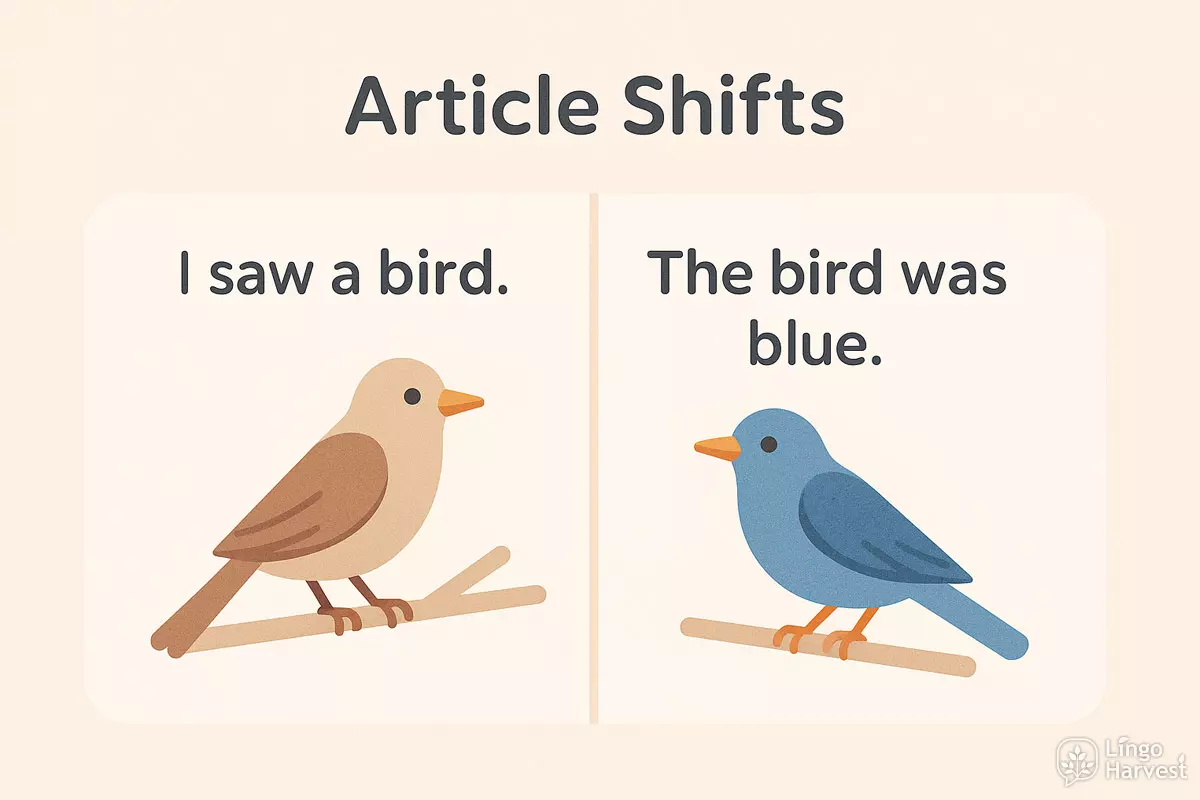
Writers often use article variation to manage discourse focus or to build connections between sentences. Here are some typical patterns:
- Introducing new topics: “I saw a bird.”
- Referring back: “The bird was blue.”
- Contrasting general and specific: “A leader inspires; the leader of our team is exceptional.”
- Highlighting uniqueness: “It was a moment to remember, but not the moment.”
- Shifting from one of many to the only one: “Choose a book. Now, read the book you picked.”
- Clarifying identity: “She became a teacher. The teacher inspired her students.”
- Emphasizing an individual instance: “He wanted a chance. The chance finally came.”
- Moving from hypothesis to reality: “If you find a solution, use the solution to fix the problem.”
- Generalization to specification: “A problem can be solved. The problem here is different.”
- Creating contrast: “A dog barked. The cat slept.”
Summary Table: Article Shift and Discourse Focus
| Article Use | Effect on Focus |
|---|---|
| Introducing with “a/an” | Presents new, non-specific information; encourages attention to novelty or category. |
| Switching to “the” | Narrows focus to a specific, previously mentioned or contextually unique item. |
| Alternating articles | Enables contrast, comparison, or progression from general to particular points. |
| Omitting articles | Highlights generic or abstract reference, often signaling universality or habitual action. |
In summary, the strategic use of articles in discourse is more than a grammatical formality—it’s a dynamic tool for guiding interpretation, establishing emphasis, and managing the reader’s focus throughout a text.
From a to the: tracking known information
Understanding how English speakers shift between the indefinite article a and the definite article the is crucial for following the flow of information in discourse. This transition marks the movement from introducing something new to referencing something already established in the conversation or text. When a noun is mentioned for the first time, it is usually introduced with a or an—signaling that it is new or unknown to the listener. Once that noun has been established, subsequent references use the to indicate that both speaker and listener now recognize it. This process helps readers and listeners keep track of which entities are already familiar within the context.
How articles signal information status
Speakers rely on articles to guide the audience’s attention and understanding. Here’s how the shift typically works:
- First mention: "I saw a dog in the park." (a dog is new information)
- Subsequent mention: "The dog was chasing a ball." (the dog is now known; a ball is new)
This pattern is not just about grammar; it reflects how we manage shared knowledge in conversation and writing. The definite article often marks an item as "trackable"—something both parties can easily recall or identify.
Common patterns for article shift
Writers and speakers use article changes for a range of communicative effects. Here are some typical situations:
- Introducing a character or object, then referring back to it
- Describing a process step-by-step (each step becomes definite after mention)
- Distinguishing between general and specific references ("A teacher must be patient. The teacher I met yesterday was very kind.")
- Clarifying which item is meant in a group ("She picked a book from the shelf. The book had a red cover.")
- Signaling contrast or emphasis by switching articles ("There’s a solution, but the solution is not simple.")
- Building narrative cohesion—helping the audience follow the story
- Managing ambiguity: shifting from a to the clarifies which referent is meant
- Using the for items presumed to be unique or contextually obvious ("the sun," "the president")
- Navigating generic vs. specific statements ("A lion is a dangerous animal." vs. "The lion at the zoo is sleeping.")
- Signaling shared cultural or situational knowledge ("Let’s go to the movies.")
Article shift in context: mini-paradigm
The following table illustrates how the same noun moves from indefinite to definite status as it becomes familiar within the discourse:
| Discourse Step | Article Usage Example |
|---|---|
| Introduction (new) | I bought a notebook yesterday. |
| Reference (known) | The notebook has a blue cover. |
| Further detail | I wrote my notes in the notebook during class. |
| Contrast (different entity) | Today I need a new notebook. |
Why tracking matters
Effective article use is about more than correctness; it shapes how readers and listeners construct mental models of what’s being discussed. Shifting from indefinite to definite articles is a subtle but powerful way to signal which information is shared and which is new, making communication clearer and more coherent.
Using article shift to highlight contrast
Switching between definite and indefinite articles is a subtle but effective way to draw attention to differences or unexpected elements in discourse. By deliberately choosing "a" or "the," speakers and writers can set up contrasts between the familiar and the new, or between general categories and specific instances. This linguistic technique is especially useful in academic writing, storytelling, and persuasive speech, where highlighting distinctions can clarify meaning or strengthen an argument.
How article choice signals contrast
Selecting an indefinite article ("a" or "an") introduces something as unfamiliar or one among many, while the definite article ("the") points to something already known or previously mentioned. Shifting between these forms helps the audience notice when a new idea is being introduced or when a specific, established reference is being made. For example, consider how the following sentences use articles to create contrast:
- She wanted a solution, but the answer she found surprised everyone.
- They saw a dog in the yard, not the neighbor's dog they expected.
- He searched for a book on the shelf; the book he needed was missing.
- We met a teacher at the conference, but the teacher from our school wasn't there.
- She asked for a pen, but the pen on the table was broken.
- He dreamed of a future where peace was possible, not the future others predicted.
- They entered a room expecting silence, but the room was full of laughter.
- He wanted a chance to speak, but the chance never came.
- She needed a plan, yet the plan they had was flawed.
- He reached for a cup, only to realize the cup was empty.
Common patterns for contrastive article use
Writers often rely on certain structures to make differences stand out. These patterns can be useful for both native and non-native speakers aiming to sharpen their communication:
- a(n) X, but the X (general idea vs. specific instance)
- a(n) X, not the X (unexpected vs. expected)
- a(n) X, while the X (parallel comparison)
- a(n) X, yet the X (contrast in outcome)
- the X, not a(n) X (emphasizing uniqueness)
- the X, but a(n) X (challenging assumptions)
Comparison of article shift for contrast
To further illustrate how changing articles can shift meaning and highlight differences, consider the following structured examples:
| Sentence with Indefinite Article | Sentence with Definite Article |
|---|---|
| He gave her a ring. | He gave her the ring she wanted. |
| They visited a museum. | They visited the museum we discussed. |
| She found a solution. | She found the solution to the problem. |
| He opened a door. | He opened the door to the garden. |
| They hired a manager. | They hired the manager recommended by the board. |
Discourse-level effects in paragraphs and arguments
Shifting the use of articles within a paragraph or across an argument can significantly influence how readers interpret emphasis, contrast, and topical focus. Rather than being a mere grammatical formality, article choice often signals what information is presented as known, new, or especially important. These subtle choices help guide interpretation and shape the flow of reasoning in both expository and persuasive writing.
Emphasis and Contrast through Article Manipulation
Writers often exploit the difference between definite and indefinite articles to highlight contrasts or draw attention to particular elements. For instance, moving from "a solution" to "the solution" within an argument can signal a transition from possibility to certainty, or from one example to a unique, salient point. This technique is frequently used to steer the reader's perspective, especially when introducing new entities versus referring back to previously mentioned ones.
- Introducing a new concept: "A theory emerged during the discussion."
- Signaling importance: "The theory that changed everything was then presented."
- Contrasting options: "A proposal was considered, but the proposal lacked evidence."
- Shifting focus: "An experiment was conducted. The experiment revealed surprising results."
- Generalizing: "A researcher might encounter this problem."
- Particularizing: "The researcher in question solved the problem."
- Moving from one among many to a unique instance: "A candidate was interviewed. The candidate impressed the panel."
- Highlighting a contrast: "A result was expected, but the result was disappointing."
- Signifying a stage in argument: "A step was overlooked. The step proved crucial."
- Marking thematic progression: "A concern was raised. The concern dominated subsequent debate."
Article Shift in Argument Structure
Transitions between indefinite and definite articles often mirror the logical progression of an argument. The indefinite article introduces an idea as one of many, while the definite article narrows the focus, identifying a specific, contextually relevant item. This progression not only organizes information but also helps readers track which concepts are foregrounded or backgrounded as the discussion unfolds.
| Article Shift Pattern | Discourse Function |
|---|---|
| Indefinite → Definite | Introducing a new idea, then making it the main focus |
| Definite → Indefinite | Moving from a specific known item to a generalization or alternative |
| Omission → Definite | Bringing backgrounded or generic information into focus |
| Indefinite → Omission | Backgrounding previously introduced information |
Practical Considerations for Writers
Attentive use of articles at the paragraph and argument level can subtly enhance clarity and rhetorical impact. By consciously shifting article use, authors can guide readers’ expectations, spotlight contrasts, and reinforce the logical structure of their discourse. This nuanced control is especially valuable in academic, technical, and persuasive writing where reader interpretation hinges on precise signaling.
Examples from news, essays, and speeches
Writers and speakers often manipulate definite and indefinite articles to highlight important contrasts or to shift focus within a sentence or paragraph. This technique is especially visible in journalistic writing, academic essays, and public addresses, where subtle changes in article usage can alter the reader's perception of what is general and what is specific.
Contrast and Emphasis in Headlines and Reporting
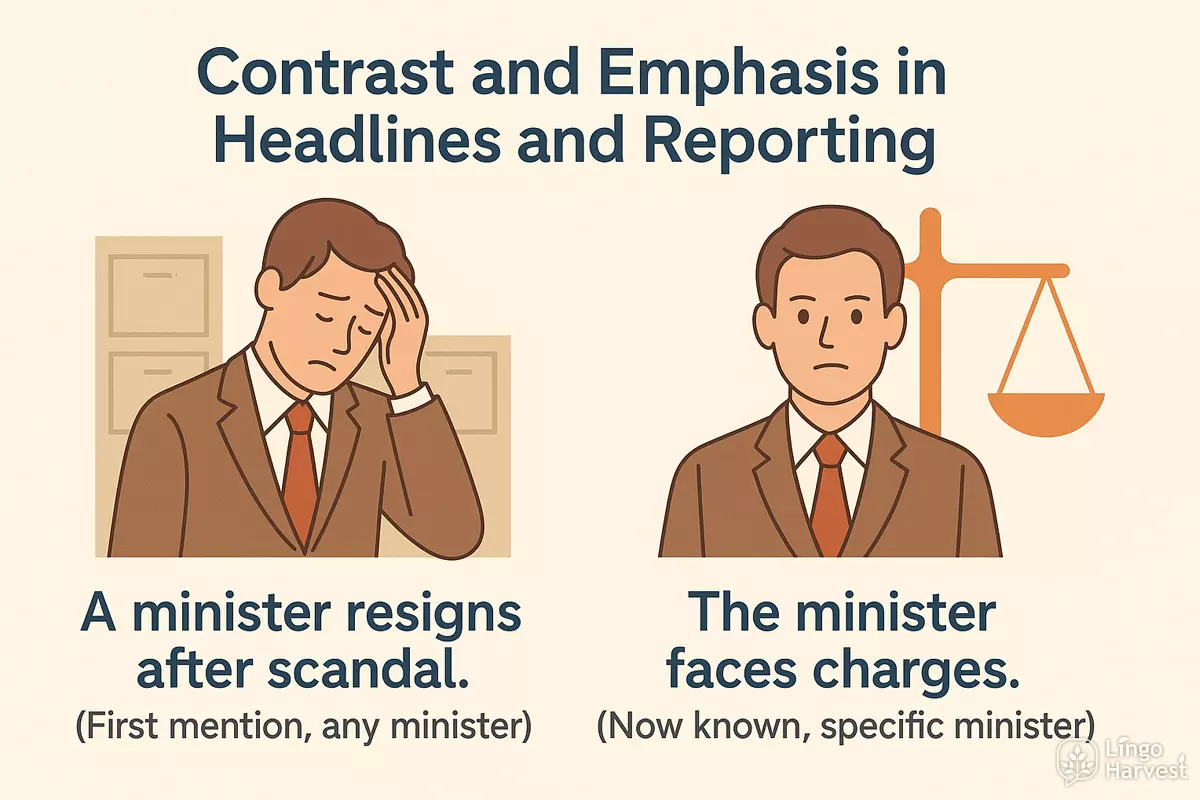
News headlines frequently shift between “a” and “the” to change the scope of a story. For example:
- A minister resigns after scandal. (First mention, any minister)
- The minister faces charges. (Now known, specific minister)
- Police search for a suspect. Later: Police arrest the suspect.
- Scientists discover a new planet. Follow-up: The planet may support life.
Shifts in Essays and Analytical Writing
In essays, moving from indefinite to definite articles helps guide the reader from general concepts to specific cases:
- A problem in modern education is engagement. The problem becomes clear in large classrooms.
- A solution was proposed last year. The solution, however, has limitations.
- An idea emerged during the debate. The idea quickly gained support.
- Initially, a theory dominated discussion. Later, the theory was revised.
Public Speeches and Rhetorical Effect
Orators often use article shifts for emphasis or to establish contrast:
- We face a challenge. But this is not just any challenge; it is the challenge of our generation.
- There is a dream that unites us. The dream is freedom and equality.
- Let us seek a solution, not just the solution.
- They spoke of a hope. Today, the hope lives on.
Comparative Overview: Article Shift in Context
| Excerpt | Article Shift and Effect |
|---|---|
| “A leader emerged from the crowd. The leader inspired many.” | Moves from an unknown individual to a known figure, signaling importance. |
| “A solution exists. The solution is within our reach.” | General to specific; focus narrows as argument develops. |
| “A crisis is unfolding. The crisis threatens stability.” | First mention introduces the issue; second mention frames it as urgent and specific. |
| “A voice is missing in this debate. The voice of youth.” | Builds anticipation, then specifies for rhetorical emphasis. |
| “A law was passed last year. The law has changed lives.” | General reference becomes the main subject, showing progression in narrative. |
Common Patterns and Their Purposes
Writers use article shifts for several reasons:
- To move from the abstract to the concrete
- To introduce a topic, then focus on its specifics
- To create suspense or highlight a turning point
- To distinguish between alternatives or signal a preferred option
- To guide the audience’s attention and expectations
These real-world examples show how careful article selection is a subtle but powerful tool for shaping meaning and emphasis in discourse.
Practice: edit texts to add emphasis through articles
Understanding how articles (a, an, the, zero article) can subtly shift focus or introduce contrast is a valuable editing skill. Below you'll find guided exercises to help you recognize and apply these shifts in sample sentences and short texts. Take note of how inserting, omitting, or replacing an article changes the nuance or brings a detail forward.
Task 1: Insert or change articles for emphasis
Read the following sentences. Edit them by adding, removing, or replacing articles to emphasize the underlined idea or create a contrast. Consider how each change alters the reader's perception:
- He became president after years of hard work.
- She bought car that changed her life.
- Dog in the garden is barking again.
- This is solution we've been waiting for.
- She met artist who inspired her.
- They reached agreement after long negotiations.
- He finally found courage to speak up.
- We saw movie you recommended.
- She chose path that surprised everyone.
- They discovered error in the final report.
Show answers
- He became the president. (Specific notable title)
- She bought the car. (Specific car that changed her life)
- The dog in the garden. (Known specific dog)
- This is the solution. (The one everyone expected)
- She met the artist. (A known, specific artist)
- They reached an agreement. (One of many possible agreements)
- He finally found the courage. (Abstract noun used in a specific sense)
- We saw the movie. (The one previously mentioned)
- She chose a path. (One path out of many)
- They discovered an error. (One error among possible errors)
Task 2: Contrast through article choice
For each pair below, choose the article that creates the strongest contrast or emphasis. Explain your choice.
- I need a/the plan, not just any plan.
- He is a/the genius behind the project.
- They found a/the answer, but it wasn’t the answer they needed.
- Is there a/the way out of this situation?
- We must choose a/the moment carefully.
- She is a/the person we’ve been searching for.
- This is a/the chance of a lifetime.
- He offered a/the solution, but not the solution we expected.
- I’m looking for a/the answer that fits all conditions.
- Is he a/the leader the team truly needs?
Show answers
- the plan (Specific, important plan)
- the genius (Unique standout role)
- a answer … not the answer (Contrast any vs specific)
- a way (Any possible option)
- the moment (A specific, crucial moment)
- the person (Specific, expected individual)
- the chance (Unique, major opportunity)
- a solution … not the solution (Contrast)
- the answer (A particular answer that fits all conditions)
- the leader (The ideally suited one)
Common Patterns That Shift Emphasis
- Using the to single out something unique or previously mentioned.
- Switching to a/an to introduce something new or less specific.
- Omitting the article (zero article) to generalize or refer to things in a broad sense.
- Repeating the for contrast: “The solution, not a solution.”
- Shifting from a/an to the as the reference becomes specific.
- Using the with superlatives: “the best day.”
- Employing the for emphasis in titles: “the Queen,” “the President.”
- Choosing a/an for one of several: “a student in the class.”
- Omitting articles for general institutions: “go to school,” “play chess.”
- Using the for shared knowledge: “the sun,” “the internet.”
- Switching from zero article to the for specificity: “Dogs are friendly. The dog next door is friendly.”
- Adding the for contrast: “Not just any solution, but the solution.”
Task 3: Edit for subtlety and focus
Edit the excerpt below to give special emphasis to the highlighted parts by adjusting articles:
Yesterday, we visited museum. Exhibit about ancient Egypt was fascinating. Afterward, we had lunch at café near the river. Later, we walked through garden behind the building. There we discovered statue dedicated to local artists. In the afternoon, we joined tour that explained the city’s history. At the end of the day, we relaxed in park overlooking the city. Finally, we returned by bus that stops near our home.
Show answers
- the museum — a specific museum visited that day
- the exhibit — a particular exhibit being discussed
- a café — a new, unspecified café introduced for the first time
- the garden — a specific garden behind the building
- a statue — one of many, introduced for the first time
- the tour — a particular tour they joined
- the park — a specific park where they relaxed
- the bus — a specific bus route they regularly use